
Key takeaways
- A multiplayer online game may be released only when the business holds both a licence to provide the service and a release decision for each game, so the organisation must have a point of contact responsible for keeping and updating these two documents[1].
- The conditions for a G1 licence include organisational capacity, management staff, a player authentication system and playing time limits for under-18s, so the operations division and the compliance division form part of the business conditions rather than being support functions[2].
- Separating the development company from the publishing company helps ring-fence risk and opens the way for foreign investors to enter the development line, but the effects on licences, tax and the licensing contract between the two companies must be worked out in advance.
- Economic rights in source code, artwork and music belong to the business only when the creative task was clearly assigned or the contract with the author says so, so the structure needs a position that manages intellectual property[7].
Most game businesses in Vietnam start as a small product team in which the project lead decides on game design, decides how to charge players and also deals with the regulator. When the business adds a second and third game, the organisation grows project by project, yet tasks with legal consequences such as holding licences, controlling updates, protecting player data and managing contracts with freelance artists still have no clearly responsible owner. Digital content businesses face a similar situation, with the risks concentrated in copyright and advertising.
This page introduces Justeps’ organisational structure design service for game developers, publishers and businesses that produce and distribute digital content. Operating rules, monthly legal support and employment terms are covered on three sister pages, so this page answers only the questions of who does what, who decides what and which divisions the organisation should be divided into.
The value chain determines the shape of the organisation
An ordinary software business completes most of its work when it hands over the product, whereas an online game only starts to generate revenue after launch and must be operated continuously for many years. Revenue comes from players topping up to buy items, take part in events or buy memberships, so the operations, community care and payments divisions keep growing and at times outnumber the production division. For this reason, Justeps designs the structure along the chain of development, publishing, operation and support, and then attaches the legal obligations to each link.
The share of staff across the divisions varies greatly according to the business model. The chart below compares, as an illustrative example, how people are allocated among the three main divisions in three types of business commonly found in the sector.
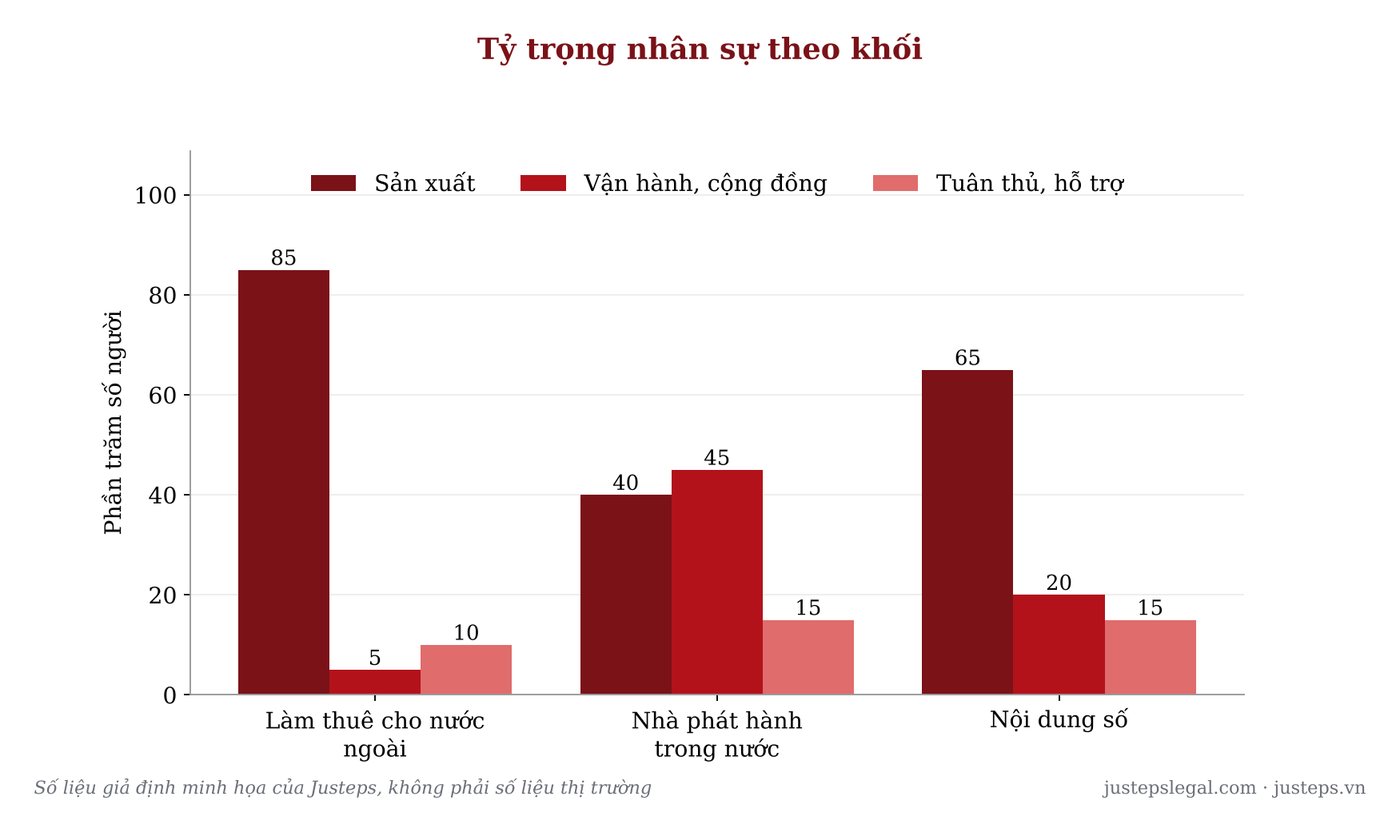
Example of the share of staff by division in three game and digital content business models
In this example, a studio working on contract for a foreign partner puts almost all its people into production, because publishing and operation belong to the partner. A domestic publisher has the highest share of people working in operations and player care and also needs a compliance division strong enough to keep its licences and handle complaints, while a digital content business sits in between.
The regulations that govern how the business is organised
Licences and release decisions for games
Online video games are divided into four groups, G1, G2, G3 and G4, according to how players interact with one another and with the business’s server. A business may release a G1 game, meaning a game in which many players interact through the server, only once it holds a licence to provide G1 online video game services and a release decision for each game; for groups G2, G3 and G4, the business needs a registration certificate and a confirmation of release notification[1]. Each game therefore has its own legal file that must be tracked throughout the product’s life cycle, and the organisation needs to state clearly which division keeps, updates and reports on that file.
Conditions on organisation, staff and systems
To be granted a G1 licence, a business must have financial capacity, an organisation and management staff appropriate to its scale, a system that authenticates player accounts by mobile phone number, storage of player information in Vietnam and limits on the playing time of under-18s of 60 minutes per game and 180 minutes for all of the business’s games in a day[2]. The business must also place at least one server system in Vietnam and have a unit that receives and resolves player complaints[3]. These conditions must be maintained consistently for every game, so the functions of the technical operations division and the player care division need to be set down in writing rather than left to each project team.
Foreign investors and partners
A foreign organisation that wishes to provide video game services to users in Vietnam, including on a cross-border basis, must establish an enterprise under Vietnamese law and comply with the rules on foreign investment[1]. Foreign investors also need to examine carefully the market access conditions for online video game services before contributing capital[4], so the entity structure should be designed early rather than restructured when the deal has already reached signing.
Player data and the data protection officer
Game businesses process the names, dates of birth, telephone numbers, top-up history and playing behaviour of a very large number of users, including children. The Law on Personal Data Protection allows a business to designate qualified staff or to engage an organisation that provides data protection services[5], while small businesses and start-ups may defer certain obligations only if they do not process sensitive data or the data of a large number of data subjects[6]. Most publishers do not qualify for the deferral, so the position of data protection officer must appear on the chart and report directly to the management board.
Copyright in creative products
An organisation that assigns a person within it the task of creating a work is the owner of the economic rights in that work, and an organisation that enters into a contract with an author is also the owner, unless otherwise agreed[7]. A game consists of source code written by employees, artwork drawn by freelance artists, licensed music and the voices of dubbing actors, so without centralised management the business will find it hard to prove its rights when licensing to a publisher or during an investor’s due diligence. Justeps proposes an intellectual property manager position within the compliance division, keeping the asset register and the rights transfer contracts for every game.
One legal entity or separate development and publishing companies
The biggest question for many game business owners is whether to separate development from publishing. The answer depends on whether the business publishes its own games or works for partners, whether it has foreign investors and where most of its revenue comes from.
| Model | Suitable when | Points to work out in advance |
|---|---|---|
| One legal entity | A small business that develops and publishes a few games of its own in Vietnam. | All risks relating to licences, complaints and copyright are concentrated in the same company. |
| Separate development and publishing | The business has several games and wants to raise capital for development separately or ring-fence operating risk. | A licensing contract between the two companies at an arm’s length price and declaration of related-party transactions are needed[10]. |
| Publisher of foreign games | The business mainly brings in foreign partners’ games to publish in Vietnam. | The licensing contract, foreign contractor tax and player data sharing obligations determine the structure of the publishing division. |
When a business holding a release decision changes owner or control, the procedure for the game may no longer be a simple amendment and may have to follow the process for a new grant[8]. Justeps therefore considers the option of separating legal entities together with the licence timetable of each game and the fundraising schedule, and presents the owner with at least two options, together with their effects on licences, tax, staff and management costs.
Functional divisions and the obligations attached to them
For a publisher operating two or more games, Justeps usually proposes a hybrid model in which each game has a product team responsible for business results, while shared functions are grouped into a production division, an operations division, a compliance division and a payments and finance division. The compliance division covers legal affairs, data protection, content review and intellectual property management, sits outside the product teams and has the power to suspend an update or an event when it identifies a problem with content, age rating or virtual items. Product teams are always under weekly revenue pressure, so if the reviewer sits within the same team, their opinion is often overridden once the event has already been promoted.
Common mistakes in existing organisations
The project lead has full authority, including over how money is collected
In many businesses, the project lead alone decides item drop rates, top-up package prices and event content without any review. These decisions directly affect the content that has been approved and the interests of players, and they can give rise to collective complaints. Justeps separates the product team’s power to propose from the compliance division’s power to approve for changes with legal consequences, while the final decision rests with the publishing director.
No one tracks licences when staff change
A G1 licence has a maximum term of ten years, a release decision must be amended when the game changes its name, its age rating, an upgrade changes its content or the server location changes[8], and periodic reports must be submitted on time. When the person who prepared the files leaves, these milestones are often missed until the regulator sends a reminder. The new structure needs to state the title responsible for the legal file of each game and the back-up person when that title is vacant.
Allocating authority over risky decisions
An organisation chart only answers the question of who reports to whom, whereas an authority matrix answers the question of who may decide matters that could lead to penalties, lost revenue or player complaints. Justeps builds the matrix around three roles, in which the product team proposes and implements, the compliance division reviews and has the power to stop, and the publishing director or the management board approves matters above the thresholds.
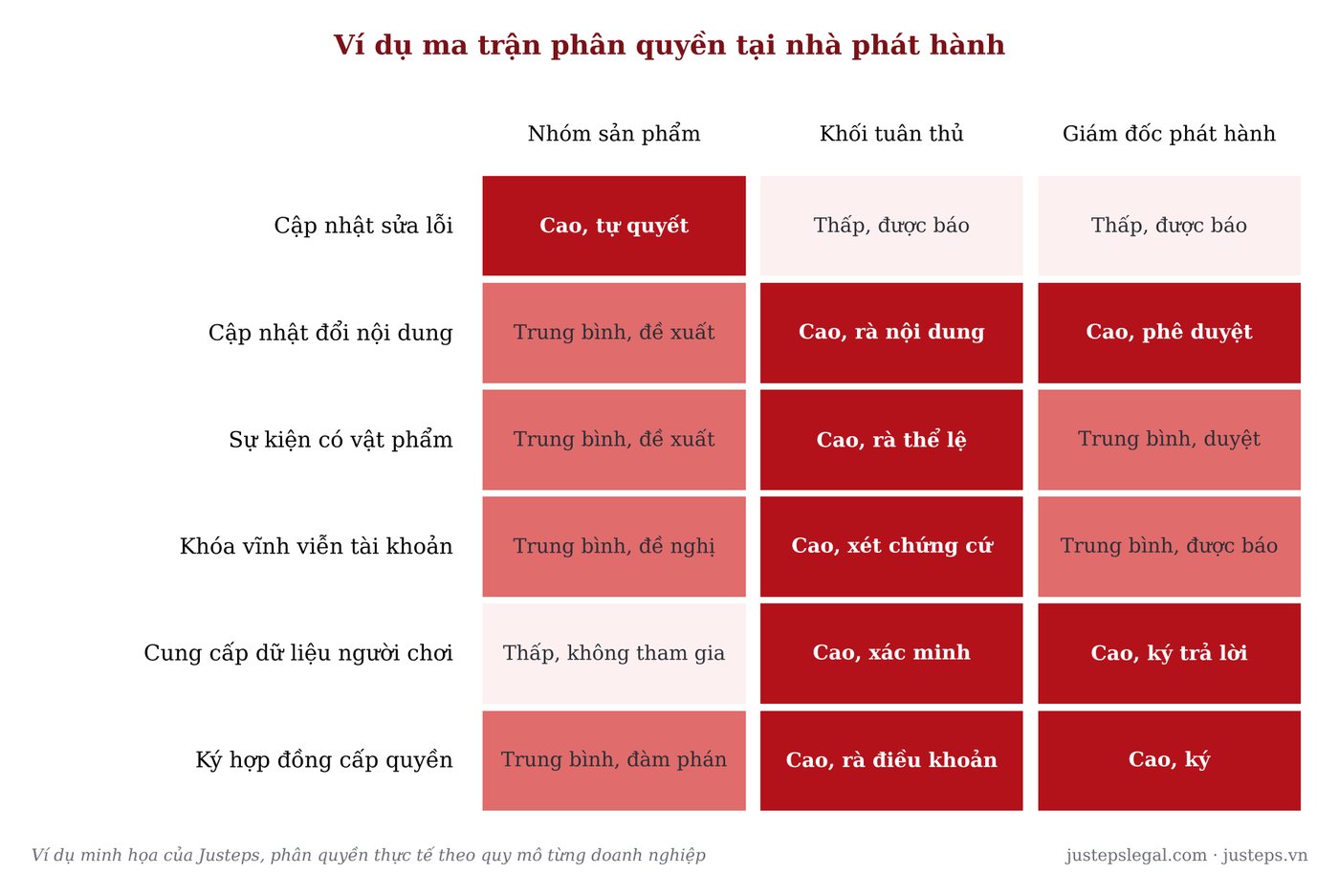
Example allocation of authority for six common decisions at a game publisher
In this example, an update that only fixes technical bugs is decided by the product team alone, while an update that changes content or the age rating must pass through the compliance division because the release decision may have to be amended before the update goes onto the server. Permanently banning an account requires evidence and a review step, and requests from state authorities for player data always go through the data protection officer to verify the authority and scope. Spending limits and limits on signing licensing and revenue sharing contracts can then be carried over into financial regulations and delegation of authority.
Application by size and business model
A development studio of fewer than about thirty people that does not yet publish its own games usually needs only a director, production teams organised by project and one person who also handles contracts, intellectual property and project confidentiality, with the minimum requirement that every contract with freelancers passes through a single point of contact. Once it begins publishing its own games, the business needs to add an operations division and a person responsible for the licence file immediately, because the conditions of a G1 licence must be met before the application is filed.
A publisher of several games needs the full hybrid model, an authority matrix and a statement of functions and duties for each division. A digital content business that works with many creators should also consider the organisational structure design service for KOL, KOC and multi-channel network (MCN) businesses, while a business that belongs to a foreign group must align its structure with the parent company’s approval policies.
How the service is carried out
An organisational structure design project for a game business usually takes eight to ten weeks. The step that differs from many other sectors is checking the proposed structure against the conditions of the licences and the publishing contracts before it is issued, because a change in legal entity, management staff or server location may trigger procedures with the regulator.
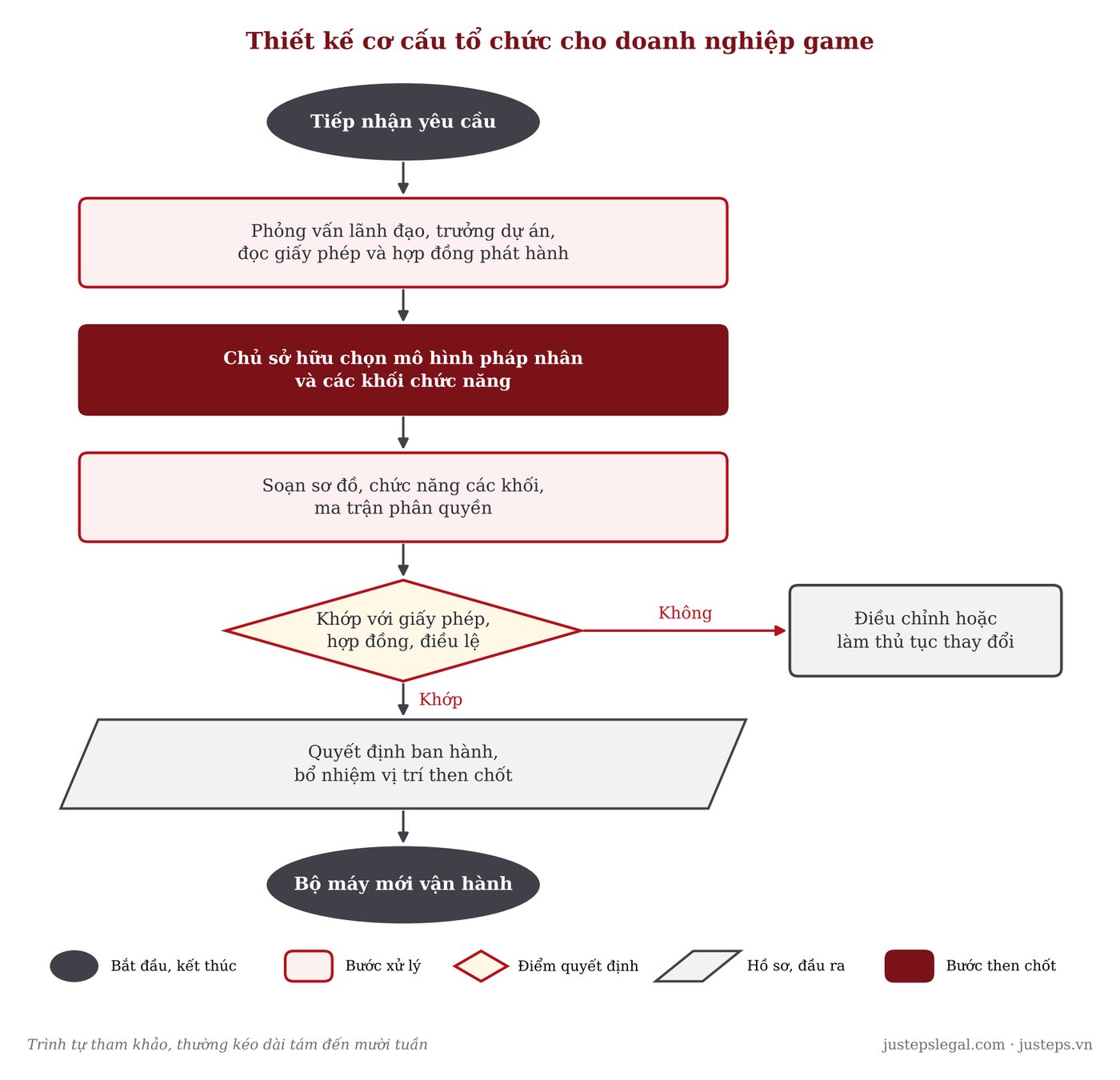
Sequence of organisational structure design including a check against licences and publishing contracts
In the first two weeks, Justeps consultants interview management, project leads and the head of operations, and read the licences, release decisions and contracts with partners and freelancers. In week three, the owner chooses the entity model and the functional divisions. After drafting the chart, the statement of functions and the authority matrix, Justeps checks them against the licence conditions, the publishing contracts and the charter, and any point that does not match is adjusted before the structure is submitted for issue.
At the end of the project, the business receives files it can edit later, together with draft decisions for the members’ council, the board of directors or the owner to approve under the charter[9], including the following documents:
- A report assessing the current entity model and the proposed option, with an analysis of the effects on licences, tax and foreign capital.
- A new organisation chart built around the production, operations, compliance, payments and support divisions.
- A statement of the functions and duties of each division, stating clearly the legal obligations that the division must carry out.
- An authority matrix covering updates, events, virtual items, account bans, player data and licensing contracts.
- A list of key positions such as the person responsible for the licence file, the data protection officer and the intellectual property manager, with selection criteria.
- A staff transition roadmap and a list of employees whose job title, place of work or salary changes.
Once the new organisation has been issued, the update control procedure, the event rules and player protection fall under the service for building internal procedures and regulations for game and digital content businesses, while contract types and terms for freelance artists and musicians are dealt with under the labour, payroll and insurance service for game and digital content businesses.
What determines the service fee
After the first working session, the business receives Justeps’ fixed-fee proposal in writing. The size of the fee depends on the number of legal entities and games in operation, whether an analysis of the option of separating companies is needed, the involvement of foreign investors, the number of employees whose job titles must change and any need for bilingual documents for partners or the parent company. The proposal lists the deliverables, the timeline and also the matters outside the scope, so that the business does not face unexpected additional costs.
How Justeps can help
Alongside organisational structure design, game and digital content businesses may combine the following Justeps services:
- Building internal procedures and regulations for game and digital content businesses. Justeps drafts the update control procedure and the rules on events, virtual items and player protection so that the new divisions work to the same standard.
- Ongoing legal advisory for game and digital content businesses. Justeps tracks licences and reviews publishing contracts and event rules every month once the new organisation is up and running.
- Organisational structure design for KOL, KOC and multi-channel network (MCN) businesses. Justeps designs the creator management organisation for digital content businesses with a large influencer business.
- Financial regulations and delegation of authority. Justeps turns the authority matrix into financial regulations with limits on spending, on signing licensing contracts and on revenue sharing.
Frequently asked questions
Does a studio that only makes games for foreign partners need a G1 licence?
If the business only develops games to order and does not provide game services to players in Vietnam, it is not the publisher and usually does not need a G1 licence. Once it begins publishing its own games in Vietnam, it must hold a licence and a release decision before bringing the game to players[1].
Should the development company and the publishing company be separated?
This is worth considering when the business has several games, wants to raise capital for development separately or wants to ring-fence operating risk. In return, the two companies must sign a licensing contract at an arm’s length price and declare related-party transactions[10].
Must a game business have a personal data protection officer?
The business may designate qualified staff or engage an outside service[5]. Small businesses may defer certain obligations during an initial period unless they process sensitive data or the data of a large number of users, so most publishers need to fill this position straight away[6].
What needs to change in the structure when there is a foreign investor?
The business needs to review the market access conditions for each line, the option of placing foreign capital in the appropriate entity and the investor’s decision-making rights in the charter[4]. If control of the company holding the release decision changes, the procedures for the game should be checked before the deal is signed[8].
Must the new organisation chart be filed with a state authority?
An organisation chart is an internal document and does not need to be filed. However, a change of legal representative, owner or server location may require registration or a procedure to amend documents already issued.
Related articles
- Organisational structure of a technology start-up
- Setting up a technology start-up, capital structure, ESOP and ownership of source code
- Software development contracts, acceptance, warranty and ownership of source code
- Organisational structure design for communications, advertising and event agencies with an independent content review function
Notes
[1] Clauses 1, 2, 3 and 4 of Article 37 of Government Decree No. 147/2024/ND-CP dated 9 November 2024 on the management, provision and use of Internet services and online information.
[2] Points c, dd and e of Clause 1 of Article 39 of Government Decree No. 147/2024/ND-CP dated 9 November 2024 on the management, provision and use of Internet services and online information.
[3] Clauses 1 and 4 of Article 54 of Government Decree No. 147/2024/ND-CP dated 9 November 2024 on the management, provision and use of Internet services and online information.
[4] The Law on Investment No. 143/2025/QH15, effective from 1 March 2026, and the international investment commitments to which Vietnam is a party.
[5] Clause 2 of Article 33 of the Law on Personal Data Protection No. 91/2025/QH15, effective from 1 January 2026.
[6] Clause 2 of Article 38 of the Law on Personal Data Protection No. 91/2025/QH15, effective from 1 January 2026.
[7] Clauses 1 and 2 of Article 39 of the Law on Intellectual Property No. 50/2005/QH11 dated 29 November 2005, as amended and supplemented several times.
[8] Article 46 of Government Decree No. 147/2024/ND-CP dated 9 November 2024 on the management, provision and use of Internet services and online information.
[9] The Law on Enterprises No. 59/2020/QH14 dated 17 June 2020, as amended and supplemented by Law No. 03/2022/QH15 and Law No. 76/2025/QH15.
[10] Government Decree No. 255/2026/ND-CP dated 30 June 2026 on related-party transactions, applicable from the 2026 corporate income tax period.
This article is for reference and reflects the regulations in force at the time of publication. Please consult Justeps for advice tailored to your company’s records and situation.
For further information, please contact:
📩 Email: info@justeps.vn
🌐 Website: https://justepslegal.com · https://justeps.vn
🌐 Page: Justeps
☎️ Hotline (Zalo): 096 172 2607
📍 Thanh Xuan Office: 12th Floor, Licogi 13 Tower, 164 Khuat Duy Tien Street, Thanh Xuan Ward, Hanoi, Vietnam
📍 Ha Dong Office: LK06B, No.10, Dong Dua Area, Ha Dong Ward, Hanoi, Vietnam
📍 Ho Chi Minh City Branch: 528 Le Van Sy, Ho Chi Minh City, Vietnam
📍 Hai Phong Office: Truong Thinh Village, Ha Dong Commune, Hai Phong, Vietnam
📍 Quang Ninh Office: Van Don Special Zone, Quang Ninh Province, Vietnam





