
Key takeaways
- Commercial sports activities are a conditional business line, so a business may operate only after obtaining a certificate of eligibility and must maintain those conditions throughout its operation, which means each facility needs a person assigned by name to maintain them[3].
- Personal trainers should report to the head of the professional line rather than to the head of sales, because sales pressure easily overrides the requirements on training plans, health screening and member safety.
- When a business changes its business location or adds a sport, the certificate must be reissued, so any decision to open a facility or add a sport should pass through the person responsible for legal matters before works begin[5].
- The authority to grant refunds, freeze or transfer memberships and close an area for safety reasons should be written into the authority matrix, rather than left to sales consultants to decide case by case.
A gym with a swimming pool and a sauna usually runs three very different streams of work at the same time. The sales consultants sell memberships against monthly targets, the trainers teach by session and are responsible for training plans, and the technical and lifeguard team keeps the equipment, the pool and the electrical system safe every day. When all three streams report to a single facility manager whose income is tied to sales, decisions on professional standards and safety tend to rank below sales targets. Injuries, collective complaints about prepaid memberships and penalty records for failing to meet business conditions mostly stem from the fact that nobody has been given clear responsibility.
This page presents Justeps’ organisational structure design service for gyms, yoga and pilates studios, martial arts schools, commercial swimming pools, fitness club chains and professional sports clubs. It moves from the operating features of the sector, through the business conditions that need to be tied to a specific position, the model for each type of business and the authority matrix, to the implementation process and deliverables. The main legal basis is the Law on Physical Training and Sports of 2006 as amended and supplemented, Decree No. 36/2019/NĐ-CP and the Law on Enterprises No. 59/2020/QH14 as amended and supplemented.
Operating features of gyms and sports clubs
The first feature is that revenue comes mainly from prepaid memberships, some of which run for one to three years. Each membership sold is a commitment to provide services in the future, so every decision on opening hours, closing an area, moving a facility or changing a trainer affects the interests of people who have already paid. The organisation therefore needs a point of contact standing between sales and operations, with the right to require changes to the sales script when promises go beyond what the facility can actually deliver.
The second feature is that service quality depends on the people who directly instruct members. A good trainer can retain dozens of members, but can also cause injuries if the training plan does not suit the member’s health condition. The law on sports sets qualification requirements for sports instructors, lifeguards and medical staff depending on the sport[1], and the business must ensure that everyone who actually teaches, including substitute instructors, meets those requirements.
The third feature is that safety risks arise every day rather than seasonally. Swimming pools, saunas, treadmills, free weight areas and the electrical system all need to be checked before opening. The fire prevention and fighting responsibilities of the head of the establishment and of the organisation using the premises are set out in the 2024 Law on Fire Prevention and Fighting and Rescue[2], so the organisational structure must show who is responsible at each facility and who has the right to close an area immediately when a hazard is detected.
Business conditions that need to be assigned to a specific position
The certificate and maintaining the conditions
Under the Law on Physical Training and Sports, a business engaged in commercial sports activities must have managers and professional staff suited to its activities and facilities and equipment that meet the requirements, and is inspected and granted a certificate of eligibility by the specialised sports authority under the provincial People’s Committee[3]. A household business that wishes to offer an adventure sport or a sport that requires an instructor must register as an enterprise[4], which is why many studios operating as household businesses need to review their legal form before expanding.
Decree No. 36/2019/NĐ-CP provides that a business may operate only after it has been granted the certificate, that a business with several business locations files its application where its head office is located, and that it must apply for reissuance when it changes its name, head office address, business location or list of sports activities[5]. In practice, gym chains often open new facilities or add swimming or martial arts classes in response to demand without anyone remembering the reissuance procedure. For this reason, in the structure proposed by Justeps, the person in charge of legal and compliance matters must give an opinion before a new lease is signed or memberships for a new sport go on sale.
Professional staff for each sport
A sports instructor must be a coach or an athlete ranked at level 2 or above or equivalent, hold a sports qualification at intermediate level or above relevant to the business activity, or have completed professional training as prescribed by the Minister of Culture, Sports and Tourism[1]. Water sports require lifeguards, and adventure sports also require medical staff on duty or a written agreement with the nearest medical facility. Sports commonly offered at gyms, such as yoga, bodybuilding and fitness, swimming and martial arts, are also governed by separate circulars on facilities, equipment and training for professional staff.
Operating without a certificate, or using sports instructors, lifeguards or medical staff who do not meet the requirements, may be penalised under Decree No. 46/2019/NĐ-CP, which has just been amended and supplemented by Decree No. 285/2026/NĐ-CP, effective from 1 September 2026[6]. The list of professional staff at each facility, together with their diplomas and certificates, therefore needs one person to keep and update it, usually the head of the professional line, and the facility manager may not schedule anyone whose name is not on the list.
Separating the sales line from the professional line
The most common mistake Justeps finds when reviewing gyms is that personal trainers report to the head of sales. Personal training sales targets then become the main measure of a trainer, health screening forms are filled in perfunctorily, and members with underlying conditions are still placed on high intensity programmes. An injury in these circumstances is very difficult to explain, because the records show that the business put sales ahead of professional standards.
Justeps proposes two parallel reporting lines. The sales and member care line is responsible for consultation, signing contracts, renewals and handling routine requests. The professional line is headed by a head of the professional line who manages trainers, yoga teachers and lifeguards, approves standard training plans, checks certificates and has the right to refuse to admit a member to a class when the screening result is not satisfactory. The two lines meet at the facility manager, but the income of the head of the professional line should not be directly tied to membership sales.
The technical operations unit, covering equipment maintenance, the pool, utilities and fire prevention, should be separate from both lines. Where the business outsources lifeguard or maintenance services, the structure must still have one of the business’s own people to supervise the contractor, sign the inspection log and hold the right to close an area temporarily, because responsibility towards members does not pass to the contractor under the service contract.
Models for each type of business
There is no single chart for every business in the sector. The figure below shows the functional units of a multi-facility gym chain under a two-tier model, comprising a head office that maintains standards and the facilities that run day-to-day operations.
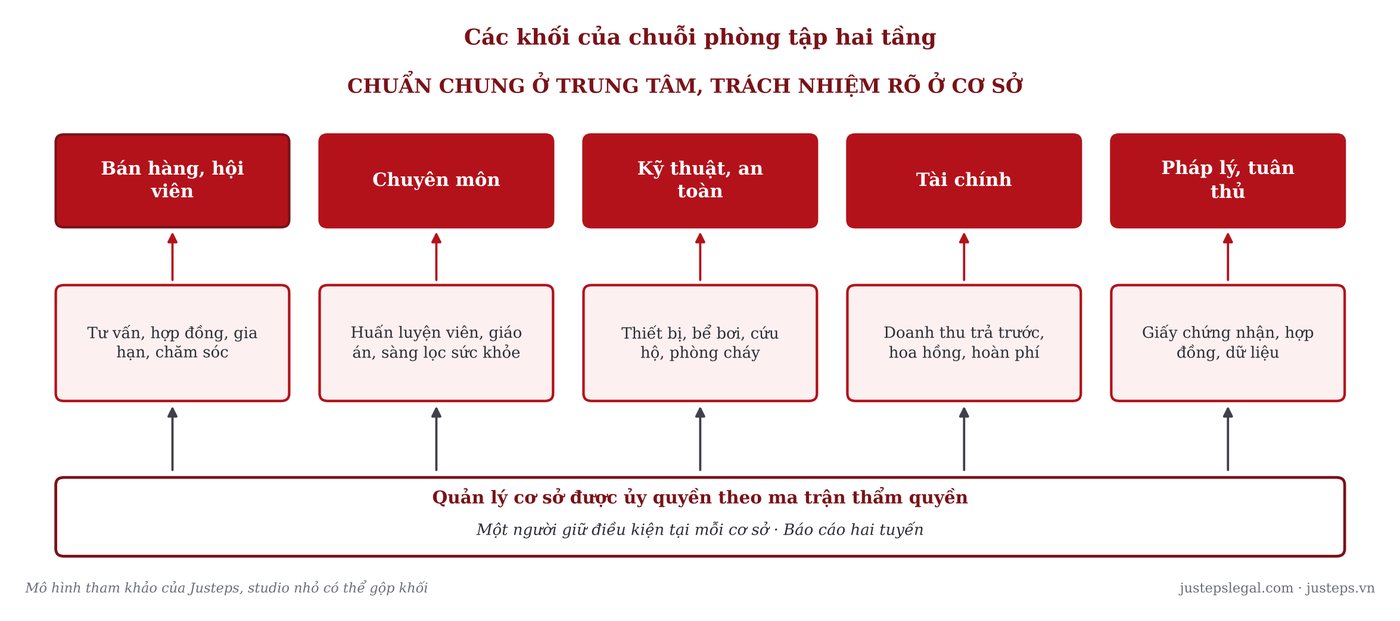
Functional units of a gym chain under a two-tier model
Under this model, the head office manages the brand, the price list, the standard membership contract, the trainer training standards, the accounting for prepaid revenue and the legal records of the whole chain. The facility manager is responsible for day-to-day operations, safety and service quality at the facility, acting under authority with clear limits. The table below compares the design focus for the common types of business.
| Type of business | Design focus | Common mistake |
|---|---|---|
| Standalone yoga or pilates studio | The owner often doubles as head of the professional line, so the person collecting money must be separated from the person teaching. | Teachers paid per class have not been clearly classified as employees or freelance collaborators. |
| Multi-facility gym chain | Two tiers of head office and facilities, with standardised authority for facility managers. | The certificate is not reissued when a facility or a sport is added. |
| Facility with pool or sauna | Add technical and lifeguard positions with the right to close an area. | Lifeguard services are outsourced with nobody from the business supervising. |
| Franchised gym | Reconcile the franchisor’s standards with the business conditions in Vietnam. | Job titles copied from a foreign template do not match the requirements for professional staff. |
| Professional club | Separate training and competition from commercial activities, sponsorship and ticketing. | One person both manages athletes and negotiates sponsorship. |
A professional sports club is a business that trains and coaches athletes and organises professional competition, is a member of the national sports federation and must have a certificate of eligibility before operating[7]. For this type of business, the structure needs an additional sports medicine unit, an athlete management unit and a point of contact for dealing with the federation. When a gym chain opens a facility in another province, the business also has to choose between a branch and a business location under the Law on Enterprises[8]; a facility with a manager authorised to sign contracts and keep separate accounts is usually suited to a branch, while a facility that simply operates to head office standards is usually suited to a business location.
An authority matrix for decisions on members and safety
Once the model has been settled, Justeps prepares an authority matrix for the decisions that gyms usually handle according to the instinct of whoever is on duty. All of these decisions concern money members have paid in advance or safety, so it must be clear who proposes, who decides and who is only informed. The example below applies to a chain of three facilities.
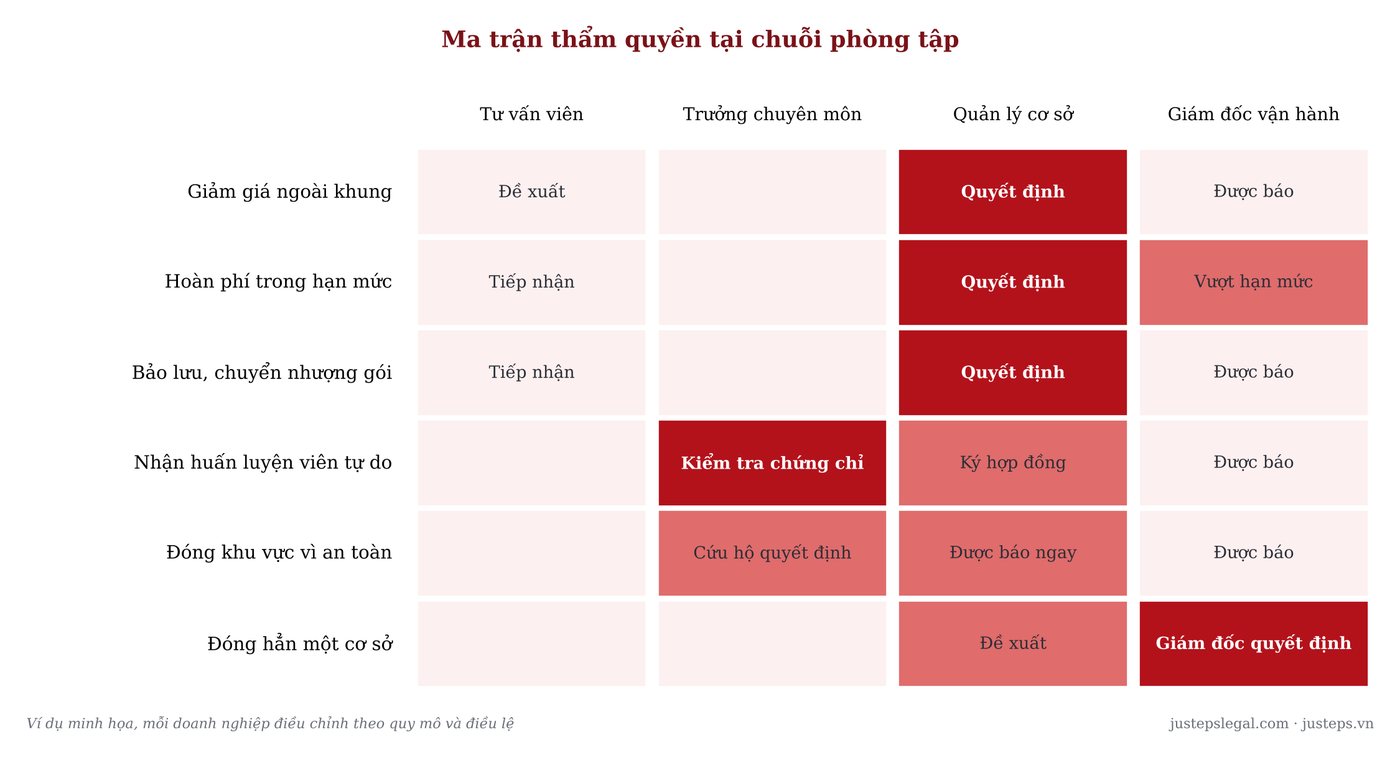
Example division of authority between sales consultant, head of the professional line, facility manager and operations director
In this example, sales consultants may only apply discounts within the published range, while refunds and membership transfers must be approved by the facility manager within a set limit, with anything above that limit passed to the operations director. Allowing a freelance trainer to teach at the facility requires the head of the professional line to check certificates first. The right to close an area immediately for safety reasons belongs to the technician or lifeguard on duty, without waiting for a superior, whereas the decision to close a facility entirely belongs to the director because it brings obligations towards every member whose membership is still valid, and the business may not stop providing services contrary to the contracts it has signed[9].
Implementation process, deliverables and fees
A project usually takes about eight weeks. The key decision point is whether the business has several facilities or offers water sports, because these two factors determine the number of management tiers and the number of mandatory professional positions. The flowchart below shows the sequence of work.
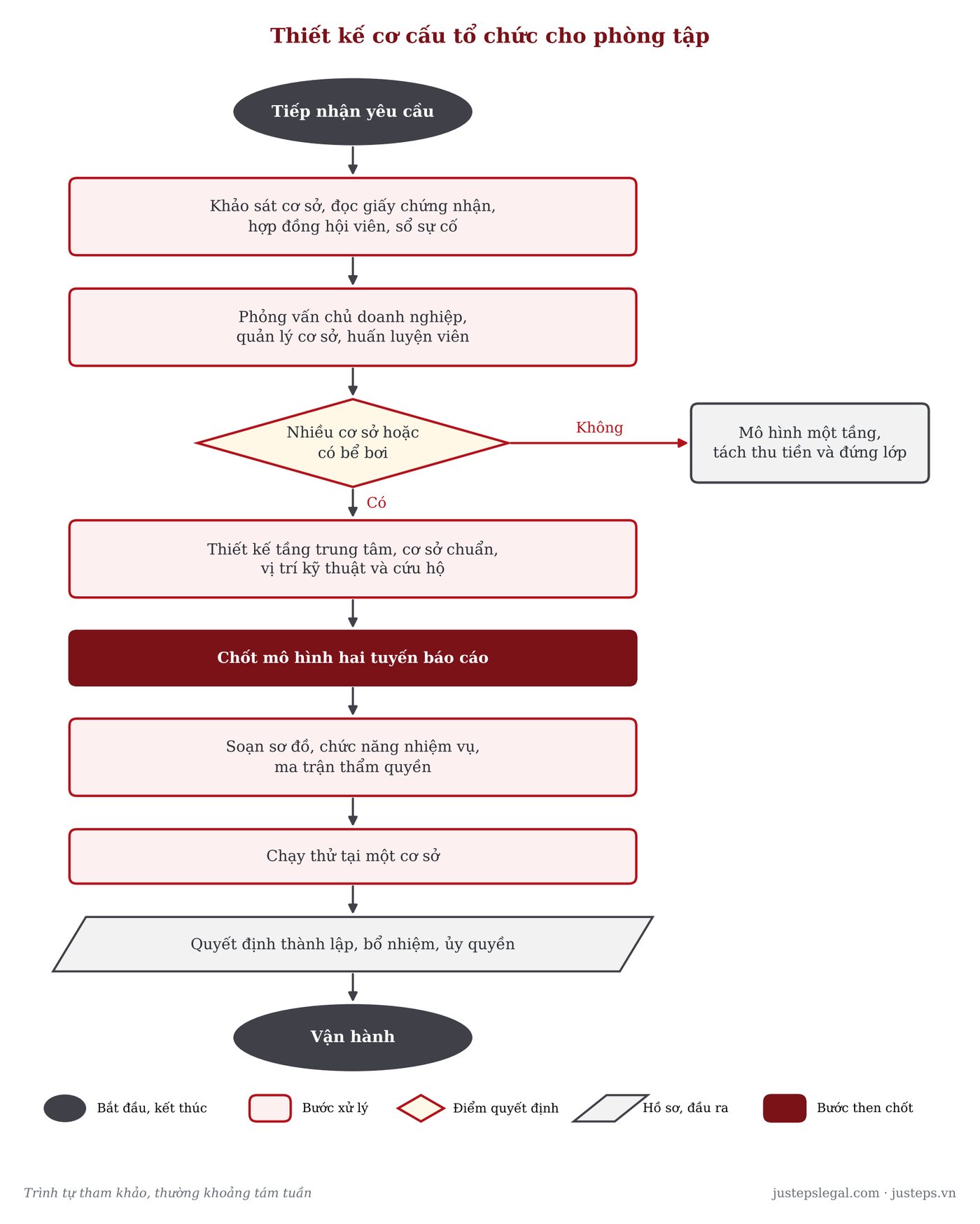
Sequence for designing the organisational structure of a gym, yoga or sports club business
In the first two weeks, Justeps’ consultants visit at least one operating facility, read the certificate of eligibility, the list of professional staff, the standard membership contract, contracts with trainers, the commission scheme and the incident log, and interview the owner, facility managers and several trainers. Week three is the meeting with management to settle the model. The following weeks are for drafting documents, running a trial of about one week at one facility and making adjustments. The deliverables comprise the following documents:
- A chart of the head office and of the standard facility model, with an explanation of why the model was chosen.
- A statement of the functions and duties of each unit and descriptions of key positions such as facility manager, head of the professional line, head of technical operations and lifeguard.
- An authority matrix for discounts, refunds, freezes, membership transfers, admitting freelance trainers, closing an area and closing a facility.
- A list of the business conditions to be maintained at each facility, with the person responsible and the date for the next check.
- Draft decisions establishing units, appointment decisions and letters of authorisation for facility managers.
A studio with fewer than ten people usually only needs to separate the person collecting money from the person teaching and to state clearly who keeps the records on business conditions. A facility with a pool, sauna or martial arts area needs additional technical and lifeguard positions and possibly medical staff as well. Once the organisation has taken shape, the procedures for selling memberships, health screening and safety checks are written in detail under the internal procedures and regulations service for gym and yoga businesses, while trainers’ contracts and pay schemes are handled under the labour, payroll and insurance service for gym and yoga businesses.
Fees are quoted as a fixed package in writing after the initial discussion, depending on the number of facilities, the number of sports, whether there is a pool or other special areas, the franchise model, the number of positions to be described and any need for bilingual documents. Justeps recommends reviewing the structure when the business opens a new facility, adds a sport or moves to a franchise model, or at least once a year.
How Justeps can help
Alongside organisational structure design, gym, yoga and sports club businesses can combine the following Justeps services:
- Building internal procedures and regulations for gym, yoga and sports club businesses. Justeps writes procedures for selling memberships, health screening, freezes, refunds and safety checks that match the newly designed organisation.
- Labour, payroll and insurance services for gym, yoga and sports club businesses. Justeps classifies trainers and per-class teachers and designs pay and commission schemes that fit the two reporting lines.
- Organisational structure, functions and duties, and job descriptions. Justeps drafts the functions of each unit and job descriptions for facility managers, heads of the professional line and lifeguards.
- Setting up branches, representative offices and business locations. Justeps chooses the form of registration for a new facility and coordinates the procedure to reissue the certificate of eligibility.
Frequently asked questions
Does a gym need a certificate of eligibility for commercial sports activities?
Yes. A business engaged in commercial sports activities may operate only after the provincial sports authority has granted it a certificate of eligibility[3]. When it changes its business location or its list of sports, the business must apply for reissuance[5].
Which unit should personal trainers report to?
They should report to the head of the professional line, who approves training plans and checks certificates. The sales unit may coordinate on personal training sales targets, but should not be the trainers’ direct line manager.
Does a yoga studio operating as a household business have to become an enterprise?
If the sport offered is on the list of sports that require an instructor or is an adventure sport, the household business must register as an enterprise[4]. The studio should check this list before expanding or adding new classes.
Who should have the authority to approve refunds for members?
The facility manager should be able to approve refunds within a set limit, with anything above that limit passed to the operations director. Sales consultants should not have this authority, because refunds can easily be used as a tool for closing sales.
If lifeguard services for the pool are outsourced, whom must the business still assign?
The business still needs one of its own people to supervise the contractor, sign the inspection log and hold the right to close an area temporarily. The requirement to have lifeguards for water sports is a condition imposed on the business itself[1].
Where does a gym chain operating in several provinces file its certificate application?
Under Decree No. 36/2019/NĐ-CP, a business with several business locations files its application with the issuing authority where its head office is located[5]. The business should also check the list of administrative procedures published by the province to see how applications are received in practice.
Related articles
- Building internal procedures and regulations for gym, yoga and sports club businesses across the membership life cycle
- Ongoing legal advisory for gym, yoga and sports club businesses from premises and franchising to member incidents
- Labour, payroll and insurance services for gym, yoga and sports club businesses with commission-based trainers
- How to choose an organisation chart model that fits the size of a business and the way it generates revenue
Notes
[1] Articles 13, 15, 16 and 17 of Decree No. 36/2019/NĐ-CP dated 29 April 2019 of the Government detailing a number of articles of the Law amending and supplementing a number of articles of the Law on Physical Training and Sports, as amended and supplemented by Decree No. 31/2024/NĐ-CP.
[2] Law on Fire Prevention and Fighting and Rescue No. 55/2024/QH15, effective from 1 July 2025.
[3] Article 55 of the Law on Physical Training and Sports No. 77/2006/QH11 dated 29 November 2006, as amended and supplemented by Law No. 26/2018/QH14 dated 14 June 2018 (Consolidated Document No. 64/VBHN-VPQH of 2025).
[4] Article 56 of the Law on Physical Training and Sports No. 77/2006/QH11 dated 29 November 2006, as amended and supplemented by Law No. 26/2018/QH14 dated 14 June 2018 (Consolidated Document No. 64/VBHN-VPQH of 2025).
[5] Article 18, Clause 1 of Article 20 and Clause 1 of Article 21 of Decree No. 36/2019/NĐ-CP dated 29 April 2019 of the Government detailing a number of articles of the Law amending and supplementing a number of articles of the Law on Physical Training and Sports, as amended and supplemented by Decree No. 31/2024/NĐ-CP.
[6] Articles 16 and 20 of Decree No. 46/2019/NĐ-CP dated 27 May 2019 of the Government on administrative penalties for violations in the field of sports, as amended and supplemented by Decree No. 129/2021/NĐ-CP and Decree No. 285/2026/NĐ-CP dated 17 July 2026.
[7] Articles 49, 50 and 51 of the Law on Physical Training and Sports No. 77/2006/QH11 dated 29 November 2006, as amended and supplemented by Law No. 26/2018/QH14 dated 14 June 2018 (Consolidated Document No. 64/VBHN-VPQH of 2025).
[8] Articles 44 and 45 of the Law on Enterprises No. 59/2020/QH14 dated 17 June 2020, as amended and supplemented by Law No. 03/2022/QH15 and Law No. 76/2025/QH15.
[9] Clause 3 of Article 41 of the Law on Protection of Consumers’ Rights No. 19/2023/QH15 dated 20 June 2023, effective from 1 July 2024.
This article is for reference and reflects the regulations in force at the time of publication. Please consult Justeps for advice tailored to your company’s records and situation.
For further information, please contact:
📩 Email: info@justeps.vn
🌐 Website: https://justepslegal.com · https://justeps.vn
🌐 Page: Justeps
☎️ Hotline (Zalo): 096 172 2607
📍 Thanh Xuan Office: 12th Floor, Licogi 13 Tower, 164 Khuat Duy Tien Street, Thanh Xuan Ward, Hanoi, Vietnam
📍 Ha Dong Office: LK06B, No.10, Dong Dua Area, Ha Dong Ward, Hanoi, Vietnam
📍 Ho Chi Minh City Branch: 528 Le Van Sy, Ho Chi Minh City, Vietnam
📍 Hai Phong Office: Truong Thinh Village, Ha Dong Commune, Hai Phong, Vietnam
📍 Quang Ninh Office: Van Don Special Zone, Quang Ninh Province, Vietnam





