
Key takeaways
- Guest registration, security and order, fire prevention and food safety are obligations that arise every day, so the organisational chart must name the person primarily responsible and a deputy for each of them.
- A general manager seconded by a management company has authority within the owner’s company only when appointed or given a letter of authorisation in writing[5], while the owner’s legal representative remains answerable to the authorities[6].
- The person who collects money from guests, the person who records revenue and the person who performs the end-of-day reconciliation should be three different people, and income audit should report to the chief accountant rather than to the general manager.
- A homestay chain managed remotely needs an area manager and a person assigned the obligations at each location, because the authorities inspect each establishment rather than the company’s head office.
A hotel operates day and night, and a single guest stay passes through reception, housekeeping, the kitchen, engineering, security and accounting before it ends. When responsibility at any stage is unclear, the consequences show up very quickly, whether it is a foreign guest whose temporary residence has not been declared, a fire extinguisher past its inspection date or a discount nobody approved. Although all are accommodation establishments, a hotel run by its owner, a hotel managed by an international brand operator and a homestay chain run by telephone need very different organisations.
This page introduces Justeps’ service of designing the organisational structure of hotels, resorts, serviced apartments and homes with rooms let to tourists (homestays). It focuses on choosing the organisational model, assigning each legal obligation to a specific position, dividing authority between the owner and the management company, and setting staffing by room count and season. The operating procedures written for each department once the organisation is in place are presented under the internal procedures and regulations service for hotel, resort and homestay businesses.
Every obligation of an accommodation establishment needs a responsible person
A tourist accommodation establishment must meet minimum conditions on facilities and services corresponding to the type registered, from hotels, tourist villas and tourist apartments to guesthouses and homestays[1]. Beyond tourism law, the establishment must also ensure security and order conditions and check guests’ documents under the decree on business lines subject to security and order conditions[2], notify guest stays to the police[3], and ensure fire prevention and fire fighting safety, for which the head of the establishment is directly responsible[4]. Establishments with a restaurant or banqueting service must also meet food safety conditions.
These obligations arise every day, including on night shifts and public holidays, so they cannot all be left to the director. Justeps prepares a table linking each obligation to a position in the organisational chart and to a deputy who acts when that position is absent. The table below shows the allocation Justeps usually proposes for an owner-operated three- to four-star hotel.
| Obligation | Person primarily responsible | Deputy and method of checking |
|---|---|---|
| Guest registration and temporary residence declaration | The front office manager, carried out through the receptionists on each shift. | The night shift leader deputises, and the night auditor compares occupied rooms with the number of guests registered. |
| Security and order | The head of security or a person assigned by decision of the director. | The front office shift leader deputises out of hours, and the security log is signed at each handover. |
| Fire prevention and fire fighting | The chief engineer, with an on-site fire team set up by the director. | The duty technician, who checks equipment on a monthly schedule and keeps records. |
| Food safety | The executive chef, working with the restaurant manager. | The sous chef deputises, and the food check log and sample records are signed daily by the food and beverage manager. |
| Equipment with strict safety requirements | The chief engineer. | Accounting tracks inspection due dates on the business’s common compliance calendar. |
Decisions assigning these duties should be made in writing and kept with the establishment’s legal records. During an inspection, these documents show that the business has organised the performance of its obligations, and when an incident occurs they help identify who must give an explanation instead of all responsibility falling on the legal representative.
The owner, the management company and the general manager
Under the management company model, the hotel still belongs to the owner’s company and the licences and contracts with guests remain in the owner’s name, while the management company seconds a general manager and several heads of department to run it under a management agreement. A mistake Justeps often sees is that the general manager signs contracts with suppliers, sets room rates and recruits staff without any appointment decision or letter of authorisation from the owner. An authorised representative may only establish and perform transactions within the scope of the authorisation[5], so without written documents the contracts signed by the general manager may be challenged as to their validity, while the owner’s legal representative remains the person answerable to the authorities[6].
Justeps proposes that the owner appoint the general manager to a management title within the company, issue a letter of authorisation with value limits and a term, and designate an owner’s representative to monitor the budget, monthly reports and large expenditure items. The authority matrix must be consistent with the management agreement, because management agreements usually give the management company the right to decide room rates and recruitment, while the owner retains approval of the annual budget and major repairs. The matrix below is an example Justeps built for a resort of about 200 rooms run by a management company.
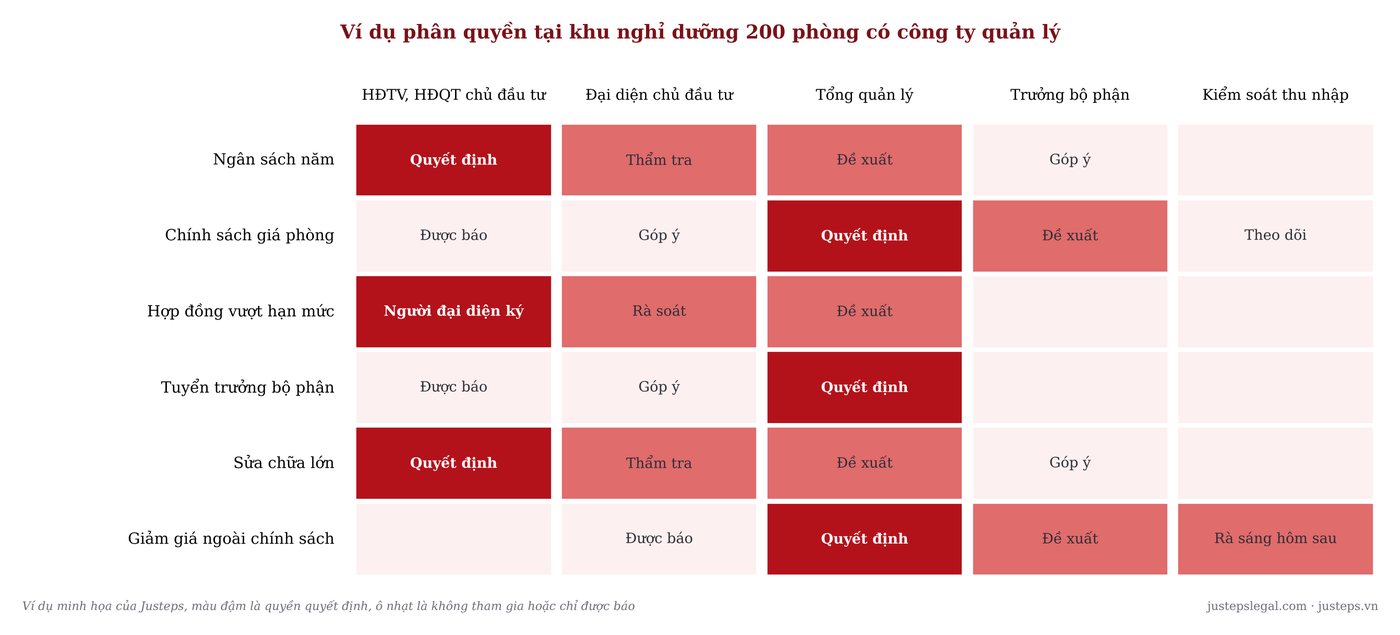
Example of authority among the owner, the management company and management levels at a 200-room resort
In this example, the owner’s members’ council or board of directors decides the annual budget and major repairs, on the basis of the general manager’s proposal and the review of the owner’s representative. The general manager decides room rate policy and the recruitment of heads of department as provided in the management agreement, while contracts above the authorised limit must go to the legal representative for signature after review by the owner’s representative. Discounts outside the policy are decided by the general manager but are always reviewed by income audit the following morning.
Separating the cashier, the revenue recorder and the reconciler
The most common control weakness in small hotels is that one receptionist both takes cash from guests, enters room rates into the software and prepares the end-of-shift revenue report. When one person handles all three tasks, items such as rooms sold outside the system, room changes without charging the difference or voids after payment has been collected are very hard to detect. The structure should separate the receptionist who collects money, the night auditor who reconciles revenue at the end of the day and the income audit team that performs an independent review the following morning.
Income audit and accounting should report to the chief accountant or the finance director, not to the front office manager or the sales director, so that reconciliation is not subject to occupancy pressure. For hotels below about 50 rooms without enough staff for three positions, Justeps proposes that the owner or an outsourced accountant check the end-of-day report directly through the property management system. Discount limits for each level and the approval sequence for spending are written into a regulation, which can be prepared together with the financial regulations and delegation of authority service.
Resorts with several zones and ancillary services
Resorts usually have pools, beaches, a health and wellness area (spa), several dining outlets and outdoor activities, each carrying its own type of risk. Pools and beaches are where the risk to life is highest, so they need a lifeguard team with trained staff, a duty schedule matching opening hours and the authority to close the area in bad weather, rather than leaving this to beverage staff as a side task. Resorts located far from a city also need a person responsible for staff housing and transport, because most employees cannot commute on their own each day.
Many establishments outsource security, cleaning of public areas, laundry or landscaping to reduce the number of permanent staff. Outsourcing does not transfer the establishment’s responsibility towards guests and the authorities to the contractor, so the structure still needs a person from the business to supervise each outsourcing contract, check quality and receive incident reports. Justeps names this supervisory contact in the statement of functions and duties of the security, housekeeping or engineering department.
Homestay chains and serviced apartments managed remotely
Homestay or serviced apartment chains usually centralise reservations, accounting and marketing, while each location has only one housekeeper or no permanent staff at all. The police, the fire authorities and the local government inspect each establishment separately, so each location must have a person assigned responsibility for guest registration, checking fire equipment and handling night-time situations. When the business organises these locations as branches or business locations, the registration procedure and the authority of the head of each location need to be determined at the same time as the structure[7].
Justeps usually proposes an area manager responsible for five to ten locations, with authority to handle incidents, arrange replacements and report to head office using a compliance tracking sheet for each location. Self check-in through door codes or an app helps reduce staffing but does not remove the duty to check documents and notify guest stays, so the procedure must state who receives guest information and who sends the notification within the time limit.
Staffing by room count and season
The right number of staff depends on the room count, the type of services and the degree of seasonal fluctuation, so Justeps does not apply a common ratio to every establishment. The chart below illustrates the number of permanent staff in five divisions at three types of establishment of different sizes.
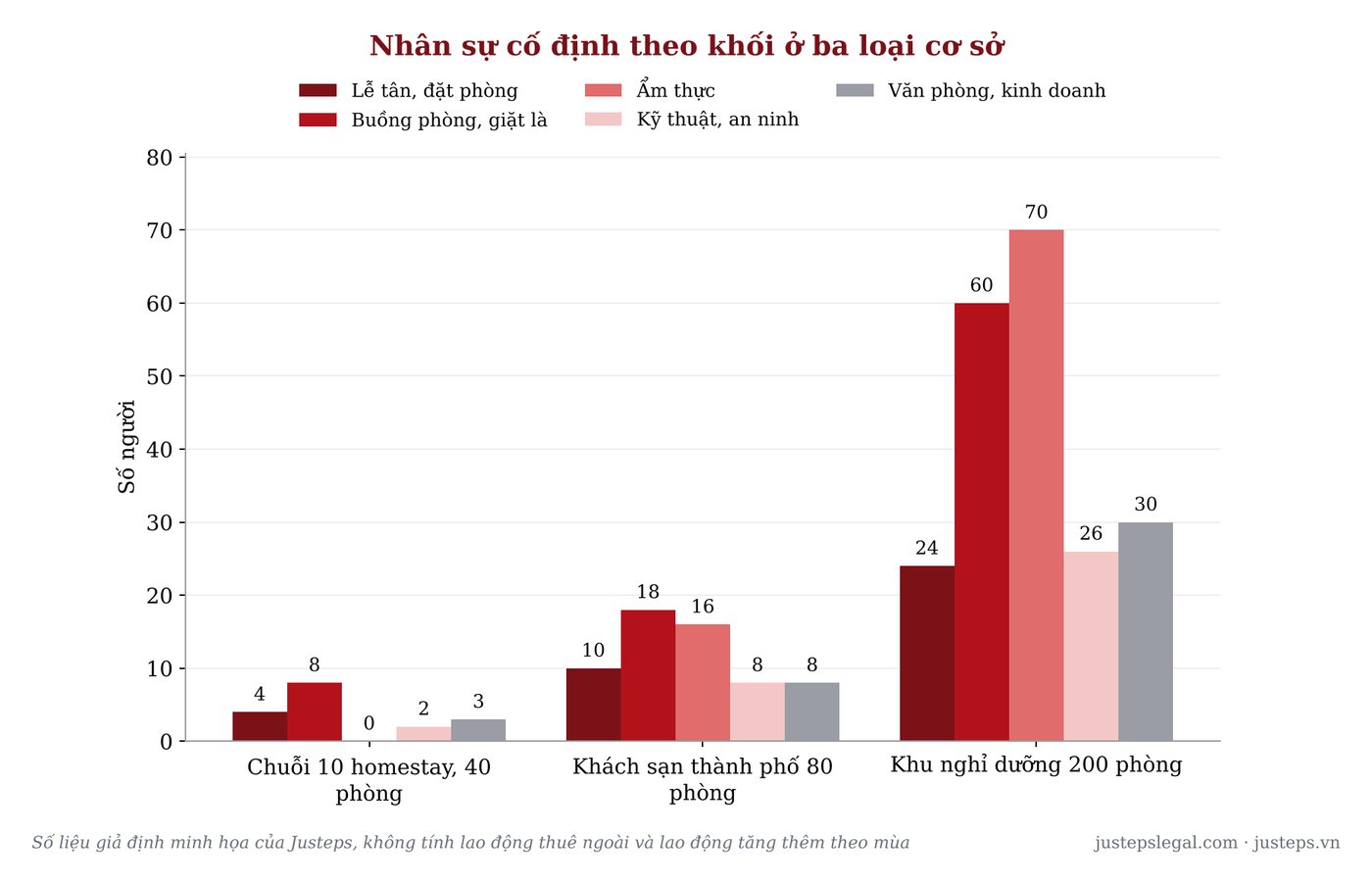
Example of permanent staff by division at three types of accommodation establishment
In this example, a chain of ten homestays with about 40 rooms has 17 staff, comprising 4 in reception and reservations, 8 in housekeeping, 2 in engineering and 3 in the office, with no food and beverage division. An 80-room city hotel has 60 staff, of whom 10 are in reception, 18 in housekeeping, 16 in food and beverage, 8 in engineering and security and 8 in the office. A 200-room resort has 210 staff, with food and beverage the largest division at 70 people, followed by housekeeping with 60, the office with 30, engineering and security with 26 and reception with 24. At coastal resorts, Justeps separates permanent staff from additional peak-season staff, so the business knows which positions to recruit seasonally and which must be kept all year round.
Implementation process, deliverables and fees
A project to design the organisational structure of an accommodation establishment usually takes about eight weeks. For resorts and coastal hotels, Justeps proposes carrying it out in the low season so that there is time to recruit and train before occupancy rises.
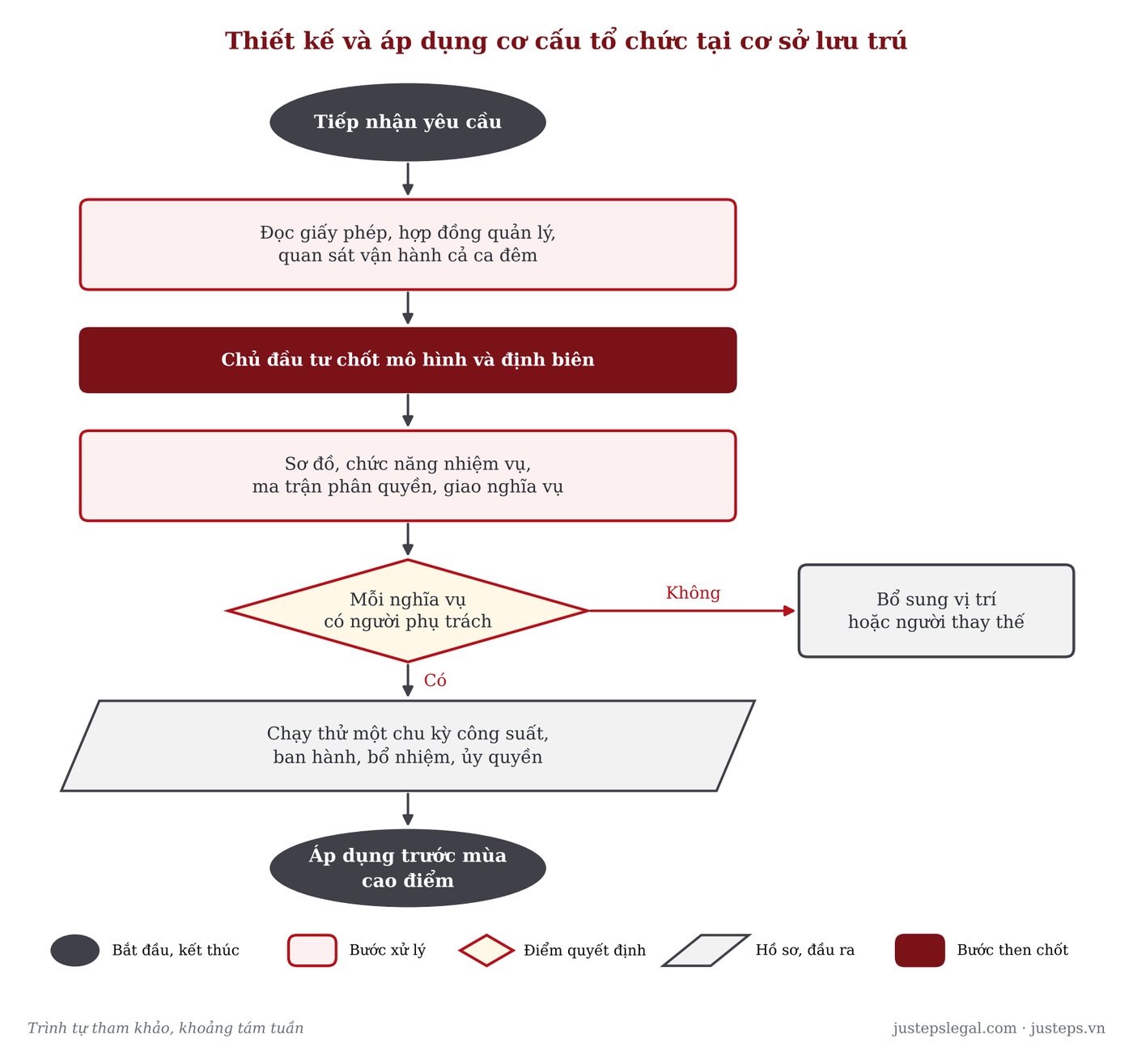
Sequence for designing and applying the organisational structure at an accommodation establishment
In the first two weeks Justeps reads the licences, the charter, the management agreement, shift rosters and operating reports, interviews the general manager and the heads of department, and observes actual operations, including one night shift. In the third week the owner, together with the management company where there is one, agrees the model and staffing, after which Justeps prepares the chart, the functions and duties and the authority matrix and trials them over at least one full occupancy cycle covering both weekdays and weekends. The deliverables include the following documents:
- The overall organisational chart and detailed charts of each department, used for internal communication and when dealing with inspection teams or partners.
- Rules on the functions and duties of reception, housekeeping, food and beverage, engineering, security, sales, accounting, human resources and ancillary services.
- An authority matrix covering the owner, the owner’s representative, the management company and each management level.
- A staffing table by occupancy and season, with shift arrangements, so that human resources can plan recruitment.
- Draft resolutions or decisions issuing the structure, appointment decisions, a letter of authorisation for the general manager and decisions assigning duties on security, guest registration, fire prevention and food safety.
The authority to issue the structure is set by the charter, and normally the members’ council, the board of directors or the owner decides the organisational structure, while the director issues internal management regulations within the scope assigned[8]. Justeps quotes the project fee as a fixed fee in writing after the initial meeting, depending on the room count, the number of departments and establishments, whether there is a management company, the need for bilingual documents, whether the structure must be checked against star rating standards and whether the business needs Justeps to follow the trial phase closely. Job descriptions for each new title can then be prepared through the organisational structure, functions and duties and job description service, while employment contracts and shift arrangements are handled under the labour, wages and social insurance service for hotel, resort and homestay businesses.
How Justeps can help
Alongside organisational structure design, hotel, resort and homestay businesses may combine the following Justeps services:
- Internal procedures and regulations for hotel, resort and homestay businesses. Justeps writes procedures for reception, housekeeping, food and beverage, revenue control and incident handling, in line with the newly designed organisation.
- Labour, wages and social insurance services for hotel, resort and homestay businesses. Justeps turns the new titles into contracts, shift rosters, salary scales and a service charge allocation policy.
- Organisational structure, functions and duties and job descriptions. Justeps drafts job descriptions for the general manager, the front office manager, the night auditor and area managers.
- Financial regulations and delegation of authority. Justeps sets limits for approving spending, discounts and contract signing for the owner, the management company and each management level.
Frequently asked questions
Does a hotel with about 20 rooms need a formal organisational chart?
Yes, even if it is very simple. The chart shows who is responsible for guest registration, fire prevention, cash handling and the end-of-day reconciliation, and helps the person on shift know what to do when the owner is away.
Once a management company is engaged, what is the owner still responsible for?
The owner still holds the licences, is the party contracting with guests and is usually the employer, so it remains legally answerable to the authorities[6]. It therefore needs a supervisory mechanism through the owner’s representative, monthly reports and the right to approve major decisions.
What documents does a foreign general manager need?
In addition to a work permit or a written confirmation of exemption from a work permit, the business needs an appointment decision and a letter of authorisation clearly stating the scope and limits. The work permit procedure is handled under the labour, wages and social insurance service.
Who should be responsible for guest registration?
The responsibility lies with the accommodation establishment[3], and within the organisation it should be assigned to the front office manager and carried out through the staff on each shift. The night auditor should compare occupied rooms with the number of guests notified to detect omissions during the night.
Should security and cleaning be outsourced?
Outsourcing offers flexibility and savings, but the accommodation establishment remains responsible to guests and to the authorities. The business needs a person to supervise each contract and clear terms on standards, incident reporting and compensation.
Does a resort need its own lifeguard team for the pool and beach?
It should have one, because these are the areas with the highest risk to life. The lifeguard team needs trained staff, a duty schedule matching opening hours and the authority to close the area temporarily when the weather or safety conditions are not adequate.
How often should the organisational structure be reviewed?
Once a year, and immediately when the management company changes, the star rating is upgraded, services such as a restaurant or spa are added or another establishment is opened. These changes usually require obligations to be reassigned and the authority matrix to be revised.
Related articles
- Internal procedures and regulations for hotel, resort and homestay businesses by shift and by department
- Ongoing legal advisory for hotel, resort and homestay businesses in day-to-day operations
- Labour, wages and social insurance services for hotel, resort and homestay businesses with shift work and service charges
- Building restaurant operating procedures from the organisational structure to every service shift
Notes
[1] The Law on Tourism No. 09/2017/QH14 dated 19 June 2017, as amended and supplemented by the law passed by the National Assembly on 21 November 2026.
[2] Government Decree No. 96/2016/ND-CP dated 1 July 2016 on security and order conditions for certain conditional business lines, as amended and supplemented by Decree No. 392/2026/ND-CP dated 20 October 2026.
[3] Article 30 of the Law on Residence No. 68/2020/QH14, as amended and supplemented by Law No. 118/2025/QH15, effective from 1 July 2026.
[4] The Law on Fire Prevention, Fire Fighting, Rescue and Salvage No. 55/2024/QH15, effective from 1 July 2025, as amended and supplemented by the law passed by the National Assembly on 20 November 2026.
[5] Article 138 of the Civil Code No. 91/2015/QH13 dated 24 November 2015.
[6] Article 12 of the Law on Enterprises No. 59/2020/QH14 dated 17 June 2020, as amended and supplemented by Law No. 76/2025/QH15.
[7] Article 44 of the Law on Enterprises No. 59/2020/QH14 dated 17 June 2020, as amended and supplemented by Law No. 76/2025/QH15.
[8] Point l of Clause 2 of Article 153 and Point d of Clause 2 of Article 63 of the Law on Enterprises No. 59/2020/QH14 dated 17 June 2020, as amended and supplemented by Law No. 76/2025/QH15.
This article is for reference and reflects the regulations in force at the time of publication. Please consult Justeps for advice tailored to your company’s records and situation.
For further information, please contact:
📩 Email: info@justeps.vn
🌐 Website: https://justepslegal.com · https://justeps.vn
🌐 Page: Justeps
☎️ Hotline (Zalo): 096 172 2607
📍 Thanh Xuan Office: 12th Floor, Licogi 13 Tower, 164 Khuat Duy Tien Street, Thanh Xuan Ward, Hanoi, Vietnam
📍 Ha Dong Office: LK06B, No.10, Dong Dua Area, Ha Dong Ward, Hanoi, Vietnam
📍 Ho Chi Minh City Branch: 528 Le Van Sy, Ho Chi Minh City, Vietnam
📍 Hai Phong Office: Truong Thinh Village, Ha Dong Commune, Hai Phong, Vietnam
📍 Quang Ninh Office: Van Don Special Zone, Quang Ninh Province, Vietnam





