
Key takeaways
- The 2022 Law on Insurance Business treats the heads of risk management, compliance and internal audit and the appointed actuary as control positions with professional independence, so these four positions cannot be placed under the business division[2].
- Any change of the Chair of the Board of Directors or Members’ Council, the General Director or the appointed actuary must be approved in writing by the Ministry of Finance before it takes place, so the organisation chart needs a succession plan for these positions[4].
- From 1 January 2026, an agent working for one insurance business may not at the same time act as an agent for another business of the same type, which directly affects how the channel force is organised and recruited[7].
- An insurance business remains liable to customers for contracts concluded by its agents even where the agent is in breach, so the agency management unit should stand independently of sales targets[8].
An insurance business collects premiums today in order to honour commitments over many years, and some life insurance contracts run for several decades. For that reason, alongside capital and the solvency margin, the regulator examines whether the organisation is capable of pricing correctly, setting aside adequate reserves, selling honestly and settling claims fairly. Many businesses are still organised around the sales channel, with pricing, claims and agency management all reporting to the person responsible for sales, and only discover the weakness when a specialised inspection team issues its conclusions.
This page introduces Justeps’ organisational structure design service for life, non-life and health insurance businesses, branches of foreign non-life insurance businesses and organisations acting as insurance agents. It focuses on the governance system required by law, the positions that require approval, how to organise the agency and bancassurance channels, how the work is carried out and the deliverables. Operating regulations, ongoing advisory and arrangements for the channel force are covered on other service pages in the same group.
The governance system is a condition for an insurance business to operate
The 2022 Law on Insurance Business shifted the focus of supervision from checking documents to assessing the governance capability of the business itself. The management structure of an insurance business follows the models in the Law on Enterprises, but must also meet specific requirements regarding independent members and control functions[1]. The head of risk management, the head of compliance, the head of internal audit and the appointed actuary are defined by law as control positions, with professional independence in performing their duties[2].
In addition to the independence requirement, the law restricts the holding of management and control positions concurrently and authorises the Minister of Finance to prescribe the duties of the appointed actuary[3]. On the organisation chart, this means the four control positions need their own reporting lines to the Board of Directors, the Members’ Council or a committee under it, access to the information they need and no revenue targets. A common mistake is to place pricing under the product development division, which is always under pressure to cut premiums to compete, making it difficult for the appointed actuary to give an independent opinion on assumptions and reserves.
Positions that need a succession plan in advance
Some personnel changes at an insurance business cannot take effect on the day the decision is made. A change of the Chair of the Board of Directors or the Chair of the Members’ Council, the General Director or Director, or the appointed actuary must be approved in writing by the Ministry of Finance before it takes place[4]. The nominee must also meet standards of qualifications, experience and background, and Law No. 139/2025/QH15 added stricter conditions for managers from 1 January 2026[5].
The figure below shows the level of requirements for each group of key positions against three criteria, namely prior approval, independence from the business division and the need for a successor prepared in advance.
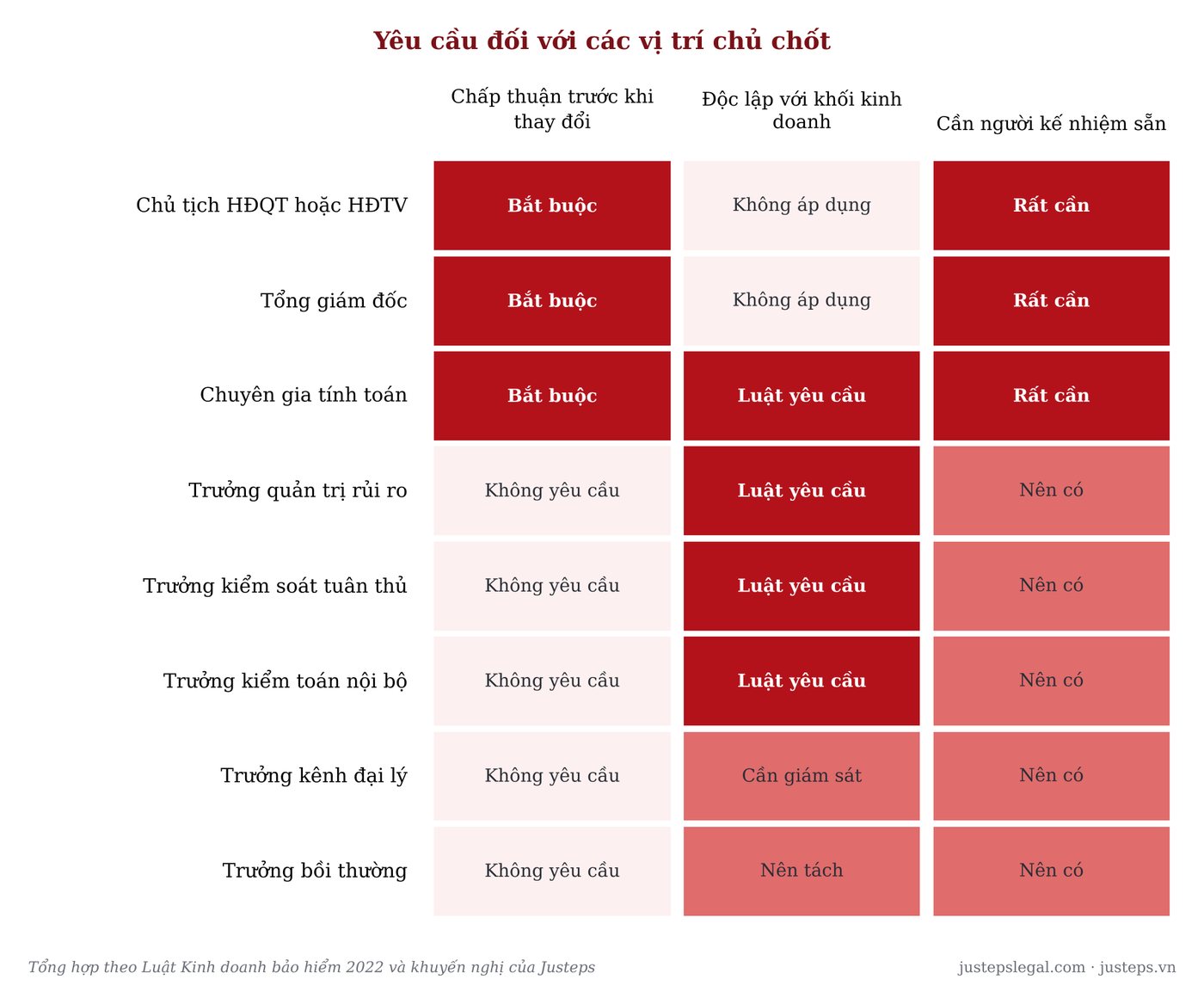
Level of requirements for key positions in an insurance business
The positions requiring prior approval are concentrated at the top executive level and the appointed actuary, so when one of those people leaves, the business must both wait for the procedure and ensure that work is not interrupted. The other three heads of control functions do not require prior approval but demand a high degree of independence, so their successors must be people who do not currently hold a position in the business division. For the head of the agency channel and the head of claims, the legal requirements are lower, but Justeps still considers these two positions to carry significant conflicts of interest and to need their own oversight mechanism.
Organising the agency, bancassurance and online channels
An insurance agent may be an individual or an organisation, and an organisation must be lawfully established, registered to carry on agency activities and have staff directly advising customers who meet the same conditions as individual agents[6]. From 1 January 2026, an agent working for a life, non-life or health insurance business may not at the same time act as an agent for another business of the same type, and agents may only sell products for which they have been trained[7]. The insurance business is responsible for managing its agents and must still perform its obligations to customers under contracts concluded by agents, even where the agent breaches the agency contract[8].
On the basis of these rules, Justeps usually proposes taking the agent life cycle, comprising selection, training, code issuance, monitoring of advice quality, discipline and termination, out of the business division and assigning it to an agency management unit that carries no sales targets. Circular No. 96/2026/TT-BTC introduced the concept of individual agent management, under which the business may perform this work itself or outsource part of it, but must still monitor the quality of advice and handle complaints[9]. For the bancassurance channel, credit institutions may not tie the sale of non-compulsory insurance products to the provision of banking services in any form[10], so the insurance business needs a bank partnership team with authority to check how products are sold at the counter, separate from the team negotiating sales volumes with the bank.
Features by type of business
Life insurers are usually organised around a multi-tier agency channel, a bancassurance team and an operations division covering underwriting, policy issuance, policy servicing and fraud prevention. Non-life insurers are usually divided by line of business and region, with provincial branches, a loss assessment and claims centre and a network of partner garages and medical facilities, while the reinsurance and risk assessment function plays a decisive role for large property and engineering risks. Organisations acting as insurance agents have a much leaner structure, comprising a person in charge of agency activities, certified advisory staff and a team handling files, premium collection and customer care, and the way premiums are collected and remitted is the point that needs the most careful design.
How Justeps carries out the work
An organisational structure design project for an insurance business usually takes around ten weeks, and a shorter four to six weeks for an agency organisation. The starting point is the establishment and operation licence, the charter, the channel strategy and the most recent inspection and audit conclusions, because these documents show what the business lacks compared with the legal requirements. The sequence below shows that the first turning point is comparing the current governance system with the law.
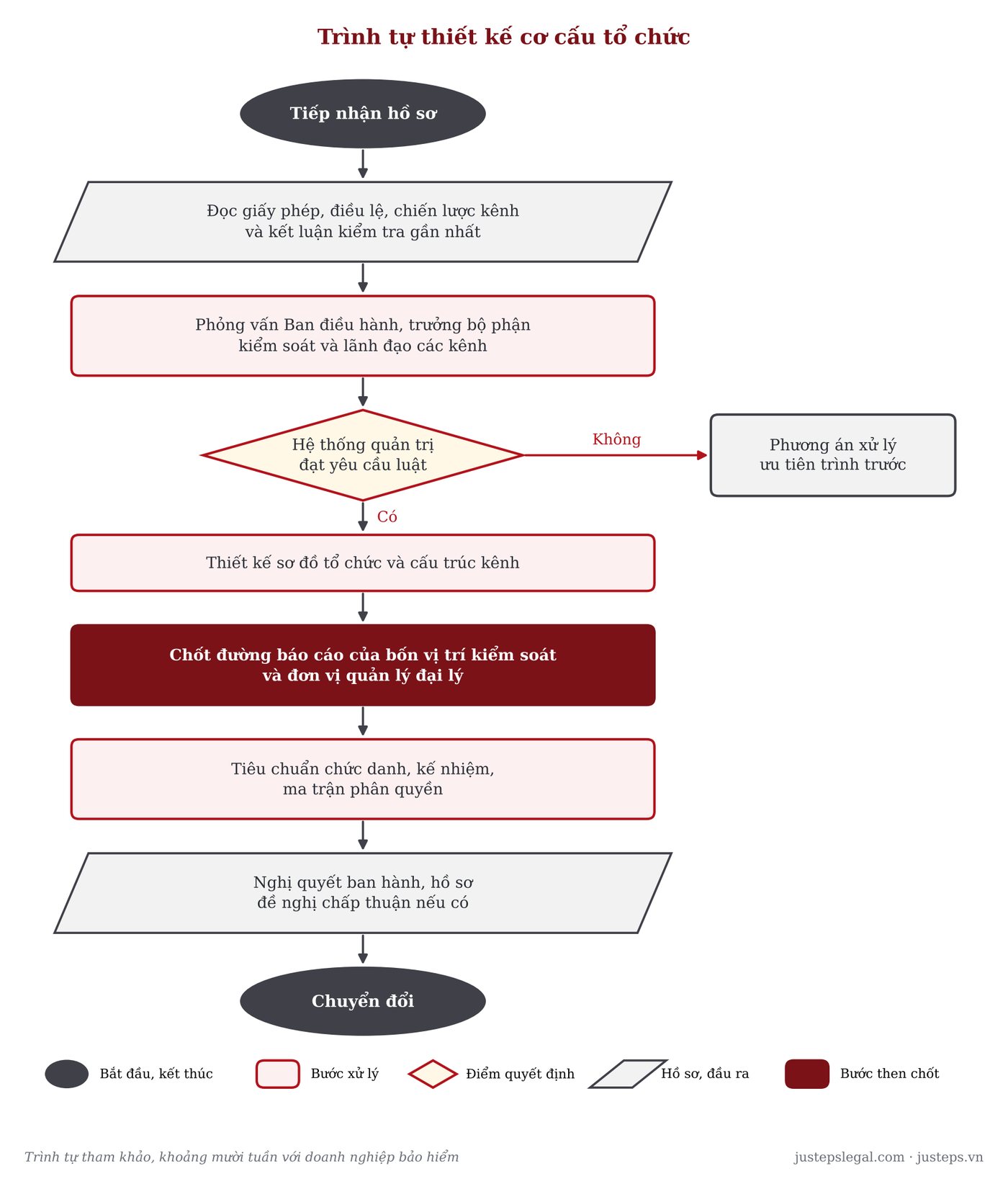
Sequence for designing the organisational structure of an insurance business
In the first two weeks, Justeps consultants interview the executive board, the heads of control functions and the channel leaders, and read the inspection conclusions and a sample of complaint files. If a control position is found to be held concurrently in breach of the rules or to report to the business division, the corrective plan is submitted first so that the Board of Directors or Members’ Council can choose an option. From the fourth week, Justeps builds the organisation chart, the channel structure, the position standards and the delegation of authority matrix; the last two weeks are devoted to the approving documents, the application for approval where a position changes and a transition plan that does not disrupt customer service.
Deliverables, scale of application and fees
The results of the project are delivered as a set of documents that the business can adopt and put into operation immediately. The set usually comprises the following main documents:
- A gap assessment report comparing the current governance system with the legal requirements, with a remediation plan for the Board of Directors.
- An organisation chart and a distribution channel chart explaining the reporting line of each control function.
- Regulations on the functions and duties of divisions, departments, branches and the agency management unit.
- Standards for key positions and a succession plan for positions requiring prior approval.
- A delegation of authority matrix for underwriting, claims, reinsurance and investment by value threshold.
- Draft resolutions or decisions adopting the structure and an application file to the Ministry of Finance where needed.
A newly established business may combine some functions in its early stage, provided this does not breach the limits on concurrent positions and the person in charge of control does not run business operations. Long-established businesses usually need to reorganise their distribution channels and separate claims and pricing from the sales division, while foreign-invested businesses must reconcile the group model with the requirements of Vietnamese law. When designing the agency management tiers, businesses should also consider labour, payroll and insurance services for insurance businesses and insurance agents at the same time, because the way channel tiers are organised determines whether the relationship is one of agency or of employment.
Justeps quotes a fixed fee in writing after the initial discussion. The main factors are the type of insurance, the number of distribution channels, the size of the branch network, any foreign element, the need for bilingual documents and whether the business needs support with approval applications or the transition. Justeps works in person in Hanoi, Hai Phong, Quang Ninh and Ho Chi Minh City and online with businesses in other provinces.
How Justeps can help
Alongside organisational structure design, insurance businesses and insurance agents may combine the following Justeps services:
- Building internal procedures and regulations for insurance businesses and insurance agents. Justeps drafts regulations on risk management and procedures for distribution, advice, claims and agency management so that the new divisions operate consistently.
- Labour, payroll and insurance services for insurance businesses and insurance agents. Justeps distinguishes agents from employees at each channel tier and designs income policies that fit the new structure.
- Succession planning and transfer of management. Justeps prepares succession plans for the General Director, the appointed actuary and the heads of control functions.
- Governance standardisation. Justeps reviews the charter, the regulations of the Board of Directors and its committees and the powers of the General Director in insurance businesses.
Frequently asked questions
Must an insurance business have an appointed actuary?
Yes. The appointed actuary is one of the control positions required by law, and a change of the person holding it must be approved in advance by the Ministry of Finance[4]. The business may engage an external provider to support the calculations, but still needs someone within the organisation capable of reviewing the results.
Can one person be in charge of both risk management and compliance?
The law restricts holding management and control positions concurrently[3], so each pair of positions must first be checked. For small businesses, Justeps only proposes combining roles where the law permits, the person holding both does not run business operations and still reports directly to the Board of Directors.
Which division should claims sit under?
Justeps recommends placing claims outside the business division, because people with sales targets tend to be lenient with large customers and slow with small ones. Claims may be centralised for tight control or delegated by value threshold for faster settlement.
May an agent work for two insurance businesses at the same time?
From 1 January 2026, an agent may not at the same time act as an agent for another business of the same type; for example, an agent of a life insurer may not work for another life insurer[7]. Businesses should build this check into the agent code issuance procedure.
What kind of structure does an organisation acting as an insurance agent need?
A corporate agent needs advisory staff who meet the same conditions as individual agents[6], a person in charge of agency activities and a team that tracks files and collects and remits premiums. Where the corporate agent is a bank, the people selling insurance should be separated from those appraising and disbursing loans.
Can insurance brokers use this service?
Yes, but an insurance broker represents the customer and is subject to separate licensing conditions on capital and personnel, so its organisational structure is designed against a different set of conditions from an agent’s. Justeps checks the licensing conditions before proposing a model.
Related articles
- Organisational structure design for securities, investment fund and consumer finance businesses
- Building internal procedures and regulations for insurance businesses and insurance agents
- Labour, payroll and insurance services for insurance businesses and insurance agents
- Legal compliance for fintech businesses, electronic identification, data protection and cooperation with banks
Notes
[1] Article 79 of the Law on Insurance Business No. 08/2022/QH15 dated 16 June 2022, as amended and supplemented by Law No. 139/2025/QH15 dated 10 December 2025.
[2] Article 80(3) of the Law on Insurance Business No. 08/2022/QH15 dated 16 June 2022, as amended and supplemented by Law No. 139/2025/QH15 dated 10 December 2025.
[3] Article 82 of the Law on Insurance Business No. 08/2022/QH15 dated 16 June 2022, as amended and supplemented by Law No. 139/2025/QH15 dated 10 December 2025.
[4] Article 74(1)(dd) of the Law on Insurance Business No. 08/2022/QH15 dated 16 June 2022, as amended and supplemented by Law No. 139/2025/QH15 dated 10 December 2025.
[5] Law No. 139/2025/QH15 dated 10 December 2025 amending and supplementing a number of articles of the Law on Insurance Business, effective from 1 January 2026.
[6] Article 125(1) and (2) of the Law on Insurance Business No. 08/2022/QH15 dated 16 June 2022, as amended and supplemented by Law No. 139/2025/QH15 dated 10 December 2025.
[7] Article 127(1) and (3) of the Law on Insurance Business No. 08/2022/QH15 dated 16 June 2022, as amended and supplemented by Law No. 139/2025/QH15 dated 10 December 2025; Article 127(1) as amended by Law No. 139/2025/QH15, effective from 1 January 2026.
[8] Article 128(2)(a) and (g) of the Law on Insurance Business No. 08/2022/QH15 dated 16 June 2022, as amended and supplemented by Law No. 139/2025/QH15 dated 10 December 2025.
[9] Circular No. 96/2026/TT-BTC dated 2 July 2026 of the Ministry of Finance amending and supplementing Circular No. 67/2023/TT-BTC dated 2 November 2023 guiding the Law on Insurance Business and Decree No. 46/2023/ND-CP.
[10] Article 15(5) of the Law on Credit Institutions No. 32/2024/QH15 dated 18 January 2024.
This article is for reference and reflects the regulations in force at the time of publication. Please consult Justeps for advice tailored to your company’s records and situation.
For further information, please contact:
📩 Email: info@justeps.vn
🌐 Website: https://justepslegal.com · https://justeps.vn
🌐 Page: Justeps
☎️ Hotline (Zalo): 096 172 2607
📍 Thanh Xuan Office: 12th Floor, Licogi 13 Tower, 164 Khuat Duy Tien Street, Thanh Xuan Ward, Hanoi, Vietnam
📍 Ha Dong Office: LK06B, No.10, Dong Dua Area, Ha Dong Ward, Hanoi, Vietnam
📍 Ho Chi Minh City Branch: 528 Le Van Sy, Ho Chi Minh City, Vietnam
📍 Hai Phong Office: Truong Thinh Village, Ha Dong Commune, Hai Phong, Vietnam
📍 Quang Ninh Office: Van Don Special Zone, Quang Ninh Province, Vietnam





