
Key takeaways
- A retail chain needs to choose the registered form of each store before drawing the organisational chart, because a business location, a branch or a foreign-invested retail outlet each entail a different contract signatory, place of tax declaration and licensing procedure[1][4].
- Purchasing, store operations and loss prevention should be kept separate, because the person who selects suppliers, the person who sells and the person who checks shrinkage have different interests.
- A store open 24 hours needs a tier of shift leaders with written authority to decide on the spot about cash, goods receipt, refusing restricted sales and security incidents when the store manager is absent.
- Company-owned stores and franchised stores need two separate management lines, because the staff of a franchised store do not belong to the franchisor[9].
A chain of convenience stores or mini-supermarkets usually starts with a few stores where the owner personally places orders, checks the till and calls suppliers. That approach still works with three or four stores, but when the chain reaches ten, twenty and then fifty stores, every decision still converges on one person while thousands of product lines, dozens of suppliers and many work shifts run simultaneously across several areas. Obligations attached to each store, such as notifying the business location, conditions for selling alcohol, fire prevention records or the food safety certificate for a fast-food counter, are easily overlooked because nobody has been assigned to monitor them.
This page introduces Justeps’ service of designing the organisational structure of convenience store chains, mini-supermarkets, specialist store chains such as cosmetics, mother and baby or mobile phones, and retail systems with franchised stores. It focuses on choosing the legal form of each store, dividing the head office into functional divisions, establishing the regional management and shift leader tiers, allocating authority and setting headcount by time slot. How staff carry out each task, such as receiving goods, closing a shift or writing off goods, is set out under the internal procedures and regulations service for retail chain and convenience store businesses.
The five functional divisions of a retail chain
Whatever its size, the work of a retail chain revolves around five groups of tasks: deciding what to sell and at what price, getting goods to the stores on time, selling and serving customers, opening new stores, and managing money, people and data. In a small chain one person may handle several groups, but the organisational chart still needs to state who holds which role so that the business can see where conflicts of interest lie. The table below shows how Justeps describes the five divisions at the start of a project.
| Division | Main tasks | What must be kept separate |
|---|---|---|
| Purchasing and category | Selecting product lines and negotiating purchase prices, discounts and display fees with suppliers. | It should not both decide store order quantities and approve payments to suppliers. |
| Supply chain | Managing the central warehouse, transport, delivery schedules and returns to suppliers. | The warehouse’s delivery figures need to be checked independently by the stores. |
| Store operations | Regional managers, store managers and shift leaders are responsible for sales, service and compliance at the store. | They do not decide promotions, selling prices or write-offs beyond the limits assigned. |
| Network development | Finding premises, negotiating leases, registering stores, obtaining licences and preparing openings. | No store opens until its list of licences has been confirmed as complete. |
| Support | Finance, accounting, human resources, technology, legal and loss prevention. | The loss prevention unit reports outside the operations division. |
The most common conflict arises where purchasing also runs operations, so that the person negotiating with suppliers also decides how much each store orders and where goods are displayed. Display support, volume discounts and supplier gifts can then easily influence ordering decisions, while the stores bear the overstock and expired goods. Justeps proposes separating these two divisions and placing the authority to approve supplier contracts at a level above both, within the limits set in the financial regulations and delegation of authority.
The legal form of a store determines a great deal
Under the Law on Enterprises, a branch is a dependent unit that may perform all or part of the functions of the enterprise, whereas a business location is a place where the enterprise conducts a specific business activity[1]. The enterprise must notify the business registration authority of a business location within 10 days from the date of the decision to establish it[2][3]. Most convenience stores are registered as business locations because the procedure is simple and management remains centralised in the company. A branch is more suitable when the chain enters a new province and needs a unit whose head is authorised to sign leases and employment contracts and to deal with the local authorities.
Foreign-invested enterprises are subject to an additional layer of procedures. In addition to the business licence for retail activities, each retail outlet requires a licence to establish a retail outlet, and from the second outlet onwards an economic needs test may be required depending on the investor’s country, the floor area and the location of the store[4]. Decree No. 342/2026/ND-CP has replaced Decree No. 09/2018/ND-CP on this matter, so foreign-invested chains should review their existing licences and store opening plans against the new rules. The organisational chart of such an enterprise must clearly show who is responsible for the licensing file of each outlet and who monitors the validity of each licence.
Apart from registration, each store has its own list of conditions depending on the product lines it sells. A store selling alcohol must satisfy the conditions for alcohol trading[5], a store with a counter preparing fast food, coffee or bread is subject to the food safety requirements for food service establishments[6], and every store must ensure the fire prevention and fire fighting conditions of the building[7]. The tobacco retail licence was abolished in the 2026 round of administrative simplification, but prohibitions such as selling to persons under 18 remain unchanged[8]. Justeps prepares the list of conditions for each store and assigns a person to keep the records at the store and a person to monitor them at head office. Registration filings can then be handled through the service for opening branches, representative offices and business locations.
Owned stores and franchised stores are two management lines
When a chain begins franchising, many businesses continue to manage franchised stores as if they were their own, setting targets, assigning staff and handling discipline directly. This practice can easily lead to the business being regarded as the de facto employer of the franchised store’s staff and having to bear liability in place of the franchisee. Under commercial law, the relationship between the two parties is a franchise relationship in which the franchisor controls compliance with the business system through the contract, while the franchisee organises its own business and manages its own employees[9].
Justeps therefore designs a separate franchise development unit, consisting of a person who selects franchisees, a trainer and a standards inspector, reporting to the chief executive rather than sitting within the owned-store operations division. This unit works with the owners of franchised stores on the basis of standards and inspection reports and does not give instructions directly to their staff. A chain preparing to move to franchising can combine this with the retail chain and franchise set-up service to build the full set of documents for franchisees.
Shift leaders for stores open 24 hours
A convenience store that stays open overnight has many hours without a store manager, yet situations requiring an immediate decision still arise, for example a delivery lorry arriving at 2 a.m. with quantities that differ from the order, a drunk customer demanding alcohol, a till exceeding its cash limit or someone causing a disturbance. If the organisational chart shows only a store manager and sales staff, night-shift staff either have to phone for instructions or decide on instinct. Justeps proposes a shift leader tier with authority set out in writing, including the authority to sign for or refuse a delivery, to drop surplus cash into the safe, to refuse to sell alcohol and tobacco and to call security or the police.
The shift leader’s job description also states clearly what the shift leader may not do, such as changing selling prices, writing off goods outside the approved list or allowing staff to leave mid-shift without a replacement. Each night shift needs at least two people in the store for safety reasons, and this requirement feeds directly into the staffing table. Night-shift pay, breaks during the shift and safety for night workers are dealt with under the labour, wages and social insurance service for retail chain and convenience store businesses.
Allocating authority between head office, regional managers and stores
For a retail chain, the hardest question in allocating authority is how far a store may decide for itself. If head office keeps everything, stores cannot react in time when goods are about to expire or when a competitor next door cuts prices; if everything is delegated, prices and promotions differ from store to store and head office loses control of shrinkage. The example below is the matrix Justeps built for a chain of about sixty convenience stores with a central warehouse.
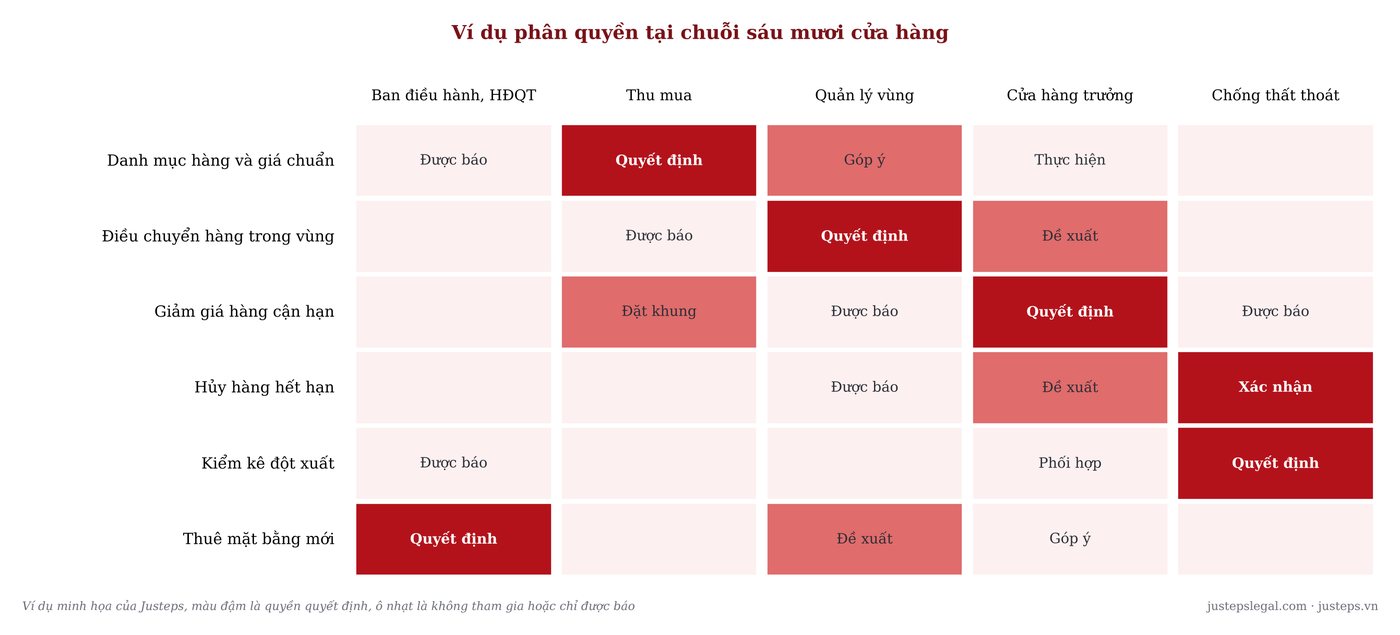
Example allocation of authority between head office, regional managers, store managers and the loss prevention unit
In the example, the purchasing division decides the product range and standard selling prices, the regional manager decides transfers of goods between stores in the region, and the store manager may discount near-expiry goods within an approved range. Write-offs of expired goods are proposed by the store manager but confirmed by the loss prevention unit, which also has the authority to order a surprise stocktake at a store without notifying the operations division in advance. Leasing new premises is a long-term financial commitment and therefore falls within the authority of the Members’ Council, the Board of Directors or the owner depending on the type of enterprise, which is also the body that issues the organisational structure under the Charter[10].
Regional span of control and staffing by time slot
The number of stores a regional manager can oversee depends on the distance between stores, the degree of standardisation and the quality of reporting from the sales software. In the chains Justeps has worked with, a regional manager can usually oversee eight to twelve stores in the same area well, enough for each store to be visited at least once a week. Beyond that level, inspections become a formality and discrepancies in cash and goods are only discovered at the period-end stocktake.
Store staffing should be calculated by time slot and sales rather than by floor area. The chart below compares the number of permanent staff needed in three typical store models, before adding part-time workers for peak hours and weekends.
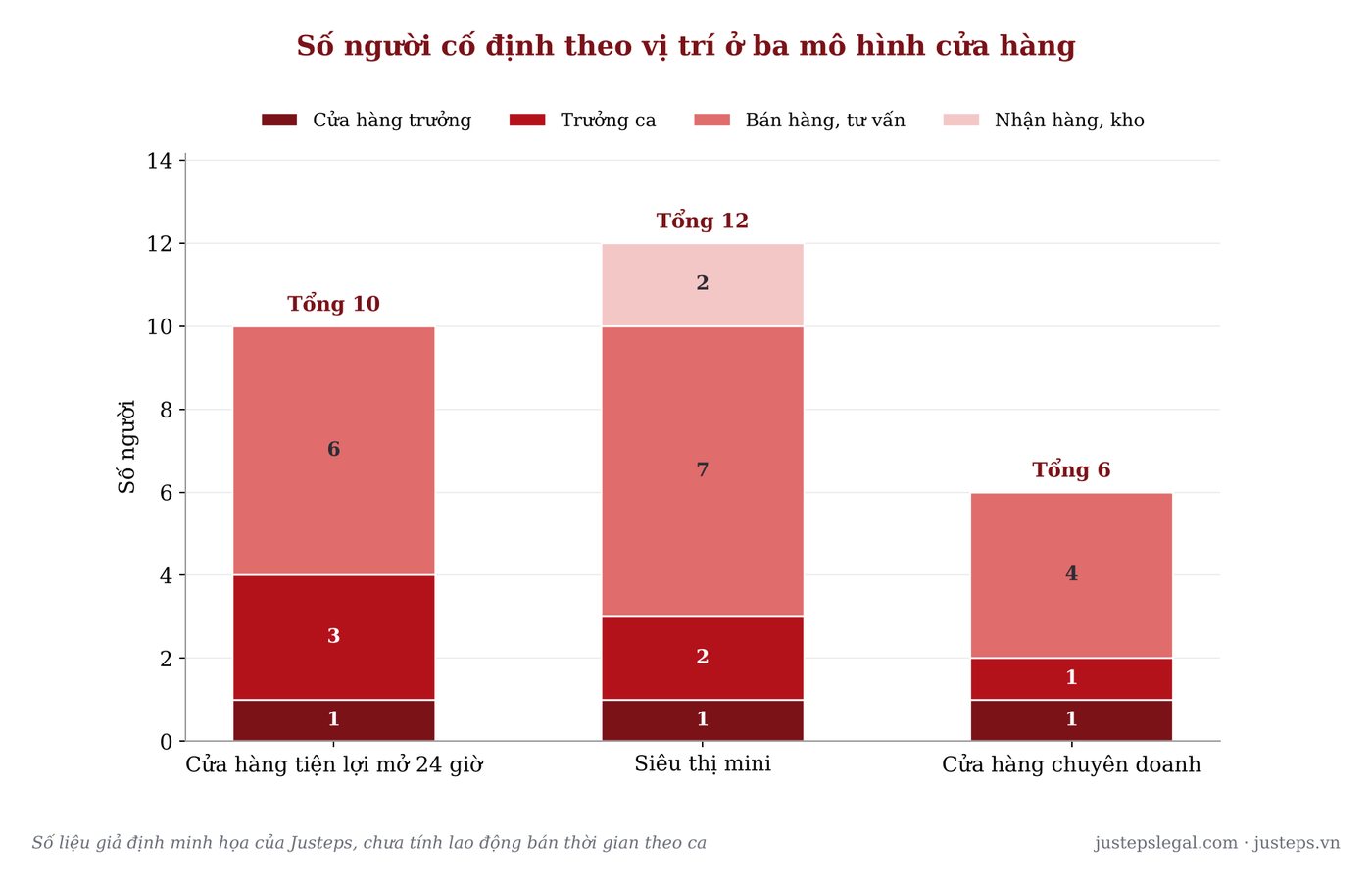
Example number of permanent staff by position in three retail store models
In the example, a 24-hour convenience store needs 10 people, consisting of 1 store manager, 3 shift leaders and 6 sales staff, because it must cover three shifts a day with at least two people per shift. A mini-supermarket open from morning to evening needs 12 people, including 1 store manager, 2 shift leaders, 7 sales staff and 2 goods receiving and warehouse staff, because it receives larger volumes of goods. A specialist cosmetics or mother and baby store needs only 6 people, consisting of 1 store manager, 1 shift leader and 4 sales advisers. The staffing table Justeps delivers sets out separately the number of permanent staff, the part-time hours by shift and the projected wage bill for each model.
Implementation process, deliverables and fees
For a chain of ten to one hundred stores, a project usually takes about eight weeks. Justeps works at head office, the warehouse and several stores representative of each model, attending a night shift and a goods receipt session to see the work as it actually happens.
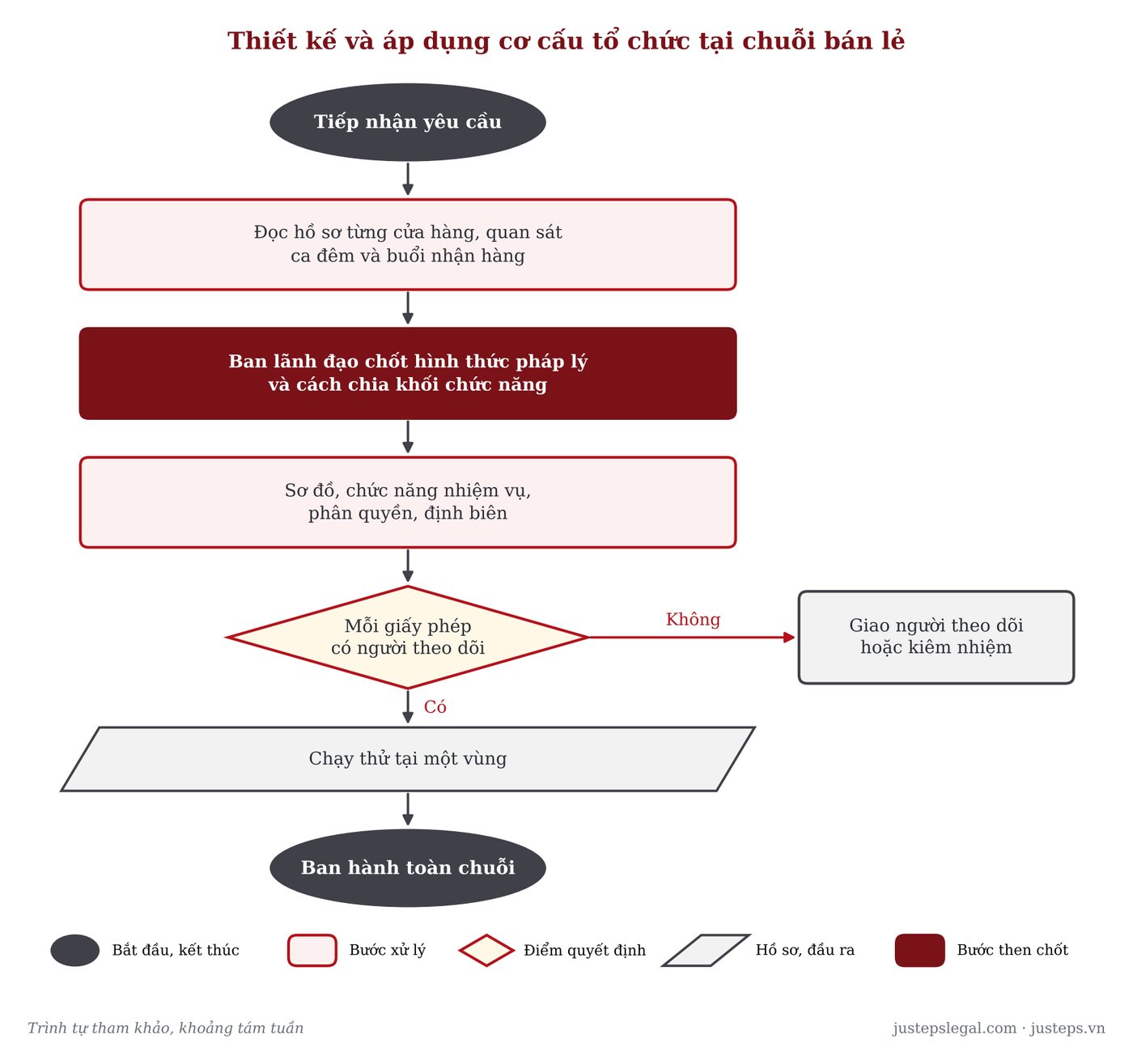
Sequence for designing and applying the organisational structure in a retail chain
In the first two weeks Justeps reads the registration documents, licences and leases of each store and interviews the executive team, regional managers and store managers. In the third week the leadership confirms the legal form for existing and planned stores, and whether functional divisions are to be separated or combined. From the fourth to the sixth week Justeps drafts the chart, the functions and duties, the authority matrix and the staffing table, then pilots them in one region during the final two weeks and makes adjustments before issuing them across the chain. The deliverables comprise the following documents:
- A report assessing the legal form of each store, with recommendations for planned stores.
- A three-level organisational chart covering head office, regions and stores, with a separate line for franchised stores where applicable.
- Regulations on the functions and duties of the divisions and job descriptions for regional managers, store managers and shift leaders.
- An authority matrix covering goods, prices, promotions, write-offs, personnel and premises.
- A staffing table by store model and time slot.
- A list of licences and conditions for each store, with the person responsible for monitoring their validity.
- Draft decisions issuing the organisational structure and letters of authorisation for regional managers and heads of branches.
Justeps quotes a fixed project fee in writing after the initial discussion. The fee depends on the number of stores and store models, whether there is a central warehouse, franchised stores or foreign investment, the need for bilingual documents and whether the business needs Justeps to stay closely involved during the pilot. Once the organisation has been issued, legal questions arising each month can be handled under the ongoing legal advisory service for retail chain and convenience store businesses.
How Justeps can help
Alongside organisational structure design, retail chain and convenience store businesses can combine the following Justeps services:
- Internal procedures and regulations for retail chain and convenience store businesses. Justeps writes procedures for goods receipt, shift closing, write-offs and restricted sales for the positions just designed.
- Labour, wages and social insurance services for retail chain and convenience store businesses. Justeps turns the staffing table into contracts, shift rosters, night-shift pay calculations and social insurance files.
- Opening branches, representative offices and business locations. Justeps carries out the registration procedures for each store according to the chosen legal form.
- Financial regulations and delegation of authority. Justeps sets limits on spending, supplier contracts, discounts and write-offs for each management level.
- Retail chain and franchise set-up. Justeps builds the franchise development unit and the document system for franchisees.
Frequently asked questions
Does a chain of five stores need a regional management tier?
Usually not yet. At this size the owner or one operations manager can oversee the stores directly, but the person who orders, the person who receives goods and the person who checks the till should still be separate. A regional management tier should be set up once the chain exceeds about ten stores or expands into another province.
Should a convenience store be registered as a business location or a branch?
A business location suits most stores because the procedure is simple and management stays centralised[1]. A branch suits a chain that needs a unit whose head is authorised to sign contracts and deal with the authorities in a new province. Justeps compares the two options against each chain’s expansion plan.
What should a foreign-invested enterprise note when opening more stores?
Each retail outlet requires a licence to establish a retail outlet, and from the second outlet an economic needs test may be required depending on the case[4]. The organisational chart should include a person responsible for licensing files so that opening schedules are not delayed.
To whom should the loss prevention unit report?
It should report to the chief financial officer or directly to the general director, not to the director of store operations. Results of surprise stocktakes and findings on shrinkage are then not influenced by sales pressure.
May a franchisor give instructions to the staff of a franchised store?
It should not. The staff of a franchised store belong to the franchisee, while the franchisor controls compliance with the system through the franchise agreement[9]. The franchise development unit works with the owners of franchised stores and does not give instructions directly to their staff.
How often should the organisational structure be reviewed?
Once a year, and immediately when the chain opens a central warehouse, adds a new store model, enters a new province, starts franchising or brings in an investor. Each of these changes usually requires reassigning who monitors licences and amending the authority matrix.
Related articles
- Internal procedures and regulations for retail chain and convenience store businesses following the life cycle of goods and cash
- Ongoing legal advisory for retail chain and convenience store businesses on premises, suppliers and inspections
- Labour, wages and social insurance services for retail chain and convenience store businesses with night shifts and cashiers
- Building the organisational structure of a trading and distribution company around goods flow, cash flow and scale
Notes
[1] Article 44 of the Law on Enterprises No. 59/2020/QH14 dated 17 June 2020, as amended and supplemented by Law No. 76/2025/QH15.
[2] Article 45 of the Law on Enterprises No. 59/2020/QH14 dated 17 June 2020, as amended and supplemented by Law No. 76/2025/QH15.
[3] Government Decree No. 168/2025/ND-CP dated 30 June 2025 on enterprise registration, as amended and supplemented by Decree No. 296/2026/ND-CP dated 23 July 2026.
[4] Government Decree No. 342/2026/ND-CP detailing the Commercial Law and the Law on Foreign Trade Management regarding the purchase and sale of goods and activities directly related to the purchase and sale of goods by foreign investors and foreign-invested economic organisations, replacing Decree No. 09/2018/ND-CP.
[5] The Law on Prevention and Control of Harmful Effects of Alcoholic Beverages No. 44/2019/QH14 and Government Decree No. 105/2017/ND-CP on alcohol trading, together with the documents amending and supplementing them.
[6] The Law on Food Safety No. 55/2010/QH12 dated 17 June 2010.
[7] The Law on Fire Prevention, Fire Fighting, Rescue and Salvage and the documents amending and supplementing it.
[8] The Law on Prevention and Control of Harmful Effects of Tobacco No. 09/2012/QH13 and the 2026 documents of the Government and the Ministry of Industry and Trade abolishing the licences for trading in tobacco.
[9] The Commercial Law and the documents amending and supplementing it, and Government Decree No. 35/2006/ND-CP detailing the Commercial Law on franchising activities, together with the documents amending and supplementing it.
[10] The Law on Enterprises No. 59/2020/QH14 dated 17 June 2020, as amended and supplemented by Law No. 76/2025/QH15.
This article is for reference and reflects the regulations in force at the time of publication. Please consult Justeps for advice tailored to your company’s records and situation.
For further information, please contact:
📩 Email: info@justeps.vn
🌐 Website: https://justepslegal.com · https://justeps.vn
🌐 Page: Justeps
☎️ Hotline (Zalo): 096 172 2607
📍 Thanh Xuan Office: 12th Floor, Licogi 13 Tower, 164 Khuat Duy Tien Street, Thanh Xuan Ward, Hanoi, Vietnam
📍 Ha Dong Office: LK06B, No.10, Dong Dua Area, Ha Dong Ward, Hanoi, Vietnam
📍 Ho Chi Minh City Branch: 528 Le Van Sy, Ho Chi Minh City, Vietnam
📍 Hai Phong Office: Truong Thinh Village, Ha Dong Commune, Hai Phong, Vietnam
📍 Quang Ninh Office: Van Don Special Zone, Quang Ninh Province, Vietnam





