
Key takeaways
- A start-up’s organisational structure must be designed around its fundraising roadmap, because each investment round usually brings changes to the type of company, the composition of the Board of Directors and the investors’ veto rights.
- A limited liability company cannot issue shares, so a start-up planning to take institutional capital or allocate shares to its staff usually has to convert into a joint stock company before its first funding round[2].
- The rights that investors require in a term sheet bind the company and its managers only once they have been incorporated into the charter and internal documents in a manner consistent with the Law on Enterprises.
- Justeps delivers a three-stage organisation chart, an authority matrix allocating powers between the General Meeting of Shareholders, the Board of Directors, the General Director and the founders, and a draft charter aligned with that roadmap.
Most start-ups in Vietnam begin with a team of two to four people building a product together, dividing the work according to their abilities and trusting one another. At this stage, the founding team rarely records who decides what, who holds how much of the capital and why, or what happens when one of them leaves. When an investment fund begins its due diligence, those questions are raised at the same time as requests for a seat on the Board of Directors, veto rights and an employee share pool, and the founding team has to rework the structure within a very short time, usually from a weak negotiating position.
This page introduces Justeps’ organisational structure design service for start-ups and innovative start-up enterprises, from incorporation until after the second funding round. Under the Law on Science, Technology and Innovation of 2025, an innovative start-up enterprise is an enterprise that implements an innovative business model, is capable of rapid growth and market expansion, and is based on the exploitation of technology, intellectual property rights, breakthrough ideas or new business models[1]. The content below focuses on the ownership and governance layers; operating regulations, contracts and human resources are covered on the other service pages in the same group.
A start-up’s structure changes with each funding round
Unlike a traditional business, a start-up’s organisational structure does not stand still after registration. Each funding round brings in new owners, reduces the founding team’s percentage and is usually accompanied by demands to change the way decisions are made. Justeps therefore designs the structure in three successive stages, as shown in the figure below, so that the charter written at the first stage already leaves room for later changes.
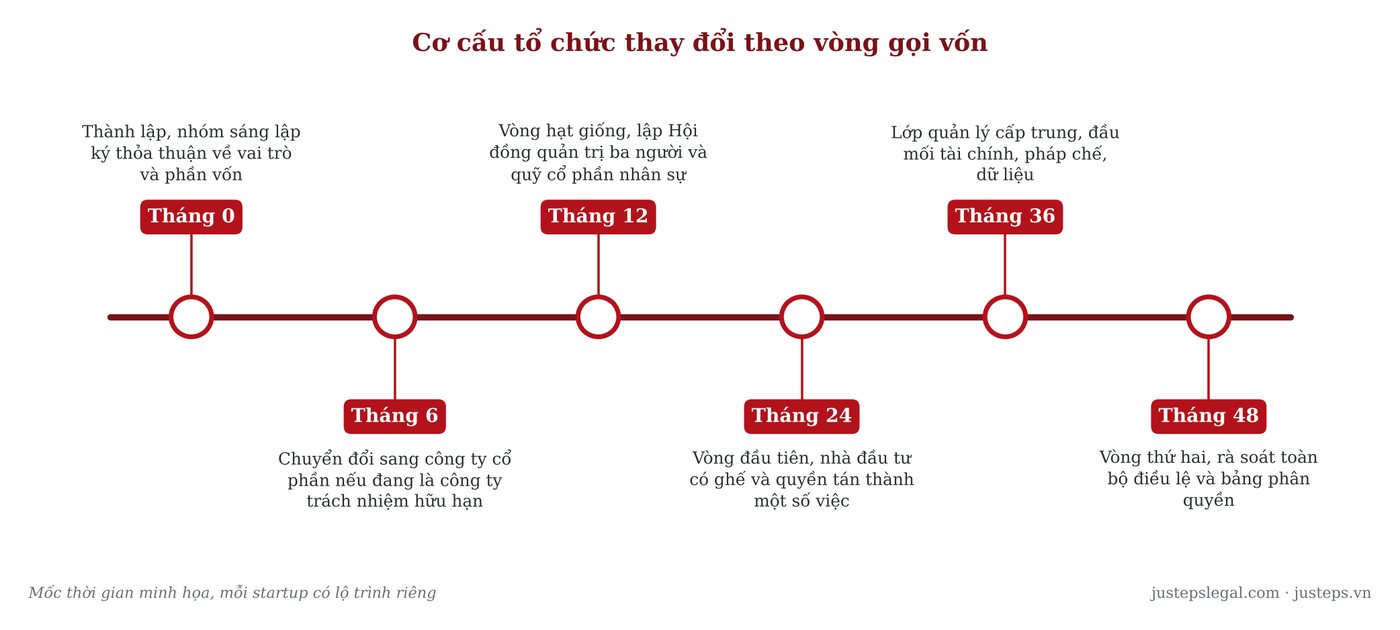
Typical milestones at which a start-up’s organisational structure changes, from incorporation to the second funding round
At the idea and prototype stage, the organisation needs only a founding team with clear roles and an agreement among the founders. By the seed round, the company is usually already a joint stock company with a small Board of Directors and a portion of shares reserved for key staff. From the first institutional round onwards, the lead investor usually holds a seat on the Board of Directors, and the company needs a layer of middle management and certain control functions such as finance, legal and data.
Provisions of the Law on Enterprises that shape a start-up’s structure
Type of company and timing of conversion
Many start-ups register as limited liability companies because the procedure is simple, and then discover that this type of company cannot issue shares and is capped at fifty members. When an investor wishes to buy preference shares or the company wishes to reserve shares for its employees, the company must convert into a joint stock company by one of the statutory methods, such as conversion without raising additional capital, conversion by admitting additional contributors or conversion by selling capital contributions to other persons[2]. Justeps recommends completing the conversion before negotiating the term sheet, because carrying it out alongside the transaction tends to delay disbursement and raises questions about how the existing capital is valued.
Special rules for founding shareholders
The Law on Enterprises lays down certain rules specific to founding shareholders that the founding team should understand before dividing the shares. Ordinary shares held by founding shareholders are restricted from transfer to persons who are not founding shareholders during the first three years, unless approved by the General Meeting of Shareholders[3]. Founding shareholders may hold voting preference shares, but this preference is effective only for three years from the date on which the company is granted its enterprise registration certificate[4]. Consequently, any mechanism for the founders to retain long-term control should rest on the charter and a shareholders’ agreement rather than on voting preference shares alone.
Management model and voting thresholds
A joint stock company may choose one of two management models, namely a model with a Supervisory Board and a model with a Board of Directors and an audit committee, and a Supervisory Board is mandatory only where the company has eleven or more shareholders or where institutional shareholders own fifty per cent or more of the shares[5]. For resolutions of the General Meeting of Shareholders, the Law on Enterprises allows the charter to set specific voting thresholds for particular categories of matters[6]. This is the legal basis for writing investors’ consent rights into the charter, for example a requirement that preference shareholders vote in favour of any issuance of new shares or any sale of core intellectual property.
Common mistakes when founding teams design the structure themselves
The first mistake is to split the shares equally among the founders without linking them to each person’s time commitment and contribution. When one person leaves the team after a few months, that person keeps the same percentage, while those who remain carry the workload and suffer dilution in later rounds. Investors usually require this to be resolved before disbursement, through a mechanism under which shares vest over the period of service and the company has a right to buy back shares when a founder leaves early.
The second mistake is to concentrate every power in the lead founder, who is at once Chairperson of the Board of Directors, General Director, legal representative and the only authorised signatory on the bank account. This model allows quick decisions but paralyses the company when that person falls ill, travels for a long period or falls out with other shareholders. The Law on Enterprises allows a company to have several legal representatives and requires the charter to specify the number, titles, rights and obligations of each of them[7], so dividing these powers is entirely feasible.
The third mistake is to have no one at all responsible for data and compliance, even though the product collects data from tens of thousands of users. The Law on Personal Data Protection allows small enterprises and start-ups to choose not yet to designate a personal data protection unit or officer for five years from the date on which the Law takes effect, but this option is not available where the enterprise provides data processing services, directly processes sensitive personal data or processes the data of a large number of data subjects[8].
How Justeps designs the organisational structure for a start-up
The service is divided into workstreams that answer the four questions investors usually ask during due diligence, namely who owns the company, who decides what, who is responsible for each function and where there is room for newcomers.
- Justeps assesses the current type of company and, where necessary, prepares a plan and roadmap for conversion into a joint stock company, together with a plan for dealing with the capital held by existing members.
- Justeps defines the role of each founder and proposes a mechanism under which shares vest over the period of service, with a buy-back right when a founder leaves the company.
- Justeps prepares an authority matrix allocating powers between the General Meeting of Shareholders, the Board of Directors, the General Director and the founders, and checks it against the rights that investors have requested or are likely to request.
- Justeps determines the size of the employee share pool, the body authorised to issue shares from it and how the pool is reflected in the charter and the capitalisation table.
- Justeps assigns persons responsible for finance, personal data, intellectual property and licences in the organisation chart, even where that person holds the role on a concurrent basis.
The size of the employee share pool should be decided together with the fundraising roadmap, because the pool and the shares sold to investors both reduce the founding team’s percentage. The figure below illustrates the ownership structure of a start-up after two funding rounds where the employee pool was created at the seed round.
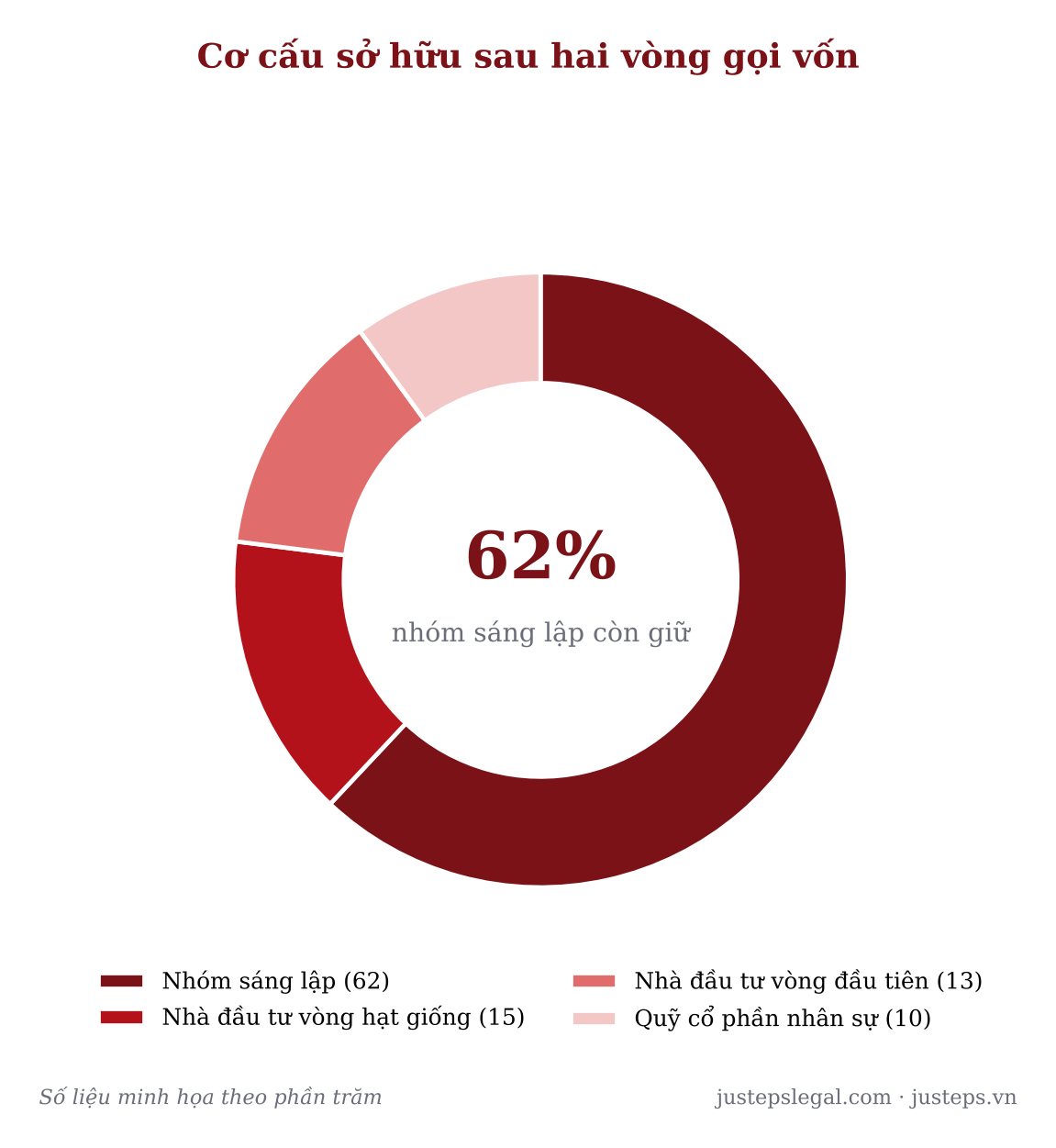
Example ownership structure of a start-up after the seed round and the first institutional round
In this example, the founding team retains about sixty-two per cent, enough to pass most ordinary resolutions but possibly not enough for matters on which the charter requires a higher threshold. For this reason, when sizing the employee pool, Justeps always prepares a table simulating the ownership percentages after each round, so that the founding team can see in advance which voting thresholds it will still control. The pool is approved once at the level of the General Meeting of Shareholders, while issuance to each individual is decided by the Board of Directors by way of a private placement of shares[9].
The authority matrix is usually where founders and investors negotiate the most. The table below is an example of how powers may be allocated in a joint stock company after the seed round, with a three-member Board of Directors on which one member is nominated by the investor.
| Type of decision | Decision-making body | Design notes |
|---|---|---|
| Capital increase and issuance of new shares | General Meeting of Shareholders, which may delegate to the Board of Directors within a limit | Investors usually require a separate consent right, which needs to be written into the charter. |
| Issuance from the employee share pool | Board of Directors within the approved pool | The General Meeting of Shareholders approves the pool size once to avoid repeated meetings. |
| Appointment of the General Director | Board of Directors | A favourable vote of the investor-nominated member may be required. |
| Annual budget and hiring plan | Board of Directors | The General Director prepares and submits them and reports on implementation quarterly. |
| Customer contracts within the limit | General Director or an authorised person | The limit should be based on both contract value and the level of indemnity liability. |
| Transfer or licensing of core intellectual property | Board of Directors or General Meeting of Shareholders | This should not fall within the authority of a single individual. |
The table reflects a general principle under which decisions affecting the ownership structure go up to shareholder level, decisions on strategy and senior personnel belong to the Board of Directors, and day-to-day business falls to the General Director within set limits. Once authority has been settled, contracts and transactions between the company and major shareholders, members of the Board of Directors or their related persons must still be approved under the separate procedure in the Law on Enterprises[10], and Justeps writes that procedure clearly into the charter.
How the service is delivered
An organisational structure design project for a start-up usually takes four to eight weeks, depending on whether a conversion of company type is needed and whether negotiations with an investor are under way. The flowchart below shows the sequence of work, in which the most important decision point is whether the current type of company meets the fundraising plan.
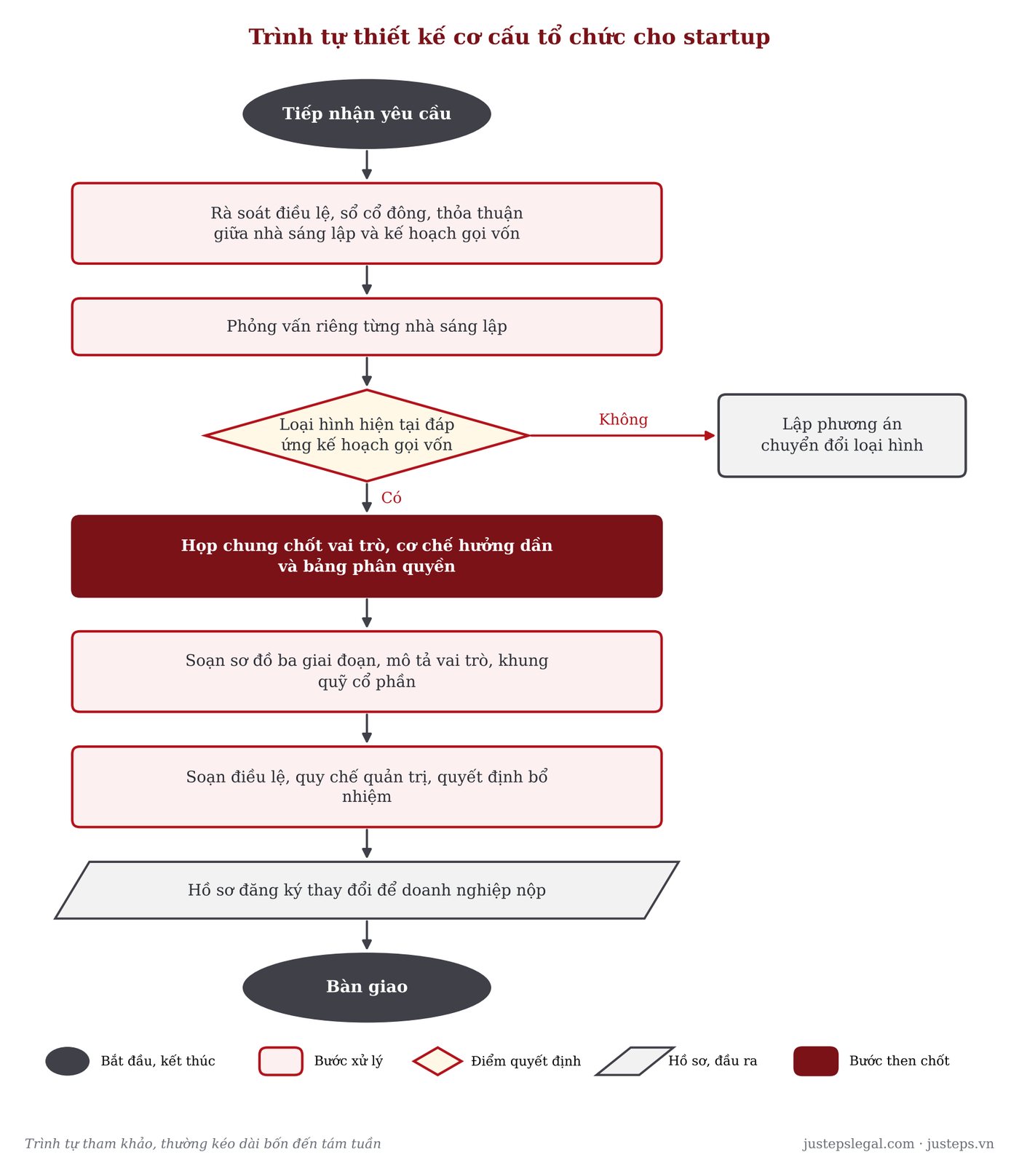
Sequence of an organisational structure design project for a start-up
In the first week, Justeps’ consultants read the charter, the register of members or shareholders and any founders’ agreement, and interview each founder separately to understand their expectations about roles and control. If the company is a limited liability company and the fundraising plan requires shares, Justeps prepares a conversion plan before designing the structure. The pivotal step is a joint working session with the whole founding team to settle roles, the vesting mechanism and the authority matrix, because these are the matters most likely to cause disagreement. Justeps then drafts the charter, the internal governance regulations, the appointment decisions and the registration file for the changes, which the enterprise submits itself.
Deliverables and application by stage
On completion of the project, the enterprise receives editable electronic versions and signed versions of the documents requiring adoption, including a three-stage organisation chart, descriptions of the founders’ roles and key positions, the authority matrix, the draft amended charter, internal governance regulations, the framework for the employee share pool and, where applicable, the registration file for the changes. The detailed rules of the share pool, including eligibility, the vesting schedule and the form of grant letter, are prepared under the service for building internal procedures and regulations for start-ups so that they are consistent with employment contracts and the intellectual property regulations.
A start-up that has not yet raised capital usually needs only a founders’ agreement, a charter with vesting provisions and a concise authority matrix, and does not yet need a Supervisory Board. A start-up that has taken investment needs a Board of Directors that meets in substance on a regular schedule, with minutes and meeting papers properly kept, because investors will check them again in the next round. A start-up with a parent company abroad, for example in Singapore, needs a two-tier design so that decisions of the parent company are implemented through the proper procedures at the Vietnamese subsidiary, while complying with investment procedures under the Law on Investment No. 143/2025/QH15[11]. Where the company is preparing a transaction, the structure design work is coordinated with the fundraising and share issuance service so that the charter and the transaction documents are consistent.
What determines the service fee
Justeps quotes a fixed fee in writing after the first discussion with the founding team. The main factors are the number of founders and existing shareholders, whether a conversion of company type is required, the complexity of the investor rights already agreed, any foreign element in the ownership structure and the deadline by which the enterprise needs the work completed.
How Justeps can help
In addition to organisational structure design, start-ups and innovative start-up enterprises may combine the following Justeps services:
- Building internal procedures and regulations for start-ups and innovative start-up enterprises. Justeps drafts regulations on the employee share pool, intellectual property, personal data and spending so that the new organisation operates consistently.
- Ongoing legal advisory for start-ups and innovative start-up enterprises. Justeps keeps track of meeting records, resolutions and registration changes after each funding round so that the structure always matches reality.
- Fundraising and private placement of shares. Justeps prepares the issuance file, the investment agreement and the procedures for investors to become shareholders in compliance with the law.
- Corporate governance. Justeps organises meetings of the Board of Directors and the General Meeting of Shareholders and keeps governance records to the standard that investors check.
Frequently asked questions
Should a start-up incorporate as a joint stock company from the outset?
If the founding team already plans to raise capital from funds or to allocate shares to staff within the next one to two years, incorporating as a joint stock company from the outset avoids a conversion. If there is only one founder and the fundraising direction is still unclear, a limited liability company remains suitable and can be converted later[2].
Should the shares be split equally among the founders?
An equal split is not wrong, but it should be combined with a mechanism under which shares vest over the period of service and can be bought back when a founder leaves. Without such a mechanism, a person who leaves the team early keeps the same percentage, and investors usually require the matter to be resolved before disbursement.
Can an investor hold a seat on the Board of Directors?
A shareholder or group of shareholders meeting the relevant conditions has the right to nominate members of the Board of Directors under the Law on Enterprises and the charter. In practice, the lead investor usually negotiates a permanent seat and a right of approval over certain important decisions, and these rights need to be written into the charter.
Do voting preference shares help founders retain long-term control?
No, because the voting preference of founding shareholders is effective only for three years from the date on which the company is granted its enterprise registration certificate[4]. Long-term control should be designed through the charter, voting thresholds and a shareholders’ agreement.
Must a small start-up designate a person responsible for personal data protection?
Small enterprises and start-ups may choose not yet to make such a designation for five years from the date on which the Law on Personal Data Protection takes effect, unless they provide data processing services, process sensitive data or process the data of a large number of data subjects[8]. A start-up falling within these exceptions should put this position into its organisation chart straight away.
When should the organisational structure be reviewed?
Justeps recommends a review before and after each funding round, when a founder leaves the company or when headcount doubles.
Related articles
- Setting up a technology start-up, capital structure, ESOP and ownership of source code
- The procedure for a private placement of shares and registration of a charter capital increase by a non-public joint stock company
- Choosing between a household business, a limited liability company and a joint stock company, comparing operations, tax and fundraising
- Setting up a foreign-invested company, the IRC and ERC route, the capital account and post-licensing reporting
Notes
[1] Clause 18 of Article 3 of the Law on Science, Technology and Innovation No. 93/2025/QH15 dated 27 June 2025, effective from 1 October 2025.
[2] Article 202 of the Law on Enterprises No. 59/2020/QH14 dated 17 June 2020, as amended and supplemented by Law No. 03/2022/QH15 and Law No. 76/2025/QH15.
[3] Clause 3 of Article 120 of the Law on Enterprises No. 59/2020/QH14 dated 17 June 2020, as amended and supplemented by Law No. 03/2022/QH15 and Law No. 76/2025/QH15.
[4] Article 116 of the Law on Enterprises No. 59/2020/QH14 dated 17 June 2020, as amended and supplemented by Law No. 03/2022/QH15 and Law No. 76/2025/QH15.
[5] Article 137 of the Law on Enterprises No. 59/2020/QH14 dated 17 June 2020, as amended and supplemented by Law No. 03/2022/QH15 and Law No. 76/2025/QH15.
[6] Article 148 of the Law on Enterprises No. 59/2020/QH14 dated 17 June 2020, as amended and supplemented by Law No. 03/2022/QH15 and Law No. 76/2025/QH15.
[7] Article 12 of the Law on Enterprises No. 59/2020/QH14 dated 17 June 2020, as amended and supplemented by Law No. 03/2022/QH15 and Law No. 76/2025/QH15.
[8] Law on Personal Data Protection No. 91/2025/QH15 dated 26 June 2025, effective from 1 January 2026, provisions on the option available to small enterprises and start-ups for a period of five years.
[9] Articles 123 and 125 of the Law on Enterprises No. 59/2020/QH14 dated 17 June 2020, as amended and supplemented by Law No. 03/2022/QH15 and Law No. 76/2025/QH15, on the offering of shares and the private placement of shares by joint stock companies that are not public companies.
[10] Article 167 of the Law on Enterprises No. 59/2020/QH14 dated 17 June 2020, as amended and supplemented by Law No. 03/2022/QH15 and Law No. 76/2025/QH15.
[11] Law on Investment No. 143/2025/QH15, effective from 1 March 2026.
This article is for reference and reflects the regulations in force at the time of publication. Please consult Justeps for advice tailored to your company’s records and situation.
For further information, please contact:
📩 Email: info@justeps.vn
🌐 Website: https://justepslegal.com · https://justeps.vn
🌐 Page: Justeps
☎️ Hotline (Zalo): 096 172 2607
📍 Thanh Xuan Office: 12th Floor, Licogi 13 Tower, 164 Khuat Duy Tien Street, Thanh Xuan Ward, Hanoi, Vietnam
📍 Ha Dong Office: LK06B, No.10, Dong Dua Area, Ha Dong Ward, Hanoi, Vietnam
📍 Ho Chi Minh City Branch: 528 Le Van Sy, Ho Chi Minh City, Vietnam
📍 Hai Phong Office: Truong Thinh Village, Ha Dong Commune, Hai Phong, Vietnam
📍 Quang Ninh Office: Van Don Special Zone, Quang Ninh Province, Vietnam





