
Key takeaways
- Most legal questions in an events business revolve around three types of contract, namely contracts with artists or management companies, sponsorship contracts and venue hire contracts, and all of them need answers at short notice.
- The year 2026 brings many changes for the sector, including new deadlines for approval files, the devolution of approval powers to local authorities from 1 June 2026 and a draft that would move some activities from approval to notification[5].
- Force majeure clauses in venue hire contracts and artist contracts should be drafted to match the risks of an event, such as weather, an order from a state authority to stop the show and an artist falling ill, rather than relying on generic wording[4].
- Justeps is a consulting company and does not act as representative before courts or arbitral tribunals; when a dispute arises, Justeps assesses the matter, drafts documents and supports negotiation and mediation so that the business can decide its next step itself.
An events business rarely needs a legal opinion running to dozens of pages. What it needs is the right answer within a few hours, when a sponsor sends a contract with a heavy penalty clause, when a singer’s management company demands the full performance fee as a deposit, or when the management board of an arena wants to charge an extra fee because the show runs over time. Hiring a full-time in-house legal specialist is usually beyond the means of small and medium-sized businesses, while asking about each matter separately means the adviser does not understand the business’s context.
This page introduces Justeps’ ongoing legal advisory package for businesses that organise events, produce performing arts shows, manage artists and operate entertainment venues. It covers the types of work that come up most often, the notable legal changes in 2026, how Justeps receives and handles requests, and the scope and fees of the package. The advisory package differs from the organisational design and procedure writing services in that it follows each transaction and each show throughout the year.
Legal matters events businesses face regularly
From the businesses it has worked with, Justeps has found that advisory requests are concentrated in a fairly stable set of groups. The figure below gives an example of the distribution of requests over one year for a business that both organises corporate events and produces two or three ticketed concerts.
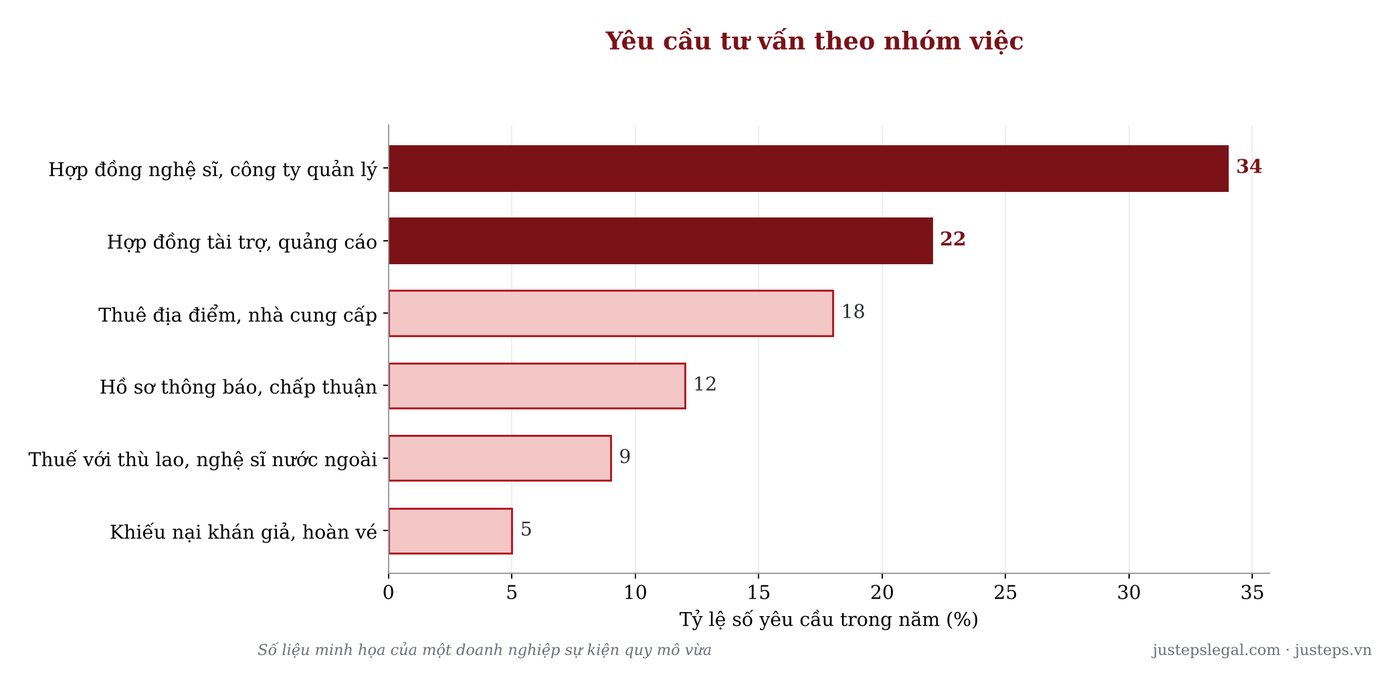
Example distribution of advisory requests over one year by type of work
Contracts with artists and management companies account for the largest share, because each show has many artists, each with a different contract template. Next come sponsorship and advertising contracts, venue hire and supplier contracts, and permits, followed by tax questions on fees and audience complaints. The exact proportions vary by business model, but this order helps a business estimate the workload when choosing a package.
Contracts with artists and management companies
A performance contract with an artist is usually a service contract under the Civil Code, under which the service provider performs work for the hiring party and receives remuneration[1]. Beyond price and schedule, the contract needs to deal with the performer’s rights in the performance, such as the rights of fixation, reproduction and broadcasting; if the business wants to record the show for streaming or resale, this must be clearly agreed and paid for accordingly[2]. When signing through a management company, Justeps checks whether that company has the right to represent the artist for this specific engagement, and who is liable if the artist does not turn up.
Sponsorship contracts and advertising content
Sponsors often demand the right to display their logo, play product videos and have artists mention the product on stage or on their personal pages. From 1 January 2026, the amended Law on Advertising places specific responsibilities on persons conveying advertising products, including artists and influencers[3]. Justeps reviews the documents so that the advertising obligations in the sponsorship contract are consistent with the artist contracts, products whose content must be confirmed before advertising are identified early, and responsibility for any penalty on the content is clearly allocated.
Venue hire contracts, show cancellations and force majeure
The Civil Code defines a force majeure event as one that occurs objectively, cannot be foreseen and cannot be overcome despite all necessary measures having been taken, and a party that fails to perform an obligation due to force majeure is not liable, unless otherwise agreed[4]. Heavy rain forecast several days in advance may not meet this definition, so the contract should list the specific situations that give relief from liability, the duty to give notice, the sharing of costs already incurred and the right to move the date. An order from a competent state authority to stop or change the show should also be written in as a separate case[5].
Legal changes in 2026 that events businesses need to know
An important part of the advisory package is providing updates on legal changes and explaining their specific effect on the business. 2025 and 2026 have seen many new instruments that directly affect the sector, summarised in the timeline below.
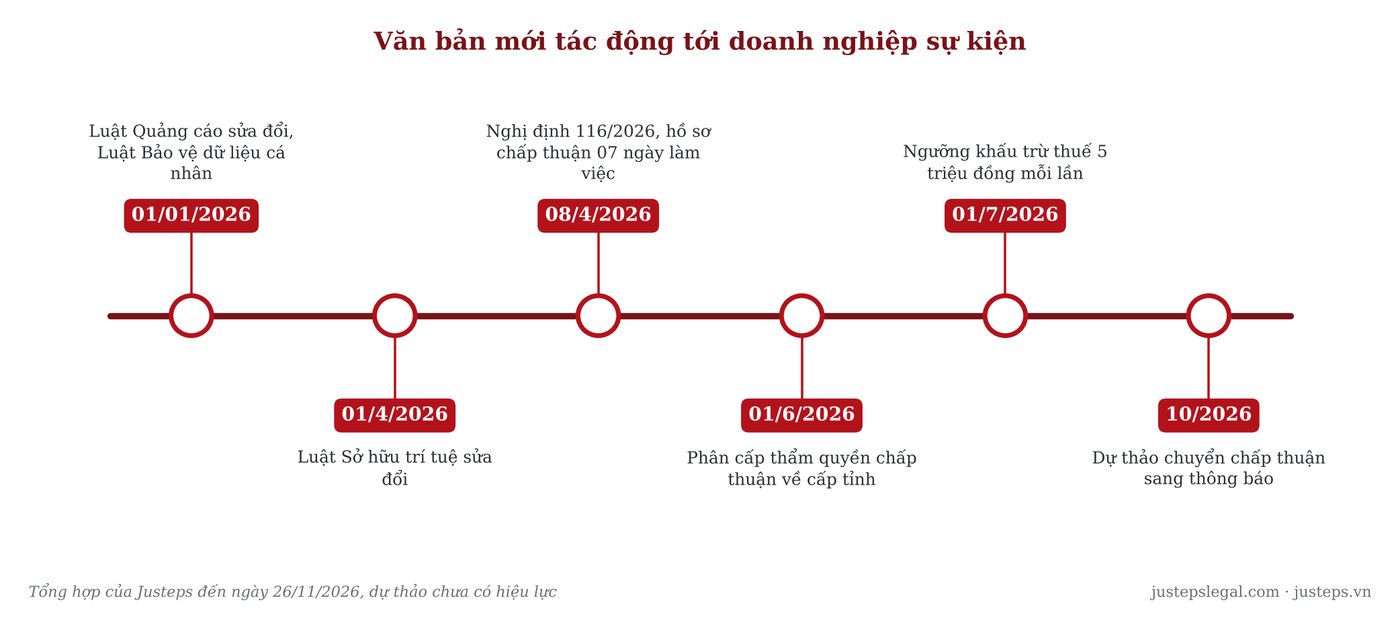
Effective dates of new instruments affecting events and performing arts businesses
For performing arts, Decree No. 116/2026/NĐ-CP changes the deadline for submitting approval files to at least 07 working days before the event, and Resolution No. 18/2026/NQ-CP transfers the power to approve certain shows involving international cooperation from the Ministry of Culture, Sports and Tourism to the provincial People’s Committees from 1 June 2026[5]. In October 2026, the Ministry released for consultation a draft amending decree that would move performances, competitions and festivals from approval to notification, but the draft is not yet in force, so businesses must still follow the current rules.
General legislation is also changing how businesses work. The Law on Personal Data Protection, effective from 1 January 2026, affects lists of ticket buyers and guests[6]. The amended Law on Intellectual Property, effective from 1 April 2026, adds certain forms of exploitation that are subject to royalty payments[2]. Decree No. 253/2026/NĐ-CP guiding the Law on Personal Income Tax raises the withholding threshold for payments to individuals without employment contracts to VND 5 million per payment[7]. Justeps sends a short bulletin when changes occur and points out which of the business’s contract templates and procedures need to be revised.
How Justeps receives and handles requests
The urgency of requests from events businesses varies greatly. A sponsorship contract for a show six months away can be answered within a few days, while a question about replacing an artist two days before the show needs an answer within hours. Justeps classifies each request on receipt so that it is given the right response time, following the sequence below.
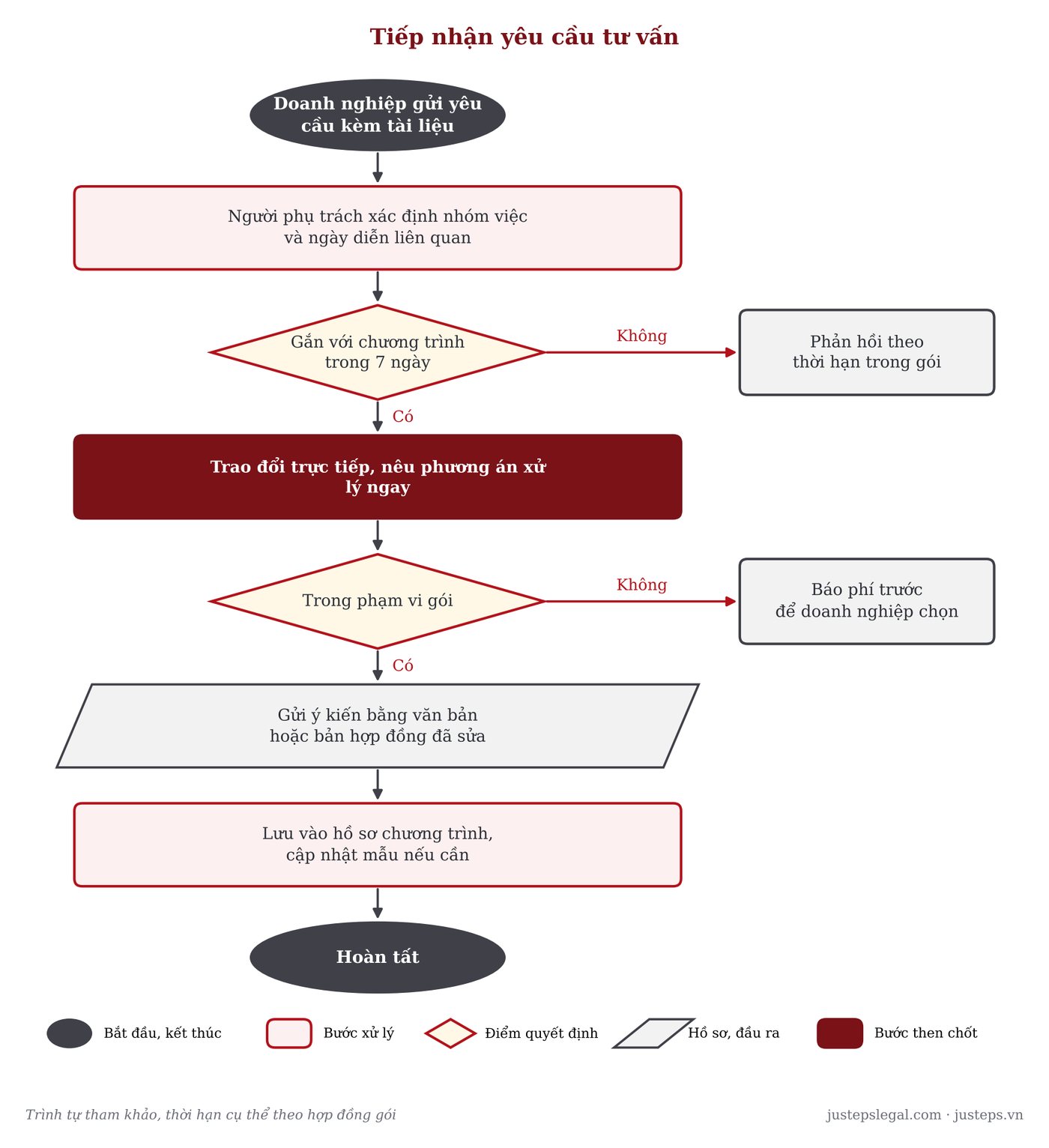
Sequence for receiving and handling an advisory request
Each business has a lead consultant who knows its legal records, contract templates and show calendar. Requests are sent by email or an agreed messaging channel, together with the relevant documents. For requests linked to an upcoming show, the lead consultant may first discuss the matter directly by telephone and then send a written opinion for the file. Matters outside the scope of the package, such as drafting a complete set of procedures, are flagged in advance so that the business can decide.
When a dispute arises
Common disputes include an artist cancelling, a supplier delivering the wrong equipment, a sponsor paying late or a group complaint from the audience because a show was cancelled. Justeps is a consulting company and does not take on disputes before adjudicating bodies. Within the package, Justeps assesses the matter, reviews evidence such as contracts, minutes and messages, drafts letters of demand and options for negotiation and mediation, and prepares the file for the business to act on itself or to pass to a practitioner of the business’s own choosing if it decides to bring a claim.
Package scope, suitable clients and fees
The ongoing advisory package suits businesses with several shows or more each quarter, artist management businesses with many performance and sponsorship contracts, and venue operators with a busy events calendar. Businesses that run only one or two shows a year are usually better suited to advice on a matter-by-matter basis. Besides answering questions and reviewing contracts, the package may include a quarterly review of the files of shows already performed.
The advisory package does not replace reorganising the business or writing a full set of procedures. When it sees the same error recurring across several shows, Justeps recommends that the business deal with the root cause through the internal procedures and regulations service for events businesses. Questions about contracts with stage crews and collaborators, insurance and pay are answered within the package, while full standardisation falls under the labour, payroll and insurance service for events businesses. The package fee is quoted in writing based on the expected number of hours or requests per month, the number of shows in the year and the need to work in a foreign language with international artists and partners.
How Justeps can help
Alongside the ongoing advisory package, event, performing arts and entertainment businesses can combine the following Justeps services:
- Building internal procedures and regulations for event, performing arts and entertainment businesses. Justeps turns recurring answers into procedures for permits, rights clearance, refunds and final accounts.
- Labour, payroll and insurance services for event, performing arts and entertainment businesses. Justeps standardises contracts, pay, insurance and tax withholding for stage crews, collaborators and artists.
- Intellectual property and trademark protection. Justeps registers trademarks for show and festival names and deals with copying of event brands.
- Drafting and reviewing commercial contracts. Justeps drafts a set of artist, sponsorship and venue hire contract templates for use across all shows.
Frequently asked questions
How does the ongoing advisory package differ from engaging advice matter by matter?
Under the package, the lead consultant already holds the business’s records, contract templates and show calendar, so answers are faster and more consistent. Matter-by-matter engagement suits businesses with only a few shows a year.
Can Justeps respond on show day?
For requests linked to an upcoming show, the lead consultant discusses the matter directly first and sends a written opinion afterwards. Support hours outside normal working hours are agreed in the package contract.
Is a storm automatically force majeure?
Not automatically. The event must be objective, unforeseeable and impossible to overcome despite all necessary measures having been taken[4], so the contract should list the specific weather situations that give relief from liability.
What needs to be agreed with artists to record a show for streaming?
The rights to fix, reproduce and communicate the performance must be clearly agreed, together with the corresponding payment, because these are rights of the performer and of the owner of rights in the performance[2]. The rights of the songwriters must also be dealt with separately.
Has the move from approval to notification taken effect yet?
As at the end of November 2026, this is only a draft under consultation. Businesses must still obtain written approval for shows that are subject to approval under the current rules[5].
Does Justeps represent the business when it sues an artist who cancelled?
No. Justeps is a consulting company; it only assesses the matter, drafts documents, supports negotiation and mediation, and prepares the file for the business to act on itself or to pass to a practitioner of its own choosing.
Related articles
- Organisational structure design for event, performing arts and entertainment businesses based on a standing organisation and project teams
- Building internal procedures and regulations for event, performing arts and entertainment businesses across the life cycle of a show
- Labour, payroll and insurance services for event, performing arts and entertainment businesses with a workforce that changes with each show
- Controlling advertising content within a business through a pre-publication approval procedure
Notes
[1] Article 513 of the Civil Code No. 91/2015/QH13 dated 24 November 2015.
[2] Articles 29 and 33 of the Law on Intellectual Property No. 50/2005/QH11, as amended and supplemented by Law No. 36/2009/QH12, Law No. 42/2019/QH14, Law No. 07/2022/QH15 and Law No. 131/2025/QH15 (effective from 1 April 2026).
[3] Article 15a of the Law on Advertising No. 16/2012/QH13, as supplemented by Law No. 75/2025/QH15, effective from 1 January 2026.
[4] Clause 1 of Article 156 and Clause 2 of Article 351 of the Civil Code No. 91/2015/QH13 dated 24 November 2015.
[5] Articles 10, 13 and 17 of Decree No. 144/2020/NĐ-CP dated 14 December 2020 of the Government on performing arts activities, as amended and supplemented by Decree No. 116/2026/NĐ-CP dated 2 April 2026 and Resolution No. 18/2026/NQ-CP dated 29 April 2026 of the Government.
[6] Law on Personal Data Protection No. 91/2025/QH15, effective from 1 January 2026.
[7] Law on Personal Income Tax No. 109/2025/QH15 and Decree No. 253/2026/NĐ-CP of the Government detailing the Law on Personal Income Tax.
This article is for reference and reflects the regulations in force at the time of publication. Please consult Justeps for advice tailored to your company’s records and situation.
For further information, please contact:
📩 Email: info@justeps.vn
🌐 Website: https://justepslegal.com · https://justeps.vn
🌐 Page: Justeps
☎️ Hotline (Zalo): 096 172 2607
📍 Thanh Xuan Office: 12th Floor, Licogi 13 Tower, 164 Khuat Duy Tien Street, Thanh Xuan Ward, Hanoi, Vietnam
📍 Ha Dong Office: LK06B, No.10, Dong Dua Area, Ha Dong Ward, Hanoi, Vietnam
📍 Ho Chi Minh City Branch: 528 Le Van Sy, Ho Chi Minh City, Vietnam
📍 Hai Phong Office: Truong Thinh Village, Ha Dong Commune, Hai Phong, Vietnam
📍 Quang Ninh Office: Van Don Special Zone, Quang Ninh Province, Vietnam





