
Key takeaways
- The premises lease is the document that decides the fate of a gym’s fit-out investment, so before signing it should be reviewed for the rent-free period, renewal rights, what happens when the property changes hands and the residual value of the fit-out on early termination.
- Playing music in a gym is a use of works and sound recordings for business purposes, so a personal streaming account cannot replace obtaining permission from, or paying royalties to, the rights holders[2].
- When a facility is sold, closed or relocated, the obligations to members with valid memberships are a real debt, and the business may not stop providing services contrary to the contracts it has signed[3].
- Decree No. 285/2026/NĐ-CP amending the rules on penalties in the sports sector took effect on 1 September 2026, which is a reason to review the certificate and the professional staff records of each facility[5].
A chain of three gyms usually has at least three long-term premises leases, several equipment leases or deferred payment purchase agreements, a franchise agreement or a licence for a branded training programme, and thousands of membership contracts still in force. Alongside these are the certificate of eligibility, fire prevention and fighting records, inspections by the authorities and injuries that may occur on any given day. A business of this size rarely has its own legal department, yet each legal question needs to be answered within a few days and sometimes within a few hours.
This page presents Justeps’ ongoing legal advisory service for gyms, yoga and pilates studios, martial arts schools, commercial swimming pools, fitness club chains and sports clubs. It covers the groups of legal work specific to the sector, how Justeps deals with an injury, the legal changes to follow in 2026 and early 2027, the request handling process, deliverables and the scope of the package. Justeps is a consulting company and does not take on matters before courts or arbitral tribunals; in disputes, Justeps assesses the matter, prepares the file and advises on negotiation and mediation so that the business can act itself or pass the matter to a practitioner of its own choosing.
Groups of legal work that gym and yoga businesses face regularly
A gym’s legal requests are not spread evenly but are concentrated in a few recurring groups of work. The figure below is an example breakdown of requests over one year from a gym chain client, showing that membership contracts, complaints and leases take up most of the advisory time.
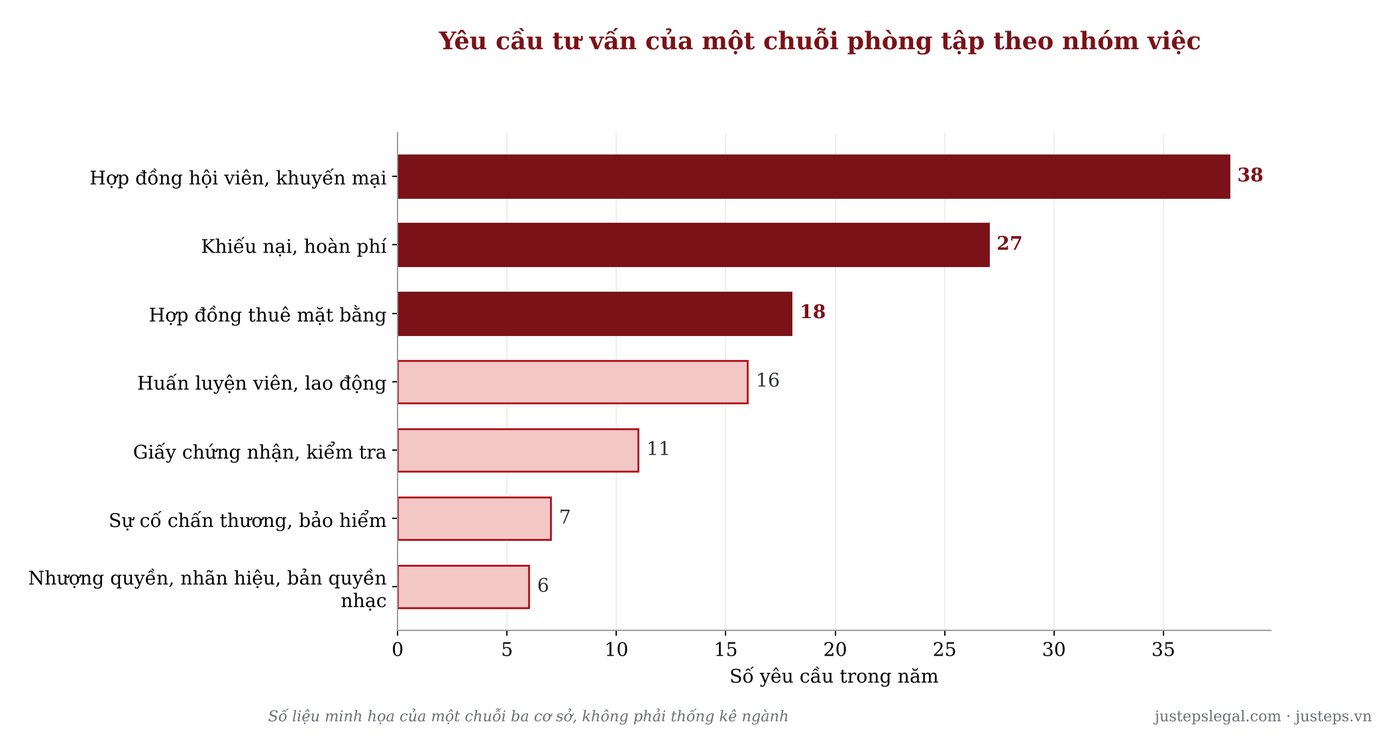
Example number of advisory requests in one year by group of work
Premises leases
Gyms usually invest heavily in fitting out their premises, with items such as acoustic flooring, air conditioning, changing rooms, swimming pools or structural reinforcement for heavy equipment. This investment can only be recovered if the business stays long enough. Justeps therefore reviews closely the rent-free period during construction, renewal rights and the rent increase on renewal, the landlord’s obligations when the property is transferred or mortgaged, the conditions for early termination and how the residual value of the fit-out to be reimbursed is calculated. The lease must also permit use of the premises for commercial sports activities and allocate responsibility for fire prevention and fighting records clearly between the two parties.
Franchising and branded training programmes
Franchise agreements with foreign brands are usually drafted in advance by the franchisor and contain many financial obligations, such as an initial fee, recurring fees based on revenue, a shared advertising fee and a requirement to buy equipment from designated suppliers. Commercial franchising is governed by the Commercial Law[1], and franchising from abroad into Vietnam must be registered with the Ministry of Industry and Trade. Justeps reviews the terms on territory, facility opening targets, termination and the treatment of members on leaving the system, and also points out that payments abroad usually give rise to foreign contractor tax obligations and that the protection status of the trade mark in Vietnam should be checked.
Music and copyright content
Performing and communicating a work to the public is an economic right of the copyright owner, while published sound and video recordings used in business and commercial activities do not require permission but royalties must be paid to the owner[2]. Background music in the gym and music used for dance and indoor cycling classes therefore requires an agreement with the owner or a collective management organisation. Justeps helps the business determine which uses require a licence, assess fee claims it receives and keep records to explain its position during an inspection.
Selling, closing or relocating a facility
When a facility or an entire chain is sold, the buyer usually wants to take over the members but not the services that have been paid for and not yet provided. The business may not unilaterally terminate or stop providing services contrary to the contract, while members have the right to terminate unilaterally and pay only for the services used, unless otherwise agreed[3]. Justeps calculates the total remaining obligations to members, designs the allocation clauses in the transfer agreement, drafts the notice to members and the options for them to continue or receive a refund.
Trainers who leave and take members with them
A clause that absolutely prohibits a trainer from working for another gym after leaving is usually difficult to enforce and likely to lead to disputes. A more effective form of protection is a confidentiality agreement covering the member list, training plans and pricing policy, controlled access to the membership management software, and a clear rule that members contract with the business and not with the individual trainer. Trainers’ employment contracts and pay schemes are dealt with in detail under the labour, payroll and insurance service for gym and yoga businesses.
How Justeps supports the business when a member is injured
Training injuries, drowning in the pool or a cardiac event in a high intensity class are the most urgent legal situations a gym can face. The first priority is always first aid and getting the injured person to a medical facility. Immediately afterwards, the way the business preserves evidence and communicates with the family will largely determine the outcome. The flowchart below shows the sequence Justeps guides clients through.
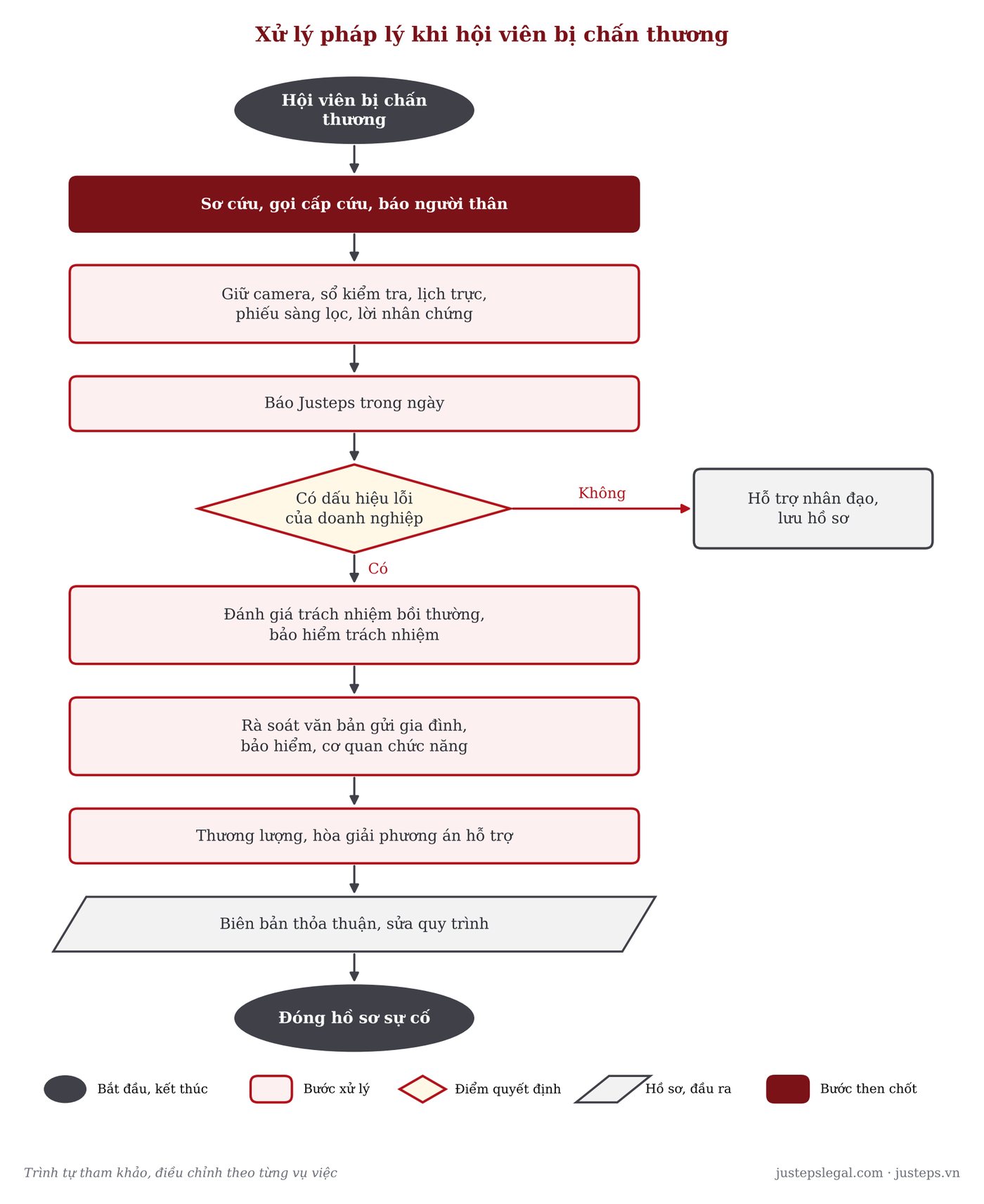
Sequence for handling the legal side of a member injury at a gym
The evidence to be preserved includes camera footage, the pre-shift equipment inspection log, the duty roster of trainers and lifeguards, the member’s health screening form and witness statements. On that basis, Justeps assesses contractual and non-contractual liability for damages under the Civil Code[4], reviews any liability insurance policy and proposes a plan to support the member’s family. Every document sent to the family, the insurer or the authorities is reviewed by Justeps first, because a poorly worded apology may be read as an admission of fault before the cause has been established.
If the incident reveals a gap in procedures, such as missing equipment checks or a substitute trainer without a certificate, Justeps records it so that the business can fix it immediately. Fixing procedures at system level is carried out under the internal procedures and regulations service for gym and yoga businesses, while within the ongoing advisory package Justeps follows up on the remedial action until the incident file is closed.
Legal changes to follow in 2026 and early 2027
An important part of ongoing advisory work is giving the business advance notice of legal changes that affect its operations. The figure below summarises the milestones Justeps is tracking for clients in the sector.
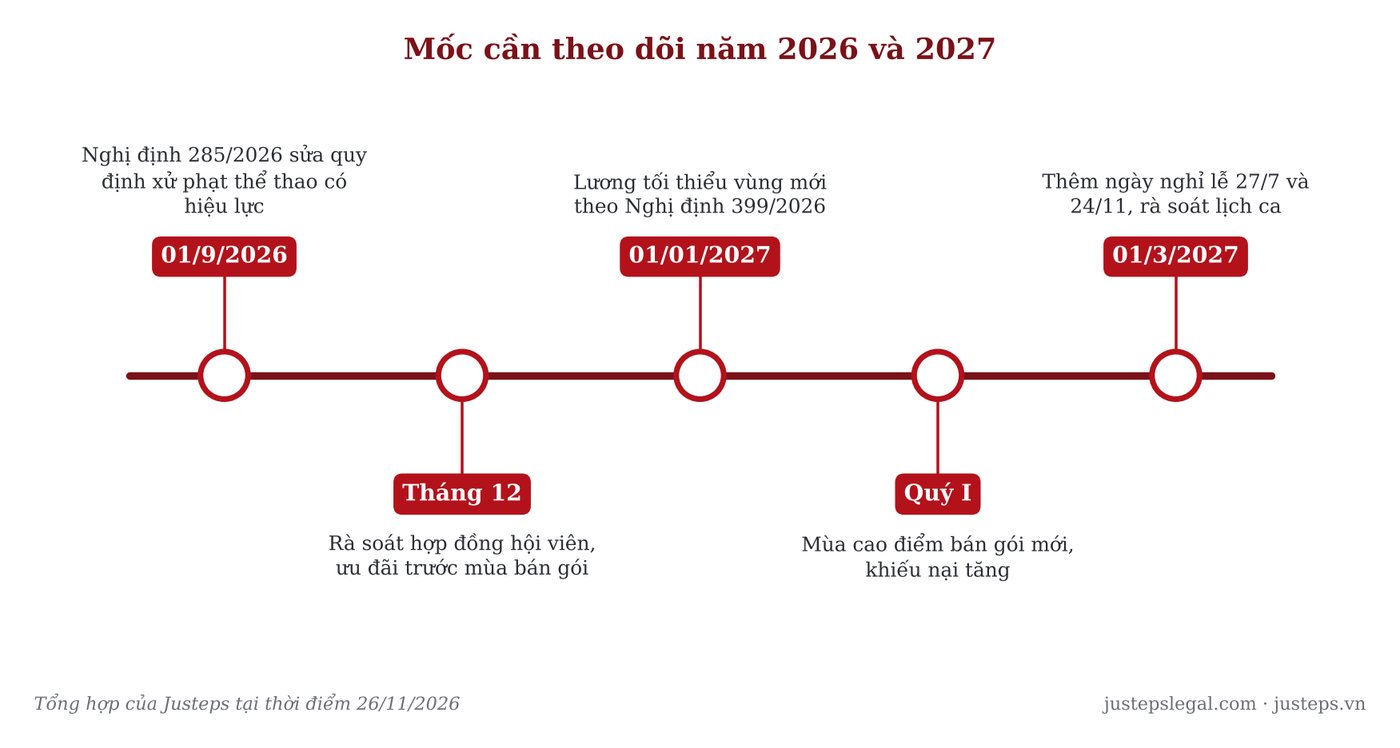
Legal and operational milestones that gym and yoga businesses need to follow
Decree No. 46/2019/NĐ-CP on administrative penalties in the sports sector has been amended and supplemented by Decree No. 285/2026/NĐ-CP, effective from 1 September 2026. Violations commonly found at gyms, such as operating without a certificate of eligibility, failing to apply for reissuance of the certificate, or using sports instructors and lifeguards who do not meet the requirements, remain subject to penalties[5]. The certificate must be reissued when the business changes its business location or its list of sports activities[6], so every new facility or new sport needs to be checked against it.
From 1 January 2027, regional minimum wages increase under Decree No. 399/2026/NĐ-CP, and the Law amending the Labour Code passed by the National Assembly on 21 November 2026 adds public holidays on 27 July and 24 November, effective from 1 March 2027. For gyms that open on public holidays, these two changes directly affect shift schedules and the payroll budget. The first quarter of each year is also the peak season for new memberships, so Justeps usually reviews membership contracts and promotions before Tết so that the business does not have to change its templates in the middle of the season.
Request handling process, deliverables and scope of the package
The ongoing advisory package begins with about two weeks of reviewing the legal status of each facility, including the certificate of eligibility, fire prevention and fighting records, leases, any franchise agreement and the membership contract templates in use. The result is a list of priority actions to be dealt with in the first three months. During the operating phase, all requests are sent through a single channel, Justeps classifies them by urgency and replies within the committed time; injuries and requests from inspecting authorities are handled first. The periodic deliverables comprise the following documents:
- An initial legal review report for each facility with a list of priority actions.
- A standardised set of template contracts for premises leases, equipment purchases, cooperation with freelance trainers and members.
- A written advisory opinion for each request, filed by group of work for future reference.
- A register tracking the terms of leases, certificates, insurance policies and recurring obligations.
- A file on the handling of each incident and complaint, and a report at the end of each service period with recommendations.
Small studios usually choose an hourly package focused on the lease and membership contracts. Multi-facility chains need a package with a dedicated point of contact and a quarterly review schedule. Professional clubs also need advice on athlete contracts, sponsorship and relations with the federation. Fees are quoted in writing on a monthly or annual basis after the initial discussion, depending on the number of facilities, the number of long-term contracts and the usual level of urgency; acquisitions and transfers of facilities are agreed separately.
How Justeps can help
Alongside ongoing legal advisory, gym, yoga and sports club businesses can combine the following Justeps services:
- Building internal procedures and regulations for gym, yoga and sports club businesses. Justeps turns lessons from incidents and complaints into membership and safety procedures applied at every facility.
- Labour, payroll and insurance services for gym, yoga and sports club businesses. Justeps standardises the contracts, pay and insurance of trainers, teachers and shift staff.
- Setting up retail chains and franchising. Justeps reviews gym brand franchise agreements and prepares franchise registration files.
- Intellectual property and trade mark protection. Justeps registers trade marks for gym brands and advises on using licensed music and branded training programmes.
Frequently asked questions
May a gym play music using a personal paid streaming account?
Usually that is not enough, because a personal account only permits private listening, while playing music in a gym is use for business purposes[2]. The business should reach an agreement with the rights holders or a collective management organisation, or use a music provider licensed for commercial premises.
Does a business that buys a gym have to keep serving existing members?
It depends on how the transaction is structured. If the buyer acquires the company, it takes over the obligations to members as well; if it buys only the assets, the parties must agree clearly who bears the remaining obligations and notify members[3].
What is the first thing a business should do when a member is injured?
Give first aid and take the injured person to a medical facility. Then preserve the camera footage, the equipment inspection log, the duty roster and the health screening form, and contact a consultant before sending any document to the family or the insurer.
Does a foreign gym franchise have to be registered?
Yes. Franchising from abroad into Vietnam must be registered with the Ministry of Industry and Trade under the law on commerce[1]. The business should also check its foreign contractor tax obligations on franchise fees paid abroad.
If a member brings a lawsuit, how far does Justeps support the business?
Justeps is a consulting company and does not take on matters before courts or arbitral tribunals. Justeps assesses the matter, prepares the file, advises on negotiation and mediation and hands over the file so that the business can act itself or pass it to a practitioner of its own choosing.
When should the certificate of eligibility be reviewed?
Whenever the business changes its location, opens a new facility or adds a sport, because these are the cases in which the certificate must be reissued[6]. It should also be reviewed every year together with the professional staff records.
Related articles
- Organisational structure design for gym, yoga and sports club businesses based on a sales line and a professional line
- Building internal procedures and regulations for gym, yoga and sports club businesses across the membership life cycle
- Labour, payroll and insurance services for gym, yoga and sports club businesses with commission-based trainers
- A 72-hour playbook for handling a legal and media crisis
Notes
[1] Section 8 of Chapter VI of the Commercial Law No. 36/2005/QH11 dated 14 June 2005 on commercial franchising, and Decree No. 35/2006/NĐ-CP dated 31 March 2006 of the Government, as amended and supplemented by Decree No. 08/2018/NĐ-CP.
[2] Articles 20 and 33 of the Law on Intellectual Property No. 50/2005/QH11, as amended and supplemented by Law No. 36/2009/QH12, Law No. 42/2019/QH14, Law No. 07/2022/QH15 and Law No. 131/2025/QH15.
[3] Clause 3 of Article 41 and Clause 3 of Article 42 of the Law on Protection of Consumers’ Rights No. 19/2023/QH15 dated 20 June 2023, effective from 1 July 2024.
[4] Articles 360 and 584 of the Civil Code No. 91/2015/QH13 dated 24 November 2015.
[5] Articles 16 and 20 of Decree No. 46/2019/NĐ-CP dated 27 May 2019 of the Government on administrative penalties for violations in the field of sports, as amended and supplemented by Decree No. 129/2021/NĐ-CP and Decree No. 285/2026/NĐ-CP dated 17 July 2026.
[6] Clause 1 of Article 21 of Decree No. 36/2019/NĐ-CP dated 29 April 2019 of the Government detailing a number of articles of the Law amending and supplementing a number of articles of the Law on Physical Training and Sports, as amended and supplemented by Decree No. 31/2024/NĐ-CP.
This article is for reference and reflects the regulations in force at the time of publication. Please consult Justeps for advice tailored to your company’s records and situation.
For further information, please contact:
📩 Email: info@justeps.vn
🌐 Website: https://justepslegal.com · https://justeps.vn
🌐 Page: Justeps
☎️ Hotline (Zalo): 096 172 2607
📍 Thanh Xuan Office: 12th Floor, Licogi 13 Tower, 164 Khuat Duy Tien Street, Thanh Xuan Ward, Hanoi, Vietnam
📍 Ha Dong Office: LK06B, No.10, Dong Dua Area, Ha Dong Ward, Hanoi, Vietnam
📍 Ho Chi Minh City Branch: 528 Le Van Sy, Ho Chi Minh City, Vietnam
📍 Hai Phong Office: Truong Thinh Village, Ha Dong Commune, Hai Phong, Vietnam
📍 Quang Ninh Office: Van Don Special Zone, Quang Ninh Province, Vietnam





