
Key takeaways
- Building a greenhouse on rice land leased from households is a change to another type of land within the agricultural land group and must be permitted by the competent State authority before construction[2].
- Businesses holding a certificate of high-tech agricultural enterprise need to track its expiry date, because from 1 July 2026 the new law no longer provides for this type of certificate to be reissued[6].
- Contracts for importing greenhouses, irrigation systems or farming procedures drafted by the seller often lack yield commitments and may be subject to technology transfer registration if they include non-public technical information and training.
- Offtake contracts need a definition of force majeure that fits the risks of weather and disease and clear procedures for notice and evidence, because a crop failure does not automatically release a party from liability.
High-tech agriculture businesses commit long-term capital to net houses, irrigation systems and closed barns on land that is mostly leased. Technology is usually imported under contracts drafted by the foreign seller, while produce is sold under offtake contracts with heavy penalties for short or late delivery. Each season opens a new series of questions about leasing more land, taking on more linked households, applying for growing area codes or dealing with crop losses caused by the weather, and most of those questions need an answer within days rather than weeks.
This page introduces Justeps’ ongoing legal advisory service for high-tech agriculture businesses, crop and livestock farms and businesses leading linkage arrangements with cooperatives and farming households. Justeps works as an outsourced legal department, monitoring the business’s records and obligations throughout the life of the project. The page moves from the sector’s specific risk groups and common legal mistakes to the scope of the service, the seasonal working rhythm, the deliverables and the fee.
The sector’s specific legal risk groups
The level of risk differs between greenhouse crop production and large-scale livestock farming. The chart below compares the monitoring priority of five groups of issues for the two common models.
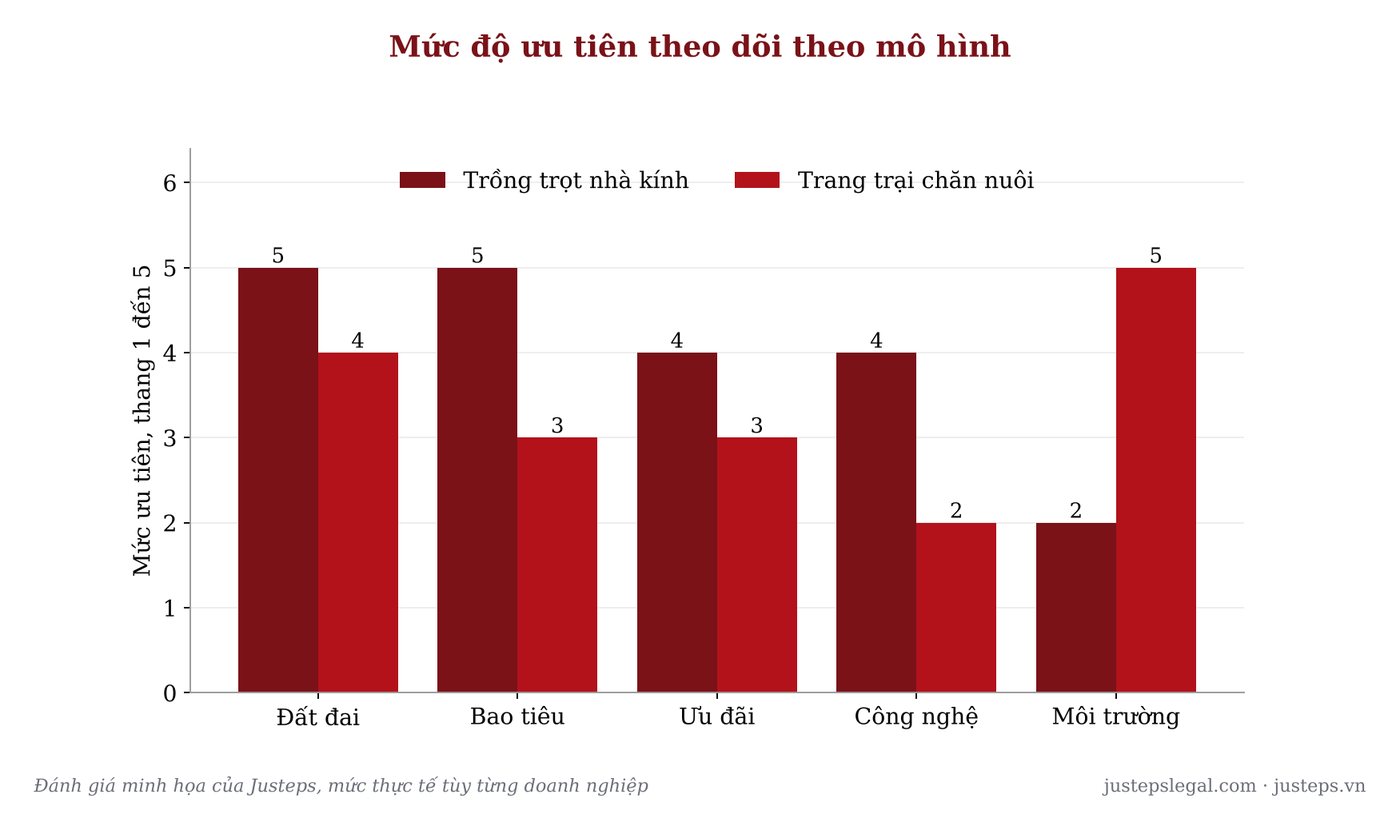
Monitoring priority of five groups of legal issues for two production models
For greenhouse crop production with exports, land and offtake and export contracts are the two groups that need the closest monitoring, followed by investment incentives and technology transfer. For livestock farms, environment, waste and livestock farming conditions come first, because a discharge incident or a disease outbreak may lead to suspension of operations. Justeps uses this ranking to allocate review time in the first month and to draw up a calendar of obligations suited to each business.
Land is the central asset and also the greatest risk
A medium-sized crop business may at the same time lease land from the State, sublease land from dozens of households with different terms and receive land use rights as capital contributions. Each source of land carries its own risks as to who has the right to sign, the term, the rent and how assets on the land are dealt with on expiry. Land for greenhouses, net houses and farming houses, and for structures serving production such as storage for agricultural products and areas for storing chemicals and fertilisers, is classified as other agricultural land[1]. Building a greenhouse on rice land is therefore not free construction on agricultural land, but a change to another type of land within the agricultural land group that must be permitted by the competent authority[2].
The obligation to put land into use also needs close monitoring. Land for annual crops left unused for twelve consecutive months, or land for perennial crops for eighteen consecutive months, may be recovered if it is still not put into use after a penalty has been imposed; a delayed project may be granted an extension of no more than twenty-four months and must pay additional land rent for the extension period[3]. If the land is still not used when the extension expires, the State recovers it without compensation for the land and the assets attached to it, except in cases of force majeure. Justeps keeps a land register for each plot, recording its origin, term, committed schedule and the milestones to be dealt with at least one season in advance.
Common legal mistakes
Leasing land from households on handwritten papers
Many farms lease land on handwritten papers or contracts that are neither notarised nor certified, without checking whether the signatory is the person entitled to sign and without dealing with land held jointly by several members of a household. The contracts also often leave blank the terms on net houses, wells and pipework when the lease expires. When a household member objects or land prices rise, the business may have to stop production on that land in the middle of the season.
Signing technology import contracts on the seller’s template
Contracts for buying greenhouses, microclimate control systems or packages of farming procedures usually commit only to delivering equipment to specification, give no yield commitment, cap warranties at a low level and choose foreign law and distant arbitration. A simple purchase of equipment is usually not subject to registration, but where the contract includes non-public technical information, procedures and training for operation, it may be a contract for the transfer of technology from abroad into Vietnam that must be registered under the Law on Technology Transfer[4]. Justeps reviews the scope of transfer, acceptance milestones linked to payment, warranties, intellectual property rights in the control software and the dispute resolution mechanism.
Offtake contracts that do not address seasonal risks
Force majeure is an event that occurs objectively, cannot be foreseen and cannot be remedied despite all necessary and permissible measures having been taken[5]. A heatwave or unseasonal rain does not automatically satisfy this definition, especially where the buyer is accustomed to weather risks in agriculture. An offtake contract should list the events regarded as force majeure, the notice period, the acceptable types of evidence and how delivery quantities are adjusted, instead of leaving the parties to argue after the crop has failed.
Failing to monitor the conditions for incentives
Tax and land rent incentives are tied to the registered project and sector, so when a business expands into trading or processing without reassessment, the new income may not qualify for incentives and may be subject to retrospective collection. A certificate of high-tech agricultural enterprise issued under the old law remains valid, and the corporate income tax incentives attached to it are preserved until the expiry date stated on it, but the new law no longer provides for this type of certificate to be reissued[6]. Businesses need to prepare early a plan to meet the criteria for high-tech enterprises or other investment incentives for the period after the certificate expires.
Scope of the service and the seasonal working rhythm
The service begins with a comprehensive review of the land, project, licence and certification records and the key contracts, and then moves to day-to-day support through a fixed point of contact with committed response times. Ongoing support usually covers the following work:
- Leasing land, contributing land use rights as capital, extensions, adjustments to the project schedule and procedures for permission to build greenhouses and barns.
- Reviewing and negotiating contracts for importing technology, equipment and varieties, and preparing technology transfer registration files when needed.
- Drafting offtake contracts, linkage contracts with cooperatives and households, and input purchase contracts on uniform templates.
- Monitoring the conditions for investment incentives and the term of certificates, and preparing files when moving to a new incentive regime.
- Preparing files and providing support during sectoral inspections on crop production, livestock, plant protection, environment and tax.
- Advising on growing area codes, packing facility codes, plant quarantine and the legal requirements of importing markets.
Growing area codes are now issued online on the principle of self-declaration and self-responsibility, within no more than three working days where the produce is not exported to a market requiring a code and no more than ten working days where it is[7]. The procedure is faster, but responsibility for the accuracy of the file rests with the business, so Justeps reviews the file before submission. The work is organised around the seasonal rhythm shown in the cycle below, so that the legal work stays one step ahead of the field work.
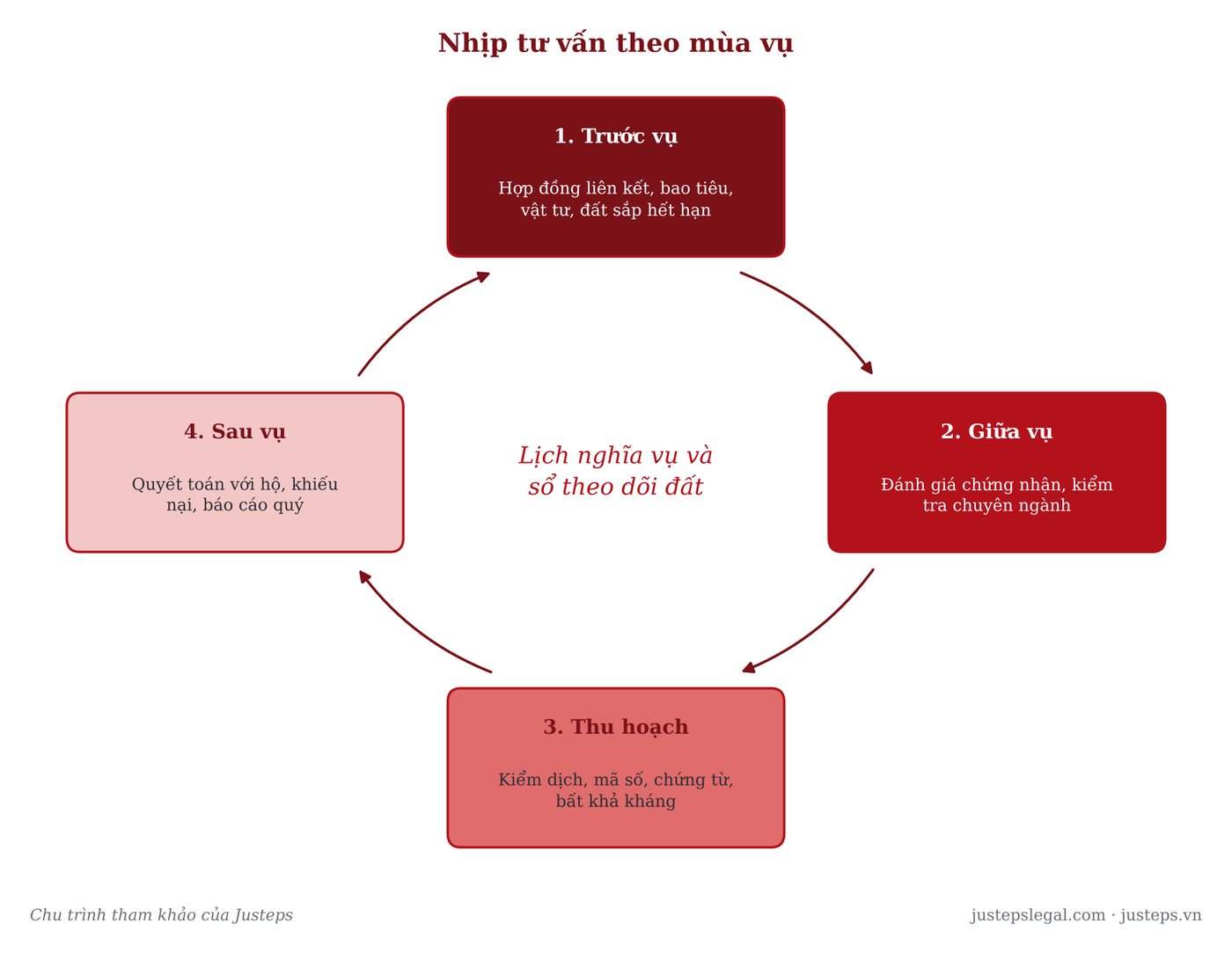
The rhythm of legal advisory across the four stages of a crop season
Before the season, the focus is on reviewing linkage, offtake and input and seed purchase contracts, while checking land leases that are about to expire. During the season, Justeps provides support when certification assessments or sectoral inspections take place and resolves difficulties with linked households. At harvest, the main work is quarantine files, codes, delivery documents and any force majeure notices. After the season, the parties settle accounts with households and handle quality complaints, and Justeps sends a quarterly report on the work done, outstanding risks and changes in the law.
When a dispute arises, Justeps assesses the matter, reviews the evidence, drafts documents and advises on negotiation and mediation with households, partners or customers. Justeps does not conduct litigation, so if the business decides to bring a lawsuit or refer the matter to arbitration, Justeps prepares the file for the business to proceed itself or to hand over to a practitioner of the business’s own choosing. Where the problem lies in internal operations, such as using chemicals outside the permitted list or discrepancies in store records, the remedial work is transferred to the service for building internal procedures and regulations for high-tech agriculture businesses.
Starting the service and the deliverables
The first month is the busiest period, when Justeps consultants work at the farm and the office to get to grips with all the records.
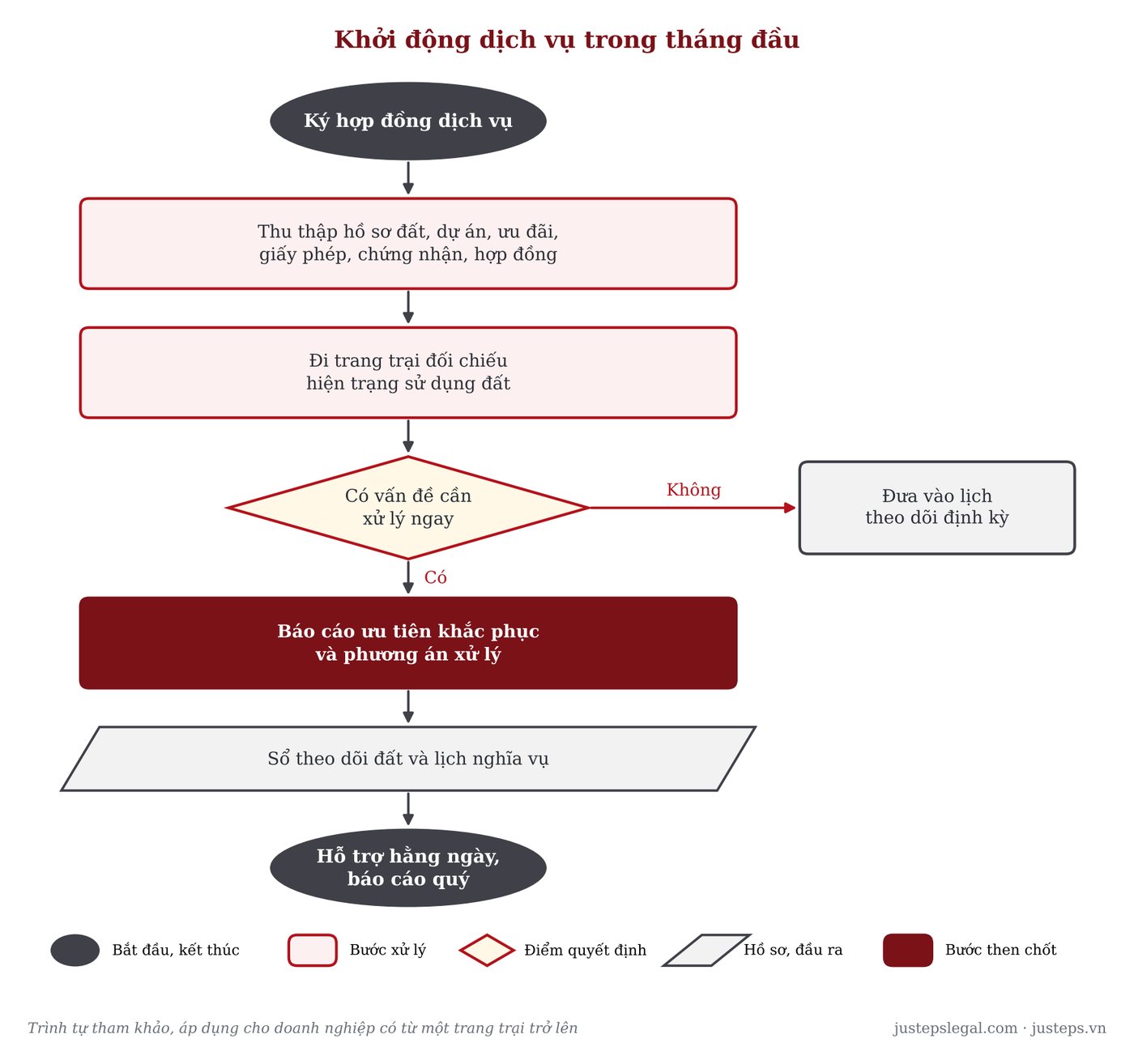
Sequence for starting the ongoing legal advisory service in the first month
Justeps collects and reads the land records, the investment registration certificate, incentive certificates, water resource licences, production certifications and key contracts, and then visits the farm to compare them with actual land use. Issues requiring immediate action, such as land leases about to expire or greenhouses built on land not yet permitted to change type, are set out separately in the first report. From the second month onwards, the business receives the following documents:
- An initial legal review report on land, projects, licences and contracts, with the order of priority for remedial action.
- A land register for each plot and a calendar of periodic obligations on land rent, project reports, licences and certifications.
- A set of standardised template contracts for land leases, linkage, offtake and input purchases.
- Advisory opinions and draft documents for each request that arises.
- A quarterly report on matters handled, outstanding risks and legal updates affecting the business.
Application by business model and fee
A family farm that has just become a business usually needs only a package focused on land, sales contracts and labour. A large greenhouse business that exports needs a full package with an emphasis on technology transfer, international contracts and quarantine, while a livestock farm focuses on livestock farming conditions, safety distances and the environment. A foreign-invested business needs additional advice on the conditions for access to agricultural land and on governance as required by its investors. Issues on seasonal contracts, piece-rate pay and insurance are dealt with in depth in the labour, payroll and insurance service for high-tech agriculture businesses.
The service fee is charged monthly, quarterly or annually and quoted in writing after the initial meeting. The factors involved include the number of farms and locations, the number of land leases being managed, the extent of exports, whether technology is negotiated with foreign partners, any need for bilingual documents and the increase in workload during the harvest season. Major matters arising outside the ongoing scope, such as due diligence on a new land project or preparing files for a high-value dispute, are agreed separately.
How Justeps can help
Alongside ongoing legal advisory, high-tech agriculture businesses and farms may combine the following Justeps services:
- Building internal procedures and regulations for high-tech agriculture businesses and farms. Justeps turns the legal requirements on chemicals, traceability, growing area codes and linkage into day-to-day operating regulations.
- Labour, payroll and insurance services for high-tech agriculture businesses and farms. Justeps standardises seasonal contracts, piece rates and insurance arrangements for a workforce that fluctuates with the season.
- Legal due diligence on projects and land banks. Justeps reviews the legal status of land before the business leases more land or acquires an agricultural project.
- Software contracts and technology transfer. Justeps drafts and negotiates technology import contracts, greenhouse control software contracts and technology transfer registration files.
Frequently asked questions
May a greenhouse be built on rice land leased from households?
A greenhouse must be consistent with the type of land permitted for use. Changing rice land to another type of land within the agricultural land group must be permitted by the competent State authority, and rice land is protected more strictly than other types of land[2].
Do land leases with households need to be notarised?
Whether notarisation or certification is required depends on the type of transaction and the parties involved. Even where it is not mandatory, notarisation or certification and registration of the change give the business better protection in a dispute with the household or a third party.
Does buying a greenhouse system from abroad require technology transfer registration?
A simple purchase of equipment usually does not require registration. If the contract includes non-public technical information, farming procedures, operator training or software linked to the technology, the business needs to assess its registration obligation under the Law on Technology Transfer[4].
Is a crop failure caused by the weather a ground for exemption from liability under an offtake contract?
Only if the event meets the definition of force majeure or an exemption clause in the contract, and the party in breach has given notice and taken timely remedial measures[5]. The contract should clearly list the weather and disease events regarded as force majeure.
Is a certificate of high-tech agricultural enterprise still valid?
A certificate issued under the Law on High Technology of 2008 remains valid until the expiry date stated on it, and the corporate income tax incentives attached to it are preserved until that date[6]. The business should prepare an incentive plan for the following period.
Can the business start with a small package and expand later?
Yes. Many businesses start with a review of land and key contracts and then expand to monthly support once the workload has become clear. Justeps adjusts the scope and fee at each stage.
Related articles
- Contract lifecycle management in small and medium-sized enterprises
- Penalty and damages clauses and how to draft them so that the money can actually be recovered
- When a counterparty breaches a contract, the steps from notice and negotiation to mediation and proceedings
- Converting an agricultural processing cooperative into an enterprise, choosing a suitable model and reorganising the management structure
Notes
[1] Clause 7 of Article 4 of Government Decree No. 102/2024/ND-CP dated 30 July 2024 detailing a number of articles of the Land Law.
[2] Point a of Clause 1 of Article 121 of the Land Law No. 31/2024/QH15 dated 18 January 2024.
[3] Clauses 7, 8 and 9 of Article 81 of the Land Law No. 31/2024/QH15 dated 18 January 2024.
[4] The Law on Technology Transfer No. 07/2017/QH14 dated 19 June 2017, provisions on registration of technology transfer.
[5] Clause 1 of Article 156 of the Civil Code No. 91/2015/QH13 dated 24 November 2015.
[6] Clause 1 of Article 27 and Point i of Clause 7 of Article 25 of the Law on High Technology No. 133/2025/QH15 dated 10 December 2025, effective from 1 July 2026.
[7] Article 64 of the Law on Crop Production No. 31/2018/QH14 dated 19 November 2018, as amended and supplemented by Law No. 146/2025/QH15 dated 11 December 2025; Government Resolution No. 36/2026/NQ-CP on simplifying administrative procedures for growing area codes and packing facility codes.
This article is for reference and reflects the regulations in force at the time of publication. Please consult Justeps for advice tailored to your company’s records and situation.
For further information, please contact:
📩 Email: info@justeps.vn
🌐 Website: https://justepslegal.com · https://justeps.vn
🌐 Page: Justeps
☎️ Hotline (Zalo): 096 172 2607
📍 Thanh Xuan Office: 12th Floor, Licogi 13 Tower, 164 Khuat Duy Tien Street, Thanh Xuan Ward, Hanoi, Vietnam
📍 Ha Dong Office: LK06B, No.10, Dong Dua Area, Ha Dong Ward, Hanoi, Vietnam
📍 Ho Chi Minh City Branch: 528 Le Van Sy, Ho Chi Minh City, Vietnam
📍 Hai Phong Office: Truong Thinh Village, Ha Dong Commune, Hai Phong, Vietnam
📍 Quang Ninh Office: Van Don Special Zone, Quang Ninh Province, Vietnam





