
Key takeaways
- In November 2026 the National Assembly amended the Law on Tourism, the Law on Fire Prevention, Fire Fighting, Rescue and Salvage and the Law on Intellectual Property at the same time, so accommodation establishments need to review the conditions they apply once the guiding documents are issued.
- The standard terms of online travel agencies on rate parity, penalties for refusing bookings and rights over guest data should be read together with the business’s tax obligations before they are accepted.
- A lease of a house to be used as a homestay must permit accommodation business use, otherwise the business may be unable to meet the business conditions and may lose its renovation investment when the lease ends.
- Inspection teams often arrive in the evening or at weekends, so staff on duty need to know how to check the inspection decision, whom to call, which records to present and how to record their comments in the minutes when they disagree.
An accommodation establishment is supervised at the same time by the police on security, order and residence, the fire authorities, the health or food safety authorities, the tourism authority, the tax authority and the labour authority. In addition, it must manage dozens of commercial contracts, from online travel agencies, travel companies and brand management companies to landlords, food suppliers and renovation contractors. Most of the sector’s legal problems come not from a single major case but from many small decisions taken in a hurry during day-to-day operations.
This page introduces Justeps’ Ongoing legal advisory service for hotels, resorts, serviced apartments and chains of homes with rooms let to tourists (homestays). Under this service, the business has a single advisory contact who understands its establishments, contracts and partners and responds within the time committed under the package. The initial set of procedures and regulations is drafted under the internal procedures and regulations service for hotel, resort and homestay businesses, while this page covers the situations that arise after those documents have been issued.
What a hotel typically needs to ask during the year
The advisory needs of accommodation establishments concentrate on a number of recurring groups of matters. The chart below illustrates the breakdown of advisory requests over one year at a medium-sized hotel with a restaurant and conference rooms.
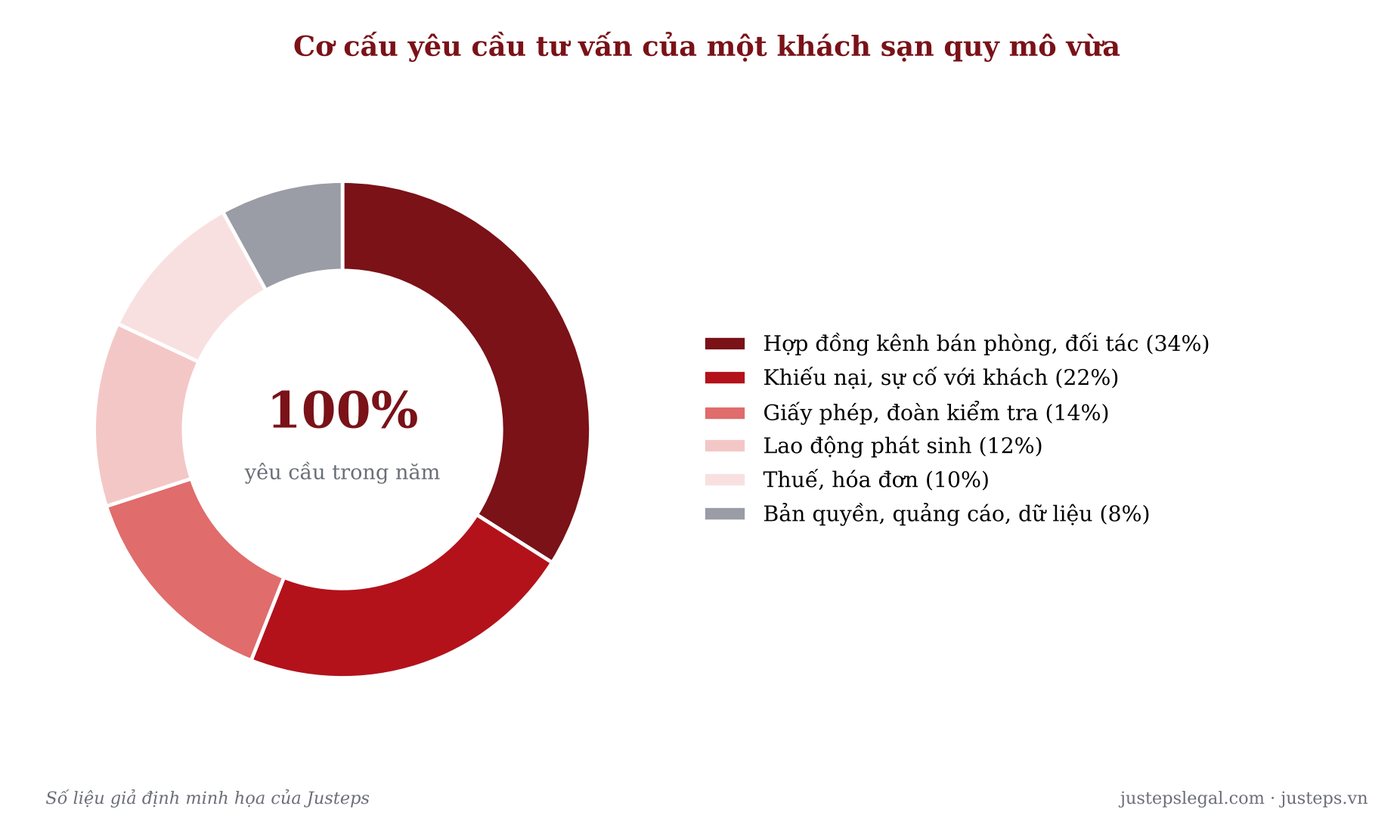
Example of the breakdown of advisory requests over one year at a medium-sized hotel
In this example, contracts with online travel agencies, travel companies and partners account for 34% of requests, guest complaints and incidents for 22%, and licences and inspections for 14%. Labour matters arising account for 12%, tax and invoices for 10%, and copyright, advertising and guest data for 8%. Although the licence and inspection group is smaller, it is usually urgent and has the most serious consequences, so Justeps always gives it same-day priority.
Business conditions and recently changed documents
The year 2026 has brought many changes for accommodation establishments. Decree No. 392/2026/ND-CP, effective from 15 November 2026, amends the rules on security and order conditions for conditional business lines, including the duty of accommodation establishments to check guests’ documents[1]. The rules on notification of guest stays were amended and have applied since 1 July 2026[2], and in November 2026 the National Assembly passed laws amending the Law on Tourism[3], the Law on Fire Prevention, Fire Fighting, Rescue and Salvage[4] and the Law on Intellectual Property[5].
Newly passed laws require guiding documents before businesses know exactly which conditions have changed. Justeps follows the guiding documents, compares each new condition with the establishment’s records and tells the business what it needs to do and by when, rather than sending a general summary of the document. Recurring obligations such as equipment inspections, fire drills, renewal of certificates, purchase of compulsory fire and explosion insurance where required and application of the new minimum wage from 1 January 2027[6] are built into each establishment’s annual compliance calendar.
Contracts with online travel agencies and management companies
The terms of online travel agencies (OTA) are usually general conditions in English, governed by foreign law and accepted with a single click when the account is opened. The points Justeps reviews closely include rate parity commitments across channels, penalties when the establishment refuses or cancels bookings, the platform’s rights over images, content and guest data, and how commission is calculated and paid. On tax, whether the business must declare and pay tax on behalf of a foreign supplier on the commission paid depends on whether that supplier has registered and declared tax directly in Vietnam under the law on tax administration[7], so this needs to be checked for each channel.
Management agreements with international brands usually last ten to twenty years and include a base fee calculated on revenue, an incentive fee calculated on profit, performance targets, termination rights and the cost of rebranding. The management company’s template is a starting point for negotiation rather than a fixed document, and the clauses on the owner’s rights when business results fall below target usually carry the greatest value. Before the owner signs or renews a management agreement, Justeps can review the entire document through the commercial contract drafting and review service.
Leasing houses for homestays and tourist apartments
Homestay chains usually lease many houses or apartments from individuals, and leases drafted by landlords often state only residential use or no purpose at all. When the stated purpose does not allow accommodation business, the business may have difficulty meeting the business conditions, may have the lease terminated by the landlord or may lose its renovation investment. For apartments in residential buildings, the building rules and the fire safety conditions of the whole building may restrict short-term letting to tourists.
Justeps reviews the lease before it is signed and proposes clauses on the permitted use, the landlord’s consent to renovation and business registration, reimbursement of renovation costs on early termination and liability where the building does not meet fire safety conditions. Justeps gives the property development team a list of conditions to check before leasing, to be used for every new location.
Background music, promotional content and online reviews
Playing background music in the lobby, restaurant or pool area, or showing television programmes in guest rooms, is a use of works, sound recordings and broadcasts for commercial purposes, which usually requires permission or payment of royalties under intellectual property law[5]. Many establishments learn of this obligation only when they receive a letter from a collective copyright management organisation. Justeps reviews music sources, agreements with television providers and images used in promotion to identify what is already licensed and what requires an agreement.
With negative online reviews, harsh public responses, disclosing the guest’s personal information or threatening legal action usually make the matter bigger and may breach the rules on personal data protection[8]. Justeps drafts calm response templates that do not disclose guest information, and for seriously false content guides the business to request removal under the platform’s policy after the evidence has been reviewed.
When an inspection team arrives outside office hours
Inspection teams on security and order, fire prevention or food safety often work in the evening, at weekends or during holiday peaks, when the management team is not present and the person receiving them is the front office shift leader. The staff on duty then need a simple sequence telling them what to do, as in the flowchart below.
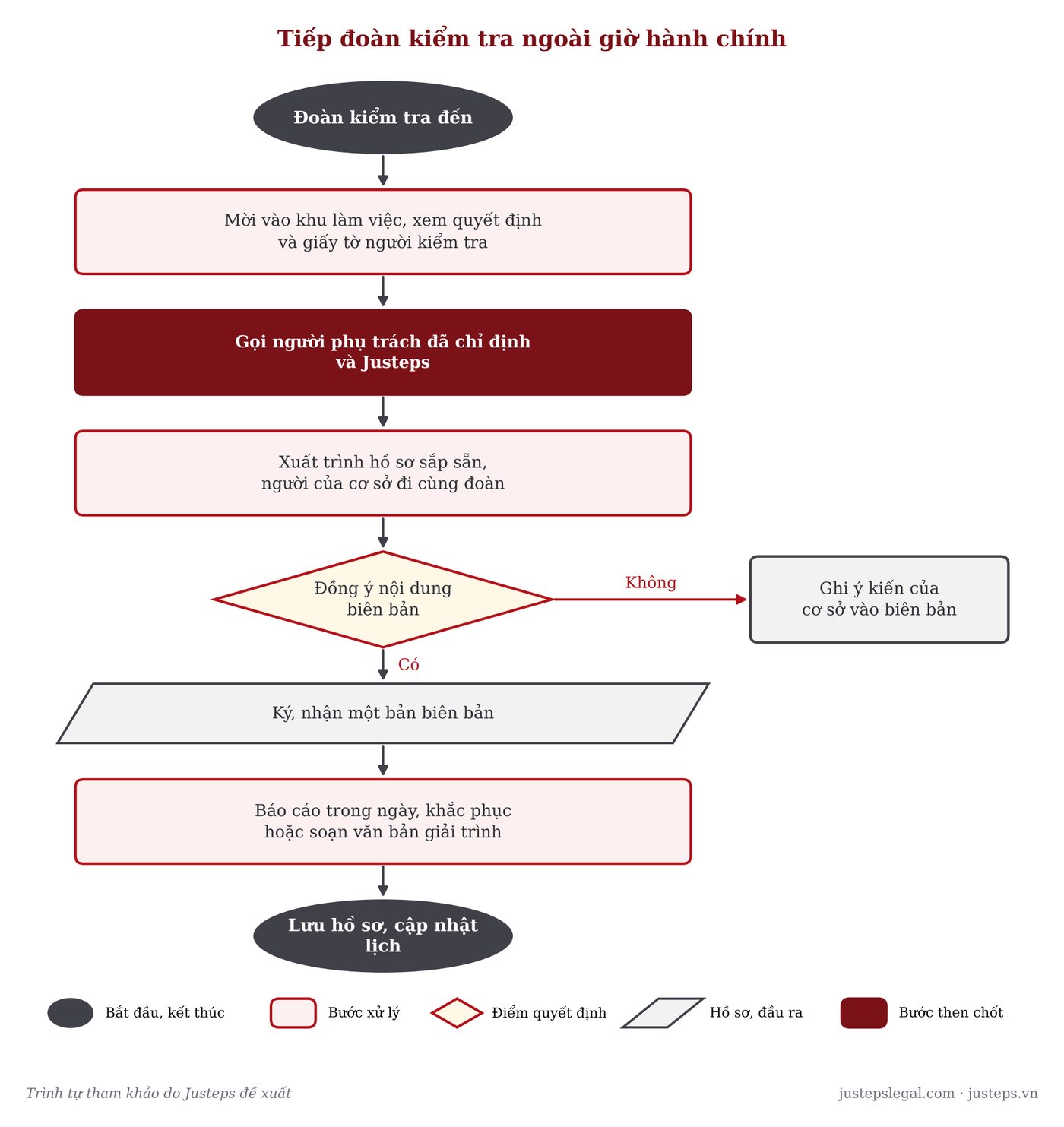
Sequence for receiving an inspection team outside office hours at an accommodation establishment
Under this sequence, the shift leader invites the team into a working area, asks to see the decision or assignment document and the inspectors’ identification, and immediately calls the designated person in charge and Justeps. The records presented come from the file prepared in advance at the front desk, and a staff member of the establishment accompanies the team throughout the inspection. Before signing the minutes, the shift leader reads the content again and records the establishment’s comments if it disagrees, then asks for a copy and reports the same day so that Justeps can propose remedial action or draft a written explanation. At the business’s request, a Justeps adviser gives guidance by telephone or attends the meeting in person.
Complaints, compensation and disputes
A guest injured at the pool, food poisoning after a banquet, property lost from a room or disclosure of personal information are situations that may lead to compensation claims. Justeps assesses the liability of the establishment and of the suppliers or contractors involved, reviews insurance conditions, drafts written responses and supports the business in negotiation or mediation with the guest. The business should also note that the limitation period for bringing a contract dispute is three years from the date the party with the right knew or should have known that its rights had been infringed[9].
Justeps does no litigation and does not bring or defend lawsuits. When the business decides to take a dispute with a guest, landlord, management company or contractor to court or arbitration, all the records, the evidence reviewed and the analysis are handed over to a practitioner of the business’s own choosing.
How we work, what you receive and fees
In the first month Justeps reviews the licences, the most recent inspection records, the main contracts and the open matters of each establishment, then sends a status report together with the annual compliance calendar. From the second month, the business sends requests through the agreed contact, and requests relating to an inspection or an ongoing incident are handled immediately through the urgent channel. The records the business receives include the following documents:
- A legal status report for each establishment, identifying weaknesses to be remedied before inspections.
- An annual compliance calendar and a list of licences and certificates with their expiry dates.
- A flowchart for receiving inspection teams and templates for written explanations, for use on night shifts and at weekends.
- Advisory opinions, contracts and documents drafted or reviewed, filed with the business’s records for later reference.
- Periodic reports on open matters, risks to be monitored and relevant changes in the law.
Justeps quotes the fee monthly, quarterly or annually in writing after the initial meeting, depending on the number of establishments and rooms, ancillary services such as restaurants, spas and conferences, whether there is an international management company, the number of contracts to review, the need for bilingual documents and the commitment to respond outside office hours. A business with a single homestay usually needs only advice on a case-by-case basis combined with the periodic corporate legal review service, while matters relating to shifts, service charges and staff insurance are handled in depth under the labour, wages and social insurance service for hotel, resort and homestay businesses.
How Justeps can help
Alongside Ongoing legal advisory, hotel, resort and homestay businesses may combine the following Justeps services:
- Internal procedures and regulations for hotel, resort and homestay businesses. Justeps drafts procedures for check-in, guest registration, revenue control and incident handling to reduce the number of situations that have to be dealt with case by case.
- Labour, wages and social insurance services for hotel, resort and homestay businesses. Justeps standardises contracts, shifts, service charges and insurance for permanent staff, seasonal workers and interns.
- Commercial contract drafting and review. Justeps drafts and reviews management agreements, land and building leases and high-value renovation contracts.
- Personal data protection and cybersecurity. Justeps prepares the records for processing guest data from booking software, online sales channels and CCTV systems.
- Periodic corporate legal review. Justeps periodically reviews all licences, contracts and internal records for establishments that do not yet need an ongoing advisory package.
Frequently asked questions
Does a homestay need an ongoing advisory package?
A single homestay usually needs only advice on a case-by-case basis. A chain with several locations should use an ongoing package, because the number of leases, guest registration obligations and conditions at each location grows very quickly.
Does Justeps provide support when an inspection team arrives at night?
Yes, through the urgent contact channel agreed in the package. The adviser guides the staff on duty by telephone and attends the establishment when needed.
Must tax be withheld when paying commission to a foreign online travel agency?
It depends on whether the foreign supplier has registered and declared tax directly in Vietnam[7]. Justeps checks each channel and agrees with the accountant on the set of supporting documents to keep.
Does a hotel playing background music have to pay royalties?
Usually yes, because this is use for commercial purposes in a public place[5], unless the establishment uses a properly licensed music source. Justeps reviews the music sources and existing agreements.
Should the brand’s template management agreement be signed as it stands?
No. Fees, performance targets, termination rights and rebranding costs should be analysed and negotiated before signing, because the agreement lasts many years.
Does Justeps represent the business if a guest sues it?
No. Justeps assesses the matter, reviews the evidence, drafts documents and supports negotiation and mediation. When the business decides to take the matter to court or arbitration, the file is handed over to a practitioner of the business’s own choosing.
The Law on Tourism has just been amended, so what must an accommodation establishment do now?
For now the business continues to comply with the conditions currently in force[3] and follows the effective date and the guiding documents. Justeps compares each new condition with the establishment’s records and reports what needs to be done once the documents are issued.
Related articles
- Internal procedures and regulations for hotel, resort and homestay businesses by shift and by department
- Organisational structure design for hotel, resort and homestay businesses by operating model and room count
- Labour, wages and social insurance services for hotel, resort and homestay businesses with shift work and service charges
- Building a customer complaint handling procedure that complies with the law, sets clear authority and leaves an audit trail
Notes
[1] Government Decree No. 96/2016/ND-CP dated 1 July 2016 on security and order conditions for certain conditional business lines, as amended and supplemented by Decree No. 392/2026/ND-CP dated 20 October 2026, effective from 15 November 2026.
[2] Article 30 of the Law on Residence No. 68/2020/QH14, as amended and supplemented by Law No. 118/2025/QH15, effective from 1 July 2026.
[3] The Law on Tourism No. 09/2017/QH14 dated 19 June 2017, as amended and supplemented by the law passed by the National Assembly on 21 November 2026.
[4] The Law on Fire Prevention, Fire Fighting, Rescue and Salvage No. 55/2024/QH15, as amended and supplemented by the law passed by the National Assembly on 20 November 2026.
[5] The Law on Intellectual Property No. 50/2005/QH11, the laws amending and supplementing it and the amending law passed by the National Assembly on 21 November 2026.
[6] Government Decree No. 399/2026/ND-CP dated 2 November 2026 on the minimum wage for employees working under labour contracts, applicable from 1 January 2027.
[7] The Law on Tax Administration No. 108/2025/QH15, effective from 1 July 2026.
[8] The Law on Personal Data Protection No. 91/2025/QH15, effective from 1 January 2026.
[9] Article 429 of the Civil Code No. 91/2015/QH13 dated 24 November 2015.
This article is for reference and reflects the regulations in force at the time of publication. Please consult Justeps for advice tailored to your company’s records and situation.
For further information, please contact:
📩 Email: info@justeps.vn
🌐 Website: https://justepslegal.com · https://justeps.vn
🌐 Page: Justeps
☎️ Hotline (Zalo): 096 172 2607
📍 Thanh Xuan Office: 12th Floor, Licogi 13 Tower, 164 Khuat Duy Tien Street, Thanh Xuan Ward, Hanoi, Vietnam
📍 Ha Dong Office: LK06B, No.10, Dong Dua Area, Ha Dong Ward, Hanoi, Vietnam
📍 Ho Chi Minh City Branch: 528 Le Van Sy, Ho Chi Minh City, Vietnam
📍 Hai Phong Office: Truong Thinh Village, Ha Dong Commune, Hai Phong, Vietnam
📍 Quang Ninh Office: Van Don Special Zone, Quang Ninh Province, Vietnam





