
Key takeaways
- The risks of import-export transactions often surface late, when a buyer pays late or the customs authority re-examines declarations from several years earlier, so the value of ongoing advisory lies in reviewing matters before signing and before declaring.
- Contracts on a foreign counterparty’s template often choose a governing law and dispute resolution forum favourable to that counterparty, while the 1980 Vienna Convention may apply automatically if the contract does not exclude it[1].
- When a post-clearance audit decision is issued, the business needs to review the list of declarations and prepare explanations from the outset, because the audit conclusion is the basis for tax recovery and penalties[6].
- In 2027 there are two major milestones for import-export businesses, namely the law amending the Law on Customs effective from 1 March 2027[13] and the law amending the Commercial Law and the Law on Foreign Trade Management effective from 1 July 2027[4].
An import-export business is simultaneously governed by several systems of rules, including the contract law of Vietnam or of the counterparty’s country, the international convention on the sale of goods, customs and tax law, product management rules and the banks’ rules on international payments. Each system changes at its own pace, while commercial staff must make decisions within a few hours when a customer sends a contract or goods are already at the port. Advice on individual matters only helps once a problem has arisen, whereas ongoing advisory enables the business to ask at the right time, before signing and before declaring.
This page describes Justeps’ ongoing legal advisory service for import-export trading businesses, including the types of matter that typically arise during the year, how Justeps handles each type, how urgent requests are received and the legal changes to be tracked in 2026 and 2027. Justeps advises on substance, drafts and reviews documents and works alongside the business with administrative authorities, but it does not file customs declarations on the business’s behalf and does not undertake litigation.
Matters import-export businesses typically raise during the year
The volume of requests differs from business to business, but the mix is usually fairly stable. Most requests relate to foreign trade contracts and questions about the tariff codes, customs value and origin of new products, followed by letters of credit, tax and claims against counterparties. The chart below is an example of the mix of requests over one year at a business that both imports machinery for distribution and exports processed agricultural products.
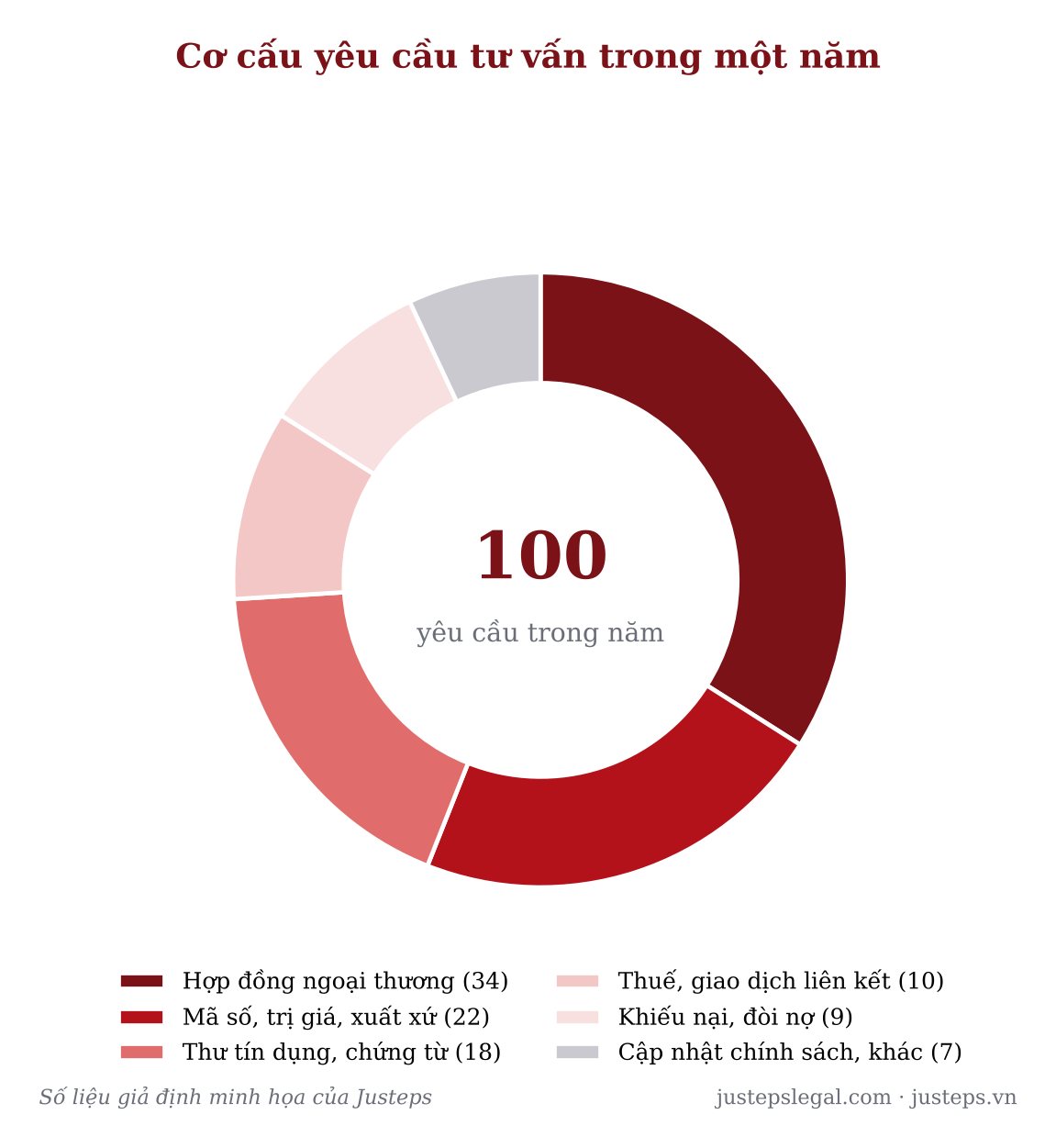
Example mix of 100 advisory requests over one year at an import-export business
In the example, 34 of 100 requests concerned drafting, reviewing or negotiating foreign trade contracts, distribution agreements and entrustment agreements, 22 concerned tariff codes, customs value, origin and product policies, and 18 concerned letters of credit and payment document sets. VAT, tax refunds and transactions with related companies accounted for 10 requests, quality claims and debt recovery for 9 requests, and the remaining 7 related to policy updates and other matters. Justeps uses this mix to assign suitable specialists to each business and to agree response times for each type of matter.
Foreign trade contracts on the counterparty’s template
Vietnamese businesses often sign on contract templates prepared by the foreign buyer or seller. These templates often choose the law of the counterparty’s country, resolve disputes in courts or arbitration in that country, limit the counterparty’s liability and give it the right to reject goods based on inspection results from an inspector it appoints. Where the contract between parties whose places of business are in member states does not exclude it, the United Nations Convention on Contracts for the International Sale of Goods applies[1], and many businesses are unaware of this until a dispute arises.
When reviewing, Justeps focuses on the clauses that determine who actually bears the risk, namely the Incoterms delivery terms and the time when risk passes, quality inspection standards and venue, the time limit for claims, the price adjustment mechanism, force majeure, the governing law and the dispute resolution forum. As regards the forum, arbitration is often preferred because awards are readily recognised in many countries under the 1958 New York Convention[2], but the business needs to weigh the costs and where the counterparty holds assets. The limitation period for initiating arbitration is generally two years from when the rights were infringed, unless specialised law provides otherwise[3], so the claim deadlines in the contract need to be monitored closely.
Justeps drafts a set of bilingual template contracts for recurring transactions, with an appendix of fallback positions that the sales function is permitted to concede during negotiations. Export and import entrustment agreements and agency agreements clearly specify who is the customs declarant, who bears the tax obligations and who bears the risk when goods are detained, in accordance with current commercial law[4].
Letters of credit and rejected document sets
A letter of credit is a safe payment method for the seller only when the documents presented comply with its terms. Banks examine documents on their face, so a minor discrepancy in the description of goods, the bill of lading date, the number of originals or the way the consignee is stated may be treated as a discrepancy, and the seller’s right to payment then depends on the buyer’s goodwill. Most discrepancies can be avoided if the terms of the letter of credit are reviewed as soon as it is received, before the business accepts it and ships the goods.
Under the advisory package, Justeps reviews the terms of a letter of credit within the working day it is received, pointing out terms that cannot be met or that conflict with the contract so that the business can request an amendment. When the bank reports discrepancies, Justeps identifies the error, assesses whether it can be corrected and the documents re-presented within the time limit, and drafts a letter asking the buyer to accept the discrepancies. Payments are also checked against the requirement for proof of payment through a bank so that exported goods retain the 0% VAT rate[5].
Customs value consultations, post-clearance audits and complaints
The customs authority may question the declared customs value and invite the business to a consultation, may carry out a post-clearance audit within five years from the date the declaration is registered[6], and may issue a tax assessment or penalty decision. Each procedure has its own deadline for explanations, right to provide further documents and right to complain. Penalties are applied under the decree on penalties for administrative violations in the customs sector effective from 1 July 2026[7], so the way the business explains itself at the early stage directly affects the outcome.
On receiving an audit decision, the business sends it to Justeps immediately so that the list of declarations can be reviewed, points likely to be found incorrect can be anticipated and a list of documents to be gathered can be prepared. Justeps drafts the explanations, works alongside the business with the audit team where needed and reviews the draft minutes before they are signed. Once the conclusion is issued, Justeps assesses the grounds so that the business can choose whether to comply or to complain under the law on complaints[8], and drafts the complaint if the business so decides. If the business wishes to bring an administrative lawsuit, Justeps prepares the case file for the business to pursue itself or to pass to a practitioner of the business’s own choosing.
Trade remedies, origin and transactions with related companies
Goods exported to certain markets may be subject to anti-dumping, anti-subsidy or anti-circumvention investigations, and importers in those markets often ask the Vietnamese business to answer questionnaires or prove the origin of materials. Justeps helps the business assess the extent of its exposure, gather supply chain and origin records, coordinate with the Vietnamese foreign trade authority as required[9] and work with specialists in the importing market where the response must be made under that country’s law. Requests for origin verification from the authorities of the importing country are handled in the same way.
Foreign-invested enterprises that buy from or sell to their parent company or companies in the same group need an additional layer of review. The price of transactions with related parties affects customs value and must also meet the rules on related-party transactions when calculating corporate income tax[10]. Justeps reviews intra-group contracts, royalties and year-end price adjustments so that these two obligations do not conflict.
Tracking legal changes in 2026 and 2027
The end of 2026 and the year 2027 bring many new documents that directly affect import-export businesses. Under the advisory package, Justeps sends a short bulletin each month on changes to tariff schedules, lists of managed goods, trade agreements and trade remedy cases relevant to the business’s products, with an opinion on which regulations or template contracts need amending. The timeline below summarises the main milestones.
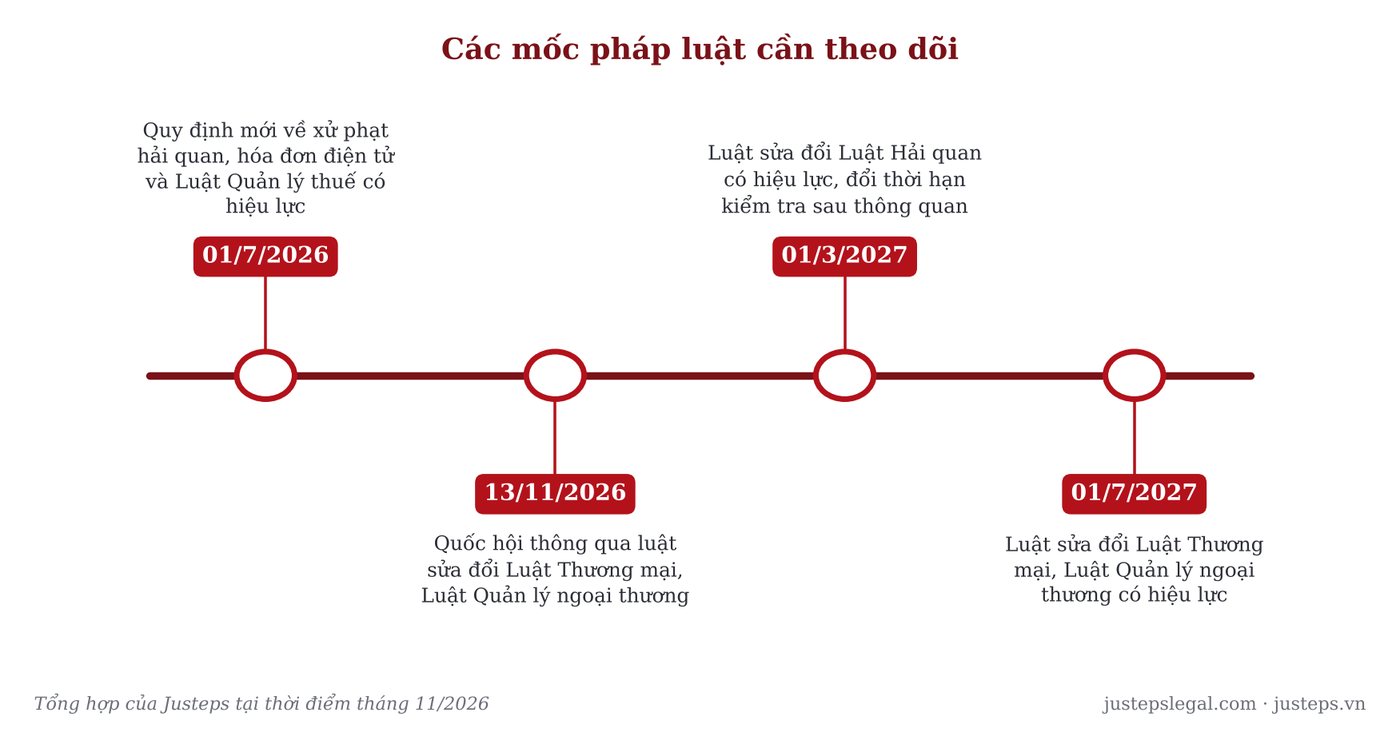
Main legal milestones for import-export businesses in 2026 and 2027
From 1 July 2026, the new rules on penalties in the customs sector[7], electronic invoices[11] and the new Law on Tax Administration[12] all took effect. On 13 November 2026, the National Assembly passed the law amending and supplementing the Commercial Law, the Law on Competition, the Law on Foreign Trade Management and the Law on Consumer Rights Protection, effective from 1 July 2027[4]. Between these two milestones, the law amending the Law on Customs takes effect from 1 March 2027, including changes to the duration and procedure of post-clearance audits[13]. Justeps reviews the business’s template contracts and regulations before each milestone and updates the internal procedures and regulations for import-export trading businesses if the business already has them.
Receiving requests and handling urgent matters when goods are at the port
Many matters in an import-export business have deadlines measured in hours, such as goods held at the port pending additional documents, a bank reporting discrepancies close to the payment deadline or a counterparty sending a contract to be signed the same day. From the first month, the two sides agree on contact persons, the channel for sending requests and how urgency is classified. The sequence below shows how Justeps receives and handles a request.
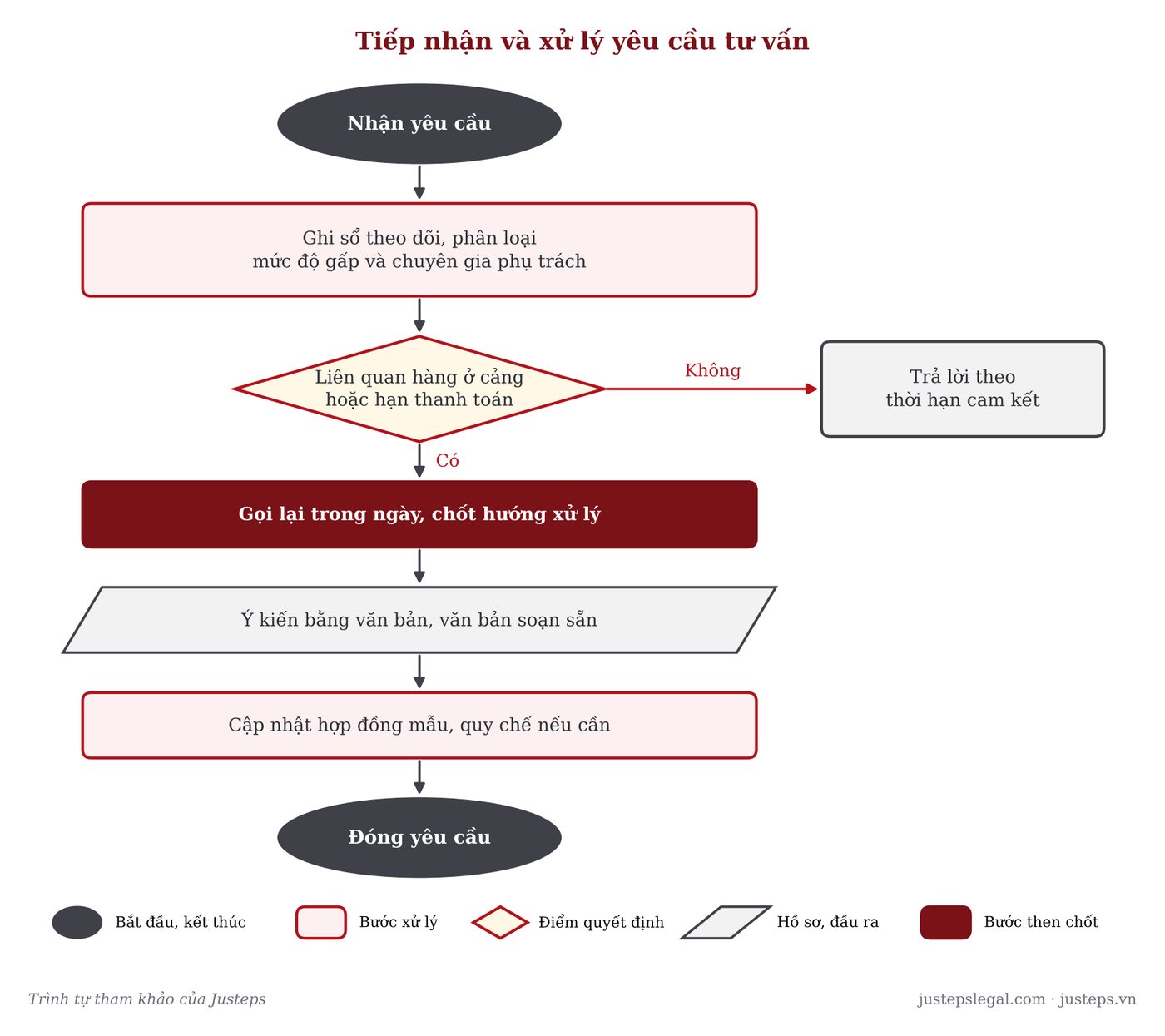
Sequence for receiving and handling requests under the ongoing legal advisory package
Every request is entered in a shared tracking log. Urgent matters concerning goods at the port or a payment deadline receive a call back from the responsible specialist on the same day to agree the approach, after which the written opinion is finalised. Ordinary matters are answered within the time committed in the service contract. For quality claims or debt recovery against counterparties, Justeps drafts letters, supports negotiation and mediation and prepares the arbitration file, while proceedings before courts or arbitral tribunals abroad are pursued by the business itself or entrusted to a practitioner in that country of the business’s own choosing.
Deliverables and fees
The first month is the foundation stage, in which Justeps reviews the template contracts in use and samples a number of declarations and origin files to identify outstanding risks. From the second month, the business sends requests weekly, receives the monthly bulletin and a quarterly risk report, and at year end the two sides assess the volume to adjust the scope. During the year, the business receives the following documents:
- A baseline review report on contracts and customs files, setting out points requiring immediate remediation.
- A set of bilingual foreign trade template contracts with an appendix of fallback positions for negotiations.
- Checklists for letter of credit terms and document sets before acceptance and before presentation.
- A log of advisory opinions on tariff codes, customs value and origin, used as a basis for explanations.
- A monthly legal bulletin and a quarterly risk report for management.
- The explanation and complaint files and documents for each matter handled.
Justeps quotes a monthly or annual fee in writing after the initial meeting. The fee depends on the number of foreign trade contracts per month, the number of products and markets, the number of declarations to be sampled, the need for bilingual drafting, the committed response times and whether working alongside the business with the customs authority is included. A business unsure of its volume may start with a three- to six-month package and then move to an annual package.
How Justeps can help
In addition to ongoing legal advisory, import-export trading businesses can combine the following Justeps services:
- Internal procedures and regulations for import-export trading businesses. Justeps turns recurring advisory opinions into shared rules on tariff codes, customs value, origin and file retention.
- Organisational structure design for import-export trading businesses. Justeps identifies who holds each control point so that advisory opinions are received and applied within the business.
- Labour, wages and social insurance services for import-export trading businesses. Justeps handles contracts, commissions, confidentiality and foreign employees for the international sales team.
- Drafting and reviewing commercial contracts. Justeps drafts major contracts such as exclusive distribution, long-term entrustment or framework agreements with foreign groups.
- Tax, customs and international trade. Justeps carries out in-depth projects on tax refunds, goods classification or the value of related-party transactions.
Frequently asked questions
Does Justeps draft bilingual contracts?
Yes. Bilingual contracts are drafted with a clause stating which language version prevails in case of inconsistency, and Justeps also reviews English versions sent by counterparties.
Should a foreign trade contract choose arbitration or the courts?
Arbitration is often more suitable because awards are recognised in many countries under the New York Convention[2]. The business still needs to weigh costs, language, where the counterparty holds assets and the limitation period[3].
What should we do first when the bank reports a discrepant document set?
Identify the specific error immediately, check whether there is still time to correct and re-present the documents, and at the same time contact the buyer to ask it to accept the discrepancies. All exchanges should be in writing to preserve evidence.
What if we disagree with a post-clearance audit conclusion?
The business has the right to complain against the administrative decision under the law on complaints[8] or to bring an administrative lawsuit. Justeps assesses the grounds and time limits and drafts the complaint file, while any lawsuit is pursued by the business itself or entrusted to a practitioner of the business’s own choosing.
Does Justeps help recover debts from foreign counterparties?
Yes, by assessing the matter, drafting demand letters, negotiating, mediating and preparing the arbitration file. Proceedings before foreign courts usually require a practitioner in that country, chosen by the business under a separate agreement.
Can we start with a short-term package?
Yes. A three- to six-month package covers the baseline review and handling of matters that arise, after which the two sides use actual data to design a suitable annual package.
Related articles
- Organisational structure design for import-export trading businesses by order flow and control point
- Internal procedures and regulations for import-export trading businesses from contract to shipment file
- Labour, wages and social insurance services for import-export trading businesses with commissions and foreign employees
- Ongoing legal advisory for logistics, warehousing and freight transport businesses
Notes
[1] The 1980 United Nations Convention on Contracts for the International Sale of Goods (CISG), in force for Vietnam from 1 January 2017.
[2] The Convention on the Recognition and Enforcement of Foreign Arbitral Awards, signed in New York in 1958, to which Vietnam is a party.
[3] Article 33 of the Law on Commercial Arbitration No. 54/2010/QH12 dated 17 June 2010.
[4] The Commercial Law, the Law on Foreign Trade Management and the Law amending and supplementing a number of articles of the Commercial Law, the Law on Competition, the Law on Foreign Trade Management and the Law on Consumer Rights Protection, passed by the National Assembly on 13 November 2026 and effective from 1 July 2027.
[5] The Law on Value-Added Tax No. 48/2024/QH15 and Article 17 of Government Decree No. 181/2025/ND-CP dated 1 July 2025, together with the documents amending and supplementing them.
[6] Article 77 of the Law on Customs No. 54/2014/QH13 dated 23 June 2014, as amended and supplemented by subsequent laws, most recently Law No. 11/2026/QH16 effective from 1 March 2027.
[7] Government Decree No. 169/2026/ND-CP dated 15 May 2026 on penalties for administrative violations in the customs sector, effective from 1 July 2026.
[8] The Law on Complaints and the documents amending and supplementing it.
[9] The Law on Foreign Trade Management and the documents amending and supplementing it.
[10] Government Decree No. 255/2026/ND-CP dated 30 June 2026 on related-party transactions, effective from 1 July 2026.
[11] Government Decree No. 254/2026/ND-CP dated 30 June 2026 on electronic invoices and electronic documents, effective from 1 July 2026.
[12] The Law on Tax Administration No. 108/2025/QH15, effective from 1 July 2026.
[13] Law No. 11/2026/QH16 amending and supplementing a number of articles of the Law on Customs, effective from 1 March 2027.
This article is for reference and reflects the regulations in force at the time of publication. Please consult Justeps for advice tailored to your company’s records and situation.
For further information, please contact:
📩 Email: info@justeps.vn
🌐 Website: https://justepslegal.com · https://justeps.vn
🌐 Page: Justeps
☎️ Hotline (Zalo): 096 172 2607
📍 Thanh Xuan Office: 12th Floor, Licogi 13 Tower, 164 Khuat Duy Tien Street, Thanh Xuan Ward, Hanoi, Vietnam
📍 Ha Dong Office: LK06B, No.10, Dong Dua Area, Ha Dong Ward, Hanoi, Vietnam
📍 Ho Chi Minh City Branch: 528 Le Van Sy, Ho Chi Minh City, Vietnam
📍 Hai Phong Office: Truong Thinh Village, Ha Dong Commune, Hai Phong, Vietnam
📍 Quang Ninh Office: Van Don Special Zone, Quang Ninh Province, Vietnam





