
Key takeaways
- The legal framework for insurance changes constantly, most recently with Law No. 139/2025/QH15 effective from 1 January 2026 and Circular No. 96/2026/TT-BTC with a new commission table applying from 1 January 2027, so businesses need a contact point that monitors it continuously[1][3].
- Insurance disputes are usually decided by evidence created at the point of sale, so advice is most valuable when it is brought in before products, marketing materials and sales scripts are released.
- An insurer must still perform its obligations to customers when an agent is in breach and only then require the agent at fault to reimburse it, so each case of agent misconduct needs to be handled on both fronts at once[6][7].
- The limitation period for contract disputes is three years, so a decision to reject a claim may be reopened long after the file has been closed[9].
A working day in the legal department of an insurance business usually involves very different questions, for example whether a claim can be rejected because the customer did not declare a pre-existing condition, whether a new benefit illustration can be used, or how to respond when a partner bank asks to amend the fee clause. Each question needs a quick but well-founded answer, and many recur with the sales season or with each round of inspections. Case-by-case advice often cannot keep up with that pace, while smaller businesses and corporate agents are not large enough to maintain a legal department specialising in insurance.
This page introduces Justeps’ ongoing legal advisory service for life, non-life and health insurance businesses, foreign-invested businesses and organisations acting as insurance agents, including businesses outside the sector that sell insurance alongside their own products. It focuses on the groups of issues that commonly arise, how Justeps receives and answers requests, the periodic deliverables and fees. Justeps is a consulting company and only supports work outside the courts, so for disputes Justeps assesses the case, prepares the file and advises on negotiation and mediation, for the business to pursue itself or to hand over to a licensed practitioner of its choice.
Legal changes businesses need to monitor
The 2022 Law on Insurance Business has been amended by Law No. 139/2025/QH15, effective from 1 January 2026, with changes such as stricter standards for managers, a requirement to register premiums for life and health products, a rule that an agent may only work for one business of the same type, and stronger specialised inspection[1]. The Government has issued Resolution No. 32/NQ-CP of 2026 confirming that Decree No. 46/2023/ND-CP, Decree No. 67/2023/ND-CP and Decree No. 174/2024/ND-CP on administrative penalties remain in force until amended or supplemented[2]. Where the amended law provides differently from a decree, the instrument of higher legal force prevails, so every answer must be checked against both the amended law and the existing guiding instruments.
At circular level, Circular No. 96/2026/TT-BTC dated 2 July 2026 amends Circular No. 67/2023/TT-BTC on premium allocation for unit-linked insurance, the cost of insurance, commission, bonuses and support for agents, with the new maximum commission table applying from 1 January 2027[3]. The table below summarises the key dates and what businesses should do for each.
| Date | Content | What businesses should do |
|---|---|---|
| 1 January 2026 | Law No. 139/2025/QH15 takes effect. | Review agency contracts, the code issuance procedure and standards for managers. |
| 2 July 2026 | Circular No. 96/2026/TT-BTC takes effect, except for certain clauses. | Update premium allocation rules, notices of premium changes and monitoring of advice quality. |
| 1 January 2027 | The new commission table and bonus limits apply. | Amend the commission policy, incentive programmes and agency contracts before this date. |
Groups of issues that commonly arise
The largest group of issues concerns claims linked to exclusion clauses and the duty of disclosure. The law requires exclusion clauses to be fully explained and confirmed by the policyholder[4], and a rejection for failure to disclose truthfully must be linked to a specific question in the application and to the insured event that occurred. If the business cannot prove that it explained the exclusion clause, Justeps usually recommends considering payment or negotiation rather than maintaining the rejection.
The second group concerns sales materials, such as benefit illustrations assuming high returns, leaflets calling unit-linked products savings, or sales scripts that omit investment risk. The third group concerns partner contracts with banks acting as agents, e-commerce platforms, ride-hailing apps, e-wallets, loss adjusters and foreign reinsurers, where contracts with banks must comply with the prohibition on tying non-compulsory insurance to banking services[5]. The fourth group is agent misconduct such as misappropriation of premiums, forged signatures or mis-selling, which requires liability to customers, termination of the contract, recovery of money and communication with the press to be handled at the same time.
The figure below shows a typical breakdown of advisory requests over one year at a medium-sized insurance business, to illustrate where advisory time is usually concentrated.
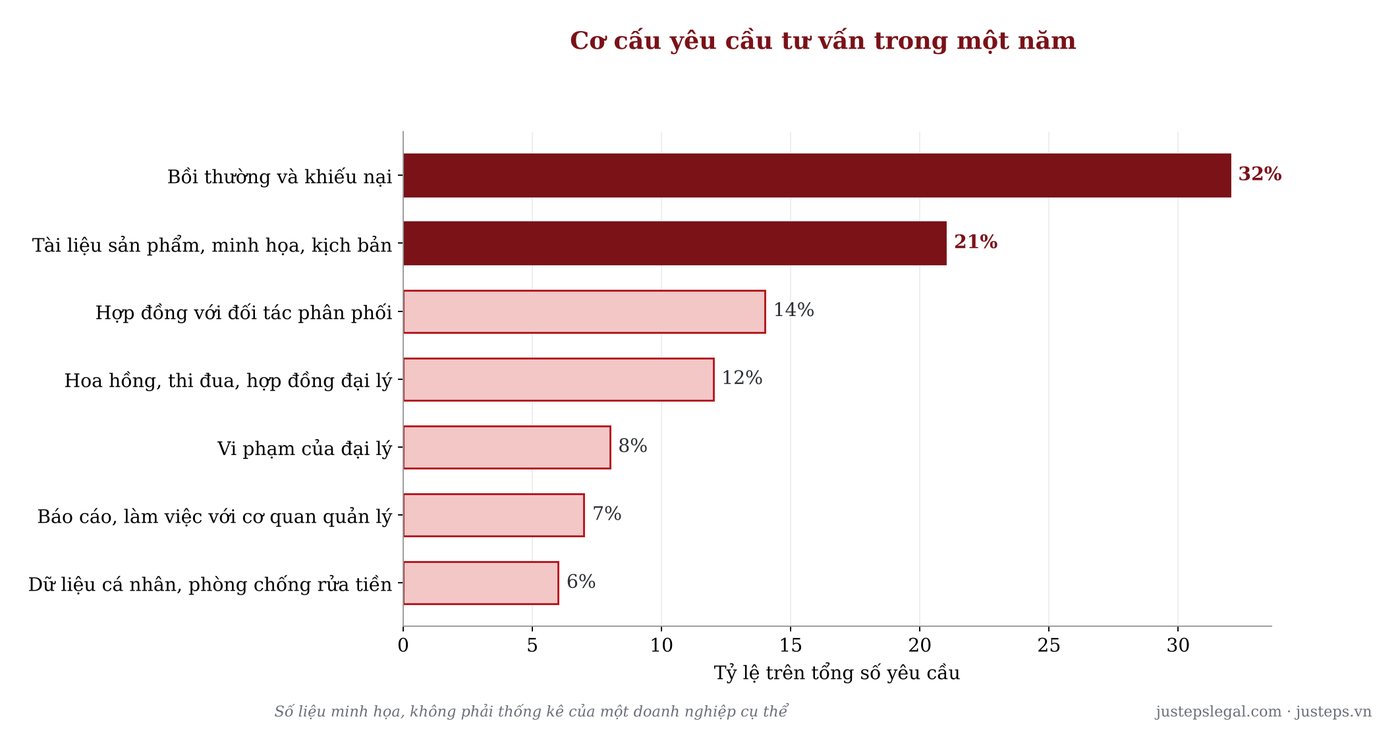
Illustrative breakdown of advisory requests at a medium-sized insurance business
Claims, complaints and product materials account for most requests, so Justeps’ advisory package usually assigns a person with insurance operations experience as the main contact for these two groups. Partner contracts and agent misconduct generate fewer requests, but each case takes considerable time and involves large amounts. For corporate agents the proportions are quite different, as most questions relate to agency contracts, commission and liability for mis-selling.
Handling agent misconduct and customer complaints
The insurer must still perform its obligations under insurance contracts concluded by agents, even where the agent breaches the agency contract[6]. After settling with the customer, the insurer is entitled to require the agent to reimburse compensation paid as a result of the agent’s fault[7]. In these cases, Justeps helps the business determine its liability to the customer first, then prepares the documents to terminate the agency contract, the reimbursement demand and the response to the press, so that the three do not contradict each other.
When a dispute cannot be resolved by the parties themselves, they may negotiate, mediate or refer it to arbitration or the courts in accordance with their agreement and the law[8]. The limitation period for contract disputes is three years from the date the person entitled to make the claim knew or ought to have known that their lawful rights and interests had been infringed[9], so claim rejection files should be kept in full for at least that period. Justeps prepares the case assessment, the response to the complaint and the negotiation and mediation strategy; if the business decides to sue or is sued, the file is handed over to a licensed practitioner chosen by the business.
How Justeps works month by month
The first month is a familiarisation phase, during which Justeps reads the licence, product rules, agency contracts, claims procedure, complaint files from the past year and the most recent inspection conclusions. The result is a list of priority risks and an agreement on the contact point, response times by level of urgency and how customer data will be kept confidential. From the second month, the service runs in the cycle shown below.
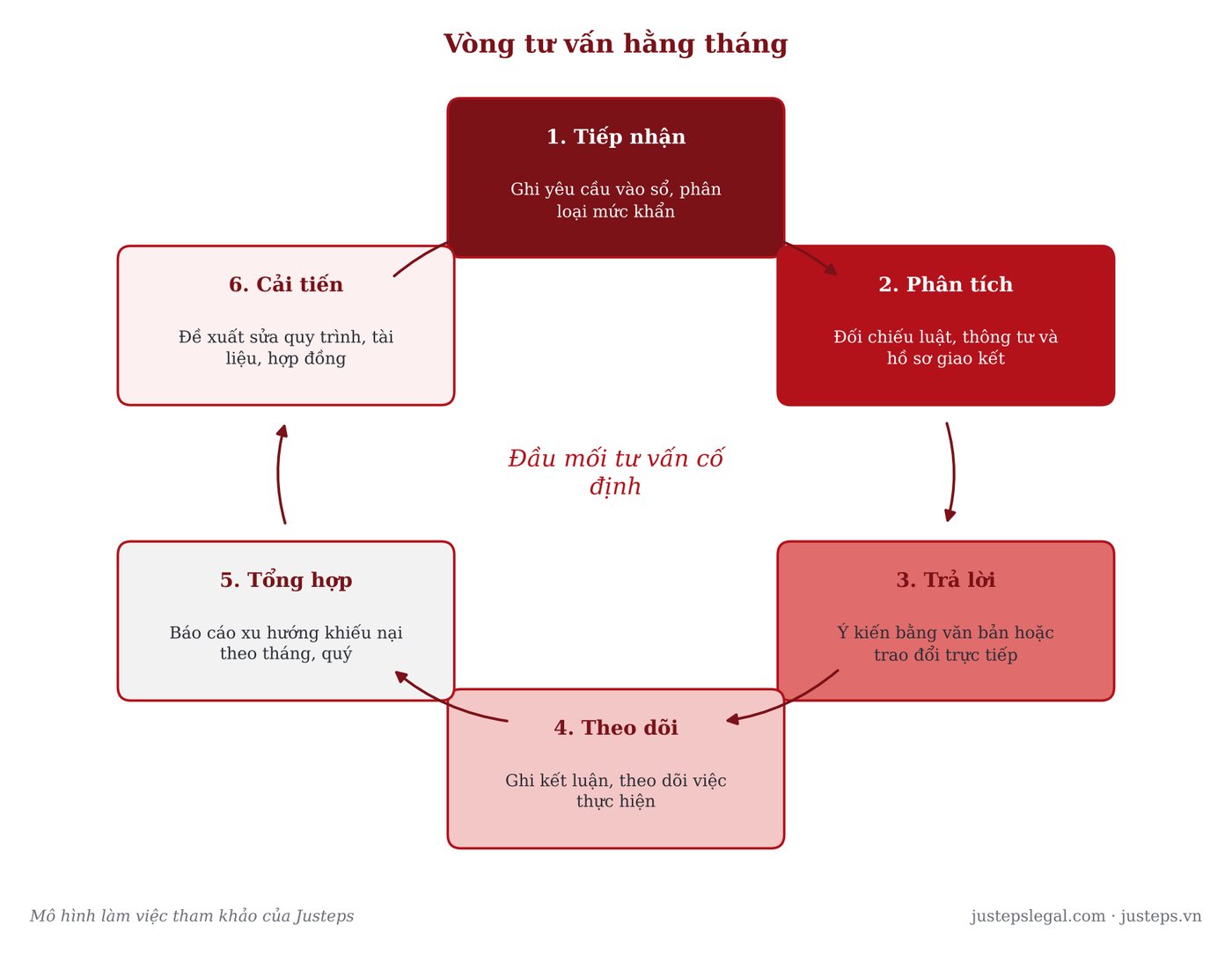
Monthly ongoing legal advisory cycle
Each request is entered in a tracking log with the time of receipt, the person who answered and the conclusion, so that the business can look it up again when a similar question arises. At the end of each month or quarter, Justeps summarises complaint trends and recurring questions and proposes amendments to procedures, sales materials or template contracts. Where a proposal needs to become a new regulation, the drafting can be carried out under building internal procedures and regulations for insurance businesses and insurance agents.
Deliverables, suitable clients and fees
At the end of each period, the business receives the advisory tracking log, written legal opinions on major issues, the contracts and product materials reviewed, a complaint analysis report, a legal update bulletin and short training materials for the sales channels. Life insurers usually use the service for issues relating to sales, agents and long-term contracts, non-life insurers for claims, loss adjusting, reinsurance and large losses, while foreign-invested businesses need bilingual advice and a comparison of group policies with Vietnamese regulations. Corporate agents and businesses outside the sector that sell insurance have a leaner package focused on agency contracts, certificates, premium remittance and liability to customers.
Justeps quotes a monthly or annual fee in writing after the initial discussion. The main factors are the type of insurance, the number of products and distribution channels, the expected volume of complaints, the committed response time, the need for bilingual work and whether the business needs support with mediation or with inspection teams. Justeps works in Hanoi, Hai Phong, Quang Ninh and Ho Chi Minh City and online with businesses in other provinces.
How Justeps can help
Alongside ongoing legal advisory, insurance businesses and insurance agents may combine the following Justeps services:
- Building internal procedures and regulations for insurance businesses and insurance agents. Justeps turns proposals arising during the advisory work into formally issued procedures for sales, claims and agency management.
- Labour, payroll and insurance services for insurance businesses and insurance agents. Justeps reviews agency contracts and commission and bonus policies against the new table applying from 1 January 2027.
- Drafting and reviewing commercial contracts. Justeps drafts and reviews contracts with banks, digital platforms, loss adjusters and reinsurers.
- Legal and media crisis management. Justeps supports insurance businesses when an agent’s misconduct or mass complaints spread to the media.
Frequently asked questions
Can an insurer reject a claim because the customer did not declare a pre-existing condition?
It may, but only where the insurance application asked specifically about that condition, the policyholder deliberately failed to declare it and the conditions under the contract and the law are met[10]. Justeps checks the contract formation file before the business makes its decision.
Is the insurer liable if an agent gives the customer wrong advice?
As a rule, the insurer is liable to the customer for contracts concluded by its agents[6]. The insurer is then entitled to require the agent at fault to reimburse the amount paid[7].
How far does Justeps’ support go when a dispute has to go to court?
Justeps is a consulting company; work before the courts is carried out by the business itself or by a licensed practitioner it engages. Justeps assesses the case, prepares the file, takes part in negotiation and mediation at the business’s request and hands the file over to the practitioner chosen by the business.
Do incentive programmes for agents need a legal review?
Yes, because bonuses and support for agents are capped under Ministry of Finance rules, and Circular No. 96/2026/TT-BTC has changed these caps[3]. Justeps also checks whether a programme encourages mis-selling.
How is customer data sent to Justeps kept confidential?
The parties sign a confidentiality undertaking, health data is anonymised where possible and only those directly handling the matter have access, in line with the Law on Personal Data Protection[11].
Does a small corporate agent need an ongoing advisory package?
A small corporate agent usually only needs a compact package focused on agency contracts, advisory staff certificates, premium remittance and liability for mis-selling. This package can be charged by the number of hours or requests per month.
Related articles
- Ongoing legal advisory for securities, investment fund and consumer finance businesses
- Building internal procedures and regulations for insurance businesses and insurance agents
- Labour, payroll and insurance services for insurance businesses and insurance agents
- Legal compliance for fintech businesses, electronic identification, data protection and cooperation with banks
Notes
[1] Law No. 139/2025/QH15 dated 10 December 2025 amending and supplementing a number of articles of the Law on Insurance Business, effective from 1 January 2026.
[2] Government Resolution No. 32/NQ-CP of 2026 on the continued application of the decrees guiding the Law on Insurance Business.
[3] Circular No. 96/2026/TT-BTC dated 2 July 2026 of the Ministry of Finance amending and supplementing Circular No. 67/2023/TT-BTC dated 2 November 2023; certain clauses on agents’ commission and bonuses take effect from 1 January 2027.
[4] Article 19(2) of the Law on Insurance Business No. 08/2022/QH15 dated 16 June 2022, as amended and supplemented by Law No. 139/2025/QH15 dated 10 December 2025.
[5] Article 15(5) of the Law on Credit Institutions No. 32/2024/QH15 dated 18 January 2024.
[6] Article 128(2)(g) of the Law on Insurance Business No. 08/2022/QH15 dated 16 June 2022, as amended and supplemented by Law No. 139/2025/QH15 dated 10 December 2025.
[7] Article 129(2)(g) of the Law on Insurance Business No. 08/2022/QH15 dated 16 June 2022, as amended and supplemented by Law No. 139/2025/QH15 dated 10 December 2025.
[8] Article 32 of the Law on Insurance Business No. 08/2022/QH15 dated 16 June 2022, as amended and supplemented by Law No. 139/2025/QH15 dated 10 December 2025.
[9] Article 429 of the Civil Code No. 91/2015/QH13 dated 24 November 2015.
[10] Article 22(1) of the Law on Insurance Business No. 08/2022/QH15 dated 16 June 2022, as amended and supplemented by Law No. 139/2025/QH15 dated 10 December 2025.
[11] Law on Personal Data Protection No. 91/2025/QH15.
This article is for reference and reflects the regulations in force at the time of publication. Please consult Justeps for advice tailored to your company’s records and situation.
For further information, please contact:
📩 Email: info@justeps.vn
🌐 Website: https://justepslegal.com · https://justeps.vn
🌐 Page: Justeps
☎️ Hotline (Zalo): 096 172 2607
📍 Thanh Xuan Office: 12th Floor, Licogi 13 Tower, 164 Khuat Duy Tien Street, Thanh Xuan Ward, Hanoi, Vietnam
📍 Ha Dong Office: LK06B, No.10, Dong Dua Area, Ha Dong Ward, Hanoi, Vietnam
📍 Ho Chi Minh City Branch: 528 Le Van Sy, Ho Chi Minh City, Vietnam
📍 Hai Phong Office: Truong Thinh Village, Ha Dong Commune, Hai Phong, Vietnam
📍 Quang Ninh Office: Van Don Special Zone, Quang Ninh Province, Vietnam





