
Key takeaways
- 2026 brings several changes that directly affect studios: the Law on Personal Data Protection and the amended Law on Advertising took effect on 1 January 2026, and the amended Law on Intellectual Property takes effect on 1 April 2026[6].
- For videos made for corporate clients, the hardest question is usually not the price but who owns the rights in the product, the scope of use and the rights in the music and in the images of people appearing in the film.
- Studios that post promotional content on social media or hire influencers to introduce their services must comply with the new requirements on identifying advertising content[5].
- An ongoing advisory package gives the studio a same-day answer to situations as they arise, such as a client demanding a deposit back, images being copied or a client asking for data to be deleted, instead of handling them by instinct.
- Justeps does not provide litigation services; when a dispute arises, Justeps assesses the matter, prepares the file and supports negotiation and mediation, so that the studio can act itself or pass the matter to a practitioner of its own choosing.
Owners of wedding studios and video production companies rarely have an in-house legal team, yet legal questions come up almost every week. A corporate client sends a twenty-page contract demanding full rights even to the raw footage, a couple asks for their photographs to be removed from the showcase page after they split up, an unknown account reposts the studio’s photo set to advertise its own services, or a one-star review spreads through brides’ groups. Each situation needs a quick answer, and the wrong answer can turn a small matter into a dispute.
This page introduces Justeps’ ongoing legal advisory service on an annual package for photo studios, wedding studios and video production companies. It sets out the groups of matters studios most often need help with, the notable legal changes in 2026, how Justeps receives and answers requests, the scope of the package and the factors that determine fees. The studio’s organisational structure, internal procedures and labour documentation are covered on separate service pages.
The legal matters studios face most often
From working with businesses in the sector, studios’ advisory requests tend to fall into six groups. The chart below is an example of the distribution of requests over one year at a studio that does both wedding photography and video work for businesses.
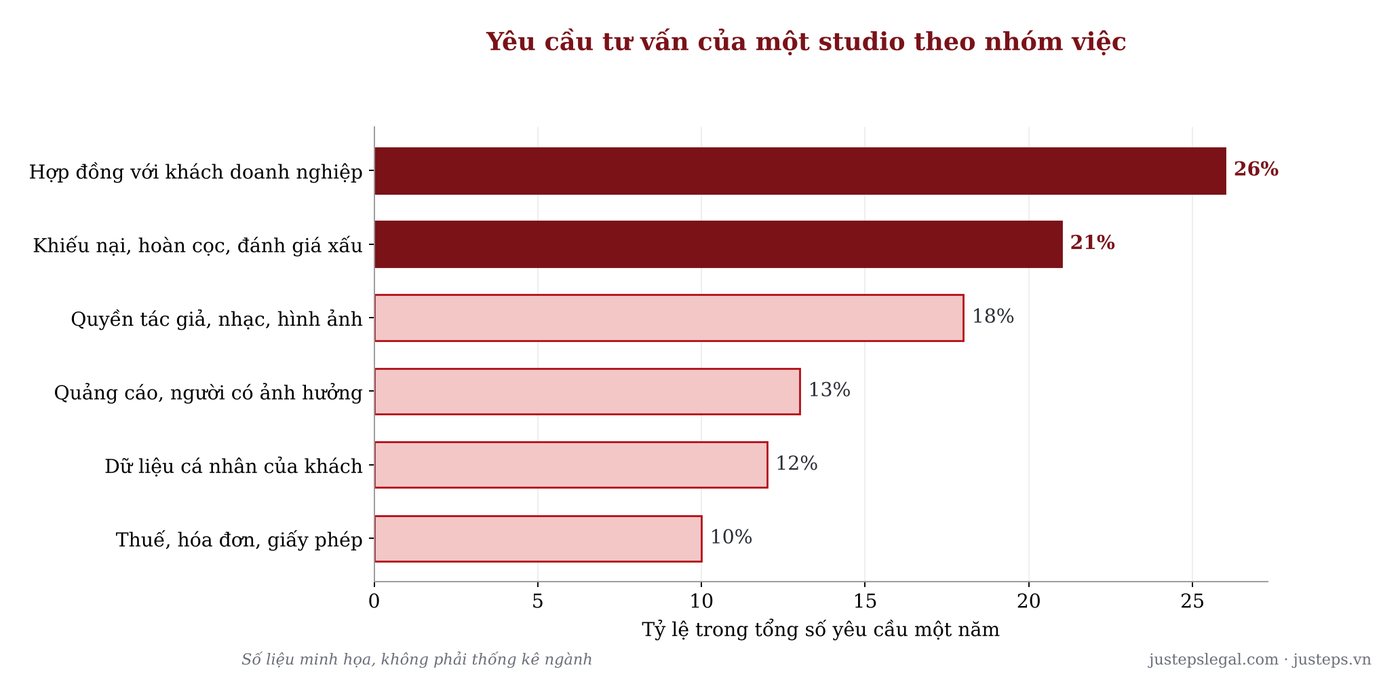
Example distribution of advisory requests over one year by group of matters
In this example, contracts with corporate clients and complaints from individual clients account for almost half of all requests, followed by copyright, music and the images of people appearing in the product. Questions on advertising, personal data, tax and invoices are fewer in number but are often linked to the risk of administrative penalties, so they need to be answered correctly from the outset.
Contracts with corporate clients and partners
Advertising videos, corporate films and event coverage are produced under service contracts, in which the points most often disputed are the scope of work, the number of editing rounds, acceptance criteria and clients delaying the final payment. Intellectual property law allows the parties to agree on who owns the copyright in a work created under a contract[1], so the studio needs to decide clearly whether it assigns all economic rights or only permits use within a defined scope, term and territory, and whether it keeps the raw footage. Justeps reviews contracts sent by clients, proposes amendments and drafts standard contract templates for each type of project.
Copyright, music and the images of people in the product
Wedding videos and advertising videos often use background music, while the rights in the sound recording and the musical work belong to others. Videos posted on sharing platforms may be blocked or receive claims if the studio does not hold an appropriate licence, and the contract with the client should state which party is responsible for the music. For models, actors and people appearing in a film, the studio needs an agreement on the use of their images under the Civil Code[2], particularly where the product is used for the client’s commercial purposes.
Complaints, negative reviews and disputes with individual clients
When a client demands a deposit back, criticises the quality or posts a negative review, Justeps helps the studio check the contract, the hand-over records and the stored correspondence, and then draft a measured response. The studio should resolve complaints through the mechanisms laid down by consumer protection law, namely negotiation and mediation, before either party chooses another route[3]. If the matter cannot be resolved by negotiation, Justeps assesses the prospects and prepares the evidence file so that the studio can act itself or pass the matter to a practitioner of its own choosing.
Legal changes in 2026 that studios need to know
2026 is a year with many new laws that directly affect how studios promote, store and use images. The timeline below summarises the main effective dates that the ongoing advisory package monitors and turns into action points for the studio.
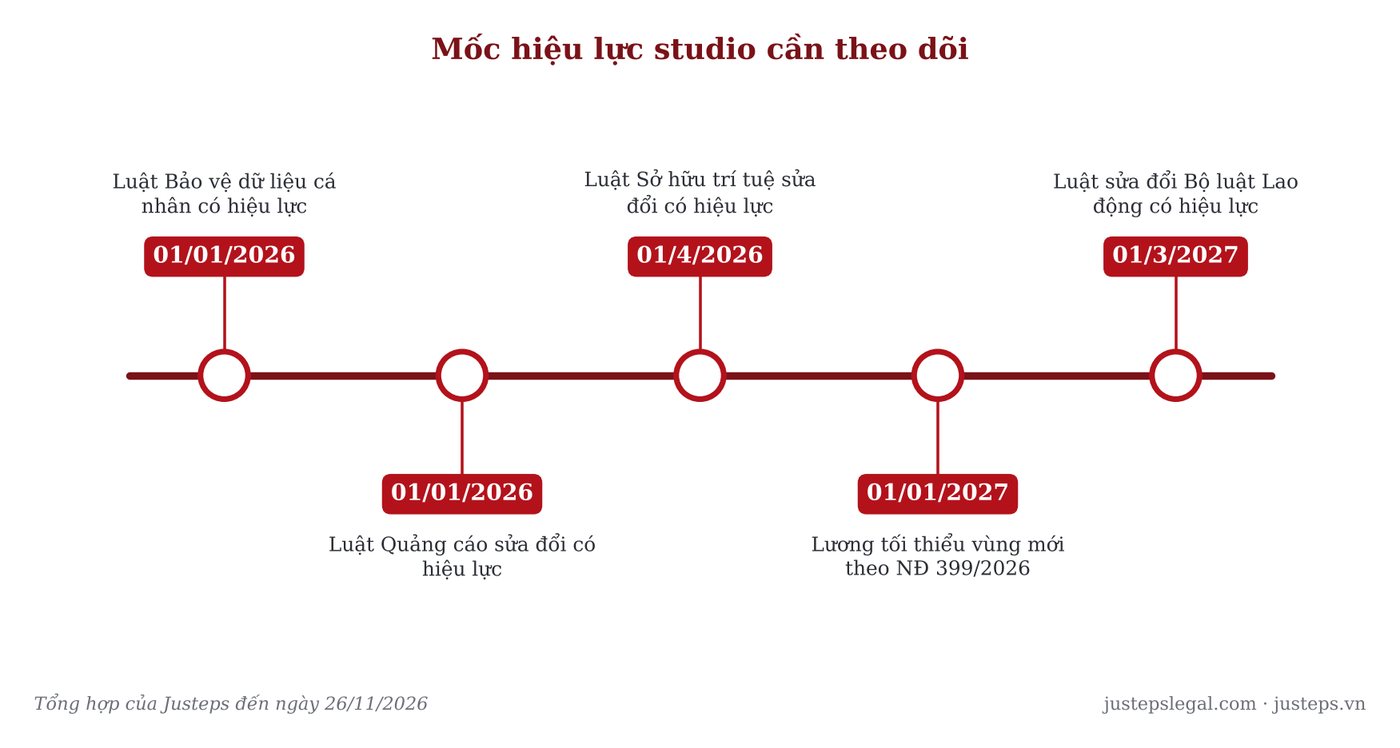
Effective dates of new laws relevant to photo studios and video production
The Law on Personal Data Protection No. 91/2025/QH15 took effect on 1 January 2026; under it, the studio as data controller must have a lawful basis for processing, inform clients and apply appropriate protective measures for clients’ photographs, films and information[4]. On the same day, Law No. 75/2025/QH15 amending the Law on Advertising took effect, adding obligations for those who disseminate advertising products, including influencers, and requiring online advertising content to be clearly identified[5]. Studios that hire well-known people to post images promoting their packages, or that post clients’ images with package prices themselves, should review how they label content and how they keep records of the collaboration.
Law No. 131/2025/QH15 amending the Law on Intellectual Property was passed on 10 December 2025 and takes effect on 1 April 2026[6]. According to the materials introducing the law, the points of note for studios are the added responsibility of digital platform operators for preventing infringement and the measure requiring removal of infringing content in the digital environment, together with a provision assigning the Government to guide how rights are established where works are created using artificial intelligence systems. These provisions give studios additional tools when their images are copied online, while also raising questions about rights in images edited with artificial intelligence tools, so the implementing guidance needs to be followed.
How Justeps works within the ongoing advisory package
The studio is assigned a lead consultant who understands its business model and files, supported by a team covering specialist areas such as intellectual property, data, tax and labour. Requests are sent by email or through a shared messaging group, classified by urgency and answered within the time committed in the service contract.
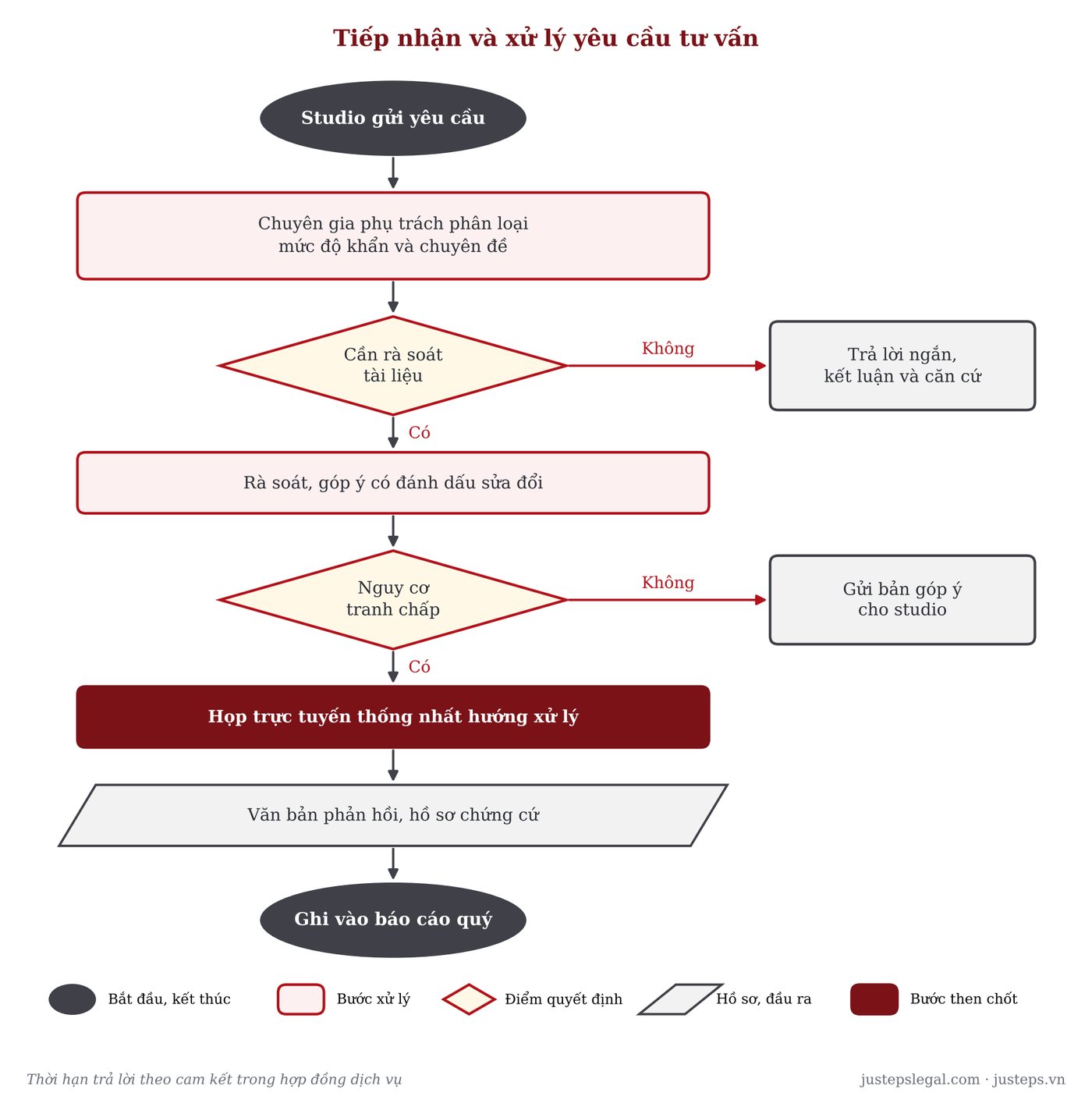
Sequence for receiving and handling an advisory request
Under this sequence, ordinary questions are answered with a short written note giving the conclusion, the legal basis and what the studio needs to do. Requests that require a document review, such as a corporate client’s contract, are returned as a marked-up commentary showing proposed amendments. Situations with a risk of dispute or involving dealings with state authorities are escalated to an online meeting to agree on the approach before the studio acts. Each quarter, Justeps sends a summary of the requests handled and the points that need to be amended in the template contracts or through the service for building internal procedures and regulations for studios if the same issue keeps recurring.
Package scope, suitable clients and fees
The scope of the package is agreed in the service contract from the start, so that the studio knows which work is covered by the annual fee and which is charged separately. The ongoing advisory package usually includes the following, adjusted to the size and needs of each studio:
- Answering legal questions on day-to-day operations by email, telephone and online meetings.
- Reviewing and commenting on contracts with corporate clients, venue rental partners, models and suppliers.
- Drafting responses to complaints, takedown requests for infringing content and letters to partners who are late in paying.
- Updates on changes in the law on copyright, advertising, personal data, tax and labour, with the action the studio needs to take.
- Attending the studio’s meetings with state authorities on request, within the scope of advisory work.
The package suits studios that have operated steadily for one to two years, have one or more showrooms or have a corporate video line with high-value contracts. Fees are charged annually and depend on the expected number of advisory hours each month, the number of contracts to be reviewed, the number of legal entities and locations, and whether the studio needs support in a foreign language with international clients. Justeps sends a written proposal after the initial discussion, setting out clearly the work inside and outside the scope of the package.
How Justeps can help
In addition to the ongoing advisory package, photo studios and video production companies can combine the following Justeps services:
- Building internal procedures and regulations for photo studios, wedding photography and video production. Justeps writes procedures for package sales, post-production and delivery and regulations on the use of client images to reduce recurring complaints.
- Labour, payroll and insurance services for photo studios, wedding photography and video production. Justeps standardises contracts with crews, per-shoot pay arrangements and insurance for employees and collaborators.
- Ongoing legal advisory for media, advertising and event agencies. Suitable for video production companies that work mainly on brands’ advertising campaigns.
- Drafting and reviewing commercial contracts. Justeps drafts a set of template contracts for video projects, copyright assignment and collaboration with influencers.
Frequently asked questions
If a corporate client asks for the raw footage as well, must the studio hand it over?
That depends on what the contract says about the scope of the product and the transfer of rights[1]. If the contract is silent, the studio should negotiate and record the point in an addendum, because raw footage has its own value and may contain images of people who have not consented to its use.
How should a studio deal with another account reposting its images for advertising?
The studio should preserve the evidence and send takedown requests to the person who posted them and to the platform. The 2025 amendment to the Law on Intellectual Property added responsibilities for digital platform operators to cooperate in handling infringing content[6].
May a studio use popular music as the soundtrack for a wedding video posted online?
The studio needs the right to use the musical work and the sound recording from the rights holder or a collective management organisation, or must use a music library with an appropriate licence. The contract with the client should state which party is responsible for the music.
If a couple who have separated ask for their wedding photographs to be removed from the studio’s page, must the studio comply?
The studio should remove them, because the use of images for promotion is based on the consent of the people in them, and those people have the right to withdraw consent[2]. The data regulations should set a removal deadline so that the studio handles such requests consistently.
If a client sues the studio, how far can Justeps help?
Justeps is a consulting company and does not provide litigation services. Justeps assesses the matter, prepares the file, supports negotiation and mediation, and hands the file over to a practitioner chosen by the studio when needed.
Does a small studio need an annual advisory package?
A newly established studio or one with few corporate contracts can start with a per-matter package or an hourly package. As the number of contracts and complaints grows, an annual package is usually more economical and gives the studio someone who follows its files continuously.
Related articles
- Building internal procedures and regulations for wedding photo studios and video production, from taking deposits to delivering the final product
- Organisational structure design for wedding photo studios and video production companies to protect bookings, deposits and client data
- Controlling advertising content within a business through a pre-publication approval procedure
- Personal data protection in the HR department under the 2025 Law on Personal Data Protection
Notes
[1] Article 39 of the Law on Intellectual Property No. 50/2005/QH11, as amended and supplemented by Law No. 36/2009/QH12, Law No. 42/2019/QH14, Law No. 07/2022/QH15 and Law No. 131/2025/QH15.
[2] Article 32 of the Civil Code No. 91/2015/QH13 dated 24 November 2015.
[3] Law on Protection of Consumer Rights No. 19/2023/QH15 dated 20 June 2023, provisions on resolving disputes between consumers and business organisations.
[4] Law on Personal Data Protection No. 91/2025/QH15, effective from 1 January 2026.
[5] Law on Advertising No. 16/2012/QH13 dated 21 June 2012, as amended and supplemented by Law No. 75/2025/QH15, effective from 1 January 2026.
[6] Law No. 131/2025/QH15 amending and supplementing a number of articles of the Law on Intellectual Property, passed on 10 December 2025, effective from 1 April 2026.
This article is for reference and reflects the regulations in force at the time of publication. Please consult Justeps for advice tailored to your company’s records and situation.
For further information, please contact:
📩 Email: info@justeps.vn
🌐 Website: https://justepslegal.com · https://justeps.vn
🌐 Page: Justeps
☎️ Hotline (Zalo): 096 172 2607
📍 Thanh Xuan Office: 12th Floor, Licogi 13 Tower, 164 Khuat Duy Tien Street, Thanh Xuan Ward, Hanoi, Vietnam
📍 Ha Dong Office: LK06B, No.10, Dong Dua Area, Ha Dong Ward, Hanoi, Vietnam
📍 Ho Chi Minh City Branch: 528 Le Van Sy, Ho Chi Minh City, Vietnam
📍 Hai Phong Office: Truong Thinh Village, Ha Dong Commune, Hai Phong, Vietnam
📍 Quang Ninh Office: Van Don Special Zone, Quang Ninh Province, Vietnam





