
Key takeaways
- The legal work of a retail chain is small in scale but repeats with every store, so an unfavourable clause in a template lease or template supplier contract is multiplied across dozens of locations.
- The right to renew and the right to terminate early are the two clauses in a premises lease that need the most careful negotiation, because they determine the cost when the chain has to close or keep a store[1].
- Display fees, new product listing fees and promotional support collected from suppliers need to be recorded according to their true nature in the contract and invoiced accordingly[4].
- Foreign-invested chains need to review their business licences and retail outlet establishment licences under Decree No. 342/2026/ND-CP before opening further stores[6].
The legal affairs of a retail chain have three characteristics that make a case-by-case approach less effective. First, the matters are small but repetitive, because each new store means a lease, a registration file and a set of business conditions. Second, stores are inspected by several authorities at once, from market surveillance, health and fire prevention to tax. Third, the chain deals directly with thousands of consumers every day, so a badly handled complaint can spread across social media within a few hours.
This page introduces Justeps’ ongoing legal advisory service for convenience store chains, mini-supermarkets and specialist store chains, under which Justeps acts as the point of contact for legal questions arising in operations on a monthly, quarterly or annual basis. It focuses on the matters retail chains ask about most and how Justeps organises its support. How staff work day to day in the stores is standardised separately under the internal procedures and regulations service for retail chain and convenience store businesses.
What a retail chain needs to ask about during the year
From the advisory engagements it has carried out, Justeps finds that retail chains’ requests concentrate on six groups of matters. The chart below illustrates the breakdown of requests over one year for a chain of about forty stores that is opening about ten new stores a year.
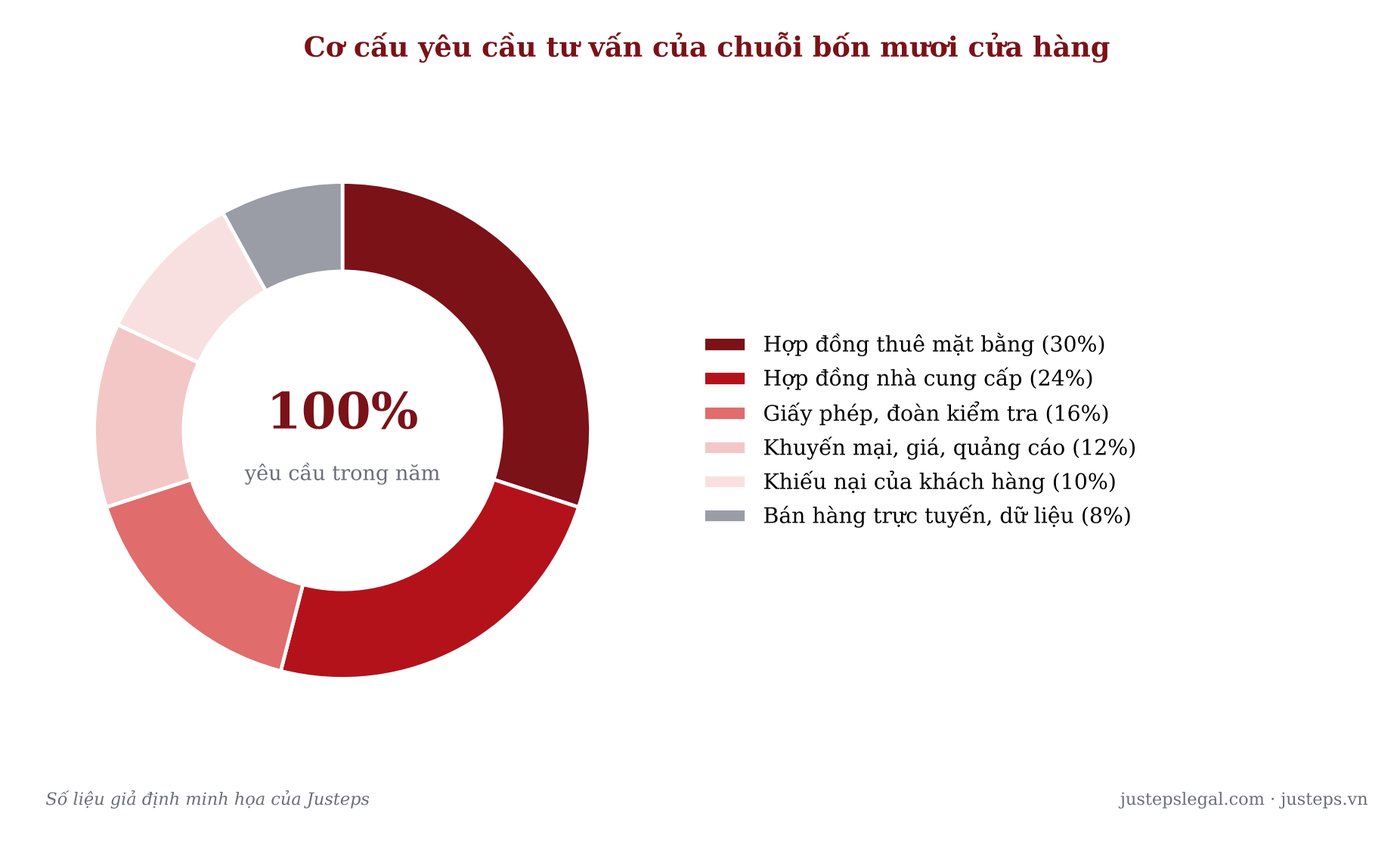
Example breakdown of advisory requests over one year for a chain of forty stores
In the example, premises leases account for 30% of requests because the chain is both opening new stores and renewing old ones. Supplier contracts account for 24%, store licences and inspections for 16%, and promotions, pricing and advertising for 12%. Customer complaints account for 10%, while online sales and customer data account for 8%. When the chain slows new openings to focus on existing stores, the share of leases falls and the share of promotions and member customers rises, so Justeps adjusts the scope of the engagement to each year’s business plan.
Premises leases for stores
A corner site near a school or a densely populated residential area is the asset that determines a convenience store’s sales, and the network development team often has to close the deal quickly before a competitor pays a deposit. That pressure leads many leases to be signed on the landlord’s template without checking whether the lessor has full authority, especially where the property is in the names of several people or is mortgaged. Justeps reviews the property documents and the deposit terms before money is transferred[1], and checks whether the intended use of the building meets the fire prevention conditions for business operations[2].
For a convenience store, the lease needs clauses that ordinary residential leases often omit, such as the right to operate overnight, the right to install signage and refrigeration equipment, the right to continue the lease if the landlord sells the property and the right to transfer the lease to a franchisee. The two highest-risk clauses are the right to renew and the right to terminate early, because compensation that seems small becomes large when the chain has to close several stores at once. When leasing from an individual, the lease should also state clearly which party declares and pays tax on the rent to avoid later disputes[3]. Justeps builds a set of fallback clauses for the network development team to use immediately in negotiations, and monitors the renewal notice deadline of each lease.
Supplier contracts and trade fees
A retail chain’s relationship with suppliers involves more than purchase prices and volume discounts. Chains often also charge fees for listing new products in the system, fees for prime display positions, promotional support fees and fees for inclusion in advertising leaflets. Each of these has a different nature: some are reductions in the price of goods purchased, while others are service revenue of the chain, so they need to be recorded correctly in the contract and invoiced according to the nature of the transaction[4].
Supplier contracts must also answer operational questions such as whether near-expiry goods may be returned, who bears the cost of destroying expired goods, what the supplier must do when a product recall notice is issued and who is responsible when goods do not meet quality standards. A chain with a strong position in the local market needs to be careful with clauses that squeeze prices, demand support outside the contract or prevent suppliers from selling to competitors, as these are matters that competition law may examine[5]. High-value or complex contracts can be dealt with in more depth through the commercial contract drafting and review service.
Store licences and inspections
Each store has its own list of licences and conditions, and this list changes when the store is refurbished, adds a fast-food counter or starts selling alcohol. There were several notable changes in 2026: the tobacco retail licence was abolished in the round of administrative simplification, the rules on product labelling were replaced and the rules on the purchase and sale of goods by foreign-invested enterprises were reissued[6]. Foreign-invested enterprises therefore need to check the business licence and retail outlet establishment licence of each store again before planning new openings. Justeps maintains a licence tracking table for the whole chain and sends alerts before renewal deadlines or when a new document changes the conditions.
When an inspection team arrives at a store, the store manager is often unsure what the team is authorised to inspect and what rights the store has. Under current policy, inspections and checks at an enterprise take place no more than once a year, except where there are clear signs of a violation[7]. Justeps drafts a one-page conduct guide to be displayed at the counter, covering asking to see the inspection decision, calling the chain’s point of contact immediately, providing exactly the documents requested and reading the record carefully before signing. After the inspection, Justeps assesses the record, drafts an explanatory letter and, where necessary, drafts a complaint against an administrative penalty decision for the business to submit.
Online sales, delivery apps and member customers
Many convenience store chains now have their own apps, storefronts on e-commerce marketplaces and connections with delivery apps. The Law on E-commerce, effective from 1 July 2026, imposes new obligations on sellers and platform operators[8], so the chain needs to determine which role it plays on each channel to know the corresponding obligations. Contracts with delivery apps need to be read carefully regarding commission, liability when goods are damaged in transit, who resolves complaints and the sharing of customer data.
Member customer schemes and promotional campaigns on apps are often designed by the marketing team, which rarely knows all the legal limits. Justeps reviews each scheme before launch regarding promotion procedures, advertising content, information that must be disclosed to consumers[9] and how consent to personal data processing is obtained[10]. A chain running many large campaigns during the year can combine this with the advertising, sales promotion and consumer protection service.
Customer complaints and disputes
Most complaints at convenience stores are minor matters such as wrong prices, near-expiry goods or staff attitude, and are resolved immediately under the internal regulations. A small number of cases need a legal opinion, such as a customer claiming food poisoning after eating fast food, a customer falling in the store or a customer posting a video featuring a staff member on social media. Justeps guides the store on preserving evidence, drafts the reply to the customer and the public response, assesses the business’s liability for compensation and advises on negotiation and mediation.
Justeps is a consulting company and does not undertake litigation. When a dispute with a customer, landlord or supplier cannot be resolved through negotiation, Justeps assesses the case, reviews the evidence and prepares the file so that the business can exercise its right to bring proceedings itself or pass the matter to a practitioner of its own choosing. Early preparation helps the business avoid missing limitation periods and have sufficient evidence when needed[1].
Receiving requests and ways of working
Each chain appoints a legal point of contact, usually the head of administration, the head of network development or the chief accountant, to collect questions from head office, regional managers and stores. The flowchart below describes how a question from a store is received and handled under the advisory engagement.
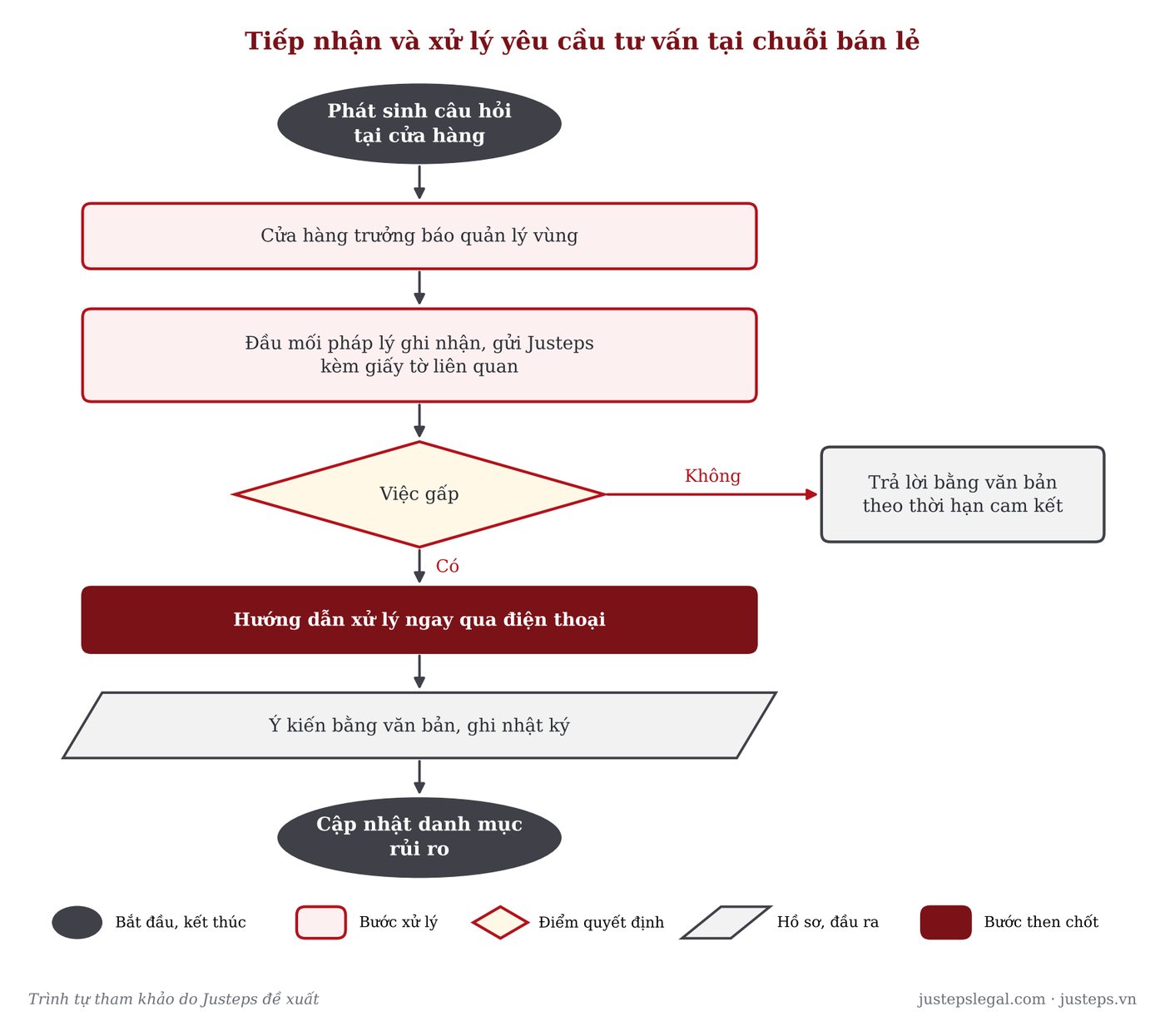
Sequence for receiving and handling requests under the ongoing legal advisory engagement for a retail chain
A question arising at a store is reported by the store manager to the regional manager, who passes it with the relevant documents to the legal point of contact, who then sends it to Justeps. Urgent matters, such as an inspection team currently on site or a customer complaining at the counter, are handled immediately by Justeps over the telephone, followed by a written opinion. Non-urgent matters are answered in writing within the response time committed under the engagement. Every request is recorded in a log, and issues that recur at several stores are added to the risk register so that the regulations or template contracts can be amended.
The first month is the baseline phase, in which Justeps reviews the licence list, template leases, template supplier contracts and any existing disputes. After that, each month the business receives a legal update relevant to the retail sector and a log of matters handled, and each quarter it receives a risk report and a list of licences about to expire. The documents the business receives comprise the following:
- A baseline review report on licences, leases and supplier contracts.
- A set of template premises leases and supplier contracts, with fallback clauses for negotiation.
- A table tracking licences and lease renewal deadlines for each store.
- A conduct guide for inspections, to be displayed in the store.
- A request log and written advisory opinions.
- A quarterly risk report for meetings of the executive team or the Board of Directors.
Justeps quotes the advisory fee in writing on a monthly or annual basis after the initial discussion. The fee depends on the number of stores, the pace of new openings, the number of contracts to be reviewed each month, the committed response time, the need for bilingual documents and whether participation in negotiations or dealings with State authorities is included. A chain that wants someone working on a regular schedule can consider the outsourced in-house legal service.
How Justeps can help
Alongside ongoing legal advisory, retail chain and convenience store businesses can combine the following Justeps services:
- Internal procedures and regulations for retail chain and convenience store businesses. Justeps writes procedures for goods receipt, displayed prices, shift closing and complaint handling to reduce the number of situations that need to be asked about again.
- Organisational structure design for retail chain and convenience store businesses. Justeps chooses the legal form of each store and assigns a person at head office to monitor licences.
- Commercial contract drafting and review. Justeps drafts and reviews high-value or complex leases, supplier contracts and franchise agreements.
- Advertising, sales promotion and consumer protection. Justeps reviews and handles the procedures for the chain’s major promotions and advertising campaigns.
Frequently asked questions
Does a chain of ten stores need an ongoing advisory engagement?
It is usually worthwhile when the chain is opening more stores, because each new store brings a lease, a registration file and its own set of conditions. A stable chain that rarely opens new stores can use hourly advice for each matter.
If the landlord sells the premises midway, can the store continue the lease?
This depends on the lease and on the civil law rules on property leases[1]. Justeps recommends stating the right to continue the lease when the landlord transfers the property from the moment the lease is signed.
What should be noted when charging suppliers display fees?
The fee should be stated clearly as either a service fee or a reduction in the price of goods purchased and invoiced according to its true nature[4]. A chain with a strong market position also needs to be careful with clauses that may be examined under competition law[5].
What should a foreign-invested enterprise do first before opening more stores?
It needs to check its existing business licence and retail outlet establishment licence, and the economic needs test requirements for the planned store, under Decree No. 342/2026/ND-CP[6]. Justeps prepares the list of documents and the timeline for each store.
How far does Justeps support a business when a dispute has to go to court?
Justeps is a consulting company and does not undertake litigation. Justeps assesses the case, drafts documents, advises on negotiation and mediation and prepares the file for the business to proceed itself or pass to a practitioner of its own choosing.
Can the advisory engagement be terminated midway?
The termination conditions are set out in the service contract between the business and Justeps. On termination, Justeps hands over the licence tracking table, the template contracts and the opinions provided so that the business can continue to use them.
Related articles
- Organisational structure design for retail chain and convenience store businesses, from store and region to head office
- Internal procedures and regulations for retail chain and convenience store businesses following the life cycle of goods and cash
- Exclusive distribution agreements, sales targets, territory, termination and handling of inventory
- Sales promotion procedures in 2026, when to notify, register and report results
Notes
[1] The Civil Code No. 91/2015/QH13 dated 24 November 2015 and the documents amending and supplementing it.
[2] The Law on Fire Prevention, Fire Fighting, Rescue and Salvage and the documents amending and supplementing it.
[3] The Law on Tax Administration No. 108/2025/QH15 and the guiding documents on tax declaration by individuals leasing out property.
[4] Government Decree No. 254/2026/ND-CP dated 30 June 2026 on electronic invoices and electronic documents.
[5] The Law on Competition and the documents amending and supplementing it.
[6] Government Decree No. 342/2026/ND-CP detailing the Commercial Law and the Law on Foreign Trade Management regarding the purchase and sale of goods and activities directly related to the purchase and sale of goods by foreign investors and foreign-invested economic organisations, replacing Decree No. 09/2018/ND-CP.
[7] Article 4 of National Assembly Resolution No. 198/2025/QH15 dated 17 May 2025 on a number of special mechanisms and policies for private sector development.
[8] The Law on E-commerce No. 122/2025/QH15, effective from 1 July 2026, and Government Decree No. 248/2026/ND-CP dated 30 June 2026 detailing that Law.
[9] The Law on Protection of Consumer Rights and the documents amending and supplementing it.
[10] The Law on Personal Data Protection No. 91/2025/QH15 and Government Decree No. 356/2025/ND-CP detailing that Law.
This article is for reference and reflects the regulations in force at the time of publication. Please consult Justeps for advice tailored to your company’s records and situation.
For further information, please contact:
📩 Email: info@justeps.vn
🌐 Website: https://justepslegal.com · https://justeps.vn
🌐 Page: Justeps
☎️ Hotline (Zalo): 096 172 2607
📍 Thanh Xuan Office: 12th Floor, Licogi 13 Tower, 164 Khuat Duy Tien Street, Thanh Xuan Ward, Hanoi, Vietnam
📍 Ha Dong Office: LK06B, No.10, Dong Dua Area, Ha Dong Ward, Hanoi, Vietnam
📍 Ho Chi Minh City Branch: 528 Le Van Sy, Ho Chi Minh City, Vietnam
📍 Hai Phong Office: Truong Thinh Village, Ha Dong Commune, Hai Phong, Vietnam
📍 Quang Ninh Office: Van Don Special Zone, Quang Ninh Province, Vietnam





