
Key takeaways
- The Law on Securities requires securities companies to establish internal control, risk management, segregation of client assets and priority for client orders, so these requirements must be visible on the organisation chart and not only in the regulations[1].
- For consumer finance companies, the proposed list of members of the Board of Directors or Members’ Council, the Supervisory Board and the General Director must be approved by the State Bank of Vietnam before election or appointment, so the personnel roadmap must be built into the restructuring timetable[4].
- Separating departments on paper is not enough; access rights to the trading system, the lending system and client data must be cut along exactly the same boundaries as the chart.
- Justeps delivers a gap report, the organisation chart and reporting lines, a list of regulated positions, a list of prohibited combinations of roles and a matrix of delegated authority by business line.
Securities companies, fund management companies and consumer finance companies share one feature: they do business with other people’s money, securities and trust. Regulators therefore ask not only whether the business is profitable, but also who may decide on transactions, who sets limits, who checks the decision-makers and to whom the checkers report. Many businesses in this group grow very quickly, adding business lines, branches and points of sale, while the organisation chart remains the one drawn up for the licence application and the control functions are concentrated in a handful of people holding several roles at once.
This page introduces Justeps’ organisational structure design service for three groups of financial businesses, namely securities companies, securities investment fund management companies and finance companies operating mainly in consumer lending. It focuses on the legal requirements that directly shape the organisation, the three lines of control model, the specific features of each type of business, common mistakes, the working process and the deliverables. Business regulations, ongoing advice and employment arrangements for finance sector staff are covered on separate service pages in the same group.
Why the law shapes the organisation of a financial business
In an ordinary business, the organisational structure is an internal matter and the owners are free to arrange it as they see fit. In a securities company, the Law on Securities No. 54/2019/QH14 already imposes a number of obligations that can only be met if the organisation has certain units, such as establishing internal control, risk management and supervision systems, preventing conflicts of interest, managing the assets of each client separately and executing client orders before the company’s own orders[1]. A fund management company must meet most of these obligations and must also calculate the net asset value of its funds, deposit all entrusted assets with a custodian and manage the assets of each entrusting client independently and separately from the company’s own assets[2].
A consumer finance company is subject to an entirely different legal framework. It is a non-bank credit institution regulated by the State Bank of Vietnam under the Law on Credit Institutions No. 32/2024/QH15. This Law requires credit institutions to have an internal control system made up of mechanisms, policies, procedures and internal rules to prevent, detect and deal with risks, and to establish an internal audit function reporting to the Supervisory Board[3]. Senior appointments are not entirely at the owners’ discretion either, because the proposed list of members of the Board of Directors or Members’ Council, the Supervisory Board and the General Director must be approved in writing by the State Bank of Vietnam before election or appointment[4].
In addition, all three types of business are reporting entities under the Law on Anti-Money Laundering No. 14/2022/QH15. Internal regulations on anti-money laundering must clearly set out the responsibilities of each individual and unit and the mechanisms for internal control and internal audit of compliance[5]. The person in charge of anti-money laundering must therefore have a defined position on the chart, access to transaction data and a reporting channel that does not pass through the business units.
Three lines of control as a common framework for all three types
Justeps uses the three lines of control model as its starting framework, because it answers the regulator’s question of who is responsible at each level. The first line consists of the business units, such as brokerage, proprietary trading, portfolio management, sales and loan appraisal, which identify and control risks themselves within each transaction. The second line comprises risk management, compliance and anti-money laundering, whose task is to set limits, monitor and raise alerts without being bound by sales targets. The third line is internal audit, which independently assesses the first two lines and reports to the Supervisory Board or the Board of Directors.
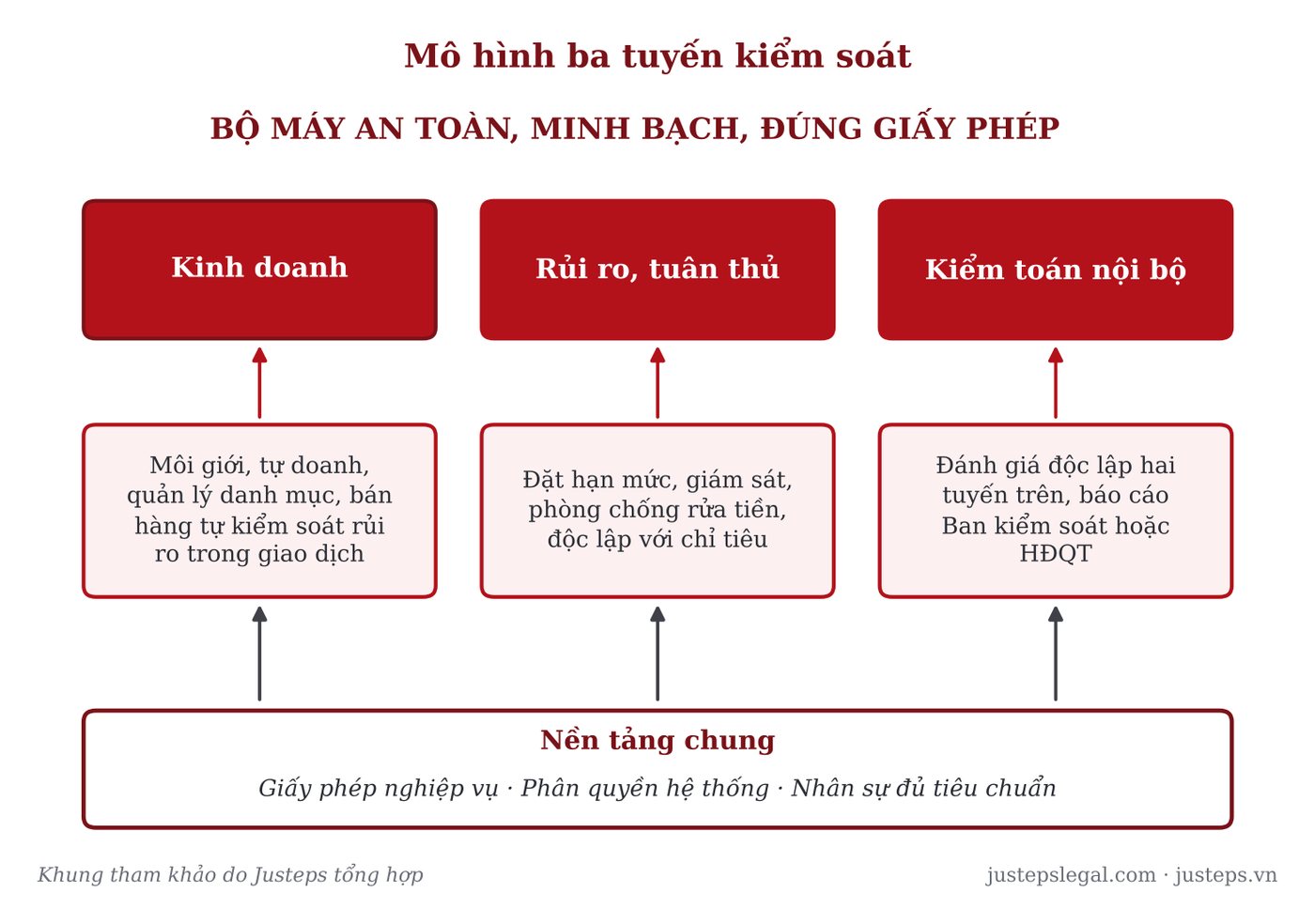
The three lines of control model applied to securities, fund and consumer finance businesses
The figure above shows that each line has its own task and that all three rest on a common foundation of licences, system access rights and suitably qualified staff. When this foundation is weak, for example where the system allows proprietary traders to see the client order book or the person in charge of risk does not hold the appropriate certificate, all three lines exist only on paper. For this reason, Justeps’ design always comes with a table matching the organisation chart against access rights on the core systems.
Specific features of each type of business
Securities companies
A securities company is usually divided into a client services division covering brokerage and margin trading, a capital and proprietary trading division, and an investment banking division covering underwriting and corporate finance advisory. Each division may only exist once the corresponding business line is included in the licence, because the Law on Securities sets out the scope of each business line in detail and other services must be reported to the State Securities Commission before they are offered[6]. The hardest point is the information barrier between the investment banking division, which holds unpublished information about client companies, and the proprietary trading and brokerage divisions, so the structure must be accompanied by a restricted list and a procedure for when a member of staff needs to cross that barrier.
Opening or closing a branch, transaction office or representative office and changing the business lines carried on at a branch all require prior approval from the State Securities Commission[7]. The network therefore needs to be designed at the same time as the head office chart, together with the authority limits of branch directors over margin lending and the handling of under-margined accounts. The law amending and supplementing a number of articles of the Law on Securities, passed by the National Assembly on 13 November 2026 and effective from 1 March 2027, further tightens staffing conditions for each business line and requires a compliance officer[8], so companies currently restructuring should plan in advance how many certified practitioners each division will need.
Fund management companies
Fund management companies usually have fewer staff but stricter segregation requirements, because one team manages several funds and several discretionary portfolios at the same time. The net asset valuation unit must be independent of the portfolio managers, and the allocation of orders between funds must be checked by a unit whose bonuses do not depend on the performance of any particular fund. The operations unit is also the point of contact with the supervisory bank, the custodian and the transfer agent, so it should sit on the same level as the investment division rather than under the Chief Investment Officer.
Consumer finance companies
Most staff of a consumer finance company work in sales at points of service, in telesales and in debt collection, and their number may reach several thousand across many provinces. The structure must therefore separate sales from loan appraisal and approval, and have an independent unit that monitors sales quality, detects fraudulent applications and checks the conduct of debt collection staff. The Law on Credit Institutions also requires the Board of Directors or Members’ Council to set up supporting committees, including a risk management committee and a human resources committee[9], so the governance level of the chart must clearly show these committees and their relationship with the Executive Board.
Combinations of roles to avoid and common mistakes
The most common mistake is to give risk management or compliance to the person already running a business division, on the grounds that this person understands the business best. When the market turns volatile, that person has to weigh loosening limits to keep clients against tightening them to protect the company, and the decision usually leans towards sales. The second mistake is to separate departments on the chart but not on the system, so that proprietary traders can still see the client order book or sales staff can still edit income details in loan applications themselves. The matrix below shows the level of conflict of interest when one person combines two roles in each type of business.
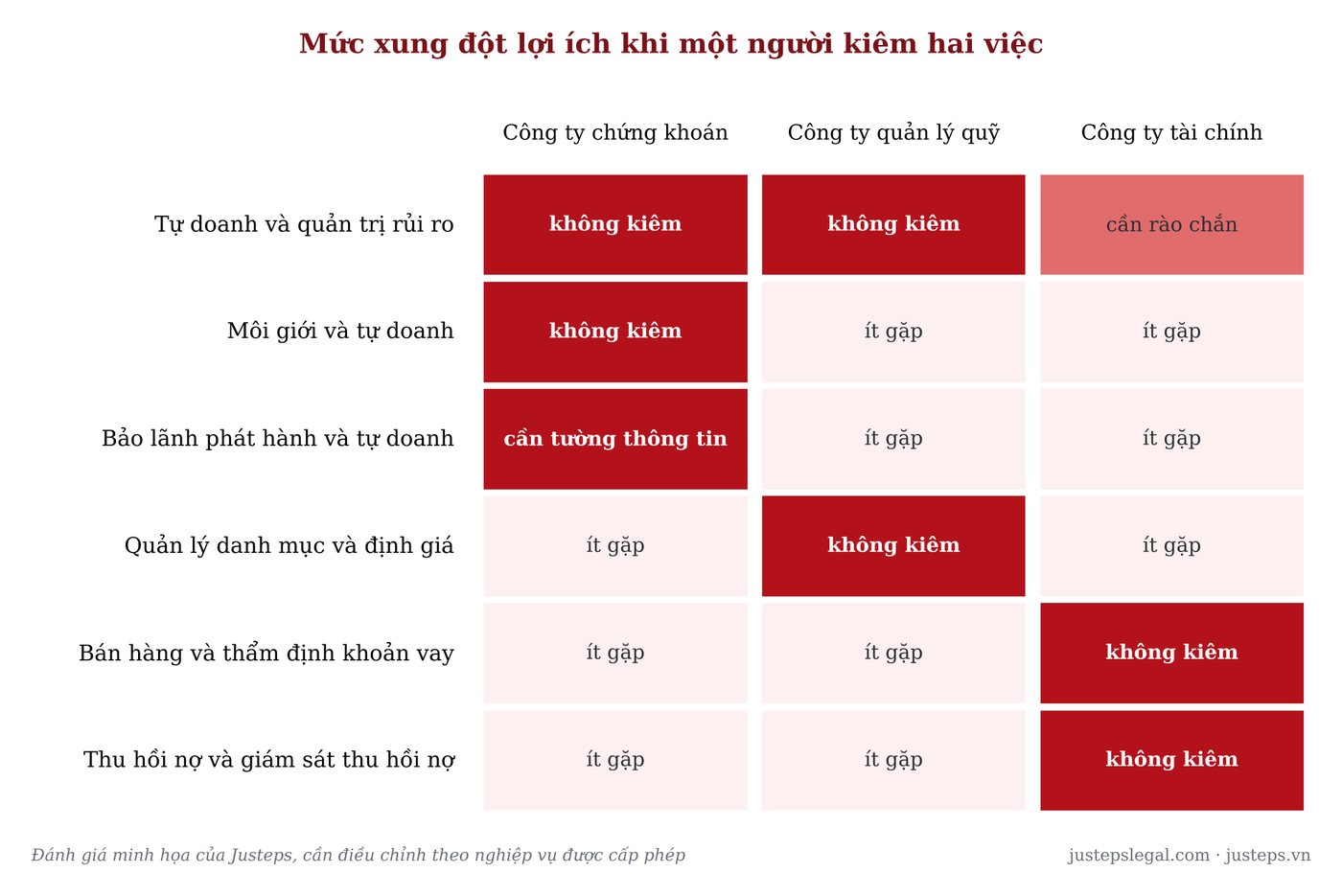
Level of conflict of interest when one person combines two roles in each type of business
Pairs of roles with a high level of conflict, such as proprietary trading combined with risk management or portfolio management combined with fund valuation, should be placed on the list of prohibited combinations and recorded in the decision issuing the structure. Pairs with a medium level may be acceptable in a small business if compensating measures are in place, such as dual approval or periodic re-checking. The third mistake is appointing people who do not meet the criteria, do not hold the appropriate practising certificate or have not been approved for a regulated position, and the fourth is opening branches and points of sale faster than the second line can control them.
The consequences of these mistakes go beyond administrative penalties. The business may be refused when it applies to add business lines, open branches or increase its capital, and members of the Board of Directors and the General Director may face personal liability where an inspection finds that the fault lies in the organisation. Securities practitioners may only work within the scope of their authorisation and the company is responsible for their professional activities[10], so the more blurred the boundaries of authority, the greater the risk that falls on the company.
How the service is delivered
An organisational structure design project for a medium-sized financial business usually takes around ten weeks. Justeps works with the Board of Directors, the Executive Board, the heads of divisions and the technology team, because most segregation boundaries only become real once they are built into the systems. The indicative sequence is as follows.
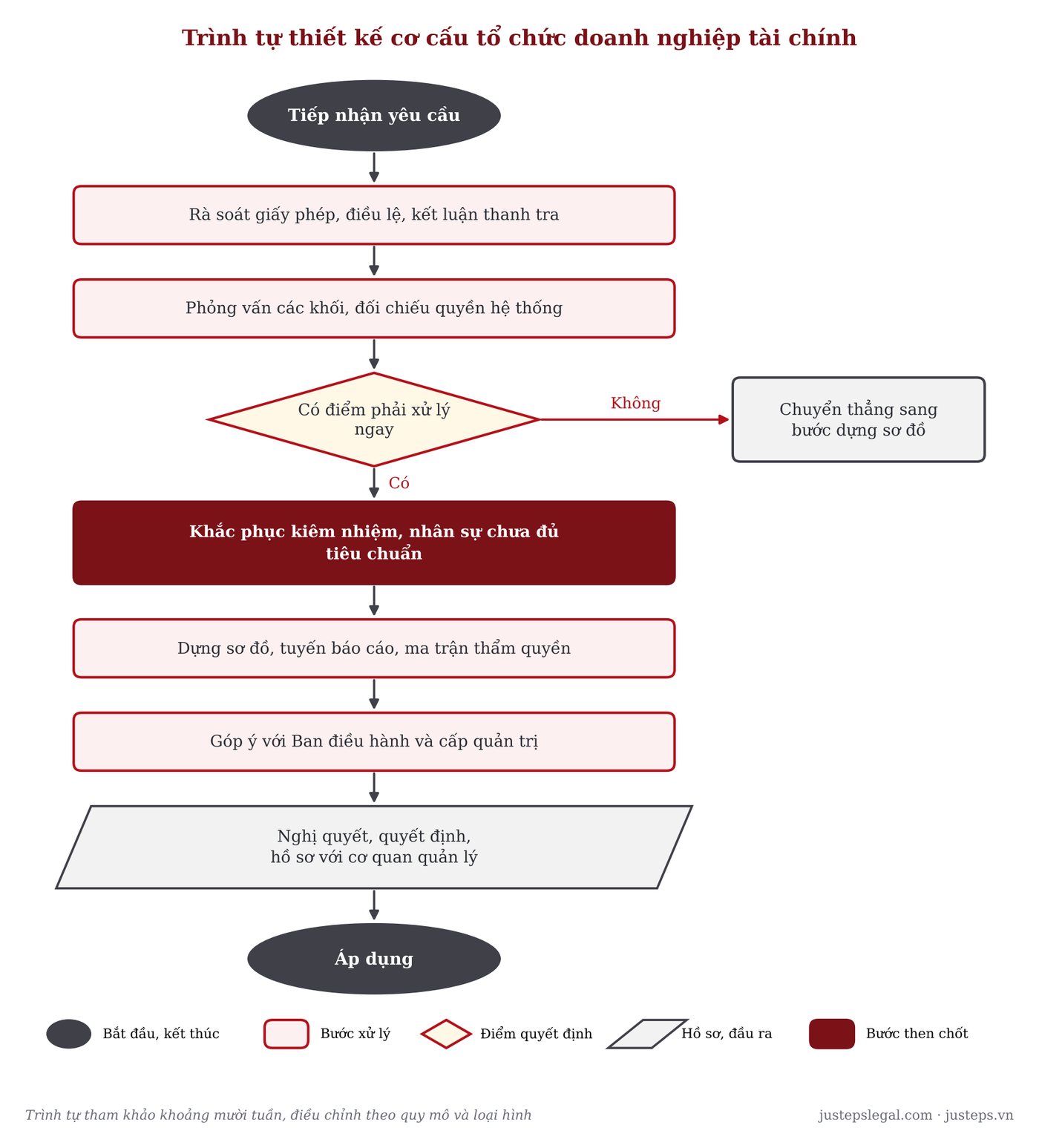
Sequence of an organisational structure design project for a financial business
In the first two weeks, Justeps reviews the licences, the charter, the current chart, the list of staff holding regulated positions and the most recent inspection and audit findings, and interviews the heads of divisions. By the third week, Justeps presents a gap report that singles out matters requiring immediate action, such as people who do not meet the criteria or combinations of roles with a high level of conflict. The following weeks are spent building the chart, reporting lines and authority documents through two rounds of comments, and the last two weeks are used to finalise the approval documents and the procedures with the regulator, which are phased so as not to disrupt client trading.
Deliverables and application by size
At the end of the project, the business receives a gap assessment report with remediation priorities, the organisation chart and reporting lines, a statement of the functions and duties of each unit, a list of regulated positions, a list of prohibited combinations of roles and a matrix of delegated authority by business line. These are accompanied by a draft resolution of the Board of Directors or Members’ Council, a decision issuing the structure and the filing documents for the State Securities Commission or the State Bank of Vietnam where the change requires approval or notification. The internal documents for each type of business are designed in line with Circular No. 121/2020/TT-BTC for securities companies and Circular No. 99/2020/TT-BTC for fund management companies[11].
The level of detail varies with size. A small securities company offering only brokerage and advisory services may combine compliance and risk management in one unit, but internal audit must still be independent and may be outsourced to an external provider. A foreign-invested fund management company often needs to reconcile the group’s matrix reporting model with the requirement for responsible persons in Vietnam. A consumer finance company with a nationwide network should be divided by region, with each region having a sales quality and debt collection control lead reporting directly to head office.
Once the structure has been approved, the new units need procedures to work together, such as the procedure for approving margin limits, the fund valuation procedure or the loan appraisal procedure. The business may combine this work with Justeps’ service for building internal procedures and regulations for securities, investment fund and consumer finance businesses so that the procedures use the correct unit names and the authority set out in the issued matrix.
What determines the service fee
Justeps quotes a fixed fee in writing after the initial meeting, once it understands the type of business, the licensed business lines and the size of the network. The main factors are the number of business lines and divisions, the number of branches, transaction offices or points of service, the complexity of the ownership structure, any foreign element, the need for bilingual documents and the volume of regulatory procedures arising from the changes. Justeps has offices in Hanoi, Hai Phong, Quang Ninh and Ho Chi Minh City, so it can work in person at head office or online with branches in other provinces.
How Justeps can help
Once the organisation has been redesigned, securities, investment fund and consumer finance businesses may combine the following Justeps services:
- Building internal procedures and regulations for securities, investment fund and consumer finance businesses. Justeps drafts business regulations and procedures for margin trading, valuation, lending and debt collection in line with the new structure and authority matrix.
- Labour, payroll and insurance services for securities, investment fund and consumer finance businesses. Justeps standardises contracts, commission schemes and insurance for staff in the new divisions, particularly the sales and debt collection workforce.
- Financial regulations and delegation of authority. Justeps sets approval limits for spending, investment and credit at each level of management in line with the organisation chart.
- Anti-money laundering compliance and risk control. Justeps defines the position, powers and reporting channel of the anti-money laundering unit in the new organisation.
Frequently asked questions
Does a small securities company need its own internal audit unit?
A securities company must have internal control, risk management and supervision systems[1]. For a small company, the internal audit function may be outsourced to an external provider in accordance with the implementing rules, but it must be independent of the Executive Board and report directly to the governance level.
Does an operating business have to rebuild its whole organisation?
Usually not. Most projects focus on correcting reporting lines, removing combinations of roles with a high level of conflict, adding missing units and resetting system access rights, while units that are working well are kept as they are.
Do changes to internal departments require regulatory approval?
Ordinary changes to internal departments do not require approval but must be adopted by the competent body and kept on file. However, opening or closing a branch or transaction office and changing the business lines carried on at a branch of a securities company require prior approval from the State Securities Commission[7], and the appointment of managers of a finance company must be approved by the State Bank of Vietnam[4].
Which division should the sales staff of a finance company belong to?
Sales staff usually belong to the business division, but checking applications, detecting fraud and monitoring sales conduct must be carried out by a unit independent of sales targets. If the same regional manager both sets targets and approves applications, the risk of false applications and complaints rises quickly.
Can the person in charge of anti-money laundering also handle compliance?
In small and medium-sized businesses, these two functions are often placed together in the compliance unit. What matters is that the person in charge does not belong to a business division, has access to transaction data and has responsibilities clearly set out in the internal regulations on anti-money laundering[5].
How does the 2026 amendment to the Law on Securities affect the organisational structure?
According to the information published when the National Assembly passed it, the amending law continues to set conditions on the number of certified practitioners for each business line and requires a compliance officer, with effect from 1 March 2027[8]. Justeps will check the official text and the detailed guidance when reviewing staffing levels for each division.
Related articles
- The authority of the General Director and how to delegate executive powers within the limits of the charter and internal rules
- The minimum set of internal governance regulations for companies with 50 to 200 employees
- Legal compliance for fintech companies, electronic identification, data protection and partnerships with banks
Notes
[1] Clauses 1, 3 and 5 of Article 89 of the Law on Securities No. 54/2019/QH14 dated 26 November 2019, as amended and supplemented by Law No. 56/2024/QH15 dated 29 November 2024.
[2] Article 90 of the Law on Securities No. 54/2019/QH14 dated 26 November 2019.
[3] Clause 1 of Article 57 and Clause 1 of Article 58 of the Law on Credit Institutions No. 32/2024/QH15 dated 18 January 2024.
[4] Clause 1 of Article 44 of the Law on Credit Institutions No. 32/2024/QH15 dated 18 January 2024.
[5] Article 24 of the Law on Anti-Money Laundering No. 14/2022/QH15 dated 15 November 2022, effective from 1 March 2023.
[6] Article 86 of the Law on Securities No. 54/2019/QH14 dated 26 November 2019.
[7] Article 87 of the Law on Securities No. 54/2019/QH14 dated 26 November 2019.
[8] The law amending and supplementing a number of articles of the Law on Securities, passed by the National Assembly on 13 November 2026 and effective from 1 March 2027.
[9] The Law on Credit Institutions No. 32/2024/QH15 dated 18 January 2024, on the committees of the Board of Directors and the Members’ Council.
[10] Article 98 of the Law on Securities No. 54/2019/QH14 dated 26 November 2019.
[11] Circular No. 121/2020/TT-BTC on the operation of securities companies and Circular No. 99/2020/TT-BTC guiding the operation of securities investment fund management companies, together with their amending and supplementing instruments.
This article is for reference and reflects the regulations in force at the time of publication. Please consult Justeps for advice tailored to your company’s records and situation.
For further information, please contact:
📩 Email: info@justeps.vn
🌐 Website: https://justepslegal.com · https://justeps.vn
🌐 Page: Justeps
☎️ Hotline (Zalo): 096 172 2607
📍 Thanh Xuan Office: 12th Floor, Licogi 13 Tower, 164 Khuat Duy Tien Street, Thanh Xuan Ward, Hanoi, Vietnam
📍 Ha Dong Office: LK06B, No.10, Dong Dua Area, Ha Dong Ward, Hanoi, Vietnam
📍 Ho Chi Minh City Branch: 528 Le Van Sy, Ho Chi Minh City, Vietnam
📍 Hai Phong Office: Truong Thinh Village, Ha Dong Commune, Hai Phong, Vietnam
📍 Quang Ninh Office: Van Don Special Zone, Quang Ninh Province, Vietnam





