
Key takeaways
- The service provision scheme and the qualifications and experience of the legal representative, the General Director and key staff are conditions for a payment intermediary licence, so the organisation chart must be designed at the same time as the licence application[1].
- Internal anti-money laundering regulations must be appropriate to the business’s organisational structure, scale and level of risk, so the anti-money laundering function should sit in an independent control line and not under the sales division[4].
- E-wallets, payment gateways and technology companies that cooperate with banks have their risks concentrated in different stages, so there is no single organisation chart that suits every fintech business.
- The sudden departure of key staff may mean the business no longer meets the conditions of its licence, so the structure needs position standards, back-up persons and a temporary delegation mechanism from the outset.
Most fintech businesses in Vietnam are built by a group of engineers and product people, so the initial organisation revolves around the speed of releasing features. The chief technology officer both runs the system and is responsible for information security, the head of sales both finds merchants and approves the applications that his or her own team has brought in, while anti-money laundering is often assigned to a member of the legal team as a secondary role. This arrangement works while the business is small, but its weaknesses appear as soon as the State Bank of Vietnam appraises the licence application or a partner bank assesses the business’s control capacity before signing a contract.
This page introduces Justeps’ organisational structure design service for providers of e-wallets, electronic payment gateways, collection and disbursement support services and technology companies that cooperate with banks. It answers only the questions of which divisions the organisation should be divided into, who controls whom and who may decide sensitive matters. Operating procedures, monthly legal advice and the employment regime for the sector are presented on three sister pages in the same sector group.
The organisation forms part of the licence application
For an ordinary business the organisation chart is an internal matter, whereas for a payment intermediary service provider the organisation and its people are part of the licensing conditions themselves. The business must have a service provision scheme approved by the competent body under its charter; a legal representative and a General Director holding at least a university degree and having at least 5 years’ experience as a manager or executive in finance or banking; Deputy General Directors and key staff implementing the scheme with appropriate qualifications; and a technical solution meeting the requirements of level 3 information system security[1]. The business must also ensure that at least one legal representative always resides in Vietnam, and the minimum charter capital for e-wallets, collection and disbursement support and electronic payment gateways is VND 50 billion.
Because these conditions are examined through the curriculum vitae, qualifications and title of specific individuals, the organisation chart in the scheme must match the real people at work and cannot be a drawing made to embellish the application. After the licence is granted, certain changes such as a change of name, a change of head office or the discontinuation of a service require a procedure to amend or supplement the licence[2], so every restructuring should be checked against the licence before it is issued. In 2026 the Government adopted a plan to cut certain business conditions in this field, so Justeps always checks the legislation in force at the time the business files its application or changes its staff.
The law on anti-money laundering adds a further organisational requirement. A payment intermediary service provider is a reporting entity[3], and the internal regulations of a reporting entity must be appropriate to its organisational structure, scale and level of risk, must apply throughout the system and to its agents, and must include provisions on internal control and audit and on the responsibility of each individual and unit[4].
Three lines of defence applied to a payment business
Justeps designs the structure on the three lines of defence model, a way of organising that banks and regulators are used to reading. The first line consists of the divisions that create risk in day-to-day activity, such as sales, product, operations and customer care, which are responsible for controlling their own processes. The second line consists of risk management, compliance, anti-money laundering, anti-fraud, information security and data protection, whose task is to issue policies, monitor and stop a transaction, a merchant or a feature where necessary. The third line is internal audit, which reports directly to the board of directors or the members’ council and assesses whether the first two lines are doing their work properly.
The most important principle is that the second line does not double up with the sales division and has no sales targets. A small business may group several second-line functions into one division and outsource internal audit for its first few years, provided that the head of the control line reports to the General Director or the governing body and not to the head of sales. Where the business already has a financial internal control system, this design should be connected with the financial internal control system to avoid two sets of rules overlapping.
Each type of service needs a different organisational shape
The risk of an e-wallet lies in its large number of individual users, the risk of a payment gateway lies in its merchants, and the risk of a technology company that cooperates with banks lies in its contracts and data. The share of staff across divisions therefore differs markedly, as shown in the illustrative example below of three businesses each with around 120 people.
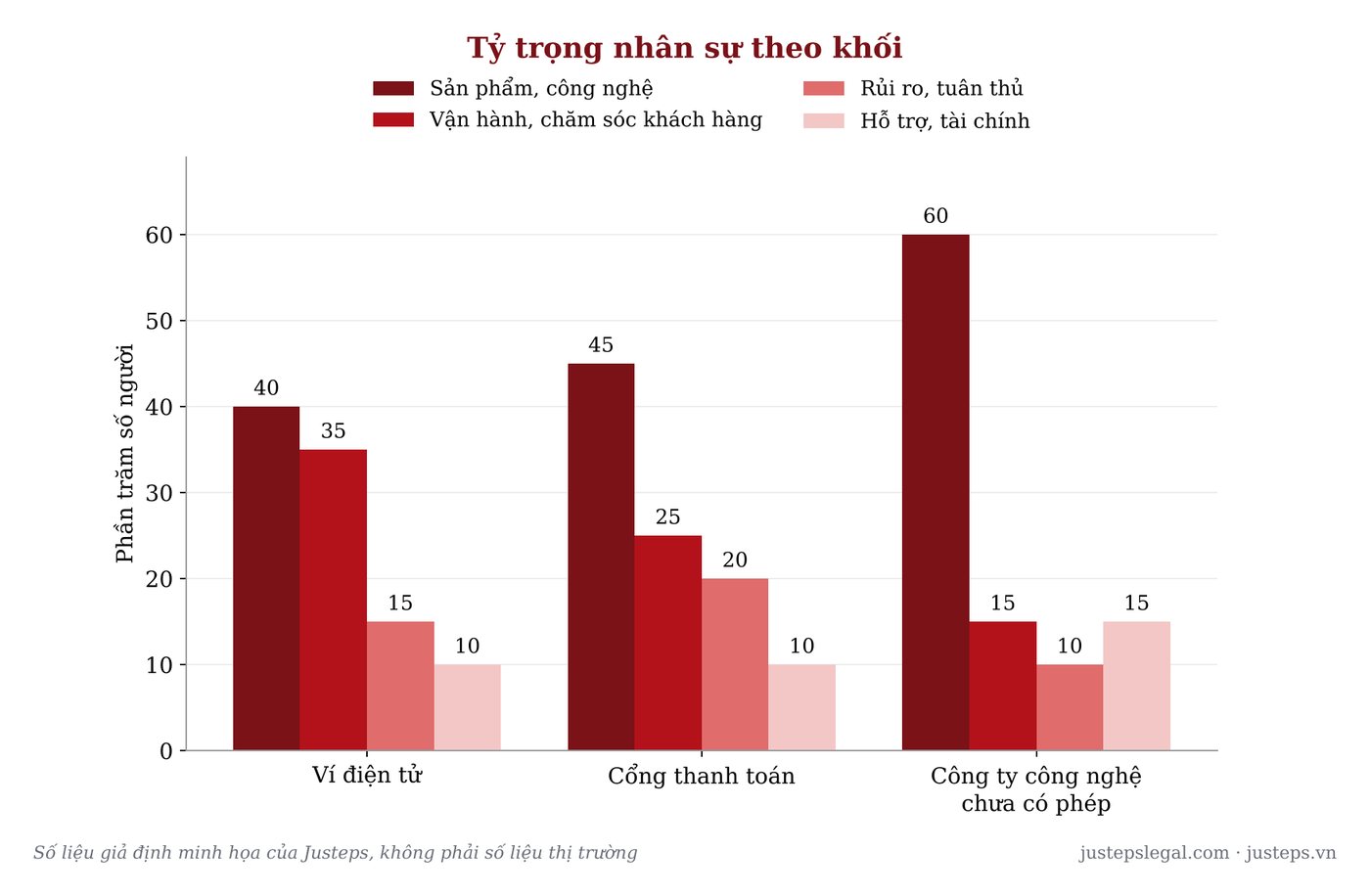
Example allocation of staff by division in three fintech business models of around 120 people each
In this example, the e-wallet devotes about 35% of its staff to operations, reconciliation and customer care because it must handle investigations, complaints and account locking for millions of users. The payment gateway has the largest risk and compliance division, at about 20%, because it must examine and monitor each merchant, while the technology company without a licence puts about 60% of its people into product and technology but still needs a small compliance team to meet the requirements of its partner banks.
E-wallets
For e-wallets, Justeps usually divides the wallet operations division into teams for wallet account management, reconciliation of balances with the payment guarantee account at the bank and handling of investigations and complaints. The reconciliation team should not belong to the product division, because it is where any discrepancy between the total wallet balance and the money actually held at the bank is detected first. The anti-fraud team needs the power to lock wallets temporarily under the rules issued, without having to wait for the sales division’s agreement.
Payment gateways and collection and disbursement support
In a payment gateway, the most common structural mistake is to place the merchant due diligence team under the sales division, so that the standards are relaxed when targets have to be met at the end of the quarter. Justeps places the merchant due diligence and monitoring function in the risk management division, while the sales team only receives applications and manages relationships. This division of roles allows the business to account for itself when a merchant is found to be using the payment gateway for prohibited goods or services.
Technology companies and businesses in the regulatory sandbox
A company that only supplies solutions to banks needs to show clearly in its structure that it does not provide payment services itself, with one point of contact managing contracts, the scope of activities and the data received from banks. A business with a credit scoring solution, data sharing through an open application programming interface (Open API) or peer-to-peer lending may apply to take part in the controlled regulatory sandbox for a maximum of two years[5]. The amending decree of 2026 also adjusted the conditions applying to the legal representative and General Director of a company taking part in the sandbox, so the organisation needs a person responsible for monitoring the scope of the trial and reporting on its results.
Where to place the anti-money laundering, information security and data functions
The anti-money laundering lead is the position Justeps examines most carefully, because this person must have enough access to transaction data to decide on reporting suspicious transactions and to propose refusing customers without being under sales pressure. Justeps places this position in the second line, reporting directly to the General Director and with a separate reporting channel to the board of directors or the members’ council when there is a serious matter. In a large business, anti-fraud and anti-money laundering should be separated into two units because one protects the business and its customers from losses while the other performs obligations owed to the State, although the two units still share data and alerts.
The person responsible for information security should not report to the chief technology officer, because when the launch schedule for a feature overrides security testing requirements that person needs the power to say no. For personal data, the business may designate a qualified unit or staff member or engage an organisation that provides data protection services[6], and data protection staff must hold at least a college qualification, have at least 2 years’ experience and have received training[7]. A payment business processes the identification data, biometric data and transaction history of a very large number of people, so Justeps recommends making this a dedicated position rather than a secondary role for the legal team.
Allocating authority over sensitive decisions
An organisation chart only shows who reports to whom, whereas an authority matrix shows who may decide matters that could lead to losses of customers’ money, penalties or the loss of a relationship with a partner bank. Justeps builds the matrix around three roles, in which the sales and product divisions propose, the control line examines and has the power to stop, and the General Director or the executive board approves matters above the thresholds.
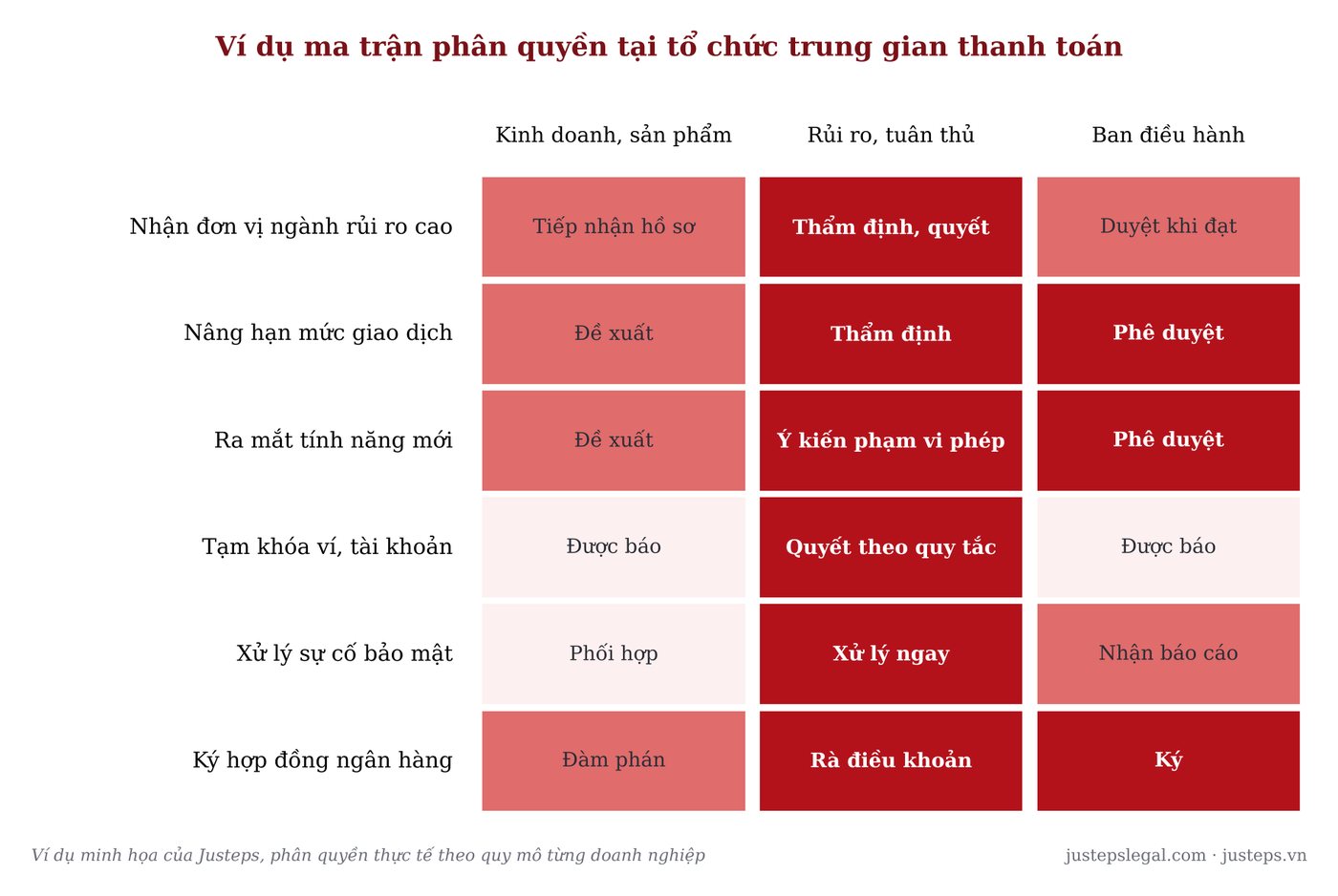
Example allocation of authority for six sensitive decisions at a payment intermediary
In this example, the onboarding of a merchant in a high-risk sector is decided by the risk management division, which determines whether it is accepted, and goes to the executive board only when that division agrees subject to enhanced controls. Launching a new feature always requires the compliance opinion on the scope of the licence before the executive board approves, while an information security incident is handled immediately by the person responsible for information security and reported afterwards, without waiting for approval. Spending limits and limits on signing contracts with banks and suppliers can then be carried over into financial regulations and delegation of authority.
Shareholders, foreign investors and successors
Many fintech businesses raise capital from foreign investment funds, so the governance structure must be designed together with the shareholding structure. Before receiving capital, the business needs to check the market access conditions applying to foreign investors for each type of service[8], and to consider whether the matters reserved to the investor under the shareholders’ agreement would change the person who actually runs the business compared with the application filed. Justeps reviews the charter, the shareholders’ agreement and the board regulations together with the organisation chart to ensure that the powers set out in these three documents are consistent with one another[9].
Key personnel risk is the most distinctive feature of the sector. If the General Director or the head of technology leaves without a suitably qualified replacement, the business may no longer meet the conditions on which it was licensed and will have to deal with the regulator on the back foot. The structure Justeps designs always comes with position standards for each key position, the name of a back-up person whose background has been checked against the conditions and a temporary letter of authorisation prepared in advance, while the notice period and contract terms for this group are dealt with under the Labour, wages and social insurance service for fintech and payment intermediary businesses.
Application by stage and size
A business preparing a licence application needs a minimal but genuine organisation, with all the positions named in the scheme and an independent control line, even if it consists of only a few people. A business that already has millions of users needs deeper specialisation, separating anti-fraud, anti-money laundering, information security and data protection, and setting up internal audit instead of outsourcing it. A business that belongs to a foreign group must reconcile the parent company’s approval policies with Vietnamese law, so Justeps prepares bilingual documents and states clearly which decisions must be signed by the manager in Vietnam.
Implementation process, deliverables and fees
An organisational structure design project for a payment business usually takes about ten weeks. What differs from other sectors is that Justeps starts by mapping the flow of money from users and merchants to the partner bank, because each control point on the chart must be tied to a segment of that flow.
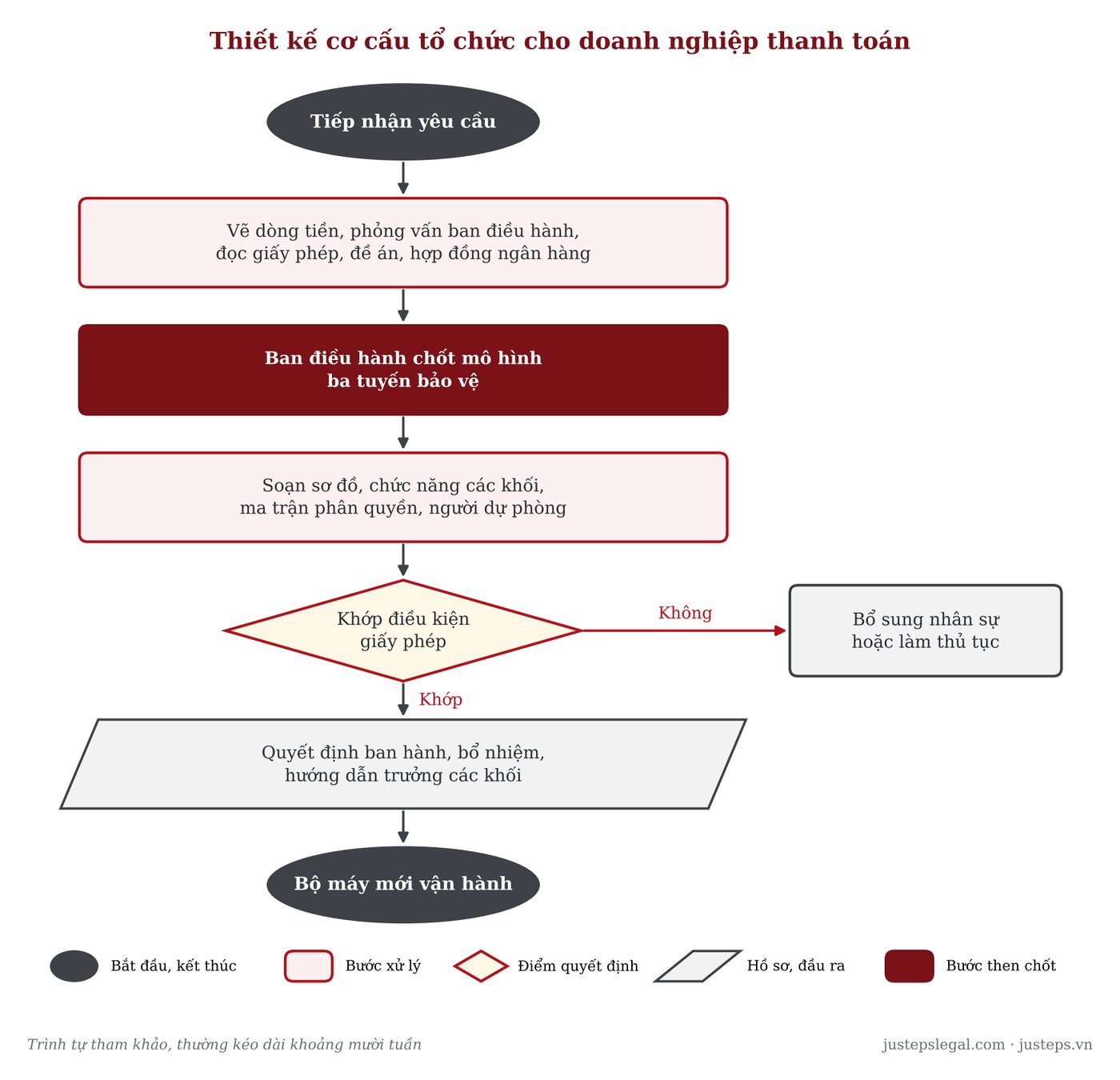
Sequence of organisational structure design including a check against licence conditions
In the first two weeks, Justeps consultants interview the executive board and the heads of divisions and read the licence, the scheme filed and the contracts with partner banks. After the executive board settles on the model, Justeps drafts the chart, the functions of the divisions and the authority matrix, and in about week eight reviews the second-line functions separately in terms of reporting channels, budget and performance indicators. If the new structure changes matters registered with the regulator, the business also receives a list of items that must be reported or processed before issue. The deliverables include the following documents:
- A report comparing the licence conditions with the current organisation, stating clearly what needs to be added.
- An organisation chart along three lines of defence and a statement of the functions and duties of each division.
- An authority matrix for sensitive decisions, naming the proposer, the controller and the approver.
- Standards for key positions, a list of back-up persons and a template temporary letter of authorisation.
- Draft resolutions and decisions issuing the structure and making appointments, and a list of changes to be reported to the regulator.
Once the new organisation has been issued, the operating procedures for each division are built under the service for building internal procedures and regulations for fintech and payment intermediary businesses. Justeps quotes the project fee as a fixed fee in writing after the first working session, depending on the number of types of service provided, whether the business is applying for a licence or already operating, the number of staff, the involvement of foreign investors and any need for bilingual documents.
How Justeps can help
Alongside organisational structure design, fintech and payment intermediary businesses may combine the following Justeps services:
- Building internal procedures and regulations for fintech and payment intermediary businesses. Justeps drafts anti-money laundering rules and procedures for merchant due diligence, reconciliation and incident handling so that the new divisions work to the same standard.
- Ongoing legal advisory for fintech and payment intermediary businesses. Justeps tracks reporting milestones and changes that require procedures and reviews contracts with partner banks every month once the new organisation is up and running.
- Financial internal control system. Justeps connects the three lines of defence with the business’s control points for spending, reconciliation and financial reporting.
- Financial regulations and delegation of authority. Justeps turns the authority matrix into specific limits on spending, contract signing and approvals for each level of management.
Frequently asked questions
Must a payment intermediary have its own internal audit function?
Internal anti-money laundering regulations must include provisions on internal control and audit of compliance[4]. A small business may outsource this function in the early stage, but the person performing it must be independent of the divisions audited and report to the governing body.
To whom should the anti-money laundering lead report?
Justeps recommends that this lead reports directly to the General Director, has a separate reporting channel to the board of directors or the members’ council and has no sales targets. This person needs access to transaction data and the power to decide on reporting suspicious transactions.
Can the chief technology officer also be responsible for information security?
The law does not directly prohibit it, but combining the roles creates a conflict when the feature launch schedule clashes with security testing requirements. The system must meet level 3 information security under the licensing conditions[1], so the person responsible should have independent authority.
Does a technology company without a licence need a compliance unit?
Yes, although it can be lean. Partner banks usually require a point of contact for data, security and scope of activities, while a business taking part in the regulatory sandbox must have a person responsible for monitoring the scope and reporting on results[5].
Must the State Bank of Vietnam be notified of an internal restructuring?
The organisation chart is an internal document, but certain changes such as the name, the head office or the discontinuation of a service require a procedure to amend or supplement the licence[2]. Changes to key staff should be checked against the conditions met at the time of licensing before they are issued.
How often should the organisational structure be reviewed?
The business should review it once a year and immediately when it adds a new service, has a change of major shareholder, replaces key staff or faces new legislation. An annual review also fits with the duty to reassess internal anti-money laundering regulations every year.
Related articles
- Legal compliance for fintech businesses, electronic identification, data protection and cooperation with banks
- Organisational structure of a technology start-up
- Building internal procedures and regulations for fintech and payment intermediary businesses that match their operating systems
- Ongoing legal advisory for fintech and payment intermediary businesses in day-to-day operations
Notes
[1] Clause 2 of Article 22 of Government Decree No. 52/2024/ND-CP dated 15 May 2024 on non-cash payments, effective from 1 July 2024.
[2] Clause 1 of Article 26 of Government Decree No. 52/2024/ND-CP dated 15 May 2024 on non-cash payments, effective from 1 July 2024.
[3] Point dd of Clause 1 of Article 4 of the Law on Anti-Money Laundering No. 14/2022/QH15 dated 15 November 2022, effective from 1 March 2023.
[4] Clauses 1 and 3 of Article 24 of the Law on Anti-Money Laundering No. 14/2022/QH15 dated 15 November 2022, effective from 1 March 2023.
[5] Government Decree No. 94/2025/ND-CP dated 29 April 2025 on the controlled regulatory sandbox in the banking sector, as amended and supplemented by Decree No. 382/2026/ND-CP dated 6 October 2026.
[6] Clause 2 of Article 33 of the Law on Personal Data Protection No. 91/2025/QH15, effective from 1 January 2026.
[7] Clause 2 of Article 13 of Government Decree No. 356/2025/ND-CP detailing a number of articles of and measures to implement the Law on Personal Data Protection, effective from 1 January 2026.
[8] The Law on Investment No. 143/2025/QH15, effective from 1 March 2026, and the international investment commitments to which Vietnam is a party.
[9] The Law on Enterprises No. 59/2020/QH14 dated 17 June 2020, as amended and supplemented by Law No. 03/2022/QH15 and Law No. 76/2025/QH15.
This article is for reference and reflects the regulations in force at the time of publication. Please consult Justeps for advice tailored to your company’s records and situation.
For further information, please contact:
📩 Email: info@justeps.vn
🌐 Website: https://justepslegal.com · https://justeps.vn
🌐 Page: Justeps
☎️ Hotline (Zalo): 096 172 2607
📍 Thanh Xuan Office: 12th Floor, Licogi 13 Tower, 164 Khuat Duy Tien Street, Thanh Xuan Ward, Hanoi, Vietnam
📍 Ha Dong Office: LK06B, No.10, Dong Dua Area, Ha Dong Ward, Hanoi, Vietnam
📍 Ho Chi Minh City Branch: 528 Le Van Sy, Ho Chi Minh City, Vietnam
📍 Hai Phong Office: Truong Thinh Village, Ha Dong Commune, Hai Phong, Vietnam
📍 Quang Ninh Office: Van Don Special Zone, Quang Ninh Province, Vietnam





