
Key takeaways
- The person in charge of travel services is a condition of the licence[1], so this position must carry real decision-making power in the organisational chart and have a qualified successor ready to step in when needed.
- One person who sells tours, books services and pays suppliers is the most common control weakness, and the structure should separate the three functions of sales, operations and tour accounting.
- A representative office may not perform business functions[5], so a tour sales point in another province must be organised as a branch or a business location.
- The business should have a single out-of-hours incident contact with a clear emergency spending limit, because most incidents on tour happen in the evening, on days off or while the group is abroad.
Most travel businesses in Vietnam start as a small group around the founder, in which each person can do many jobs and every decision goes through the director. This works well while the business sells only a few dozen domestic groups a month. When the business applies for an international travel licence, opens up the Korean or European markets, takes on corporate groups or opens a sales point in another province, the old set-up begins to show gaps where nobody is responsible, such as who approves the price of a large group, who decides to change the itinerary when a flight is cancelled and who may spend money out of hours.
This page introduces Justeps’ service of designing the organisational structure of domestic travel businesses, businesses receiving international visitors to Vietnam, businesses taking Vietnamese travellers abroad and organisers of programmes for corporate customers. It focuses on choosing how to organise the sales and operations divisions, positioning the control functions, allocating decision-making authority and organising branches. The operating procedures written for each division once the structure is in place are presented under the internal procedures and regulations service for travel and tour businesses.
The structure must preserve the conditions of the travel licence
Travel services are a conditional business line. The business must hold a domestic or international travel licence, place a deposit at a bank at the level corresponding to its business scope and have a person in charge of travel services who holds a management position and meets the requirements on specialised qualifications or a certificate in tour operations[1]. The deposit levels and the licensing file are set out in the decree detailing the Law on Tourism[2]. The organisational chart of a travel business is therefore both a management tool and part of maintaining the licence conditions.
A mistake Justeps often sees is that the person in charge of travel services appears only by name in the licensing file while the actual operations are run by someone else, or that this person left months ago and the business has not appointed a replacement. Failing to maintain business conditions, using a person who does not meet the conditions and failing to notify changes are all acts that may be penalised under the decree on administrative penalties in the field of tourism[3], and serious cases may lead to revocation of the licence. Justeps proposes placing the person in charge of travel services as head of the operations division or as deputy director for products, with authority to approve tour programmes and assign tour guides, and naming in advance a successor who already meets the qualification or certificate requirements.
The Law on Tourism has just been amended and supplemented together with a number of laws on culture and sport at the National Assembly session of November 2026[4]. When designing the structure, Justeps checks the conditions on the person in charge, the deposit and tour guides against the documents in force at the time of the work and alerts the business to the points to watch when new guiding documents are issued.
Three ways to organise sales and operations
Travel businesses usually organise their sales and operations divisions in one of the three ways below. The choice depends on the revenue mix, the number of customer markets being served and the language skills of the team, not on what other businesses in the sector do.
| Model | Suitable when | Weakness to address |
|---|---|---|
| By customer market | The business receives international visitors from a few large markets, each of which needs its own language, partners and seasons. | Each unit books its own services, so the business loses its leverage to negotiate common prices with hotels and transport operators. |
| By product line | The business has several lines such as domestic tours, outbound tours, corporate programmes and online sales. | A large customer may receive different quotations from several units unless there are rules for allocating customers. |
| Combined | A medium-sized or larger business with both a large international customer market and a stable domestic product line. | Authority must be clearly divided between market heads and the head of operations, otherwise two people will decide on the same group. |
Under the combined model that Justeps often proposes for businesses with several dozen staff or more, the sales function is divided by market or customer group, while the operations division is centralised to book services, manage suppliers and assign tour guides for every group. Centralised operations allow the business to negotiate room and vehicle rates on the basis of total annual volume and give it one place that knows the whole departure schedule. Programmes that combine travel with meetings, incentives, conferences and exhibitions (MICE) for corporate customers should have their own team when each contract is of high value and requires events to be staged, because the quotation and acceptance process of this team is quite different from that of retail tours.
Separating sales, operations and tour accounting
In many small travel businesses, the tour sales staff also book hotels and vehicles, collect money from customers and request payments to suppliers. When one person controls both the income and the spending of a group, the business finds it hard to detect price differences, commissions received privately from suppliers or advances that are never settled. The structure should separate the three functions, so that the sales unit quotes prices and signs contracts with customers, the operations division books services according to the approved budget, and tour accounting checks the budget before spending and settles the accounts after the group returns.
Tour accounting should report to the chief accountant or the finance director, not to the head of sales, so that cost checks are not subject to sales pressure. For a business too small to have its own tour accountant, Justeps proposes that at least the director or a person who does not sell directly signs off the group budget and any payment request above a set limit. The specific limits and approval sequence for spending are written into the financial regulation, which can be prepared together with the financial regulations and delegation of authority service.
The tour guide team and the incident contact
Tour guides represent the business before customers throughout the trip, yet in many businesses they do not appear on the organisational chart and it is unclear who their direct manager is. Justeps proposes setting up a tour guide team within the operations division, with a team leader responsible for the list of guides qualified to practise, the assignment schedule, the evaluation after each group and receiving incident reports. Guides who work trip by trip are still managed through this team so that the business keeps control over who is leading groups under its name. How contracts are signed and how each group of guides is paid falls under the labour, wages and social insurance service for travel and tour businesses.
Incidents on tour such as accidents involving customers, lost luggage, cancelled flights or bad weather often occur outside office hours. The structure needs an out-of-hours duty contact on a rotating schedule, with authority to make emergency payments within a limit and with a list of people to report to according to the severity of the incident. A business taking travellers abroad also needs a person in charge of relations with the receiving partner in the destination country and with the Vietnamese diplomatic mission when a major incident occurs.
The matrix below is an example Justeps built for an international travel business with about 60 staff, showing who decides, who proposes and who only gives input on six decisions that often cause disagreement.
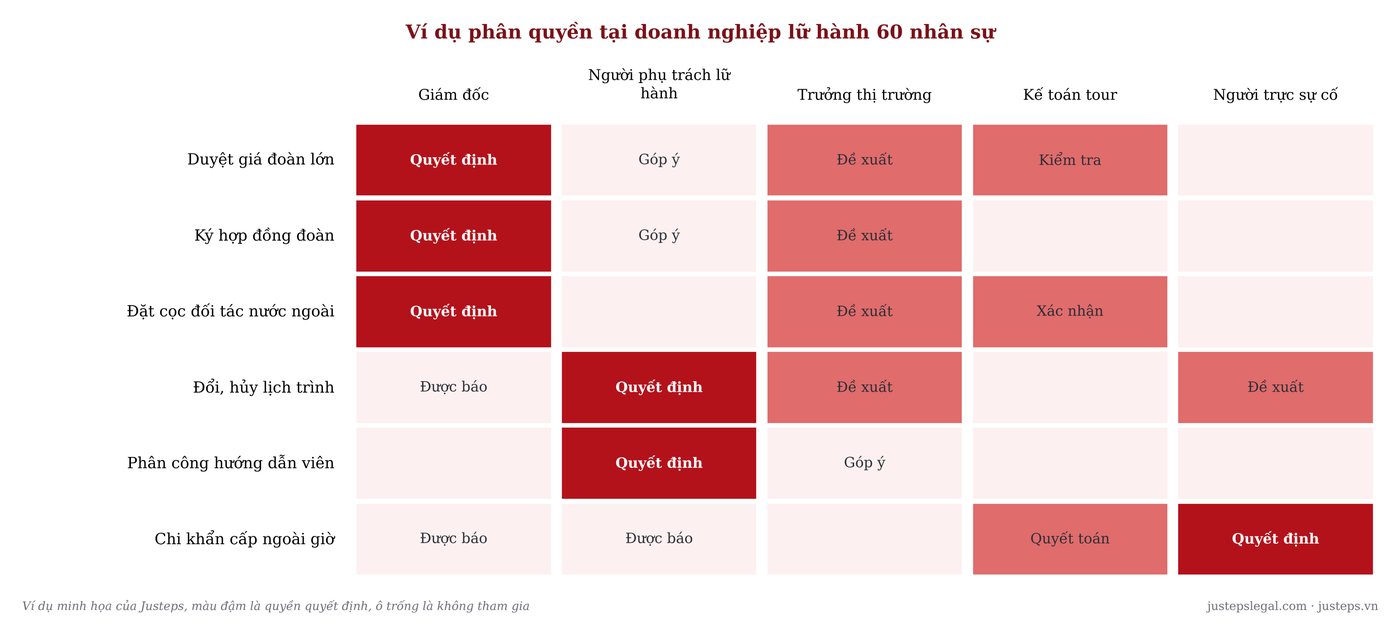
Example of authority among five positions for six common decisions
In this example, the director decides the price of large groups and signs group contracts, while the market head proposes and tour accounting checks the budget. The person in charge of travel services decides on changes to itineraries and the assignment of tour guides, because these matters are linked to the licence conditions and to customer safety. Deposits to partners abroad are approved by the director after tour accounting confirms them, while emergency spending out of hours within the limit is decided by the duty contact and reported afterwards. This allocation means that no decision needs two people to sign while a group is waiting.
Branches, representative offices and online sales channels
When opening a tour sales point in another province, many businesses register a representative office because the procedure is simple. However, a representative office only acts as an authorised representative and may not perform business functions, whereas a branch may perform all or part of the functions of the business[5]. An office that signs contracts and collects money from customers must therefore be organised as a branch or business location, and the structure needs to determine which contracts the branch director may sign, which payments the branch may make and to whom it reports.
Online sales through the website, messaging applications and travel platforms usually begin as a side task of the sales unit. Once online revenue makes up a significant share, this channel needs its own contact responsible for price information, cancellation conditions and responding to customer feedback, because the obligation to provide truthful information to consumers[6] applies to every item posted. Justeps determines whether this channel belongs to the sales division or should be a separate unit, depending on its share of revenue and how different the products sold online are.
How the structure changes with size
A travel business does not need to set up every department from the start. The chart below illustrates the number of permanent staff in each division at three sizes, excluding tour guides who work trip by trip.
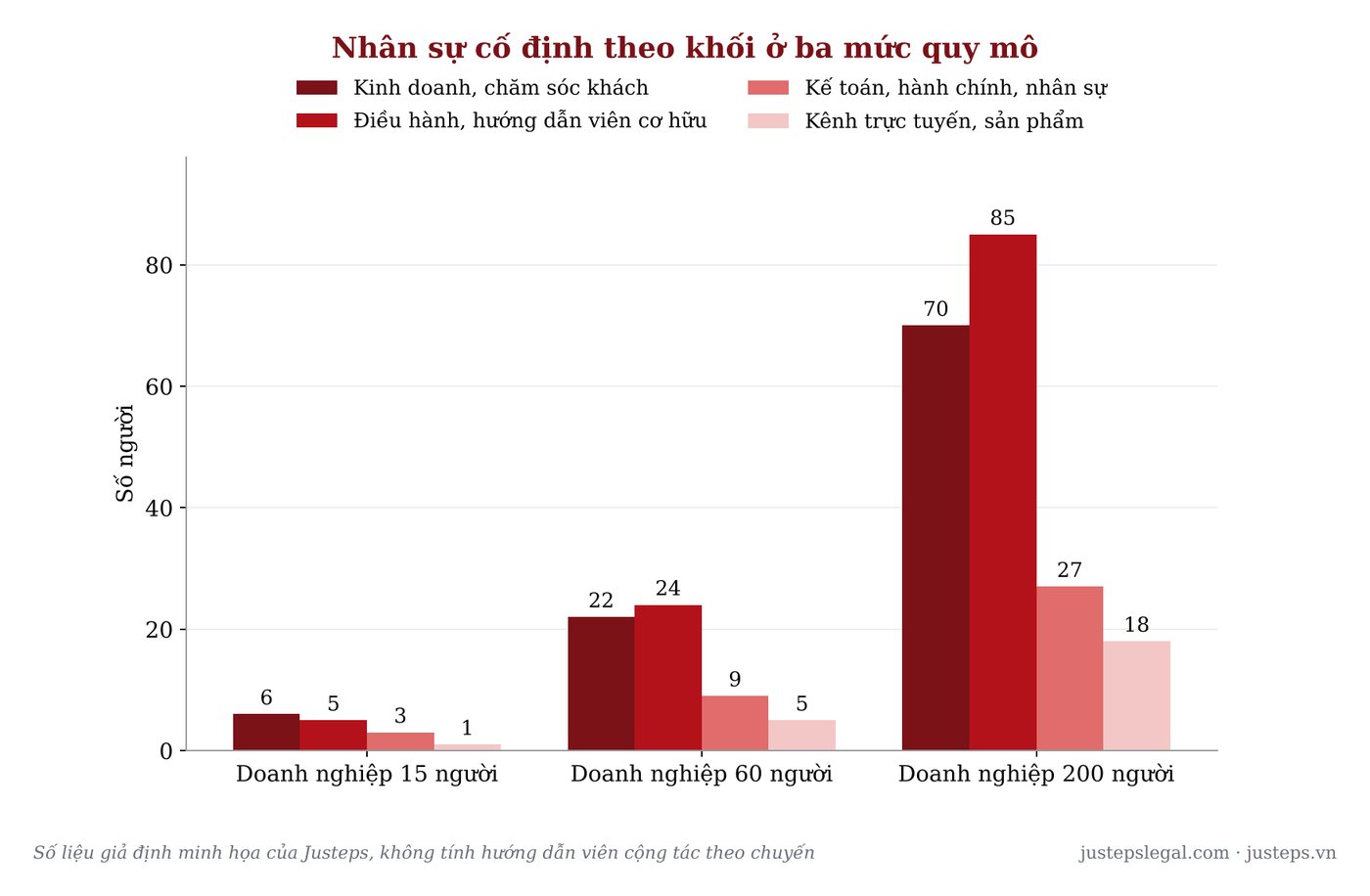
Example of permanent staff by division at three sizes of travel business
In this example, a business of 15 people has 6 in sales, 5 in operations and guiding, 3 in accounting and administration and 1 responsible for the online channel. In a business of 60 people the corresponding figures are 22, 24, 9 and 5, and in a business of 200 people they are 70, 85, 27 and 18. The operations and guiding division grows faster than sales as the business expands because more groups depart at the same time, increasing the need for incident duty and supplier management. Justeps uses this view to decide when to separate tour accounting, set up a corporate customer team or create a dedicated online channel unit.
Implementation process, deliverables and fees
A project to design the organisational structure of a travel business usually takes about eight weeks and should be completed one to two months before the peak season, so that the new structure can be tested on real groups before the departure schedule becomes busy.
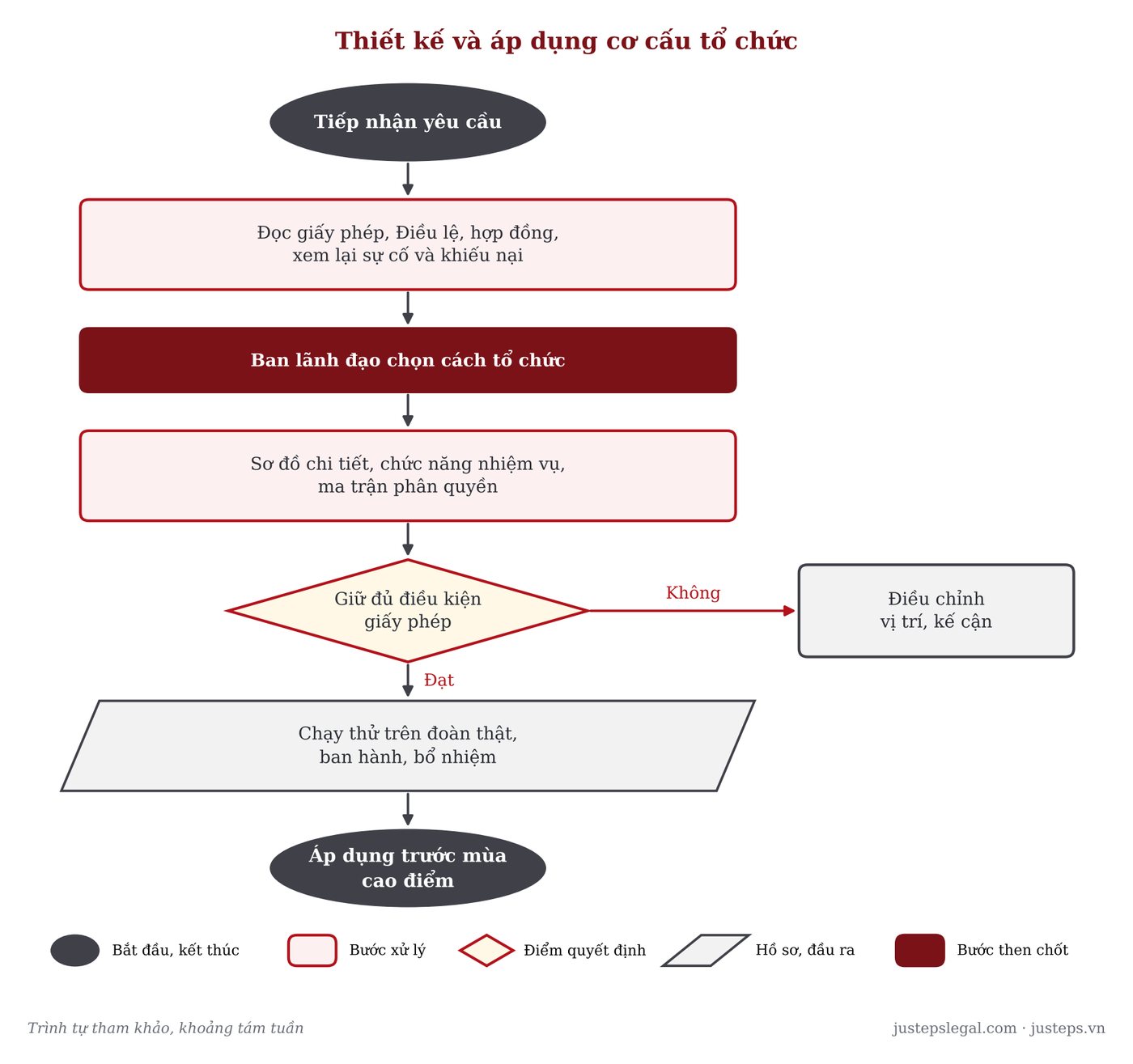
Sequence for designing and applying the organisational structure at a travel business
In the first two weeks Justeps reads the licence, the charter, the staff list and the contracts with suppliers and tour guides, interviews the heads of each unit and several key guides, and reviews the incidents and complaints of the last one or two years. The third week is a working session at which management chooses the organisational model, after which Justeps prepares the detailed chart and the authority matrix and checks them against the licence conditions before trialling them on a number of groups in operation. The deliverables include the following documents:
- The overall organisational chart and detailed charts of the sales division, the operations division, the tour guide team and the branches.
- Rules on the functions and duties of each unit and of the person in charge of travel services, with a succession plan.
- An authority matrix for decisions on prices, group contracts, deposits abroad, changes to or cancellation of programmes and emergency spending.
- Rules on the out-of-hours incident contact and the emergency spending limit.
- Draft resolutions or decisions issuing the structure, appointment decisions and templates for notifying changes to the authorities where needed.
The authority to issue the structure is set by the charter, and normally the members’ council, the board of directors or the owner decides the organisational structure, while the director issues internal management regulations within the scope assigned[7]. Justeps quotes the project fee as a fixed fee in writing after the initial meeting, depending on the number of staff, the licence scope, the number of customer markets, the number of branches, the need for bilingual documents and whether the business needs Justeps to follow the trial phase closely. Job descriptions for each new position can then be prepared through the organisational structure, functions and duties and job description service.
How Justeps can help
Alongside organisational structure design, travel and tour businesses may combine the following Justeps services:
- Internal procedures and regulations for travel and tour businesses. Justeps writes procedures for each stage of the trip, from contracts with customers, advances and settlement to incident handling, in line with the newly designed structure.
- Labour, wages and social insurance services for travel and tour businesses. Justeps turns the new positions into contracts, salary scales and working arrangements suited to operations staff and tour guides.
- Organisational structure, functions and duties and job descriptions. Justeps drafts job descriptions for market heads, tour operators, tour guide team leaders and tour accountants.
- Financial regulations and delegation of authority. Justeps sets approval limits for spending, deposits and emergency payments for each level of management in a travel business.
Frequently asked questions
Can the person in charge of travel services also be the director?
Yes, if that person holds a management position and meets the requirements on qualifications or a professional certificate[1]. However, in businesses with several dozen staff, Justeps usually proposes separating the two roles so that the person in charge has time to actually run the tour programmes.
What should be done when the person in charge of travel services resigns?
The business must immediately appoint a qualified replacement and complete the procedure for notifying the change under the tourism regulations. This is why the structure should name a successor in advance rather than waiting until someone leaves to look for one.
Does a small business need many departments?
No. A domestic travel business with fewer than about 20 people usually needs only three divisions, namely sales, operations combined with products, and accounting, provided that the person approving payments is not the person selling tours.
Should a representative office be opened to sell tours in another province?
Not if the office will sign contracts and collect money from customers, because a representative office may not do business[5]. The business should register a branch or a business location and clearly define the authority of its head.
Is it better to organise by customer market or by product line?
It depends on the revenue mix. A business that mainly receives international visitors from a few large markets suits the market model, while a business with many product lines suits the product model. Many businesses combine the two, dividing sales by market and keeping operations centralised.
Does the new structure need to be reported to the tourism authority?
The organisational chart itself does not need to be registered, but related changes such as a new person in charge of travel services, a new legal representative or the opening of a branch may require notification or registration. Justeps lists these procedures in the deliverables.
Related articles
- Conditions for domestic tour operations, licences, deposits, tour contracts and management of tour guides
- Internal procedures and regulations for travel and tour businesses organised around each stage of the trip
- Ongoing legal advisory for travel and tour businesses through the peak seasons
- Building a customer complaint handling procedure that complies with the law, sets clear authority and leaves an audit trail
Notes
[1] The Law on Tourism No. 09/2017/QH14 dated 19 June 2017.
[2] Government Decree No. 168/2017/ND-CP dated 31 December 2017 detailing a number of articles of the Law on Tourism, as amended and supplemented by Decree No. 94/2021/ND-CP.
[3] Government Decree No. 45/2019/ND-CP dated 21 May 2019 on administrative penalties in the field of tourism, as amended and supplemented by Decree No. 129/2021/ND-CP and Decree No. 348/2025/ND-CP.
[4] The Law amending and supplementing a number of articles of the Law on Physical Training and Sports, the Law on Tourism, the Law on Libraries, the Law on Cinema, the Law on Cultural Heritage, the Law on Advertising and the Law on the Press, passed by the National Assembly on 21 November 2026.
[5] Article 44 of the Law on Enterprises No. 59/2020/QH14 dated 17 June 2020, as amended and supplemented by Law No. 76/2025/QH15.
[6] The Law on Protection of Consumer Rights No. 19/2023/QH15, as amended and supplemented by the law passed by the National Assembly on 13 November 2026.
[7] Point d of Clause 2 of Article 63 of the Law on Enterprises No. 59/2020/QH14 dated 17 June 2020, as amended and supplemented by Law No. 76/2025/QH15.
This article is for reference and reflects the regulations in force at the time of publication. Please consult Justeps for advice tailored to your company’s records and situation.
For further information, please contact:
📩 Email: info@justeps.vn
🌐 Website: https://justepslegal.com · https://justeps.vn
🌐 Page: Justeps
☎️ Hotline (Zalo): 096 172 2607
📍 Thanh Xuan Office: 12th Floor, Licogi 13 Tower, 164 Khuat Duy Tien Street, Thanh Xuan Ward, Hanoi, Vietnam
📍 Ha Dong Office: LK06B, No.10, Dong Dua Area, Ha Dong Ward, Hanoi, Vietnam
📍 Ho Chi Minh City Branch: 528 Le Van Sy, Ho Chi Minh City, Vietnam
📍 Hai Phong Office: Truong Thinh Village, Ha Dong Commune, Hai Phong, Vietnam
📍 Quang Ninh Office: Van Don Special Zone, Quang Ninh Province, Vietnam





