
Key takeaways
- The person in charge of professional pharmacy matters is a statutory position that requires an appropriate practising certificate and real decision-making power; it cannot be a name on a certificate only[1].
- From 1 July 2025, the pharmacy chain is a model expressly recognised by the Law on Pharmacy, with requirements for a person in charge at chain level and a single quality management system[7].
- The quality assurance function should report directly to the head of the business or to the person in charge of professional pharmacy matters, not to the warehouse or the sales division, so that quarantine and stop-sale decisions are not driven by sales figures.
- A business that sells both to hospitals and to pharmacies should separate the two channels in its organisation chart and place medical representatives under the control of the professional division as regards the content of drug information[14].
Many pharmaceutical businesses start as a single pharmacy run by the pharmacist who owns it, then open more outlets, become a distributor for a few manufacturers and take part in tenders to supply hospitals. The organisation grows with sales needs while the professional line stays almost unchanged, with one pharmacist named on the certificate of eligibility for pharmaceutical business and decisions on purchasing, discounts and near-expiry stock taken by the owner or the head of sales. When inspectors discover drugs of unknown origin or good practice records that do not match reality, the pharmacist named on the certificate is the first to be penalised, while the business may have its operations suspended or its certificate revoked.
This page introduces Justeps’ organisational structure design service for independent pharmacies, pharmacy chains, drug wholesalers and foreign-invested distributors. It covers the regulations that shape the organisation, the functional division model, common mistakes, the allocation of authority between the professional and commercial sides, application by business type, the implementation process and the deliverables. Standard operating procedures, monthly legal support and labour and payroll policies are presented on three other service pages for the same sector.
The regulations that determine how a pharmaceutical organisation is structured
The person in charge of professional pharmacy matters is a statutory position
The Law on Pharmacy defines the person in charge of professional pharmacy matters at a pharmaceutical business establishment as a position that must hold a pharmacy practising certificate[1]. That certificate must match the type of business stated on the certificate of eligibility for pharmaceutical business, which is one of the conditions for the establishment to obtain and keep its certificate[2]. For a pharmacy, the person in charge must hold a university degree in pharmacy and have two years of professional practice at an appropriate pharmaceutical establishment[3]. For a drug wholesaler, the requirements on qualifications and practice time are similar, with additional conditions if the business wholesales vaccines, biological products or medicinal materials[4].
The law strictly prohibits hiring, borrowing, leasing or lending a pharmacy practising certificate or a certificate of eligibility for pharmaceutical business, or allowing another person to use them[5]. A pharmacist whose name appears on the certificate but who does not direct professional matters may be regarded as lending the certificate, and the business using it bears a corresponding risk. In organisational terms, the chart must give the person in charge of professional pharmacy matters the powers that go with that responsibility, such as approving suppliers, releasing batches for receipt and sale and ordering quarantine, and there must be a work schedule proving that the person is actually present.
The pharmacy chain is a separately recognised model
Law No. 44/2024/QH15 amending the Law on Pharmacy, effective from 1 July 2025, defines a pharmacy chain as a system of pharmacies belonging to a pharmacy chain organiser[6]. The chain organiser must have at least two affiliated pharmacies that have been granted certificates and must apply a single quality management system across the chain[7]. The person in charge of professional pharmacy matters at the chain organiser must hold a university degree in pharmacy and have two years of practice, while each pharmacy in the chain must still have its own person in charge meeting the same conditions as a stand-alone pharmacy[8]. The chain organiser may also purchase drug ingredients to transfer to pharmacies in the chain for compounding[9], so the central purchasing unit becomes a department with its own professional obligations.
Good practices require an independent quality line
Pharmacies must meet Good Pharmacy Practice (GPP)[10], wholesalers must meet Good Distribution Practice (GDP)[11], and the warehouses of importers and distributors must meet Good Storage Practice (GSP)[12]. Each of these sets of principles requires the business to assign staff clearly, to have a person responsible for quality and to keep records proving control over receipt, storage and dispatch. Compliance with business conditions is also assessed periodically by the regulator[13], so the organisation chart in the good practice file must be the one the business actually operates, not a drawing prepared for submission.
The five-division model for pharmaceutical businesses
Justeps divides the organisation along the path of a batch of drugs, from selecting the supplier, receipt into the warehouse and storage to sale to pharmacies or hospitals and, finally, complaint handling and recall. The five divisions below are a reference framework for a business that runs both a distribution warehouse and a pharmacy network; it is reduced for an independent pharmacy and expanded for a group with several legal entities.
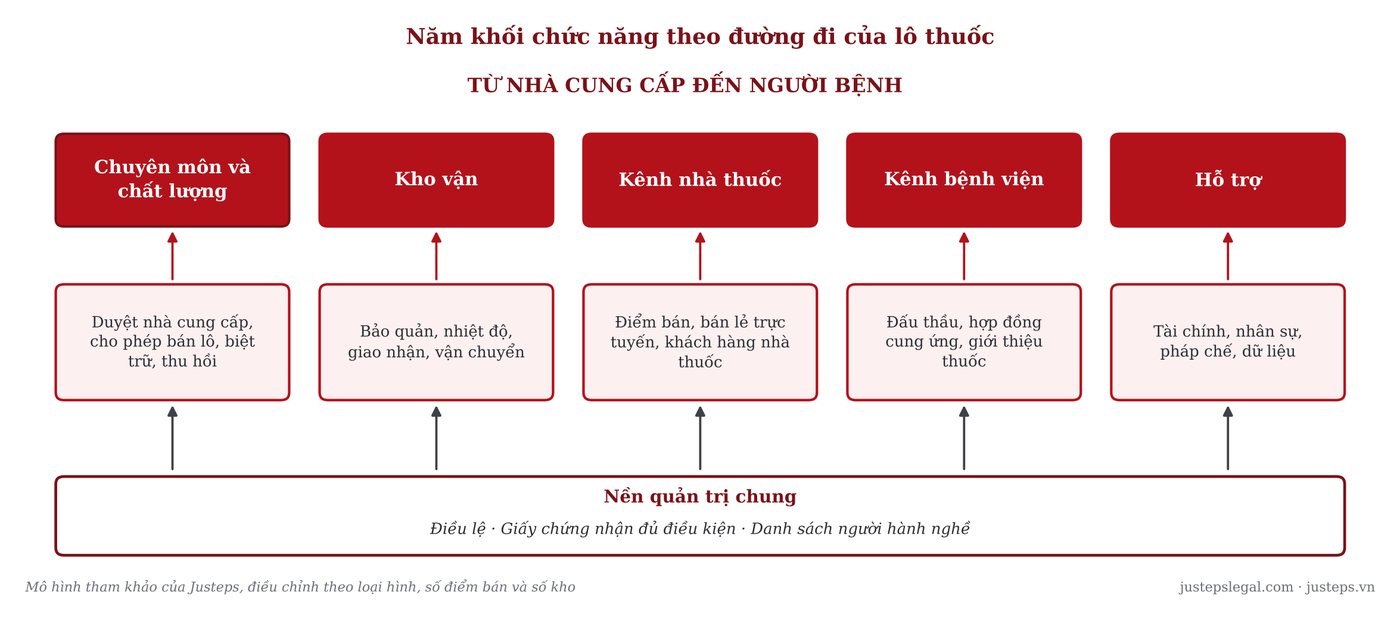
The five functional divisions of a pharmacy and pharmaceutical distribution business
The professional and quality division is headed by the person in charge of professional pharmacy matters and holds the power to approve suppliers, release batches for receipt and dispatch, order quarantine and act as the focal point for drug recalls. The logistics division manages storage conditions, temperature, humidity, receipt, delivery and transport, but may not release for sale on its own a batch awaiting a quality decision. The pharmacy channel sales division looks after the outlet network, online retail and customers that are other pharmacies, while the hospital channel sales division handles tenders, supply contracts and the team of medical representatives. The support division covers finance, human resources, legal affairs and data, with the legal function tracking the validity of certificates, marketing authorisations and practising certificates.
Common mistakes in existing organisations
The pharmacist in charge is a name on paper
The most common mistake is that the person in charge of professional pharmacy matters is paid a fixed amount to have their name on the certificate, is not regularly present and is not consulted when the business changes supplier or accepts urgent deliveries. All records are signed on their behalf by sales staff, so at an inspection the business cannot prove that the person in charge has performed their duties. Justeps proposes placing the person in charge on a direct reporting line to the head of the business, with a list of decisions that only this person may sign and a mechanism for a written letter of authorisation when they are absent.
Quality assurance sits under the warehouse or sales
In many wholesalers, quality assurance staff report to the warehouse manager, who is in turn measured on dispatching goods to customers on time. When a batch shows signs of irregular storage temperature or packaging, the decision to hold it back is often set aside to meet an order. Separating quality assurance into an independent unit with the power to record deviations and hold a batch without the consent of the warehouse or sales is a basic requirement of good distribution and storage practice.
The pharmacy chain is managed like an ordinary retail chain
As a chain grows quickly, the business often appoints area managers with retail experience to run several outlets, including transferring stock, handling near-expiry goods and setting sales targets by drug group. If the area manager has no pharmaceutical qualification, these decisions may exceed the authority of the pharmacist in charge of each pharmacy. The solution is to separate the retail operations line from the professional line, with area pharmacists reporting to the chain’s person in charge of professional pharmacy matters and having the power to stop instructions that conflict with professional procedures.
Medical representatives report only on sales
Medical representatives who promote drugs to healthcare professionals are usually assessed entirely on hospital channel sales, while nobody controls the content of drug information, presentation materials or spending on seminars. The Law on Pharmacy requires drug information to be accurate and well founded and to aim at the rational and safe use of drugs[14]. The organisation should keep sales targets with the hospital channel sales division, but give the professional division the task of approving information content and give finance and legal the task of controlling seminar and sponsorship costs.
Allocating authority between the professional and commercial sides
An organisation chart is only meaningful when it comes with an authority matrix for risky decisions. The principle Justeps applies is that decisions affecting drug quality belong to the professional line and cannot be reversed by the sales divisions, while decisions creating major commercial commitments belong to the head of the business after a professional opinion has been obtained. The example below is for a business that both wholesales and owns a pharmacy chain.
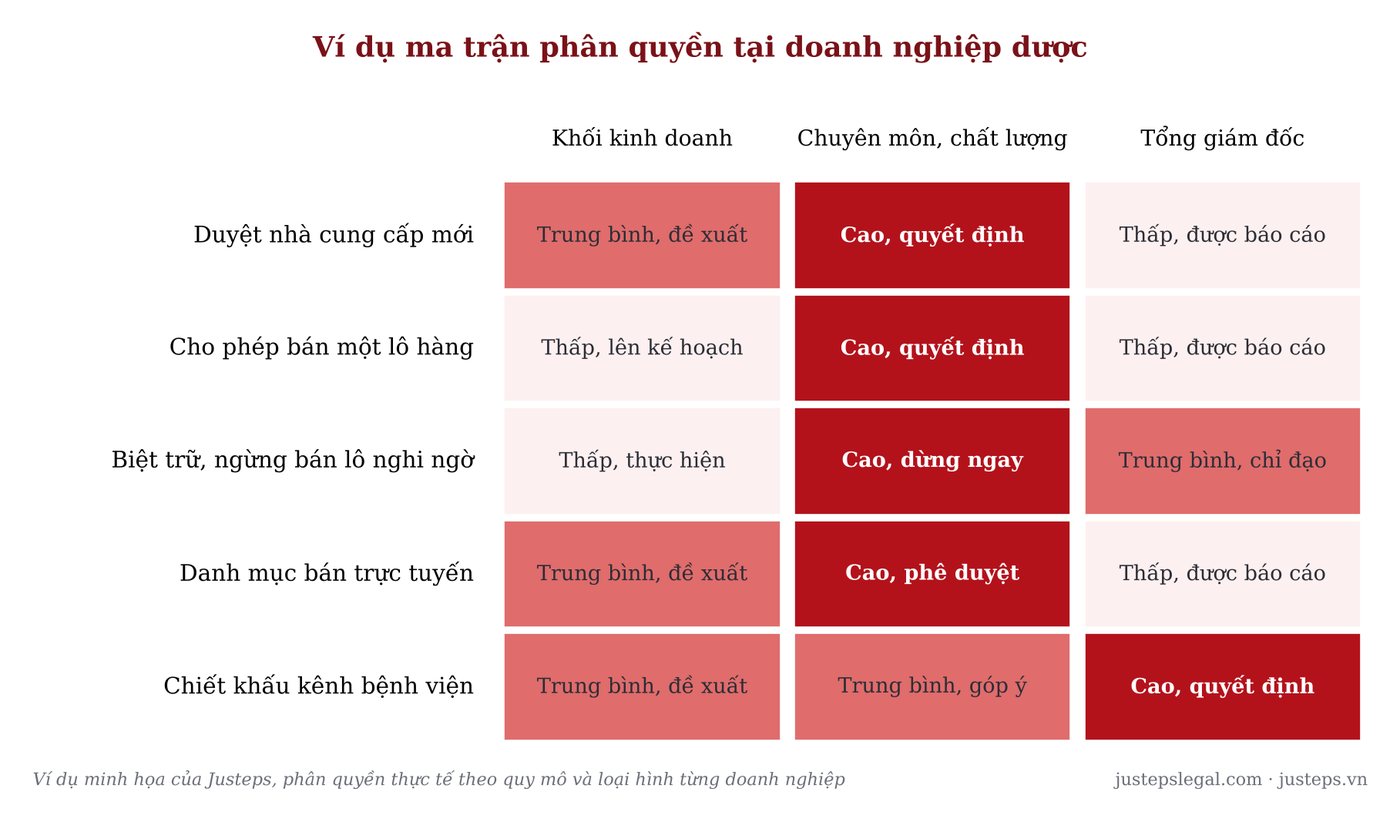
Example allocation of authority for five common decisions in a pharmaceutical business
In this example, the sales division may propose a new supplier and plan dispatches, but adding a supplier to the approved purchasing list and releasing a batch for sale belong to the professional and quality division. When there is information that a batch may be substandard, the professional division may quarantine it and stop sales immediately across the whole system and report afterwards. The list of drugs offered on the online channel is settled by the professional division, because the law only allows online retail of non-prescription drugs and excludes certain groups of drugs[15]. Discount policy for the hospital channel belongs to the head of the business after review by legal and finance, as this decision is governed by the law on bidding and pricing.
Application by business type
An independent pharmacy does not need many divisions, but it does need a job description for the pharmacist in charge, a qualified deputy and a work schedule matching the opening hours. A pharmacy chain needs to distinguish clearly between three levels, namely the person in charge of professional pharmacy matters at the chain organiser, area pharmacists and the pharmacist in charge of each pharmacy, together with a central purchasing unit and a chain quality unit. A wholesaler needs a strong logistics division, an independent quality assurance unit and a tender focal point separate from the team selling to pharmacies.
A foreign-invested business must check its permitted scope of activities against market access conditions under investment law and international commitments before designing its distribution division[16]. The parent company usually wants to control prices, the product portfolio and contracts with manufacturers, while professional responsibility in Vietnam rests with the person in charge at the Vietnamese entity, so the authority matrix should be bilingual and state clearly which decisions the Vietnamese entity may take on its own. A business that both wholesales and runs a pharmacy chain may consider separate legal entities to keep certificates and risks apart, at the cost of having to manage transactions between related parties[17].
How the service is carried out
An organisational structure design project for a pharmaceutical business usually takes about eight weeks. What sets it apart from many other sectors is that the new organisation must be checked against the good practice files already submitted and the certificates currently held, because some changes require the business to complete procedures with the pharmaceutical regulator.
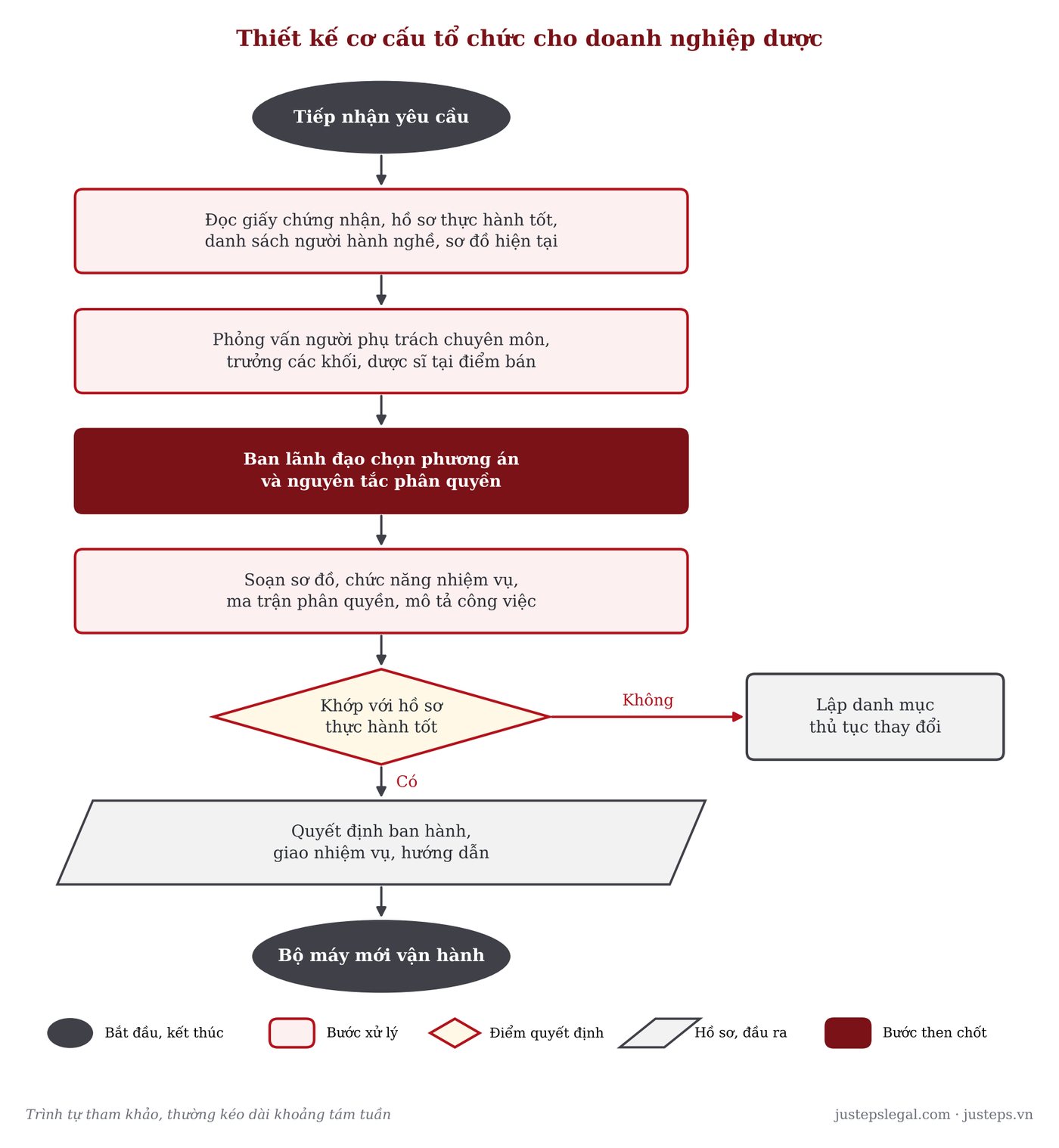
Sequence of organisational structure design including a check against the good practice files
In the first two weeks, Justeps consultants read the certificates, business scope, good practice files, list of practitioners and current chart, then interview the person in charge of professional pharmacy matters, the division heads and pharmacists at a number of outlets. In week three, Justeps presents two or three options for the management to choose from. After drafting the documents, Justeps checks each change against the good practice files; if a change affects the person in charge or the content of a certificate, Justeps lists the procedures to be completed before issue. The final week is devoted to signing decisions, assigning duties and briefing division heads on their new powers.
The set of documents is delivered in editable electronic form, together with draft instruments for approval by the competent body under the charter, and comprises the following main documents:
- A gap assessment report comparing the current organisation with the requirements on the person in charge of professional pharmacy matters, good practices and pharmacy chains.
- A company-level organisation chart and model charts for one pharmacy and one distribution warehouse.
- Regulations on the functions and duties of each division, clearly stating the powers of the person in charge of professional pharmacy matters and the quality assurance unit.
- An authority matrix for professional and commercial decisions.
- A contingency plan for when the person in charge of professional pharmacy matters is absent, with a template letter of authorisation.
- Job descriptions for key positions and a draft decision issuing the organisational structure.
Once the organisation has been issued, each division needs standard operating procedures and commercial regulations so that everyone works to the same standard; this work falls under the service for building internal procedures and regulations for pharmacy and pharmaceutical distribution businesses. Contracts, work schedules and remuneration for the person in charge of professional pharmacy matters, dispensing pharmacists and medical representatives are developed in the labour, payroll and insurance service for pharmacy and pharmaceutical distribution businesses.
What determines the service fee
Justeps quotes a fixed fee in writing after the initial meeting. The main factors are the type of business, the number of pharmacies and warehouses, the number of legal entities in the group, whether the business takes part in tenders to supply hospitals, the number of positions to be described and any need for bilingual documents for an overseas parent company. Whether Justeps assists with preparing the file to change the person in charge of professional pharmacy matters or only lists the procedures also affects the workload. Justeps’ proposal sets out the scope, deliverables, timeline and matters outside the scope so that management can plan the budget.
How Justeps can help
Alongside organisational structure design, pharmacy and pharmaceutical distribution businesses may combine the following Justeps services:
- Building internal procedures and regulations for pharmacy and pharmaceutical distribution businesses. Justeps drafts standard operating procedures under good practices and regulations on discounts and drug information so that each division works to the same standard.
- Labour, payroll and insurance services for pharmacy and pharmaceutical distribution businesses. Justeps develops contracts and benefits for the person in charge of professional pharmacy matters, dispensing pharmacists and medical representatives in line with the new organisation.
- Organisational structure, functions and duties, and job descriptions. Justeps drafts detailed job descriptions for key positions in the professional and logistics divisions.
- Financial regulations and delegation of authority. Justeps links the professional authority matrix with approval limits for expenditure, discounts and contracts.
Frequently asked questions
Must the person in charge of professional pharmacy matters be a member of the board of management?
The law does not require it. However, this person needs real decision-making power on professional matters and a direct reporting line to the head of the business; otherwise it will be difficult to prove that they perform their responsibilities under the Law on Pharmacy[1].
Can one pharmacist be in charge of professional matters for several pharmacies in a chain?
No. Each pharmacy in the chain must have its own person in charge meeting the same conditions as an independent pharmacy, in addition to the person in charge at the chain organiser level[8].
To whom should the quality assurance unit report?
This unit should report to the person in charge of professional pharmacy matters or to the head of the business. It should not sit under the warehouse or sales, because those two divisions carry delivery and sales targets.
Does a change to the organisation chart have to be reported to the pharmaceutical regulator?
The internal chart does not have to be registered. However, a change of the person in charge of professional pharmacy matters or of the content of the certificate of eligibility for pharmaceutical business requires a procedure under the Decree guiding the Law on Pharmacy[18].
Should a pharmacy chain purchase centrally?
Central purchasing helps control origin and obtain better prices. Even so, each pharmacy must still hold valid receipt records, and the pharmacist at the outlet must still check goods on receipt in accordance with good practice principles[10].
Which division should medical representatives belong to?
For targets, medical representatives belong to the hospital channel sales division. For drug information content and seminar costs, this group should be subject to the control of the professional and legal divisions.
Related articles
- Pharmacy chain management, pharmacy staff, GPP standards and inventory control
- Authority of the General Director, delegation of executive powers and limits under the charter and internal rules
- The minimum set of internal governance rules for businesses with 50 to 200 employees
- Service for building internal rules on delegation and authorisation
Notes
[1] Article 11 of the Law on Pharmacy No. 105/2016/QH13 dated 6 April 2016, as amended and supplemented by Law No. 44/2024/QH15 dated 21 November 2024.
[2] Clause 2, Article 33 of the Law on Pharmacy No. 105/2016/QH13 dated 6 April 2016, as amended and supplemented by Law No. 44/2024/QH15 dated 21 November 2024.
[3] Clause 1, Article 18 of the Law on Pharmacy No. 105/2016/QH13 dated 6 April 2016, as amended and supplemented by Law No. 44/2024/QH15 dated 21 November 2024.
[4] Article 16 of the Law on Pharmacy No. 105/2016/QH13 dated 6 April 2016, as amended and supplemented by Law No. 44/2024/QH15 dated 21 November 2024.
[5] Clause 9, Article 6 of the Law on Pharmacy No. 105/2016/QH13 dated 6 April 2016, as amended and supplemented by Law No. 44/2024/QH15 dated 21 November 2024.
[6] Article 2 of the Law on Pharmacy No. 105/2016/QH13 dated 6 April 2016, as amended and supplemented by Law No. 44/2024/QH15 dated 21 November 2024; Law No. 44/2024/QH15 took effect on 1 July 2025.
[7] Point h, Clause 1, Article 33 of the Law on Pharmacy No. 105/2016/QH13 dated 6 April 2016, as amended and supplemented by Law No. 44/2024/QH15 dated 21 November 2024.
[8] Article 17a of the Law on Pharmacy No. 105/2016/QH13 dated 6 April 2016, as amended and supplemented by Law No. 44/2024/QH15 dated 21 November 2024.
[9] Article 47a of the Law on Pharmacy No. 105/2016/QH13 dated 6 April 2016, as amended and supplemented by Law No. 44/2024/QH15 dated 21 November 2024.
[10] Circular No. 02/2018/TT-BYT dated 22 January 2018 of the Minister of Health on Good Pharmacy Practice, as amended and supplemented.
[11] Circular No. 03/2018/TT-BYT dated 9 February 2018 of the Minister of Health on Good Distribution Practice for drugs and drug ingredients, as amended and supplemented.
[12] Circular No. 36/2018/TT-BYT dated 22 November 2018 of the Minister of Health on Good Storage Practice for drugs and drug ingredients.
[13] Clause 3, Article 33 of the Law on Pharmacy No. 105/2016/QH13 dated 6 April 2016, as amended and supplemented by Law No. 44/2024/QH15 dated 21 November 2024.
[14] Article 76 of the Law on Pharmacy No. 105/2016/QH13 dated 6 April 2016, as amended and supplemented by Law No. 44/2024/QH15 dated 21 November 2024.
[15] Clause 17, Article 6 and Clause 4, Article 42 of the Law on Pharmacy No. 105/2016/QH13 dated 6 April 2016, as amended and supplemented by Law No. 44/2024/QH15 dated 21 November 2024.
[16] The Law on Investment No. 143/2025/QH15, effective from 1 March 2026.
[17] The Law on Enterprises No. 59/2020/QH14 dated 17 June 2020, as amended and supplemented by Law No. 03/2022/QH15 and Law No. 76/2025/QH15.
[18] Government Decree No. 163/2025/ND-CP dated 29 June 2025 detailing and guiding the implementation of the Law on Pharmacy.
This article is for reference and reflects the regulations in force at the time of publication. Please consult Justeps for advice tailored to your company’s records and situation.
For further information, please contact:
📩 Email: info@justeps.vn
🌐 Website: https://justepslegal.com · https://justeps.vn
🌐 Page: Justeps
☎️ Hotline (Zalo): 096 172 2607
📍 Thanh Xuan Office: 12th Floor, Licogi 13 Tower, 164 Khuat Duy Tien Street, Thanh Xuan Ward, Hanoi, Vietnam
📍 Ha Dong Office: LK06B, No.10, Dong Dua Area, Ha Dong Ward, Hanoi, Vietnam
📍 Ho Chi Minh City Branch: 528 Le Van Sy, Ho Chi Minh City, Vietnam
📍 Hai Phong Office: Truong Thinh Village, Ha Dong Commune, Hai Phong, Vietnam
📍 Quang Ninh Office: Van Don Special Zone, Quang Ninh Province, Vietnam





