
Key takeaways
- A business managing apartment buildings must have technical, customer care, security, fire prevention and sanitation departments and staff with professional training[1], so its organisational chart is also part of the evidence of its operating capacity.
- The business remains responsible to the Management Board for work it has subcontracted[3], so each building management office needs a named person to supervise outsourced security, cleaning and maintenance.
- A building manager needs a written authorisation stating the spending limit, the records they may sign and their authority to deal with state agencies; otherwise every small decision has to wait for head office.
- Money collected on behalf of others, service fees and Management Board funds must follow separate flows, and the person collecting money at a project should not also approve payments.
Building management businesses usually grow contract by contract. When a new apartment tower or office block is won, the business sends a building manager to the site, recruits more security guards, technicians and receptionists and signs a few more cleaning and landscaping contracts. After five or seven projects, every building runs its own way, head office cannot see which project is overspending, and when a fire, a lift entrapment or a theft occurs nobody knows who must decide and who must answer to the Management Board.
This page describes the Justeps service for designing the organisational structure of businesses that manage apartment buildings, office buildings, shopping centres and urban areas, including subsidiaries of developers and businesses managing many projects across several provinces. It focuses on the departments required by housing law, the relationship between head office and the management office at each project, the authority of building managers, the point of contact for subcontractors and staffing. How each department works day to day with residents and the Management Board is covered separately under the internal procedures and regulations service for building and urban area management businesses.
Capacity conditions shape the basic framework
For apartment buildings, the organisational structure is not entirely a matter of the business’s own choice. The Law on Housing requires a management and operation unit to have apartment management as a business function, to have departments for technical matters, customer care, security, fire prevention and fighting, and sanitation and environment, and to have managers and staff with suitable professional training who hold a certificate of completion of a training course on apartment building management[1]. The business may provide the service only after receiving a written notice of eligibility from the competent authority[1], and in practice the provincial housing authority checks precisely these departments and staff when reviewing the application.
Justeps therefore starts by checking the existing organisation against each condition before drawing a new chart. A common error is that the business has all five departments on paper, while in reality the fire prevention department is a single technician with other duties and the person holding the training certificate left long ago. The table below shows how Justeps places the statutory departments in the chart of a business that has both a head office and management offices at its projects.
| Department | At head office | At the project management office |
|---|---|---|
| Technical | Chief engineer for the whole system, who plans maintenance and evaluates equipment contractors. | Technical team on shift operating power, water and lifts and handling first response to incidents. |
| Customer care | Prepares notice templates, tracks long-running complaints and surveys satisfaction. | Reception staff who receive feedback from residents and tenants and reply within the committed time. |
| Security | Selects and supervises the security services company where security is outsourced. | Security team, or the person supervising the security contract at the building. |
| Fire prevention | Dedicated officer who guides and inspects projects and deals with the police authority. | On-site fire team, the firefighting plan and periodic inspection records. |
| Sanitation | Selects cleaning and waste collection contractors and sets acceptance criteria. | Supervisor who checks daily cleaning quality and confirms volumes. |
Office buildings, shopping centres and urban areas are not subject to the eligibility notice regime that applies to apartment buildings, and mainly operate under real estate management service contracts, which cover providing services to keep the property running normally, arranging maintenance and repairs and supervising use under contract[2]. Many businesses manage both types of project, however, so Justeps usually keeps one common framework that meets the apartment building conditions and adjusts only staffing and job titles for office or urban area projects.
How head office and project management offices divide the work
In this industry the centre of the organisation is not head office but each building management office, where all daily dealings with residents, tenants and contractors take place. Head office has three main tasks, namely setting standards, controlling money and providing specialist support in engineering, fire prevention, legal matters and human resources. If head office takes over operations, the building manager becomes a messenger, and if head office lets go completely, each project becomes a small separate business that nobody controls.
Justeps usually proposes one of two models. The first suits businesses with fewer than ten projects, where building managers report directly to the operations director and technical, accounting and human resources functions are centralised at head office. The second suits businesses with many projects in several locations, adding a regional cluster level, with each cluster sharing a chief engineer and a fire prevention officer. The Law on Housing allows one management unit to operate several apartment buildings in one or more localities[3], so the cluster model is lawful and saves specialist staff.
Where a project is in a province other than the head office, the business should consider registering a branch or a business location, because the registration form determines where tax is declared, who may sign contracts and how labour at the project is managed[4]. Justeps considers this question together with the organisational chart, because a management office registered as a branch has a head with different authority from a management office that is only an internal unit.
The authority of the building manager
The building manager is the hardest position in the business, because the role must answer to three parties at once, namely the Management Board, residents and head office. This person is often expected to deal immediately with a water leak, decide to call out a technician after hours, sign acceptance records with the cleaning contractor and work with the police during fire safety inspections, yet has no document granting that authority. In principle, only the legal representative or a person authorised in writing may enter into transactions on behalf of the business[5], so a lack of authorisation means a lack of basis for the very things the building manager does every day.
Justeps builds an authority matrix between head office and the project management office, and then turns the matrix into appointment decisions and authorisation letters for each building manager. The example below is the matrix Justeps often uses as a starting point for a business managing about eight projects.
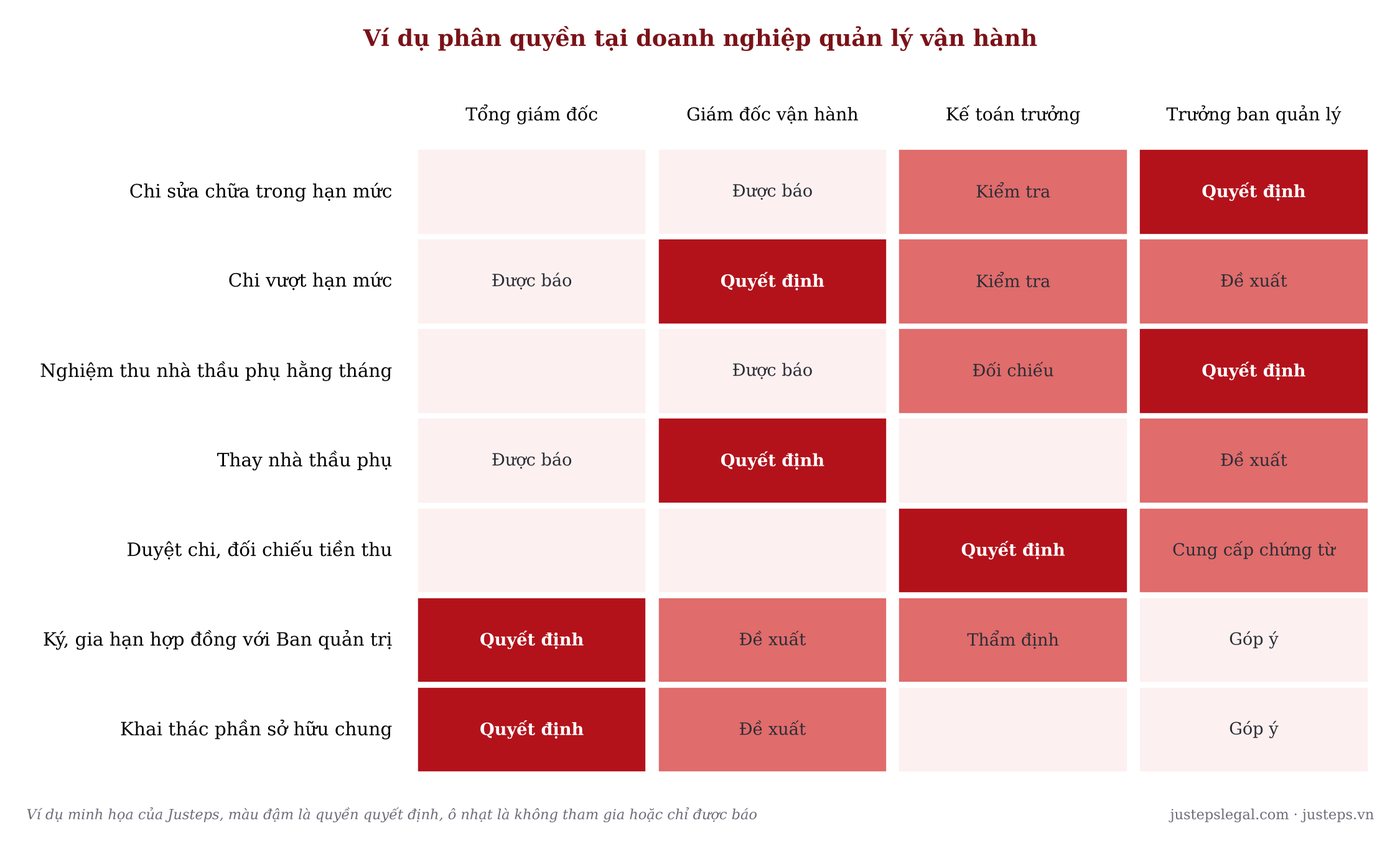
Example of authority between head office and project management offices at a building management business
In the example, the building manager may decide on minor repair spending within the limit, call in emergency technicians and sign the monthly volume acceptance records of subcontractors. The operations director decides on spending above the limit and on replacing subcontractors, while the chief accountant holds the authority to approve payments and reconcile collections. Signing or renewing the contract with the Management Board and exploiting common areas are always decided by the general director, because these are commitments of the business rather than of a single project. The specific spending limit for each level should then be set through the financial regulations and delegation of authority service.
One point of contact for subcontractors and fire prevention
Many businesses outsource security, cleaning, landscaping, pest control and the maintenance of lifts and generators. Housing law allows the management unit to hire other businesses to provide some services, but the management unit remains responsible to the Management Board for the work committed under its contract[3]. So when an outsourced guard leaves the post or a lift contractor is late with maintenance, the Management Board will deal with the building management business, not with the subcontractor.
The organisational structure must show who at the project supervises each contractor, who confirms monthly volumes and who proposes penalties or replacement. Justeps also draws attention to giving daily instructions directly to subcontractor staff, because managing them as if they were the business’s own employees can blur the line between a service contract and the use of leased labour. For fire prevention, the Law on Fire Prevention, Firefighting and Rescue places responsibility on the head of the establishment and requires an on-site force[6], so the chart must state who is responsible at each building, who commands the on-site team and who keeps the inspection records.
Separating money collected and paid on behalf of others
A building management office usually collects several types of money, including the management service fee, parking fees, electricity and water charges collected on behalf of suppliers and deposits for interior fit-out works. The management service fee does not include maintenance funds, parking fees, electricity and water or the remuneration of the Management Board[7], and the Management Board of a building with multiple owners has its own seal and bank account[8]. Many amounts collected by the project office therefore belong to other parties, and the organisational structure must ensure which amount goes into which account, who may spend it and who reconciles it.
The principle Justeps applies is that the person collecting money at the project may not also approve payments, and every receipt is recorded in the head office system on the same day. Invoices for service fees and other charges must be issued under the current rules on electronic invoices[9], so the accounting team at head office needs the list of apartments, chargeable areas and amounts collected on behalf of others for each project. In a small business the project accountant may also act as cashier, but reconciliation of receipts and payments must be done weekly by someone else.
Staffing by project type and shift
The size of a management office depends on the number of floors, the number of lifts, the area of the car park, the hours that must be covered and the extent of outsourcing, more than on the number of apartments. A building must have technical and security staff on duty twenty-four hours a day, so each continuously staffed position needs four to five people to rotate without exceeding overtime limits. The chart below compares staffing for three typical types of project.
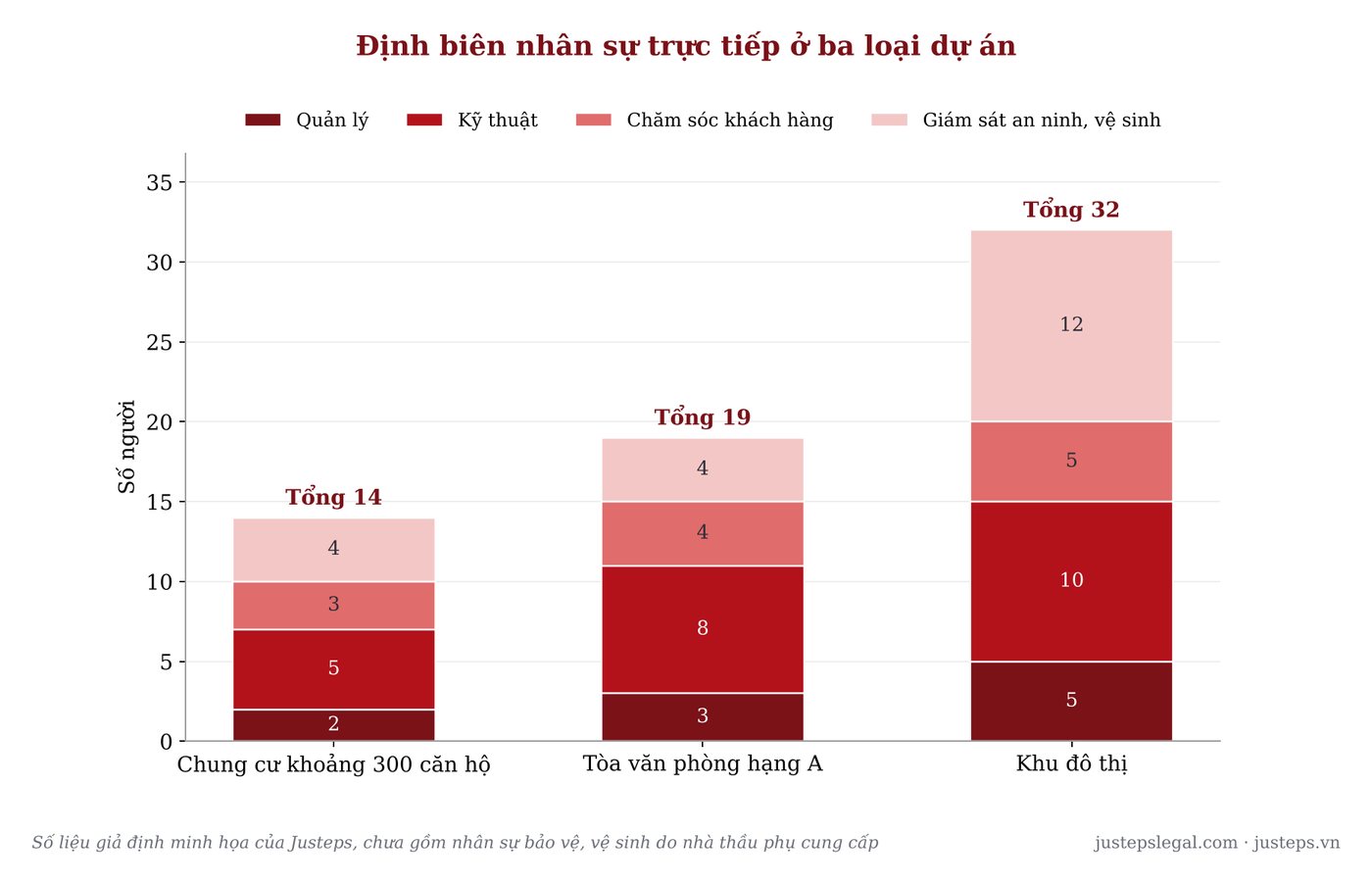
Example of direct staffing of the business at three types of managed project
In the example, an apartment building of about 300 units needs 14 staff of the business, namely 2 managers, 5 technicians, 3 customer care staff and 4 security and cleaning supervisors, with security and cleaning themselves outsourced. A grade A office building needs 19 people because its technical systems are more complex and tenants expect more reception staff, while an urban area needs 32 people because of its large area, landscaping, internal roads and many access control points. These are assumed figures to illustrate the method; actual staffing is calculated by Justeps from the duty roster and workload of each project. Shift, overtime and pay policies for these positions are handled under the labour, wages and social insurance service for building and urban area management businesses.
Implementation process, deliverables and fees
A project to design the organisational structure of a building management business usually takes about eight weeks. Justeps selects two or three representative projects, including at least one apartment building, observes the actual shifts and records at the building, and only then proposes a model for management to choose.
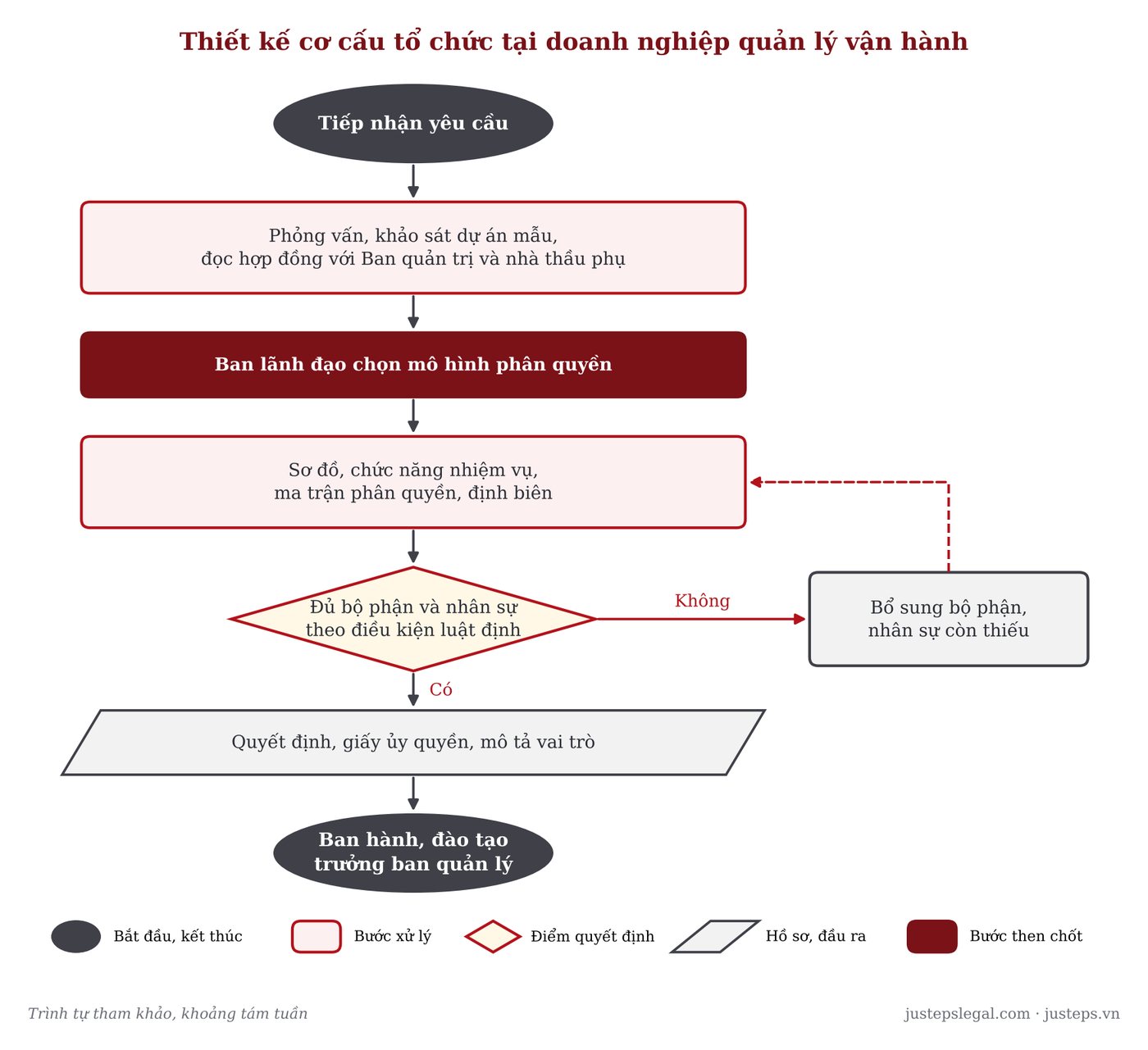
Sequence for designing and applying the organisational structure at a building management business
In the first two weeks Justeps interviews management, department heads and building managers and reads the contracts with the Management Board and with subcontractors. In the third week management chooses the authority model, after which Justeps prepares the chart, functions and duties, authority matrix and staffing table. If the new organisation still lacks a department or staff required by the statutory conditions, Justeps returns to adjust the chart before drafting decisions and authorisation letters, and the final week is spent training building managers. The deliverables include the following documents:
- A report comparing the current organisation with the capacity conditions for an apartment building management unit.
- The head office organisational chart and a standard chart for the management office of each type of project.
- Functions and duties of departments and role descriptions for the building manager, chief engineer and fire prevention officer.
- An authority matrix between head office, cluster managers and project management offices.
- A staffing table by project type and duty roster.
- Draft decisions issuing the organisational structure, appointment decisions, fire prevention assignments and authorisation letters for building managers.
The project fee is quoted by Justeps in writing as a fixed package after an initial discussion. The fee depends on the number of projects and locations, the proportion of apartment buildings compared with offices and urban areas, the extent of outsourced services, the need for bilingual documents and whether the business needs Justeps to follow the implementation phase. A business wishing to link the new structure with performance indicators for building managers can combine it with the KPI and performance evaluation system service.
How Justeps can help
In addition to organisational structure design, building and urban area management businesses can combine the following Justeps services:
- Internal procedures and regulations for building and urban area management businesses. Justeps writes the procedures for taking over buildings, handling feedback, incidents and fee collection for the newly designed positions.
- Labour, wages and social insurance for building and urban area management businesses. Justeps designs shift rosters, overtime policies, allowances and contracts for on-duty staff at projects.
- Ongoing compliance advisory for building and urban area management businesses. Justeps supports head office and building managers in dealings with the Management Board, residents and state agencies.
- Financial regulations and delegation of authority. Justeps sets spending limits, approval rights and procedures for reconciling collections at each management level.
- KPI and performance evaluation system. Justeps builds indicators to evaluate project management offices by service quality, fee collection rate and operational safety.
Frequently asked questions
Does a small business need all five departments required by law?
For apartment buildings, the business must have technical, customer care, security, fire prevention and sanitation and environment departments[1]. A department may be small and shared across projects, but it must have staff with specific assigned duties and the required training certificates.
If security and cleaning are outsourced, are security and cleaning departments still needed?
A supervisor is still needed, because the management business is responsible to the Management Board for work given to subcontractors[3]. This department may consist of only one person at the project who checks daily and confirms volumes.
May a building manager sign contracts with contractors?
Only with a written authorisation and within its scope[5]. Justeps usually lets building managers sign acceptance records and small orders, while framework contracts with contractors are signed by head office.
Must a management office in another province be registered as a branch?
Not in every case, but the choice between a branch and a business location affects where tax is declared, who signs contracts and how labour is managed[4]. Justeps considers this based on the number of projects, revenue and staff in each location.
May the business hold the maintenance funds of an apartment building?
Maintenance funds are not part of the management service fee[7] and the Management Board of a building with multiple owners has its own account[8]. The business only carries out maintenance under the contract and approved plan and should not receive or hold these funds in its own account.
When should the organisational structure be reviewed?
Once a year and whenever the business takes on projects in a new location, loses a major contract, moves from office management into apartment buildings or has just received an unfavourable fire safety inspection conclusion.
Related articles
- Internal procedures and regulations for building and urban area management businesses from takeover to incident handling
- Ongoing compliance advisory for building and urban area management businesses in relations with the Management Board and residents
- Labour, wages and social insurance for building and urban area management businesses with twenty-four hour shifts
- Building an occupational safety and health system for factories from the responsible department to training and monitoring
Notes
[1] Article 150 of the Law on Housing No. 27/2023/QH15 dated 27/11/2023, effective from 01/8/2024.
[2] Clause 3, Article 66 of the Law on Real Estate Business No. 29/2023/QH15 dated 28/11/2023.
[3] Article 149 of the Law on Housing No. 27/2023/QH15 dated 27/11/2023, effective from 01/8/2024.
[4] Article 44 of the Law on Enterprises No. 59/2020/QH14 dated 17/6/2020, as amended and supplemented by Law No. 76/2025/QH15.
[5] Article 12 of the Law on Enterprises No. 59/2020/QH14 dated 17/6/2020, as amended and supplemented by Law No. 76/2025/QH15.
[6] Law on Fire Prevention, Firefighting and Rescue No. 55/2024/QH15, effective from 01/7/2025, and Decree No. 105/2025/ND-CP of the Government guiding this Law.
[7] Clause 2, Article 151 of the Law on Housing No. 27/2023/QH15 dated 27/11/2023, effective from 01/8/2024.
[8] Clause 3, Article 146 of the Law on Housing No. 27/2023/QH15 dated 27/11/2023, effective from 01/8/2024.
[9] Decree No. 254/2026/ND-CP dated 30/6/2026 of the Government on electronic invoices and electronic documents, effective from 01/7/2026.
This article is for reference and reflects the regulations in force at the time of publication. Please consult Justeps for advice tailored to your company’s records and situation.
For further information, please contact:
📩 Email: info@justeps.vn
🌐 Website: https://justepslegal.com · https://justeps.vn
🌐 Page: Justeps
☎️ Hotline (Zalo): 096 172 2607
📍 Thanh Xuan Office: 12th Floor, Licogi 13 Tower, 164 Khuat Duy Tien Street, Thanh Xuan Ward, Hanoi, Vietnam
📍 Ha Dong Office: LK06B, No.10, Dong Dua Area, Ha Dong Ward, Hanoi, Vietnam
📍 Ho Chi Minh City Branch: 528 Le Van Sy, Ho Chi Minh City, Vietnam
📍 Hai Phong Office: Truong Thinh Village, Ha Dong Commune, Hai Phong, Vietnam
📍 Quang Ninh Office: Van Don Special Zone, Quang Ninh Province, Vietnam





