
Key takeaways
- An events business lives on short projects, so its organisational structure needs two clearly defined tiers, a standing organisation that maintains standards and a project team accountable for each individual show.
- A performance that requires approval must have its file submitted at least 07 working days before the show date, so the person responsible for the legal file must be involved from the moment the script and the list of works are settled[2].
- The authority to stop or suspend a show where safety is at risk should be assigned in writing to a specific person present on site, rather than depending on whether the director can be reached[3].
- Artist management should be separated from show production at least in terms of people and books, because the two lines often sit on opposite sides of the same performance contract.
An events business may at the same time be running a product launch for a corporate client, a ticketed concert and a series of brand activation activities in three provinces. Each show has its own budget, venue, suppliers, script and risks, lasts a few weeks and then ends. Where the organisation is divided only into functional departments such as sales, creative, technical and accounting, each department does its own part well, but nobody is accountable for the final outcome of the show, and incidents tend to fall into the gaps between departments.
This page presents Justeps’ organisational structure design service for businesses that organise events, produce performing arts shows, manage artists and operate entertainment venues. It moves from the operating features of the sector, through the legal obligations that need to be tied to a specific position, the common mistakes, the proposed model, the implementation process and deliverables, to how the service applies by size. The underlying legal basis is the Law on Enterprises No. 59/2020/QH14 as amended and supplemented, most recently by Law No. 76/2025/QH15[1], together with the sector-specific rules on performing arts, fire prevention and fighting, and copyright.
Operating features that set an events business apart from ordinary service businesses
The first feature is that work is organised as projects with a fixed end date. Once the show date has been announced, tickets have been sold and guests have received their invitations, it can hardly be postponed. Every decision in the final days, from changing the sound supplier to replacing an act, has to be made within a few hours, so the organisation needs people authorised to decide on the spot instead of waiting for signatures along the administrative chain.
The second feature is that the workforce swells very quickly and then contracts. A large show may need hundreds of people, including stage crews, security, volunteers, artists, dancers and suppliers’ staff, while the standing organisation has only a few dozen. The organisational structure must answer who directs this temporary workforce, who is responsible for their safety and to whom they report throughout set-up, performance and dismantling.
The third feature is that the density of legal obligations per show is very high relative to the time available. A ticketed concert must have written approval from the competent authority, meet fire prevention and fighting, security and order and medical requirements, have permission from the copyright owners of the works performed, comply with advertising rules for sponsors and follow a ticket refund policy for consumers. Each of these obligations needs a person assigned by name, otherwise there will be times when everyone assumes someone else has dealt with it.
Legal obligations that need to be tied to a position in the organisation
Approval and notification files for performances
Under Decree No. 144/2020/NĐ-CP on performing arts activities, internal shows and non-ticketed performances at tourism establishments and restaurants are subject to notification, while other shows, including ticketed shows, are subject to approval[2]. The approval file comprises a written request, the script and the list of works with their authors, the person in charge, and Vietnamese translations of foreign works, and under the 2026 amendments it must be submitted at least 07 working days before the planned date. Where the time or venue changes, the business must notify the approving authority and the local authorities at least 02 working days before the planned date.
These deadlines show that the person responsible for the legal file cannot be brought in only after the script is finished. In the structure proposed by Justeps, this position sits within the standing organisation, attends the meeting at which the script and the running order of every show are settled, has the right to require that signing contracts with artists or opening ticket sales be put on hold while the file is incomplete, and is the sole point of contact with the licensing authority.
Safety, fire prevention and the authority to stop a show
The 2024 Law on Fire Prevention and Fighting and Rescue places responsibility for fire prevention on the head of the establishment and on the organisations and individuals using the venue[3], while the Law on Occupational Safety and Health requires employers to provide a safe workplace for workers, including stage crews working at height with lifting equipment and suspended structures[4]. At an outdoor show with thousands of spectators, the decision to suspend the show in a thunderstorm, when the crowd surges or when a structure shows signs of being unsafe must be made within minutes.
The organisational structure therefore needs to appoint a safety lead for each show, present throughout set-up, performance and dismantling, and authorised in writing to stop or suspend the show without having to consult the director. This person should not also be the show director or the person in charge of sponsorship, because those two positions are always under pressure to keep the show running on time.
Copyright and related rights
Performing a work in public, whether live or through sound or video recordings, is an economic right of the copyright owner[5]. Published sound and video recordings used in business and commercial activities do not require permission, but royalties must be paid to the owner as agreed or as prescribed by the Government. Rights clearance should belong to the standing legal point of contact, while the person in charge of a show’s content is responsible for supplying a complete list of works on time.
The proposed model of a standing organisation and project teams
For most small and medium-sized events businesses, Justeps proposes a two-tier model. The standing tier comprises the units that maintain standards and shared resources, and exists continuously however many shows are running. The project tier is set up for each show on a standard framework, headed by a project director, and is dissolved once the final accounts are settled. The figure below shows the five units of the standing tier and the common foundation that links the two tiers.
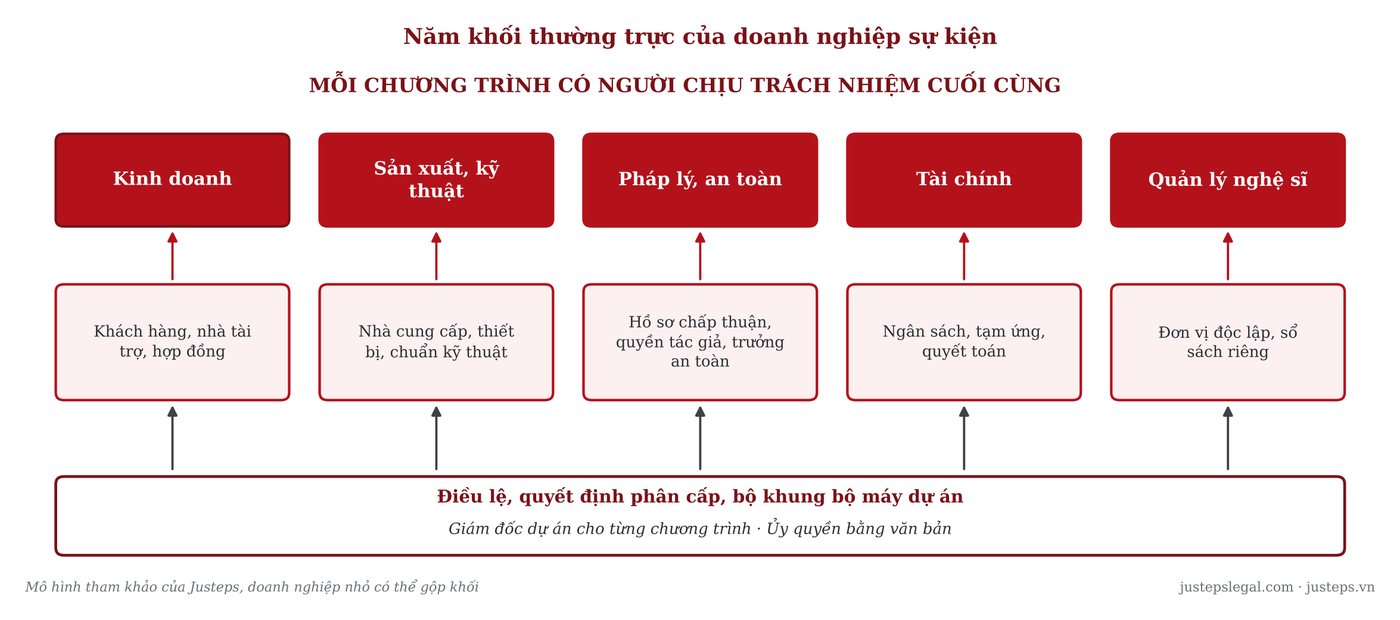
Five standing units of an events and performing arts business
The sales unit finds clients and sponsors and closes contracts, but does not commit on its own to a show date or an artist without the view of the production unit. The production and technical unit keeps the list of suppliers, the equipment and the technical standards, and seconds people to the project teams. The legal and safety unit handles approval files, clears rights and trains safety leads. The finance unit approves budgets, advances and final accounts. The artist management unit, where there is one, works as an independent unit. The common foundation is the charter, the decision on delegation of authority and the framework for project teams.
Within a project team, the project director bears final responsibility for the budget, timeline and quality of the show, receives people from the standing units and directs them for the duration of the project. The standing units still keep the right to set standards; for example, the finance unit does not allow spending above the approved limits even if the project director agrees, and the legal unit has the right to require that ticket sales be halted until written approval has been obtained. This is a form of matrix organisation, and it only works when the authority of both sides is clearly set down on paper.
An authority matrix for decisions that easily lead to disputes
Once the model has been settled, Justeps prepares an authority matrix for the decisions that events businesses usually handle out of habit or according to whoever has the loudest voice. The matrix shows who proposes, who decides and who is only informed. The example below applies to a business that both organises corporate events and produces its own ticketed concerts.
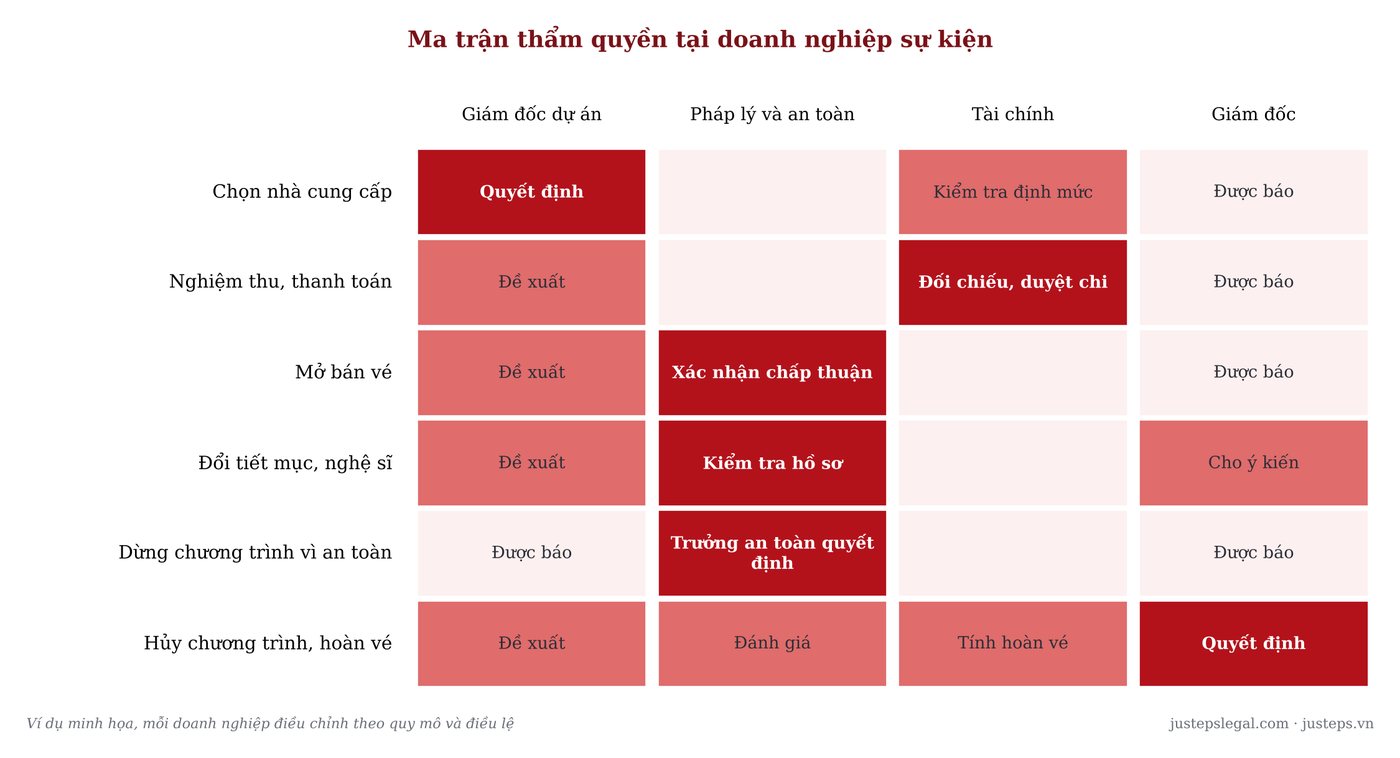
Example division of authority between the project director, legal and safety, finance and the director
In this example, the project director may choose suppliers from the approved list, but acceptance and payment must be checked by the finance unit, so that no single person chooses, accepts and approves payment. The decision to open ticket sales may only be made once the legal unit confirms that written approval has been obtained. The decision to stop a show for safety reasons belongs to the safety lead on site, whereas the decision to cancel a show entirely and refund tickets belongs to the director, because it brings obligations towards consumers, sponsors and artists.
Common mistakes and the choice of legal model
The legal function is brought in too late
In many businesses, the sales team signs contracts with clients and artists, the creative team finalises the script, and only then is the file passed to an administrative employee to submit. When the authority asks for additional documents or a work turns out not to have the author’s permission, the time left is not enough to make corrections, while tickets and sponsorships have already been committed. Bringing the legal point of contact into the script meeting from the start usually saves far more than the cost of maintaining that position.
Conflicts of interest between show production and artist management
When the same business both manages artists and produces shows, the artist manager wants a high performance fee while the producer wants low costs. If both roles are held by the same person, artists find it hard to believe they are being represented fairly, and partners find it hard to believe the costs are reasonable. The organisational structure should separate the persons in charge, keep separate records of revenue and costs, and set disclosure rules for when artists managed by the business take part in the business’s own shows.
When artist management reaches a significant scale, with long-term exclusive contracts and revenue of its own, Justeps assesses the option of setting up a separate company to isolate risk and make it easier to bring in partners as investors. For an office in another province or an equipment warehouse, the Law on Enterprises allows a choice between a branch, a representative office and a business location[6]; a warehouse that only stores equipment is usually suited to a business location, while an office with a person authorised to sign contracts and its own production team is suited to a branch.
Implementation process, deliverables and application by size
A structure design project usually takes about eight weeks and should avoid the year-end peak season, so that the model can be trialled on a real show before it is formally issued. The flowchart below shows the sequence, in which the decision point is whether the business needs to separate artist management or venue operation into its own unit.
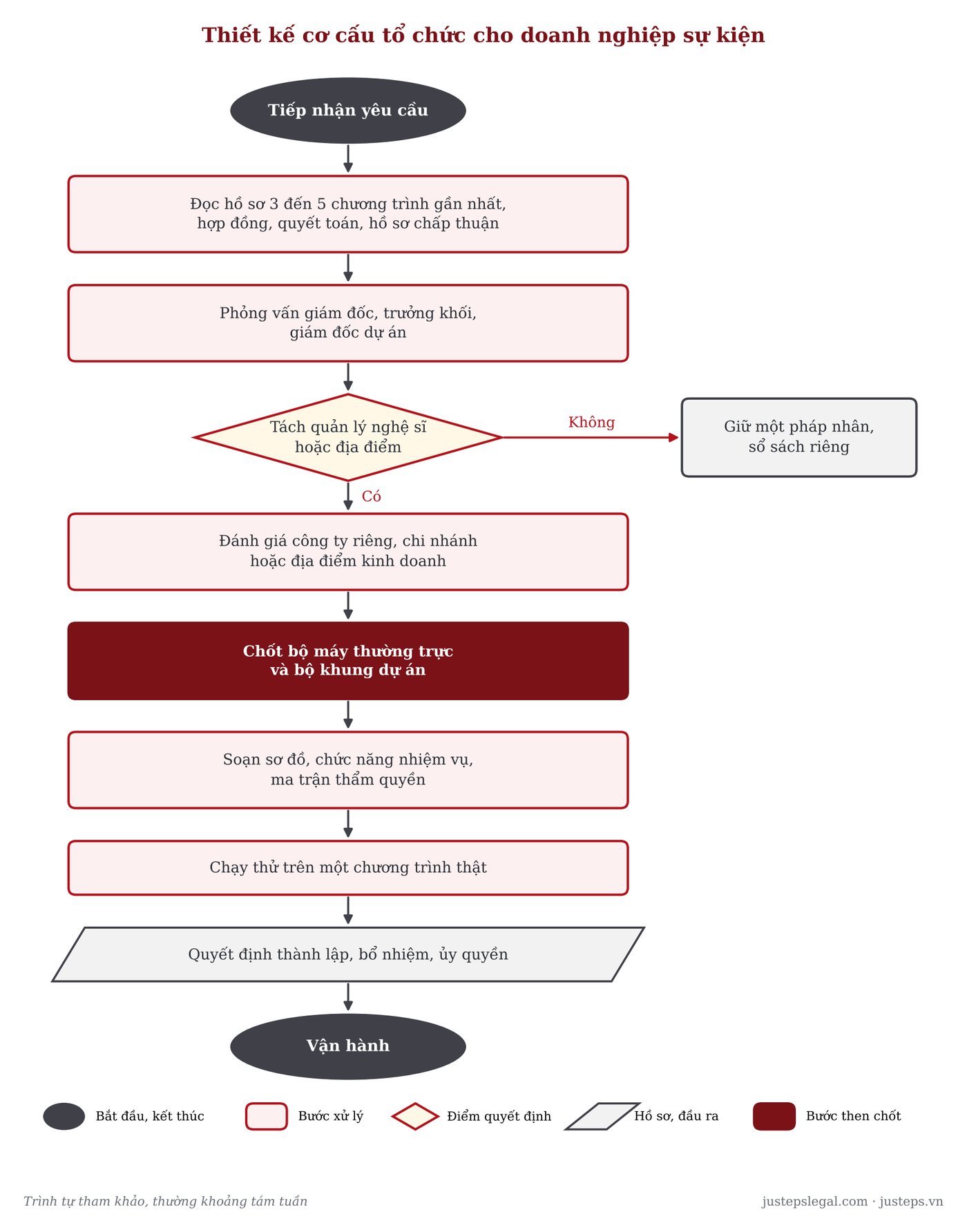
Sequence for designing the organisational structure of an events and performing arts business
In the first two weeks, Justeps’ consultants read the files of the three to five most recent shows, including contracts, budgets, final accounts, approval files and incident reports if any, and interview the director, the heads of units and several project directors. Week three is the meeting with management to settle the model. The following weeks are for drafting documents, trialling on one show and making adjustments. The deliverables comprise the following documents:
- A chart of the standing organisation and a standard project team framework, with an explanation of why the model was chosen.
- A statement of the functions and duties of each unit and descriptions of key positions such as project director, safety lead and legal point of contact.
- An authority matrix for choosing suppliers, acceptance, opening ticket sales, stopping a show, cancelling a show and refunding tickets.
- A report assessing the legal options for artist management, venue operation and offices in other provinces.
- Draft decisions establishing units, appointment decisions and letters of authorisation for project directors and safety leads.
A business with fewer than twenty people usually needs only three units, namely sales, production, and a combined finance and legal unit, with the director also acting as project director for large shows. A business that invests in its own ticketed concerts should treat each show as a profit centre with its own books. A business that brings in international artists needs an additional position responsible for entry procedures, labour matters and tax obligations on fees paid abroad. Once the organisation has taken shape, the detailed procedures for each stage are written under the internal procedures and regulations service for events and performing arts businesses, while contracts with stage crews, artists and seasonal workers are handled under the labour, payroll and insurance service for events businesses.
Fees are quoted as a fixed package in writing after the initial discussion, depending on the number of business lines, the number of locations of operation, whether separate legal entities are needed and the number of positions to be described. Justeps recommends reviewing the structure after each peak season or at least once a year, and as soon as the business opens a new line such as venue operation or digital content production.
How Justeps can help
Alongside organisational structure design, event, performing arts and entertainment businesses can combine the following Justeps services:
- Building internal procedures and regulations for event, performing arts and entertainment businesses. Justeps writes procedures for permits, safety, ticket sales and project final accounts that match the newly designed two-tier organisation.
- Labour, payroll and insurance services for event, performing arts and entertainment businesses. Justeps classifies standing and seasonal workers and drafts contracts for stage crews, artists and freelance collaborators.
- Business model and corporate structure advisory. Justeps assesses options for separating artist management or venue operation into a separate company.
- Setting up branches, representative offices and business locations. Justeps chooses the form and prepares registration files for an office in another province or an equipment warehouse.
Frequently asked questions
Does a small events business need a separate project team?
Yes, but in a compact form. Each show should have one person appointed in writing as project director and one person appointed as safety lead, even if they also hold other roles in the standing organisation.
Who should have the authority to stop a show when an incident occurs?
The safety lead present on site, authorised in writing. A decision to stop for safety reasons has to be made within minutes, whereas the decision to cancel the show entirely and refund tickets belongs to the director[3].
When must the approval file for a ticketed concert be submitted?
Under the 2026 amendments, the file must be submitted at least 07 working days before the planned date[2]. The business should set an earlier internal deadline so that there is time to provide additional documents if the authority asks for them.
Should artist management be set up as a separate company?
It depends on the scale and independence of that line. At an early stage, separating the persons in charge and the books is usually enough; once there are many long-term exclusive contracts and significant revenue of its own, a separate company is worth considering.
What form of registration does an equipment warehouse in another province need?
If the warehouse only stores and moves equipment in and out, registering a business location is usually appropriate. If there is a person there authorised to sign contracts and its own production team, the business should consider setting up a branch[6].
Who in the organisation should be responsible for obtaining permission to use musical works?
The standing legal point of contact should clear rights and deal with the owners or collective management organisations, while the person in charge of content supplies a complete list of works on time[5].
Related articles
- Building internal procedures and regulations for event, performing arts and entertainment businesses across the life cycle of a show
- Ongoing legal advisory for event, performing arts and entertainment businesses from artist contracts to show day
- Labour, payroll and insurance services for event, performing arts and entertainment businesses with a workforce that changes with each show
- Fire prevention and fighting records for business premises under the new law and the tasks to complete each year
Notes
[1] Law on Enterprises No. 59/2020/QH14 dated 17 June 2020, as amended and supplemented by Law No. 03/2022/QH15 and Law No. 76/2025/QH15.
[2] Articles 8, 9 and 10 of Decree No. 144/2020/NĐ-CP dated 14 December 2020 of the Government on performing arts activities, as amended and supplemented by Decree No. 116/2026/NĐ-CP dated 2 April 2026 and Resolution No. 18/2026/NQ-CP dated 29 April 2026 of the Government.
[3] Law on Fire Prevention and Fighting and Rescue No. 55/2024/QH15, effective from 1 July 2025.
[4] Law on Occupational Safety and Health No. 84/2015/QH13 dated 25 June 2015.
[5] Articles 20 and 33 of the Law on Intellectual Property No. 50/2005/QH11, as amended and supplemented by Law No. 36/2009/QH12, Law No. 42/2019/QH14, Law No. 07/2022/QH15 and Law No. 131/2025/QH15 (effective from 1 April 2026).
[6] Articles 44 and 45 of the Law on Enterprises No. 59/2020/QH14 dated 17 June 2020, as amended and supplemented by Law No. 03/2022/QH15 and Law No. 76/2025/QH15.
This article is for reference and reflects the regulations in force at the time of publication. Please consult Justeps for advice tailored to your company’s records and situation.
For further information, please contact:
📩 Email: info@justeps.vn
🌐 Website: https://justepslegal.com · https://justeps.vn
🌐 Page: Justeps
☎️ Hotline (Zalo): 096 172 2607
📍 Thanh Xuan Office: 12th Floor, Licogi 13 Tower, 164 Khuat Duy Tien Street, Thanh Xuan Ward, Hanoi, Vietnam
📍 Ha Dong Office: LK06B, No.10, Dong Dua Area, Ha Dong Ward, Hanoi, Vietnam
📍 Ho Chi Minh City Branch: 528 Le Van Sy, Ho Chi Minh City, Vietnam
📍 Hai Phong Office: Truong Thinh Village, Ha Dong Commune, Hai Phong, Vietnam
📍 Quang Ninh Office: Van Don Special Zone, Quang Ninh Province, Vietnam





