
Key takeaways
- From the moment the enterprise is granted its enterprise registration certificate, the former household business may no longer operate, so the organisational structure must be settled before the conversion file is submitted[3].
- Only people who actually contribute money or assets should be listed as owners or members; relatives who merely work in the shop should sign employment contracts rather than be named as capital contributors to complete the paperwork.
- A house, land or vehicle recorded in the charter capital is treated as contributed only once it has been valued and ownership has been transferred to the company; where the family does not wish to transfer ownership, leasing the asset to the company is usually the safer option.
- A compact structure with an owner, a director, an independent accountant and a store manager is enough for most converted household businesses, provided that each person’s decision-making boundary is written into the charter and the internal regulations.
A household business that has operated for many years usually relies on one person, the household business owner. The owner decides on purchases, holds the cash, pays wages and signs every document, while a spouse, children or siblings help out as needed without any clear title. When deciding to become an enterprise, many owners download a template charter, enter the whole family in the list of members and submit the file. The new company therefore has all the paperwork but still operates like the old household, and questions about who decides, who signs and whose assets are whose only arise once there is a disagreement or when the tax authority comes to review.
This page introduces Justeps’ organisational structure design service for household businesses that are preparing for, or have just completed, conversion into an enterprise. It covers, in turn, the organisational differences between a household business and a company, the common mistakes, what Justeps does, the process, the deliverables and how the service applies by size and sector. The main legal basis is the Law on Enterprises No. 59/2020/QH14, as amended and supplemented, most recently by Law No. 76/2025/QH15[1], together with Decree No. 168/2025/ND-CP on enterprise registration.
What changes organisationally when a household business becomes a company
A household business has no legal personality, so its business assets and the family’s assets are in substance one and the same, and the household business owner or the household members are liable with all of their assets. The law places almost no requirements on how a household business is managed. A company is different, because it has its own assets, is liable to the extent of those assets and must have a management structure appropriate to the chosen type, comprising an owner or a Members’ Council, a Director and at least one legal representative residing in Vietnam[2].
The conversion procedure is carried out at the provincial business registration authority where the company has its head office, with a file comprising a copy of the household business registration certificate and the registration documents for the relevant type of enterprise. After issuing the enterprise registration certificate, the provincial registration authority informs the commune-level authority so that it can terminate the household business, and the household may not operate from the moment the enterprise is granted its certificate[3]. Questions about who owns, who manages and who signs contracts must therefore be answered before the file is submitted, not left for later.
Common mistakes when owners design the structure themselves
One person holding every role
The most common mistake is for the household business owner to continue acting simultaneously as owner, Director, legal representative, accountant and cashier. This is lawful for a single-member limited liability company owned by an individual, but it leaves the company without any independent control over cash and accounting documents. The Law on Accounting also restricts the parents, spouse, children and siblings of the legal representative or Director from acting as accountant or cashier of the entity, except in certain cases such as private enterprises and limited liability companies owned by a single individual[4]. Once the company has two or more members, handing the books to family members needs to be reconsidered.
Naming relatives as capital contributors to complete the paperwork
Many owners choose a limited liability company with two or more members and name a spouse, children or siblings as members even though they contribute no money. A person named as a member has voting rights, the right to share in profits, the right to require the company to buy back their capital stake and the right to transfer that stake under the law. When a family dispute, a divorce or the death of a member occurs, the capital stake recorded on paper becomes a real asset to be divided or inherited, even though nobody previously regarded it as a contribution. Justeps therefore separates the people who actually contribute capital from those who only work in the company; the latter sign employment contracts and receive wages and bonuses under the company’s regulations.
Recording a house, land or vehicles in the charter capital without transferring ownership
Household businesses often use the family home as a shop and the family vehicle for deliveries, so owners want to put these assets into the charter capital to make the capital look larger. Assets subject to registration of ownership or land use rights are treated as contributed only once those rights have been transferred to the company, and the value of the assets must be determined by the members or by a valuation organisation[5]. If the contribution deadline expires and the assets have not been transferred, the company must register an adjustment of its charter capital to the amount actually contributed[6]. Where the house is also the family’s home, leasing it to the company under a contract with a clear rent is usually safer, because the family keeps ownership while the company has documents to account for the rent.
How Justeps designs the organisational structure
The service does not start from a template charter but from an inventory of assets, a list of the people currently working and the family relationships of the household business owner. From that data, Justeps proposes a structure on three tiers, namely ownership, management and departments, and then turns each decision into specific provisions in the charter and appointment documents.
Choosing the type of company and the ownership percentages
The choice of company type depends on how many people actually contribute capital, the owner’s wish to retain control and any plans to raise further capital in the next few years. The figure below compares how well the three types usually considered on conversion suit different situations.
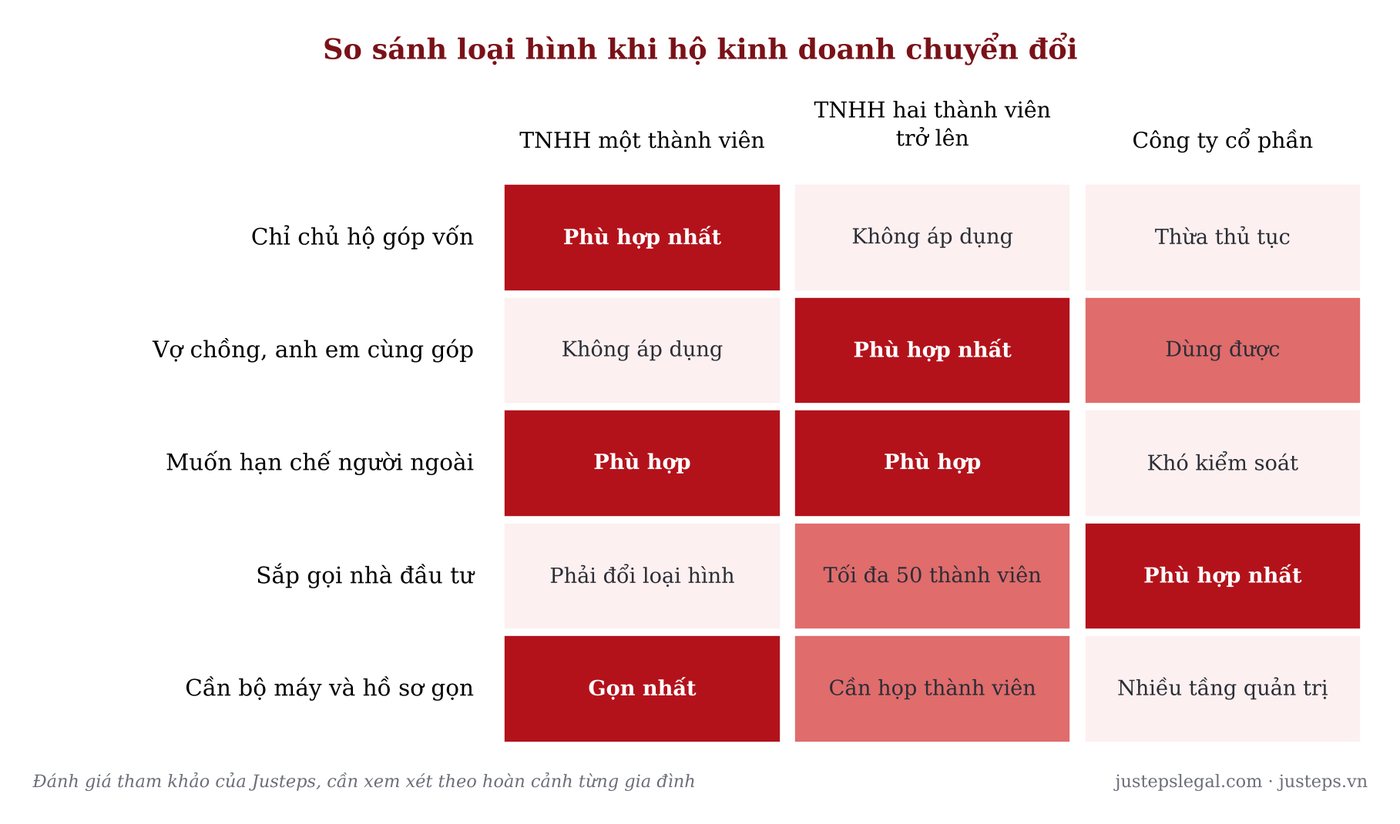
How well three types of company suit common situations when a household business converts
According to this comparison, where only the household business owner contributes capital, a single-member limited liability company gives the leanest structure and keeps decision-making power in the owner’s hands. Where a married couple or siblings put in money together, a limited liability company with two or more members is more suitable because it can restrict outsiders from acquiring capital stakes. A joint stock company should be chosen only where there is already a plan to bring in investors or issue shares to key employees, because this type requires considerably more complex meeting records and governance.
Separating the owner, the manager and the signatory
Once the company type is settled, Justeps determines who holds the title of Company Chairperson or Chairperson of the Members’ Council, who is the Director, who is the legal representative and who is authorised to sign each type of contract. The owner of a single-member limited liability company must identify and separate their own assets from those of the company and may not withdraw profits while the company has not fully paid its debts that have fallen due[7]. Contracts between the company and the owner or the owner’s relatives, such as a lease of premises or purchases from a business owned by a relative, must be reviewed and approved in accordance with the statutory procedure[8]. These points are written directly into the charter so that the manager and the accountant know the limits of their authority.
Department chart and job descriptions
The final tier is a department chart that reflects the company’s actual size, with a short job description for each position. For most converted household businesses, Justeps proposes a four-pillar model as shown below, in which the accountant is separated from the person holding the cash so that there is at least one independent point of reconciliation.
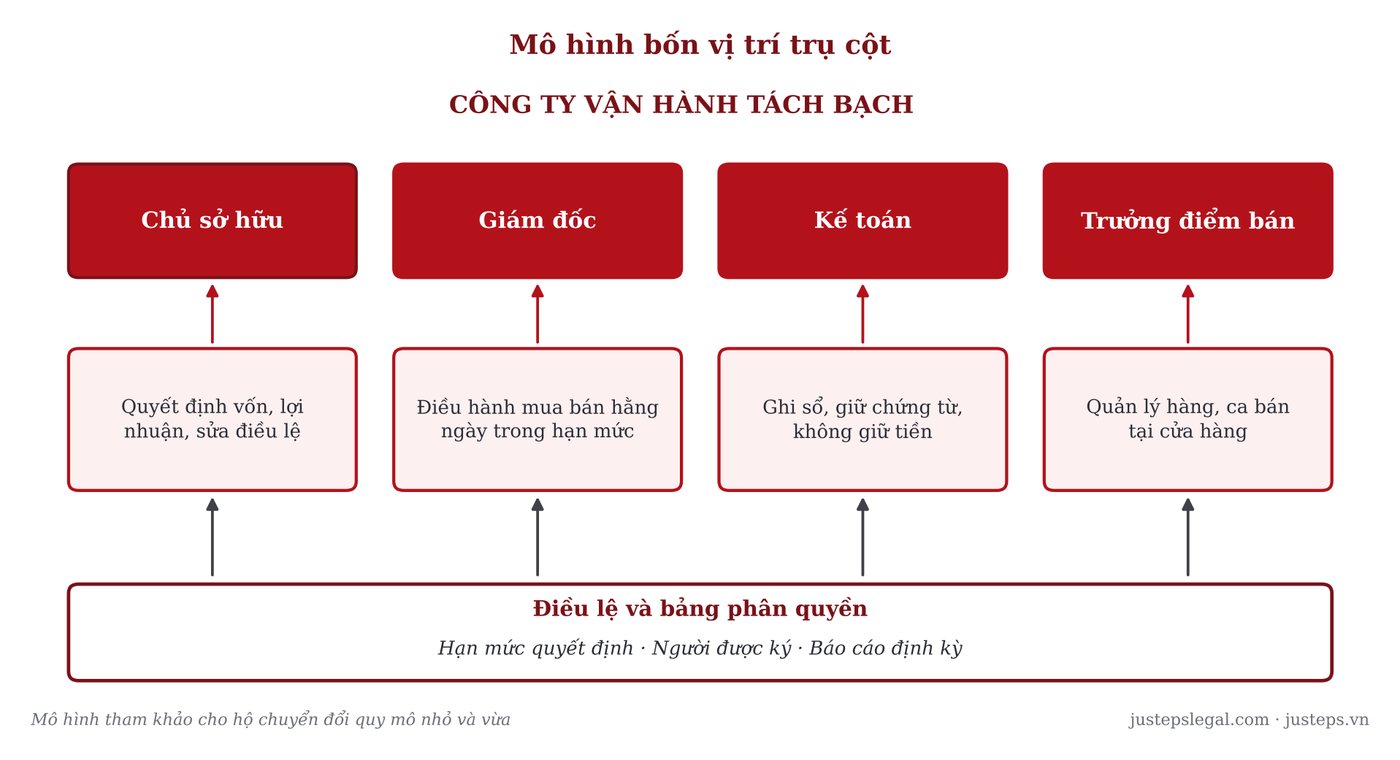
Four-pillar model for a company converted from a household business
In this model, the owner decides only major matters such as capital, profit distribution and amendments to the charter, while day-to-day buying and selling falls to the Director within the assigned limits. The accountant keeps the books and the supporting documents but does not handle cash receipts and payments directly, and the store manager manages stock and shifts at each shop. The common foundation for all four positions is the charter and the delegation of authority matrix, two documents that Justeps drafts at the same time so that the limits in them do not conflict.
How the service is delivered
An organisational structure design project for a converting household business usually takes six to eight weeks and runs in parallel with the preparation of the enterprise registration file. The sequence below shows that the most important decision point is how to deal with the assets that the family wishes to bring into the company.
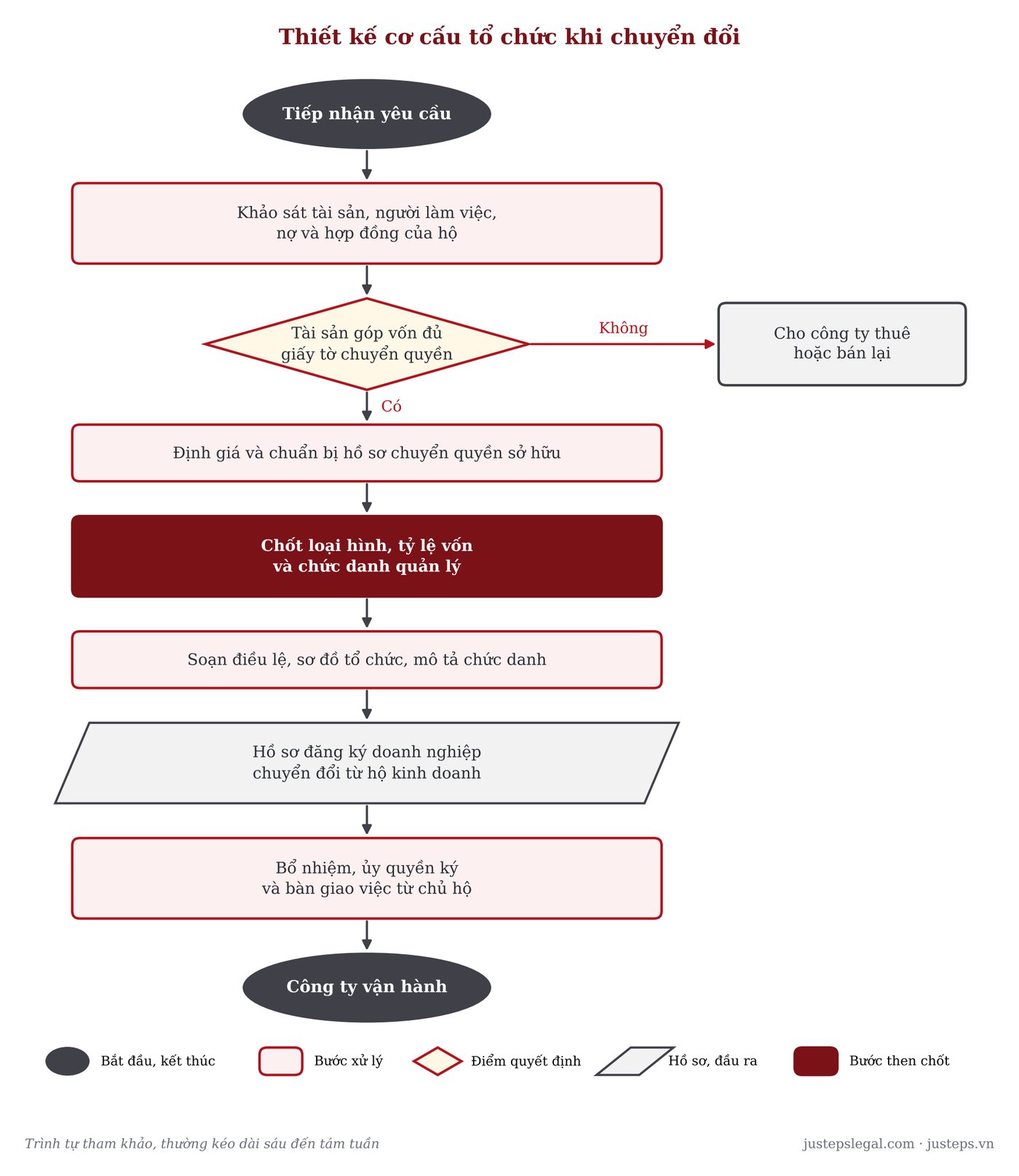
Sequence for designing the organisational structure in parallel with the conversion file
In the first two weeks, Justeps’ consultants work directly at the shop or workshop to list the assets, the people working there and the debts and contracts in progress. If the assets intended for contribution have complete title documents and the family agrees to transfer ownership, Justeps prepares the valuation record and the transfer file; otherwise, the assets are placed under a lease or bought by the company at market price. The pivotal step is the working session that settles the company type, the capital percentages and the management titles, after which Justeps drafts the charter, the organisation chart, the job descriptions and the file for the company to submit. The last two weeks are used to sign the appointment decisions and authorisations and to hand over each task from the household business owner to the new person in charge.
What the company receives on completion
The documents are delivered in editable electronic form and in signed form for documents requiring adoption, including the following main items:
- A survey report setting out the assets, the people working, the capital contribution relationships and the risks to be addressed before conversion.
- A proposal on the company type, ownership percentages and management titles, with the reasons for each choice.
- A draft charter with provisions on the Director’s limits of authority, transfers and inheritance of capital stakes and transactions with related persons.
- A valuation record for contributed assets and a list of ownership transfer documents, or a lease between the family and the company.
- An organisation chart, job descriptions for each position, appointment decisions and signing authorisations.
- An enterprise registration file on the basis of conversion from a household business for the company to submit to the business registration authority.
Once the structure has taken shape, the company usually needs a set of financial, sales and labour regulations straight away so that the new office holders work in the same way. Justeps carries out this work under its service for building internal procedures and regulations for converting household businesses, which can be signed at the same time as the organisational structure design service.
Application by size and sector
A household business with one shop and fewer than ten people usually needs only a single-member limited liability company, one Director who is also the legal representative and an outsourced or part-time accountant. At this size, the focus is on separating bank accounts, separating assets and keeping supporting documents, not on building many departments. A household with several outlets, a workshop or a warehouse needs an additional tier of middle management, with clear decision-making limits for each store manager and a mechanism for reporting to the Director.
Conditional business lines impose further requirements on managers. A pharmacy needs a person in charge of professional matters who holds a practising certificate, while businesses trading in gold and silver, alcohol or petroleum or providing food and beverage services need licences and certificates issued in the name of the new company. Justeps reviews the household’s existing licences, identifies which must be reapplied for or amended and places people who meet the professional conditions in the organisation chart from the outset.
What determines the service fee
The fee for organisational structure design is quoted as a fixed fee in writing after the first survey session. The main factors are the number of capital contributors, the number of assets to be valued and transferred, the number of business locations, the number of sub-licences to be reviewed and whether the company needs Justeps to prepare the registration file as well. A household that already has books and a clear list of assets usually needs less survey time, so the fee is also lower. Justeps’ proposal sets out the scope, the deliverables, the timeline and the matters outside the scope so that the owner can plan the budget.
How Justeps can help
In addition to organisational structure design, converting household businesses may combine the following Justeps services:
- Building internal procedures and regulations for converting household businesses. Justeps drafts financial regulations, sales, invoicing and inventory procedures and internal labour rules that fit the way the shop currently operates.
- Ongoing legal advisory for converting household businesses. Justeps supports the company through its first one to two years, tracking the compliance calendar and answering questions on contracts, tax and licences.
- Company formation and corporate foundations. Justeps prepares the registration file, the charter and the post-licensing procedures so that the new company starts operating on time.
- In-house training. Justeps explains to the owner, the Director and the accountant the powers and responsibilities of each position in the new company.
Frequently asked questions
Should a converting household business choose a limited liability company or a joint stock company?
Most converting household businesses are better suited to a limited liability company because its structure is lean and it is easier to control who contributes capital. A joint stock company should be chosen only where there is already a plan to raise capital or allocate shares to key employees.
Can the household business owner be both the owner and the Director of the company?
Yes, particularly in a single-member limited liability company owned by an individual. In that case the owner must separate personal assets from company assets and should give the bookkeeping to someone else so that there is an independent point of reconciliation[7].
Is it compulsory to put the house or land used for the business into the charter capital?
No. The family may keep ownership and lease the property to the company under a contract. If the family chooses to contribute it, the asset must be valued and ownership transferred to the company within the contribution period[5].
Should relatives who only help with sales be named as capital contributors?
No, because a person named as a member has all the rights of a member, including the right to transfer the capital stake and to leave it by inheritance. Relatives who work in the company should sign employment contracts and receive wages under the company’s regulations.
Can the former household business continue selling after the enterprise registration certificate is issued?
The household business may not continue operating from the moment the enterprise is granted its certificate, and the commune-level authority terminates the household once the tax authority confirms that its tax obligations have been fulfilled[3]. Goods, contracts and workers should be transferred to the company according to a plan prepared in advance.
Does the organisational structure need to change when the company opens more shops?
It usually needs an additional tier of store managers with their own decision-making limits and rules on reporting to the Director. Justeps recommends reviewing the organisation chart and the delegation of authority matrix whenever a new business location is opened or the number of workers rises significantly.
Related articles
- How to choose a business form between a household business, a limited liability company and a joint stock company
- Setting up a company in Hanoi: documents required, processing time and what to do immediately after registration
- Passing a family business to the next generation with a family charter and a five-year roadmap
- Building internal financial regulations for a limited liability company, from approval authority to advances and their settlement
Notes
[1] Law on Enterprises No. 59/2020/QH14 dated 17 June 2020, as amended and supplemented by Law No. 03/2022/QH15 and Law No. 76/2025/QH15.
[2] Article 12 of the Law on Enterprises No. 59/2020/QH14.
[3] Article 27 of Decree No. 168/2025/ND-CP dated 30 June 2025 of the Government on enterprise registration, as amended and supplemented by Decree No. 296/2026/ND-CP.
[4] Article 52 of the Law on Accounting No. 88/2015/QH13 dated 20 November 2015.
[5] Articles 35 and 36 of the Law on Enterprises No. 59/2020/QH14.
[6] Articles 47 and 75 of the Law on Enterprises No. 59/2020/QH14.
[7] Article 77 of the Law on Enterprises No. 59/2020/QH14.
[8] Article 86 of the Law on Enterprises No. 59/2020/QH14; Article 67 of the same Law for limited liability companies with two or more members.
This article is for reference and reflects the regulations in force at the time of publication. Please consult Justeps for advice tailored to your company’s records and situation.
For further information, please contact:
📩 Email: info@justeps.vn
🌐 Website: https://justepslegal.com · https://justeps.vn
🌐 Page: Justeps
☎️ Hotline (Zalo): 096 172 2607
📍 Thanh Xuan Office: 12th Floor, Licogi 13 Tower, 164 Khuat Duy Tien Street, Thanh Xuan Ward, Hanoi, Vietnam
📍 Ha Dong Office: LK06B, No.10, Dong Dua Area, Ha Dong Ward, Hanoi, Vietnam
📍 Ho Chi Minh City Branch: 528 Le Van Sy, Ho Chi Minh City, Vietnam
📍 Hai Phong Office: Truong Thinh Village, Ha Dong Commune, Hai Phong, Vietnam
📍 Quang Ninh Office: Van Don Special Zone, Quang Ninh Province, Vietnam





