
Key takeaways
- The loss of property at a guarded site does not mean the security business must compensate in full; liability depends on the scope committed to in the contract and the security plan, the fault of the staff and the evidence recorded on the spot[1].
- A business must compensate for damage caused by its staff while performing assigned duties and only then has the right to require the person at fault to reimburse it, so every incident must be recorded correctly on the very night it occurs[4].
- Security and order conditions must be maintained throughout the period of business, together with obligations to notify when operations begin, when staff are deployed to another province and when the contents of the certificate change[5].
- Justeps’ ongoing advisory package focuses on prevention, review and guidance; when a dispute arises, Justeps assesses the matter, prepares the file and supports negotiation, while the decision to bring proceedings rests with the business.
For a security service business, legal questions rarely arrive during office hours. A warehouse reports ten reels of copper cable missing on a Monday morning, a member of staff scuffles with a drunk person in a residential car park at midnight, a client asks staff to hold the lorry of a supplier that owes it money, and a tender document demands a commitment to unlimited compensation. Each situation needs an answer within a few hours, and how it is handled in the first hours often decides how much the business has to pay and whether it loses the contract.
This page introduces Justeps’ ongoing legal advisory service for businesses providing site security, event security, bodyguard services and security monitoring. The service acts as an external legal point of contact, covering review of contracts with clients, guidance on handling incidents at sites, monitoring of security and order obligations and updates on changes in the law that affect service prices. Justeps is a consulting company and does not take on work before courts or arbitral tribunals; for disputes, Justeps assesses the matter, prepares the file and advises on negotiation and mediation so that the business can act itself or pass the matter to a practitioner of its own choosing.
The security services contract decides who bears the loss when property goes missing
The Civil Code sets the principle that a party in breach of an obligation must compensate for the full damage, unless otherwise agreed or provided by law[1]. Therefore, if the contract merely states that the security provider is liable to compensate for all property lost, the business all but gives up its ability to limit its liability. Conversely, where the contract describes the obligation as carrying out the security plan correctly with due care, with a cap on compensation and a procedure for establishing fault, both parties have a basis for resolving the matter instead of arguing on impressions.
A business must sign a contract for the provision of security services before deploying its staff[2], but in practice many sites receive staff first and the contract is signed a few weeks later, on the client’s template. The table below compares the wording commonly found in those templates with the wording Justeps proposes for the five most important clauses.
| Clause | Common wording | Wording proposed by Justeps |
|---|---|---|
| Scope of services | Ensure the absolute safety of all the client’s property. | Carry out the attached security plan correctly, specifying the areas, number of posts and property outside the scope. |
| Compensation | Compensate the full value of property lost during the security period. | Compensate where fault on the part of the security provider is established, with a cap based on the contract value or insurance. |
| Determining loss | Based on the client’s declaration. | Based on a jointly prepared record, warehouse records and camera footage within the notice period. |
| Price adjustment | Fixed price throughout the contract term. | Adjusted when regional minimum wages or mandatory costs change. |
| Requests outside the scope | The security provider performs all reasonable requests of the client. | The security provider may refuse requests that are unlawful or outside the signed plan. |
The price adjustment clause is becoming increasingly important because labour costs make up most of the service price, while regional minimum wages will rise from 1 January 2027, with Region I at VND 5,700,000 a month[3]. A long-term contract without an adjustment formula forces the business to absorb the increase itself or renegotiate from scratch. Justeps reviews the portfolio of current contracts to identify which contracts need an annex before the wage increase.
When staff cause damage or are accused of exceeding their authority
A legal entity must compensate for damage caused by its people while performing assigned duties, and then has the right to require the person at fault to reimburse it in accordance with the law[4]. If a member of staff uses excessive force or detains someone unlawfully, that individual may also face criminal prosecution, while the business faces compensation claims and a review of its business conditions. In such cases, the value of the initial record outweighs any argument made afterwards.
Justeps sets up a priority line for incidents at sites. The figure below shows how roles are divided between the team leader, the business’s control centre and the Justeps consultant when an incident occurs at night.
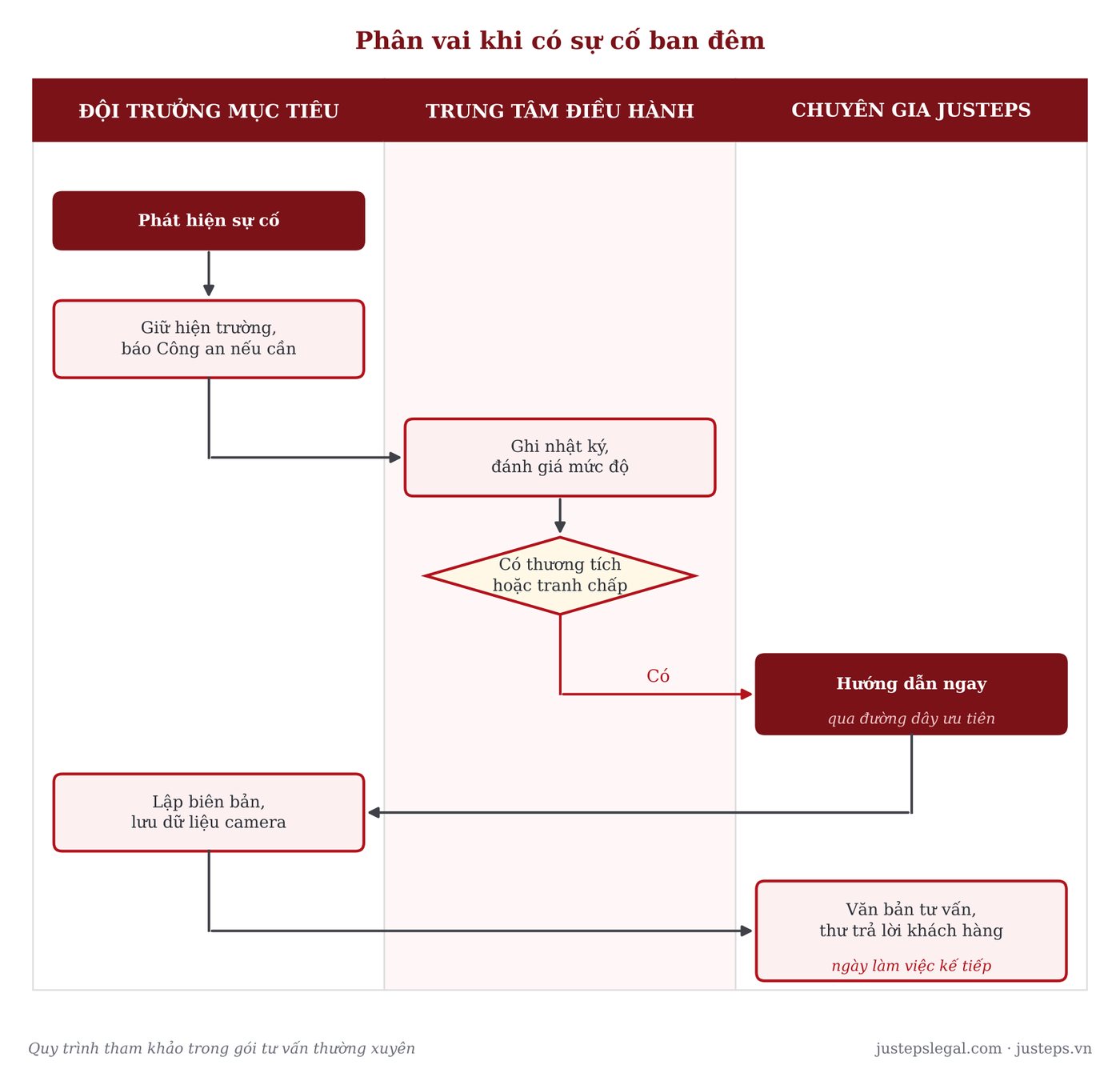
Division of roles when an incident occurs at night at a guarded site
The team leader secures the scene and reports to the centre, and to the police where there are signs of a crime or injury. The control centre assesses the severity and calls the priority line when the incident involves injury, a dispute over holding a person or a client demanding immediate compensation. The consultant gives guidance on the content of the record, what to avoid and how to extract and keep camera footage, and then on the next working day sends a written advice and a draft reply letter to the client. This approach only works when the business has issued an incident handling procedure for security service businesses, so that the team leader knows the first step without waiting for a phone call.
Maintaining security and order conditions throughout the period of business
Decree No. 96/2016/ND-CP requires the business to notify the commune-level police where it operates within 05 days of starting operations, to apply for reissue of the certificate when its contents change, to give notice before suspending operations and to comply with the reporting regime under the guidance of the Ministry of Public Security[5]. Security businesses must also give notice within 05 days when deploying staff to a site in another province, enclosing the list of staff and support tools[2]. From 15 November 2026, the time limit for the police to process applications for the issue and reissue of certificates has been shortened[6], but this does not extend the business’s own notification deadlines.
These obligations are scattered throughout the year and tied to specific events, so Justeps draws up a compliance calendar in the first month. The example below shows the milestones commonly found in a year for a business with staff in several provinces.
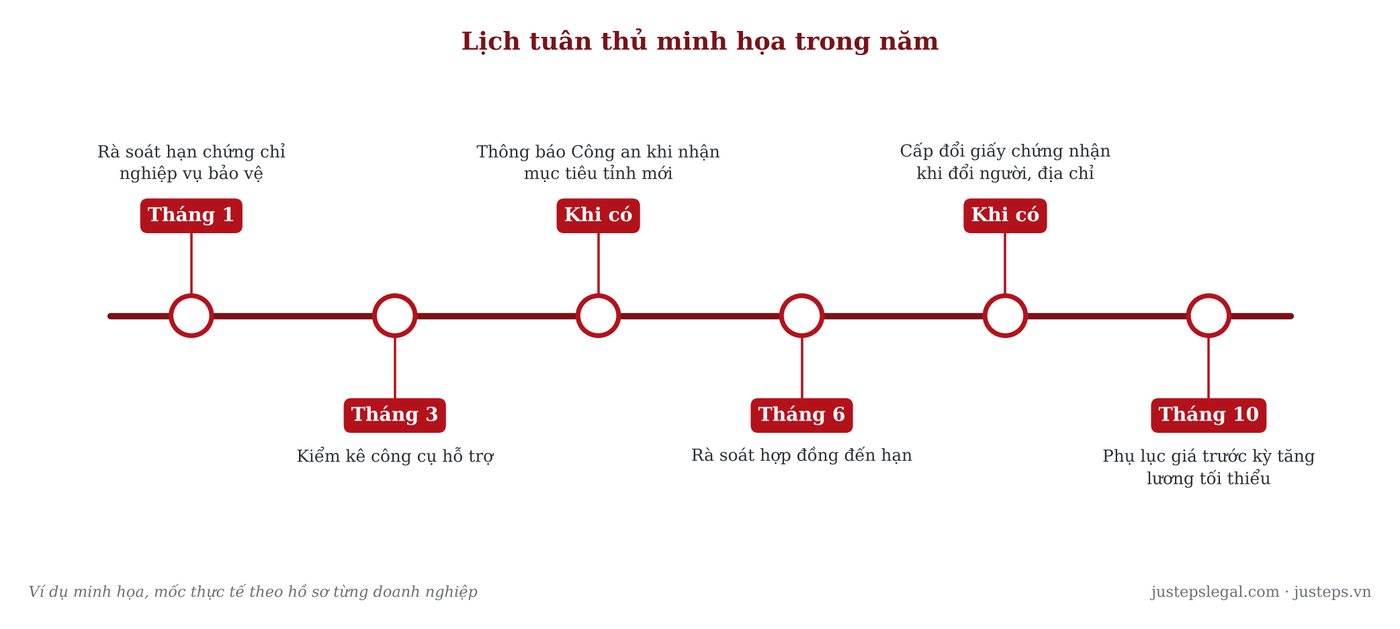
Example calendar for tracking obligations over a year in a security service business
For event-driven milestones, such as taking on a site in a new province or replacing the person responsible for security and order, the administration department informs Justeps as soon as there is a plan so that the file can be prepared in advance. Periodic milestones, such as reviewing the expiry of security guard professional certificates, stocktaking support tools, re-registering the internal labour rules after amendment or checking contract prices before the minimum wage increase, are flagged month by month. Issues relating to shifts, overtime and insurance that arise from this calendar are passed to the labour, payroll and insurance service for security service businesses when the whole system needs redesigning.
Unusual requests, subcontracting and insurance
Debt collection services are a business line in which investment is prohibited[7], and a security business may not provide services for unlawful activities[2]. Requests such as holding the property of a party that owes money, stopping people from entering land under dispute or helping with forced removal of belongings should therefore be sent to Justeps for assessment before they are accepted. In many cases, refusing in writing with reasons is the safest course, even if it means losing a contract.
When engaging another security business as a subcontractor for part of a site, the main business remains liable to the client, so it needs to check the subcontractor’s certificate of satisfaction of conditions and training records and set out its right of recourse clearly. Liability insurance should also be reviewed together with client contracts, because the exclusions in an insurance policy often do not match the scope of the compensation commitment.
How Justeps organises the monthly service
In the first month, Justeps reviews the certificate, current client contracts, the security plan template and the incidents of the last year, and then sends a report on risks requiring immediate action and an annual compliance calendar. From the second month, the business sends requests through the agreed point of contact, incidents at sites are given priority, and each quarter there is a summary report together with a meeting with the board of directors. The figure below shows an illustrative breakdown of advisory requests in one year for a business with around five hundred staff.
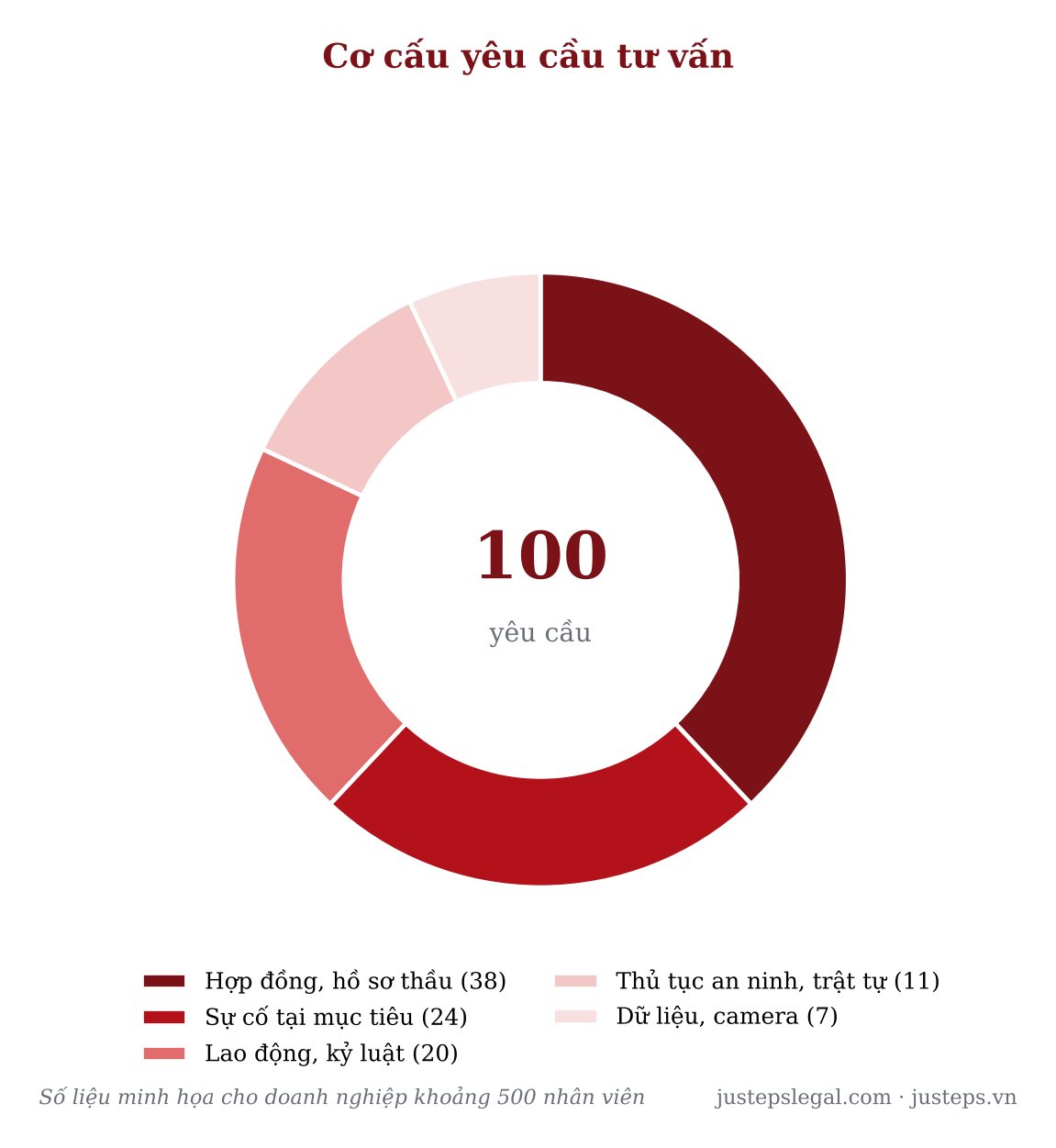
Illustrative breakdown of advisory requests over one year
Client contracts and tender files usually account for the largest share, followed by incidents at sites and labour matters. This breakdown helps the board of directors see where the main sources of risk lie and decide where to invest, for example standardising the contract template if contract requests are high. The deliverables Justeps provides during the year comprise:
- An initial review report with a list of risks ranked by severity and the actions required.
- An annual compliance calendar covering security and order, support tools, labour and contracts.
- A set of model clauses for security services contracts and subcontracts.
- Written advice on each request and draft reply letters to clients when incidents occur.
- Quarterly reports on incidents, risk trends and changes in the law.
Scope of application and fees
Small businesses with fewer than twenty sites usually choose a package focused on contracts and incidents. Businesses with branches in several provinces need additional tracking of procedures in each locality, while businesses providing bodyguard services or equipment-based monitoring need additional guidance on personal data and images. The fee is quoted monthly or annually in writing after the initial meeting, depending on the number of sites, the number of staff, the number of contracts to be reviewed each month, the number of provinces with staff and the need for out-of-hours support. Preparing the file for a specific dispute or protracted negotiations is quoted separately.
How Justeps can help
Alongside ongoing legal advisory, security service businesses may combine the following Justeps services:
- Building internal procedures and regulations for security service businesses. Justeps drafts shift procedures, procedures for incidents caught in the act and support tools rules so that incidents are handled correctly from the outset.
- Labour, payroll and insurance services for security service businesses. Justeps designs shift models, the calculation of overtime and the basis for insurance contributions for the security workforce.
- Drafting and reviewing commercial contracts. Justeps standardises templates for security services contracts, subcontracts and price adjustment annexes.
- Reviewing and controlling clause risks. Justeps reviews compensation, limitation of liability and insurance clauses in tender documents.
Frequently asked questions
If property is lost at a guarded site, must the security business compensate in full?
Not automatically. Liability depends on the scope in the contract and the security plan, the fault of the staff and evidence such as shift logs, records and camera footage; the contract may agree a level of compensation different from the principle of full compensation[1].
If a member of staff injures someone while on duty, is the business liable?
The business must compensate for damage caused by its staff while performing assigned duties and has the right to require the person at fault to reimburse it[4]. Criminal liability, if any, rests with the individual who committed the act.
Must a change of head office or head of the business be reported to the police?
Yes. Where the change alters the contents of the certificate of satisfaction of security and order conditions, the business must apply for reissue in addition to the procedure with the business registration authority[5].
Should the business accept guarding property that is under dispute?
This is a high-risk type of request. The business should send the file for assessment before accepting it, and in many cases refusing in writing is the safer course[2].
What should be considered when engaging another security business as a subcontractor?
The business should check the subcontractor’s certificate of satisfaction of conditions and training records and set out responsibilities and the right of recourse clearly. Towards the client, the main business remains the liable party.
How far does the ongoing advisory package go when a dispute arises?
Justeps is a consulting company and does not take on work before courts or arbitral tribunals. When a dispute arises, Justeps assesses the matter, prepares the file, advises on negotiation and mediation and hands over the file so that the business can act itself or pass it to a practitioner of its choice.
Related articles
- Organisational structure design for security service businesses with a chain of command from head office to every guarded site
- Building internal procedures and regulations for security service businesses so that staff know the limits of their actions
- Labour, payroll and insurance services for security service businesses with lawful 12-hour shifts
- When a counterparty breaches a contract, the steps from notice and negotiation to mediation and proceedings
Notes
[1] Article 360 of the Civil Code No. 91/2015/QH13 dated 24 November 2015.
[2] Article 32 of Government Decree No. 96/2016/ND-CP dated 1 July 2016 on security and order conditions for certain conditional business lines, as amended and supplemented by Decree No. 56/2023/ND-CP, Decree No. 58/2026/ND-CP and Decree No. 392/2026/ND-CP.
[3] Government Decree No. 399/2026/ND-CP on minimum wages for workers employed under employment contracts, applicable from 1 January 2027.
[4] Article 597 of the Civil Code No. 91/2015/QH13 dated 24 November 2015.
[5] Articles 21 and 25 of Government Decree No. 96/2016/ND-CP dated 1 July 2016 on security and order conditions for certain conditional business lines, as amended and supplemented by Decree No. 56/2023/ND-CP, Decree No. 58/2026/ND-CP and Decree No. 392/2026/ND-CP.
[6] Government Decree No. 392/2026/ND-CP dated 20 October 2026 amending and supplementing a number of decrees on administrative procedures and business conditions in the field of security and order, effective from 15 November 2026.
[7] The Law on Investment No. 143/2025/QH15, effective from 1 March 2026, on business lines in which investment is prohibited.
This article is for reference and reflects the regulations in force at the time of publication. Please consult Justeps for advice tailored to your company’s records and situation.
For further information, please contact:
📩 Email: info@justeps.vn
🌐 Website: https://justepslegal.com · https://justeps.vn
🌐 Page: Justeps
☎️ Hotline (Zalo): 096 172 2607
📍 Thanh Xuan Office: 12th Floor, Licogi 13 Tower, 164 Khuat Duy Tien Street, Thanh Xuan Ward, Hanoi, Vietnam
📍 Ha Dong Office: LK06B, No.10, Dong Dua Area, Ha Dong Ward, Hanoi, Vietnam
📍 Ho Chi Minh City Branch: 528 Le Van Sy, Ho Chi Minh City, Vietnam
📍 Hai Phong Office: Truong Thinh Village, Ha Dong Commune, Hai Phong, Vietnam
📍 Quang Ninh Office: Van Don Special Zone, Quang Ninh Province, Vietnam





