BUSINESS MANAGEMENT CONSULTING, WHEN IT IS NEEDED, SCOPE, PROCESS AND HOW TO MEASURE RESULTS
Many business owners turn to management consulting when the organisation is already overloaded: every decision goes to the director, departments shift responsibility and costs grow faster than revenue. At that point they often want a ready-made set of procedures to apply immediately. In practice, procedures copied from elsewhere rarely work, because they are not tied to the company's structure, people and specific legal obligations.
This article analyses when a business truly needs management consulting, the areas typically covered, input documents, the implementation process, deliverables, how the management system relates to obligations under the Law on Enterprises, the Labour Code and tax law, and how to measure results after consulting. It reflects regulations in force as of November 2026 and includes a flowchart, a management maturity model, a risk matrix and an implementation roadmap.
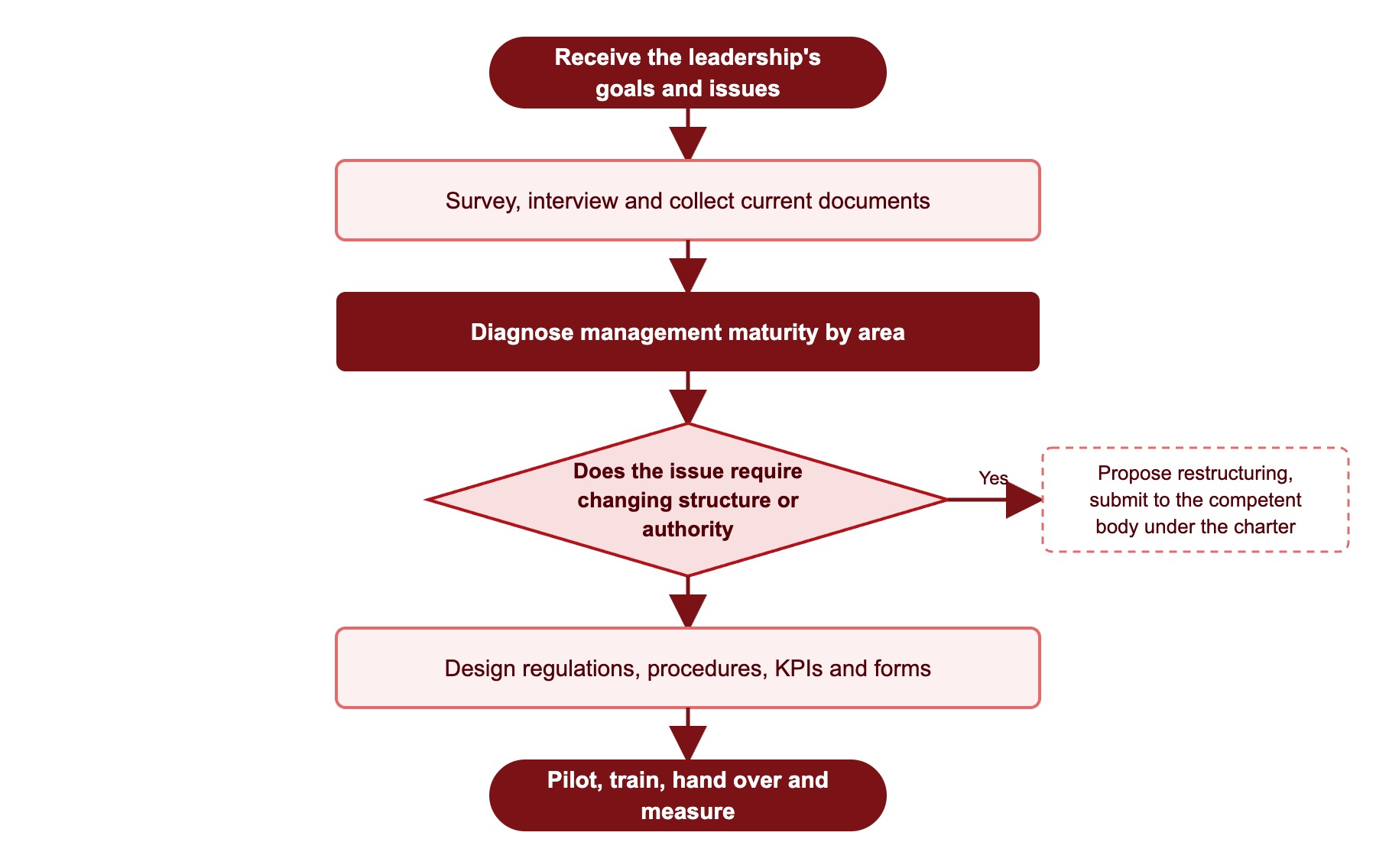
Overview flowchart of a management consulting project
An effective management consulting project moves from diagnosis to design, and only then to implementation and measurement. Skipping diagnosis is the most common reason new systems go unused.
Correct diagnosis requires a consistent assessment framework.
Theoretical basis of management maturity
Capability maturity models such as CMMI divide management maturity into levels, from working on individual experience to operating under measured and continuously improved processes.[1] The McKinsey 7S model stresses that strategy, structure and systems must be aligned with shared values, leadership style, staff and skills.[2] These frameworks help identify where a business stands and its next step, instead of applying the same solution to every company.
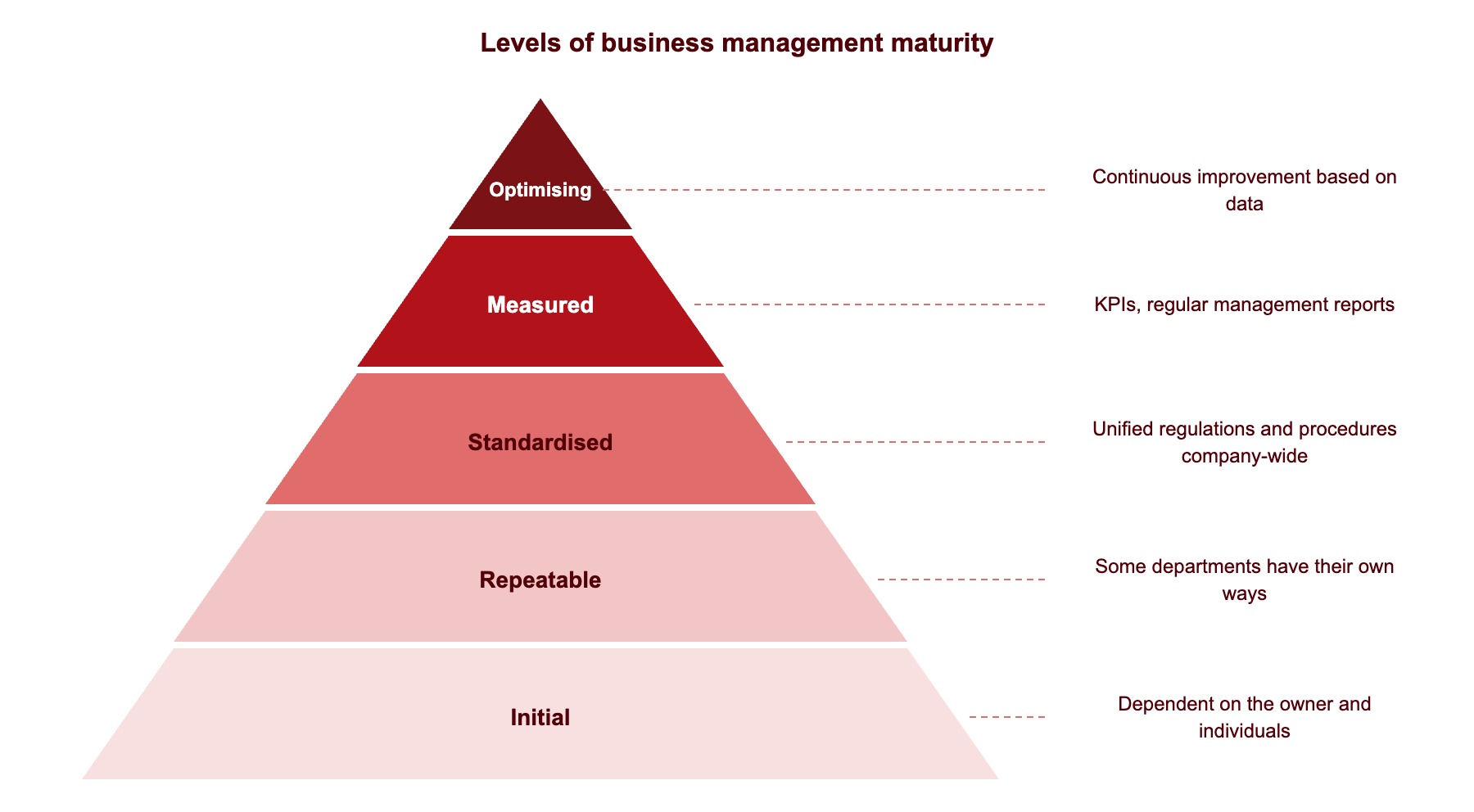
Most small and medium-sized businesses are at the initial or repeatable level. A reasonable goal for a consulting project is usually to move up one level, not to jump to the top.
Areas commonly covered by management consulting
| Management area | Common issues | Deliverables | Legal links to note |
|---|---|---|---|
| Organisational structure | Overlapping functions, unclear management layers | Organisation chart, functions and duties table | Mandatory positions under the Law on Enterprises and sector laws |
| Delegation, approval | All decisions go to the director | Delegation regulation, approval matrix | Authority of the members council or board of directors under the Law on Enterprises and the charter |
| Regulations, procedures | Each department works differently | Set of regulations, procedures and forms | Labour regulations under Article 118 of the Labour Code |
| HR, salary, KPIs | Pay not linked to performance, KPIs in form only | Salary scale, pay and bonus regulation, KPI set | Articles 93 and 104 of the Labour Code; social insurance |
| Finance, budget | No control over costs and cash flow | Financial regulation, budget, management reports | Deductible expense conditions under Decree 320/2025/ND-CP |
| Data, digital transformation | Scattered data, unconnected software | Data architecture, digitalisation roadmap | Law on Personal Data Protection No. 91/2025/QH15 |
Businesses need not cover all areas at once; prioritise the area causing the biggest bottleneck.
Before choosing priorities, businesses should identify the signs that consulting is needed.
Signs a business needs management consulting and input documents
Warning signs
- The owner is the bottleneck. Work stalls when the director is away for a few days.
- Growth without profit. Revenue grows but management and hidden costs grow faster.
- Key staff leave with their know-how. There are no procedures or handover documents.
- Opening branches or new plants. Single-site management no longer works across multiple sites.
- Preparing to raise capital, transfer or list. Investors require a transparent management system.
Input documents to prepare
| Document group | Specific documents | Purpose |
|---|---|---|
| Corporate legal | Enterprise registration certificate, charter, resolutions, appointment decisions | Determine authority and limits when designing delegation |
| Organisation, HR | Organisation chart, staff list, existing job descriptions | Assess structure, management layers and workload |
| Regulations, procedures | Labour regulations, pay and bonus regulation, financial regulation, current procedures | Avoid duplication and keep what works well |
| Finance, business | Financial statements, management reports, business plan | Set goals and performance indicators |
| Systems, data | Software list, main data flows | Ensure new procedures run on existing tools |
Documents should be provided under a confidentiality agreement between the business and the consultant.
With documents in hand, the project proceeds through steps with clear roles for each party.
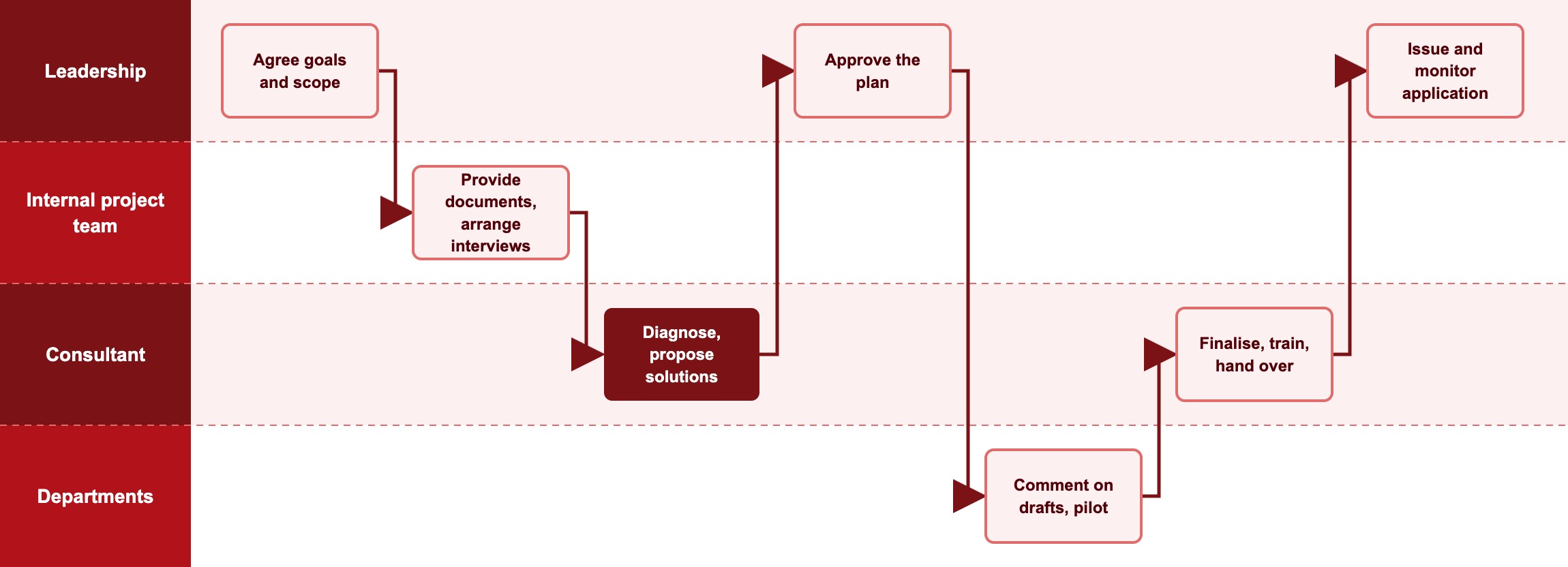
Implementation process and roles of the parties
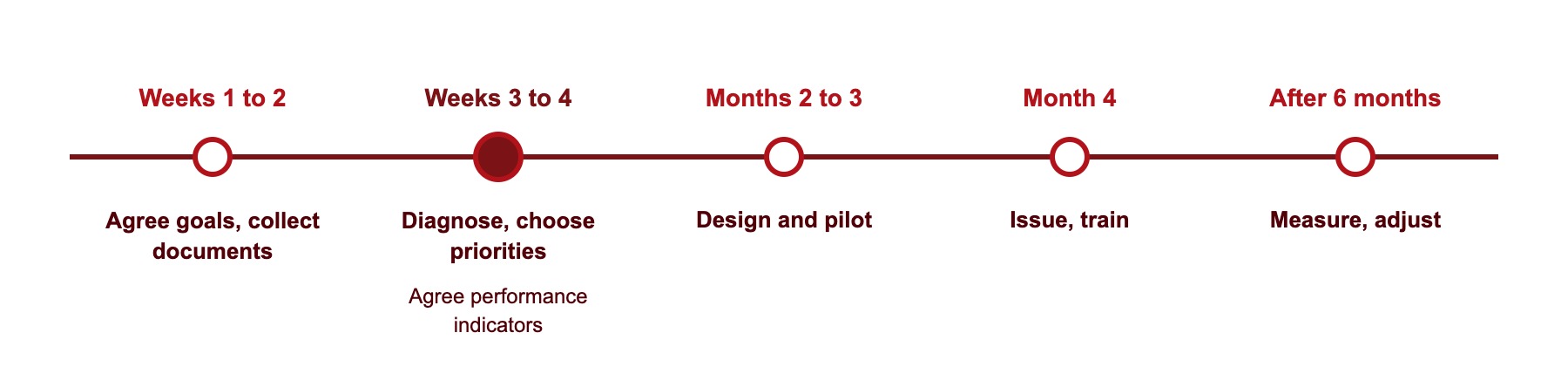
Success depends heavily on the business's involvement. The consultant designs and guides, but the internal team must run the system after the project ends.
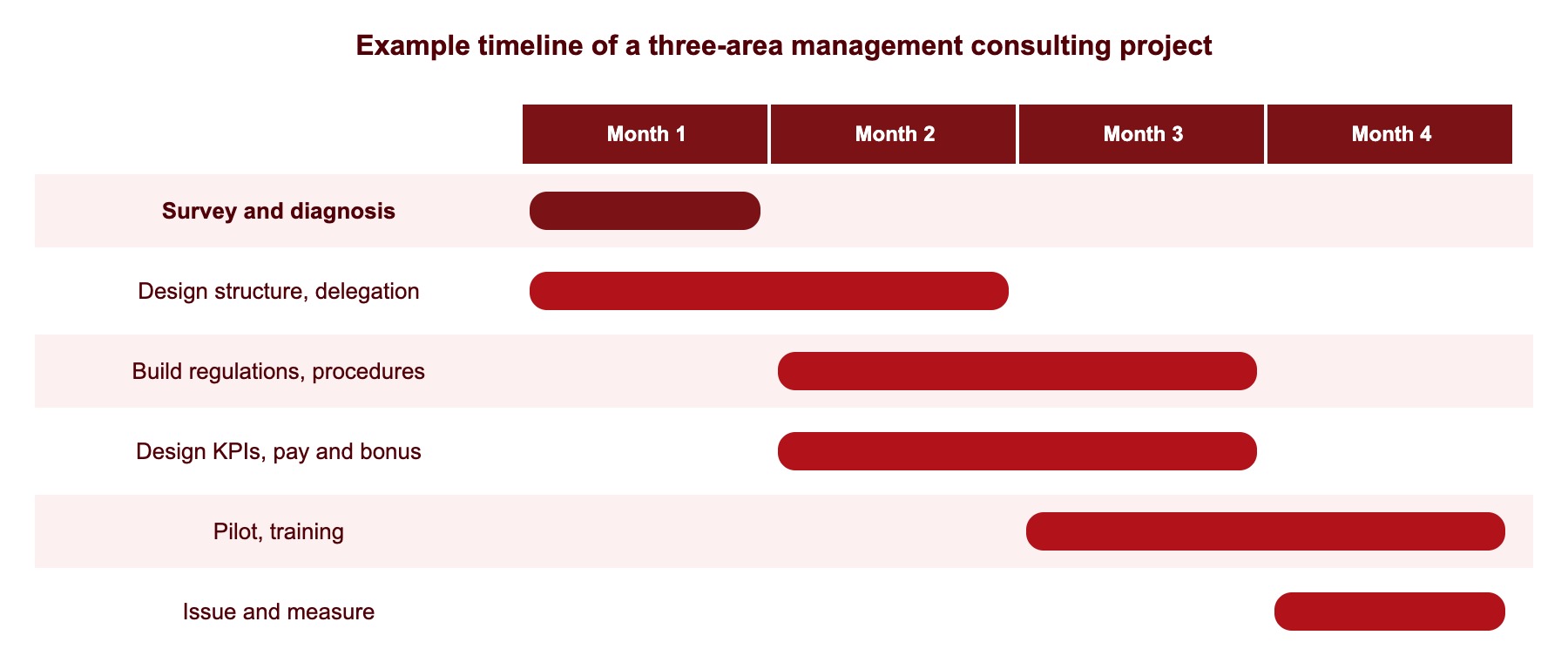
Duration depends on scope. For small and medium-sized businesses, a project focused on two or three areas usually takes a few months.
A management system is only sustainable when it fits the legal framework.
The management system must fit legal obligations
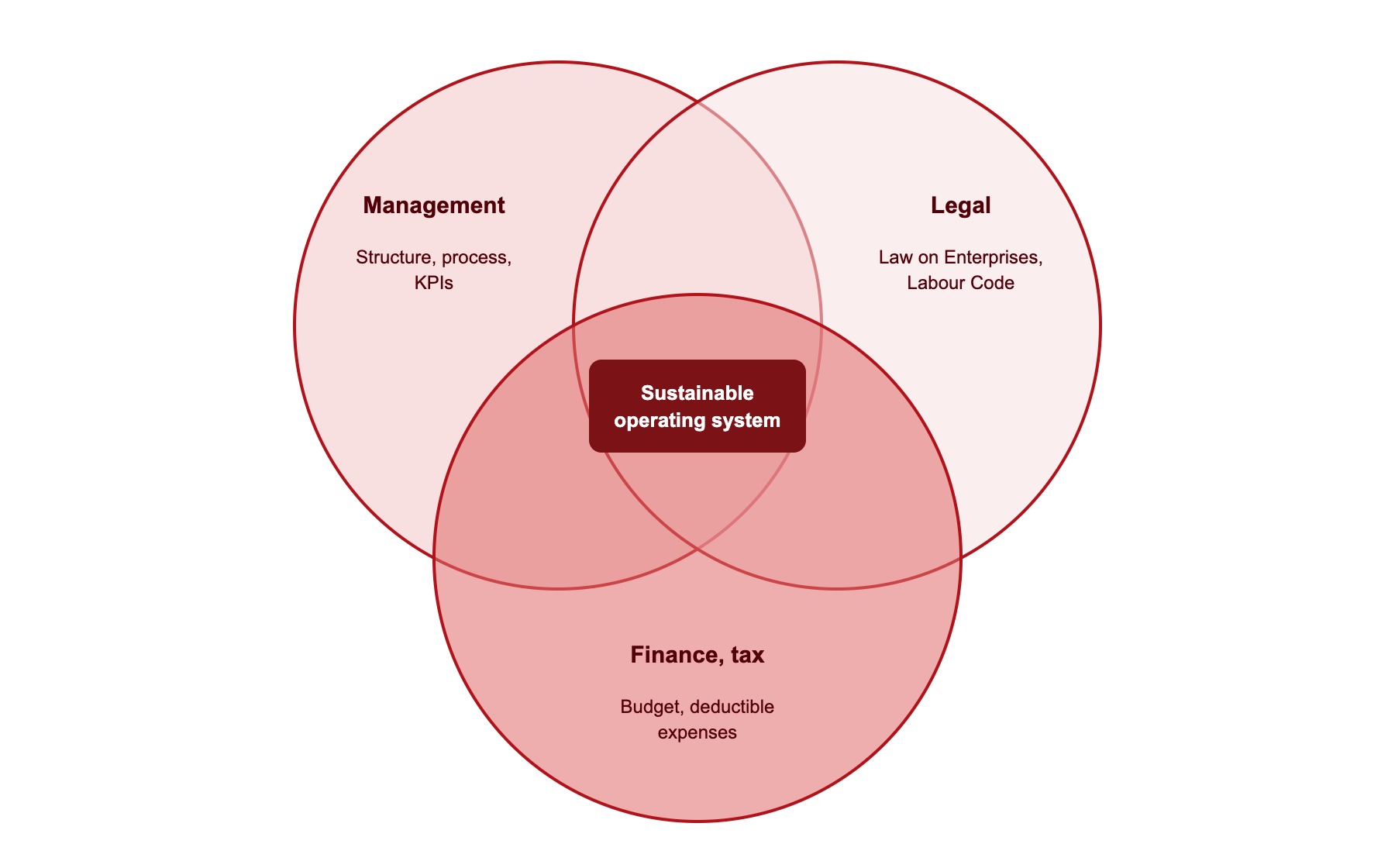
Management, legal and finance are three overlapping circles. A regulation that looks good from a management view but contradicts the charter or the Labour Code, or fails deductible expense conditions, creates rather than reduces risk.
Authority under the Law on Enterprises and the charter
When designing delegation, decisions within the authority of the members council, board of directors or general meeting of shareholders, such as high-value contracts or related-party transactions, cannot be delegated to the executive level.[3]
Labour regulations, salary scales and bonus regulations
Labour regulations must be drafted and registered under Articles 118 and 119 of the Labour Code where the employer has 10 or more employees. Salary scales are built under Article 93; the bonus regulation is decided by the employer and publicly announced under Article 104 after consulting the grassroots employee representative organisation, if any.[4]
Financial regulation and deductible expense conditions
Under Decree 320/2025/ND-CP, salaries and bonuses are deductible only when conditions and amounts are specified in the contract, collective agreement or regulation; payments of VND 5 million or more require non-cash payment documents.[5] Management regulations should therefore be written with a tax perspective at the same time.
After issuance, the business needs to measure whether the new system delivers results.
How to measure results after management consulting
Consulting results should be measured with specific operating indicators agreed at the start of the project, rather than general impressions.
| Indicator | How to measure | Frequency |
|---|---|---|
| Time to process an approval file | Days from proposal to approval | Monthly |
| Share of decisions the director handles directly | Items submitted to the director over total items | Quarterly |
| Key staff turnover | Departures over total key staff | Annually |
| Administrative costs to revenue | Administrative costs divided by revenue | Quarterly |
| KPI completion rate | Targets met over total targets | Monthly or quarterly |
Businesses should choose three to five indicators matching the project's goals.
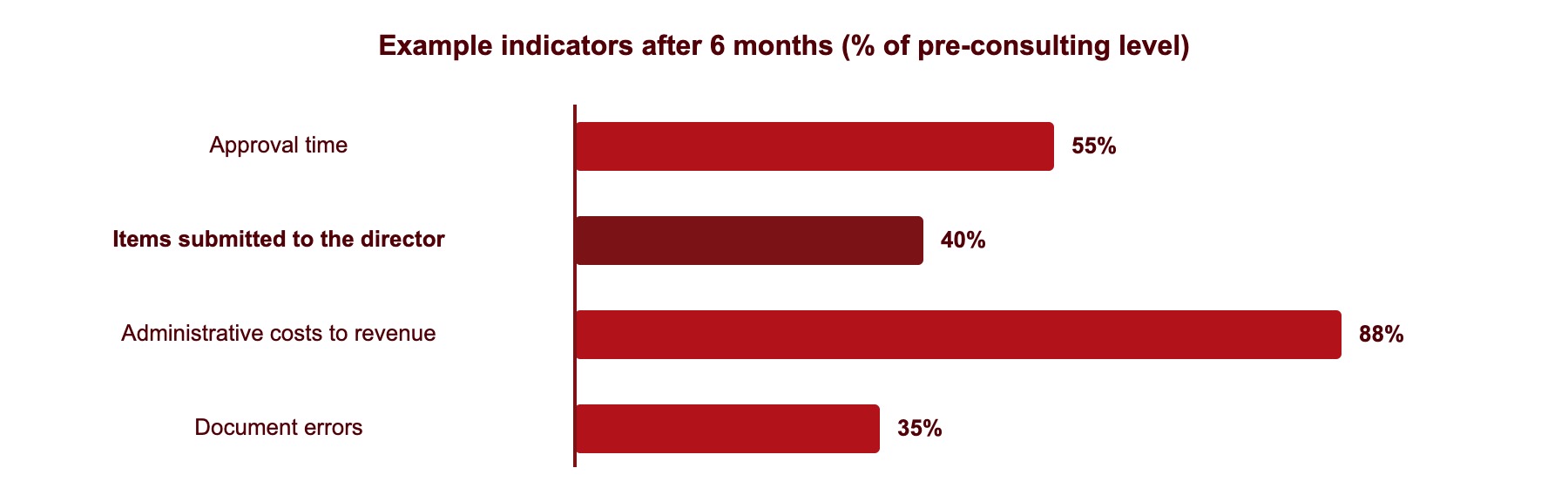
These indicators carry different weight depending on the type of business, as the cases below show.
Case analysis of management consulting by type of business
Family companies
The roles of owner, manager and employee often overlap. The focus is separating authority under the charter, building a delegation regulation and a decision mechanism when family members disagree, including succession planning.
Newly established businesses
New businesses do not need complex systems. The priority is a minimum framework: organisation chart, signing authority, cash procedures, labour contracts and labour regulations once the headcount threshold is reached. Getting it right from the start costs far less than fixing it later.
Businesses with multiple branches
The biggest risk is each branch running its own way. Consulting focuses on standardising shared procedures, delegation between head office and branches, consolidated management reports and remote internal control.
Fast-growing small and medium-sized businesses
The organisation grows faster than its systems. Priorities are job descriptions, KPIs and pay and bonus regulations to retain staff, alongside budgets and management reports to control costs.
Risks of management without a system
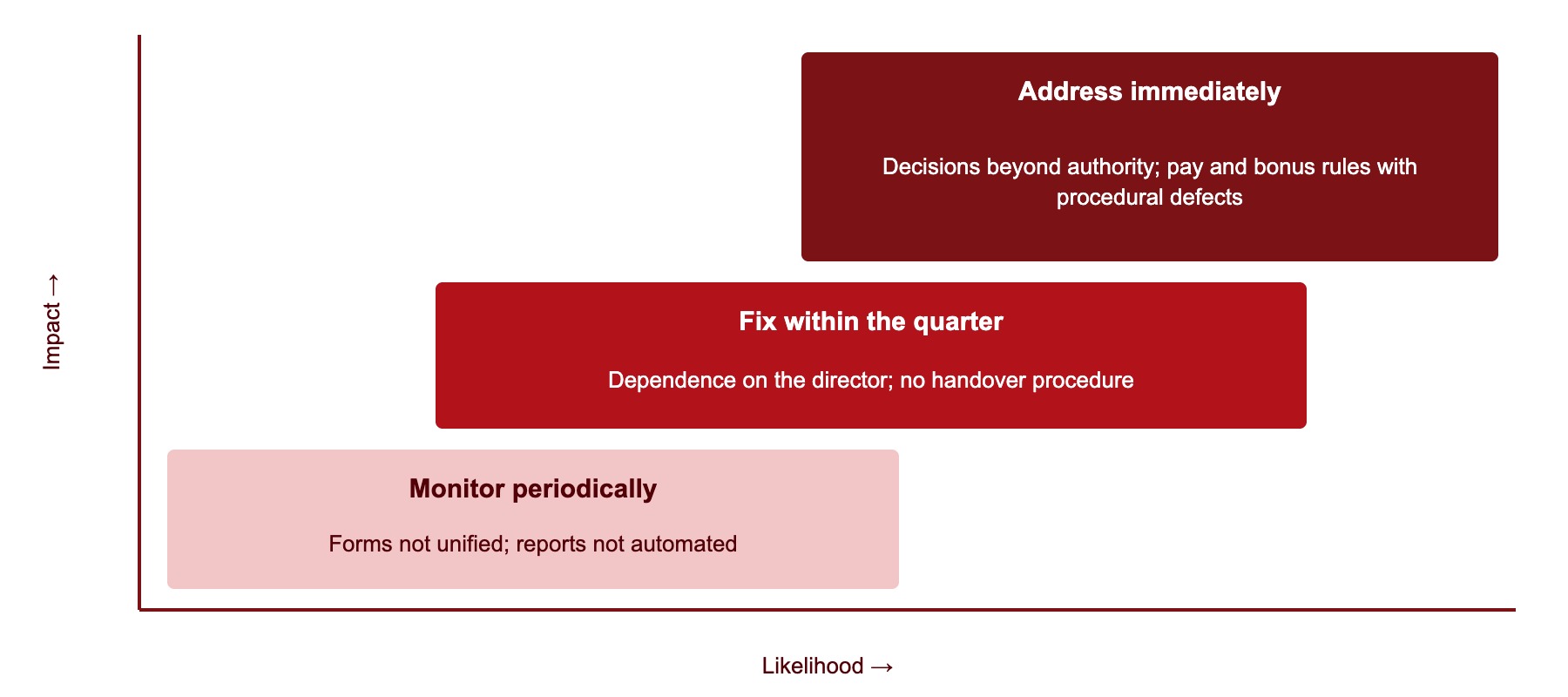
- Legal risk. Decisions beyond charter authority and labour regulations or pay rules adopted without proper procedure lead to disputes and penalties.
- Tax risk. Expenses without regulations and documents failing conditions are disallowed at finalisation.
- Operational risk. Dependence on individuals and loss of data and know-how when staff leave.
- Growth risk. Inability to expand, raise capital or transfer because the system is not transparent.
Suggested roadmap for management consulting
| Item | Owner | Deadline | Status |
|---|---|---|---|
| Appoint the internal project team | Leadership | Week 1 | ☐ |
| Gather input documents | Project team | Week 2 | ☐ |
| Agree priority areas and indicators | Leadership, consultant | Week 4 | ☐ |
| Review the legality of draft regulations | Legal | Month 3 | ☐ |
| Issue and organise training | Leadership, HR | Month 4 | ☐ |
Implementation tracking form; adjust to actual circumstances.
Related articles and templates
- Business consulting, scope, process and how to choose a consultant
- Template approval authority matrix for expenses, procurement and payments
- Guide to financial budgeting and cost control for 2027
- Management standardisation
How Justeps supports businesses
Justeps works with businesses from diagnosing management maturity and designing organisational structure, delegation, regulations, procedures, KPIs and pay, through to handover and performance measurement, ensuring the management system fits the charter, labour law and deductible expense conditions.
→ Learn about Justeps business management consulting services
Notes and references
- CMMI Institute, Capability Maturity Model Integration (CMMI); organisational capability maturity models.
- Waterman, Peters, Phillips, Structure is not organization, Business Horizons, 1980 (McKinsey 7S model).
- Law on Enterprises No. 59/2020/QH14, as amended by Law No. 03/2022/QH15 and Law No. 76/2025/QH15.
- Articles 93, 104, 118 and 119 of the Labour Code No. 45/2019/QH14.
- Article 9 and Clause 8, Article 10 of Decree No. 320/2025/ND-CP dated 15/12/2025.
This article is for research and reference only, reflects regulations in force at the time of publication (11/2026) and does not replace advice for specific cases.
For more information, please contact:
📩 Email: info@justeps.vn
🌐 Website: https://justepslegal.com · https://justeps.vn
🌐 Page: Justeps
☎️ Hotline (Zalo): 096 172 2607
📍 Thanh Xuan Office: 12th Floor, Licogi 13 Tower, 164 Khuat Duy Tien Street, Thanh Xuan Ward, Hanoi, Vietnam
📍 Ha Dong Office: LK06B, No.10, Dong Dua Area, Ha Dong Ward, Hanoi, Vietnam
📍 Ho Chi Minh City Branch: 528 Le Van Sy, Ho Chi Minh City, Vietnam
📍 Hai Phong Office: Truong Thinh Village, Ha Dong Commune, Hai Phong City, Vietnam
📍 Quang Ninh Office: Van Don Special Zone, Quang Ninh Province, Vietnam