MANAGEMENT CONSULTING FOR GARMENT COMPANIES, FROM SEWING LINES TO KPIS, PAY AND COMPLIANCE
Garment companies typically have thin margins, seasonal orders and hundreds to thousands of workers. A drop of a few percent in line efficiency, a rise in defects or a failed customer compliance audit can wipe out a whole season's profit. Many factories are still run on team leaders' experience and scattered spreadsheets, making the real causes hard to see.
This article analyses management areas specific to garment companies, including production planning, line balancing, productivity based on standard time, line KPIs, piece-rate pay, overtime management and preparation for international customer compliance audits, linked to labour regulations in force as of November 2026. It includes a flowchart, a productivity chart, overtime limits and a consulting roadmap.
Overview flowchart of managing garment factory operations
A garment factory's operations start with the order and end with delivery. The two points that determine efficiency are planning and line balancing, and in-line quality control.
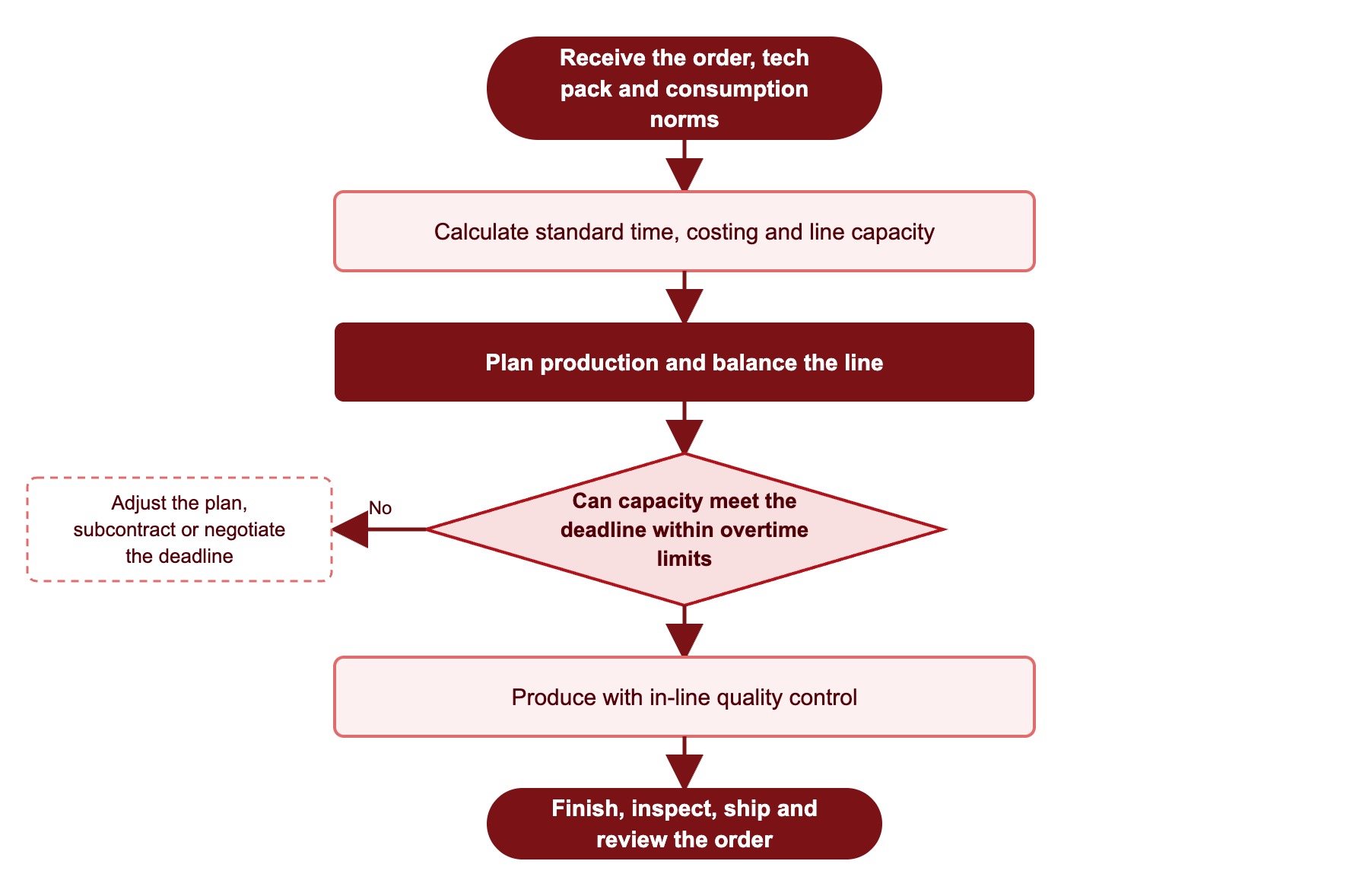
To manage this chain, businesses need a clear view of its management areas.
Theoretical basis of production management in garments
The garment industry widely uses time and motion study, where each operation has a standard time in minutes, commonly called SAM. Line efficiency is measured as total standard minutes produced divided by total labour minutes used.[1] Combined with lean manufacturing, businesses reduce waste from waiting, work-in-progress and rework.[2]
- Planning and production. Standard times, line balancing, order planning.
- Quality. In-line control and final inspection.
- HR and pay. Piece-rate pay, team and line KPIs, overtime.
- Compliance. Labour, safety and customer audits.
Each area has its own issues and solutions.
Common management issues and consulting solutions
| Area | Common issues | Consulting solution | Deliverables |
|---|---|---|---|
| Production planning | Orders beyond capacity, late delivery | Calculate line capacity by standard time, order acceptance procedure | Planning procedure, capacity sheet |
| Line balancing | Bottlenecks at difficult operations, idle workers | Allocate operations by skill and standard time | Line layout, balancing sheet |
| Quality | High defect rate, much rework | Control at operations, defect indicators by team | Quality control procedure, forms |
| Pay | Unclear piece rates, worker complaints | Rates based on standard time, clear formula | Piece-rate pay regulation, rate table |
| KPIs | Team leaders assessed subjectively | Line KPI set covering productivity, quality, delivery | KPI set, daily and weekly reports |
| Compliance | Failing customer audits | Review labour records, working hours, safety | Compliance file set, corrective action plan |
Businesses should prioritise the area that caused the greatest loss in the last season.
Productivity is the central indicator linking these areas.
Line productivity and how to measure it by standard time
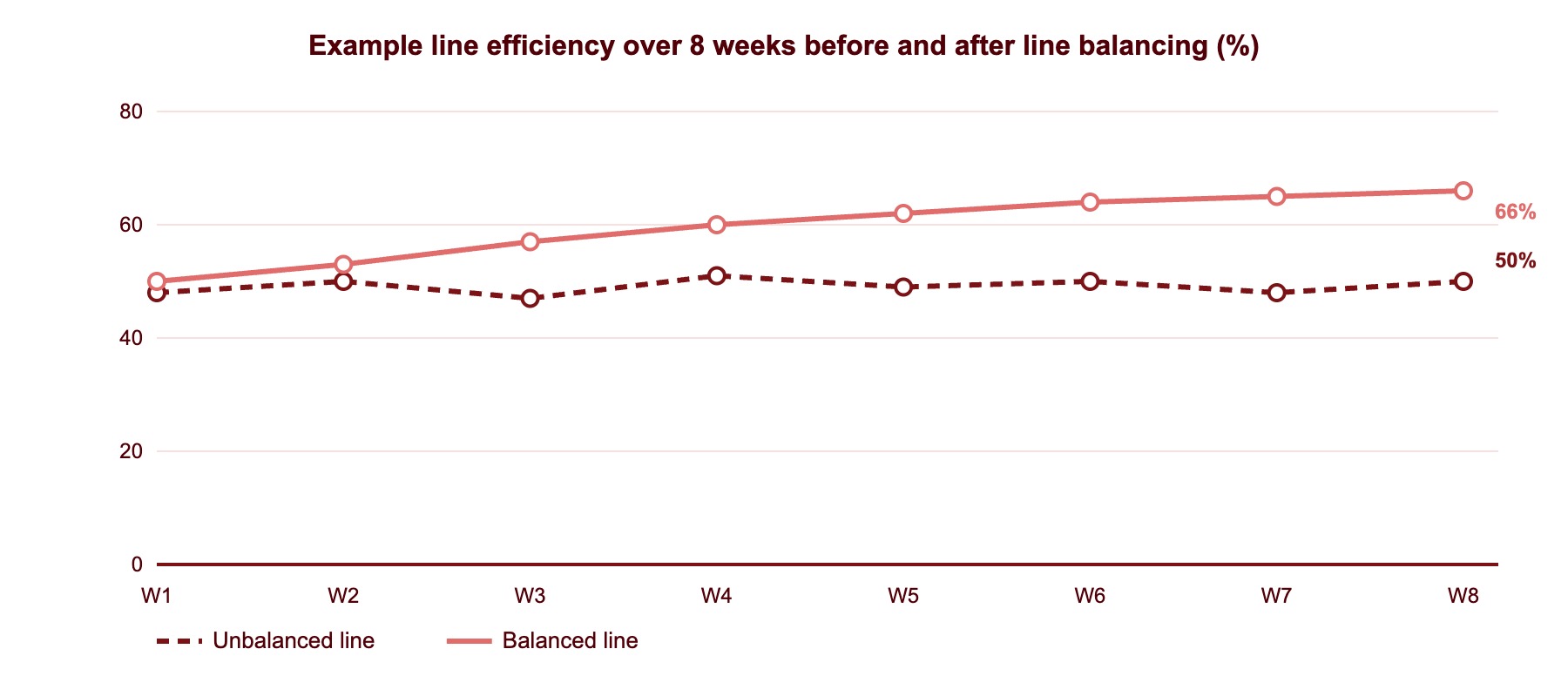
Line efficiency equals total standard minutes of finished products divided by total attended minutes of workers, times 100%. For example, a line of 40 workers working 480 minutes a day, producing 800 pieces with a standard time of 12 minutes, has an efficiency of 9,600 divided by 19,200, or 50%.
| Indicator | Formula | Management meaning |
|---|---|---|
| Line efficiency | Standard minutes produced divided by attended minutes | Measures actual line productivity |
| Right-first-time rate | Pieces passing without repair divided by total pieces | Measures quality and rework waste |
| On-time delivery rate | Orders delivered on time divided by total orders | Measures planning capability |
| Idle time | Waiting minutes divided by attended minutes | Measures line balancing effectiveness |
| Average overtime hours | Total overtime hours divided by number of workers | Warns of exceeding legal limits |
Indicators should be updated daily by line and consolidated weekly.
Productivity is only sustainable when linked to pay mechanisms and lawful working hour limits.
Piece-rate pay, overtime and legal requirements
Piece-rate pay must be transparent and not below the minimum
The Labour Code allows pay by product, but pay for employees who work normal hours and meet the norm must not be lower than the regional minimum wage.[3] From 1 January 2027, the monthly minimum wage under Decree 399/2026/ND-CP is VND 5,700,000 in region I and VND 5,080,000 in region II, where many garment factories are located. Piece rates should be built from standard times so that workers of average skill can reach the target pay.
Overtime in the garment industry
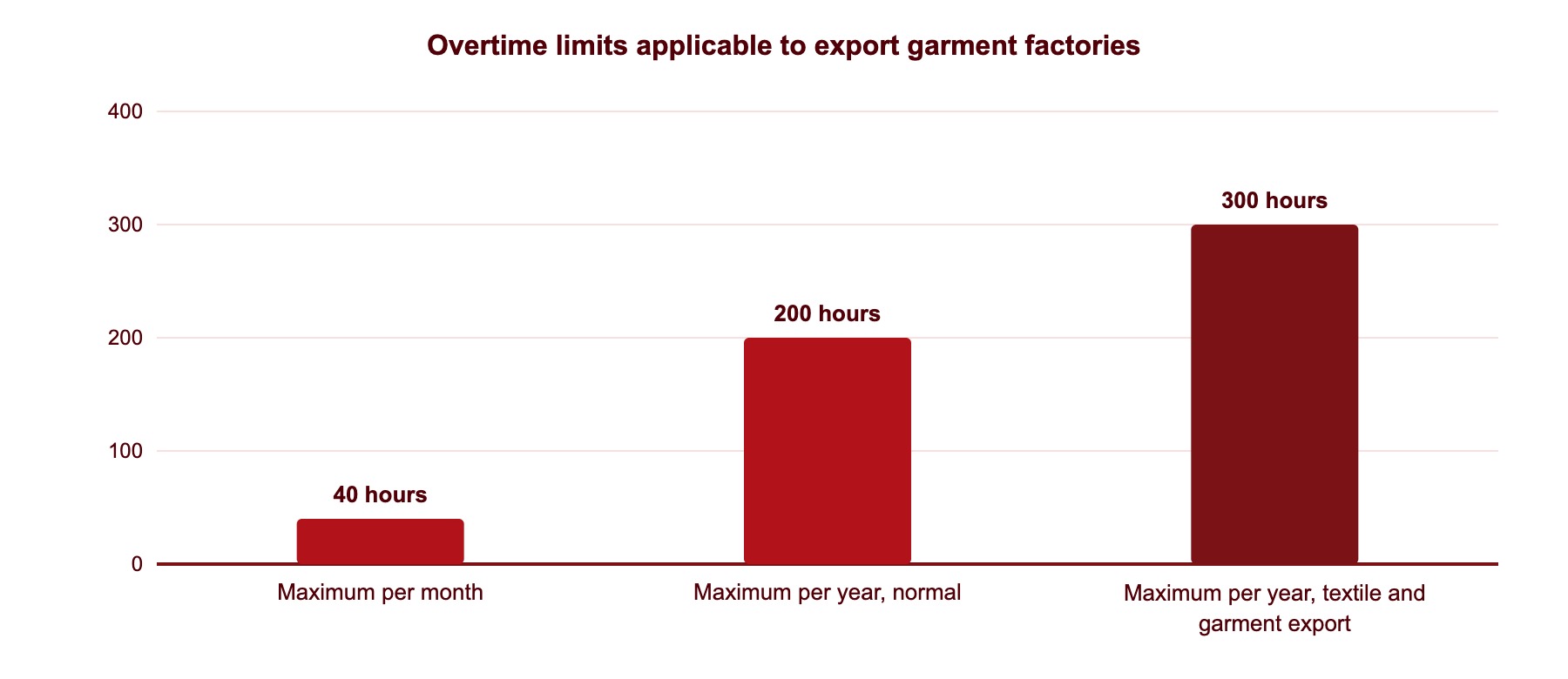
Article 107 of the Labour Code limits overtime to 40 hours per month and 200 hours per year; export production and processing of textiles and garments may use up to 300 hours per year.[4] Overtime pay within legal limits is exempt from personal income tax, while the portion beyond the limits is taxable.[5]
What a piece-rate pay regulation should contain
- Rates by operation. Calculated from standard time and target pay.
- Minimum pay top-up. When new orders start and the line has not reached productivity.
- Quality and attendance bonuses. With clear conditions and amounts so they are deductible.
- Issuance procedure. Consult the employee representative organisation and announce publicly.
These legal requirements are also what international customers check during compliance audits.
Preparing for international customer compliance audits
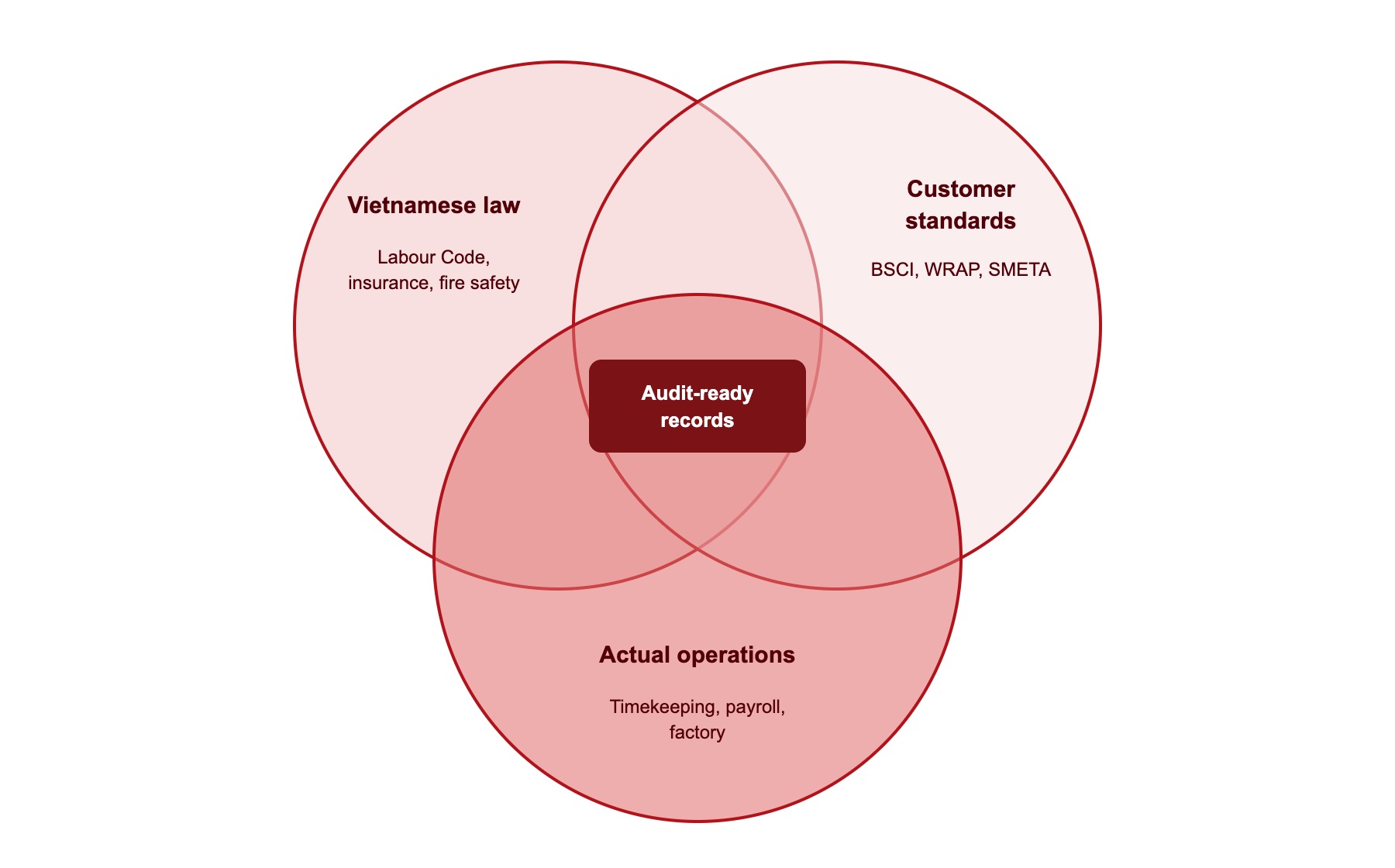
Brands usually audit suppliers against social responsibility standards such as amfori BSCI, WRAP or SMETA, covering working hours, pay, safety, fire prevention and workers' rights.[6] A failed audit can cost orders even when production capability is strong.
| Audit item | Required records | Common findings |
|---|---|---|
| Working hours | Timekeeping data, overtime registration | Double timekeeping, overtime beyond limits |
| Pay | Payroll, payslips, transfer records | Timekeeping and payroll do not reconcile |
| Contracts, insurance | Labour contracts, insurance participation list | Late contract signing, late insurance enrolment |
| Safety, fire prevention | Training records, equipment inspection, drills | Blocked exits, missing training |
| Representation, dialogue | Periodic dialogue minutes | No dialogue held as required |
Reference list; each standard has its own detailed requirements.
Real cases show how these areas interact.
Case analysis of management in garment companies
Case one, accepting rush orders beyond capacity
Sales accepts an order with a short deadline, forcing overtime beyond 300 hours a year. Besides penalty risk, overtime pay beyond the limit is no longer tax-exempt, and auditors may record a critical finding. The solution is an order acceptance procedure based on line capacity and remaining overtime allowance.
Case two, workers complain about piece rates
Rates change by style but are not announced in advance. Businesses should announce rates before production starts and keep the standard time calculations for explanation.
Case three, a team leader meets output but has high defects
KPIs measuring only output push leaders to speed up. The KPI set should balance productivity, quality and delivery with clear weights.
Case four, adding satellite workshops
When subcontracting, the business remains responsible to customers for supply chain compliance. Subcontracting agreements need compliance clauses and audit rights.
Risks of managing a garment factory without a system
- Financial risk. Low productivity, defects and late delivery erode margins and trigger late delivery penalties.
- Labour risk. Overtime beyond limits and unclear piece rates lead to penalties and strikes.
- Customer risk. Failed compliance audits and lost orders from major brands.
- Tax risk. Bonuses and allowances without a regulation are disallowed as deductible expenses.
Suggested management consulting roadmap for garment companies
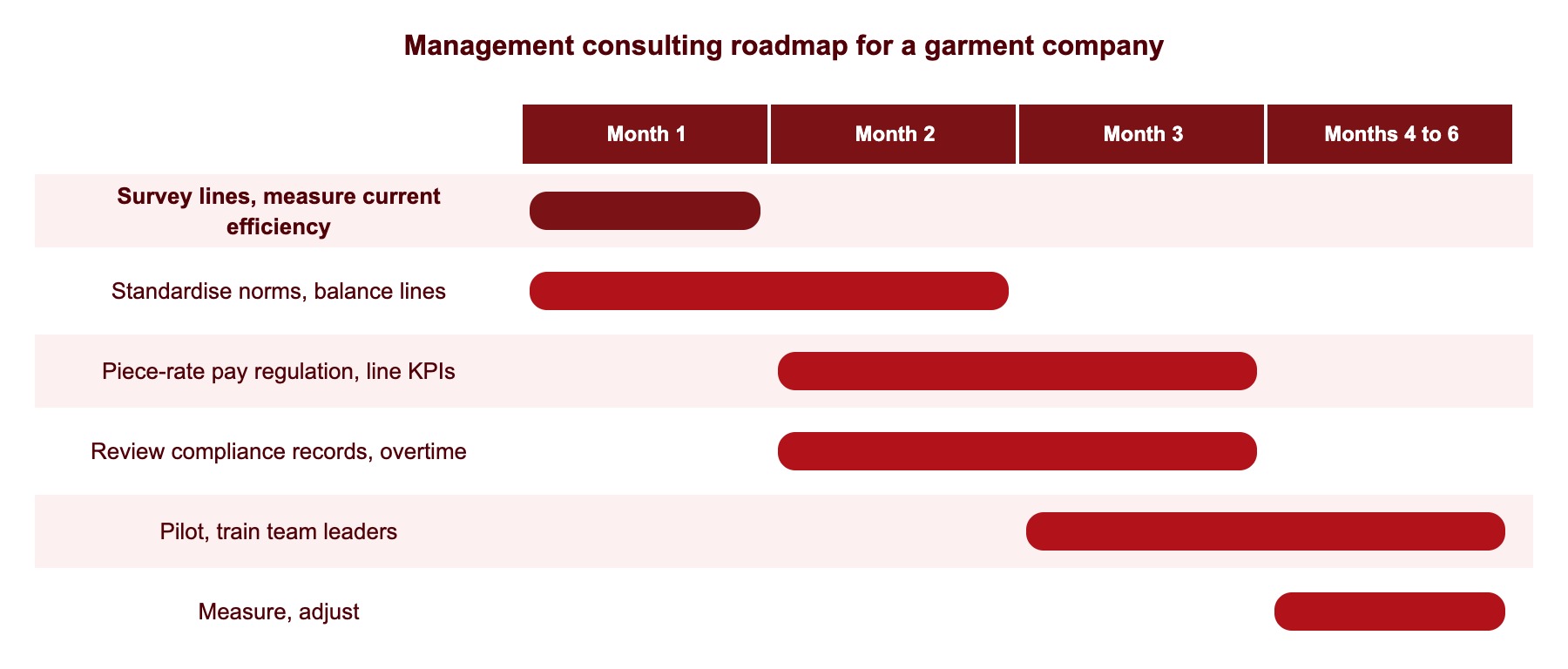
| Item | Owner | Deadline | Status |
|---|---|---|---|
| Measure current efficiency of each line | Engineering | Week 2 | ☐ |
| Review timekeeping and overtime data | HR | Week 3 | ☐ |
| Issue the new piece-rate pay regulation | Board of management | Month 3 | ☐ |
| Daily line KPI reports | Production management | Month 3 | ☐ |
| Internal mock compliance audit | Compliance team | Month 4 | ☐ |
Implementation tracking form; adjust to actual circumstances.
Related articles and templates
- Business consulting for garment companies on labour, processing contracts, origin and compliance
- Business management consulting, when it is needed, scope, process and how to measure results
- What export garment companies should prepare before international customers' labour compliance audits
- Labour and payroll compliance management
How Justeps supports businesses
Justeps helps garment companies survey and measure line efficiency, standardise norms and balance lines, build piece-rate pay regulations, line KPIs and order acceptance procedures, and review labour, working hour and safety records to be ready for customer compliance audits.
→ Learn about Justeps business management consulting services
Notes and references
- Time and motion study and standard allowed minutes (SAM) in the garment industry.
- Womack, Jones, Roos, The Machine That Changed the World, 1990 (lean manufacturing).
- Articles 90 and 96 of the Labour Code No. 45/2019/QH14; Decree No. 399/2026/ND-CP on minimum wages.
- Article 107 of the Labour Code No. 45/2019/QH14; Decree No. 145/2020/ND-CP.
- Law on Personal Income Tax No. 109/2025/QH15; Article 26 of Decree No. 253/2026/ND-CP.
- amfori BSCI Code of Conduct; WRAP Principles; Sedex SMETA.
This article is for research and reference only, reflects regulations in force at the time of publication (11/2026) and does not replace advice for specific cases.
For more information, please contact:
📩 Email: info@justeps.vn
🌐 Website: https://justepslegal.com · https://justeps.vn
🌐 Page: Justeps
☎️ Hotline (Zalo): 096 172 2607
📍 Thanh Xuan Office: 12th Floor, Licogi 13 Tower, 164 Khuat Duy Tien Street, Thanh Xuan Ward, Hanoi, Vietnam
📍 Ha Dong Office: LK06B, No.10, Dong Dua Area, Ha Dong Ward, Hanoi, Vietnam
📍 Ho Chi Minh City Branch: 528 Le Van Sy, Ho Chi Minh City, Vietnam
📍 Hai Phong Office: Truong Thinh Village, Ha Dong Commune, Hai Phong City, Vietnam
📍 Quang Ninh Office: Van Don Special Zone, Quang Ninh Province, Vietnam