MANAGEMENT CONSULTING FOR TRADING COMPANIES, INVENTORY, PRICING, RECEIVABLES AND SALES KPIS
Trading companies often see revenue rise without a matching increase in cash. Money is tied up in slow-moving inventory and overdue receivables, while sales staff are rewarded on sales without being responsible for collection. Pricing and discounts decided by individuals erode margins without management noticing.
This article analyses management areas specific to trading companies, including purchasing and inventory management, pricing and discount policies, receivables management, sales KPIs and commissions, and approval delegation, linked to related legal requirements in force as of November 2026. It includes a flowchart, an inventory classification chart, a receivables ageing chart and a risk matrix.
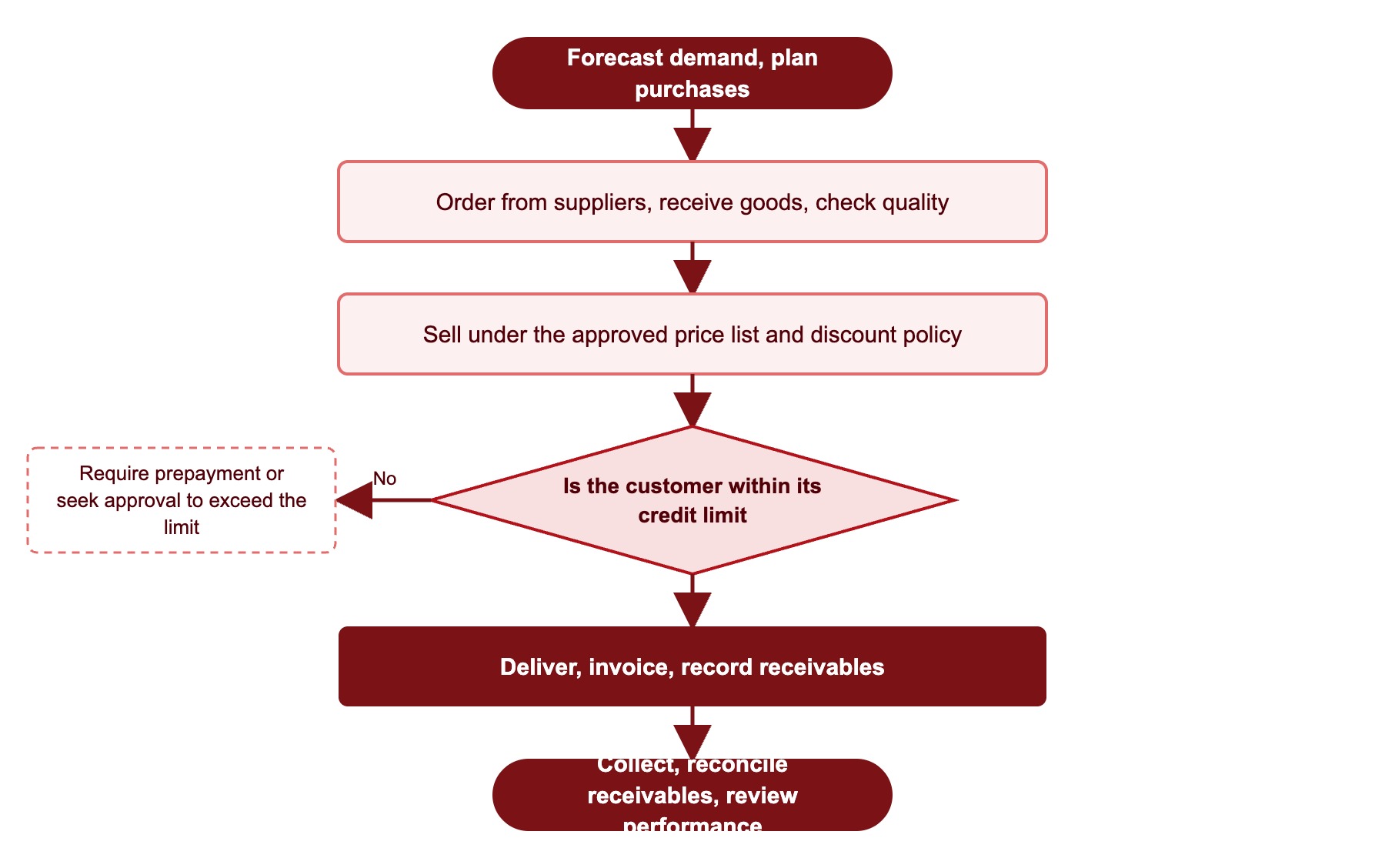
Overview flowchart of a trading company's buy-sell cycle
The trading cycle runs from demand forecasting, purchasing and storage to sales and collection. The two control points that determine cash flow are inventory levels and customer credit limits.
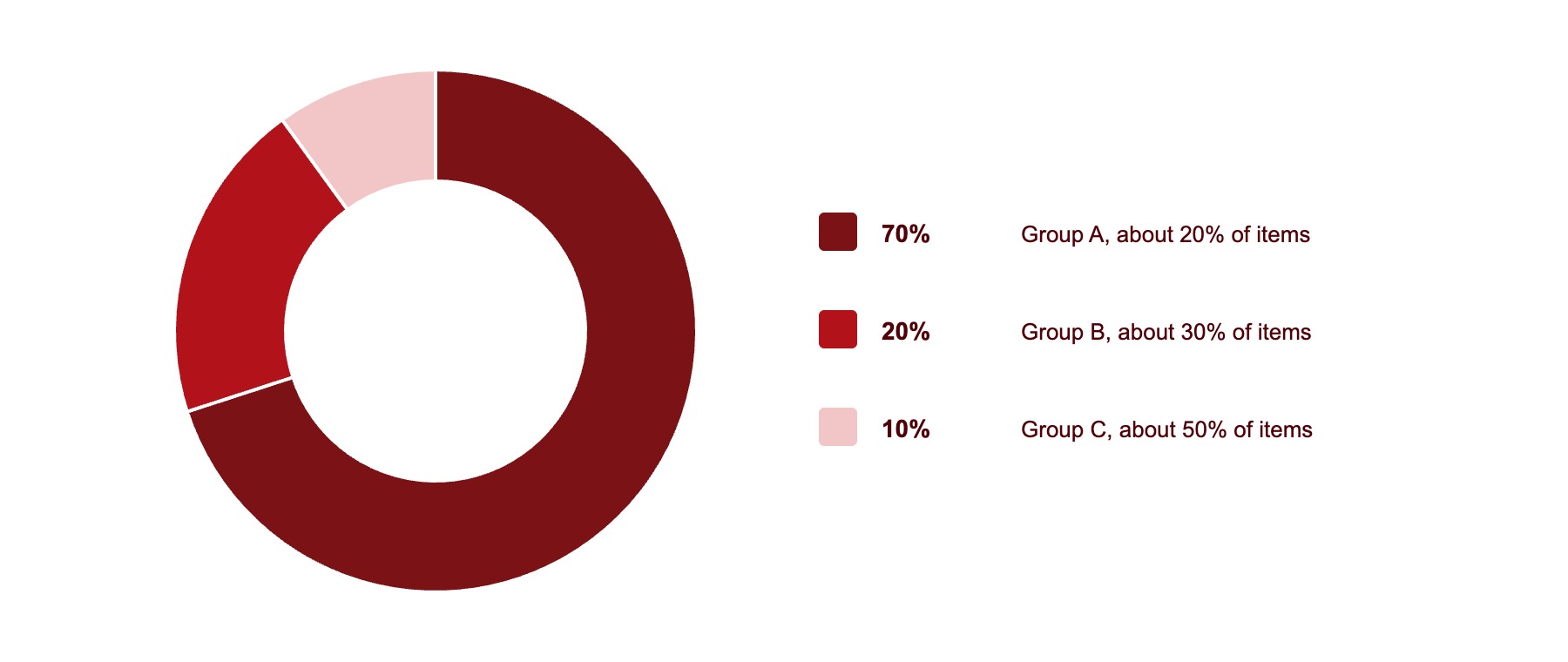
Effective inventory management requires classifying goods by value contribution.
Theoretical basis of inventory and working capital management
ABC analysis, based on the Pareto principle, divides items into group A with the largest value share, group B with medium value and group C with many items of small value, applying different levels of control.[1] The cash conversion cycle, equal to days inventory plus days receivables minus days payables, shows how many days of working capital a business needs.[2]
| Group | Control policy | Count frequency |
|---|---|---|
| A | Detailed forecasting, frequent small orders, daily monitoring | Monthly |
| B | Reorder points, moderate safety stock | Quarterly |
| C | Large batch orders, simplified procedures | Half-yearly |
Specific policies depend on supplier lead times and demand variability.
Sound inventory is only half the story; the other half is selling at the right price and collecting cash.
Pricing, discounts and approval delegation
Price lists and discount policies should be issued by customer group, channel and volume. Discounts beyond policy must be approved by the competent person with reasons recorded.
| Discount level | Approver | Conditions |
|---|---|---|
| Within policy | Salesperson applies directly | Correct customer group and volume |
| Up to 3% above policy | Sales manager | Competitive reason, strategic customer |
| More than 3% above policy | Director | Order margin assessment |
| Below cost | Director, recorded in writing | Clearing slow-moving stock under a plan |
Percentage thresholds are examples; businesses should adjust them to product margins.
Trade discounts and promotions must be shown correctly on invoices and comply with promotion rules to avoid tax risk. This is where management and legal matters intersect and is often overlooked.
After the sale, collection determines actual profit.
Managing receivables by ageing
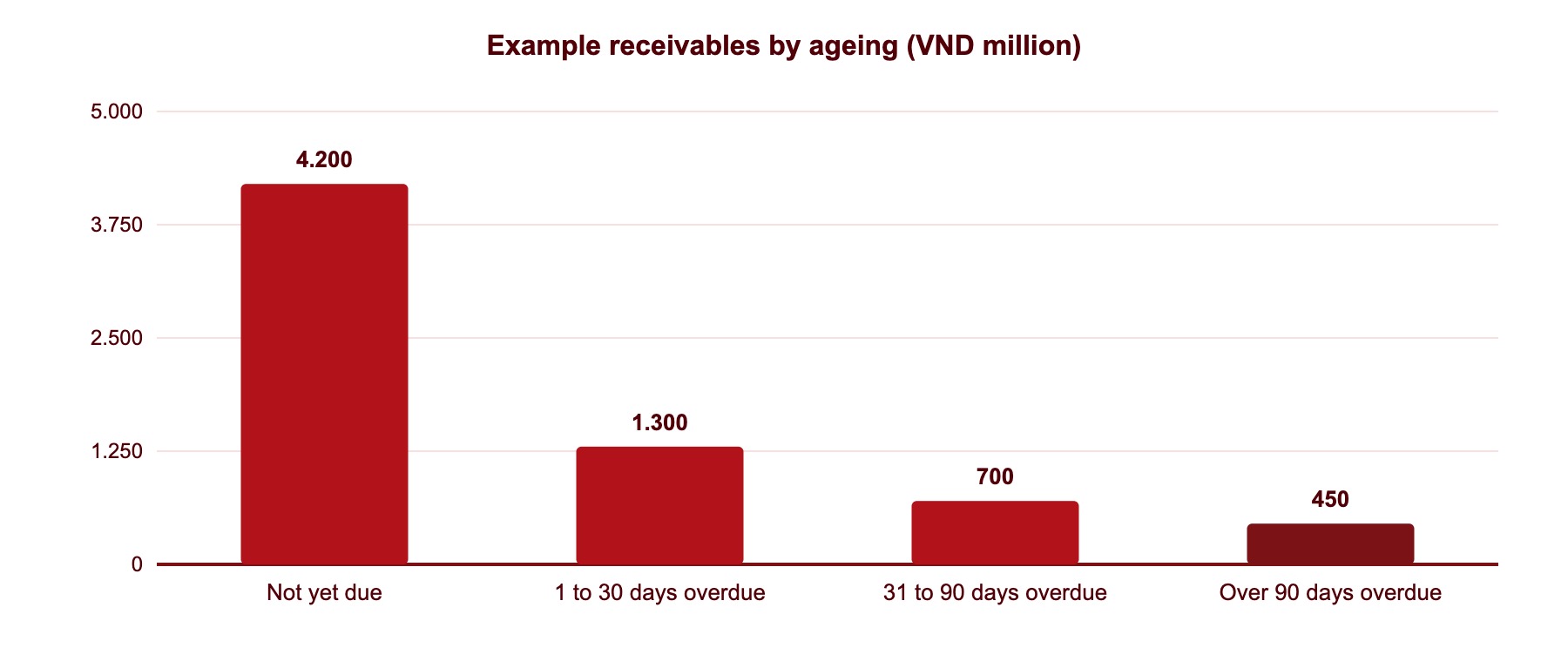
- Credit limits per customer. Approved based on payment history, size and collateral if any.
- Automatic delivery blocks. When a customer exceeds its limit or has debts overdue beyond a set number of days.
- Periodic reconciliation. Reconciliation minutes confirmed by customers are key evidence in disputes.
- Tie collection responsibility to sales. Commissions are based on collected sales, not just invoiced sales.
Commissions and KPIs are the tools for aligning sales behaviour with cash flow goals.
Sales KPIs and commissions
| Indicator | How to measure | Suggested weight |
|---|---|---|
| Collected sales | Total cash collected in the period from assigned customers | 40% |
| Gross margin | Gross profit divided by revenue | 25% |
| Overdue ratio | Overdue receivables divided by total receivables | 20% |
| New customers | Number of new customers with transactions | 15% |
Weights are examples; businesses should adjust them to each stage's strategy.
The commission regulation should state eligibility conditions, calculation, payment timing and clawback when customers do not pay. Under Decree 320/2025/ND-CP, bonuses and commissions paid to employees are deductible only when conditions and amounts are specified in the labour contract, collective agreement or regulation.[3]
Real cases show the links between these areas.
Case analysis of trading company management
Case one, revenue grows but cash is short for purchases
Analysis shows inventory days rising due to buying many group C items and overdue receivables increasing. The solution is an ABC-based inventory policy and delivery blocks when limits are exceeded.
Case two, margins fall for unclear reasons
Salespeople apply their own discounts per customer. A unified price list, a discount approval procedure and order-level margin reports are needed.
Case three, a departing salesperson leaves bad debts
Without periodic reconciliation, debts are hard to prove. A reconciliation schedule and customer handover on resignation are needed.
Case four, slow-moving stock piles up for years
A quarterly slow-moving stock review and an approved clearance policy are needed.
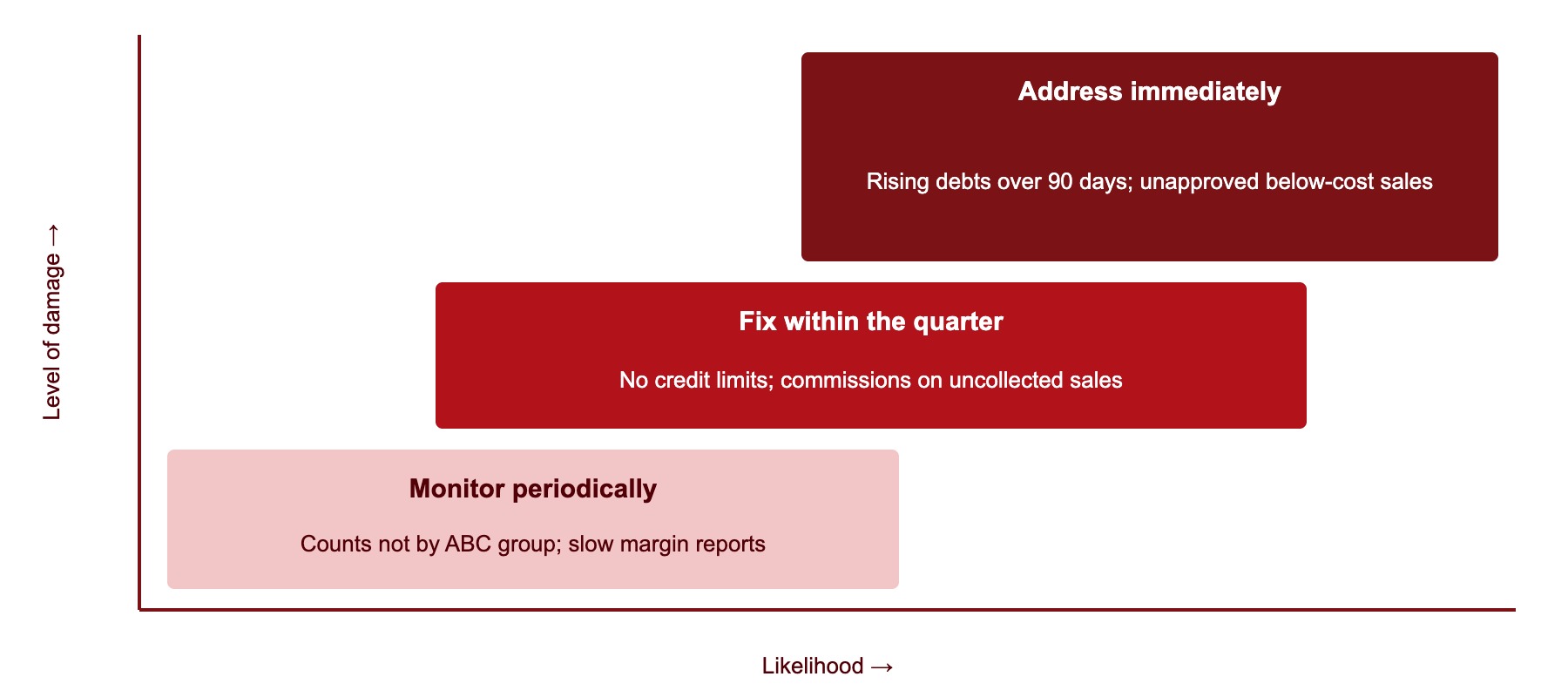
Risks of trading company management without a system
- Cash flow risk. Capital tied up in inventory and receivables, requiring costly short-term borrowing.
- Profit risk. Ad hoc discounts and uncontrolled below-cost sales.
- Legal risk. Non-compliant promotions and discounts, bad debts without evidence.
- Tax risk. Commissions without a regulation and destroyed goods without records disallowed as expenses.
Suggested management consulting roadmap for trading companies
| Phase | Content | Deliverables | Suggested timing |
|---|---|---|---|
| Diagnosis | ABC analysis, cash conversion cycle, margins | Diagnostic report | Month 1 |
| Inventory, purchasing | Inventory policy, reorder points | Purchasing and inventory procedures | Month 2 |
| Pricing, discounts | Price list, discount approval matrix | Pricing policy | Month 2 |
| Receivables, commissions | Credit limits, commission regulation, KPIs | Regulations, KPI set | Month 3 |
| Measurement | Working capital, ageing and margin reports | Management report set | From month 4 |
Suggested roadmap; adjust to the number of items and sales channels.
Related articles and templates
- Business consulting for trading companies on sales contracts, agency, promotions and invoices
- Business management consulting, when it is needed, scope, process and how to measure results
- Template approval authority matrix for expenses, procurement and payments
- Budget, cash flow and management reporting
How Justeps supports businesses
Justeps helps trading companies analyse inventory by ABC group and the cash conversion cycle, build inventory policies, price lists and discount approval matrices, credit limits, commission regulations, sales KPIs and working capital management reports.
→ Learn about Justeps business management consulting services
Notes and references
- The Pareto principle and ABC analysis in inventory management.
- Richards, V. D., Laughlin, E. J., A Cash Conversion Cycle Approach to Liquidity Analysis, Financial Management, 1980.
- Article 9 and Clause 8, Article 10 of Decree No. 320/2025/ND-CP dated 15/12/2025.
This article is for research and reference only, reflects regulations in force at the time of publication (11/2026) and does not replace advice for specific cases.
For more information, please contact:
📩 Email: info@justeps.vn
🌐 Website: https://justepslegal.com · https://justeps.vn
🌐 Page: Justeps
☎️ Hotline (Zalo): 096 172 2607
📍 Thanh Xuan Office: 12th Floor, Licogi 13 Tower, 164 Khuat Duy Tien Street, Thanh Xuan Ward, Hanoi, Vietnam
📍 Ha Dong Office: LK06B, No.10, Dong Dua Area, Ha Dong Ward, Hanoi, Vietnam
📍 Ho Chi Minh City Branch: 528 Le Van Sy, Ho Chi Minh City, Vietnam
📍 Hai Phong Office: Truong Thinh Village, Ha Dong Commune, Hai Phong City, Vietnam
📍 Quang Ninh Office: Van Don Special Zone, Quang Ninh Province, Vietnam