
Key takeaways
- A payment intermediary service provider must issue internal regulations on anti-money laundering that contain all the content required by law and must review them every year[2].
- A suspicious transaction must be reported within 3 working days from the date of the transaction or 1 working day from its detection, so the procedure must state clearly who reviews alerts, who decides to report and within what time[5].
- In a fintech business most controls are performed by the system, so a regulation has value only when the alert rules, limits and approval flows on the system are exactly as the document describes.
- The merchant due diligence procedure must separate the person who sells from the person who controls, because this is the stage most easily exploited for online gambling and fraud.
When the State Bank of Vietnam carries out an inspection, when a partner bank conducts its assessment before signing a contract or when a customer complains of losing money, the first question is always how the business has regulated the matter and whether it has complied with its own rules. Many fintech businesses have a fairly thick set of documents, but these were translated from the parent company’s policies or copy the wording of the law, so they do not answer who does the work, with what tools and within what time. Other businesses are the opposite and run very tight controls on the system, yet have no document that records those rules.
This page introduces Justeps’ service of building internal procedures and regulations for providers of e-wallets, payment gateways, collection and disbursement support services and technology companies that cooperate with banks. Dividing the organisation into divisions and positioning the control functions on the chart are covered under the organisational structure design service for fintech and payment intermediary businesses, while this page deals with the content of each document and how to make the documents match the system.
Why internal documents form part of the operating conditions
A payment intermediary service provider is a reporting entity under the law on anti-money laundering[1], and a reporting entity that is an organisation must issue internal regulations covering its customer acceptance policy, customer due diligence procedure, risk management, transaction reporting, detection and handling of suspicious transactions, retention and confidentiality of information, temporary suspension of transactions, reporting regime, training and internal control[2]. These regulations must be reviewed every year so that they can be amended and supplemented as appropriate. Besides anti-money laundering, the licence application also includes a service provision scheme and a description of the technical solution meeting level 3 information system security[3], so the procedures used later in operation must be consistent with what the business presented in those two documents.
What sets the sector apart is that most controls are performed not by people but by the system, for example transaction alert rules, limits by customer tier, biometric authentication or automatic temporary locking of accounts. Justeps therefore drafts the regulations in parallel with the system specifications, and each time the technical team changes an important rule the document must be checked against it again. A regulation that requires an on-site inspection while the system allows an online merchant to be activated within the day is the kind of discrepancy that leaves a business both penalised and discredited with its partner bank.
The set of documents a payment business needs
The number of documents depends on the type of service being provided, but a payment intermediary already in operation usually needs the seven groups of documents below. Justeps proposes an order of drafting based on the level of risk, starting with anti-money laundering and merchant due diligence.
| Document group | Main contents | Lead unit |
|---|---|---|
| Anti-money laundering | Customer acceptance, electronic customer due diligence, risk classification, monitoring and reporting of transactions. | The anti-money laundering unit. |
| Merchants | Due diligence, risk rating, limits, holding of funds, monitoring and termination of cooperation. | The risk management division. |
| E-wallets and reconciliation | Opening, locking and closing wallets, linking accounts, reconciling balances with the payment guarantee account. | The operations and accounting divisions. |
| System security | Access rights, change management, outsourced providers, back-up and recovery. | The information security unit. |
| Personal data | Legal basis for processing, consent, customer rights, data transfers and data incidents. | The data protection officer. |
| Investigations and incidents | Receiving complaints, refunds, account takeover and reporting to the regulator. | The customer care division. |
| New products | Assessing licence scope and risk before launch, monitoring after launch. | The compliance unit. |
Anti-money laundering rules must say who does what
The most common flaw in anti-money laundering regulations is that they copy the provisions of the law on customer due diligence, risk classification and transaction reporting without turning them into specific tasks. Justeps writes each obligation as a step with a person responsible, a tool, criteria and a time limit, for example which customers may open a wallet with electronic identification alone, when enhanced verification is required, who may approve high-risk customers and how often the risk rating is updated. For unusually large or complex transactions and transactions with organisations or individuals in countries on warning lists, the procedure must set out the enhanced monitoring measures and the right to refuse the transaction[4].
The deadline for reporting a suspicious transaction is 3 working days from the date of the transaction or 1 working day from the date of detection, and where a transaction requested by a customer shows signs of being linked to a crime it must be reported within 24 hours of detection[5]. With tens of thousands of alerts each month, these deadlines can be met only when the procedure clearly divides an initial screening tier, an analysis tier and the person who decides to report. Customer due diligence information and records must be kept for at least 5 years from the end of the transaction or the closure of the account[6], and staff must be shown how to answer a customer whose transaction has been refused without revealing that a report has been made, because the law requires information and reports to be kept confidential[7].
Due diligence, monitoring and termination of merchants
Payment gateways and collection services are often abused through merchants that have an ordinary-looking sales website but in reality collect money for online gambling, investment fraud or the trade in accounts. The procedure Justeps drafts separates entirely the person who brings in the merchant from the person who decides to accept it, as shown in the diagram below.
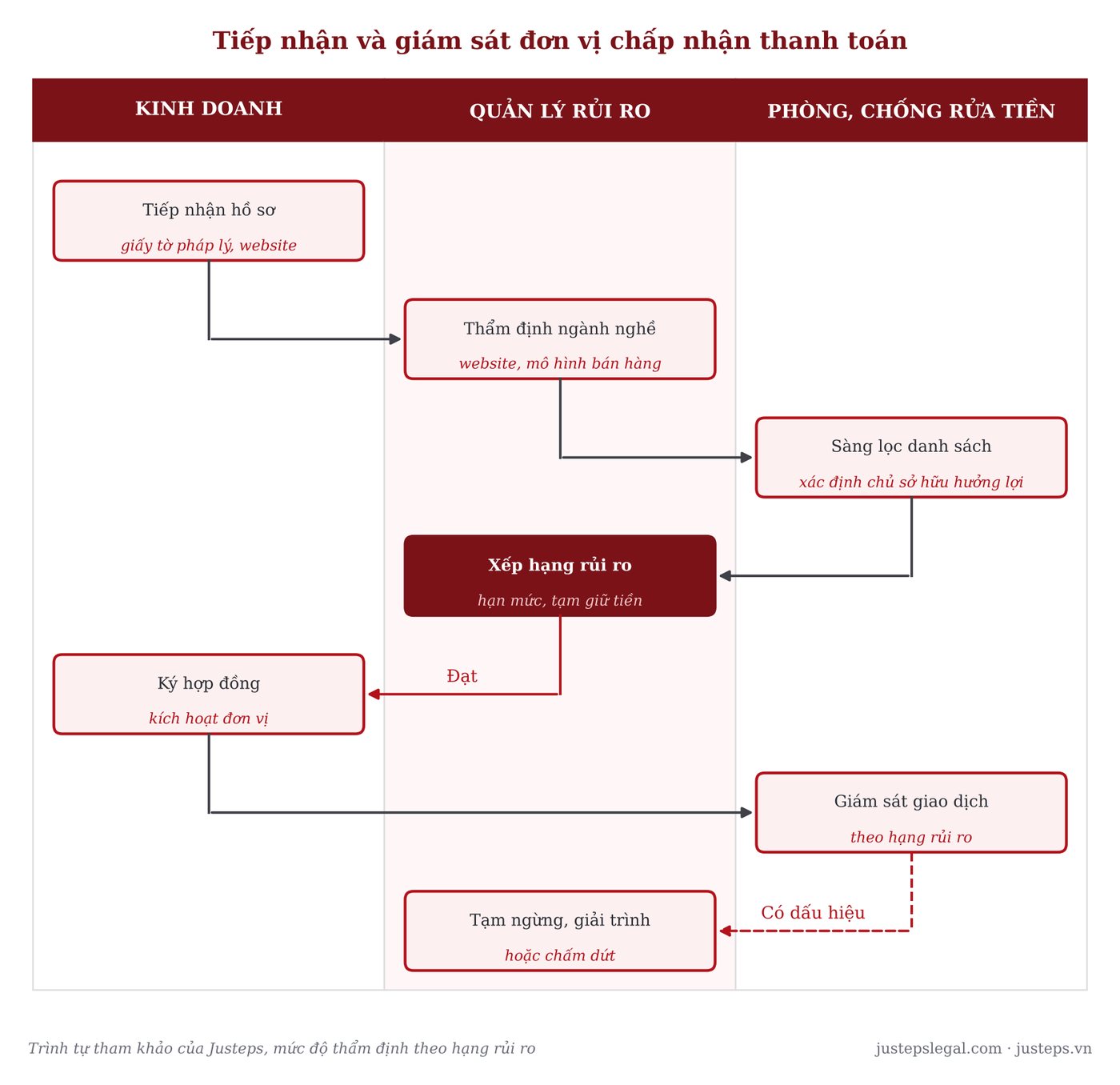
Sequence for onboarding a merchant through three units
Under this sequence, the sales team only receives the application and the legal documents, while the risk management division examines the line of business, the website and the sales model. The anti-money laundering unit screens the warning lists and identifies the beneficial owner of the merchant, after which the risk management division assigns a rating that determines the transaction limit and the rate or period for holding funds. After activation, the merchant’s transactions are monitored under rules specific to each tier, and the procedure lists in advance the signs that require suspension, a request for an explanation or termination of cooperation. A list of lines of business that are refused or subject to enhanced control is issued with it, so that the sales team knows in advance which applications it should not accept.
E-wallets, reconciliation and the payment guarantee account
For e-wallets, the procedure should follow the life cycle of the wallet, from opening, authentication and linking with a payment account to top-ups, withdrawals, transfers, temporary locking and closure, together with limits set by the State Bank of Vietnam and by internal risk tier. The daily reconciliation procedure between the total wallet balance and the balance of the payment guarantee account at the bank is the document Justeps examines most closely, because a discrepancy that is not explained in time may be an early sign of a system error or internal fraud. The document must state who carries out the reconciliation, which level of discrepancy must be escalated on the same day and who may post adjusting entries.
System security, data and outsourced providers
The information system security regulation of a payment business should cover role-based access rights, software change management, back-ups, the contingency and recovery plan and the schedule of periodic testing. The part most often overlooked is the management of outsourced providers such as cloud computing, electronic identification services or customer call centres, even though the business remains accountable to the regulator for everything an outsourced provider does on its behalf. Justeps drafts the selection criteria, the mandatory clauses in outsourcing contracts, the right of inspection and the replacement plan if a provider stops its service.
The personal data protection regulation must turn customers’ rights into procedures with time limits, for example responding to a request within 2 working days, handling a request to withdraw consent within 15 days and a request to delete data within 20 days[8]. For identification and biometric data, the regulation should state the legal basis for processing and the retention period, reconcile these with the five-year record retention duty under the anti-money laundering law, and set out the cases in which data is transferred abroad[9]. A business that needs a more detailed impact assessment file can also use the personal data protection compliance service.
Investigations, complaints, incidents and approval of new products
The investigation and complaints procedure classifies requests by their nature, including pending transactions, double debits, transactions not made by the customer and cases where customers themselves transfer money to a fraudster, each with its own time limit and evidence to be collected. The wallet terms of use and the electronic contracts with customers must be validly concluded to be relied on when matters are checked[10], while the information provided to consumers must be truthful and complaints must be handled in accordance with the rules on consumer protection[11]. For major incidents such as a system outage or the takeover of many accounts, the procedure names in advance the person in charge, the channel for notifying customers and the obligation to report to the regulator.
A new product approval procedure helps the business avoid launching a feature that falls outside the scope of its licence or does not yet have risk controls. Each product proposal passes through the following steps before it is approved:
- The product unit describes the feature, the target customers, the flow of funds and the partners involved.
- The compliance unit assesses whether the feature falls within the scope of the licence and whether the regulator must be notified before it is rolled out.
- The anti-money laundering, anti-fraud, information security and data protection units each assess the risks within their own field.
- The competent level approves the product with conditions, and the product is monitored separately for the first three months after launch.
Documents must match the system
Before drafting, Justeps reviews the gap between the existing documents and the way the system actually operates. The chart below is an example of the results of such a review at a mid-sized e-wallet, counting the points where the procedure says one thing and the system does another.
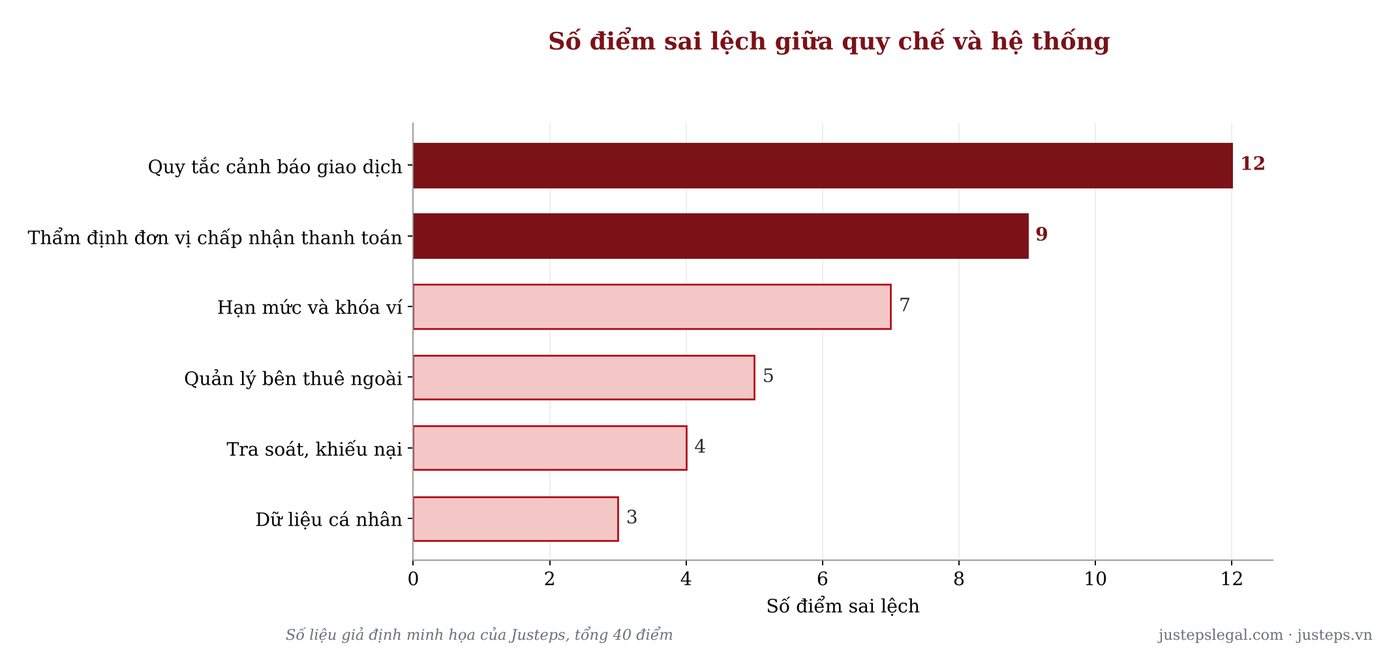
Example of the number of discrepancies between regulations and the system by document group
In this example there are 40 discrepancies in total, of which 12 concern transaction alert rules and 9 concern merchant due diligence, the two groups that the system changes most often. Justeps does not program the rules on the system itself but drafts the list of indicators, criteria and handling flows for the technical team to configure, and then tests them together by taking a merchant application through every step or triggering a test alert. Alert rules should be recalibrated periodically to reduce false alerts without missing genuine indicators.
Timeline, deliverables and fees
A project usually takes ten to twelve weeks. The first two weeks are spent interviewing the divisions and reviewing the administration screens, the alert rules and the contracts with partner banks; in the third week the list of documents is finalised; in the following weeks the documents are drafted group by group, each group with a joint working session between business, technical and compliance staff, and then tested before being issued. The deliverables include the following documents:
- Internal regulations on anti-money laundering for use in operations and for submission to the regulator on request.
- A procedure for due diligence, monitoring and termination of merchants, with a list of restricted lines of business.
- Procedures for e-wallets, reconciliation and the payment guarantee account.
- A regulation on information system security and the management of outsourced providers, and a regulation on personal data protection.
- Procedures for investigations, complaints and incidents and a procedure for approving new products.
- A table mapping each provision against legal requirements and against the system, draft issuing decisions and training materials.
The project fee is quoted as a fixed fee in writing after the initial meeting, depending on the number of payment intermediary services, the number of documents to be newly drafted or amended, the degree of automation to be checked, any need for bilingual documents and testing requirements. After issue, tracking new legislation and adjusting the regulations every quarter can be entrusted to the Ongoing legal advisory service for fintech and payment intermediary businesses.
How Justeps can help
Alongside internal procedures and regulations, fintech and payment intermediary businesses may combine the following Justeps services:
- Organisational structure design for fintech and payment intermediary businesses. Justeps divides the organisation along three lines of defence and places the control functions correctly before procedures are written for each division.
- Ongoing legal advisory for fintech and payment intermediary businesses. Justeps tracks new legislation and proposes amendments to regulations, contracts and terms of use every quarter.
- Personal data protection compliance. Justeps prepares data processing impact assessments and cross-border data transfer files for identification and biometric data.
- Fintech and payment intermediary legal services. Justeps advises fintech businesses on licences, scope of activities and cooperation with banks.
Frequently asked questions
Do anti-money laundering regulations have to be updated every year?
Yes. A reporting entity must review its internal regulations every year so that they can be amended and supplemented as appropriate[2]. Besides the annual review, Justeps recommends updating them immediately when new legislation is issued, a new product is launched or a significant incident occurs.
Can electronic customer due diligence replace meeting the customer in person?
In many cases it can, when the business is able to check against the identification database and uses biometric authentication in accordance with the guidance of the State Bank of Vietnam. The internal regulations should state clearly the cases that require enhanced verification, such as high-risk customers or transactions above the limit.
How long must customer due diligence records be kept?
Customer due diligence information and records must be kept for at least 5 years from the end of the transaction, the closure of the account or the date of the report[6]. The internal regulations should state the form of storage, the person responsible and how records are destroyed when the period expires.
May a merchant be refused without giving reasons?
The business has the right to refuse under its customer acceptance policy. Where the refusal is connected to a suspicion of money laundering, staff must not disclose that a report has been made, so the regulations need a standard response template.
How does using cloud computing abroad affect the regulations?
The business must assess where data is stored, the procedure for transferring personal data abroad, system security requirements and the regulator’s right of inspection. These requirements need to be built into the regulation on outsourced providers and the contract with the provider.
Does Justeps configure alert rules on the system?
No. Justeps drafts the list of indicators, criteria and handling flows for the business’s technical team to configure, then tests them together and records the results in the mapping table.
Related articles
- Legal compliance for fintech businesses, electronic identification, data protection and cooperation with banks
- Internal information security in a business, from document classification to handling leaks
- Organisational structure design for fintech and payment intermediary businesses meeting licence conditions
- Labour, wages and social insurance services for fintech and payment intermediary businesses with licence-critical key personnel
Notes
[1] Point dd of Clause 1 of Article 4 of the Law on Anti-Money Laundering No. 14/2022/QH15 dated 15 November 2022, effective from 1 March 2023.
[2] Clauses 1 and 4 of Article 24 of the Law on Anti-Money Laundering No. 14/2022/QH15 dated 15 November 2022, effective from 1 March 2023.
[3] Points c and dd of Clause 2 of Article 22 of Government Decree No. 52/2024/ND-CP dated 15 May 2024 on non-cash payments, effective from 1 July 2024.
[4] Article 20 of the Law on Anti-Money Laundering No. 14/2022/QH15 dated 15 November 2022, effective from 1 March 2023.
[5] Clauses 2 and 3 of Article 37 of the Law on Anti-Money Laundering No. 14/2022/QH15 dated 15 November 2022, effective from 1 March 2023.
[6] Article 38 of the Law on Anti-Money Laundering No. 14/2022/QH15 dated 15 November 2022, effective from 1 March 2023.
[7] Article 40 of the Law on Anti-Money Laundering No. 14/2022/QH15 dated 15 November 2022, effective from 1 March 2023.
[8] Article 5 of Government Decree No. 356/2025/ND-CP detailing a number of articles of and measures to implement the Law on Personal Data Protection, effective from 1 January 2026.
[9] The Law on Personal Data Protection No. 91/2025/QH15, effective from 1 January 2026.
[10] Article 34 of the Law on Electronic Transactions No. 20/2023/QH15 dated 22 June 2023, effective from 1 July 2024.
[11] The Law on Protection of Consumer Rights No. 19/2023/QH15 dated 20 June 2023, effective from 1 July 2024.
This article is for reference and reflects the regulations in force at the time of publication. Please consult Justeps for advice tailored to your company’s records and situation.
For further information, please contact:
📩 Email: info@justeps.vn
🌐 Website: https://justepslegal.com · https://justeps.vn
🌐 Page: Justeps
☎️ Hotline (Zalo): 096 172 2607
📍 Thanh Xuan Office: 12th Floor, Licogi 13 Tower, 164 Khuat Duy Tien Street, Thanh Xuan Ward, Hanoi, Vietnam
📍 Ha Dong Office: LK06B, No.10, Dong Dua Area, Ha Dong Ward, Hanoi, Vietnam
📍 Ho Chi Minh City Branch: 528 Le Van Sy, Ho Chi Minh City, Vietnam
📍 Hai Phong Office: Truong Thinh Village, Ha Dong Commune, Hai Phong, Vietnam
📍 Quang Ninh Office: Van Don Special Zone, Quang Ninh Province, Vietnam





