
Key takeaways
- An update that changes the content, storyline, age rating or server location of a G1 game requires an amendment to the release decision, so the update release procedure needs a mandatory question about content changes before the update goes onto the server[1].
- Virtual items, virtual units and reward points may be created only as declared in the file submitted to the regulator and may not be converted back into money or goods, so every event with rewards needs a rules review step[3].
- Playing time limits, account authentication and a mechanism for parents to register for children under 16 are licence conditions, so they must be set down in regulations on protecting underage players with a responsible person[5].
- A player data breach must be notified to the specialised authority within a short time limit, so the response procedure needs to be drafted and rehearsed before an incident occurs[8].
The legal risks of a game business rarely come from major decisions. Most incidents begin with a small change repeated every week, such as a new character added in an update without anyone checking whether the approved content has changed, a random item draw event run before the rules disclose the odds, or a video using a piece of music whose rights have not been bought. Without procedures, compliance depends on each person’s memory, and the business has no record to prove that it carried out checks when the regulator or players raise questions.
This page introduces Justeps’ service that turns these everyday changes into procedures with control points, responsible persons and records. The arrangement of divisions and the allocation of authority are covered on the page on organisational structure design for game and digital content businesses; this page assumes that the organisation is already clear and focuses on how each division works.
A set of regulations arranged along the game life cycle
Justeps does not draft a single general regulation hundreds of pages long but divides the documents according to the stages in the life cycle of a game or a content channel. This division means that each team only needs to read the part relevant to its own work and allows the business to amend each part separately when the law changes.
| Stage | Main documents | Responsible person |
|---|---|---|
| Development | Regulations on intellectual property management, project confidentiality and contracts with freelancers. | The project lead and the intellectual property manager. |
| Before release | Procedure for preparing the content approval file, the age rating and launch advertising. | The person responsible for the licence file. |
| Operation | Update release procedure and regulations on events and virtual items. | The head of operations, with review by the compliance division. |
| Players | Regulations on protecting players under 18, handling complaints, banning accounts and refunds. | The head of player care. |
| Data | Regulations on processing player data, answering requests and responding to incidents. | The data protection officer. |
| Closure | Procedure for ending a game and dealing with players’ assets. | The publishing director. |
Controlling updates and approved content
The release decision for a G1 game must be amended when the game changes its name or origin, changes its age rating, is upgraded to a version that changes the content or storyline compared with the licensed version, extends its scope or method of provision, or changes its server location[1]. Production teams usually release updates every few weeks and do not always recognise which changes touch the approved content. Justeps’ procedure therefore asks a mandatory question as soon as an update completes testing, accompanied by a list of concrete examples such as adding characters, adding maps, changing costumes or adding a new combat mechanic.
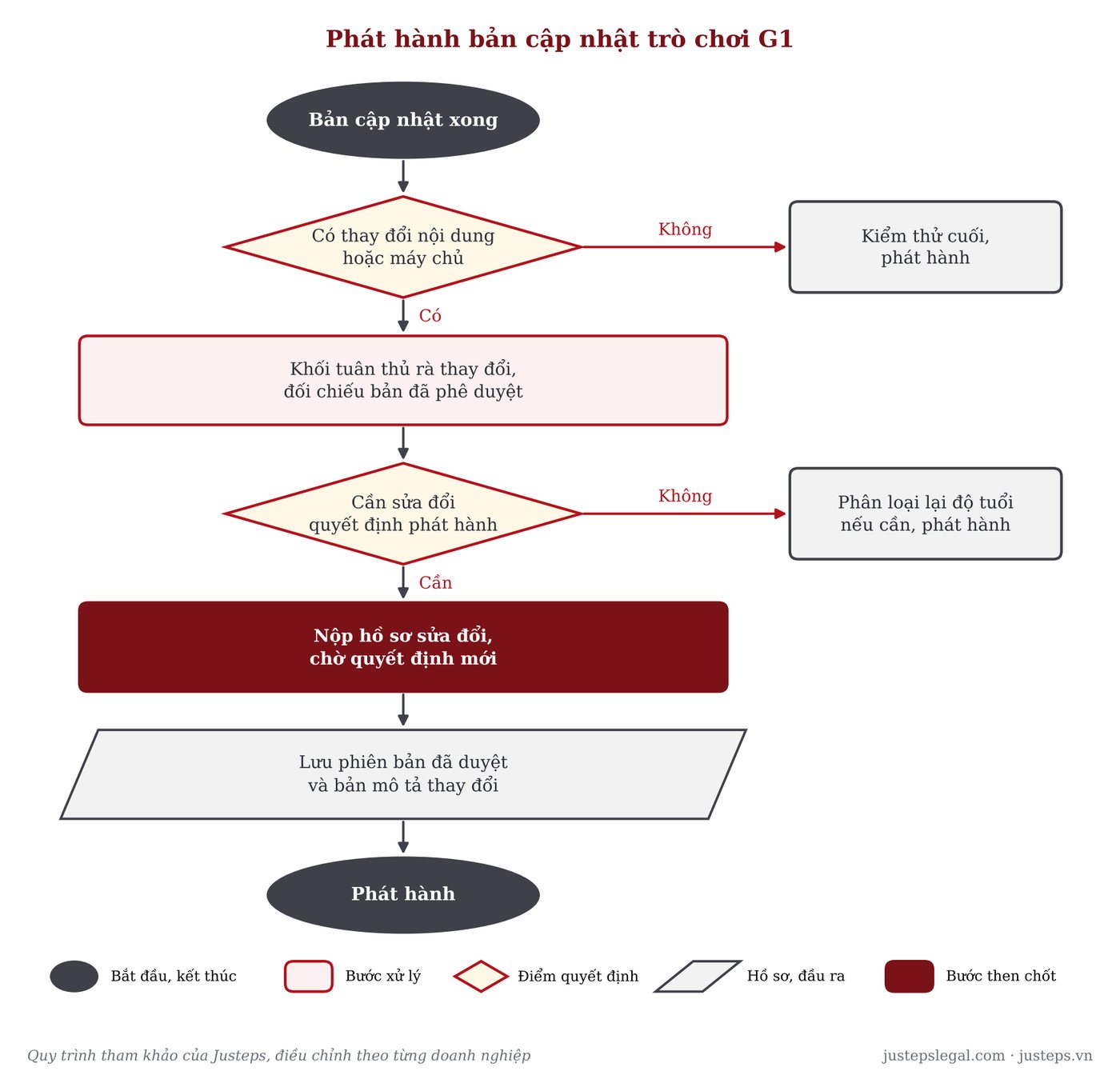
Update release procedure with a step that identifies changes to approved content
Under this procedure, an update that only fixes bugs or improves performance goes straight to final testing and release. If there is a change to content, the compliance division considers whether the change triggers a procedure to amend the release decision or requires the age rating to be revised, and then records the approved version together with a description of the change. The business rates the age of its own games and must display the rating symbol continuously on screen and in advertising, while the regulator may require a re-rating when it considers the rating incorrect[2], so the stored records are the basis for the business’s explanation.
Events, virtual items and virtual units
A business may create virtual items, virtual units and reward points only in accordance with what it declared in the file for the release decision or release notification; these items may be used only within the game, may not be converted back into money, payment cards or goods with commercial value outside the game, and players may not buy or sell them among themselves[3]. The business is also not allowed to attach promotional programmes awarding money or goods outside the game to the game’s interface and features. A publisher may run dozens of events each month, so if each event is decided in isolation, a single incorrect set of rules is enough for the business to be in breach.
Justeps’ event regulations include standard rules templates, a list of mechanics that are prohibited or require prior consultation, and a rules review step before publication, because correcting the rules before players top up costs far less than compensating them afterwards. For random item draw events, Justeps recommends disclosing the odds and keeping evidence of the actual rates, because players are consumers and have the right to accurate information about the services they pay for[4]. After each major event, the operations team prepares a wrap-up record of the number of complaints, the errors that arose and the award of prizes, so that lessons are built into the next rules template.
Protecting players under 18
The conditions for a G1 licence require the business to authenticate accounts by Vietnamese mobile phone number, to allow parents or guardians to register accounts for persons under 16 and to manage their playing time and content, and to limit persons under 18 to no more than 60 minutes per game and 180 minutes for all of the business’s games in a day[5]. This is an obligation that must be maintained every day, so the regulations need to state clearly who monitors the limiting system, who acts when the system fails and who periodically checks accounts with a false age.
Justeps’ regulations also cover transaction limits for underage accounts, how to handle parents’ refund requests when a child tops up without permission, and how to collect and store children’s data at the minimum level necessary. Children’s data must be processed with more care than ordinary data and with the consent of a parent or guardian under the rules on personal data protection[6], so the account registration form and the privacy policy must have a separate part for underage players.
Player data and requests from state authorities
A business that provides games must supply player information to the competent authority upon written request[7], while also protecting the data of those very players. The procedure for answering requests therefore has three steps, namely verifying the authority and legal basis of the document, limiting the scope of the data to exactly what is requested, and keeping a record of what was supplied, to whom and on what date. Players’ own requests to view, correct or delete their data also need a similar procedure with a specific response time.
When player data is leaked or lost, the data controller must notify the specialised personal data protection authority within 72 hours[8]. This time limit is very short compared with the time a technical team needs to determine the scope of an incident, so Justeps drafts a response plan with ready-made notification templates and a call list, and rehearses it with the business at least once. Data processing impact assessments and in-depth privacy policies can be combined with the personal data protection and cybersecurity service.
Intellectual property and content generated by artificial intelligence tools
Game source code is protected as a computer program[9], while artwork, music, scripts and voice recordings are separate subject matter of copyright and related rights. Justeps’ intellectual property management regulations require each game to have an asset register stating who created each asset, under which contract, who owns the rights, the scope within which it may be used and when the rights expire. Assets licensed for a fixed term, such as background music, fonts or stock image packs, are given renewal reminder dates to avoid a game continuing to run after the licence to use them has expired.
Many art teams already use artificial intelligence tools to sketch characters or create backgrounds. The regulations need to state which tools may be used, the tool’s terms on rights in the generated output, checks on how closely the output resembles other people’s works and the recording of the artist’s editing steps, because these are the basis on which the business can prove the human creative contribution in a dispute.
Complaints, account bans and ending a game
The business must have a unit that receives and resolves player complaints and disputes[7], and the complaint handling procedure should classify complaints into groups such as top-up errors, lost items, account bans and event prizes, each with its own response time. Permanently banning a cheating account is a decision that affects assets the player has paid for, so it should be done only when the terms of use clearly define the prohibited conduct, evidence has been kept and there has been a review step before the ban.
When deciding to end a game, except where it is suspended by a competent authority, the business must give notice on the game’s website at least 90 days before the closure date and send a written notice to the licensing authority at least 15 days before that date[7]. Justeps’ game closure procedure lists stopping item sales, the arrangements for players’ virtual unit balances, data retention and the deletion of data after the retention period.
Content review and advertising labels for digital content businesses
Businesses producing videos, comics or digital music face risk mainly at two points, namely the rights to the content used and sponsored content not being identified as advertising. Influencers who carry out advertising must tell viewers that the content is advertising and must find out about the advertiser and the product before promoting it[10], so the review procedure needs a step confirming the advertising label before posting. Businesses that work with many creators should also consider the service for building internal procedures and regulations for KOL, KOC and multi-channel network (MCN) businesses.
Implementation roadmap, deliverables and fees
Justeps does not draft every document at once but sets priorities based on the number of complaints, incidents and reminder letters the business has received. The chart below is an example of how Justeps reads six months of data from a publisher to choose the three regulations to prepare first.
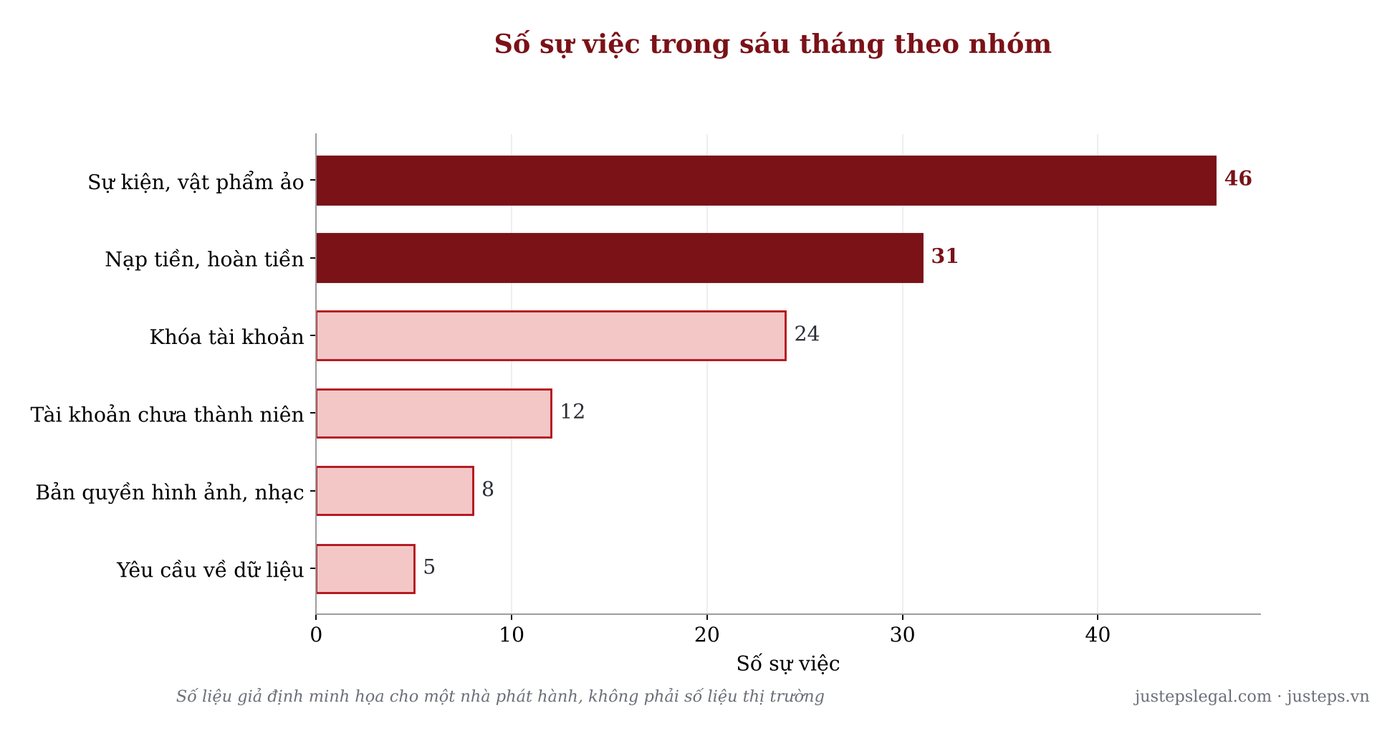
Example of the number of incidents over six months by group, used to set the order for drafting regulations
In this example, events and virtual items generate the most incidents, followed by complaints about top-ups and account bans, so these two regulations are drafted first, together with the regulations on protecting underage players because they are a licence condition. For a studio working on contract for foreign partners, the order is different, and the regulations on intellectual property and project confidentiality always come first. A typical project takes about ten weeks, and in the last two weeks Justeps and the operations team run the procedures on a trial basis on a real update and a real event, recording the sticking points and making adjustments before issue.
At the end of the project, the business receives a set of documents in a format it can edit later, together with draft issuing decisions and guidance materials for department heads to brief their staff, including the following documents:
- An update release procedure with a list of changes that must pass through the compliance division.
- Regulations on events, virtual items and virtual units, with a rules template and a list of prohibited mechanics.
- Regulations on protecting players under 18 and regulations on processing player data, with an incident response plan.
- Intellectual property management regulations with a template asset register.
- Procedures for handling complaints, account bans, refunds and ending a game.
- Flowcharts, forms and tracking logs shared by all departments.
After the first working session, the business receives a fixed-fee proposal in writing. The fee depends on the number of regulations to be drafted, the number of games and content channels in operation, how complete the existing documents are, any need for bilingual documents and whether a trial run is included. A business that wants Justeps to review the regulations periodically or to train department heads can combine this with the ongoing legal advisory service for game and digital content businesses.
How Justeps can help
Alongside building internal procedures and regulations, game and digital content businesses may combine the following Justeps services:
- Organisational structure design for game and digital content businesses. Justeps arranges the production, operations and compliance divisions and the allocation of authority before drafting regulations for each division.
- Ongoing legal advisory for game and digital content businesses. Justeps reviews event rules and publishing contracts and tracks licences every month in line with the regulations issued.
- Personal data protection and cybersecurity. Justeps prepares impact assessments and player data processing policies under the law on personal data.
- Training on building and implementing internal regulations. Justeps trains the heads of operations, player care and content review on how to apply the new regulations.
Frequently asked questions
Which updates require a procedure with the regulator?
An update that changes the name, origin, age rating, content or storyline of a G1 game compared with the licensed version, or changes its server location, requires an amendment to the release decision[1]. The internal procedure should include a list of concrete examples so that the production team can identify these cases itself.
Can a random item draw event be regarded as gambling?
The risk depends on the value of the prizes, whether they can be converted into money and how players take part. Virtual items may not be converted back into money or goods outside the game[3], so the rules must keep the prizes within the game and be reviewed before publication.
Is it mandatory to disclose item drop rates?
Justeps recommends disclosing them and keeping evidence of the actual rates, because players have the right to accurate information about the services they pay for[4]. Disclosure also helps the business explain itself when there are collective complaints.
What do the regulations on protecting players under 18 cover?
They cover account authentication, a mechanism for parents to register for children under 16, playing time limits, transaction limits, refunds for unauthorised transactions and how children’s data is processed[5].
What should the business do when a state authority requests player data?
The business verifies the authority and legal basis of the document, supplies only the scope requested and keeps a record of what was supplied[7]. The data protection officer should be the single point of contact for this type of request.
What are the risks of using artificial intelligence tools to create artwork for a game?
The risks lie in the tool’s terms on rights in the output, how closely the output resembles other people’s works and the difficulty of proving the human creative contribution. The regulations should limit the tools that may be used and require the artist’s editing steps to be recorded.
Related articles
- Controlling advertising content within a business and the approval process before publication
- Software development contracts, acceptance, warranty and ownership of source code
- Sales promotion procedures in 2026, when to notify, register and report results
- Building internal procedures and regulations for communications, advertising and event agencies
Notes
[1] Clause 1 of Article 46 of Government Decree No. 147/2024/ND-CP dated 9 November 2024 on the management, provision and use of Internet services and online information.
[2] Clauses 2 and 3 of Article 38 of Government Decree No. 147/2024/ND-CP dated 9 November 2024 on the management, provision and use of Internet services and online information.
[3] Clauses 1, 3, 4 and 5 of Article 57 of Government Decree No. 147/2024/ND-CP dated 9 November 2024 on the management, provision and use of Internet services and online information.
[4] The Law on Protection of Consumers’ Rights No. 19/2023/QH15 dated 20 June 2023.
[5] Points dd and e of Clause 1 of Article 39 of Government Decree No. 147/2024/ND-CP dated 9 November 2024 on the management, provision and use of Internet services and online information.
[6] Article 9 of the Law on Personal Data Protection No. 91/2025/QH15, effective from 1 January 2026, and the rules on processing children’s personal data.
[7] Clauses 4, 6 and 12 of Article 54 of Government Decree No. 147/2024/ND-CP dated 9 November 2024 on the management, provision and use of Internet services and online information.
[8] Clause 1 of Article 23 of the Law on Personal Data Protection No. 91/2025/QH15, effective from 1 January 2026.
[9] Clause 1 of Article 22 of the Law on Intellectual Property No. 50/2005/QH11 dated 29 November 2005, as amended and supplemented several times.
[10] Clause 3 of Article 15a of the Law on Advertising No. 16/2012/QH13 dated 21 June 2012, as amended and supplemented by Law No. 75/2025/QH15, effective from 1 January 2026.
This article is for reference and reflects the regulations in force at the time of publication. Please consult Justeps for advice tailored to your company’s records and situation.
For further information, please contact:
📩 Email: info@justeps.vn
🌐 Website: https://justepslegal.com · https://justeps.vn
🌐 Page: Justeps
☎️ Hotline (Zalo): 096 172 2607
📍 Thanh Xuan Office: 12th Floor, Licogi 13 Tower, 164 Khuat Duy Tien Street, Thanh Xuan Ward, Hanoi, Vietnam
📍 Ha Dong Office: LK06B, No.10, Dong Dua Area, Ha Dong Ward, Hanoi, Vietnam
📍 Ho Chi Minh City Branch: 528 Le Van Sy, Ho Chi Minh City, Vietnam
📍 Hai Phong Office: Truong Thinh Village, Ha Dong Commune, Hai Phong, Vietnam
📍 Quang Ninh Office: Van Don Special Zone, Quang Ninh Province, Vietnam





