
Key takeaways
- An accommodation establishment must notify the police of guest stays within the statutory time limit, even when guests arrive after midnight[3], so the check-in procedure must include a step on the night shift to reconcile the number of guests already registered.
- Property left behind by guests belongs neither to the hotel nor to the staff member who finds it[5], so the establishment needs a log, sealing, a retention period and a handover record when the item is returned or surrendered.
- Every exceptional transaction, such as a discount outside the policy, a complimentary room or a void after payment has been collected, needs an approver, a mandatory reason and an independent review the following morning.
- CCTV footage, copies of identity documents and guests’ payment details are personal data[9], so the regulations must state where cameras are placed, who may view the footage, how long it is kept and that it must not be sent through personal messaging applications.
In an accommodation establishment, every shift handover is a transfer of responsibility. Reception hands over the list of expected arrivals, deposits and special requests, housekeeping hands over room keys, lost property and rooms with faulty equipment, and the restaurant cashier hands over the cash. Without written procedures, the quality of service depends on whoever is on duty, and most of the legal risk lies in the gap between two shifts.
This page introduces Justeps’ service of building internal procedures and regulations for hotels, resorts, serviced apartments and homes with rooms let to tourists (homestays). The content follows the guest journey and each department, focusing on the steps that have legal or financial consequences. Choosing the organisational model and assigning a person to each obligation is done beforehand under the organisational structure design service for hotel, resort and homestay businesses, while this page sets out how those people work day to day.
What the regulations of an accommodation establishment cover
Written procedures help new and seasonal staff do the job correctly from their very first shift, and give the owner and the general manager a yardstick for checking compliance. Justeps divides the set of documents into five groups corresponding to the five main risk areas of an accommodation establishment. A small homestay may combine the groups into a short operations manual, but should not leave any group out.
| Group of regulations | Main content | Departments applying it |
|---|---|---|
| Front office and security | Bookings, deposits, check-in, guest registration, check-out, luggage storage and disruptive guests. | Reception, reservations and security. |
| Housekeeping and engineering | Room standards, lost property, safes, preventive maintenance, equipment inspection and fire prevention. | Housekeeping, laundry and engineering. |
| Food and beverage | Origin of ingredients, food checks, food sample retention, kitchen hygiene, sale of alcohol, banquets and events. | Kitchen, restaurant, bar and banquets. |
| Revenue and purchasing | Room rates, discount limits, complimentary stays, voids, end-of-day reconciliation, online sales channels and purchasing. | Reception, accounting, income audit and sales. |
| Data and incidents | CCTV, identity documents, guest and staff data, health incidents, accidents and complaints. | The whole establishment, coordinated by the general manager. |
Bookings, deposits and check-in
Conditions on deposits, cancellations and no-shows need to be consistent across the establishment’s website, online sales channels and contracts with travel companies, otherwise reception will have to handle the same situation in three different ways. The procedure states who may confirm group bookings, who may refund deposits and within what time, how deposits are recorded in the books and when invoices are issued under the decree on electronic invoices currently in force[1].
At check-in, reception checks guests’ identity documents under the regulations on security and order, under which a guest without documents may still be given a room but the establishment must immediately report to the nearest police office[2]. The establishment notifies guest stays before 23:00 on the day of arrival, and for guests arriving after 23:00 before 08:00 the following morning[3], while foreign guests must have their temporary residence declared under the law on entry, exit and residence of foreigners[4]. A common mistake is to register only the person who made the booking and to leave out those travelling with them, so Justeps adds a step to the procedure in which the night auditor compares the number of guests in each room with the number already notified.
Many establishments keep the original passport or identity card of the guest throughout the stay as a safeguard against guests leaving without paying. Justeps proposes only checking the document, recording the necessary information and returning it, and using a deposit or a pre-authorisation on a payment card to secure payment, because holding documents both inconveniences guests and creates a duty of safekeeping.
Lost property, safes and deposited valuables
Under the Civil Code, a person who finds property dropped or left behind by another person and knows the owner’s address must notify or return it, and if the address is unknown must surrender it to or notify the nearest commune-level People’s Committee or police[5]. For a hotel, this means that property guests leave behind belongs neither to the establishment nor to the housekeeping staff member who finds it. The procedure Justeps drafts includes a lost property log by room number and time of discovery, sealing of valuable items in front of two witnesses, contacting the guest through the booking details, a retention period and a record when the item is returned to the guest or surrendered to the competent authority.
In-room safes and the luggage and valuables service at the front desk need separate rules on how to open a safe when a guest forgets the code, who may hold the master code or override card and the record to be made when a safe has to be opened in the guest’s absence. These situations rarely arise, but when they do they often lead to disputes, because the guest and the staff give different accounts and the establishment has no document to check against.
Controlling discounts, complimentary stays and voids
The largest risk of leakage at an accommodation establishment usually lies not in cash but in exceptional transactions, such as discounts beyond the policy, complimentary stays, upgrades to a higher room category without charging the difference or voids after the guest has paid. The revenue control regulation sets discount limits for each level from receptionist, shift leader and front office manager up to general manager, requires a reason to be entered in the software for each exception and assigns the night auditor and the income audit team to review all of them the following morning. Invoices already issued that must be cancelled, adjusted or replaced are handled under the decree on electronic invoices[1], with a written agreement with the guest where the law requires one.
The chart below illustrates the results of a review by Justeps of exceptional transactions over 30 days at a city hotel with about 120 rooms before the regulations were issued.
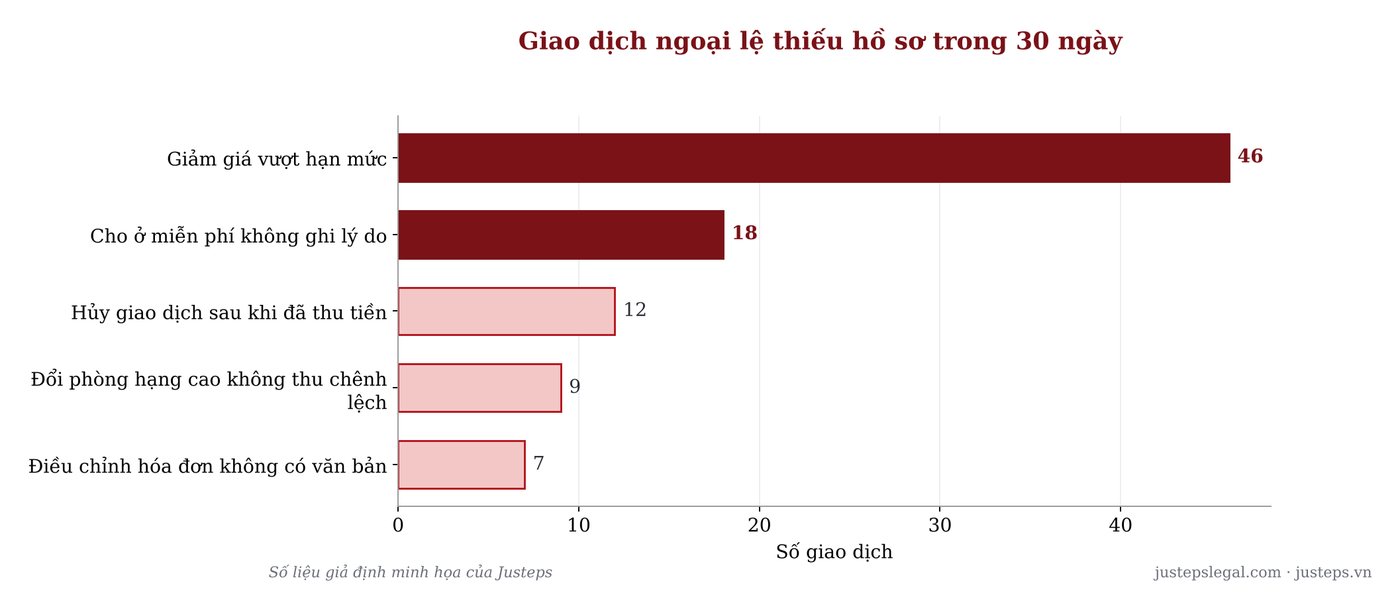
Example of exceptional transactions without adequate records found over 30 days at a 120-room hotel
In this example, the largest group is 46 discounts exceeding the limit of the person who granted them, followed by 18 complimentary stays with no reason recorded and 12 transactions voided after payment had been collected. There were also 9 upgrades to a higher room category without charging the difference and 7 invoices adjusted without a written agreement with the guest. The first two groups arose mainly because the hotel had no written limits, so Justeps gave priority to issuing the table of limits before the other procedures. Businesses wishing to build broader controls over purchasing and expenses may combine this work with the financial internal control system service.
Food and beverage, engineering and fire prevention
Hotel kitchens often have very detailed recipes but lack records on the origin of ingredients, food check logs and retained food samples for weddings, conferences or group meals. These are the records the health authorities request during an inspection or when food poisoning is suspected under the law on food safety[6], and they are also the only evidence the establishment has that it acted correctly. A bar serving alcoholic drinks needs additional rules on not serving minors and on dealing with intoxicated guests.
The engineering department needs a preventive maintenance schedule and a list of equipment subject to strict occupational safety requirements, such as lifts, boilers and pressure vessels, together with the inspection due date of each item[7]. The fire prevention and fire fighting regulation sets the schedule for checking equipment, evacuation drills, duties when a fire alarm sounds at night and how guests on each floor are guided[8]. Resorts add procedures for swimming pools, beaches, outdoor activities and natural disaster response.
CCTV, identity documents and guest data
Copies of identity documents stored on reception computers, passport photos sent through staff messaging groups and CCTV clips extracted at the request of acquaintances are situations Justeps encounters regularly. All of these are processing of personal data under the Law on Personal Data Protection and its guiding decree[9], so the establishment needs to notify guests of the processing, limit who has access, set retention periods and define how data is deleted. Cameras are placed only in public areas such as the lobby, corridors, emergency exits and car parks, with notice signs, and never in bedrooms, bathrooms or changing rooms.
Justeps drafts the personal data protection policy for guests and staff, the data processing notice displayed at the front desk and on the booking page, and a rule that CCTV footage is extracted only at the request of a competent authority or by decision of the general manager. Establishments with large guest volumes or sharing data with a management company abroad can go further through the personal data protection compliance service.
Serious incidents involving guests
A guest injured at the pool, food poisoning after a banquet or a death in a room are rare incidents with serious consequences, and the response in the first hour often determines the extent of the damage. The procedure Justeps drafts puts saving life ahead of everything else, followed by preserving the scene and the CCTV data for the authorities, and assigns a single contact to communicate with the guest’s family, the insurer and the press.
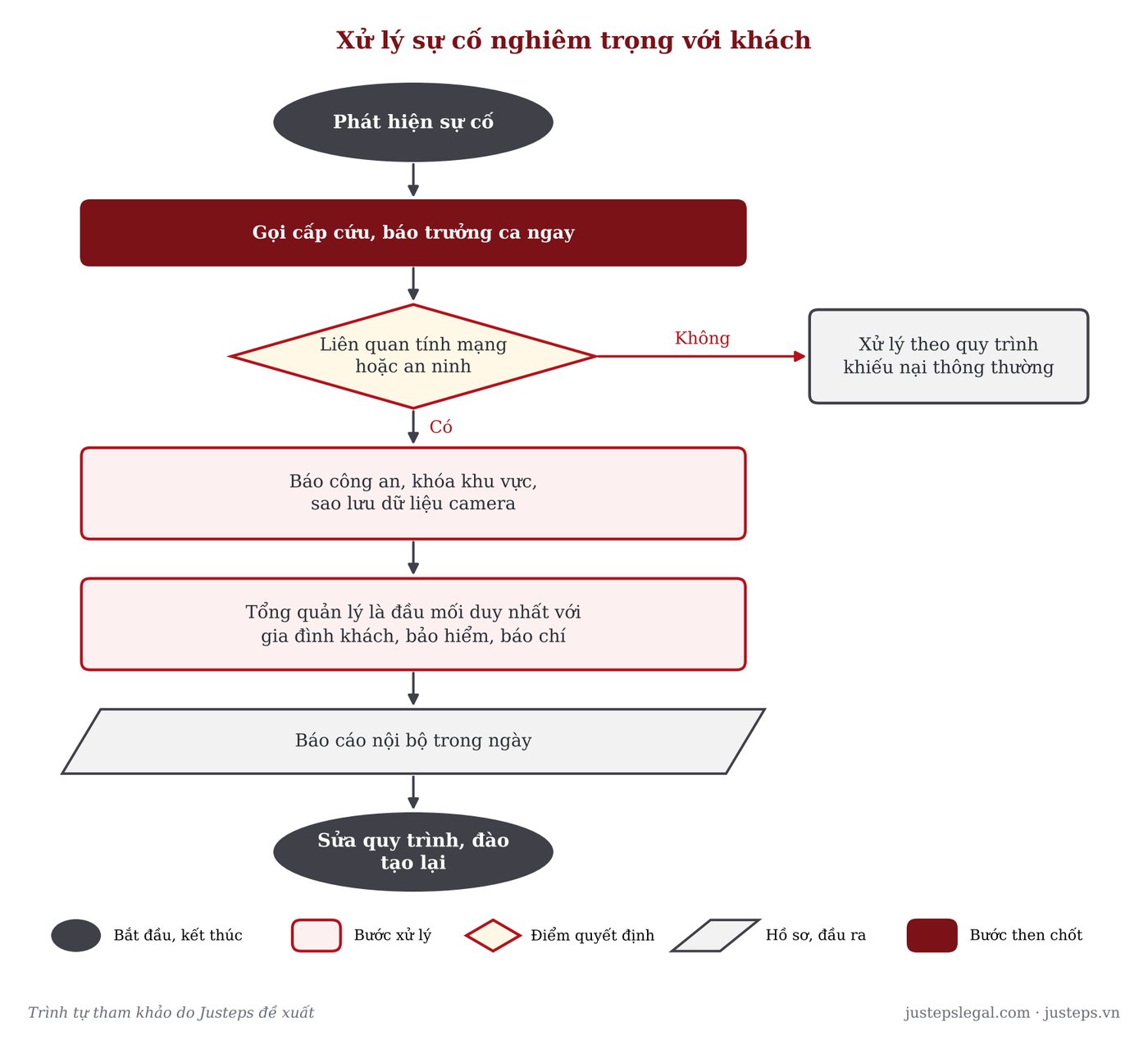
Sequence for handling a serious incident involving a guest at an accommodation establishment
Under this sequence, the person who discovers the incident immediately calls the emergency services and informs the shift leader, who reports to the police where the incident appears to involve loss of life or security, while sealing off the area and backing up the CCTV data. The general manager is the sole contact with the guest’s family, the insurer and the press, so that staff members do not each give a different account. An internal report is prepared on the same day, and the lessons learned are used to revise procedures and retrain staff.
Timeline, deliverables and fees
A project to build procedures and regulations for an accommodation establishment usually takes about ten weeks, following the milestones in the timeline below.
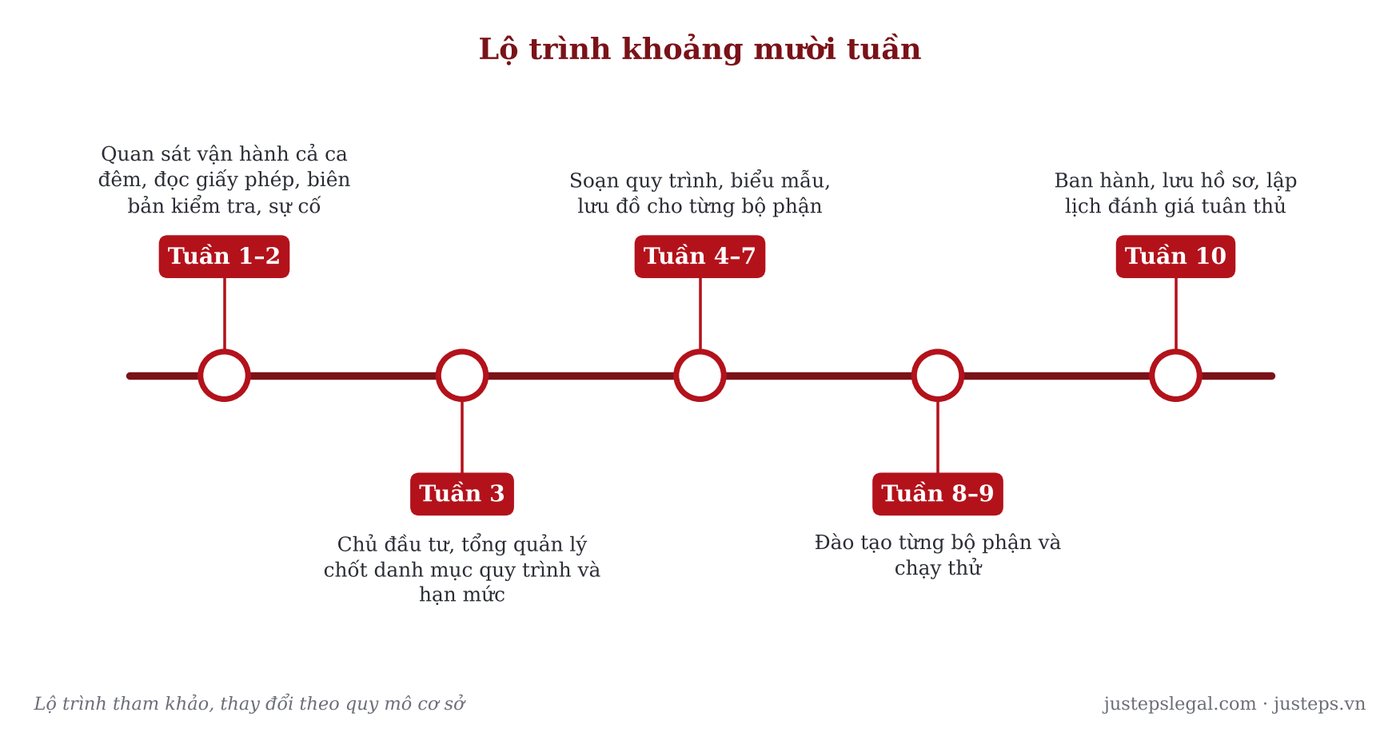
Main milestones of a project to build procedures and regulations for an accommodation establishment
In the first two weeks Justeps observes actual operations, including the night shift, and reads the licences, the most recent inspection records and past incidents and complaints. In the third week the owner and the general manager agree the list of procedures and the business limits, after which Justeps drafts the documents in plain language for front-line staff, trains each department separately and runs a trial before the documents are issued. The deliverables include the following documents:
- An operations procedure manual for each department, with flowcharts, used to train new and seasonal staff.
- A revenue and purchasing control regulation for accounting and income audit, with a table of discount limits.
- Food safety, fire prevention and equipment inspection records organised in advance for presentation to inspection teams.
- Procedures for handling incidents, complaints and lost property, with template logs and records.
- A personal data protection policy, a notice to guests and a draft decision issuing the set of regulations.
Justeps quotes the project fee as a fixed fee in writing after the initial meeting, depending on the number of departments and procedures, the number of establishments, whether there are restaurants, a spa, pools or banqueting services, the need for bilingual documents, linking procedures to the property management system and whether the business needs periodic training or compliance reviews after the regulations are issued. Once the regulations are in operation, day-to-day situations can be followed up through the Ongoing legal advisory service for hotel, resort and homestay businesses.
How Justeps can help
Alongside internal procedures and regulations, hotel, resort and homestay businesses may combine the following Justeps services:
- Organisational structure design for hotel, resort and homestay businesses. Justeps assigns each obligation on guest registration, security, fire prevention and food safety to a specific position before the procedures are written.
- Ongoing legal advisory for hotel, resort and homestay businesses. Justeps follows the situations that arise after the regulations are issued and updates them when the law changes.
- Personal data protection compliance. Justeps prepares the records for processing guest data, CCTV footage and staff data under the Law on Personal Data Protection.
- Financial internal control system. Justeps extends controls from room revenue to purchasing, stores and expenses of the accommodation establishment.
Frequently asked questions
Does a small homestay need written procedures?
Yes, but in the form of a short manual. The caretaker needs to know how to receive guests, notify guest stays and handle incidents when the owner is away, because the duty to notify guest stays still rests with the establishment[3].
May a hotel keep a guest’s passport or identity card?
Staff should check the document, record the necessary information and return it. Keeping the original throughout the stay should be considered carefully, done only with the guest’s consent, and must comply with the rules on personal data protection[9].
How long must lost property be kept?
The internal retention period is set by the establishment, but valuable items whose owner cannot be contacted must be handled under the Civil Code, namely surrendered to or notified to the competent authority at commune level[5]. Every step needs a log entry and a record.
Who may grant room discounts?
The regulation should set limits for each level from receptionist, shift leader and front office manager up to general manager. Every discount must have a reason entered in the software and be reviewed the following morning.
Is a hotel required to retain food samples?
It depends on the type of catering and the guidance of the health sector, particularly for large banquets, conferences and group meals. Justeps determines when samples must be retained and builds this into the kitchen procedure.
May cameras be installed in guest-floor corridors?
Yes, because corridors are public areas, but guests must be notified, and access and retention periods must be limited. Cameras must not be installed in bedrooms, bathrooms or changing rooms.
Do internal regulations replace brand standards?
No. Brand standards mainly concern service quality, while internal regulations add the legal obligations that apply in Vietnam. Justeps compares the two systems to remove conflicts and fill gaps.
Related articles
- Organisational structure design for hotel, resort and homestay businesses by operating model and room count
- Ongoing legal advisory for hotel, resort and homestay businesses in day-to-day operations
- Labour, wages and social insurance services for hotel, resort and homestay businesses with shift work and service charges
- Building a customer complaint handling procedure that complies with the law, sets clear authority and leaves an audit trail
Notes
[1] Government Decree No. 254/2026/ND-CP dated 30 June 2026 on electronic invoices and electronic documents, effective from 1 July 2026.
[2] Clause 2 of Article 44 of Government Decree No. 96/2016/ND-CP dated 1 July 2016 on security and order conditions for certain conditional business lines, as amended by Decree No. 392/2026/ND-CP dated 20 October 2026.
[3] Article 30 of the Law on Residence No. 68/2020/QH14, as amended and supplemented by Law No. 118/2025/QH15, effective from 1 July 2026.
[4] The Law on Entry, Exit, Transit and Residence of Foreigners in Vietnam No. 47/2014/QH13 and the laws amending and supplementing it.
[5] Article 230 of the Civil Code No. 91/2015/QH13 dated 24 November 2015.
[6] The Law on Food Safety No. 55/2010/QH12.
[7] The Law on Occupational Safety and Health No. 84/2015/QH13 dated 25 June 2015 and the amending law passed by the National Assembly on 21 November 2026.
[8] The Law on Fire Prevention, Fire Fighting, Rescue and Salvage No. 55/2024/QH15, effective from 1 July 2025, as amended and supplemented by the law passed by the National Assembly on 20 November 2026.
[9] The Law on Personal Data Protection No. 91/2025/QH15, effective from 1 January 2026, and Decree No. 356/2025/ND-CP detailing this Law.
This article is for reference and reflects the regulations in force at the time of publication. Please consult Justeps for advice tailored to your company’s records and situation.
For further information, please contact:
📩 Email: info@justeps.vn
🌐 Website: https://justepslegal.com · https://justeps.vn
🌐 Page: Justeps
☎️ Hotline (Zalo): 096 172 2607
📍 Thanh Xuan Office: 12th Floor, Licogi 13 Tower, 164 Khuat Duy Tien Street, Thanh Xuan Ward, Hanoi, Vietnam
📍 Ha Dong Office: LK06B, No.10, Dong Dua Area, Ha Dong Ward, Hanoi, Vietnam
📍 Ho Chi Minh City Branch: 528 Le Van Sy, Ho Chi Minh City, Vietnam
📍 Hai Phong Office: Truong Thinh Village, Ha Dong Commune, Hai Phong, Vietnam
📍 Quang Ninh Office: Van Don Special Zone, Quang Ninh Province, Vietnam





