
Key takeaways
- An influencer’s obligations to verify the brand, check product documents and announce that the content is advertising can only be proven through records, so the procedures must generate records at each step[1].
- For goods whose advertising content must be certified, the script and what is said during a live-stream session must stay within the scope of the certified content[4].
- Prize games and lucky draws in live-stream sessions are often sales promotions involving an element of chance and need to be checked for procedural requirements before they are announced[5].
- Internal regulations do not of themselves bind creators who are not employees, so the revenue-sharing formula and compliance obligations must be included in a signed contract or appendix.
In many KOL, KOC and multi-channel network businesses, almost everything happens in chat groups. Brand requests, draft scripts, discount codes and reminders to correct wording are passed back and forth within minutes, and then the video is published or the live-stream session begins. This way of working is fast while the business is small, but when a piece of content is reported, ordered to be taken down or a brand refuses to pay, the business cannot prove who checked what and when.
This page introduces Justeps’ service for building internal procedures and regulations for businesses managing content creators, companies built around a single KOL and businesses that combine content creation with selling through live-stream sessions. It sets out the documents a business needs, how each key procedure is designed, the mistakes commonly made when businesses draft their own documents, the implementation roadmap and the deliverables. The arrangement of functional divisions and labour and payroll relationships are presented on other service pages for the same sector.
The set of internal documents a business needs
Justeps does not start from a ready-made set of templates but from the operations the business repeats every day, because legal risk in this sector usually lies in forgetting to apply an advertising label, reading out the wrong price during a session or using a piece of music without the rights to it. For a business managing several dozen creators, the set of documents usually comprises the following procedures and regulations:
- A procedure for vetting brands and products before accepting an advertising contract, together with a list of documents to be collected for each product group.
- A procedure for approving scripts and rules on how advertising labels are applied to short videos, posts and live-stream sessions.
- A procedure for running live-stream selling sessions, covering checks before the session, handling incidents during the session and keeping the recording afterwards.
- Regulations on sales promotions and prize games on the channels of the business and of creators.
- Regulations on revenue sharing and reconciliation with brands, platforms and creators.
- Regulations on managing channels, administrator rights, follower data and buyer data.
- A procedure for handling takedown requests, copyright complaints and media crises, together with a code of conduct for creators.
Vetting brands and products before accepting a contract
The Law on Advertising as amended in 2025 requires influencers to verify the reliability of the advertiser, check the documents relating to the product and not introduce products they have not used or do not fully understand[1]. The vetting procedure turns these obligations into specific tasks, namely looking up the brand’s registration information, collecting product documents, recording that the creator has tried the product and reaching a conclusion to accept or refuse. When selling through live-stream sessions, the seller must also provide documents proving that the business conditions and the quality requirements for the goods are met before the session[2], so the business’s list of documents should cover both requirements.
The depth of vetting should vary by product group, because the same sentence of introduction may be harmless for clothing but a serious breach for health supplements. The table below shows how Justeps usually groups products when drafting the vetting list; the detailed list for each group is updated in line with the sector-specific legislation in force.
| Product group | Documents to collect before accepting | Level of script control |
|---|---|---|
| Ordinary consumer goods | The brand’s registration information and documents on the origin and quality of the product. | The editor approves on their own using the list of wording to avoid. |
| Cosmetics | The product notification documents and documents supporting the effects the brand wishes to claim. | The control division approves and does not allow claims that present the product as a medicine. |
| Health supplements, medical devices | The notification or registration file and the certification of advertising content where the law requires it. | The script must stay within the content that has been certified. |
| Finance, investment, education | Any licence or approval from the sector regulator. | The control division approves each sentence on benefits, returns and commitments. |
| Goods banned from advertising | Not accepted, and stated clearly in the business’s refusal list. | Not applicable. |
Approving scripts and applying advertising labels
The script approval procedure sets out who may approve, the grounds for refusal, the deadline for a response and how the approved version is kept. Influencers must announce that they are advertising immediately before and during the advertisement[1], and online advertising must carry a sign that allows viewers to distinguish it from ordinary content[3]. Justeps specifies how the label is shown in each format, for example text on screen for the full length of a short video, the first line of a post, and a spoken statement accompanied by a fixed icon during a live-stream session, so that editors do not have to interpret the rules themselves.
An approved script needs to be version-locked, because brands often send change requests close to the time of publication. Any change after approval must go back to the control division, even when it only adds one sentence about price or an offer. The procedure should also include a list of wording to avoid for each product group together with safe alternative wording, so that creators keep their own voice without going beyond what the law permits.
Running live-stream selling sessions
The live-stream session is where mistakes happen fastest, because the host must read out prices, discount codes, product effects and return conditions while answering comments. The live-streamer must not give false or misleading information about effects, origin, quality, price or promotions, and must use the certified content where the law requires it[4]. Justeps drafts a pre-session checklist covering the price listed on the platform, active discount codes, product documents, the advertising label and the person on duty to handle incidents.
During the session, the procedure allows the person on duty to stop the presentation of a product when a wrong price or wrong information is detected, and it sets out a standard correction statement. After the session, the recording is kept for at least as long as the longest return and warranty period of the goods sold, plus a buffer period for complaints. This recording is the most important evidence when a buyer claims to have been misled, or when a brand claims that the creator did not say what had been agreed.
Sales promotions and prize games
Many businesses regard lucky draws, prize draws or gifts for the fastest commenter as ordinary engagement activities. When linked to the purchase or introduction of goods, these activities may be sales promotions involving an element of chance, which must be notified to or registered with the trade authority before they are carried out under the regulations on sales promotion[5]. The value of the prize may also give rise to an obligation to withhold personal income tax for the winner.
Justeps’ sales promotion regulations distinguish programmes organised by the brand, programmes organised by the business and programmes that creators run themselves on their personal channels, because in these three cases a different party is responsible for completing the procedures. The rules of each programme must be reviewed by the control division before they are announced, and the results must be kept together with evidence of how the winners were determined. The business should also review its regulations whenever the rules on sales promotion change, most recently with the 2026 amendments on the file and the method of notification and registration.
Revenue sharing and reconciliation with creators
Most disputes between a business and its creators stem from different understandings of the revenue to be shared. Good regulations clearly define gross revenue and the deductible items, such as platform fees, refunds to buyers, production costs advanced by the business and tax withheld, before turning to the sharing ratio. The regulations also set the reconciliation period, the deadline for creators to confirm the figures, how foreign currency revenue not yet received in the account is treated and how adjustments are made when a platform claws back an amount already paid.
Because internal regulations do not of themselves bind people who have no employment relationship with the business, Justeps places the sharing formula in an appendix to the creator contract, while the regulations only guide the finance department on how to calculate and prepare the reconciliation record. The result of each period is confirmed by a record signed or electronically confirmed by the creator before payment is made.
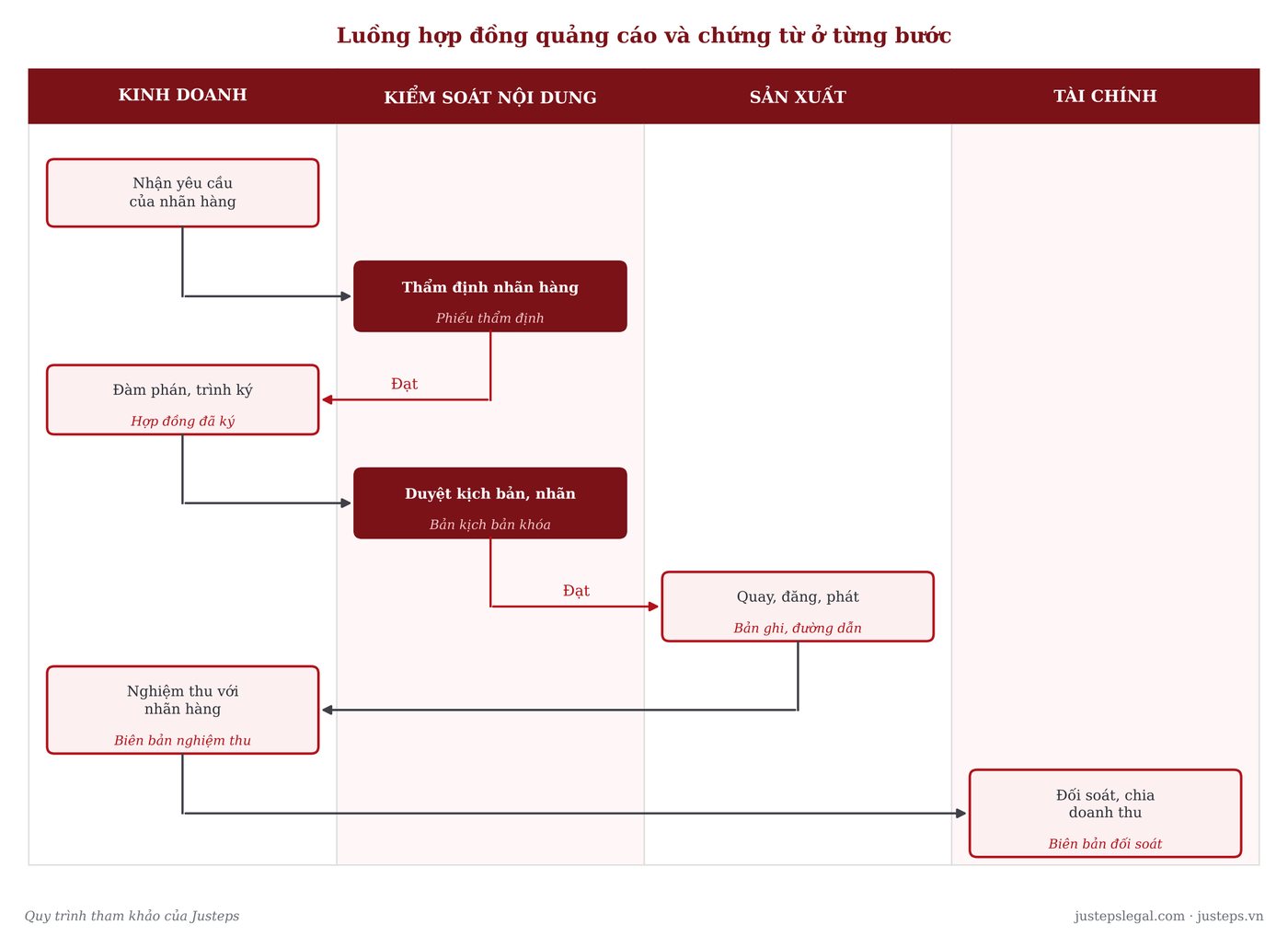
The flow of an advertising contract through four departments
In this flow, sales only submit a contract for signature once the control division has concluded that the vetting requirements are met, production only films and publishes the approved script, and finance only shares revenue once there is an acceptance record with the brand. Each step leaves a specific document, so when an explanation is required the business can present the full chain of records from receipt of the request to payment to the creator.
Managing channels and data and handling takedown requests
The telephone numbers and addresses of buyers in live-stream sessions and the lists of participants in prize games are personal data. The consent of the data subject must be voluntary and specific to each purpose, and silence is not regarded as consent[6], while the business must also inform consumers when it collects and uses their information[7]. The data management regulations specify which data are collected, where they are stored, who may view them, for what purposes they are used and when they are deleted, together with rules on granting and withdrawing channel administrator rights when an employee changes role.
On receiving a document from a competent authority requiring infringing advertising to be removed, the parties in the advertising chain, including the person conveying the advertising product, must comply within 24 hours[8]. The handling procedure therefore needs a person on duty, the power to remove content temporarily without waiting for the director, and template response documents. For copyright complaints or media crises, the procedure specifies who may speak publicly, which content must be reviewed before it is posted and when expert advice must be sought; the creators’ code of conduct is drafted consistently with the Code of Conduct on Social Networks[9].
Common mistakes when businesses draft their own documents
The most common mistake is that the approver has no power to stop anything, because the procedure says that scripts must be approved but not what happens when the approver disagrees. Justeps always states clearly that content which has not been approved may not be published or broadcast, and that anyone who deliberately bypasses the approval step will be dealt with under the contract or the internal labour rules. The second mistake is copying the procedures of a brand or another business, which produces long documents that do not match how work is actually done, so staff continue to follow their old habits.
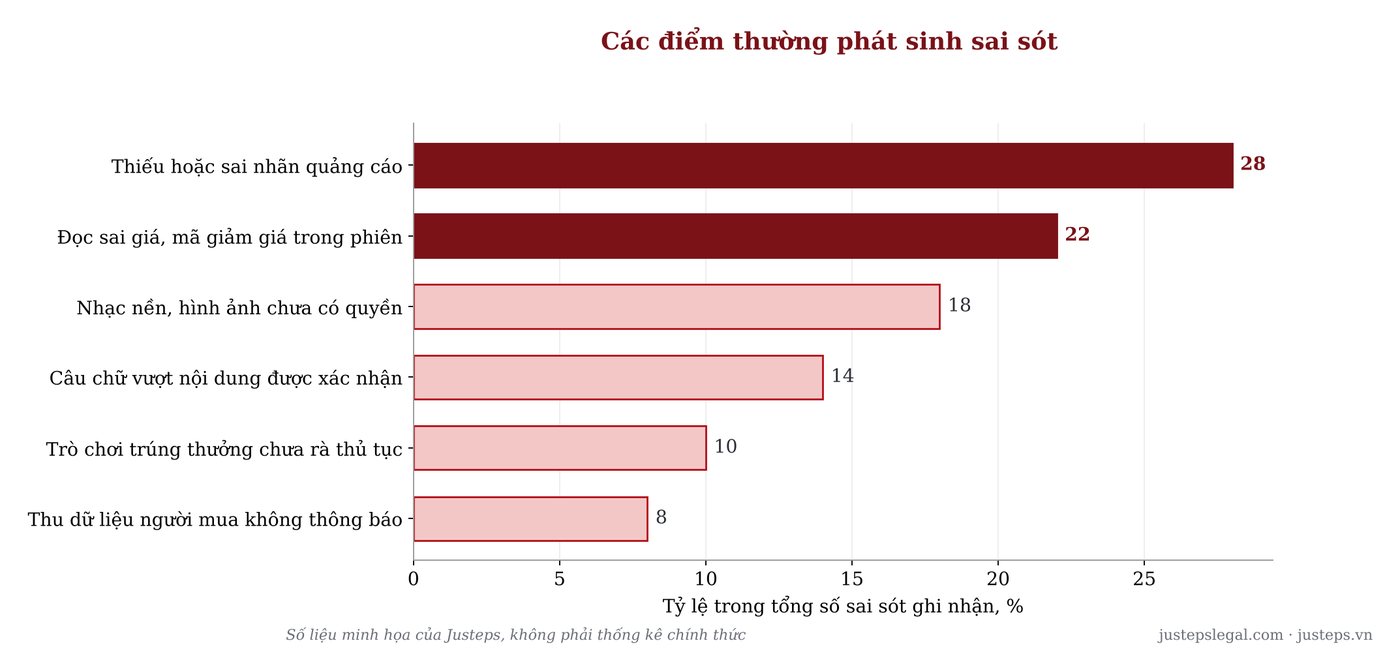
Example of the points at which mistakes commonly arise during one month of operation
The chart above is compiled from illustrative reviews and shows that most mistakes lie in operations repeated every day, such as applying advertising labels, reading out prices and discount codes and using background music, rather than in major decisions. For this reason, in addition to the full regulations, Justeps turns these requirements into a short one-page checklist that editors and session operators can use during their shift.
Implementation roadmap, deliverables and fees
A project to build a set of procedures and regulations usually takes about ten weeks. In the first two weeks, Justeps consultants review advertising contracts, creator contracts, a number of message threads and recent session recordings to find the gaps in control. In week three, Justeps and the management team finalise the list of documents, the person responsible for each procedure and the list of product categories the business will not accept; the documents are then drafted in stages, trialled on real contracts and sessions, and the project ends with a dedicated training session for creators.
When the project ends, the business receives the set of documents in editable electronic form, together with guidance on application for each department, comprising the following main documents:
- A complete set of internal procedures and regulations together with a draft decision on their issuance.
- A brand vetting list by product group and a pre-session checklist for live-stream sessions.
- A template revenue reconciliation record and a contract appendix setting out the sharing formula.
- A code of conduct and a template compliance undertaking for creators.
- Short training materials for editors, session operators and creators.
If the business has not yet clearly determined which division is responsible for approving content, it should first or in parallel use the organisational structure design service for KOL, KOC and multi-channel network businesses. Justeps quotes a fixed fee in writing after the initial meeting, depending on the number of regulations to be built, the number of product groups for which advertising is accepted, whether the business sells through live-stream sessions, the number of creators to be trained and any need for support during the trial period.
How Justeps can help
Alongside building internal procedures and regulations, KOL, KOC and multi-channel network businesses may combine the following Justeps services:
- Organisational structure design for KOL, KOC and multi-channel network (MCN) businesses. Justeps arranges the functional divisions and allocates authority so that each procedure has the right person responsible for it.
- Ongoing legal advisory for KOL, KOC and multi-channel network (MCN) businesses. Justeps reviews scripts, promotion rules and contracts at the pace of daily work once the procedures have been issued.
- Personal data protection compliance advisory. Justeps prepares the processing records for buyer, follower and creator data under the Law on Personal Data Protection.
- Advertising, sales promotion and consumer protection. Justeps checks promotion procedures, advertising content and return policies for selling programmes run through creators’ channels.
Frequently asked questions
Do creators who are not employees have to follow the business’s regulations?
Internal regulations do not automatically bind people who have no employment relationship with the business. The main obligations, such as script approval, advertising labels, confidentiality and the revenue-sharing formula, need to be included in the creator contract or a signed undertaking appendix.
What counts as an adequate advertising label?
Viewers must be able to recognise that the content is advertising, the label must be placed where it is easy to see and the influencer must announce the advertising immediately before and during it[1]. Justeps’ regulations specify how this is shown for each format so that editors do not have to decide for themselves.
Does a lucky draw game in a live-stream session require any procedure?
If the programme is linked to buying, selling or introducing goods and winning depends on chance, it is usually a sales promotion involving an element of chance and must be notified or registered before it is announced[5]. The control division should review the rules before the programme is mentioned on air.
How long should live-stream session recordings be kept?
Justeps recommends keeping them for at least as long as the longest return and warranty period of the goods sold during the session, plus a buffer period for complaints and disputes. The specific period is set out in the regulations for each product group.
Do these regulations need to be registered with a state authority?
Operating procedures and regulations do not need to be registered. Only the internal labour rules must be registered when the business employs 10 or more employees, and this falls under Justeps’ labour and payroll service.
How often should the set of regulations be updated?
The business should assign someone to follow changes in the law and in platform policies, review the whole set at least once a year and update it immediately when it accepts a new product group or starts selling goods itself.
Related articles
- Controlling advertising content within a business and the approval process before publication
- Sales promotion procedures in 2026, when to notify, register and report results
- Selling on e-commerce marketplaces in Vietnam and the rules on invoices, tax, returns and complaints
- The minimum set of internal governance rules for businesses with 50 to 200 employees
Notes
[1] Clause 3 of Article 15a of the Law on Advertising No. 16/2012/QH13 dated 21 June 2012, as amended and supplemented by Law No. 75/2025/QH15, effective from 1 January 2026.
[2] Clause 1 of Article 23 of the Law on E-commerce No. 122/2025/QH15.
[3] Article 23 of the Law on Advertising No. 16/2012/QH13 dated 21 June 2012, as amended and supplemented by Law No. 75/2025/QH15.
[4] Article 24 of the Law on E-commerce No. 122/2025/QH15 dated 10 December 2025, effective from 1 July 2026.
[5] Government Decree No. 81/2018/ND-CP dated 22 May 2018 detailing the Commercial Law on trade promotion activities, as amended and supplemented by Decree No. 239/2026/ND-CP.
[6] Article 9 of the Law on Personal Data Protection No. 91/2025/QH15, effective from 1 January 2026.
[7] Article 17 of the Law on Protection of Consumer Rights No. 19/2023/QH15 dated 20 June 2023.
[8] Clause 2 of Article 18 of Government Decree No. 342/2025/ND-CP dated 26 December 2025 detailing a number of articles of the Law on Advertising.
[9] Decision No. 874/QD-BTTTT dated 17 June 2021 of the Minister of Information and Communications promulgating the Code of Conduct on Social Networks.
This article is for reference and reflects the regulations in force at the time of publication. Please consult Justeps for advice tailored to your company’s records and situation.
For further information, please contact:
📩 Email: info@justeps.vn
🌐 Website: https://justepslegal.com · https://justeps.vn
🌐 Page: Justeps
☎️ Hotline (Zalo): 096 172 2607
📍 Thanh Xuan Office: 12th Floor, Licogi 13 Tower, 164 Khuat Duy Tien Street, Thanh Xuan Ward, Hanoi, Vietnam
📍 Ha Dong Office: LK06B, No.10, Dong Dua Area, Ha Dong Ward, Hanoi, Vietnam
📍 Ho Chi Minh City Branch: 528 Le Van Sy, Ho Chi Minh City, Vietnam
📍 Hai Phong Office: Truong Thinh Village, Ha Dong Commune, Hai Phong, Vietnam
📍 Quang Ninh Office: Van Don Special Zone, Quang Ninh Province, Vietnam





