
Key takeaways
- The template contract with customers is a standard-form contract, so unclear cancellation and change terms will be interpreted against the business[2], and the cancellation fee schedule should be divided by time thresholds linked to suppliers’ non-refundable costs.
- Payments of VND 5 million or more must be supported by non-cash payment documents to be deductible for corporate income tax[5], so the advance regulation for tour guides must state clearly which items may be paid in cash and how purchasing on the business’s behalf is authorised.
- The settlement deadline for an advance should be a condition for receiving the next advance, which is the simplest way to reduce outstanding advances after the peak season.
- Copies of customers’ passports, identity cards and health information are personal data that must be processed in accordance with the rules on personal data protection[8], so the procedure needs to state who may see them, through which channel they are sent and when they are deleted.
A trip sold by a travel business is a chain of services from many parties such as airlines, hotels, transport operators, restaurants and attractions, but the party that signs the contract and is answerable to the customer is the travel business alone. In a business without regulations, each tour operator works from personal experience, tour guides take cash advances and settle them when they have time, and the group’s passport list is sent through a chat group to every supplier. The consequences of these habits only become visible when a customer complains about cancellation fees, when the tax authority disallows costs without proper documents or when a group meets an incident and nobody knows whom to report to.
This page introduces Justeps’ service of building internal procedures and regulations for domestic travel businesses, businesses receiving international visitors and businesses taking travellers abroad, written around each stage of a trip. The structure that carries out these procedures, including who approves and who is responsible, is designed under the organisational structure design service for travel and tour businesses, while this page focuses on the content of each document and how to bring them into day-to-day operations.
The set of regulations a travel business usually needs
Not every business needs every document from the start. The table below lists the six groups of documents Justeps usually builds for travel businesses and the core content of each group.
| Document | Core content |
|---|---|
| Template contract with customers | Booking and payment conditions, a schedule of cancellation and change fees by time threshold and handling of force majeure events. |
| Tour operations procedure | The steps from confirming the group, booking services and preparing the group file to handing over to the tour guide and monitoring on tour. |
| Tour guide regulation | Assignment letter, group programme, group log, code of conduct, shopping stops and post-trip report. |
| Advance and settlement regulation | Advance limits by budget, items that may be paid in cash, documents to collect and the settlement deadline. |
| Incident and complaint procedure | Classification of incident severity, who is notified, emergency spending limits and how complaints are recorded and answered. |
| Customer data procedure | Types of data collected, legal basis for processing, who has access, channels for sending to suppliers and deletion periods. |
A small domestic travel business should give priority to the template contract, the advance and settlement regulation and the incident procedure, because these three documents resolve most everyday problems. A business receiving international visitors also needs a procedure for working with sending partners abroad, while a business taking travellers abroad needs procedures for visa files, group management and buying insurance for customers. A business that sells mainly through its website or an application also needs rules on displaying prices, confirming bookings and refunding online.
Procedures attached to each stage of the trip
Justeps does not write regulations department by department but according to the life cycle of a trip, so that each person knows what to do at the stage they are responsible for, which form to use and whom to pass it to. The timeline below shows six stages and the main control document at each stage.
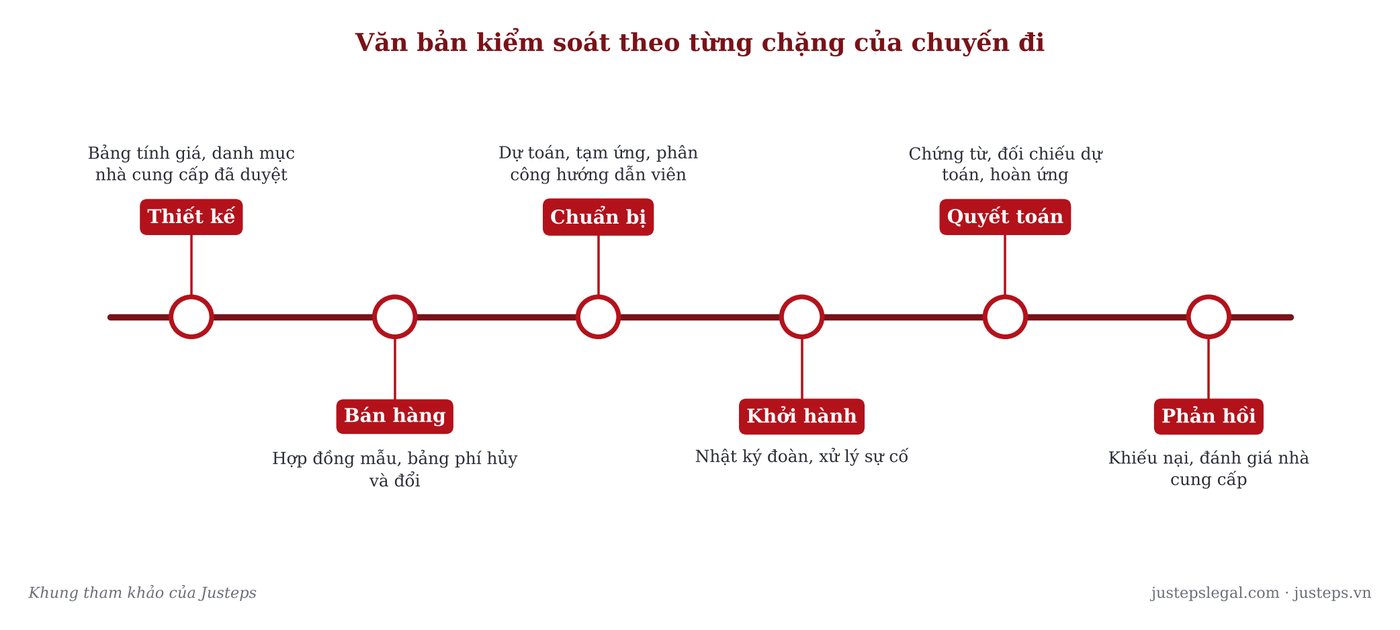
Six stages of a trip and the main control document at each stage
The product design stage is linked to the costing sheet and the list of approved suppliers, and the sales stage is linked to the template contract and cancellation conditions. The group preparation stage is linked to the budget, the advance request and the tour guide assignment letter, while the departure stage is linked to the group log and the incident procedure. The last two stages are post-trip settlement and receiving customer feedback, where the business compares actual costs with the budget and draws lessons for the next product. Each procedure has a flowchart, a responsible person, deadlines and accompanying forms so that it can be used for training new staff.
Template contracts with customers and cancellation and change terms
The Law on Tourism requires travel contracts to be made in writing and to contain main contents such as the programme, the price, payment conditions and conditions for cancellation and change[1]. Because the business prepares the contract in advance and the customer can only accept it or not, it is a standard-form contract, in which unclear terms are interpreted against the party that drafted the form, and terms that exempt the business from liability or remove the customer’s legitimate interests are invalid unless otherwise agreed[2]. The business must also provide truthful and complete information about the services to customers who are consumers under the law on protection of consumer rights[3].
The most common mistake is to use a general statement that a customer who cancels the tour loses the entire deposit, without distinguishing between cancellation 45 days or 3 days before departure and without linking it to the supplier costs that cannot be refunded, such as airline tickets already issued. Justeps builds a cancellation fee schedule by time threshold for each product line, with separate rules for changing customer names, changing the departure date and cases where the business must cancel because the minimum number of customers has not been reached. For customers who book on the website, contracts concluded by electronic means are legally valid[4], so the procedure must keep a record of the conditions the customer accepted at the time of booking.
Advances, settlement and payments to suppliers
Advances are where travel businesses lose the most control during the peak season. Tour guides receive advances for several consecutive groups, unsettled amounts from the previous group are covered by the advance for the next one, and by the end of the year the accountant cannot tell which amount was spent on which group. Justeps’ regulation requires each advance to be tied to one group, one approved budget and one settlement deadline, and provides that a person with an overdue advance may not receive a new one.
Documentation is the second issue. Each payment of VND 5 million or more must be supported by non-cash payment documents to be counted as a deductible expense for corporate income tax, including where an employee is authorised to make purchases and the business then reimburses the employee, provided there is a regulation or an authorisation decision[5]. For goods and services purchased at VND 5 million or more, non-cash payment documents are also a condition for deducting input value added tax[6]. The regulation therefore needs to list which items tour guides may pay in cash, which must be transferred from the business’s account, and a template authorisation decision for the person buying on tour.
The chart below illustrates the results at a travel business after one season of applying the new advance regulation, measured by the average number of days from the end of the group trip to the completion of settlement.
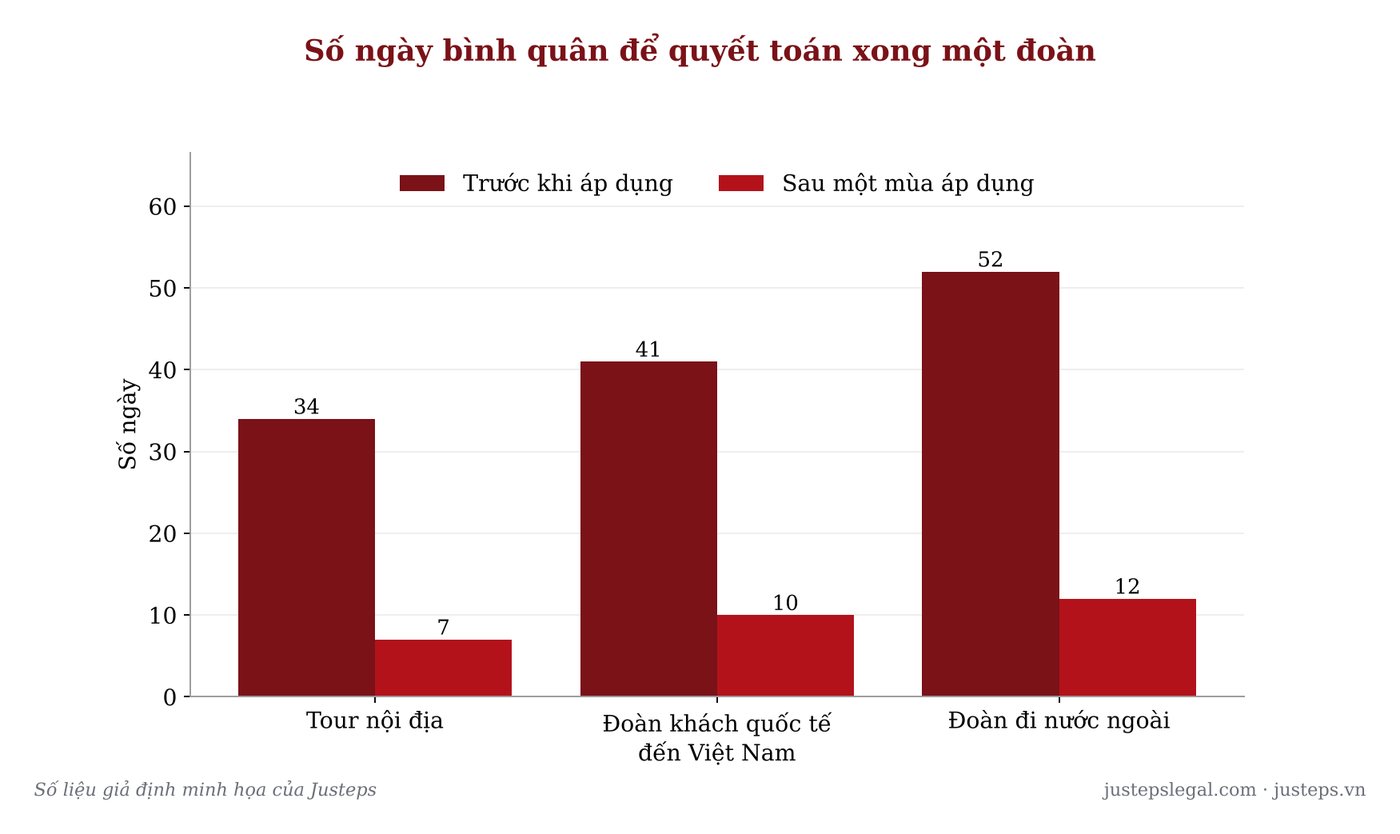
Example of the average number of days from the end of a tour to completed settlement, before and after applying the regulation
In this example, settlement time for domestic tours fell from 34 days to 7 days, for groups of international visitors to Vietnam from 41 days to 10 days and for outbound groups from 52 days to 12 days. Outbound groups are always the slowest because they must wait for invoices from partners abroad and for foreign currency conversion, so the regulation gives this group a longer deadline but requires a spending summary to be submitted as soon as they return to Vietnam. Tighter control of advances can also be developed together with the financial internal control system service.
Tour guide regulation and operations on tour
When leading a group, a tour guide must carry the business’s assignment letter and the group’s tour programme[1], yet many businesses send the itinerary only by text message. Justeps’ tour guide regulation sets out the template assignment letter, how the group file is handed over, a group log recording changes from the programme and a post-trip report sent to operations within a fixed period. Every change to the itinerary on tour must be confirmed by operations and the reason recorded, because this is the most important evidence when a customer complains about not receiving all the services.
Shopping stops and the commissions from them are a sensitive matter. The regulation should list the shopping stops approved by the business, prohibit pressuring customers to buy or extending stops beyond the programme, and require commissions to be paid to the business and fully recorded rather than received privately by the tour guide or driver. Forcing customers to buy goods or services is an act that may be penalised in the field of tourism[7], and a clear regulation helps the business show that it has taken preventive measures.
Incidents on tour and insurance for customers
The incident handling procedure divides incidents into three levels. Low-level incidents such as delays or a change of restaurant are handled by the tour guide and recorded in the log, medium-level incidents such as a cancelled flight or a vehicle breakdown must be reported to the duty contact and may be covered by emergency spending within the limit, while serious incidents such as accidents, missing customers or natural disasters must be reported immediately to the director and the person in charge of travel services. Each level has a report template, a list of emergency telephone numbers by destination and guidance on collecting evidence for insurance claims.
A business taking travellers abroad must buy insurance for customers for the duration of the programme, unless the customer already has insurance for the whole trip[1]. The procedure needs to state who checks this before the departure date and where the evidence is kept. For outbound groups or groups of international visitors to Vietnam, the procedure must also include a step for handling customers who leave the group or abscond and stay behind, because the travel business may be penalised when this happens[7] and it also affects the business’s reputation when applying for visas for later groups.
Passport, identity card and health data of customers
Travel businesses collect many types of customer personal data, from full name, date of birth, passport number and portrait photo to bank statements for visa applications and health and dietary information for booking services. Processing this data must have a legal basis, customers must be notified and appropriate protection measures must be in place under the Law on Personal Data Protection and its guiding decree[8]. Sending a group’s entire passport list to a chat group with many suppliers is a common practice but difficult to justify if the data is leaked.
Justeps’ data procedure specifies the types of data collected for each product line, the template notice and consent for customers, who has access, how data is sent to each type of supplier with only the fields they need and the deletion period after the trip ends. Health data is handled separately because it is more sensitive. A business with a large volume of data or online sales can go further through the personal data protection compliance service.
Timeline, deliverables and fees
A project usually takes about ten weeks. In the first two weeks Justeps carries out a survey, interviews tour operators, accountants and several tour guides, and reads the template contracts, group files and recent complaints. In the third week management confirms the list of procedures and the financial limits, after which Justeps sends drafts in groups, trials them on one domestic group and one international group to test the forms, and then gives short training to tour operators and tour guides. The deliverables include the following documents:
- A tour operations handbook with a flowchart for each stage, used for training and internal checks.
- Template contracts with individual customers, groups and corporate customers, with a schedule of cancellation and change fees by time threshold.
- A tour guide regulation, a supplier management regulation and a regulation on advances, settlement and international payments.
- Procedures for handling incidents, receiving complaints and protecting customer data.
- A set of forms, draft issuing decisions and short training materials.
The authority to issue each document depends on the charter, under which the director usually issues internal management regulations and operating procedures[9], while the financial regulation may need approval by the members’ council or the board of directors. Justeps quotes the project fee as a fixed fee in writing after the initial meeting, depending on the number of documents, the number of product lines and customer markets, the need for bilingual documents, whether the procedures are built into the tour operations software and whether the business needs Justeps to follow the trial phase closely. Justeps recommends reviewing the set of documents every year before the peak season and whenever the law on tourism, tax or data changes, a task that can be entrusted to the Ongoing legal advisory service for travel and tour businesses.
How Justeps can help
Alongside internal procedures and regulations, travel and tour businesses may combine the following Justeps services:
- Organisational structure design for travel and tour businesses. Justeps determines who approves prices, who runs operations, who holds the money and who is on incident duty before procedures are written for each position.
- Ongoing legal advisory for travel and tour businesses. Justeps updates the regulations when the law changes and deals with situations that arise when they are applied.
- Personal data protection compliance. Justeps prepares data processing files and templates of notices and consent for customers’ passport, identity card and health data.
- Financial internal control system. Justeps designs control points for advances, supplier payments and commissions in travel businesses.
Frequently asked questions
May the business keep the entire deposit when a customer cancels a tour?
Only if the contract clearly provides for it and the amount retained is proportionate to the time of cancellation and the costs already incurred. General terms or terms that remove the customer’s legitimate interests may not be recognised[2].
Can cash paid by a tour guide to a restaurant on tour be counted as an expense?
Payments below VND 5 million may be made in cash if there are valid invoices and documents. Payments of VND 5 million or more require non-cash payment, and if an employee pays on the business’s behalf there must be an authorisation regulation and the business must reimburse the employee[5].
Is it compulsory to buy insurance for customers on outbound tours?
Yes, a business taking travellers abroad must buy insurance for customers for the duration of the programme, unless the customer already has insurance for the whole trip[1]. The procedure should include a step to check this and keep evidence before the departure date.
May customers’ passport lists be sent through messaging applications?
The business should limit this, sending only to those who need it, with only the necessary information and through a channel with access control. The data procedure should set the sending channel and deletion period for each type of supplier[8].
Who has the authority to issue internal regulations?
It depends on the charter. The director usually issues internal management regulations and operating procedures[9], while major regulations such as the financial regulation may be approved by the members’ council, the board of directors or the owner.
How often should the set of regulations be reviewed?
At least once a year before the peak season, and immediately when the law on tourism, tax or data changes or when the business opens a new product line or market.
Related articles
- Conditions for domestic tour operations, licences, deposits, tour contracts and management of tour guides
- Building a customer complaint handling procedure that complies with the law, sets clear authority and leaves an audit trail
- Organisational structure design for travel and tour businesses by customer market and licence scope
- Ongoing legal advisory for travel and tour businesses through the peak seasons
Notes
[1] The Law on Tourism No. 09/2017/QH14 dated 19 June 2017, as amended and supplemented by the law passed by the National Assembly on 21 November 2026.
[2] Clauses 2 and 3 of Article 405 of the Civil Code No. 91/2015/QH13 dated 24 November 2015.
[3] The Law on Protection of Consumer Rights No. 19/2023/QH15, as amended and supplemented by the law passed by the National Assembly on 13 November 2026.
[4] Article 34 of the Law on Electronic Transactions No. 20/2023/QH15 dated 22 June 2023.
[5] Point c of Clause 1 of Article 9 of Government Decree No. 320/2025/ND-CP dated 15 December 2025 detailing the Law on Corporate Income Tax.
[6] Article 26 of Government Decree No. 181/2025/ND-CP dated 1 July 2025 detailing the Law on Value Added Tax.
[7] Government Decree No. 45/2019/ND-CP dated 21 May 2019 on administrative penalties in the field of tourism, as amended and supplemented by Decree No. 129/2021/ND-CP and Decree No. 348/2025/ND-CP.
[8] The Law on Personal Data Protection No. 91/2025/QH15, effective from 1 January 2026, and Decree No. 356/2025/ND-CP detailing this Law.
[9] Point d of Clause 2 of Article 63 of the Law on Enterprises No. 59/2020/QH14 dated 17 June 2020, as amended and supplemented by Law No. 76/2025/QH15.
This article is for reference and reflects the regulations in force at the time of publication. Please consult Justeps for advice tailored to your company’s records and situation.
For further information, please contact:
📩 Email: info@justeps.vn
🌐 Website: https://justepslegal.com · https://justeps.vn
🌐 Page: Justeps
☎️ Hotline (Zalo): 096 172 2607
📍 Thanh Xuan Office: 12th Floor, Licogi 13 Tower, 164 Khuat Duy Tien Street, Thanh Xuan Ward, Hanoi, Vietnam
📍 Ha Dong Office: LK06B, No.10, Dong Dua Area, Ha Dong Ward, Hanoi, Vietnam
📍 Ho Chi Minh City Branch: 528 Le Van Sy, Ho Chi Minh City, Vietnam
📍 Hai Phong Office: Truong Thinh Village, Ha Dong Commune, Hai Phong, Vietnam
📍 Quang Ninh Office: Van Don Special Zone, Quang Ninh Province, Vietnam





