
Key takeaways
- When an incident occurs, a restaurant proves it acted correctly through its receiving log, food check log and retained food samples[1], not through staff accounts, so procedures must be tied to forms completed on every shift.
- Shift close must reconcile each payment channel separately, namely cash, cards, QR codes, food delivery apps and gift vouchers, and then compare them with invoice data generated from the cash register[3].
- Counter staff need a clear rule for refusing to sell alcohol and beer to persons under 18[4] and the right to refuse further service to intoxicated customers without asking a manager.
- Procedures written for front-line staff must be short enough to follow at peak hours, with explanations of legal grounds and responsibilities kept in documents intended for managers.
A busy restaurant may serve several hundred customers a day with a team made up mostly of young staff, part-time workers and people who joined only a few weeks ago. The dishes have standard recipes, but the tasks around them, such as receiving goods early in the morning, keeping the food check log, retaining banquet samples, closing the till at the end of a shift or refusing to sell beer to school pupils, are usually passed on by word of mouth. When long-serving staff leave, the right way of working leaves with them, while the risk stays with the business.
This page introduces Justeps’ service of building internal procedures and regulations for restaurants, cafés, takeaway drinks outlets, catering providers and F&B chains. The content follows the flow of work in an outlet’s day, from the arrival of ingredients to shift close, and focuses on the steps that leave a record when there is an inspection or an incident. Assigning which position is responsible for each obligation is done beforehand under the organisational structure design service for restaurant, café and F&B chain businesses, while this page sets out how those positions work.
What the regulations of a restaurant or café cover
Justeps divides the set of documents into five groups corresponding to the five risk areas of an outlet. A small café may combine the groups into an operations manual of a few dozen pages, while a chain with a central kitchen needs separate production and transport procedures as well. Whatever the size, every procedure has a person who carries it out, a time when it is carried out and a form proving that it has been done.
| Group of regulations | Main content | Persons applying it |
|---|---|---|
| Ingredients and storage | Supplier selection, goods receipt, temperature-controlled storage, issue from stores, disposal of expired goods. | Head chef, storekeeper, purchasing. |
| Preparation and service | Kitchen hygiene, food checks, sample retention, allergen information, serving dishes. | Kitchen, bar, waiting staff. |
| Cash and invoices | Shift opening, shift close, reconciliation of each payment channel, voids, discounts, electronic invoices. | Cashier, shift leader, accountant. |
| Customers | Sale of alcohol and beer, promotions, CCTV, customer data, complaints in the outlet and online. | Shift leader, outlet manager, marketing. |
| Premises safety | Fire prevention, gas cylinders, electrical equipment, waste and wastewater, suspected food poisoning. | Outlet manager, head chef. |
Goods receipt, storage and traceability of ingredients
Food safety law requires food service establishments to use ingredients of clear origin and to keep information for traceability when needed[1][2]. In practice, many outlets buy vegetables and meat at wholesale markets without invoices, or receive goods at five in the morning when only a security guard is there to sign. The procedure Justeps drafts sets out the list of approved suppliers, the documents required for each group of goods, how goods are received outside working hours and the recording of temperatures for frozen and chilled goods at the moment of receipt.
For storage, the procedure sets out the first-in first-out principle, how to label opened or pre-prepared ingredients with the preparation date, the temperature of each refrigerator and the person recording temperatures on each shift. Expired or suspect ingredients are set aside and entered in a disposal log signed by two people, so that accounting can distinguish reasonable wastage from loss. Chains with a central kitchen add procedures for packing, batch labelling and refrigerated transport to the outlets, so that when a batch has a problem it is immediately known which outlets it went to.
Food checks, sample retention and allergen information
For wedding banquets, conferences and meals for businesses or schools, three-step food checks and retention of food samples in accordance with health sector guidance are the most important evidence when customers suspect food poisoning. The procedure Justeps drafts specifies which meals require sample retention, who takes the samples, how they are labelled, the temperature and period for keeping them, who may dispose of them and the log in which this is recorded. Cafés and à la carte restaurants that do not serve banquets usually do not need to retain a sample of every dish, but should still log checks of incoming ingredients and the hygiene of the preparation area every day.
An item that Vietnamese outlets often overlook is allergen information such as peanuts, seafood, milk and gluten. Foreign customers and customers with young children ask about it more and more, and a wrong answer from a waiter can lead to a serious health incident. Justeps proposes an allergen table for each dish kept at the counter, a rule that waiting staff must not answer when unsure but ask the head chef, and a way of recording special requests on the order slip.
Shift close and multi-channel revenue reconciliation
A café today collects payment through at least five channels, namely cash, bank cards, QR code transfers, food delivery apps and gift vouchers or discount codes. The old shift close procedure only counted the cash in the till, so it could not detect transfers into personal accounts, delivery orders cancelled after the drinks were made, or discount codes used repeatedly. Electronic invoices must be issued for each sale under the decree on electronic invoices[3], so cash register data is the source against which money actually received through each channel is reconciled.
Justeps reviewed 240 shifts over 30 days at a chain of four cafés, each with two shifts a day, before rewriting its shift close procedure. The chart below shows the number of shifts with unexplained differences between sales data and money actually received, by payment channel.
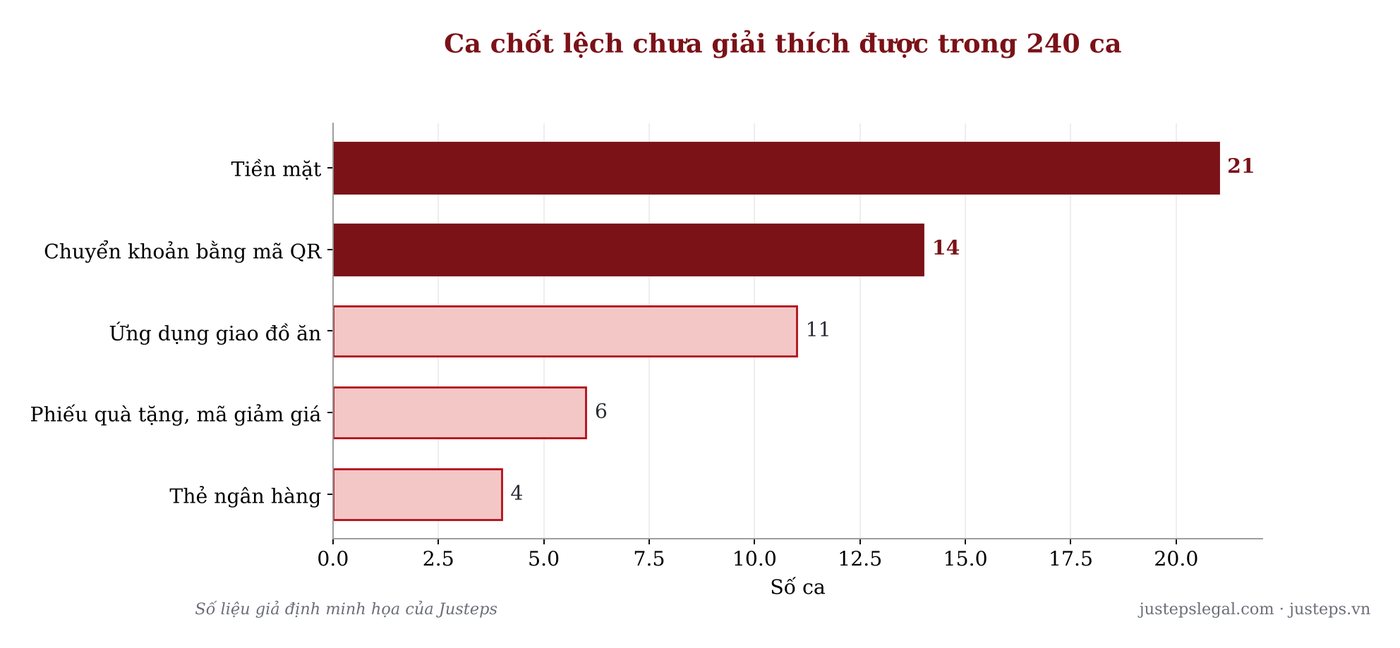
Example number of shifts closed with unexplained differences over 30 days at a four-café chain, by payment channel
In the example, cash is still the channel with the most discrepant shifts at 21, but QR code transfers follow closely with 14, mainly because customers transferred money by mistake into staff members’ personal accounts or paid before an order was cancelled. Food delivery apps account for 11 discrepant shifts because of cancelled orders, refunds or promotional fees deducted without the cashier recording them, gift vouchers and discount codes for 6, and bank cards for only 4. The new procedure therefore requires using only the business’s own accounts and QR codes, reconciling each delivery app’s report separately with the sales system and recording a reason for every void made after an order has been sent to the kitchen. How cash shortages at shift close are handled with staff must follow labour law and be written into the internal labour regulations, and this is covered by the labour, wages and social insurance service for restaurant, café and F&B chain businesses.
Alcohol sales, promotions and customer data
The Law on Prevention and Control of Harmful Effects of Alcoholic Beverages prohibits selling alcohol and beer to persons under 18[4], so bar and waiting staff need a rule on asking for identification when a customer’s age is in doubt and the right to refuse service. The regulations also set out how to deal with intoxicated customers, reminding customers not to drive after drinking and calling a ride for them, because an incident right outside the door still directly affects the outlet’s reputation. Outlets serving alcohol for consumption on the premises must also check the conditions, licences or procedures under the alcohol trading rules applicable to that location.
Promotional programmes such as buy one get one free, happy hours or vouchers for the next order must comply with commercial law on promotions, including notification or registration procedures in the cases where the law so requires[5]. The procedure Justeps drafts specifies who may propose, who approves, the minimum content of the rules, how counter staff are briefed and how the promotional value is recorded on the invoice. Advertising content and complex promotion rules can be reviewed separately through the advertising, promotions and consumer protection service.
Phone numbers collected through loyalty programmes, CCTV images and delivery information are all customers’ personal data[6]. The regulations specify the purpose of collection, notice to customers, who may access the data, the retention period and the rule that customer data must not be sent through staff members’ personal messaging groups. Cameras are placed only in service areas, at the cash desk, in the storeroom and in the kitchen, with notice signs, and never in toilets or staff changing areas.
When customers suspect food poisoning or complain on social media
A post about a hair in a dish or a customer with stomach pain after dinner can spread within hours, and how staff react in the first hour often determines the extent of the damage. The general principle of the procedure is to care for the customer’s health first, preserve evidence immediately, and assign a single person to respond to the customer and to respond publicly.
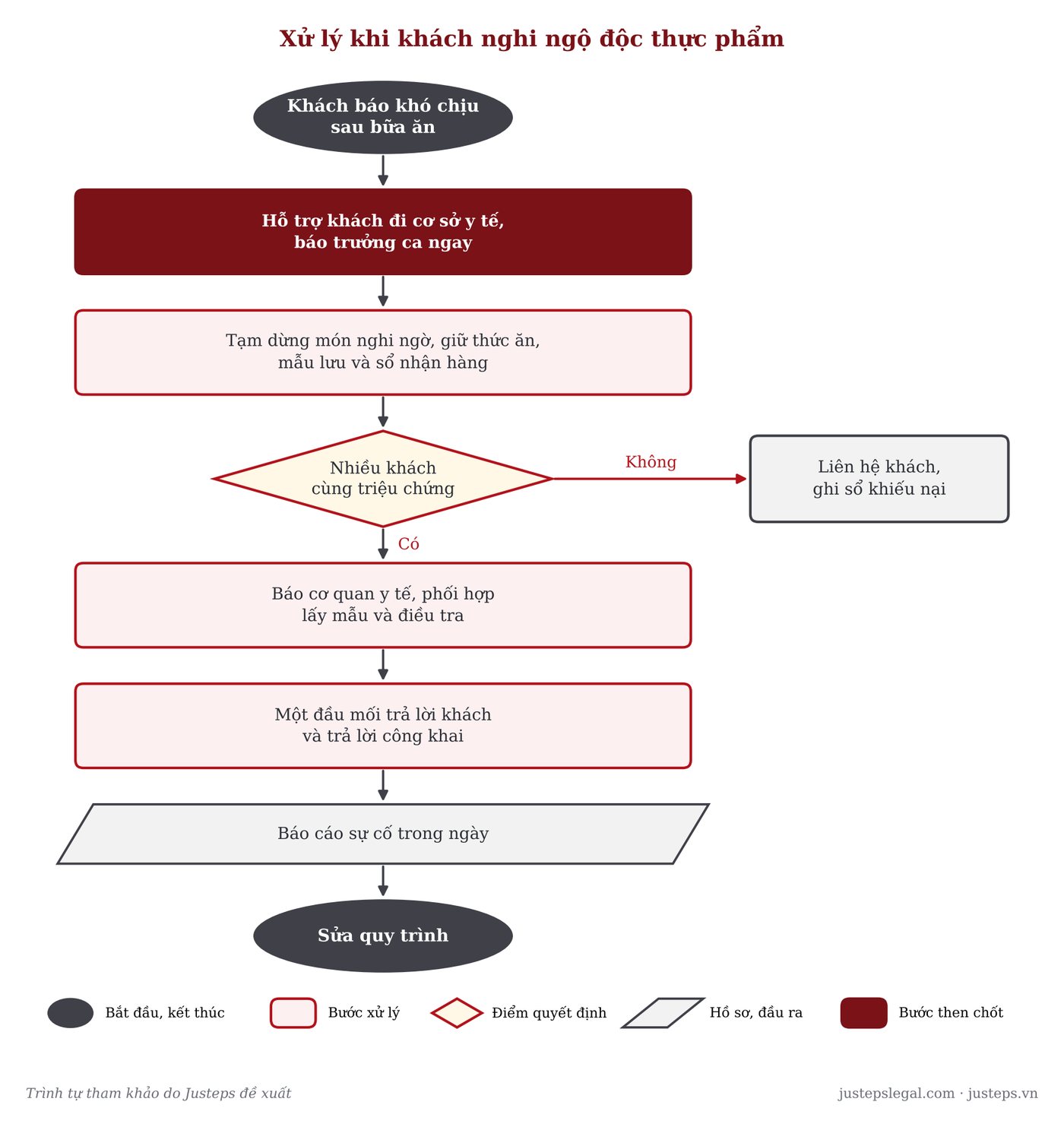
Sequence for handling suspected food poisoning at a restaurant
Under this sequence, the shift leader helps the customer go to a medical facility if there are health symptoms, while asking the kitchen to suspend the suspect dish and keep the remaining food, the retained samples and the receiving log of the relevant batch of ingredients intact. If several customers have the same symptoms, the establishment must immediately report to the health authority under food safety rules[1] and cooperate when the authorities take samples and investigate. For an individual complaint not related to health, the outlet manager contacts the customer directly and records it in the complaints log, while a public reply on social media is posted only by the chain’s communications officer once the facts are known. When a complaint turns into a claim for compensation, the business can ask the ongoing legal advisory service for restaurant, café and F&B chain businesses to assess liability and draft a reply.
Application by business model
A takeaway drinks outlet focuses on shift close, delivery app reconciliation and hygiene of the bar counter, and does not need the banquet procedures. A dine-in restaurant adds food checks, alcohol sales and the sharing of service charges, while catering providers and industrial canteens must be strictest on food checks, sample retention and transport of cooked food. For franchise systems, Justeps clearly separates the mandatory procedures franchisees must follow from recommended guidance, so that the franchisor can monitor compliance without interfering in the franchisee’s labour management.
Roadmap, deliverables and fees
The project usually takes about ten weeks. In the first two weeks Justeps attends the outlet for at least one peak shift and one goods receipt, interviews the head chef, shift leaders, cashiers and accountant, and reviews logs, supplier contracts and contracts with food delivery apps. In the third week, management agrees the priority list of documents; in the following weeks Justeps drafts them group by group, pilots them at a model outlet so that staff can point out steps that cannot be done at peak hours, and then finalises them and trains outlet managers and head chefs in person. The deliverables comprise the following documents:
- A food safety procedures manual used to train new staff and to present to inspection teams.
- A set of forms and daily logs for goods receipt, refrigerator temperatures, food checks, sample retention, disposals and cleaning.
- Procedures for shift opening, shift close and revenue reconciliation by payment channel, with rules on voids and discounts.
- Regulations on alcohol sales, promotions, CCTV and customer data.
- Procedures for handling suspected food poisoning and complaints in the outlet and on social media, with report templates.
- A draft decision issuing the set of regulations and short training materials for each position.
Justeps quotes a fixed project fee in writing once the list of documents has been agreed. The fee depends on the number of procedures, the number of outlet models, whether there is a central kitchen, banquet service or franchise system, the need for bilingual documents and the length of the pilot. Businesses that handle large volumes of member data or share data with partners can go further through the personal data protection compliance service.
How Justeps can help
In addition to internal procedures and regulations, restaurant, café and F&B chain businesses can combine the following Justeps services:
- Organisational structure design for restaurant, café and F&B chain businesses. Justeps assigns each food safety, fire prevention and invoicing obligation to a specific position before the procedures are written.
- Ongoing legal advisory for restaurant, café and F&B chain businesses. Justeps follows up situations arising after the regulations are issued and updates them when the law changes.
- Advertising, promotions and consumer protection. Justeps reviews promotion rules, advertising content and exchange and refund policies for customers.
- Personal data protection compliance. Justeps prepares processing records for member data, CCTV and delivery data under the Law on Personal Data Protection.
Frequently asked questions
Must a small café retain food samples?
Sample retention mainly applies to banquet meals, group catering and cases covered by health sector guidance. A small café does not usually retain a sample of every drink, but still needs to keep documents on the origin of ingredients and a hygiene log[1].
Who should sign the daily food check log?
The person who actually carries out the check signs each step, usually the head chef or sous chef on shift, and the outlet manager signs to confirm at the end of the day. A log signed retrospectively at the end of the week has no evidential value if an incident occurs.
May a personal bank account be used to receive customer transfers?
This is not advisable. Sales money paid into personal accounts is hard to reconcile, easily lost and distorts declared revenue. The procedure should require using only accounts and QR codes in the name of the business at every outlet.
Must a happy hour discount programme be notified to the State authorities?
Depending on the form and scope of the promotion, some cases require notification or registration and others do not[5]. Justeps determines the procedure for each programme and builds this check into the promotion approval procedure.
Must internal regulations be registered with the State authorities?
Most operating procedures only need to be issued by the business and communicated to staff. The internal labour regulations alone have a separate registration procedure under labour law and are handled under the labour, wages and social insurance service.
How often should the set of procedures be reviewed?
Once a year, and immediately when the sales software changes, a delivery channel is added, a central kitchen is opened or the law on food safety or invoices changes. After every incident, the step where the error occurred should also be corrected at once.
Related articles
- Organisational structure design for restaurant, café and F&B chain businesses by outlet and central kitchen
- Ongoing legal advisory for restaurant, café and F&B chain businesses on premises, trade marks and partners
- Preparing food safety records for a restaurant before opening day
- Building restaurant operating procedures from the organisational structure to every service shift
Notes
[1] The Law on Food Safety No. 55/2010/QH12 dated 17 June 2010.
[2] Government Decree No. 15/2018/ND-CP dated 2 February 2018 detailing a number of articles of the Law on Food Safety, applied during the period in which Decree No. 46/2026/ND-CP is suspended under Government Resolution No. 15/2026/NQ-CP.
[3] Government Decree No. 254/2026/ND-CP dated 30 June 2026 on electronic invoices and electronic documents.
[4] The Law on Prevention and Control of Harmful Effects of Alcoholic Beverages No. 44/2019/QH14.
[5] The Commercial Law and the documents amending and supplementing it, and the documents detailing promotional activities.
[6] The Law on Personal Data Protection No. 91/2025/QH15 and Government Decree No. 356/2025/ND-CP detailing this Law.
This article is for reference and reflects the regulations in force at the time of publication. Please consult Justeps for advice tailored to your company’s records and situation.
For further information, please contact:
📩 Email: info@justeps.vn
🌐 Website: https://justepslegal.com · https://justeps.vn
🌐 Page: Justeps
☎️ Hotline (Zalo): 096 172 2607
📍 Thanh Xuan Office: 12th Floor, Licogi 13 Tower, 164 Khuat Duy Tien Street, Thanh Xuan Ward, Hanoi, Vietnam
📍 Ha Dong Office: LK06B, No.10, Dong Dua Area, Ha Dong Ward, Hanoi, Vietnam
📍 Ho Chi Minh City Branch: 528 Le Van Sy, Ho Chi Minh City, Vietnam
📍 Hai Phong Office: Truong Thinh Village, Ha Dong Commune, Hai Phong, Vietnam
📍 Quang Ninh Office: Van Don Special Zone, Quang Ninh Province, Vietnam





