
Key takeaways
- Each product needs a set of records checked before listing, because the seller must provide documents on business conditions and the quality of goods to the platform and to the livestreamer[1][3].
- Livestream scripts, the list of permitted statements and the recording of each session are the only evidence with which the business can prove that it controlled content when a complaint is made or a regulator carries out an inspection.
- Cooperation with KOLs, KOCs and affiliate marketers through text messages is not enough, and a contract or electronic terms are needed that set out the approved content, advertising disclosure, image rights and liability for misstatements.
- Marketplace payouts are net of fees, refunds and subsidies, so the business needs to reconcile each marketplace payment cycle with invoices and the accounting books before filing tax returns[11].
Online sellers live on speed, as a new product must go live on the marketplace the same day, invitations to join marketplace promotions must be answered within a few hours, and tonight’s livestream is often prepared that same afternoon. When everything depends on the memory of a few long-serving staff, mistakes repeat in the same pattern, such as listing a product without its supplementary label, a livestream host saying a product cures an illness, duplicate discount codes, or a refund approved twice. Each small error can lead to a product being removed, a shop being downgraded or a meeting with a regulator at which the business has no documents to explain itself.
This page introduces Justeps’ service of building internal procedures and regulations for businesses selling on marketplaces, on social networks, on their own websites and through livestreams. The documents place control points at the right stage of the workflow, so that the business keeps its speed while still stopping foreseeable errors. These procedures assume that the business has already decided who is in charge of which unit and who has authority to decide what, which is handled first under the organisational structure design service for e-commerce and livestream selling businesses.
Starting from returns and complaints data
Justeps does not write every procedure at once but chooses the order based on the business’s own data. In the survey week, Justeps obtains the list of returned orders, cancelled orders, complaints and infringement notices from the marketplaces for the last three to six months, and classifies them by root cause. The chart below shows the result of this classification at a business selling household goods and cosmetics.
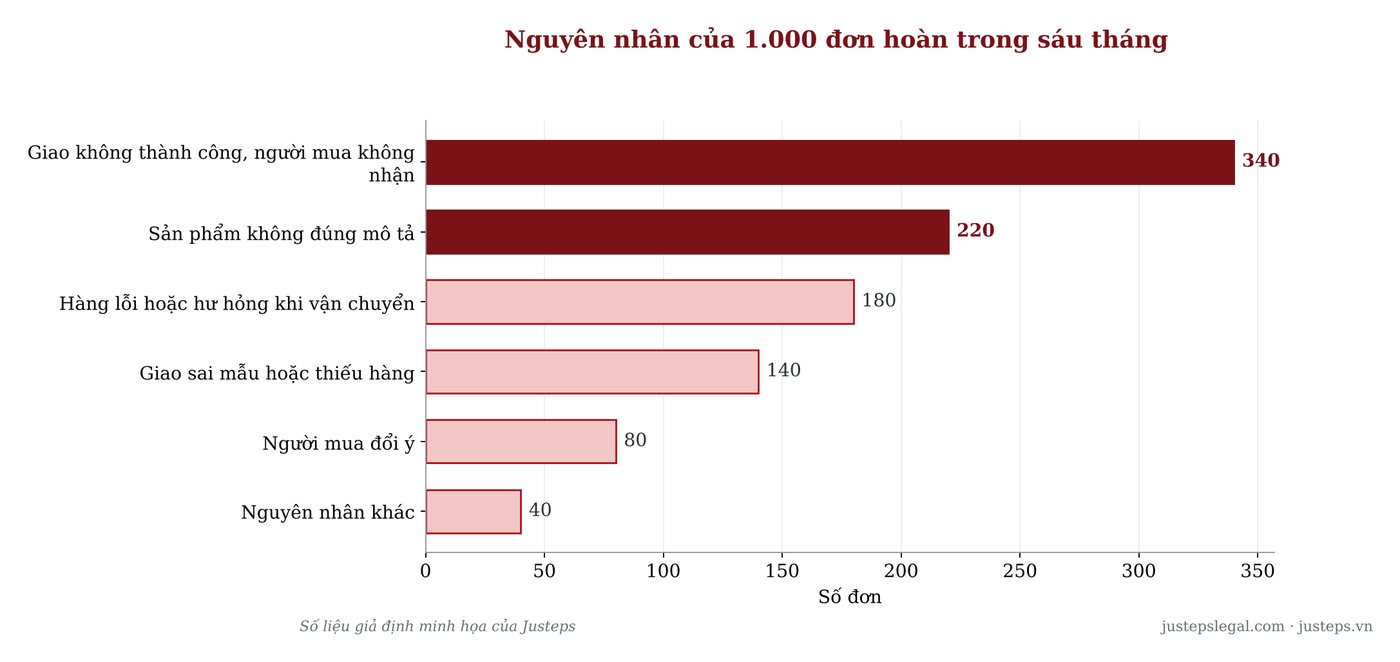
Example of the causes of 1,000 returned orders over six months at a business selling household goods and cosmetics
In the example, failed deliveries because the buyer did not accept the parcel account for 340 orders, products not matching the description for 220 orders, defective goods or damage in transit for 180 orders, wrong variants or missing items for 140 orders, buyers changing their minds for 80 orders and other causes for 40 orders. The two largest groups show that the business should prioritise an order confirmation procedure before shipping and a procedure for checking product descriptions, before investing in other procedures. This approach allows the first set of procedures to address the losses the business is currently suffering straight away and wins the support of the operations team.
Checking product records before listing
Under the Law on E-commerce, sellers must disclose information on the quality of goods and the mandatory label information under the law on goods labelling, and on platforms with an online ordering function they must provide the platform operator with documents proving their business conditions before selling goods in conditional business lines[1]. Imported goods must also bear a supplementary label in Vietnamese and have documents proving their origin under the rules on goods labelling[2], while certain groups such as cosmetics or health supplements must have notification or declaration records before circulation. Justeps’ product listing procedure therefore includes a mandatory step before a product is displayed, namely comparing the name, ingredients and uses stated on the sales page with the label and the notification records, checking whether the images belong to another party, and storing all documents in a folder by product code.
The person who carries out the check is the compliance officer, and the channel manager may only press publish after confirmation. For businesses with hundreds of product codes, Justeps builds a risk grouping table so that codes in the ordinary group only need sample checks, while codes in the conditional group must be checked one by one. The set of records by product code is also the document the business sends to the marketplace immediately when an infringement report is filed, instead of spending several days looking for papers while the product is temporarily hidden.
Scripts, monitoring and recording of livestream sessions
Before each session, the seller must provide the livestreamer with documents proving the business conditions and the quality of the goods, and for goods whose advertising content must be certified, the seller must provide the certification to both the platform and the livestreamer, while the sales content must be consistent with the certified content[3]. Livestreamers have the right and the obligation to refuse to cooperate if they do not receive these documents, and must not give false or misleading information about uses, origin, quality, price, promotions or warranty[4]. Justeps’ livestream procedure turns these obligations into specific steps, with reasonable approval deadlines so as not to delay the broadcast schedule.
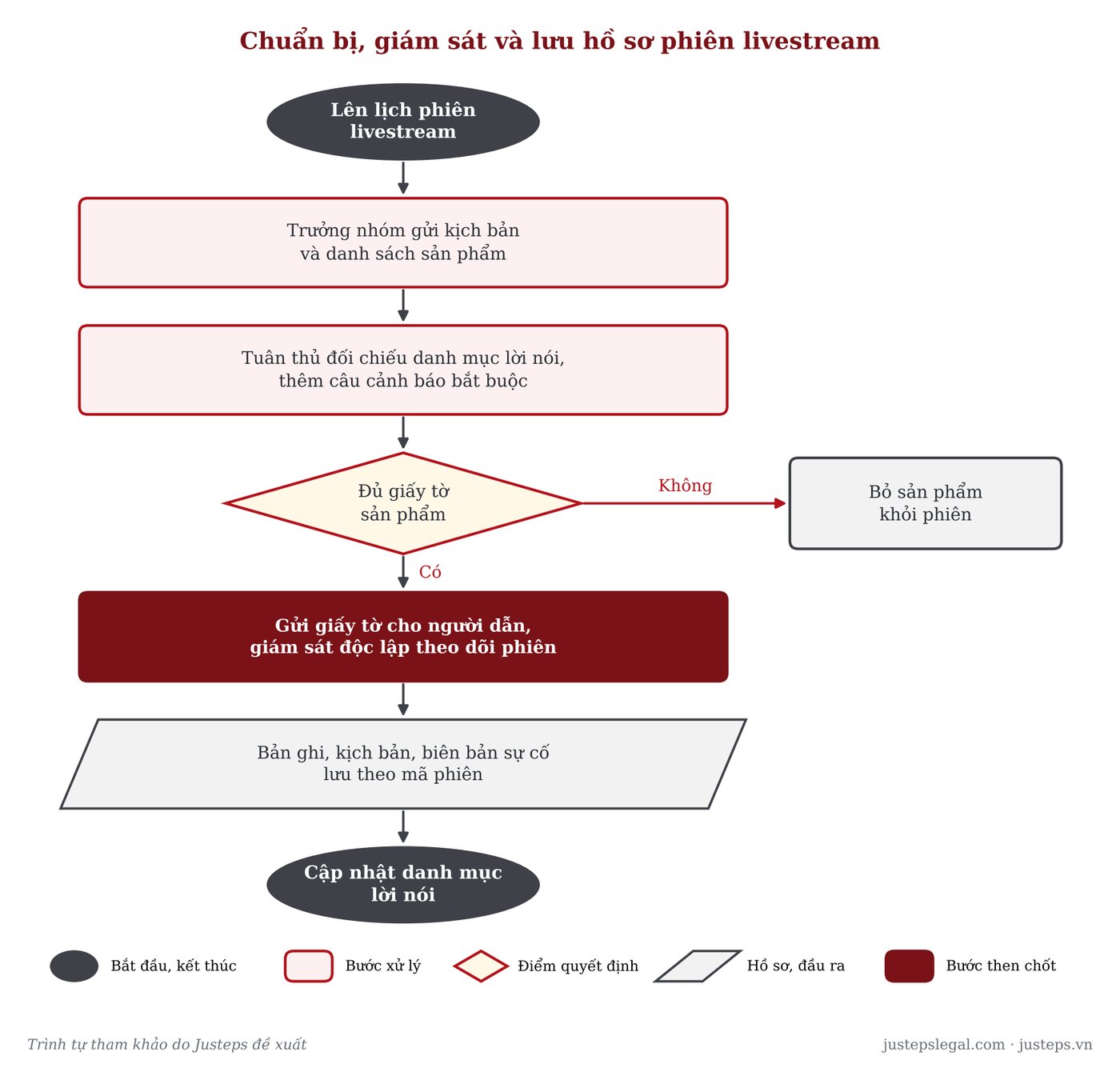
Sequence for preparing, monitoring and archiving a livestream sales session
The livestream team leader sends the script and product list to the compliance officer before air time within the deadline set by the regulations. The compliance officer checks them against the list of permitted and prohibited statements for each product group, adds any mandatory warnings and then sends the product documents to the host. During the session, a monitor who is not the host follows the broadcast and has the authority to message the host to correct a statement immediately, or to ask that the presentation of a product be stopped when an error is detected. After the session, the recording and documents are stored under the session code for a period no shorter than the return and warranty periods and the time during which the business may be asked to explain itself, and every incident is recorded in minutes in order to update the list of permitted statements.
Promotions, discount codes and pre-promotion prices
Marketplaces often invite sellers to join major promotions with very short response deadlines, and many businesses agree at once to maintain their display ranking. Promotional activities are subject to limits on discount levels, the method of determining the pre-promotion price, the information on conditions of application that must be disclosed and, in certain cases, procedures with the authorities under commercial law[5]. Raising a price just before a sale and then announcing a large discount, or not stating the conditions for receiving a gift clearly on air, are situations easily regarded as providing misleading information to consumers[6].
The promotion regulation drafted by Justeps specifies who may create discount codes and within what limits, how the pre-promotion price is taken from the product’s own price history, and the step of checking discount levels, conditions of application and notification obligations before confirming participation in a marketplace campaign. Accounting is informed before each campaign in order to correctly record the portion subsidised by the marketplace and the portion of costs borne by the business. For businesses running many campaigns a year, promotion procedures and records can be handled in detail by Justeps through the e-commerce marketplace and promotion legal service.
Cooperation with KOLs, KOCs and affiliate marketers
Many agreements with influencers are settled through text messages, stating only the amount of money and the posting date. The law on advertising sets out separate responsibilities for persons conveying advertising products, including identifying content as advertising and checking product documents before presenting them[7], while affiliate marketers must provide information for identity verification and remove links to infringing goods or when requested by a competent authority[8]. When the agreement does not set out these obligations, the business finds it difficult to require an influencer to remove a video containing misstatements, and difficult to prove that it provided correct product information.
Justeps drafts a cooperation regulation applying to all KOLs, KOCs and affiliate marketers, together with model contracts for each group. The model contract clearly sets out the content that must be approved before posting, how advertising labels are applied, the scope and duration of image use, how commission is calculated after deducting cancelled and returned orders, the obligation to remove content and liability for misstatements. Businesses working with hundreds of affiliate marketers can use electronic terms accepted on the system instead of hand-signed contracts. Businesses running their own creator network can also refer to the internal procedures and regulations service for KOL, KOC and multi-channel network (MCN) businesses.
Returns, refunds, complaints and negative reviews
Platforms with an online ordering function must publish return and refund policies under the decree detailing the Law on E-commerce[9], and sellers must handle buyers’ requests within that policy and in line with consumer rights in distance transactions[6]. A common error is that one employee receives returned goods, decides on the refund and confirms it with accounting, so nobody detects returned goods that do not match the product sold or a refund with no goods returned. The procedure Justeps proposes divides the work among four functions, under which the warehouse inspects returned goods and prepares minutes with photographs, the channel manager decides on refunds under the published policy, accounting adjusts invoices and revenue, and customer care is the sole point of contact responding to the buyer.
For public negative reviews, the procedure distinguishes between reviews reflecting genuine errors by the business, reviews based on misunderstandings and reviews showing signs of being untrue. The first group is handled by contacting the buyer and putting things right, the second is answered publicly with verifiable information, and the third is reported through the marketplace’s tools with evidence. Every public response follows an approved template, because an angry reply from an employee usually causes more damage than the original review.
Buyer data and marketplace revenue reconciliation
Order data containing buyers’ names, phone numbers and addresses is often exported to spreadsheets to send to carriers, the customer care team or the advertising agency. The processing of personal data must have a lawful basis, comply with the notified purpose and be subject to appropriate protection measures[10], so Justeps’ procedure specifies who may export data, for what purpose, through which channel, for how long it is kept and who deletes it. The delivery purpose and the marketing purpose are kept separate, and buyers’ phone numbers may only be used to send advertising messages where there is an appropriate basis. Impact assessments and data processing contracts with third parties are prepared in detail through the personal data protection compliance service.
Money transferred by a marketplace to the business’s account is net of fixed fees, payment fees, service fees and refunds to buyers and includes subsidies, so it does not directly match the total value of orders. Electronic invoices for each transaction are issued under the invoice rules[11], and without periodic reconciliation the differences between marketplace data, invoices and tax returns accumulate until the tax authority carries out an inspection. Justeps’ reconciliation procedure runs by each marketplace payment cycle, matches three sources, namely the marketplace report, invoice data and the accounting books, records the cause of each difference and is consolidated monthly before tax filing.
Roadmap, deliverables and fees
A project usually takes about nine weeks and is scheduled to avoid the marketplaces’ major sales campaigns. In the first two weeks Justeps surveys the sales channels, each marketplace’s policies, product records and order data and reviews several recent livestream sessions, and in the third week it agrees with the business on the priority procedures based on the analysis of returns, complaints and infringements. From the fourth to the sixth week Justeps drafts procedures, regulations, forms and lists of permitted statements by product group, the following two weeks are spent piloting through real livestream sessions and reconciliation cycles, and the final week is used to finalise the issuance file and train the livestream team, channel managers, warehouse and customer care. The deliverables include the following documents:
- An online sales operations manual bringing together the procedures, used to train new staff and as evidence of the control mechanism.
- Lists of permitted and prohibited statements for each product group, with mandatory warnings.
- A regulation on promotions, discount codes and determination of pre-promotion prices.
- A cooperation regulation and model contracts with KOLs, KOCs and affiliate marketers.
- Procedures for returns, refunds, complaints and handling negative reviews, with templates for minutes and incident reports.
- A buyer data management procedure and a procedure for reconciling marketplace revenue with invoices and the accounting books.
Justeps quotes a fixed project fee in writing after the list of documents is agreed. The fee depends on the number of sales channels, the number of product groups and whether any of them are conditional, the size of the livestream team and the influencer network, the need for bilingual documents and the length of the pilot. A small business selling on one marketplace should start with product records, returns and reconciliation, while businesses selling cosmetics, health supplements or mother and baby products need more detailed lists of statements and longer recording retention periods. Justeps reviews the set of procedures about every six months, or sooner when the business opens a new channel, adds a product group or the regulations change.
How Justeps can help
In addition to building internal procedures and regulations, e-commerce and livestream selling businesses can combine the following Justeps services:
- Organisational structure design for e-commerce and livestream selling businesses. Justeps identifies the persons in charge of compliance, data and reconciliation so that each procedure has someone accountable.
- Ongoing legal advisory for e-commerce and livestream selling businesses. Justeps answers questions on on-air content, complaints and infringement notices arising while the procedures are applied.
- Labour, wages and social insurance services for e-commerce and livestream selling businesses. Justeps builds the obligation to follow procedures into the contracts, internal labour regulations and commission rules of the livestream team.
- E-commerce marketplace and promotion legal services. Justeps handles the procedures and records for each of the business’s promotional campaigns.
- Personal data protection compliance. Justeps builds policies, impact assessments and buyer data processing contracts with third parties.
Frequently asked questions
Should a business record all its livestream sessions?
Yes, because the recording is evidence of what was said when a buyer complains or a regulator carries out an inspection. The retention period should be longer than the return and warranty periods and the time during which the business may have to explain itself.
Is it compulsory to join every marketplace promotion?
No. The business should check the discount level, the pre-promotion price, the conditions of application and the profit margin before confirming[5]. A promotion regulation allows this check to be done quickly, within the marketplace’s response deadline.
Does a KOC paid commission per order need to sign a contract?
There should be a contract or accepted electronic terms setting out the approved content, image rights, how commission is calculated and the obligation to remove content in the event of a breach[8]. An agreement made through text messages is difficult to rely on in a dispute.
Who is responsible if a host misstates the uses of a product?
Depending on the case, both the seller and the livestreamer have their own obligations[3][4]. An approved script, the documents provided and the monitoring minutes help the business prove that it controlled the content.
May buyers’ phone numbers be used to send advertising messages?
Only where there is an appropriate lawful basis, usually the buyer’s consent, and in compliance with the rules against spam messages[10]. The delivery purpose and the marketing purpose need to be kept separate in the procedure.
How often should marketplace revenue be reconciled?
By each marketplace payment cycle, and consolidated monthly before tax filing. Leaving reconciliation until the end of the year usually means the causes of many differences can no longer be traced.
Related articles
- Organisational structure design for e-commerce and livestream selling businesses based on the order journey
- Ongoing legal advisory for e-commerce and livestream selling businesses on content and tax
- Labour, wages and social insurance services for e-commerce and livestream selling businesses
- Sales promotion procedures in 2026, when to notify, register and report results
Notes
[1] Article 21 of the Law on E-commerce No. 122/2025/QH15 dated 10 December 2025, effective from 1 July 2026.
[2] Government Decree No. 43/2017/ND-CP on goods labelling, as amended and supplemented by Decree No. 111/2021/ND-CP.
[3] Article 23 of the Law on E-commerce No. 122/2025/QH15 dated 10 December 2025, effective from 1 July 2026.
[4] Article 24 of the Law on E-commerce No. 122/2025/QH15 dated 10 December 2025, effective from 1 July 2026.
[5] The Commercial Law and the documents amending, supplementing and detailing it on promotional activities.
[6] The Law on Protection of Consumers’ Rights and the documents amending and supplementing it.
[7] The Law on Advertising and the documents amending and supplementing it.
[8] Article 26 of the Law on E-commerce No. 122/2025/QH15 dated 10 December 2025, effective from 1 July 2026.
[9] Article 14 of Government Decree No. 248/2026/ND-CP dated 30 June 2026 detailing a number of articles of the Law on E-commerce.
[10] The Law on Personal Data Protection No. 91/2025/QH15 and Government Decree No. 356/2025/ND-CP detailing that Law.
[11] Government Decree No. 254/2026/ND-CP dated 30 June 2026 on electronic invoices and electronic documents.
This article is for reference and reflects the regulations in force at the time of publication. Please consult Justeps for advice tailored to your company’s records and situation.
For further information, please contact:
📩 Email: info@justeps.vn
🌐 Website: https://justepslegal.com · https://justeps.vn
🌐 Page: Justeps
☎️ Hotline (Zalo): 096 172 2607
📍 Thanh Xuan Office: 12th Floor, Licogi 13 Tower, 164 Khuat Duy Tien Street, Thanh Xuan Ward, Hanoi, Vietnam
📍 Ha Dong Office: LK06B, No.10, Dong Dua Area, Ha Dong Ward, Hanoi, Vietnam
📍 Ho Chi Minh City Branch: 528 Le Van Sy, Ho Chi Minh City, Vietnam
📍 Hai Phong Office: Truong Thinh Village, Ha Dong Commune, Hai Phong, Vietnam
📍 Quang Ninh Office: Van Don Special Zone, Quang Ninh Province, Vietnam





