Many agricultural processing cooperatives have outgrown their original model: they own factories, drying and packing lines, their own trademarks, and sell to supermarket chains or importers. At that point the question of converting the cooperative into an enterprise comes up, usually raised by a large customer, an investor, or a management board that wants faster decisions.
Conversion is not just a new name on a certificate. Indivisible assets, member rights, food safety certificates, growing-area codes and running contracts all have to be handled in sequence. This article takes an operational angle: which model to choose, who does what, what comes first and how to control the risks.
When to consider converting a cooperative into an enterprise
Not every growing cooperative needs to convert. The cooperative model still offers support policies, household linkage and autonomy. The board should consider conversion when at least two of these signs are present: most revenue comes from non-member customers; capital is needed from investors who are not farmers; the one-member-one-vote rule slows investment decisions; export customers require a clear ownership and governance structure like a company.
Conversely, if the main activity is still serving members (seed and input supply, purchasing, primary processing), keeping the cooperative and spinning off only processing and trading is usually safer than converting everything.
Three common restructuring models
The Law on Cooperatives No. 17/2023/QH15 allows cooperatives to contribute capital, buy shares and establish enterprises to serve their activities. In practice there are three common paths:
| Model | Indivisible assets | Relationship with members | Suitable when |
|---|---|---|---|
| The cooperative establishes or invests in a processing company | Remain with the cooperative and are contributed as the legal entity’s capital | Unchanged; the cooperative is the owner or shareholder | The cooperative identity is to be kept but a separate entity is needed to raise capital |
| Members set up a new company; the cooperative transfers assets and operations | May not be divided among members; must be handled under the Law on Cooperatives | Members become company members/shareholders through new contributions | Key members want to run a fully corporate model |
| Parallel: the cooperative keeps the raw-material area, the company processes and sells | Kept by the cooperative; the company leases or buys at market price | Members supply raw materials under offtake contracts | Many small member households; growing-area linkage must be preserved |
The parallel model is often chosen by cooperatives with hundreds of member households: the cooperative remains the hub of the raw-material area while the company handles processing, invoicing and exports. In return, transactions between the two entities must be tightly controlled to avoid conflicts of interest and transfer pricing risk.
Indivisible assets, the biggest bottleneck
A cooperative’s indivisible assets, including those formed from State support, donations and part of its reserve funds, may not be divided among members. That is why the cooperative’s assets cannot simply be “converted” into each member’s capital contribution in the new company.
The first task is to take inventory, reconcile the books and classify assets into three groups: divisible assets, indivisible assets, and assets formed from conditional support projects. For the last group, the board must reread the support decision: many programmes require the asset to keep its intended use or not be transferred for a period. Any asset moved to the company needs a contract, a market-based transfer price or rent, and a resolution of the members’ general meeting.
A six-step restructuring roadmap
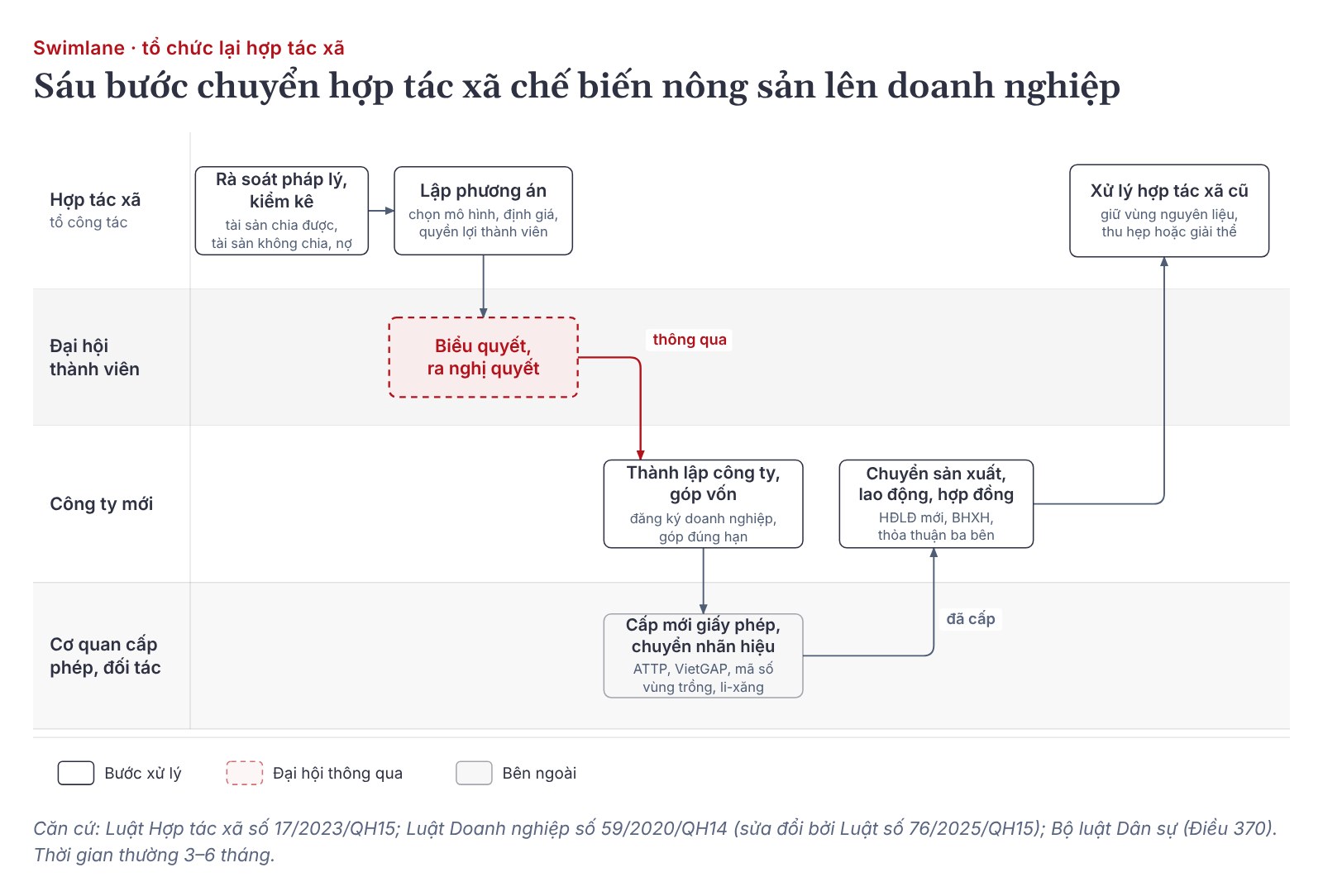
Figure 01. Swimlane of the six steps to convert an agricultural processing cooperative into a company
Basis: Law on Cooperatives No. 17/2023/QH15; Law on Enterprises No. 59/2020/QH14 (amended by Law No. 76/2025/QH15); Civil Code (Article 370)
Follow the arrows across lanes: the cooperative reviews and prepares the plan, the members' general meeting approves it by resolution (red box), and the new company takes over production, staff and contracts only after licences are reissued.
The cooperative’s director should appoint a working group of the accountant, the production lead and a supervisory board member, supported by an external adviser. The process usually takes three to six months, driven mainly by re-issuing permits and negotiating with customers. The new company is established under the Law on Enterprises No. 59/2020/QH14 (as amended by Law No. 76/2025/QH15)[2], so the charter, list of founding members or shareholders and capital contribution deadlines should be prepared as part of the plan.
Permits, trademarks and contracts do not transfer automatically
Food safety eligibility certificates, VietGAP, organic and OCOP certifications, growing-area codes and packing facility codes are all tied to the holder. When the new company operates the factory, it must apply for new or amended certificates. Keep a tracker for each permit: issuing authority, processing time, dossier, owner and expected date, and move production to the company only once the relevant permit is in hand.
Trademarks registered to the cooperative require an assignment or licence agreement registered with the IP authority. For ongoing sales contracts, transferring delivery obligations to the company requires the customer’s consent (Article 370 of the Civil Code No. 91/2015/QH13)[3]; the simplest route is a tripartite agreement or a novation appendix.
Employees and member households
Cooperative employees do not automatically become company employees. The parties should agree a plan: terminate the contract at the cooperative, close the social insurance record, sign a new contract with the company and recognise seniority where key staff are to be retained. The plan must comply with the Labor Code No. 45/2019/QH14 and be communicated clearly to each person.
Member households care most about market access. The offtake contract between the company and the cooperative (or directly with households) should cover quality standards, pricing mechanism, payment terms and traceability. Recording this commitment in the members’ meeting resolution reduces resistance to the conversion.
Governance, tax and incentives after conversion
After conversion, the company needs related-party transaction rules, especially where the cooperative is both owner and supplier; such contracts must be approved by the competent body under the Law on Enterprises and the charter. On tax, enterprises and cooperatives with annual revenue of no more than VND 10 billion receive a 30% reduction in corporate income tax payable for the 2026 and 2027 tax periods (Article 3 of Decree No. 398/2026/ND-CP)[5], but this does not apply to enterprises formed by division or separation where total post-split revenue exceeds VND 10 billion.
From 2027, the Law amending and supplementing certain articles of the Law on Corporate Income Tax, the Law on Non-agricultural Land Use Tax and the Law on Personal Income Tax grants SMEs a three-year CIT exemption, but excludes enterprises formed through merger, consolidation, division, separation, conversion, or newly established after dissolving an enterprise with the same owner. Until guidance is issued, this exemption should not be built into the financial plan of a company formed from a cooperative.
Legal basis and sources
- Law on Cooperatives No. 17/2023/QH15 of the National Assembly, effective from 1 July 2024; Decree No. 113/2024/ND-CP detailing certain articles of the Law on Cooperatives.
- Law on Enterprises No. 59/2020/QH14, as amended and supplemented by Law No. 76/2025/QH15 (effective 1 July 2025).
- Civil Code No. 91/2015/QH13; Labor Code No. 45/2019/QH14.
- Law on Corporate Income Tax No. 67/2025/QH15.
- Decree No. 398/2026/ND-CP on reduction of personal income tax and corporate income tax, effective from 29 October 2026.
- Law amending and supplementing certain articles of the Law on Corporate Income Tax, the Law on Non-agricultural Land Use Tax and the Law on Personal Income Tax, passed on 20 November 2026, generally effective from 1 January 2027.
How Justeps supports businesses
- Assessing and planning the conversion of a cooperative into an enterprise and choosing the right model: Strategic restructuring.
- Company formation, charter, members’ and shareholders’ agreements: Business establishment.
- Transfer of permits, trademarks, contracts and employees; setting up new operating processes: Operational setup.
- Related-party transaction rules and internal financial regulations: Governance standardisation.
- Review of tax, incentives and invoicing during the transition: Tax, Customs & International Trade.
Contact Justeps for advice on the right plan for your cooperative.
Frequently asked questions
Can indivisible assets be moved to the new company as they are?
Indivisible assets cannot be divided among members. If the company needs them, the cooperative may contribute them as capital, lease them or sell them at market price, backed by a members’ meeting resolution and valuation records.
Can a cooperative own a processing company?
Yes. The Law on Cooperatives No. 17/2023/QH15 allows cooperatives to contribute capital, buy shares and establish enterprises. This keeps the cooperative while creating a separate entity for raising capital.
Can the food safety certificate issued to the cooperative be used by the company?
No. The certificate is tied to its holder; the company must apply for a new one before producing at that facility in its own name.
Do cooperative members automatically become company shareholders?
No. Members become company members or shareholders only by contributing capital directly or acquiring shares. If the cooperative contributes, the cooperative is the owner.
How long does the conversion take?
Usually three to six months. Re-issuing permits and certifications and negotiating contract transfers with customers take the longest.
Related articles
- Export garment manufacturers: preparing for buyers' labour compliance audits
- Spa therapist commission policy: income structure, contracts and service quality
- Domestic tour operators in Vietnam: licence, deposit, tour contracts and guides
This article is for reference and reflects the regulations in force at the time of publication. Please consult Justeps for advice tailored to your company’s records and situation.
For further information, please contact:
📩 Email: info@justeps.vn
🌐 Website: https://justepslegal.com · https://justeps.vn
🌐 Page: Justeps
☎️ Hotline (Zalo): 096 172 2607
📍 Thanh Xuan Office: 12th Floor, Licogi 13 Tower, 164 Khuat Duy Tien Street, Thanh Xuan Ward, Hanoi, Vietnam
📍 Ha Dong Office: LK06B, No.10, Dong Dua Area, Ha Dong Ward, Hanoi, Vietnam
📍 Ho Chi Minh City Branch: 528 Le Van Sy, Ho Chi Minh City, Vietnam
📍 Hai Phong Office: Truong Thinh Village, Ha Dong Commune, Hai Phong, Vietnam
📍 Quang Ninh Office: Van Don Special Zone, Quang Ninh Province, Vietnam