
From 29 October 2026, enterprises with annual revenue of no more than VND 10 billion are entitled to a 30% reduction of the corporate income tax (CIT) payable for the 2026 and 2027 tax periods (under Article 3 of Decree No. 398/2026/ND-CP). There is no need to wait for tax authority approval: the enterprise determines the reduction itself when making quarterly provisional payments.
Because the reduction is self-determined, the risk sits entirely with the accounting team. If the enterprise claims the reduction and its full-year revenue ends up above VND 10 billion, it must pay back the shortfall plus late payment interest. This article covers the practical side: who tracks what, how to calculate, which records to keep and what to do when revenue crosses the threshold.
Who qualifies and what the reduction is based on
Eligible taxpayers are enterprises, cooperatives, public service units and other organizations with annual revenue of no more than VND 10 billion. The 30% reduction applies to all taxable income, including income under Clause 3, Article 18 of the CIT Law. If the enterprise already enjoys another tax incentive, the 30% is calculated on the tax remaining after that incentive, not on the original tax (under Article 3 of Decree No. 398/2026/ND-CP). The Decree details Resolution No. 43/2026/QH16 of the National Assembly.
Enterprises formed by division or separation after Resolution No. 43/2026/QH16 took effect are not eligible if the combined revenue of the resulting enterprises exceeds VND 10 billion. This blocks splitting a company to fall under the threshold, so management should think carefully before any restructuring during 2026–2027.
Which revenue counts toward the VND 10 billion threshold
The most common mistake is looking only at sales revenue. Under Article 3 of Decree No. 398/2026/ND-CP, revenue for the threshold includes revenue from sales of goods and services (excluding revenue deductions), financial income and other income. Revenue of branches, dependent units and business locations must also be included.
Bank interest, foreign exchange gains, proceeds from asset disposals and contract penalties received therefore all increase threshold revenue. A company with VND 9.5 billion in sales that sells a car at year end may cross VND 10 billion without the sales accountant ever noticing.
Tracking cumulative revenue every month
The threshold is annual, but control should be monthly. The accounting team keeps a dedicated tracking sheet, closes figures after the monthly book closing, adds up all revenue sources above and compares them with the threshold. Two internal alert levels work well: notify the chief accountant when cumulative revenue reaches about VND 8 billion, and notify the director when the full-year forecast exceeds VND 10 billion so a decision can be made on whether to keep claiming the reduction in the next quarter.
| Column in the tracking sheet | Data source | Updated by | Timing |
|---|---|---|---|
| Net revenue from goods and services | General ledger, output e-invoices | General accountant | 5th of the following month |
| Financial income | Bank statements, FX calculations | Payments accountant | 5th of the following month |
| Other income | Disposal minutes, penalty decisions, reconciliation minutes | General accountant | 5th of the following month |
| Revenue of branches and business locations | Reports from dependent units | Branch accountant | 3rd of the following month |
| Cumulative total and full-year forecast | Sum of the above, business plan | Chief accountant | 7th of the following month |
The tracking sheet should carry the chief accountant's signature or electronic confirmation each month. If the tax authority inspects, this is evidence that the self-determination was grounded in data, not guesswork.
Calculating the reduction for quarterly provisional payments
The enterprise determines the reduced amount itself when making quarterly provisional CIT payments (Decree No. 398/2026/ND-CP). The order of calculation is: determine provisional taxable income for the quarter, apply the applicable tax rate, deduct any incentive, then multiply the remainder by 30% to get the reduction.
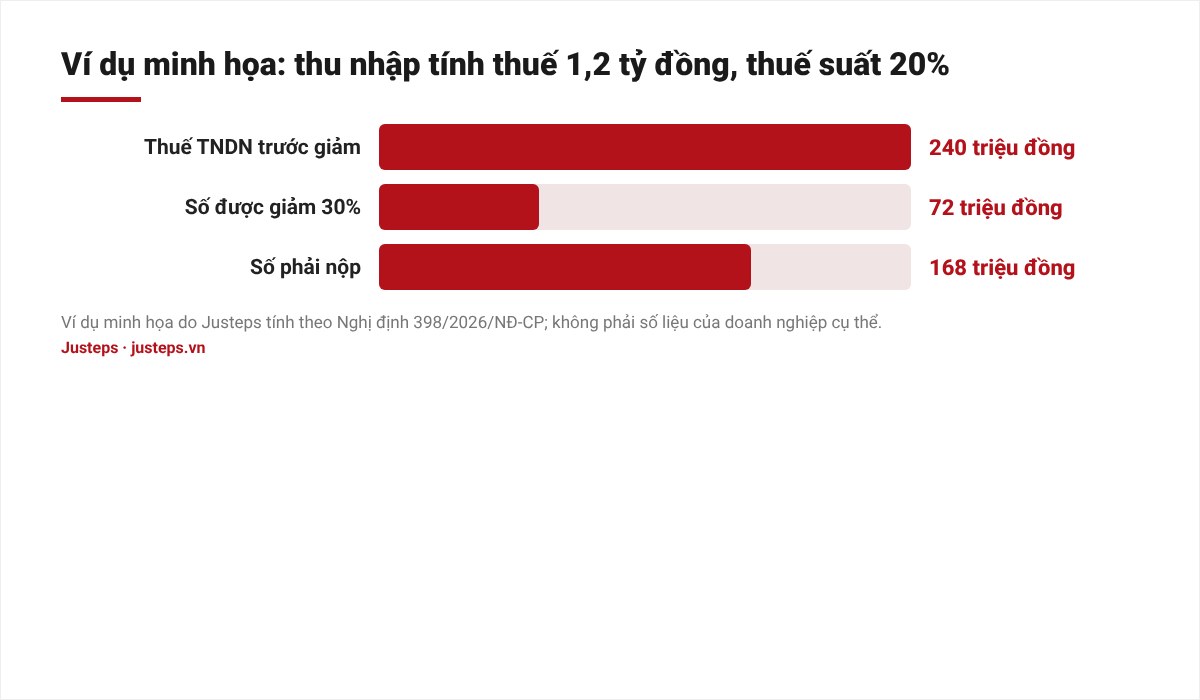
Illustrative example: taxable income of VND 1.2 billion at a 20% rate, leaving VND 168 million payable.
In the illustrative example above, tax before reduction is VND 240 million, the reduction is VND 72 million and the amount payable is VND 168 million. The 20% rate is for illustration only; each enterprise must apply its own rate under the CIT Law.
For 2026, the Decree took effect on 29 October 2026 after three quarters had already been paid. The accountant should prepare a full-year 2026 calculation, determine the corresponding reduction and reflect it in the fourth-quarter provisional payment or the annual finalization, after checking guidance from the tax office directly managing the enterprise.
Self-determination workflow and internal control
Small enterprises often have only one or two accountants, so control steps get skipped. At a minimum, separate preparation from approval: the general accountant prepares the calculation, the chief accountant reviews it and the director signs off before the return is filed.
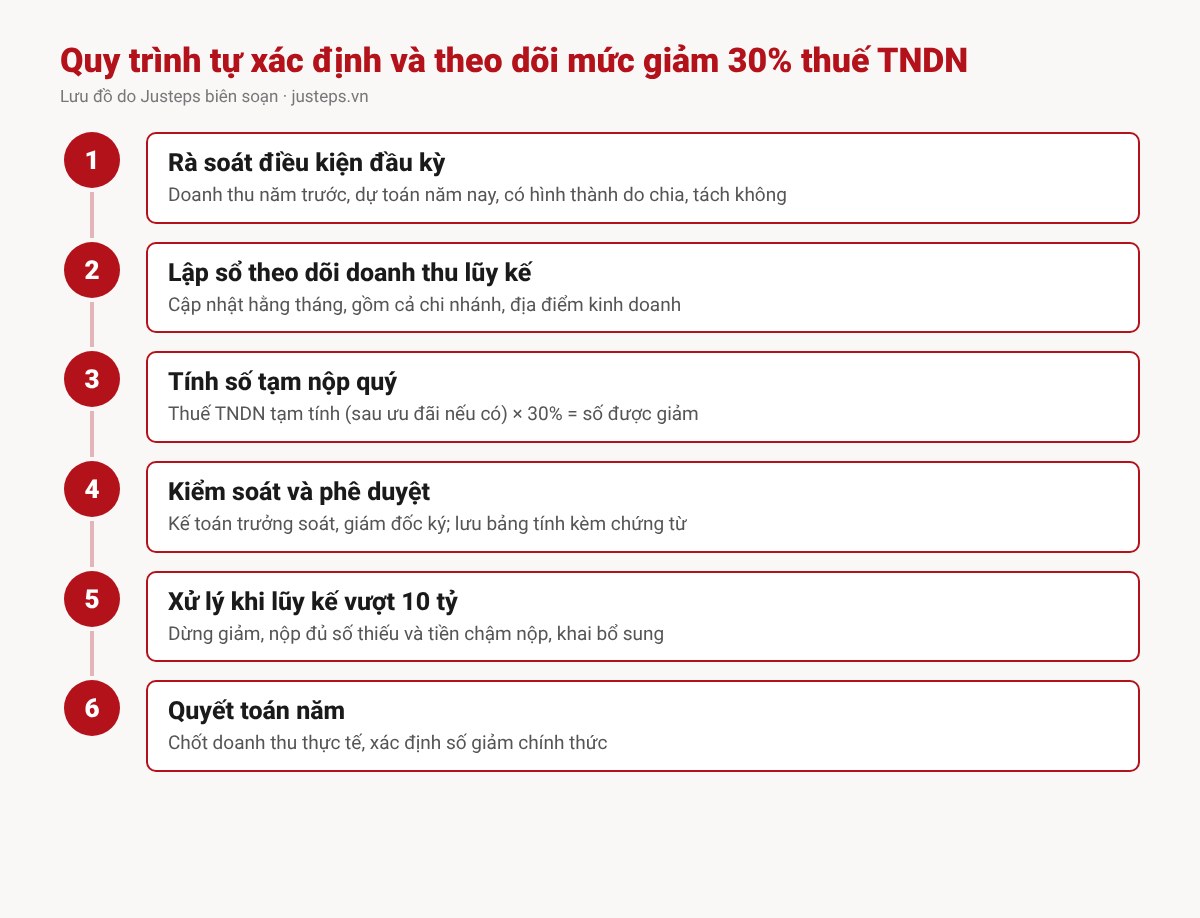
Six steps to self-determine and monitor the 30% CIT reduction during the year.
The file kept for each quarter should include: the signed cumulative revenue tracking sheet, the provisional tax calculation showing a "30% reduction" line, a short explanation if the enterprise enjoys other incentives, and a copy of the filed return. Enterprises recently formed by division or separation should also keep records of the revenue of all resulting enterprises to prove that the combined revenue is within the threshold.
When revenue exceeds VND 10 billion
If actual revenue for the year exceeds VND 10 billion, the enterprise must pay the full amount previously reduced plus late payment interest under Article 24 of Decree No. 252/2026/ND-CP. It may file a supplementary declaration or settle the matter in the annual finalization (Decree No. 398/2026/ND-CP).
Operationally, once the tracking sheet shows cumulative revenue above the threshold, the accountant stops claiming the reduction from that quarter, recalculates the shortfall for earlier quarters and proposes immediate payment to the director to limit late payment interest. Do not wait for finalization: interest accrues daily. The sales team should also be told early, because one large contract signed in December can wipe out the reduction for the whole year.
Operational mistakes to avoid
Leaving out financial income and other income when testing the threshold. Applying 30% to tax before incentives instead of after. Not adding the revenue of dependent branches. Checking the threshold only once at finalization. Not keeping an approved calculation, which makes it hard to explain figures during an inspection.
Legal basis
- Decree No. 398/2026/ND-CP of the Government on reduction of personal income tax and corporate income tax for individuals and enterprises, issued and effective from 29 October 2026, applicable to the 2026 and 2027 tax periods.
- Resolution No. 43/2026/QH16 of the National Assembly (detailed by Decree No. 398/2026/ND-CP).
- Law on Corporate Income Tax No. 67/2025/QH15.
- Decree No. 252/2026/ND-CP (late payment interest under Article 24).
How Justeps can help
- Reviewing eligibility for the 30% CIT reduction and how threshold revenue is determined, including enterprises with branches or recently divided or separated.
- Setting up a cumulative revenue tracking sheet and quarterly provisional tax calculation templates.
- Developing financial regulations and internal control procedures for tax filing, with clear preparation, review and approval roles.
- Ongoing tax and business operations advice, including supplementary declarations when revenue exceeds the threshold.
Contact Justeps for advice on your enterprise's specific situation.
Frequently asked questions
Does the enterprise need tax authority approval before claiming the reduction?
No. The enterprise determines the reduction itself when making quarterly provisional payments and is responsible for the figures. It should therefore keep the revenue tracking sheet and approved calculations on file.
Does bank deposit interest count toward the VND 10 billion threshold?
Yes. Threshold revenue includes financial income and other income in addition to revenue from goods and services.
How is the 30% calculated if the enterprise already has a 50% investment incentive reduction?
The 30% applies to the tax remaining after the incentive. For example, if original tax is VND 200 million and VND 100 million remains after the incentive, the additional reduction is VND 30 million.
What if the enterprise only discovers in Q4 that revenue exceeds VND 10 billion?
It must pay the amounts reduced in earlier quarters plus late payment interest under Article 24 of Decree No. 252/2026/ND-CP, through a supplementary declaration or at annual finalization. Paying as soon as the issue is found keeps interest down.
Can a company newly separated from its parent apply the reduction?
Not if the separation took place after Resolution No. 43/2026/QH16 took effect and the combined revenue of the resulting enterprises exceeds VND 10 billion.
Related articles
- Controlling advertising content: a pre-publication approval process
- Fire safety records for business premises under the new law: annual tasks
- Amended CIT and PIT laws passed on 20 November 2026: how enterprises should prepare for the 2027 tax year
- Pay scales for F&B chains with outlets in several minimum wage regions
Contact Justeps
Email: info@justeps.vn · Hotline/Zalo: 096 172 2607 · Website: justeps.vn
Office network
- Thanh Xuan Office: 12th Floor, Licogi 13 Tower, 164 Khuat Duy Tien, Thanh Xuan Ward, Hanoi
- Ha Dong Office: LK06B, No.10, Dong Dua Area, Ha Dong Ward, Hanoi
- Ho Chi Minh City Branch: 528 Le Van Sy, Nhieu Loc Ward, HCMC (formerly Ward 14, District 3)
- Hai Phong Office: Truong Thinh Village, Ha Dong Commune, Hai Phong
- Quang Ninh Office: Van Don Special Zone, Quang Ninh





