
Key takeaways
- Every governance commitment in the investment agreement needs to be turned into provisions of the charter, internal regulations and the reporting calendar, otherwise the company and the investor can easily fall into dispute over whether those commitments are binding.
- The amended charter should be prepared before the closing date and adopted together with the resolution on the share issue, so that the investor has its rights as soon as it becomes a shareholder.
- An investor cannot receive voting preference shares, so veto rights are usually designed through higher approval thresholds in the charter combined with a shareholders' agreement.
- The allocation of authority between the General Meeting of Shareholders, the Board of Directors and the general director needs to be recorded in a matrix with specific value thresholds.
- When a foreign investor takes part, the business must check in advance whether the transaction falls within the cases requiring registration of the capital contribution or share purchase with the investment registration authority.
A joint stock company in the distribution sector has just received capital from an investment fund, which now holds around twenty-five per cent of its shares. The investment agreement runs to dozens of pages, under which the fund has one seat on the Board of Directors, a right of prior consent over the annual budget, large loans and the issue of additional shares, and the right to receive monthly financial reports. Three months after the money arrives, the charter is still the old version, the fund's representative has not yet been elected to the Board of Directors, and the general director still signs loans in the way he always has. Only when the fund objects to a loan do the two sides realise that the commitments in the agreement have not been turned into rules that are binding within the company.
This article sets out how to adjust the governance model after fundraising in the order in which the work is done, from identifying the changes required, the timing of the charter amendment and the arrangement of a Board seat for the investor, to designing the list of matters requiring the investor's consent, delegation of executive authority and the reporting regime, and then the procedures where a foreign investor is involved. The content mainly applies to non-public joint stock companies raising capital through a private placement of shares or a share transfer, and may also serve as a reference for limited liability companies admitting new capital-contributing members. The main readers are founders, members of the Board of Directors, general directors and the persons in charge of legal and finance matters in businesses that are raising or have just raised capital.
How governance changes once there is an investor
Before raising capital, many companies operate on the basis that the founders talk to each other directly and decide quickly, while meetings of the General Meeting of Shareholders and the Board of Directors are largely a formality. Once there is an investor, important decisions must pass through more layers and must be recorded in writing, because the investor needs a basis on which to monitor the capital it has put in. This change does not take executive control away from the founders, but it requires the company to know clearly which decision belongs to whom and under what procedure. The changes commonly seen include the following:
- The Board of Directors meets periodically on a fixed schedule, with materials sent in advance and minutes and resolutions kept in full.
- Certain important decisions, such as the annual budget, large loans and the issue of additional shares, require the investor's consent.
- The authority of the general director is limited by specific value thresholds rather than being implicitly understood.
- The company must prepare and send financial statements and management reports in the agreed format and by the agreed deadlines.
- Transactions between the company and the founders or their related persons must be controlled more tightly.
Each of these changes needs to be recorded in at least one of three types of document, namely the company charter, the internal governance regulations and the shareholders' agreement. The charter is binding on the company and all shareholders, whereas a shareholders' agreement binds only the parties who have signed it. Therefore, rights that the investor wants to be effective against the company itself, such as voting approval thresholds or the authority of the Board of Directors, need to be included in the charter rather than remaining only in the agreement.
Timing of the adjustment and the sequence of steps
In principle, the most appropriate time to adjust the governance model is before the closing date of the transaction. The draft amended charter should be negotiated in parallel with the investment agreement, and then adopted by the General Meeting of Shareholders at the same time as the resolution on the share offering plan. Amending and supplementing the charter falls within the authority of the General Meeting of Shareholders[1], and a resolution on this matter is adopted when shareholders holding at least 65% of the total votes of shareholders attending the meeting vote in favour, unless the charter provides otherwise[2]. If the matter is left until after the transaction, the investor is already a shareholder and every amendment has to be renegotiated at a time when the parties' interests have already shifted.
The business should also calculate in advance the shareholding of each group of shareholders after the transaction, because these percentages determine who has enough votes to adopt or block important resolutions on its own. An investor holding more than 35% of the voting shares may in practice be able to block resolutions requiring a 65% threshold if all shareholders attend the meeting, so the founders need to know this before signing rather than afterwards. The flowchart below summarises the typical sequence from the signing of the investment agreement to the completion of registration of the changes.
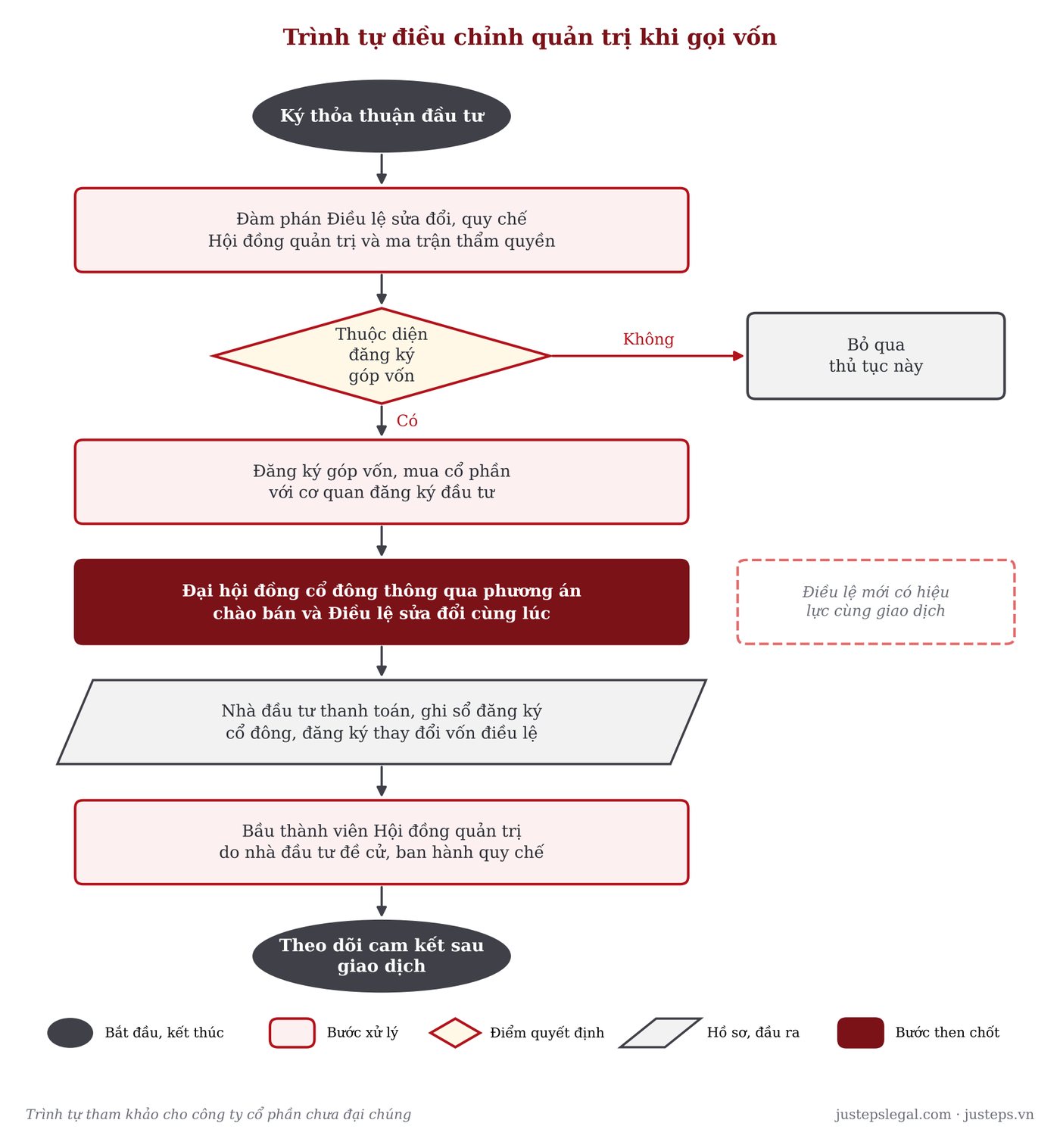
Sequence for adjusting governance in connection with a fundraising transaction
According to the flowchart, after the investment agreement is signed, the company checks whether the foreign investor falls within the cases requiring registration of the capital contribution or share purchase, because if so, this procedure must be completed before the new shareholder is recorded. Next, the General Meeting of Shareholders adopts the offering plan and the amended charter at the same time, the investor pays for the shares, and the company updates the register of shareholders and registers the change in charter capital. The final step is to elect the member of the Board of Directors nominated by the investor and issue the new internal regulations, so that all commitments take effect from the first day the investor becomes a shareholder.
The investor's seat on the Board of Directors
The right to have a representative on the Board of Directors is usually the most important commitment for the investor. The Board of Directors has from three to eleven members, with the exact number set by the charter[3], so when admitting a new investor the company may need to increase the number of members in order for the founding group to keep its majority. A shareholder or group of shareholders holding 10% or more of the total ordinary shares has the right to nominate candidates to the Board of Directors in accordance with the Law on Enterprises and the charter[4].
A point to note is that members of the Board of Directors must be elected by cumulative voting, unless the charter provides otherwise[5]. Under cumulative voting, the outcome depends on the shareholdings and on how shareholders allocate their votes, so a minority investor is not certain to be elected if the founding group concentrates its votes on other candidates. For this reason, the parties usually undertake in the shareholders' agreement that the founding group will vote for the candidate nominated by the investor, or redesign the voting method in the charter. In addition, the charter or the operating regulations of the Board of Directors should state clearly the minimum number of members required for a valid meeting and that the member nominated by the investor receives materials at the same time as the other members.
The list of matters requiring the investor's consent
Investors usually require a right of prior consent over certain decisions that could change the value of their investment. A common approach in other countries is to issue the investor a class of shares with special voting rights, but under the Law on Enterprises, voting preference shares are reserved for organisations authorised by the Government and for founding shareholders, and the preference of founding shareholders is effective only for three years from the date on which the company is issued its Enterprise Registration Certificate[6]. An investor may still buy dividend preference shares, redeemable preference shares or other classes of preference shares provided for in the charter[7], but these classes do not create a right of veto.
Consent rights are therefore usually designed in two layers. The first layer is a charter provision raising the voting approval threshold for certain matters to a level that the founding group cannot reach on its own without the investor's votes. The second layer is the shareholders' agreement, in which the parties undertake not to vote in favour of certain matters without the investor's written consent. The list should be kept short, usually eight to twelve matters, because an overly long list forces the company to seek the investor's opinion even on routine operational matters. The matrix below suggests the level of decision for a number of typical matters.
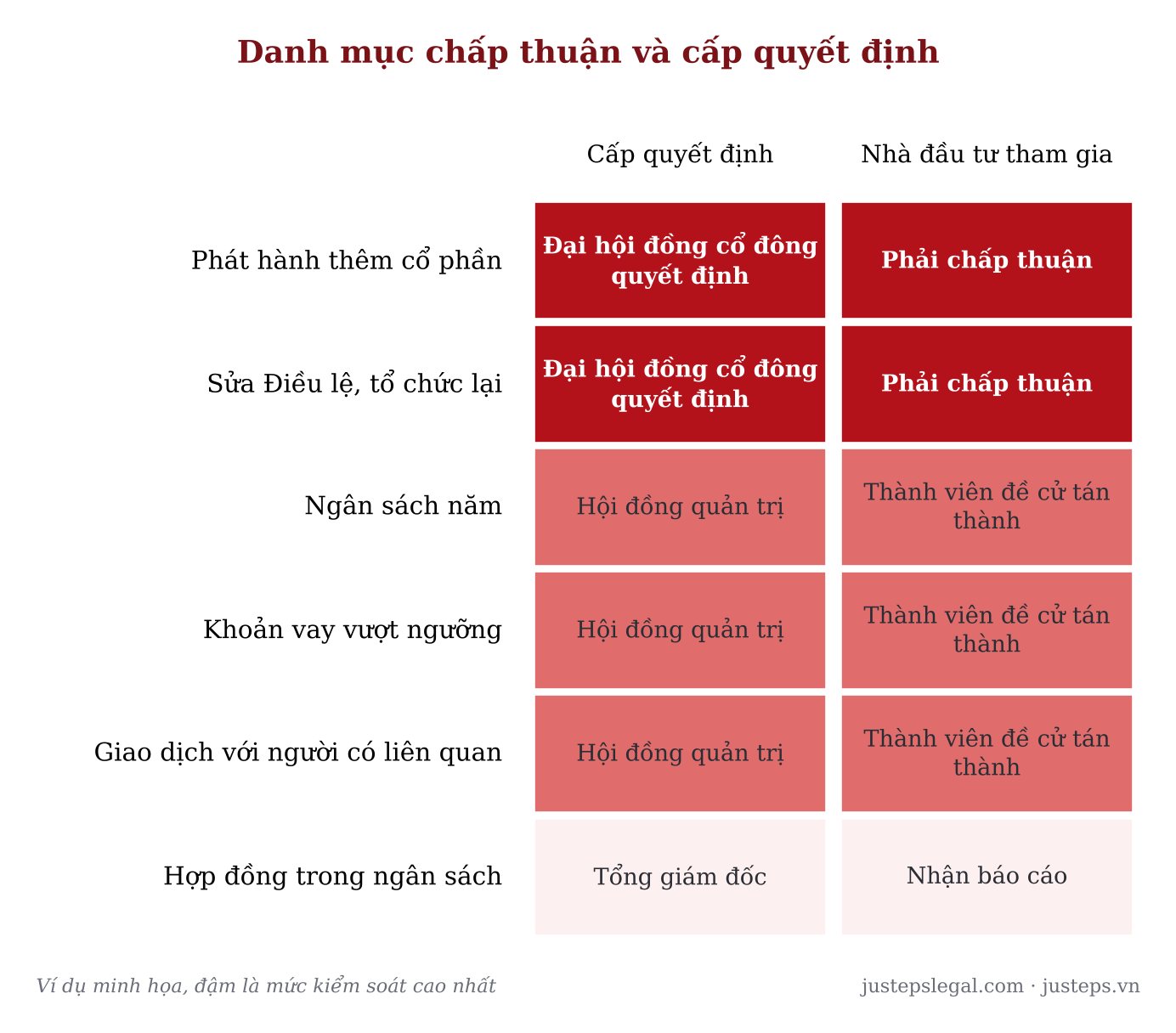
Level of decision and degree of investor involvement for typical matters
The matrix shows that matters which change the ownership structure, such as issuing additional shares, amending the charter or reorganising the company, require both a resolution of the General Meeting of Shareholders and the investor's consent. Major financial matters, such as the annual budget, loans above the threshold or transactions with related persons, are decided by the Board of Directors, on condition that the member nominated by the investor votes in favour. Ordinary business contracts within the approved budget remain within the authority of the general director, to preserve the speed of operations. The list and the levels in the matrix are illustrative and need to be adjusted to the size and the specific terms of each transaction.
Delegation of executive authority and the reporting regime
After fundraising, the authority of the general director needs to be limited by specific value thresholds in the regulations on delegation of authority. The Law on Enterprises already defines the authority of the Board of Directors[8] and requires contracts and transactions between the company and related persons to be approved by the General Meeting of Shareholders or the Board of Directors according to value thresholds[9]. On that basis, the company should prepare an authority matrix stating clearly which level approves which type of matter, together with value thresholds expressed as amounts of money or as percentages of total assets. The table below suggests how to structure these levels for a medium-sized company.
| Decision level | Typical scope | Accompanying conditions |
|---|---|---|
| General Meeting of Shareholders | Amending the charter, issuing additional shares, reorganisation, dissolution and transactions within its statutory authority. | The approval threshold under the law or a higher threshold set by the charter. |
| Board of Directors | The annual budget, loans above the threshold, appointing the general director and related-party transactions within its authority. | The member nominated by the investor votes in favour of matters on the consent list. |
| General director | Business contracts within the approved budget and below the set value threshold. | Periodic reports to the Board of Directors on the contracts signed. |
| Division directors | Operating expenses and small purchases within limits delegated in writing. | May not sign transactions with related persons. |
Alongside delegation of authority, the reporting regime is the tool that allows the investor to monitor its capital without interfering in day-to-day management. A shareholder or group of shareholders holding 5% or more of the total ordinary shares already has certain statutory rights of access to information, such as reviewing and obtaining extracts of minutes and resolutions of the Board of Directors and financial statements[4], but these rights are not sufficient for monthly monitoring. The parties should therefore agree on a standard report template covering business results against budget, cash flow, receivables and payables, major contracts signed and any unusual events, together with specific deadlines for sending it. The timeline below illustrates a reporting calendar over the year.
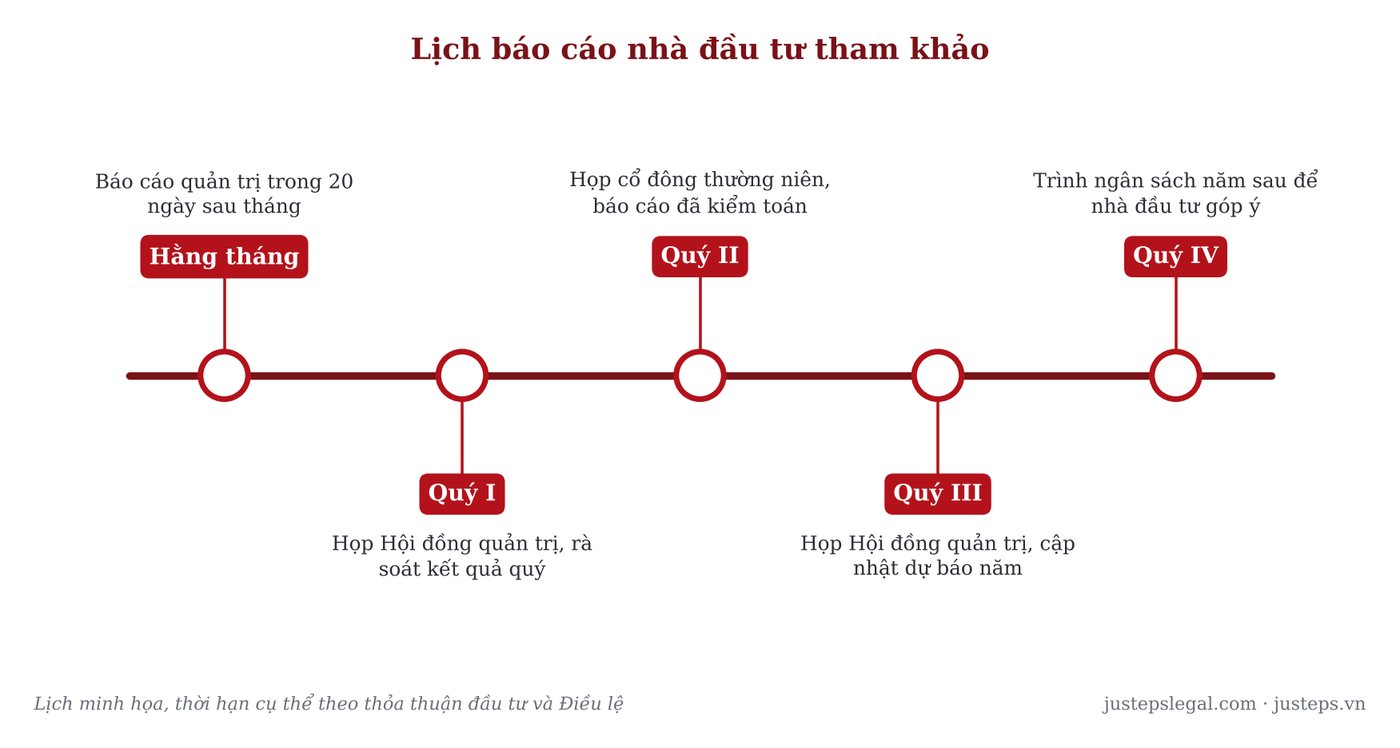
Calendar of investor reporting and Board of Directors meetings over a financial year
In this example, the monthly management report is sent within twenty days after the end of each month, the Board of Directors meets every quarter to review results and the matters on the consent list, and the audited annual financial statements are sent before the annual General Meeting of Shareholders. The budget for the following year is submitted to the Board of Directors in the last quarter so that the investor has time to comment. Each report needs a person responsible for preparing it and a person who approves it, and its figures must be reconciled with the accounting books, because inaccurate reports may lead to a breach of the commitments in the investment agreement. A business that needs to design its charter, Board regulations and authority matrix as a consistent set may refer to the Justeps service corporate governance.
Procedures when a foreign investor is involved and registration of changes
When the investor is a foreign organisation or individual, the business must check in advance whether the transaction falls within the cases requiring registration of the capital contribution or share purchase with the investment registration authority. Under the Law on Investment, this procedure is mandatory before the change of shareholders in three cases, namely a capital contribution or share purchase that increases the foreign investor's ownership in an economic organisation engaged in a business line subject to market access conditions, a capital contribution or share purchase that results in foreign investors holding more than 50% of the charter capital or that increases their ownership when they already hold more than 50%, and a capital contribution or share purchase in an economic organisation holding a land use right certificate on an island, in a border or coastal area or in another area affecting national defence and security[10]. Outside these cases, the foreign investor only needs to complete the procedure for changing shareholders or members under the law on enterprises[11].
The business should also note that when foreign investors hold more than 50% of the charter capital, that economic organisation must satisfy the conditions and carry out the procedures applicable to foreign investors when it establishes another economic organisation, contributes capital to another economic organisation or implements a new investment project[12]. As regards corporate procedures, after completing a share offering, the company must register the change in charter capital within ten days from the date on which the offering is completed[13], following the dossier and procedure set out in the decree on enterprise registration[14]. The resolution electing the member of the Board of Directors, the amended charter and the updated register of shareholders need to be kept at the head office together with the transaction documents. A business preparing for a transaction may refer to the Justeps service fundraising and private placement of shares to prepare the issuance documents and the governance documents as a consistent set.
Common mistakes after fundraising
From Justeps' experience supporting businesses after fundraising transactions, the following mistakes occur quite often and are frequently the cause of conflict between founders and investors:
- The investor's veto rights appear only in the investment agreement and are not reflected in the charter, so a resolution that contradicts the agreement is still adopted at the statutory threshold.
- The person nominated by the investor has not yet been elected to the Board of Directors but still votes or signs documents as if a full member.
- The company registers the change in charter capital later than the deadline, or records the new shareholder before completing the procedure for registering the capital contribution of a foreign investor.
- The regulations on delegation of authority are not updated, so the general director continues to sign contracts that fall within the list of matters requiring consent.
- Reports sent to the investor are prepared manually, using a different format each period, and cannot be reconciled with the accounting books.
To avoid these mistakes, the business should prepare a post-transaction commitment tracker listing each governance commitment in the investment agreement, the internal document that gives effect to it, the person in charge and the completion deadline. The minimum set of documents comprises the amended charter, the related resolutions of the General Meeting of Shareholders and the Board of Directors, the operating regulations of the Board of Directors, the authority matrix, the investor report template and the dossier for registration of changes. This tracker should be reviewed at every meeting of the Board of Directors during the first year after the transaction, until all commitments have been fully performed.
How Justeps can help
Justeps supports businesses in adjusting their governance model before and after a fundraising transaction through the following services:
- Fundraising and private placement of shares. Justeps prepares the offering plan, resolutions and the dossier for registration of the change in charter capital in line with the amended charter.
- Shareholders' agreements and founders' capital contributions. Justeps drafts shareholders' agreements covering nomination rights, the consent list and voting undertakings, consistent with the charter.
- Corporate governance. Justeps drafts the amended charter, the operating regulations of the Board of Directors and the authority matrix after fundraising.
- Financial regulations and delegation of authority. Justeps designs approval thresholds for the general director and division directors that are consistent with the commitments made to investors.
- Corporate secretarial support and periodic review. Justeps helps organise meetings, prepare minutes and resolutions and track the performance of governance commitments in the first year after the transaction.
Frequently asked questions
Can an investor receive voting preference shares?
No. Voting preference shares are reserved for organisations authorised by the Government and for founding shareholders[6]. Investors are usually protected through higher approval thresholds in the charter and voting undertakings in the shareholders' agreement.
Can the charter set an approval threshold higher than 65%?
The Law on Enterprises allows the charter to set the approval threshold for resolutions of the General Meeting of Shareholders[2]. However, an excessively high threshold may lead the company into deadlock, so it should be applied only to a list of matters that are genuinely important.
Can an investor holding less than 10% of the shares nominate a member of the Board of Directors?
The statutory right of nomination belongs to a shareholder or group of shareholders holding 10% or more of the total ordinary shares[4]. A smaller investor may obtain an undertaking from the founding group in the shareholders' agreement to nominate or vote for its candidate.
Is the company obliged to send monthly reports to the investor?
The law does not require a non-public joint stock company to send monthly reports to its shareholders. This obligation arises from the investment agreement, so the report template, deadlines and the person responsible need to be stated clearly in the agreement and the internal regulations.
Must a foreign investor buying 30% of the shares register with the investment registration authority?
This depends on the company's business lines and the location of its land. If the company is engaged in a business line subject to market access conditions for foreign investors or has land in an area affecting national defence and security, prior registration is required[10], while in other cases only the procedure for changing shareholders under the law on enterprises is carried out[11].
Within what period must the company register the change in charter capital after a share offering?
The company must register the change in charter capital within ten days from the date on which the share offering is completed[13]. The dossier needs to include the resolution and documents proving that payment for the shares has been received in full.
Can a shareholders' agreement replace the charter?
No. A shareholders' agreement binds only the parties who have signed it, whereas the charter binds the company and all shareholders[15]. Rights that the investor wants to be effective against the company itself need to be included in the charter.
Related articles
- What a founding shareholders’ agreement should contain so that the company runs smoothly when the parties’ interests diverge
- Private placement of shares by a non-public joint stock company, internal procedure and registration of changes
- Founders' shareholder agreement, governance provisions, vesting, veto rights and exit mechanisms
- When a mid-sized company needs an executive committee and specialised committees, and how to design them without exceeding authority
Notes
[1] Clause 2, Article 138 of the Law on Enterprises No. 59/2020/QH14 dated 17 June 2020, as amended and supplemented by Law No. 76/2025/QH15.
[2] Clause 1, Article 148 of the Law on Enterprises No. 59/2020/QH14.
[3] Clause 1, Article 154 of the Law on Enterprises No. 59/2020/QH14.
[4] Clauses 2 and 5, Article 115 of the Law on Enterprises No. 59/2020/QH14.
[5] Clause 3, Article 148 of the Law on Enterprises No. 59/2020/QH14.
[6] Article 116 of the Law on Enterprises No. 59/2020/QH14.
[7] Clause 2, Article 114 of the Law on Enterprises No. 59/2020/QH14.
[8] Clause 2, Article 153 of the Law on Enterprises No. 59/2020/QH14.
[9] Article 167 of the Law on Enterprises No. 59/2020/QH14.
[10] Clause 3, Article 21 of the Law on Investment No. 143/2025/QH15 dated 11 December 2025, effective from 1 March 2026.
[11] Article 76 of Decree No. 96/2026/ND-CP dated 31 March 2026 detailing the implementation of the Law on Investment.
[12] Clause 1, Article 20 of the Law on Investment No. 143/2025/QH15.
[13] Clause 4, Article 123 of the Law on Enterprises No. 59/2020/QH14.
[14] Decree No. 168/2025/ND-CP dated 30 June 2025 on enterprise registration, as amended and supplemented by Decree No. 296/2026/ND-CP.
[15] Article 24 of the Law on Enterprises No. 59/2020/QH14.
This article is for reference and reflects the regulations in force at the time of publication. Please consult Justeps for advice tailored to your company’s records and situation.
For further information, please contact:
📩 Email: info@justeps.vn
🌐 Website: https://justepslegal.com · https://justeps.vn
🌐 Page: Justeps
☎️ Hotline (Zalo): 096 172 2607
📍 Thanh Xuan Office: 12th Floor, Licogi 13 Tower, 164 Khuat Duy Tien Street, Thanh Xuan Ward, Hanoi, Vietnam
📍 Ha Dong Office: LK06B, No.10, Dong Dua Area, Ha Dong Ward, Hanoi, Vietnam
📍 Ho Chi Minh City Branch: 528 Le Van Sy, Ho Chi Minh City, Vietnam
📍 Hai Phong Office: Truong Thinh Village, Ha Dong Commune, Hai Phong, Vietnam
📍 Quang Ninh Office: Van Don Special Zone, Quang Ninh Province, Vietnam





