
On 20 November 2026, the National Assembly passed the Law amending and supplementing a number of articles of the Law on Corporate Income Tax, the Law on Non-agricultural Land Use Tax and the Law on Personal Income Tax. Most of its provisions take effect on 1 January 2027, so they apply straight away to the 2027 tax year. Enterprises have about five weeks to prepare before the new tax period begins.
The practical question is who in the company must do what in December and in Q1/2027. This article summarizes the changes that affect operations and provides a task list with owners and deadlines.
Key changes enterprises need to know
The law has 4 articles and amends three tax laws at once. It generally takes effect on 1 January 2027; the 0.2% tax on abandoned land applies from 1 July 2027, and the rule stabilizing land prices used for tax for 3 years applies from 1 January 2028 (under the amending tax law). Notable income tax changes include:
- The revenue threshold for choosing the CIT and PIT calculation method rises from VND 3 billion to VND 10 billion, from the 2027 tax period.
- Small and medium-sized enterprises (SMEs) are exempt from CIT for 3 years, except enterprises formed through merger, consolidation, division, separation, conversion or newly established after dissolving an enterprise with the same owner.
- Large and lead enterprises may deduct costs of training, technical consulting and technology transfer provided to SMEs in their value chain.
- Enterprises employing many workers with disabilities receive a CIT reduction equal to the additional amounts spent on these workers.
- CIT and PIT exemption for organizations and individuals supplying meals to educational and healthcare facilities.
- Clauses 4 and 5, Article 10 of Resolution No. 198/2025/QH15 are repealed.
The official number of the law and its implementing documents had not been published at the time of writing. Details such as when the 3-year exemption starts, documents proving SME status and what counts as "employing many workers with disabilities" must await decrees and circulars. The preparation below focuses on what enterprises can do now, regardless of guidance.
3-year exemption for SMEs: confirm eligibility first
The first step is to determine whether the company is an SME, based on the criteria of employees participating in social insurance, revenue or capital under the Law on Support for SMEs No. 04/2017/QH14 and Decree No. 80/2021/ND-CP. Accounting takes 2026 figures, and HR confirms the average number of employees in social insurance.
The second step is to check the company's legal history. The law excludes enterprises formed through merger, consolidation, division, separation, conversion, or newly established after dissolving an enterprise with the same owner. Legal or the company secretary should gather all amended enterprise registration certificates and restructuring resolutions to answer this question clearly. For groups of companies under common ownership, list each entity and how it was formed.
Note also that in 2027, enterprises with revenue of no more than VND 10 billion still receive a 30% CIT reduction under Decree No. 398/2026/ND-CP. If an enterprise is already exempt for 3 years, there is no tax left to reduce; enterprises outside the exemption should keep tracking this reduction.
The VND 10 billion threshold for choosing a tax calculation method
The revenue threshold for choosing a calculation method rises from VND 3 billion to VND 10 billion from the 2027 tax period. Many enterprises and household or individual businesses with revenue between VND 3 and 10 billion will therefore have more options. Which option is better depends on actual profit margins and how complete the expense documentation is.
The chief accountant should prepare a comparison of 2026 tax under each method and submit it to the director for a decision before the first 2027 filing. The decision should be documented with reasons and approver, because changing the method also changes bookkeeping and record keeping for the whole year.
Costs of supporting SMEs in the value chain
Large or lead enterprises that train, send engineers to coach, or transfer technology to small suppliers can treat these costs as deductible. To avoid disallowance at finalization, standardize from the start of the year: a support contract or agreement stating the content and that the beneficiary is an SME in the chain; a supplier list with evidence of size; invoices, expert timesheets and training acceptance minutes.
Purchasing and finance should agree on a dedicated cost code in the accounting software to separate these costs from ordinary selling or administrative expenses.
Tax reduction for employing workers with disabilities
Enterprises employing many workers with disabilities receive a tax reduction equal to the additional spending on these workers. The operational key is proving the "additional" spending: allowances, workplace modifications, assistive equipment, dedicated training. HR reviews disability certification in employee files, and accounting opens a detailed ledger for these costs from January 2027.
Task list, owners and deadlines
| Task | Owner | Deadline | Output |
|---|---|---|---|
| Determine SME status based on 2026 figures | Chief accountant, HR manager | 15/12/2026 | Criteria review minutes |
| Review history of merger, consolidation, division, separation, conversion, dissolution | Legal or company secretary | 15/12/2026 | Entity formation table |
| Compare and choose the tax calculation method under the VND 10 billion threshold | Chief accountant, approved by director | 31/12/2026 | Internal decision on calculation method |
| Update financial regulations on value-chain SME support costs | CFO, Purchasing | 31/12/2026 | Amended regulations, support agreement template |
| Review files of workers with disabilities, set up ledger for additional spending | HR manager, General accountant | 15/01/2027 | Employee list, detailed ledger |
| Configure cost codes and exemption/reduction tracking in software | General accountant, IT | 31/01/2027 | New cost code list |
| Monitor implementing decrees and circulars, adjust before Q1/2027 provisional payment | Chief accountant | Before Q1/2027 provisional payment deadline | Regulatory update memo |
This table should be included in the December 2026 management meeting minutes so tasks are formally assigned and someone tracks progress.
Preparation roadmap Q4/2026 – Q1/2027
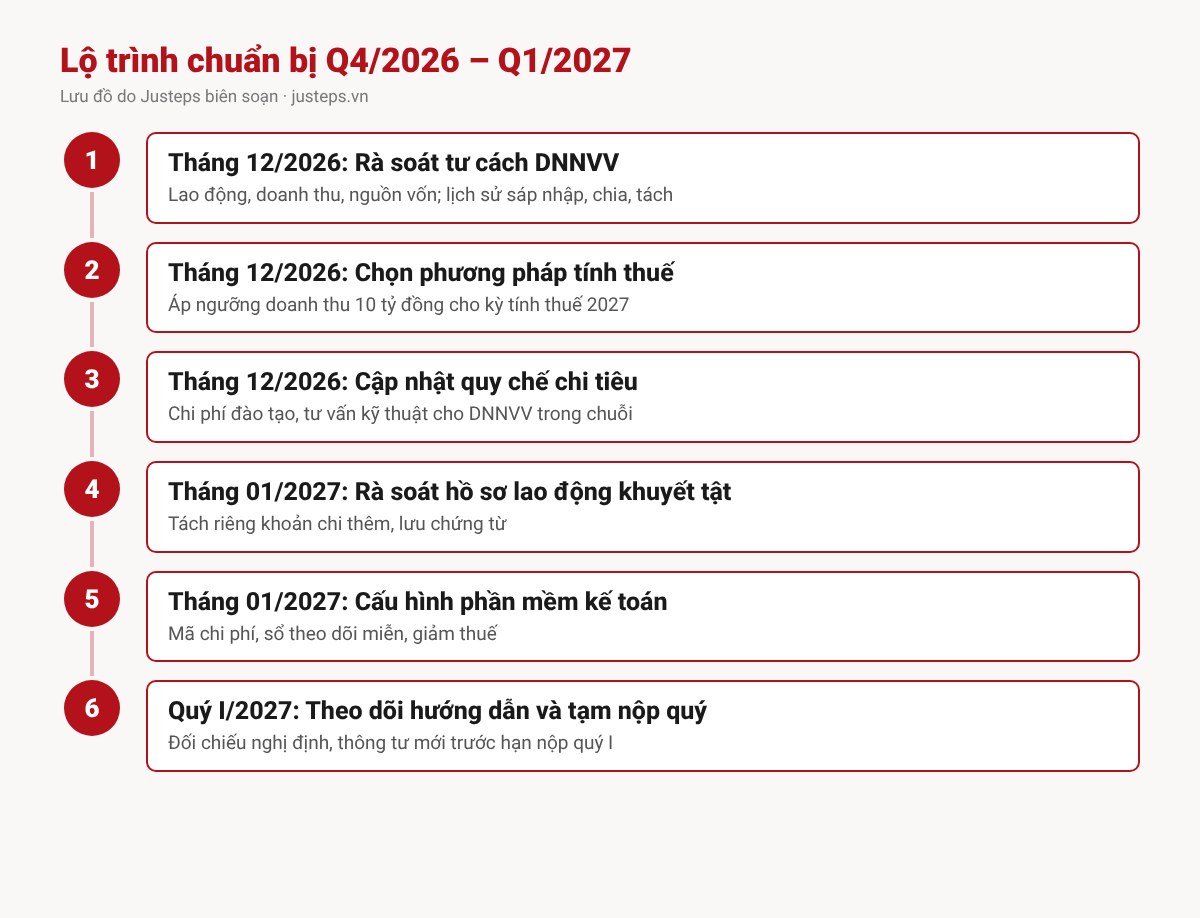
A six-step roadmap to prepare for the 2027 tax period under the amended tax law.
The order matters: SME status drives most of the later tasks, and software configuration should follow approval of the regulations to avoid rework. Detailed guidance may be issued in Q1/2027, so set a review checkpoint before the first quarterly provisional payment deadline.
Common operational risks
Applying the exemption when the company was formed through conversion, division or separation. Choosing a calculation method without assessing whether expense documents can be collected during the year. Recording value-chain support costs for suppliers that do not meet SME criteria. Failing to separate additional spending on workers with disabilities from ordinary wages. These errors usually surface only at finalization or inspection, when supplementing records is much harder.
Legal basis
- Law amending and supplementing a number of articles of the Law on Corporate Income Tax, the Law on Non-agricultural Land Use Tax and the Law on Personal Income Tax, passed by the 16th National Assembly at its 2nd session on 20 November 2026, effective 1 January 2027 (certain non-agricultural land use tax provisions effective 1 July 2027 and 1 January 2028).
- Decree No. 398/2026/ND-CP of the Government on reduction of personal income tax and corporate income tax, effective 29 October 2026, applicable to the 2026 and 2027 tax periods.
- Resolution No. 198/2025/QH15 of the National Assembly on special mechanisms and policies for private economic development.
- Law on Support for Small and Medium-sized Enterprises No. 04/2017/QH14.
- Decree No. 80/2021/ND-CP detailing a number of articles of the Law on Support for Small and Medium-sized Enterprises.
How Justeps can help
- Reviewing SME status and eligibility for the 3-year CIT exemption, including for groups with a restructuring history.
- Analyzing and comparing options for choosing a tax calculation method for the 2027 tax period.
- Amending financial regulations, internal spending rules and support agreement templates for value-chain suppliers.
- Reviewing employee files and policies for workers with disabilities.
- Ongoing tax advice and updates on implementing documents throughout 2027.
Contact Justeps to plan the preparation that fits your enterprise.
Frequently asked questions
When does the amending tax law take effect?
Generally from 1 January 2027. The 0.2% tax on abandoned land applies from 1 July 2027, and the 3-year stabilization of land prices for tax purposes applies from 1 January 2028.
Is a company converted from a limited liability company to a joint stock company eligible for the 3-year exemption?
The law excludes enterprises formed through conversion, as well as merger, consolidation, division, separation and new establishment after dissolving an enterprise with the same owner. Enterprises should check the detailed guidance once issued.
Can an enterprise exempt for 3 years still receive the 30% reduction under Decree No. 398/2026/ND-CP?
Once exempt, there is no tax payable left to reduce. The 30% reduction matters for enterprises with revenue of no more than VND 10 billion that are not exempt.
What documents support training costs for small suppliers?
A support agreement, evidence that the supplier is an SME in the chain, invoices, payment records and acceptance minutes. The official list will follow implementing guidance.
Who in the company should lead the preparation?
The chief accountant or CFO should act as the focal point, working with HR, legal and purchasing; the director approves decisions on the calculation method and regulations.
Related articles
- Controlling advertising content: a pre-publication approval process
- Fire safety records for business premises under the new law: annual tasks
- 30% CIT reduction under Decree No. 398/2026/ND-CP: how accountants self-determine it and track the VND 10 billion threshold
- Checklist for opening a Da Nang branch of a Hanoi-based company
Contact Justeps
Email: info@justeps.vn · Hotline/Zalo: 096 172 2607 · Website: justeps.vn
Office network
- Thanh Xuan Office: 12th Floor, Licogi 13 Tower, 164 Khuat Duy Tien, Thanh Xuan Ward, Hanoi
- Ha Dong Office: LK06B, No.10, Dong Dua Area, Ha Dong Ward, Hanoi
- Ho Chi Minh City Branch: 528 Le Van Sy, Nhieu Loc Ward, HCMC (formerly Ward 14, District 3)
- Hai Phong Office: Truong Thinh Village, Ha Dong Commune, Hai Phong
- Quang Ninh Office: Van Don Special Zone, Quang Ninh





