
Key takeaways
- Companies should start preparing the annual budget in November, when ten months of actual figures are available and there is still time to factor in the new regional minimum wages applying from 1 January 2027.
- The annual business plan must be approved by the body with authority under the Law on Enterprises and the charter, while the Director is responsible for organising its implementation.
- The staff budget must include the insurance contributions that the company pays on wages, allowances and other regularly paid supplements, not just the agreed wages.
- A planned profit does not guarantee enough cash, so every budget should be accompanied by a monthly cash flow forecast that identifies early the months in which a shortfall may occur.
- A budget only works when there are budget management rules, a monthly report comparing actual results with the plan and clear rules on who may approve spending above budget.
In many small and medium-sized enterprises, the annual budget is prepared by the accountant in the last few days of December by taking the previous year’s figures and adding a desired growth rate. A budget prepared in this way usually has no one accountable for each figure, ignores changes in minimum wages, insurance or public holidays, and is hardly ever opened again until the end of the following year. When first-quarter revenue falls short of expectations or a major customer pays late, the management has no basis for deciding which costs to cut, which investments to postpone or how much more to borrow.
This article explains how to plan the annual budget in the order in which the work is done, covering the legal changes to build into the 2027 assumptions, approval authority and roles, the timetable from November to January, how to prepare each part of the budget, the cash flow forecast, the documents required and how to monitor and adjust the budget during the year. It is best suited to limited liability companies and joint stock companies with 30 to 200 employees; smaller companies may shorten the steps. It is written mainly for business owners, directors, chief accountants and heads of department.
Legal changes to build into the 2027 assumptions
The first step in budgeting is to agree a common set of assumptions, because every department must plan on the same foundation. Alongside business assumptions such as market growth, raw material prices, exchange rates and interest rates, 2027 brings several legal changes that directly affect staff costs and tax obligations. The chief accountant should prepare a separate list of these changes, stating when each applies and its estimated impact, and submit it to the management for sign-off before sending the templates to the departments.
Regional minimum wages rise from 1 January 2027
From 1 January 2027, the monthly minimum wage rises to VND 5,700,000 in Region I, VND 5,080,000 in Region II, VND 4,450,000 in Region III and VND 4,040,000 in Region IV, compared with VND 5,310,000, VND 4,730,000, VND 4,140,000 and VND 3,700,000 respectively in 2026[1]. This increase directly affects the lowest step in the wage scale and payroll and pushes up insurance contributions for positions paid close to the minimum. The chart below compares the two sets of rates by region.
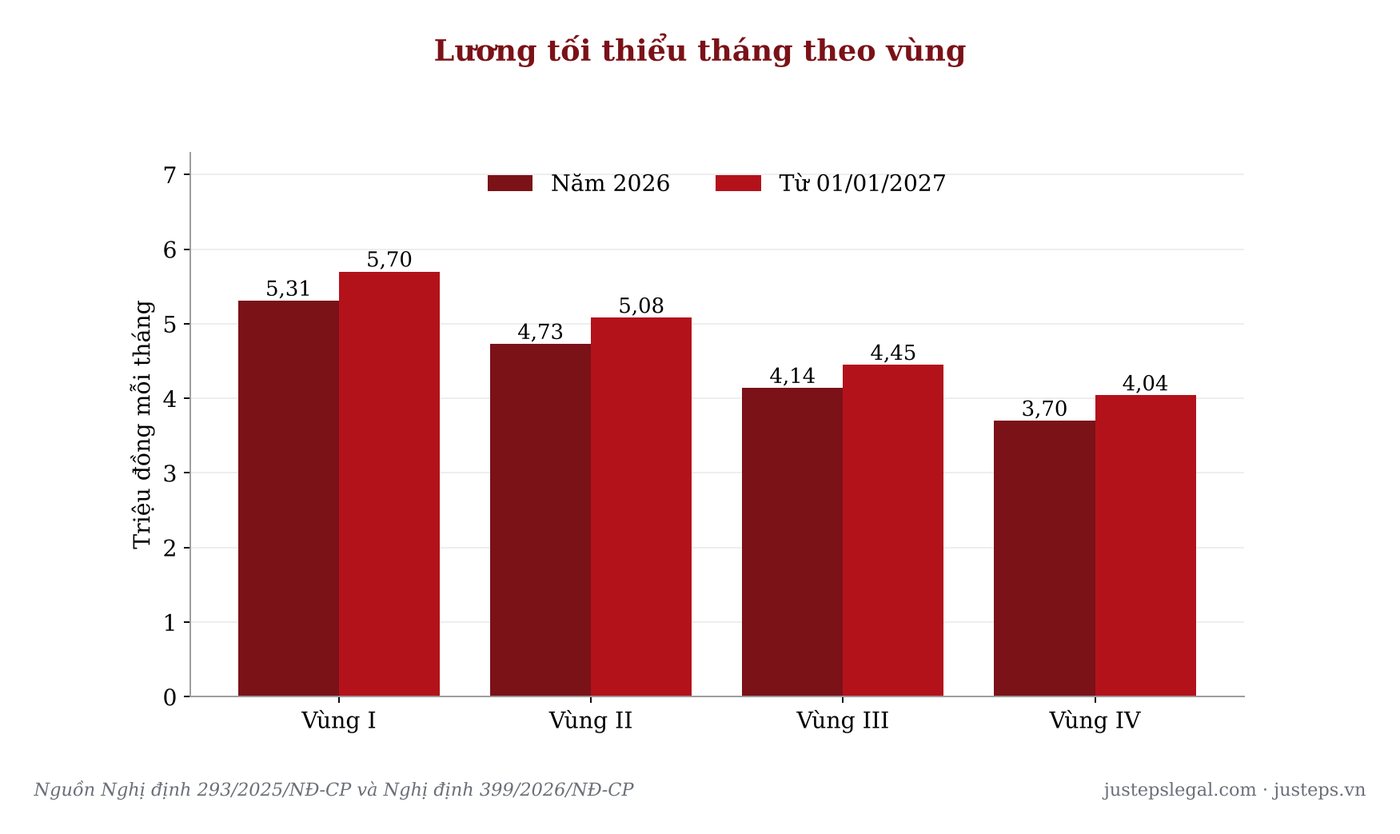
Monthly minimum wages in 2026 and from 1 January 2027 by region
The absolute increase ranges from VND 310,000 in Region III to VND 390,000 in Region I, or roughly 7% to 9%, with Region IV seeing the highest percentage increase. Companies with many unskilled workers paid close to the minimum, such as those in textiles and garments, food processing or retail, are most affected because they must adjust both wages and the insurance contributions that rise with them. Companies with sites in different regions need to prepare the payroll for each site, because the applicable rate is that of the area where the employee works. The wage scale and payroll should be reviewed before the staff budget is finalised, and companies that need support may refer to Justeps’ wage scale, payroll and pay and bonus regulations service.
New public holidays, insurance and tax
The Law amending and supplementing the Labour Code, passed by the National Assembly on 21 November 2026 and effective from 1 March 2027, adds 27 July and 24 November as fully paid days off[2]. For companies in continuous production, retail or services that must operate on public holidays, the two new days off increase overtime costs or shift arrangement costs and should be built into the staff budget from July. On insurance, the monthly wage used as the basis for compulsory social insurance contributions comprises the wage for the job or title, wage allowances and other supplements agreed to be paid regularly and consistently in each pay period[3]. On tax, the 2025 Law on Corporate Income Tax applies a rate of 15% to companies with total annual revenue of no more than VND 3 billion, 17% to companies with revenue of more than VND 3 billion up to VND 50 billion and 20% in all other cases, with revenue determined by reference to the preceding tax period[4].
Approval authority and roles in preparing the budget
The annual budget is the quantitative part of the annual business plan, and the Law on Enterprises clearly specifies which body has authority to decide that plan. A budget approved by the Director alone where the charter gives that authority to the Members’ Council or the Board of Directors may be challenged by members or shareholders, and large items of spending based on that budget will lack a proper basis of authority. The table below summarises the approval level by type of company:
| Type of company | Body deciding the annual business plan | Body organising implementation |
|---|---|---|
| Multi-member limited liability company | The Members’ Council decides the development strategy and the annual business plan[10]. | The Director or General Director organises implementation of the business plan[11]. |
| Single-member limited liability company | The company owner, or the Members’ Council or company Chairperson, according to the charter and the management model chosen[12]. | The Director or General Director as assigned by the owner. |
| Joint stock company | The Board of Directors decides the annual business plan within the development direction approved by the General Meeting of Shareholders[13]. | The Director or General Director organises implementation of the business plan and investment plans. |
Internally, preparing the budget requires three clearly separated roles. The business owner or the management sets the targets and signs off the common assumptions; the chief accountant designs the templates, consolidates the figures and prepares the cash flow forecast; and each head of department prepares the revenue, staff and cost plans for their department and is accountable for those figures throughout the year. When heads of department are not involved in preparing the budget, they tend to see it as targets imposed on them, and the monthly variance report loses its value because nobody can explain why spending has exceeded the plan.
Timetable from November to January
A fixed timetable lets departments know when they must submit their figures and avoids piling all the work into the last week of the year, when the accountants still have to close the books and prepare the annual finalisation. The timetable below suits companies whose financial year coincides with the calendar year and which need to submit the budget to the Members’ Council or the Board of Directors before the Tet holiday.
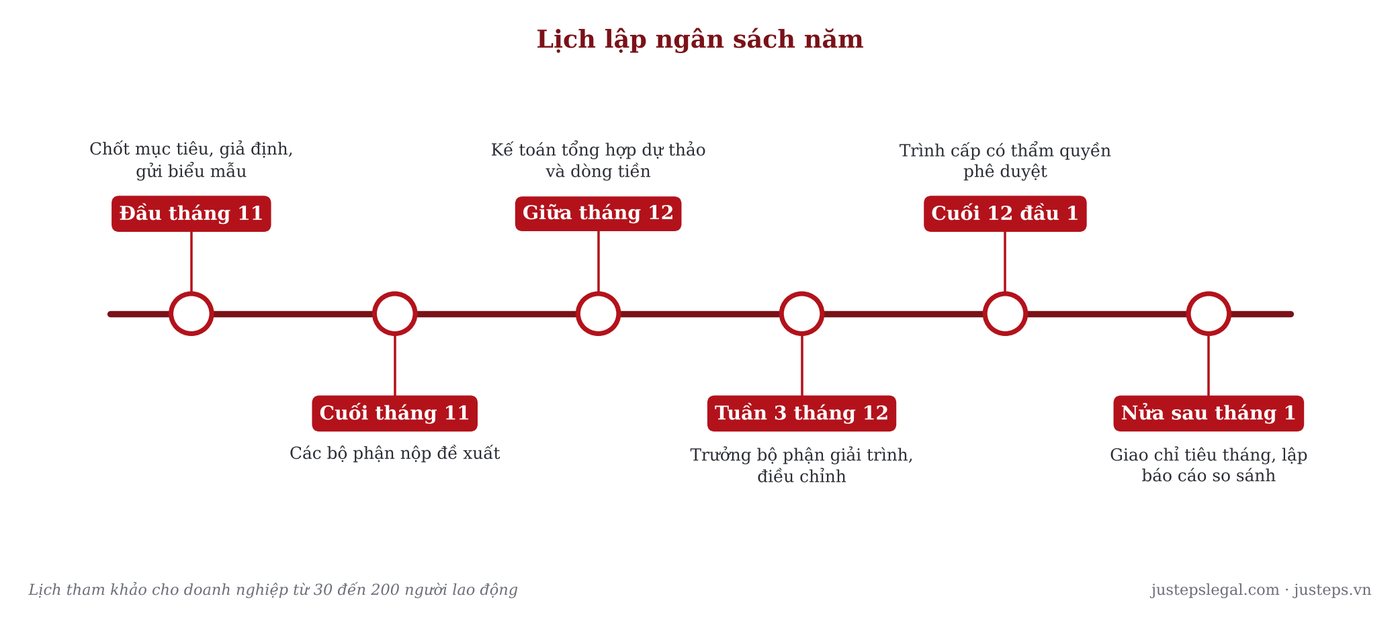
Timetable for preparing and approving the annual budget from November to January
In the first half of November, the management signs off the targets and assumptions, and the accountants send the templates to the departments together with ten months of actual figures. By the end of November, the departments submit their proposals, and in the first half of December the accountants consolidate them into a draft budget, a projected income statement and a monthly cash flow forecast. The third week of December is set aside for meetings at which each head of department explains and adjusts their figures, after which the budget is submitted to the body with authority for approval at the end of December or the beginning of January. In the second half of January, the budget is broken down into monthly targets for each department and the report comparing actual results with the plan is set up in the accounting software.
How to prepare each part of the budget
Revenue budget
The revenue budget should be prepared by customer or product group and by month, rather than as a single total divided equally over twelve months. For a company in which a small group of customers accounts for most of its revenue, for example ten customers accounting for about 60% of revenue, the sales department should prepare a separate plan for each customer based on existing contracts, ordering schedules and the likelihood of renewal. Revenue from new customers should state its source, the assumed conversion rate and the month in which it is expected to arise, so that when actual results diverge from the plan it is clear which assumption was wrong.
Staff budget
The staff budget is prepared position by position within the approved headcount and covers wages, allowances, bonuses, benefits and the company’s insurance contributions. In addition to the agreed wages, the company usually has to add about 21.5% of the contribution wage for social insurance, health insurance and unemployment insurance, plus 2% for the trade union fee[5]. When the company increases a regularly paid allowance, the insurance contributions on that allowance also rise, so any change in pay policy must be costed for both elements at the same time. The recruitment plan should state the month in which each new hire starts work, because a position filled from July generates only six months of cost in the year. For wages and bonuses to be treated as deductible expenses when determining taxable income, they must be provided for in the employment contract, the collective bargaining agreement or the company’s regulations and be supported by payment documents[6].
Operating cost budget
Operating costs should be split into fixed costs, such as office rent, depreciation and software fees, and costs that vary with revenue, such as transport, commissions and packaging. Each major item of spending should have an owner and a quarterly limit, so that the accountants have a basis for refusing payment when spending exceeds the limit without additional approval. The cost codes in the budget templates must match the chart of accounts and management codes used in the accounting software under the current enterprise accounting regime[7]; otherwise the comparison report will have to be reconciled by hand every month.
Investment budget
Each major investment, such as buying machinery, renovating a factory or implementing management software, should have its own submission stating the purpose, amount, timing of payment, source of funds and expected payback period. The investment budget should schedule payments in months with surplus cash and avoid clashing with the 13th-month salary, the Tet bonus or major tax payment dates. An investment above the Director’s authority threshold under the charter or the financial regulations must be approved separately by the body with authority, even if it is already included in the overall budget.
Monthly cash flow forecast
The projected income statement shows whether the company will make a profit or a loss, but not whether it will have enough cash to pay wages, suppliers and taxes in each month. A profitable company can still run short of cash if its customers pay 60 to 90 days late while its suppliers allow only 30 days’ credit. The cash flow forecast should therefore be prepared monthly on the basis of the actual collection and payment terms in contracts, not the timing of revenue and expense recognition.
The cash flow forecast should highlight the tight months, which are usually those in which the 13th-month salary and the Tet bonus are paid, the annual tax finalisation is due and major investments are made. For the months in which a shortfall is forecast, the chief accountant should propose solutions in advance, such as a short-term credit line, renegotiating payment terms or postponing an investment, rather than waiting until the cash runs out. Cash flow is also the basis for decisions on bonuses and pay rises, because in a limited liability company the members of the Members’ Council and the Director may not increase salaries or pay bonuses when the company is unable to pay its debts as they fall due[8].
Budget documents and budget management rules
A budget becomes a management tool only when it is recorded in a complete set of documents and linked to control rules. The Law on Accounting requires accounting units to establish an internal control system, and budget management rules form part of that system[9]. The minimum set of documents should include the following:
| Document | Main contents | Prepared and approved by |
|---|---|---|
| Budget assumptions | Growth, prices, exchange rates, interest rates, minimum wages, insurance rates and public holidays. | Prepared by the chief accountant and signed off by the management. |
| Departmental plans | Monthly revenue, staff and costs, using cost codes that match the accounting software. | Prepared by the head of department, who is accountable for them. |
| Headcount and payroll table | Number of staff by position, start month of new hires, wages, allowances, bonuses and the company’s insurance contributions. | Prepared by HR and approved by the Director. |
| Investment submissions | Purpose, amount, timing of payment, source of funds and payback period of each major item. | Prepared by the proposing department and approved by the body with authority. |
| 12-month cash flow forecast | Monthly receipts and payments, month-end balances and solutions for shortfall months. | Prepared by the chief accountant and approved by the Director. |
| Approving resolution or decision | Approval of the business plan, the overall budget and major investments. | The body with authority under the Law on Enterprises and the charter. |
| Budget management rules | Limits, who approves spending, how overruns are handled and when the budget is adjusted. | Proposed by the Director and issued by the body with authority. |
Of these documents, the budget management rules are often overlooked, yet they determine whether the budget is followed strictly. The rules should answer who may approve spending within the budget, who may approve overruns at each level, how spending outside the budget is handled, and when the variance report is prepared and to whom it is sent. Companies that need support in building this set of documents and rules may refer to Justeps’ budgeting, cash flow and management reporting service.
Monitoring implementation and adjusting the budget during the year
Once approved, the budget is monitored through a monthly report comparing actual results with the plan, prepared within roughly the first ten days of the following month. Each significant variance must be explained by the head of department, with its cause and the proposed response, rather than simply being recorded by the accountants. When an item of spending is at risk of exceeding the budget, the additional approval procedure below helps the company control costs without slowing down its business.
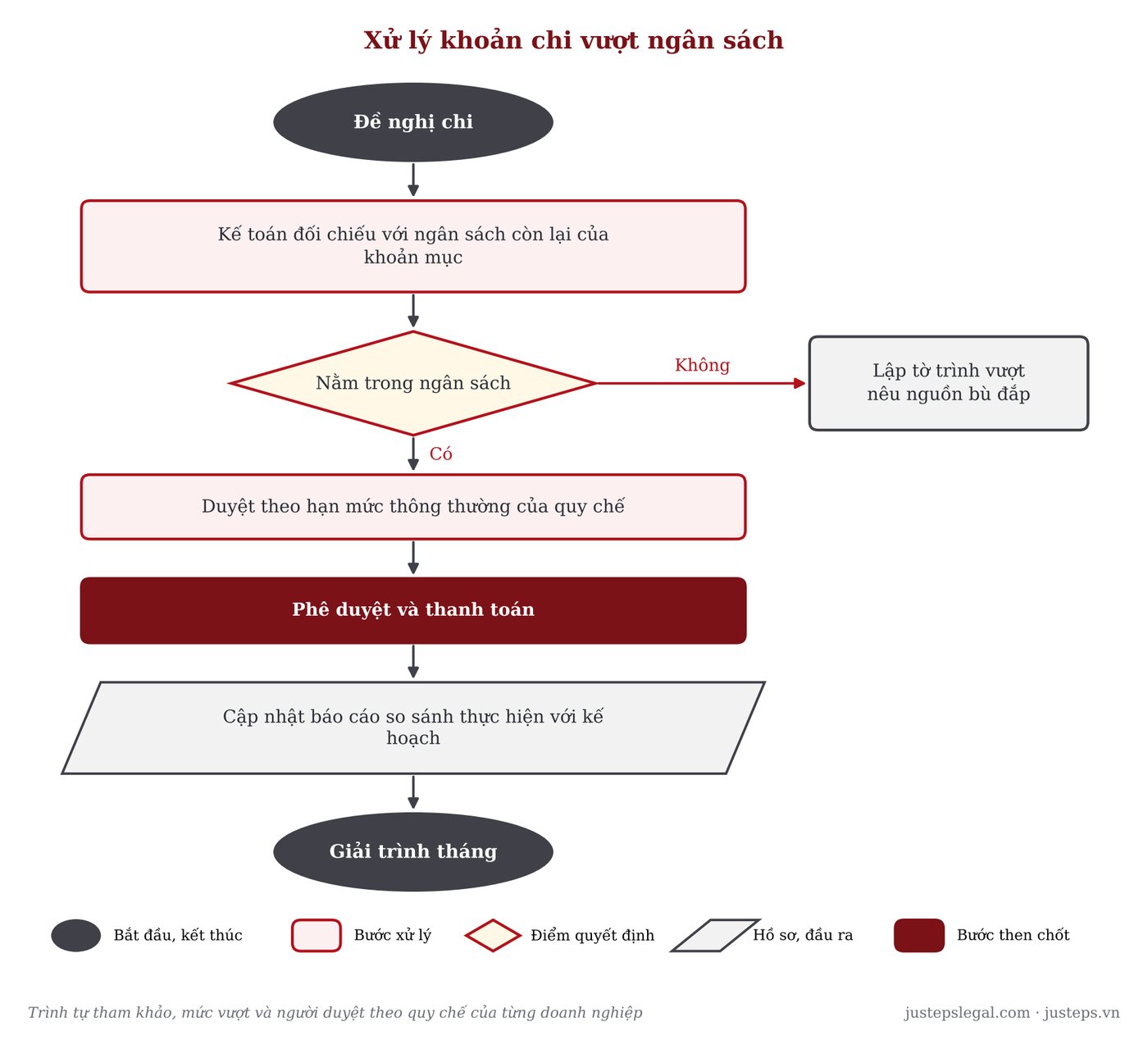
Procedure for handling spending above the approved budget
Under this procedure, the accountants check each payment request against the remaining budget before paying, and spending within the budget is paid under the normal approval limits. Overruns are classified by level; for example, an overrun of less than 5% of the budget for the line item is proposed by the head of department and approved by the Director, while a larger overrun or spending outside the budget requires a submission identifying how it will be offset. These levels are examples and should be set out in budget management rules that fit each company’s charter. Every approved overrun is entered in the monthly comparison report so that the management can see the cumulative total.
Beyond handling individual items, the overall budget should be adjusted when the underlying assumptions change significantly. Typical triggers include revenue deviating by more than 15% from the plan for two consecutive quarters, the loss or addition of a major customer, changes in pay, tax or insurance policy that significantly increase costs, or the company opening a branch, launching a new product or making an unplanned investment. The revised budget must be approved by the body that approved the original budget and should be prepared at a mid-year review rather than amended month by month.
The most common mistakes are leaving the accountant to prepare the budget alone from the previous year’s figures, preparing only a projected income statement without a cash flow forecast, failing to include the new minimum wages and the related increase in insurance in the payroll, having no monthly comparison report and using cost codes in the budget that differ from those in the accounting software. Each of these mistakes can be remedied by assigning clear roles, using standard templates and linking the budget to management rules. A company that does these things well in preparing its 2027 budget will have a management tool that is used regularly throughout the financial year.
How Justeps can help
Justeps helps companies prepare, approve and control their annual budget through the following services:
- Budgeting, cash flow and management reporting. Justeps designs budget templates, monthly cash flow forecasts and reports comparing actual results with the plan.
- Financial regulations and delegation of authority. Justeps drafts budget management rules, spending approval limits and the mechanism for approving overruns.
- Wage scales, payrolls and pay and bonus regulations. Justeps reviews wage scales and payrolls against the new minimum wages and calculates the payroll including insurance.
- Internal spending regulations and cost norms. Justeps develops cost norms as the basis for the operating budget and for spending control.
- Training on reading management financial reports. Justeps trains heads of department to read budget comparison reports and explain variances.
Frequently asked questions
Do small companies need to prepare an annual budget?
The law does not require small companies to prepare a budget in a specific format, but companies with fewer than 20 staff should still prepare at least a monthly revenue plan, payroll plan and cash flow forecast. These three tables are enough to spot cash shortfalls early and to decide when to recruit or invest.
Who must approve the annual business plan?
In a multi-member limited liability company, the Members’ Council decides the annual business plan[10], while in a joint stock company this authority belongs to the Board of Directors[13]. The Director or General Director is responsible for organising its implementation.
What are the regional minimum wages for 2027?
From 1 January 2027, the monthly minimum wage is VND 5,700,000 in Region I, VND 5,080,000 in Region II, VND 4,450,000 in Region III and VND 4,040,000 in Region IV[1]. Companies should review the lowest wage step and the related increase in insurance when preparing the payroll.
Which allowances must be included in the insurance contribution wage when budgeting?
The wage used as the basis for social insurance contributions comprises the wage, wage allowances and other supplements agreed to be paid regularly and consistently in each pay period[3]. When increasing fixed allowances, the company must therefore also budget for the insurance on the increase.
How should spending above budget be handled?
The budget management rules should specify who approves overruns at each level; for example, the head of department proposes and the Director approves small overruns, while large overruns require a submission identifying how they will be offset. Every approved overrun should be entered in the monthly comparison report.
When should the budget be adjusted during the year?
The company should adjust the budget when revenue deviates by more than 15% for two consecutive quarters, when it loses or gains a major customer, when pay, tax or insurance policy changes significantly or when there is an unplanned investment. The revised budget must be approved by the body that approved the original budget.
Which corporate income tax rate should be used in the budget?
Companies with total annual revenue of no more than VND 3 billion apply a rate of 15%, those with revenue of more than VND 3 billion up to VND 50 billion apply 17%, and all others apply 20%, with revenue determined by reference to the preceding tax period[4]. Companies enjoying tax incentives should use the remaining incentive rate.
Related articles
- Building internal financial regulations for a limited liability company, from approval authority to advances and their settlement
- A monthly labour and payroll compliance checklist for HR departments
- Setting up the organisation of a newly incorporated company with fewer than 10 staff so that roles, authority and cash flow are under control
- Which documents make up the minimum set of internal governance rules for a company with 50 to 200 staff
Notes
[1] Decree No. 293/2025/ND-CP on minimum wages applicable until 31 December 2026; Decree No. 399/2026/ND-CP on minimum wages applicable from 1 January 2027.
[2] The Law amending and supplementing a number of articles of the Labour Code, passed by the National Assembly on 21 November 2026 and effective from 1 March 2027.
[3] Clause 1 of Article 31 of the Law on Social Insurance No. 41/2024/QH15 dated 29 June 2024.
[4] Article 10 of the Law on Corporate Income Tax No. 67/2025/QH15, effective from 1 October 2025.
[5] The Law on Social Insurance No. 41/2024/QH15, the Law on Health Insurance, the Law on Employment No. 74/2025/QH15 and the Law on Trade Unions No. 50/2024/QH15, together with their implementing instruments on contribution rates.
[6] The Law on Corporate Income Tax No. 67/2025/QH15 and its implementing instruments on deductible expenses.
[7] Circular No. 99/2025/TT-BTC of the Ministry of Finance guiding the enterprise accounting regime.
[8] Article 71 of the Law on Enterprises No. 59/2020/QH14.
[9] Article 39 of the Law on Accounting No. 88/2015/QH13 dated 20 November 2015.
[10] Point a of Clause 2 of Article 55 of the Law on Enterprises No. 59/2020/QH14 dated 17 June 2020, as amended and supplemented by Law No. 76/2025/QH15.
[11] Clause 2 of Article 63 of the Law on Enterprises No. 59/2020/QH14.
[12] Articles 76 and 79 of the Law on Enterprises No. 59/2020/QH14.
[13] Point a of Clause 2 of Article 153 and Article 138 of the Law on Enterprises No. 59/2020/QH14.
This article is for reference and reflects the regulations in force at the time of publication. Please consult Justeps for advice tailored to your company’s records and situation.
For further information, please contact:
📩 Email: info@justeps.vn
🌐 Website: https://justepslegal.com · https://justeps.vn
🌐 Page: Justeps
☎️ Hotline (Zalo): 096 172 2607
📍 Thanh Xuan Office: 12th Floor, Licogi 13 Tower, 164 Khuat Duy Tien Street, Thanh Xuan Ward, Hanoi, Vietnam
📍 Ha Dong Office: LK06B, No.10, Dong Dua Area, Ha Dong Ward, Hanoi, Vietnam
📍 Ho Chi Minh City Branch: 528 Le Van Sy, Ho Chi Minh City, Vietnam
📍 Hai Phong Office: Truong Thinh Village, Ha Dong Commune, Hai Phong, Vietnam
📍 Quang Ninh Office: Van Don Special Zone, Quang Ninh Province, Vietnam





