
Key takeaways
- Every employer is responsible for preparing an annual training plan, allocating funds to training and reporting training results to the provincial labour authority.
- The plan should draw on three sources of need, namely business objectives, staff appraisal results and training required by law, and then set priorities according to impact and urgency.
- When a business funds an employee’s upskilling, professional development or retraining, the two parties must sign a vocational training contract before the course begins.
- Only costs supported by valid documents can be claimed for reimbursement, so the record of costs for each trainee must match the accounting documents.
In many small and medium-sized enterprises, training is organised as needs arise, such as when new software is introduced, when a customer requires a certificate or when a key employee leaves and the replacement does not yet have the necessary skills. This approach makes the training budget difficult to control, leads departments to compete for places on courses, and leaves the business without data to assess which expenditure is actually effective. Legal risk also arises when a business sends someone on an expensive course with nothing more than a vague written undertaking, only to find that it cannot recover the costs when that person leaves straight after the course.
This article explains how to prepare an annual in-house training plan (the Training Plan) step by step, covering the business’s legal responsibilities, identifying needs, setting priorities, budgeting, allocating roles between departments, vocational training contracts and cost reimbursement, records and reporting. It applies to businesses employing workers under employment contracts regardless of size, and is particularly useful for businesses with around 30 or more staff or those about to introduce new systems or technologies. It is written mainly for the board of directors, the HR department, the accounting team and department heads who propose training needs.
The employer’s training responsibilities
The Labour Code requires employers to prepare an annual plan and allocate funds for training, refresher training, upskilling and developing the vocational skills of their current employees, and for training employees before transferring them to another occupation within the business[1]. This provision sets no size threshold, so in principle small businesses are also responsible for having a plan, even if the plan is very brief. In addition, each year the employer must report the results of training, refresher training and vocational upskilling for its employees to the specialised labour authority of the provincial People’s Committee[2].
Training is also one of the principal terms of an employment contract, so a business that has a training policy for particular positions should reflect it in the contract or refer to its training regulations[3]. Alongside vocational skills training initiated by the business, certain types of training are compulsory under specialised legislation, most notably occupational safety and hygiene training for employees before they are assigned to work and during their employment[4]. The Training Plan should therefore clearly separate two groups: compulsory training that must be completed on time, and development training that the business decides on at its own discretion according to its budget.
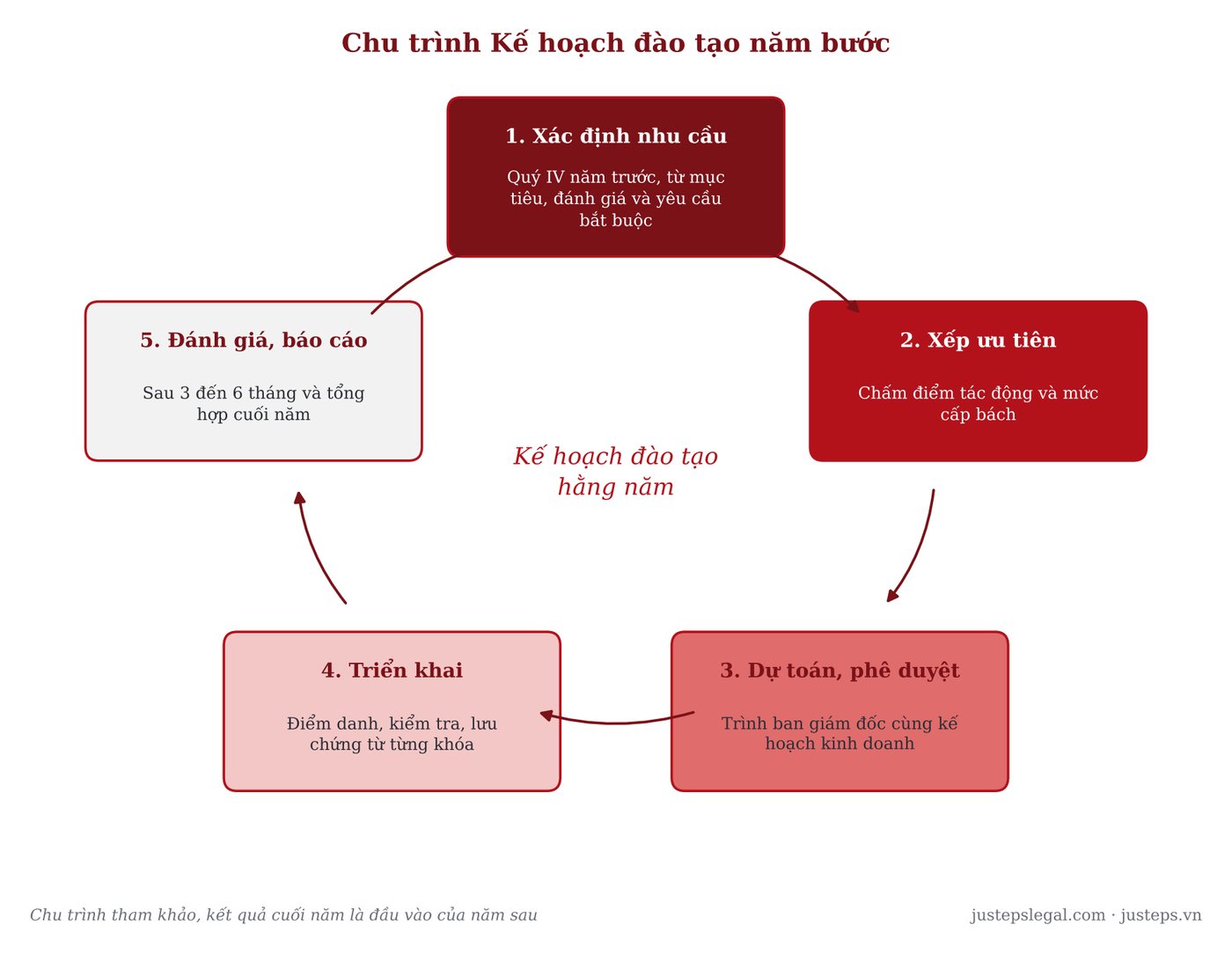
The Training Plan is prepared annually but operates as a cycle, in which the results of the previous year’s evaluation feed into the following year. The diagram below shows a five-step cycle that a business can apply.
Cycle for preparing and implementing the annual Training Plan
The cycle begins in the fourth quarter of the preceding year, when the HR department collects training needs, followed by priority setting and budgeting so that the plan can be submitted to the board of directors for approval together with the business plan. During the year, courses are delivered according to schedule, with each course having an attendance record, a test and cost documents. Three to six months after a course, the direct manager evaluates its effectiveness, and at the end of the year the HR department compiles the results to report to the authorities and to use as input for the new cycle.
Identifying needs and setting priorities
Training needs should be gathered from three sources. The first source is the following year’s business objectives, for example entering a new market that requires foreign language skills, or introducing an enterprise resource planning system that requires user training. The second source is the year-end performance appraisal results, which show which groups of staff still lack the skills required for their positions. The third source is compulsory sector requirements, such as occupational safety and hygiene training, fire prevention and fighting, or professional certificates that practitioners must maintain.
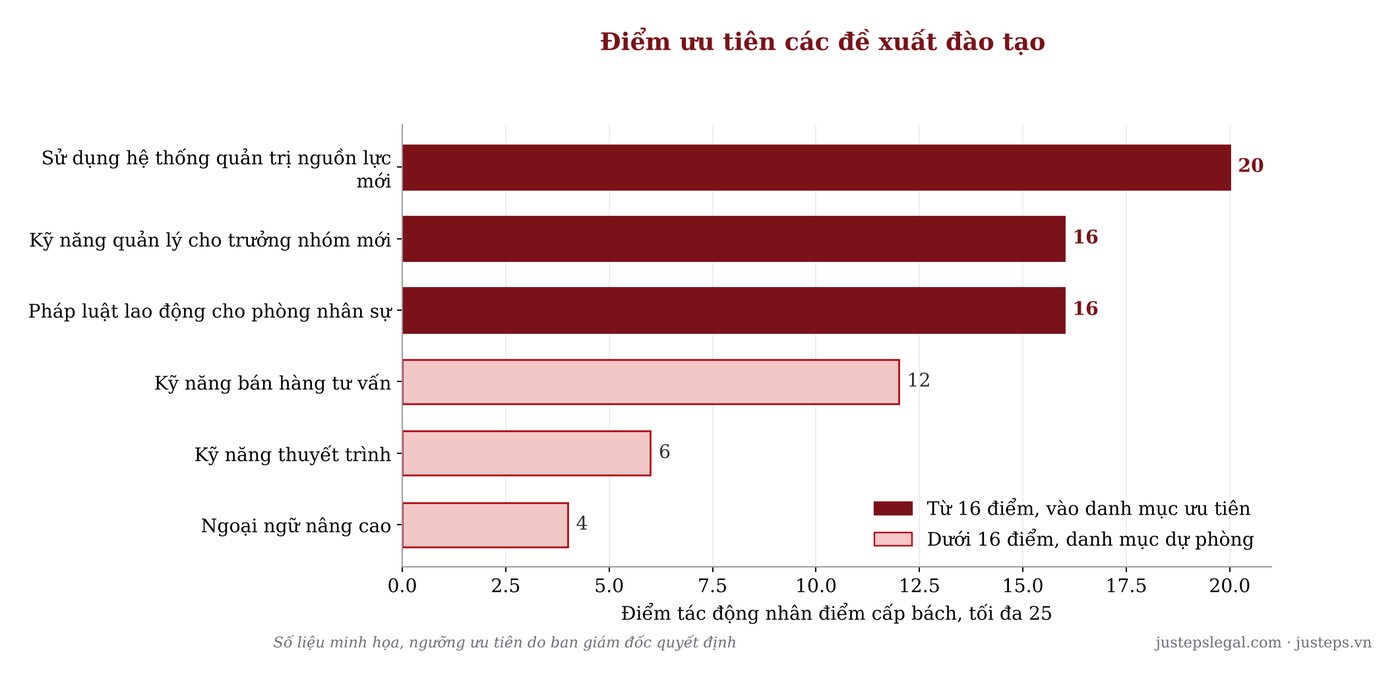
The HR department should send department heads a standard proposal form stating the course, the trainees, the objectives to be achieved, the format and the estimated cost. When proposals exceed the budget, the business needs a transparent way of setting priorities rather than favouring whichever department submits first or has the loudest voice. A simple method is to score each proposal against two criteria, impact on business results and urgency, each on a scale of 1 to 5, and then multiply the two scores. Training required by law does not need to be scored and goes straight onto the list of courses to be delivered.
Example of scoring training proposals by impact and urgency
In the example, the proposal for training on the new enterprise resource planning system scores 20 points, because the system will go live in the second quarter and affects the whole sales and accounting process. Management skills training for new team leaders scores 16 points and also makes the priority list if the business sets the threshold at 16 points. Proposals below the threshold, such as presentation skills or advanced language courses, are not discarded but moved to a reserve list to be delivered if budget remains or converted into supported self-study. The threshold is decided by the board of directors and may change from year to year.
Budgeting and allocating roles between departments
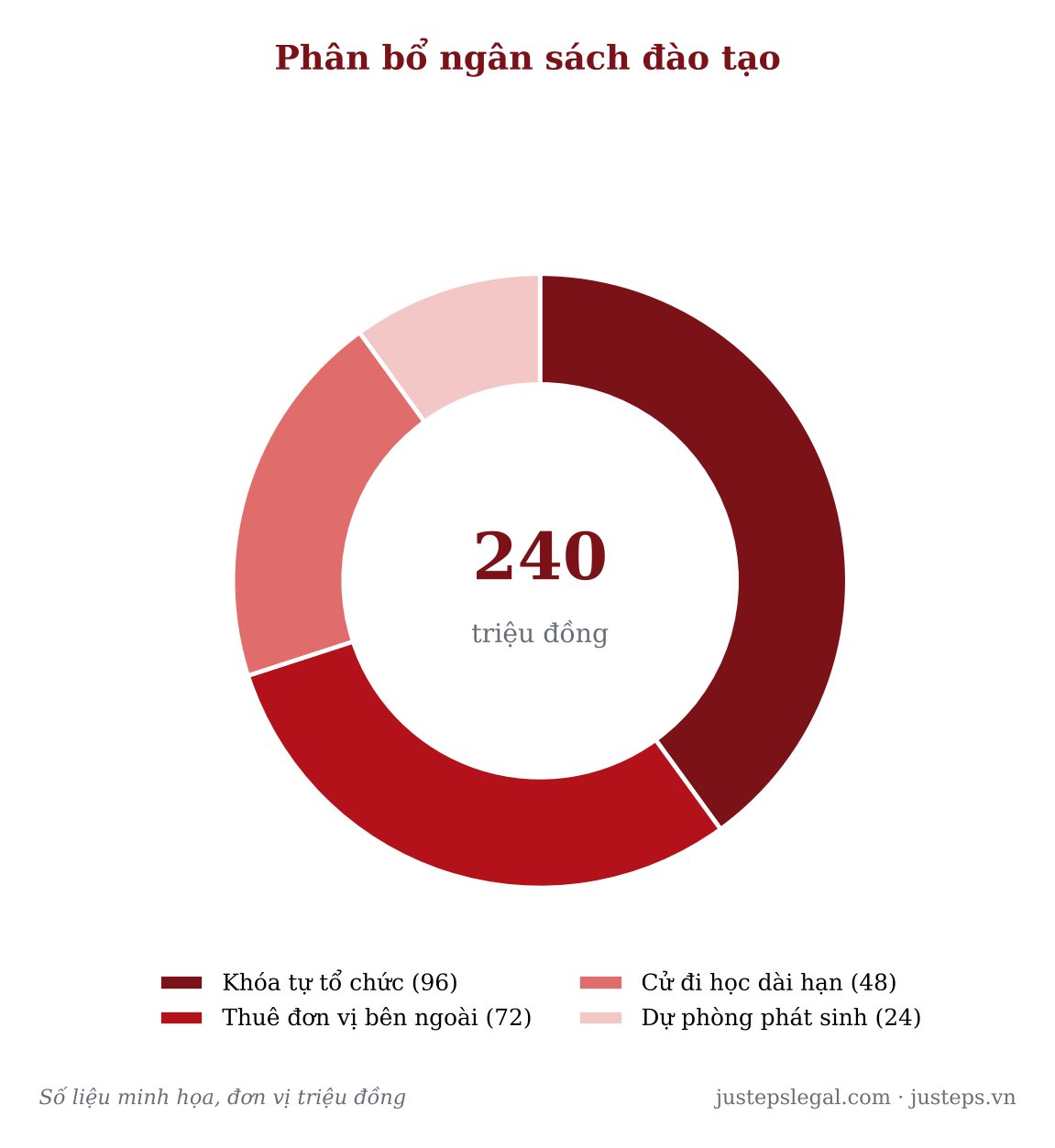
The law does not prescribe a minimum level of training funding, so businesses set it according to their financial capacity and staff development objectives. In practice, many businesses set their training budget at around 1% to 3% of the annual payroll; with a payroll of VND 12 billion and a rate of 2%, the training budget is about VND 240 million. The budget should be broken down by delivery format, because each format involves a different way of managing documents and a different level of risk.
Example allocation of a VND 240 million training budget by delivery format
The largest item in the example is courses organised by the business itself with in-house trainers, because they are inexpensive and closely related to the work. The item for external providers covers subjects in which the business has no expertise, such as labour law, occupational safety or specialised software. Long-term courses are for only a few people but are of high value per person, so this is the group that must have vocational training contracts and separate cost tracking. A small portion is held in reserve for needs that arise during the year, such as training a replacement when an employee leaves.
A clear allocation of roles ensures that the entire Training Plan does not fall on the HR department alone. The basic control principle is that the person proposing a need is not also the person approving the budget, and the person organising a course does not evaluate the effectiveness of their own course. The following table suggests how roles may be allocated between departments:
| Department | Main role | Required output |
|---|---|---|
| Board of directors | Approves objectives, budget, the priority threshold and the list of staff sent on long-term courses. | Decision approving the annual Training Plan and any adjustments. |
| Department heads | Propose needs, nominate trainees and evaluate effectiveness after training. | Proposal forms, lists of trainees and evaluation forms after three to six months. |
| HR department | Compiles needs, prepares the plan, organises courses, keeps records and prepares the annual report. | The Training Plan table, records for each course and the training results report. |
| Accounting | Tracks costs by course and by trainee and reconciles them with supporting documents. | A training cost record that matches the accounting books. |
| Legal team or external adviser | Drafts the training contract template and reviews reimbursement clauses and the training regulations. | Contract template, cost annex and opinions on any special cases. |
A business without an in-house legal team can engage an external specialist to draft the templates once and to review high-value contracts periodically. Justeps also runs in-house training programmes on labour law, payroll and compliance, and businesses may consider Justeps’ HR, labour and internal compliance training service for inclusion in their Training Plan.
Vocational training contracts and the obligation to reimburse costs
When a vocational training contract must be signed
The two parties must sign a vocational training contract where the employee receives upskilling, professional development or retraining in Vietnam or abroad funded by the employer, including funds provided to the employer by a partner; the contract is made in 02 copies, with each party keeping 01 copy[5]. The trigger for signing a contract is therefore the business’s expenditure, regardless of the length or location of the course. For low-cost in-house courses, the business may use a short-form contract or general provisions in its training regulations, but for expensive courses or long-term study, a separate contract is essential as a matter of sound management.
A vocational training contract must contain the following principal terms: the occupation being trained for, the place, the duration and the wages during the training period, the period for which the employee undertakes to work after training, the training costs and the obligation to reimburse them, and the responsibilities of each party[6]. A common mistake is a contract that only states that the employee undertakes to work for a number of years, without stating the total cost or how the amount to be reimbursed is calculated. In that case, if a dispute arises, the business must prove each item of expenditure and the calculation itself, while the employee may argue that they were never informed of these amounts.
How training costs are calculated
Training costs comprise expenses supported by valid documents for payments to trainers, learning materials, schools, classes, machinery, equipment, practice materials, other support costs for trainees, and the wages, social insurance, health insurance and unemployment insurance contributions for trainees during the training period; where trainees are sent abroad, they also include travel and living expenses[7]. The point to note is that only expenses supported by valid documents may be counted, so the cost annex to the contract must match the invoices and accounting documents. For in-house courses delivered by the business’s own trainers, proving costs is more difficult, so the business needs to decide in advance whether to include in-house trainer fees in the training costs and prepare the corresponding documents.
When costs must be reimbursed
An employee who unlawfully terminates the employment contract unilaterally must reimburse the employer for training costs in accordance with the rules on vocational training contracts[8]. Where an employee resigns lawfully after giving the full notice period[9], reimbursement depends on the specific terms of the training contract, and this is often a point of contention when disputes are resolved. To reduce risk, the contract should provide for the reimbursement amount to decrease in proportion to the time the employee has worked after training, rather than requiring full reimbursement in all cases. For example, for a course with a total cost of VND 60 million and a 24-month commitment period, if the employee leaves after 10 months, the amount reimbursable in proportion to the remaining period is about VND 35 million.
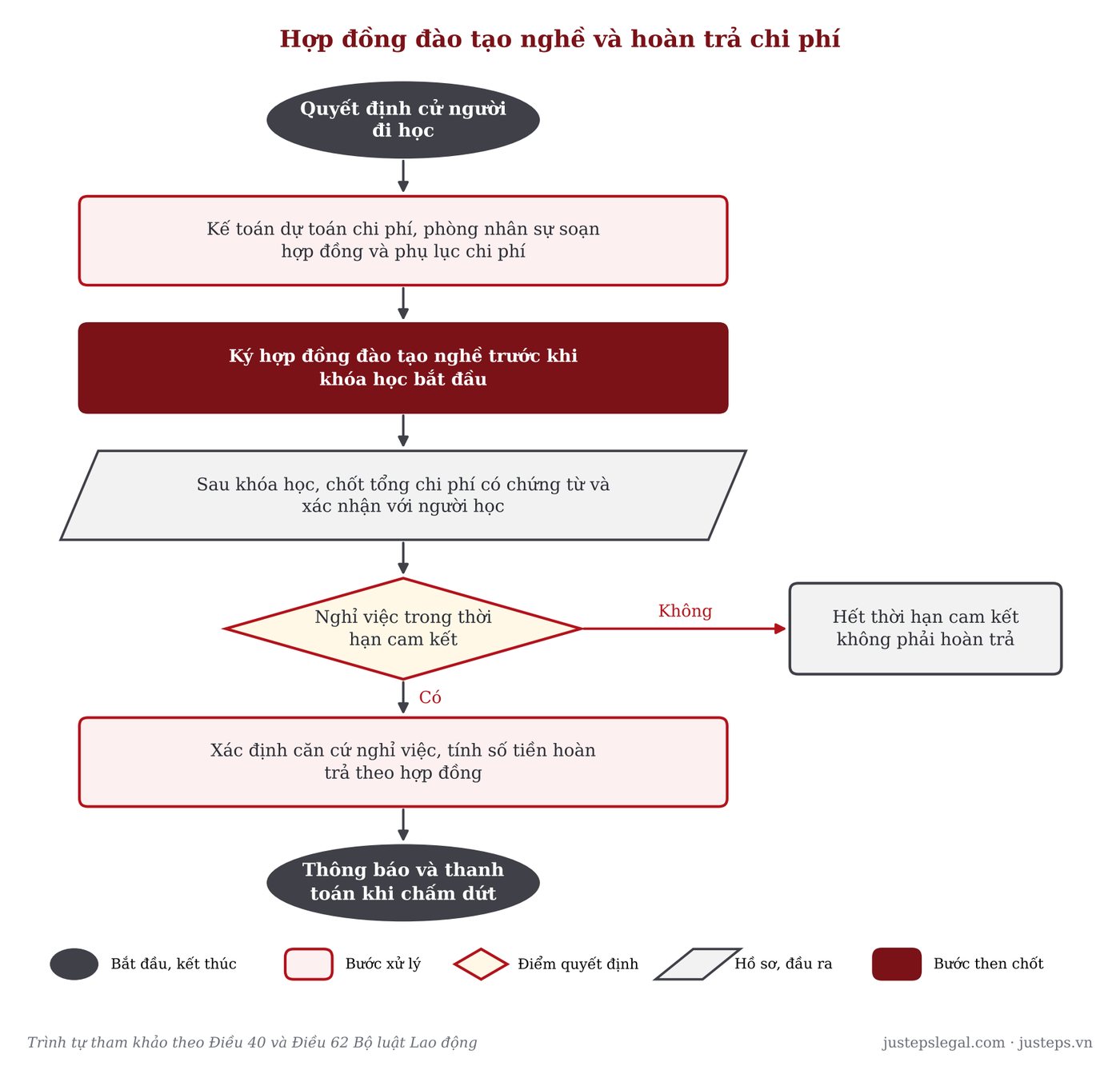
The sequence below summarises how a business should proceed from the decision to send an employee on a course to determining the reimbursement obligation, step by step.
Sequence for signing a vocational training contract and determining the reimbursement obligation
The crucial step is signing the vocational training contract before the course start date, because a contract signed after the course has begun or ended may easily be argued not to reflect the employee’s free will when deciding to take part. After the course, the accounting team finalises the total documented cost and the HR department confirms it with the employee in writing, so that the figure cannot be disputed later. When an employee leaves during the commitment period, the HR department determines the basis for termination, calculates the reimbursable amount under the contract and notifies the employee during settlement of the amounts relating to termination of the contract.
The commitment period is agreed by the parties and the law sets no maximum, but it should be proportionate to the value of the course so that the clause is not regarded as unreasonable. As a practical reference, many businesses apply around 6 to 12 months for courses costing less than VND 20 million, 12 to 24 months for courses costing from VND 20 million to VND 100 million, and 36 months or more for long-term courses abroad. These figures are only suggestions and should be adjusted according to the sector, wage levels and labour market of each business.
Apprenticeships and vocational training for work at the business
Unlike training for current employees, a business may recruit people for apprenticeship or vocational training so that they subsequently work for the business itself. In this case, the business may not charge tuition fees, the two parties must sign a training contract, and trainees are paid at the agreed rate when they directly make or take part in making products that meet specifications during the apprenticeship or training period[10]. At the end of the apprenticeship or training period, if the conditions prescribed are met, the two parties must enter into an employment contract.
This arrangement suits manufacturing and service businesses that require specific skills that are difficult to find ready-made on the labour market. However, the business must clearly distinguish apprenticeship and vocational training from probation, because the two arrangements have different conditions, durations and wages. If a trainee has been doing the work of a regular employee for a long time, the relationship may be regarded as an employment relationship and the business must fully perform its obligations regarding the contract, wages and insurance.
Records, reporting and common mistakes
A properly implemented Training Plan needs to be evidenced by records, because these form the basis for reporting to the authorities, auditing costs and requiring employees to reimburse training costs. The minimum set of records comprises the internal training regulations, the approved annual Training Plan table, the vocational training contract template with its cost annex, the records of each course including attendance lists, tests and evaluation forms, and the cost record for each trainee. The training regulations should be drafted consistently with the internal labour regulations and the wage regulations, for example on whether time spent studying counts as working time and is paid.
As regards costs, training expenses supported by valid invoices and documents and serving production and business activities are generally deductible for corporate income tax purposes[11]. The accounting team also needs to determine under current rules whether amounts paid on behalf of employees constitute taxable income for personal income tax purposes, particularly living allowances for study abroad. Businesses that need help preparing training regulations and forms may consider Justeps’ company regulations and internal rules service.
The most common mistake is having only a vague written undertaking that omits the total cost, the commitment period and the method of calculating reimbursement, so that the business is practically unable to recover costs when the employee leaves. The second mistake is signing the contract after the course has begun or ended, which reduces its evidential value. The third mistake is that the cost figures in the contract do not match the accounting documents, because the accounting team and the HR department keep two separate sets of figures. The fourth mistake is setting a commitment period that is too long relative to the value of the course, which increases the risk that the clause will be regarded as unreasonable in a dispute.
At the end of the year, the HR department compiles the number of courses, the number of trainee places, actual costs against budget and the results of effectiveness evaluations in order to prepare the report to the provincial labour authority as required[2]. This report is also the document on which the board of directors bases the following year’s budget, retaining effective courses and replacing those that have not changed work performance. Businesses should also follow the Law amending and supplementing the Labour Code, passed by the National Assembly on 21 November 2026 and taking effect on 1 March 2027, in order to update their training schedules for the new public holidays and to review their training regulations once guiding documents are issued[12].
How Justeps can help
Justeps helps businesses prepare their Training Plan and manage the legal risks associated with training through the following services:
- Building a system of company regulations and internal rules. Justeps drafts internal training regulations, proposal forms and an approval procedure consistent with the internal labour regulations and wage regulations.
- Labour, payroll and insurance. Justeps drafts vocational training contract templates and cost annexes and advises on calculating reimbursement when an employee leaves.
- HR, labour and internal compliance training. Justeps designs and delivers courses on labour law, payroll and compliance for inclusion in the annual Training Plan.
- In-house training at the business. Justeps organises training programmes tailored to the business’s needs, with materials and tests that support its training records.
Frequently asked questions
Must a small business prepare an annual training plan?
The Labour Code sets no size threshold for the responsibility to prepare an annual training plan[1]. A small business may keep its plan to a single table, but it should still have an approved document and data for reporting.
Do in-house courses require a vocational training contract?
If the business funds an employee’s upskilling or professional development, a vocational training contract must be signed[5]. For low-cost courses, the business may use a short-form template or provisions in its training regulations.
Which costs count as training costs that must be reimbursed?
Training costs include expenses supported by valid documents, such as trainer fees, materials, classrooms, equipment, trainee support, and the trainee’s wages and insurance during the training period[7]. It is difficult to claim reimbursement of expenses without supporting documents.
Must an employee who resigns lawfully reimburse training costs?
The law only clearly provides for a reimbursement obligation where the employee unlawfully terminates the contract unilaterally[8]. If the employee leaves after giving proper notice, reimbursement depends on the training contract, so the business should state clearly how it is calculated in proportion to the remaining period.
How long is a reasonable post-training commitment period?
The law does not prescribe a specific period but leaves it to the parties to agree in the contract[6]. The period should be proportionate to the value of the course, typically from 6 months for small courses to 36 months or more for long-term courses abroad.
Must a business report training results?
Yes. Each year the business must report the results of training, refresher training and vocational upskilling for its employees to the provincial labour authority[2].
May a business charge tuition fees to apprentices who will work for it?
No. When recruiting people for apprenticeship or vocational training to work for itself, the business may not charge tuition fees and must sign a training contract[10].
Related articles
- How to design an annual in-house legal training programme for a company
- How businesses should organise periodic performance appraisals that can be relied on for pay, bonuses and people management
- Practical guidance on dealing with an employee who quits without notice or handover while staying within labour law
- Annual budget planning for small and medium-sized enterprises, from assumptions and payroll to cash flow and control
Notes
[1] Clause 1 of Article 60 of the Labour Code No. 45/2019/QH14 dated 20 November 2019.
[2] Clause 2 of Article 60 of the Labour Code No. 45/2019/QH14.
[3] Point k of Clause 1 of Article 21 of the Labour Code No. 45/2019/QH14.
[4] Article 14 of the Law on Occupational Safety and Hygiene No. 84/2015/QH13 dated 25 June 2015 and its guiding documents on occupational safety and hygiene training.
[5] Clause 1 of Article 62 of the Labour Code No. 45/2019/QH14.
[6] Clause 2 of Article 62 of the Labour Code No. 45/2019/QH14.
[7] Clause 3 of Article 62 of the Labour Code No. 45/2019/QH14.
[8] Clause 3 of Article 40 of the Labour Code No. 45/2019/QH14.
[9] Clause 1 of Article 35 of the Labour Code No. 45/2019/QH14.
[10] Article 61 of the Labour Code No. 45/2019/QH14.
[11] The Law on Corporate Income Tax No. 67/2025/QH15 and its guiding documents on deductible expenses.
[12] The Law amending and supplementing a number of articles of the Labour Code, passed by the National Assembly on 21 November 2026 and effective from 1 March 2027.
This article is for reference and reflects the regulations in force at the time of publication. Please consult Justeps for advice tailored to your company’s records and situation.
For further information, please contact:
📩 Email: info@justeps.vn
🌐 Website: https://justepslegal.com · https://justeps.vn
🌐 Page: Justeps
☎️ Hotline (Zalo): 096 172 2607
📍 Thanh Xuan Office: 12th Floor, Licogi 13 Tower, 164 Khuat Duy Tien Street, Thanh Xuan Ward, Hanoi, Vietnam
📍 Ha Dong Office: LK06B, No.10, Dong Dua Area, Ha Dong Ward, Hanoi, Vietnam
📍 Ho Chi Minh City Branch: 528 Le Van Sy, Ho Chi Minh City, Vietnam
📍 Hai Phong Office: Truong Thinh Village, Ha Dong Commune, Hai Phong, Vietnam
📍 Quang Ninh Office: Van Don Special Zone, Quang Ninh Province, Vietnam





