
Key takeaways
- An annual legal compliance calendar should bring tax, accounting, corporate governance, labour and insurance obligations together in a single table, with each deadline showing its legal basis, a primary owner and a back-up.
- Most of the year’s deadlines fall at the end of March, when tax finalisation, the annual financial statements and preparation for the annual meeting all take place at once, so closing the books must start in January.
- A joint stock company must hold its annual General Meeting of Shareholders within 4 months from the end of the financial year, and any extension may not go beyond 6 months.
- The 2027 calendar must reflect the new minimum wages from 1 January 2027 and two new public holidays from 1 March 2027, and drop the business licence fee deadline, which ended from 2026.
- The calendar only works if there is a coordinator who sends reminders at 30, 10 and 3 days before each deadline, keeps evidence of filing and reports to the board of directors every quarter.
A business’s periodic legal obligations have fairly fixed deadlines, but they are scattered across many legal instruments and performed by different departments. Accounting tracks tax filing deadlines, HR tracks social insurance and labour reports, while meetings of the owners are often left to the director or company secretary to remember. The result is a set of familiar incidents, such as missing the tax finalisation deadline when the accountant leaves mid-year, a joint stock company holding its annual General Meeting of Shareholders late, or HR overlooking the report on changes in the workforce because nobody sent a reminder.
This article examines how to prepare and operate an annual legal compliance calendar (the Compliance Calendar), covering tax and financial statement deadlines, annual meetings of the owners, labour and social insurance obligations, the changes to be reflected for 2027, how to assign owners and how to set up reminders. It applies mainly to limited liability companies and joint stock companies whose financial year coincides with the calendar year, with separate notes for businesses with branches, subsidiaries or foreign investment. The deadlines in this article are general; conditional business lines usually have additional sector-specific reports that the business should add to its own calendar.
When a business needs a single compliance calendar
A newly incorporated business with a handful of people often needs nothing more than its accounting service provider reminding it of tax deadlines. However, a Compliance Calendar becomes necessary when two or more departments deal with state authorities, when the business has branches, representative offices or subsidiaries with their own obligations, when accounting and administrative staff change frequently, or when the business has already received reminders or penalties for late filing. In these businesses, the greatest risk is that nobody sees all of the year’s obligations, so a missed deadline is only discovered when a state authority sends a notice.
A proper Compliance Calendar is a consolidated table in which each row is an obligation with its deadline, legal basis, responsible department, primary owner, back-up, status and a link to the evidence of filing. The table should be prepared in December for the following year, after reviewing new legal instruments taking effect during the year. The figure below outlines the major deadlines in a calendar year for a business without special features.
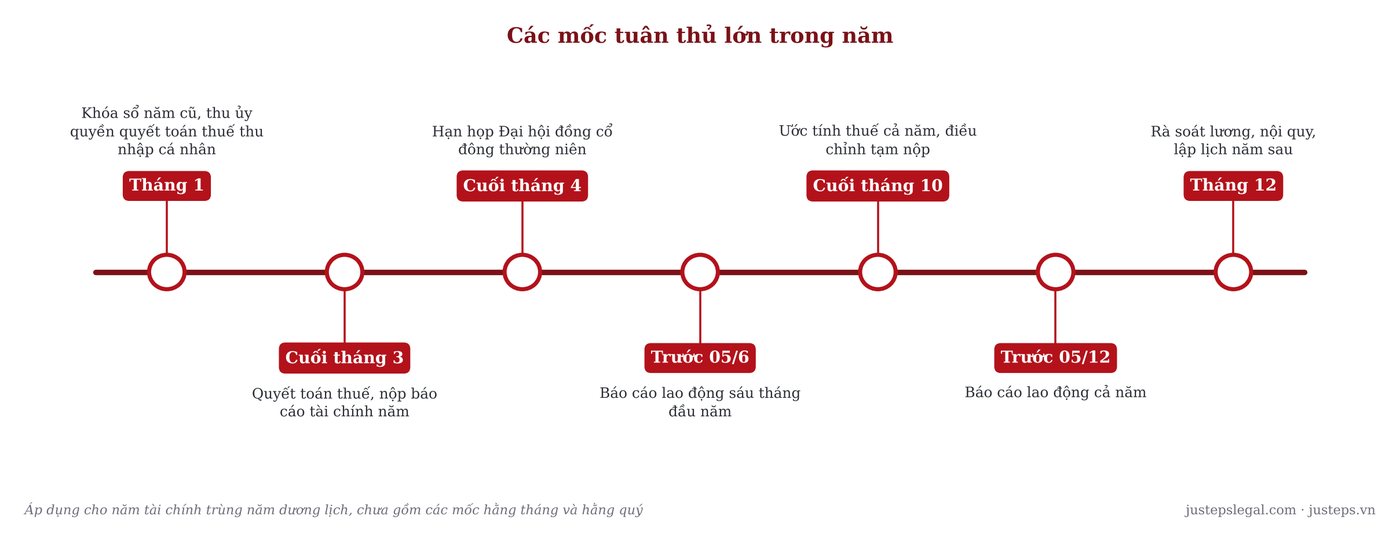
Major compliance deadlines in a calendar year of a business
As the figure shows, the first quarter is the heaviest period because closing the previous year’s books, tax finalisation, filing the financial statements and preparing the annual meeting all happen at once. April is the deadline for the annual General Meeting of Shareholders if no extension is granted, June and December each have a report on changes in the workforce, and December is the time to review wages and internal rules and prepare the Compliance Calendar for the following year. Between these major deadlines are the recurring monthly and quarterly obligations such as tax filing and insurance contributions, which account for most of the due dates in the year.
Tax and financial statement deadlines
Monthly and quarterly tax returns and provisional corporate income tax
From 1 July 2026, tax filing and payment are governed by the Law on Tax Administration No. 108/2025/QH15 and Decree 252/2026/NĐ-CP guiding that law[1]. As a general rule, monthly tax returns must be filed by the 20th day of the following month, quarterly tax returns by the last day of the first month of the following quarter, and the deadline for paying tax is the same as the deadline for filing the return. Businesses file value added tax returns monthly or quarterly depending on their revenue, while personal income tax withheld from wages is usually declared for the same period as value added tax.
Corporate income tax is not declared quarterly but is paid provisionally each quarter, no later than the last day of the first month of the following quarter[1]. The total provisionally paid over the four quarters must not be lower than the statutory percentage of the tax payable under the finalisation return; if it is lower, the business must pay late payment interest on the shortfall. The Compliance Calendar should therefore include a review of business results at the end of October, so that the accountant can estimate the tax for the whole year and adjust the fourth-quarter provisional payment if necessary.
Tax finalisation and annual financial statements
The corporate income tax finalisation return and the personal income tax finalisation return of the income-paying organisation must be filed no later than the last day of the third month from the end of the financial year. The annual financial statements must be submitted to the competent state authority within 90 days from the end of the annual accounting period[2]. Where the financial year coincides with the calendar year, these deadlines all fall at the end of March, and businesses subject to mandatory audit must also complete the audit before submitting their financial statements.
To avoid a backlog, accounting should close the previous year’s books in January, reconcile receivables and payables, carry out stocktakes and finalise the figures before mid-March. HR should send accounting the list of employees authorising the company to finalise their personal income tax in January, because collecting authorisation forms and information on dependants usually takes longer than expected. From 2026, the business licence fee is no longer collected or paid[3], so businesses may remove the 30 January business licence fee deadline from their Compliance Calendar.
The table below summarises the main deadlines in the year for a business whose financial year coincides with the calendar year, together with the departments usually assigned to them:
| Deadline | Obligation | Person responsible |
|---|---|---|
| 20th of each month | File and pay value added tax and personal income tax for the previous month, for businesses filing monthly. | Tax accountant, checked by the chief accountant. |
| End of the following month | Pay social insurance, health insurance and unemployment insurance for the previous month. | HR prepares the list, accounting makes the transfer. |
| End of the first month of the next quarter | File quarterly tax returns where applicable and make the provisional corporate income tax payment for the previous quarter. | Tax accountant. |
| End of March | Finalise corporate income tax and personal income tax and submit the annual financial statements. | Chief accountant, signed by the director. |
| End of April | Hold the annual General Meeting of Shareholders of a joint stock company if no extension is granted. | Board of directors and company secretary. |
| Before 5 June and 5 December | Report on changes in the workforce for the first six months and for the whole year. | HR department. |
| December | Review minimum wages, the wage scale and internal labour rules and prepare the Compliance Calendar for the following year. | HR, legal and the calendar coordinator. |
Annual meetings of the owners and governance records
For a joint stock company, the General Meeting of Shareholders must meet annually, within 4 months from the end of the financial year. Unless the charter provides otherwise, the board of directors may decide to extend the deadline where necessary, but not beyond 6 months from the end of the financial year[4]. The annual meeting approves the annual financial statements, audited where an audit is required, the plan for distributing profits, the business plan and other matters within its authority.
Preparation time is where businesses are most often caught out. The notice of meeting must be sent to shareholders at least 21 days before the opening date unless the charter specifies a longer period, and the list of shareholders entitled to attend must be drawn up before that[5]. Therefore, to meet before the end of April, the board of directors must finalise the shareholder list and meeting documents by the end of March, almost at the same time as the financial statements deadline, so the Compliance Calendar should record the preparation milestones and not only the meeting date.
For a limited liability company with two or more members, the members’ council meets at least once a year at intervals set by the charter[6]. A single-member limited liability company has no fixed meeting deadline, but the owner should still approve the financial statements, the plan for using profits and the annual plan in writing in the first or second quarter. These minutes, resolutions and decisions provide the basis for distributing profits, for banks when considering credit and for the tax authority when examining expenses.
Besides the annual meeting, the Compliance Calendar should include review points for governance records such as the register of members or register of shareholders, information on the legal representative, the terms of office of the board of directors and the supervisory board, and the beneficial ownership information that the business must provide and update under the Law on Enterprises as amended in 2025[7]. When registered details change, the business must complete the procedure with the business registration authority under the rules on enterprise registration[8], so the coordinator must be informed as soon as a decision to make a change is taken. Businesses wishing to outsource this work may consider Justeps’ service on corporate secretarial services and periodic reviews.
Labour and insurance obligations and the changes to reflect
Labour reports and social insurance contributions
Employers must report on changes in their workforce every six months and every year, no later than 5 June for the first half of the year and 5 December for the whole year, through the National Public Service Portal[9]. These dates are fixed by the calendar year, even for businesses with a different financial year. HR should reconcile the report figures with the social insurance contribution list before filing, because the authorities often compare these two sources of data.
Compulsory social insurance is paid monthly, no later than the last day of the following month[10]. Late payment gives rise to late payment interest, and prolonged delay may be dealt with under the rules on late payment and evasion of social insurance contributions. Besides the monthly deadline, the Compliance Calendar should include reporting new and departing employees as soon as contracts are signed or terminated, a year-end reconciliation with the social insurance authority, and occupational safety and health reports under the sector-specific rules.
Changes for 2027
From 1 January 2027, the monthly minimum wage rises to VND 5,700,000 in region I, VND 5,080,000 in region II, VND 4,450,000 in region III and VND 4,040,000 in region IV[11]. Businesses should review the wages in employment contracts, the wage scale and the wage used as the basis for social insurance contributions before that date, especially for employees whose wages are close to the minimum. The Law amending and supplementing a number of articles of the Labour Code, passed on 21 November 2026 and effective from 1 March 2027, adds 27 July and 24 November as fully paid days off[12], so 2027 work schedules, internal rules and production plans must take these two days into account. Businesses needing a comprehensive review of their labour obligations may consider Justeps’ service on labour and payroll compliance management.
The chart below illustrates the number of due dates in a year for each group of obligations at a business that files value added tax monthly. The number of due dates does not reflect importance, but it shows why recurring monthly tasks are easily taken for granted, while a single missed deadline is enough to trigger late payment interest or a penalty.
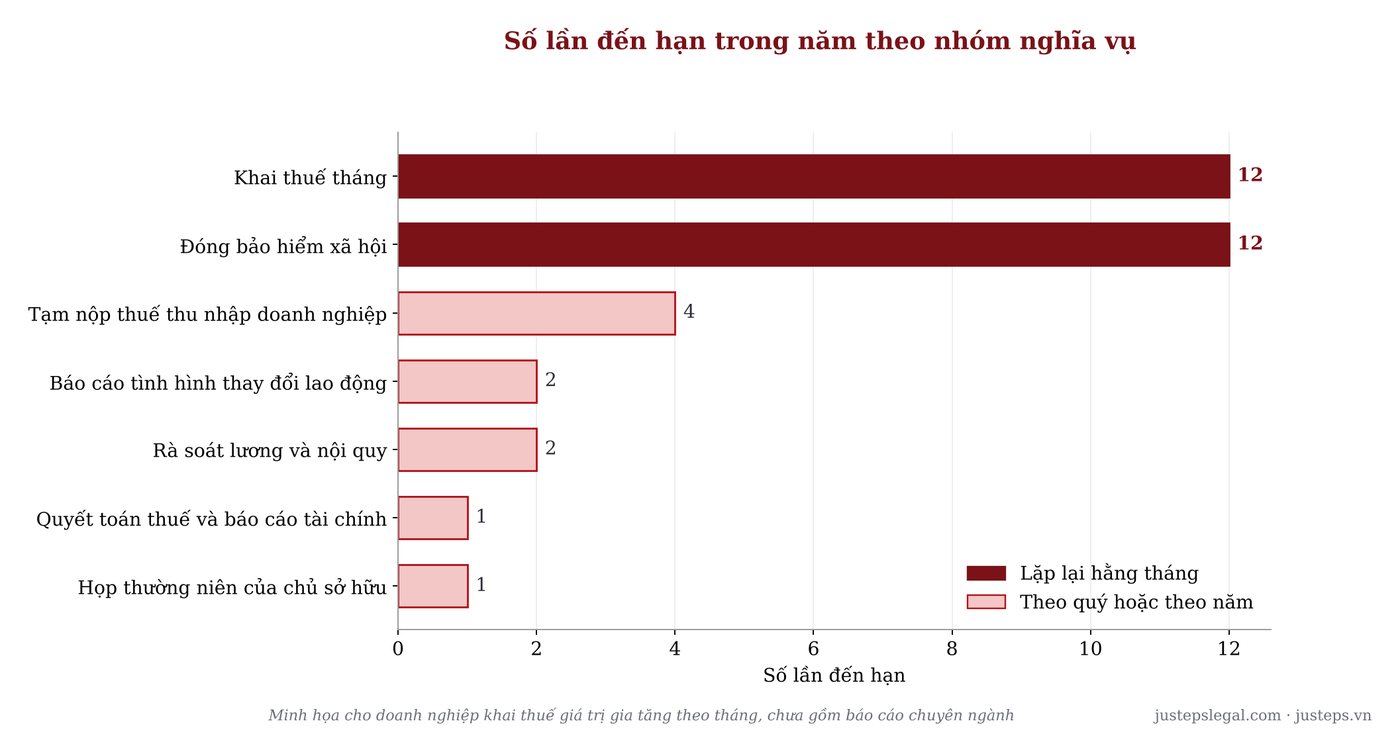
Number of due dates in a year by group of obligations, illustrative data
Monthly tax filing and social insurance contributions have the most due dates, so they should be assigned to someone with a fixed procedure and an independent checker. Obligations that fall due only once or twice a year, such as finalisation, the annual meeting and labour reports, are the easiest to forget because they never become a habit. This is the group of tasks for which the Compliance Calendar coordinator should send the earliest reminders, usually 30 days before the deadline.
Assigning owners and setting up reminders
Each deadline in the Compliance Calendar should have one primary owner and one back-up, so that work is not interrupted when the owner is on leave or leaves the business. In addition, the business needs a coordinator who holds the master calendar, usually the person in charge of legal affairs, the company secretary or the director’s assistant. The coordinator does not do the departments’ work for them but is responsible for sending reminders, checking the evidence of filing and reporting the status to the board of directors.
An effective reminder system usually involves three reminders, at 30 days, 10 days and 3 days before the deadline, with the owner required to confirm completion and upload the evidence of filing to a shared folder. The operating sequence for one deadline is shown below.
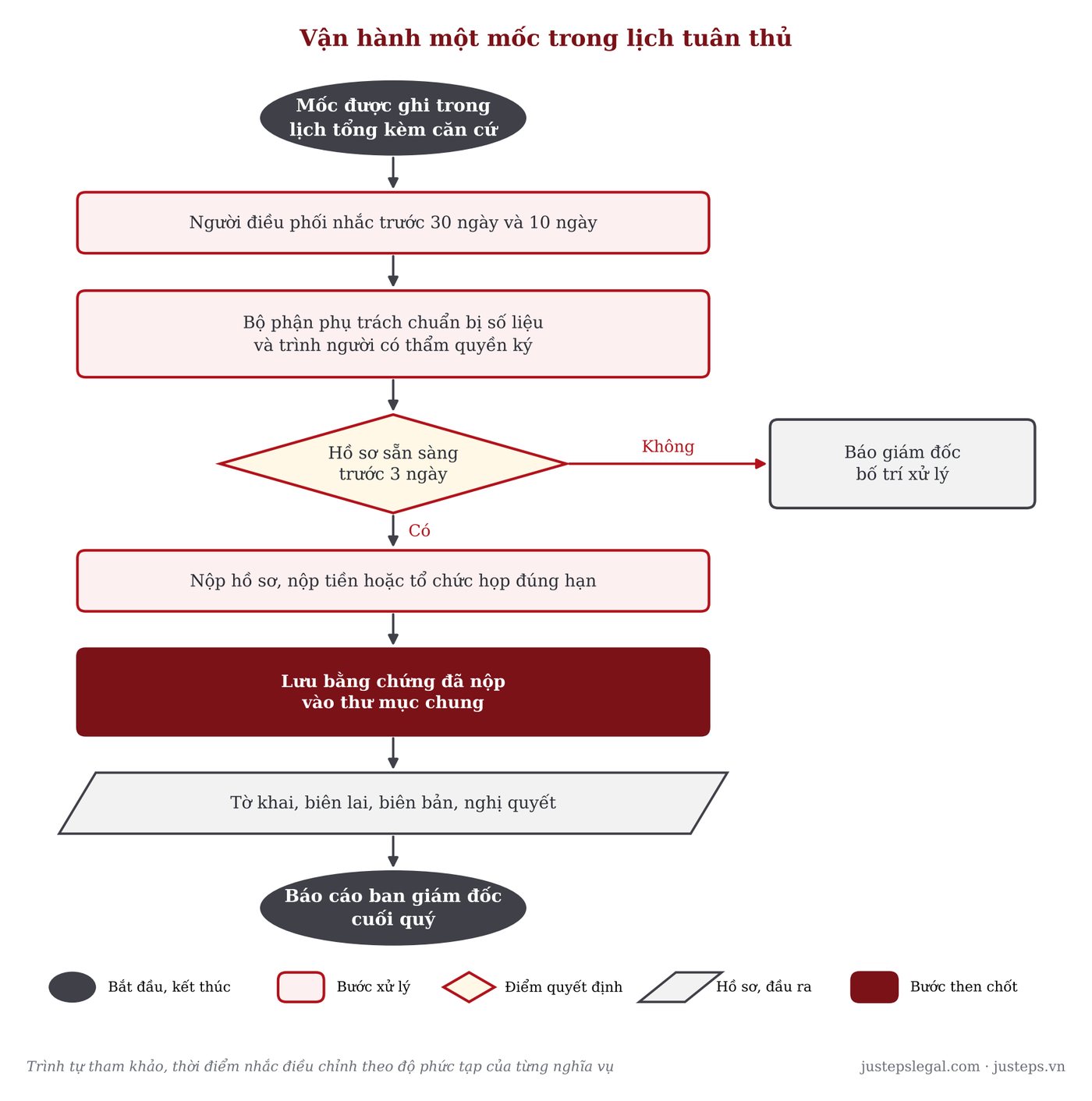
The sequence for reminding, completing and keeping evidence for one compliance deadline
The sequence begins when the coordinator sends the first reminder 30 days ahead, giving the responsible department enough time to collect figures and seek the views of the person authorised to sign. If the file is still not ready at the 3-day reminder, the matter is escalated immediately to the director to decide whether to assign more people or to contact the authority proactively, instead of reporting only after the deadline has passed. The critical step is keeping the evidence of filing, such as the electronic acceptance notice, the payment receipt or the signed meeting minutes, because in an inspection the business can only prove compliance with these documents. At the end of each quarter, the coordinator summarises the deadlines met, the deadlines missed and the reasons, and reports them to the board of directors.
As to tools, a small business can use a shared spreadsheet combined with an electronic calendar with automatic reminders, while a business with several units should use task management software with access rights and an audit trail. Whatever tool is used, the master table must have a legal basis column so that, when the law changes, the coordinator knows immediately which deadlines need updating. The storage folder should be organised by year and by obligation and contain returns, receipts, meeting minutes, resolutions and correspondence with state authorities.
Businesses with branches, subsidiaries or foreign investment
A business with branches or business locations in several provinces needs an additional column for the responsible unit in its Compliance Calendar, because some obligations arise where the dependent unit is located. For example, tax may have to be declared with the tax authority managing the branch or allocated to the locality where the activity takes place, the minimum wage applies according to the area where employees work, and registered internal labour rules must be sent to the labour authority where the branch is located. Each subsidiary is a separate legal entity, so it must have its own Compliance Calendar, even if the same coordinator at the parent company monitors it.
Foreign-invested enterprises also have obligations to report on the implementation of investment projects under the law on investment, obligations relating to the direct investment capital account and reporting obligations concerning foreign employees. These deadlines should be added to the Compliance Calendar after reviewing the Investment Registration Certificate and the instruments guiding the Law on Investment No. 143/2025/QH15 applicable to the project[13]. For businesses whose financial year does not coincide with the calendar year, the tax, financial statement and annual meeting deadlines are calculated from the end of the financial year, while labour reports still follow the fixed calendar-year dates.
Common mistakes in preparing and using a compliance calendar
The first mistake is a Compliance Calendar that contains only tax deadlines and omits owners’ meetings, labour reports and updates to enterprise registration. A calendar of this kind is usually prepared by accounting and reflects only accounting’s work, so the obligations of other departments still depend on individual memory. The business should build the calendar from a complete list of obligations according to its legal form, business lines and unit structure, and only then allocate them to departments.
The second mistake is reusing the previous year’s calendar without updating it for new legal instruments. 2026 and 2027 bring many changes, such as the new law on tax administration, the abolition of the business licence fee, the new minimum wages and two new public holidays, so a calendar that has not been reviewed will both miss deadlines and include ones that no longer apply. The review should be clearly assigned to the coordinator every December and whenever an important legal instrument is issued.
The third mistake is having one person handle all deadlines with no back-up, and the fourth is preparing the annual meeting so close to the deadline that documents cannot be sent to shareholders in time. Both can be remedied by recording preparation milestones, reminder points and back-ups directly in the Compliance Calendar. The business should also compare its Compliance Calendar once a year with the results of a comprehensive legal review, to identify new obligations arising from the expansion of its business.
How Justeps can help
Justeps helps businesses prepare and operate an annual legal compliance calendar through the following services:
- Corporate secretarial services and periodic reviews. Justeps prepares a Compliance Calendar tailored to the legal form, business lines and branch structure, and flags deadlines when new legal instruments are issued.
- Annual ongoing legal advisory package. Justeps monitors legal changes during the year and updates the business’s compliance deadlines accordingly.
- Organising meetings, minutes and resolutions in line with the Law on Enterprises. Justeps guides the preparation of meeting documents for the General Meeting of Shareholders and the members’ council and drafts minutes and resolutions.
- Labour and payroll compliance management. Justeps supports HR with labour reports and reviews of the wage scale and internal labour rules ahead of key changes.
- Review of deductible expenses and corporate income tax finalisation. Justeps reviews expenses and records ahead of the corporate income tax finalisation deadline at the end of March.
Frequently asked questions
How are deadlines calculated if the financial year does not coincide with the calendar year?
The deadlines for tax finalisation, financial statements and the annual meeting are calculated from the end of the business’s financial year. The report on changes in the workforce, however, still follows the dates of before 5 June and before 5 December each year[9].
Do businesses have to pay the business licence fee in 2026?
No. The business licence fee is no longer collected or paid from 1 January 2026[3], so businesses may remove this deadline from their Compliance Calendar.
Does a single-member limited liability company have to hold an annual meeting?
The law does not set a fixed annual meeting deadline for this type of company. Even so, the owner should approve the financial statements, the plan for using profits and the annual plan in writing to provide a basis for subsequent transactions.
What is the latest date on which a joint stock company can hold its annual General Meeting of Shareholders?
In principle, the meeting must take place within 4 months from the end of the financial year. Unless the charter provides otherwise, the board of directors may extend this where necessary, but not beyond 6 months[4].
Who should hold the business’s master Compliance Calendar?
The business should assign it to a coordinator such as the person in charge of legal affairs, the company secretary or the director’s assistant. Each deadline is still handled by the relevant department, while the coordinator is responsible for reminders and checking evidence.
What should a business do before the new minimum wage takes effect?
The business should review wages in employment contracts, the wage scale and the wage used for social insurance contributions before 1 January 2027[11]. Employees whose wages are close to the minimum should have them adjusted by a contract annex or a wage decision.
Should the Compliance Calendar state the legal basis for each deadline?
The business should record the legal basis for each deadline. When the law changes, such as the application of the new law on tax administration from 1 July 2026[1], the coordinator will know immediately which deadlines need updating.
Related articles
- An annual periodic legal review covering 12 areas that companies should check themselves
- A monthly labour and payroll compliance checklist for HR departments
- Annual budget planning for small and medium-sized enterprises, from assumptions and payroll to cash flow and control
- What to do in the first 90 days after setting up a business so that no obligation or deadline is missed
Notes
[1] Law on Tax Administration No. 108/2025/QH15, passed by the National Assembly on 10 December 2025 and effective from 1 July 2026; Decree No. 252/2026/NĐ-CP of the Government dated 30 June 2026 guiding the Law on Tax Administration.
[2] Article 29 of the Law on Accounting No. 88/2015/QH13 dated 20 November 2015.
[3] Article 10.7 of Resolution No. 198/2025/QH15 of the National Assembly dated 17 May 2025 on a number of special mechanisms and policies for the development of the private economy.
[4] Article 139.2 of the Law on Enterprises No. 59/2020/QH14 dated 17 June 2020, as amended and supplemented by Law No. 76/2025/QH15.
[5] Article 141 and Article 143 of the Law on Enterprises No. 59/2020/QH14.
[6] Article 55.1 of the Law on Enterprises No. 59/2020/QH14.
[7] Law No. 76/2025/QH15 amending and supplementing a number of articles of the Law on Enterprises, provisions on beneficial ownership information of enterprises.
[8] Decree No. 168/2025/NĐ-CP of the Government dated 30 June 2025 on enterprise registration, as amended and supplemented by Decree No. 296/2026/NĐ-CP.
[9] Article 4.2 of Decree No. 145/2020/NĐ-CP of the Government dated 14 December 2020, as amended and supplemented by Decree No. 35/2022/NĐ-CP.
[10] Law on Social Insurance No. 41/2024/QH15 dated 29 June 2024, provisions on methods of paying compulsory social insurance contributions.
[11] Decree No. 399/2026/NĐ-CP of the Government on minimum wages for employees working under employment contracts, applicable from 1 January 2027.
[12] Law amending and supplementing a number of articles of the Labour Code, passed by the National Assembly on 21 November 2026 and effective from 1 March 2027.
[13] Law on Investment No. 143/2025/QH15, effective from 1 March 2026, and the guiding instruments on the investment reporting regime.
This article is for reference and reflects the regulations in force at the time of publication. Please consult Justeps for advice tailored to your company’s records and situation.
For further information, please contact:
📩 Email: info@justeps.vn
🌐 Website: https://justepslegal.com · https://justeps.vn
🌐 Page: Justeps
☎️ Hotline (Zalo): 096 172 2607
📍 Thanh Xuan Office: 12th Floor, Licogi 13 Tower, 164 Khuat Duy Tien Street, Thanh Xuan Ward, Hanoi, Vietnam
📍 Ha Dong Office: LK06B, No.10, Dong Dua Area, Ha Dong Ward, Hanoi, Vietnam
📍 Ho Chi Minh City Branch: 528 Le Van Sy, Ho Chi Minh City, Vietnam
📍 Hai Phong Office: Truong Thinh Village, Ha Dong Commune, Hai Phong, Vietnam
📍 Quang Ninh Office: Van Don Special Zone, Quang Ninh Province, Vietnam





