
Key takeaways
- OKRs should be derived from the annual business plan approved by the Members’ Council, the owner or the Board of Directors, rather than forming a parallel system of targets.
- Each level should have no more than three objectives, each with three to four key results that have a numerical starting value and target value.
- The value of OKRs lies in a short weekly tracking rhythm and a mid-quarter review, not in software or templates.
- Linking OKR scores directly to bonuses leads employees to set safe targets, so small businesses should keep key performance indicators for the purpose of paying bonuses.
- If OKR results are used in bonus rules or in assessing the performance of work, the business must issue clear criteria, consult the employee representative organisation where there is one and publish the rules openly.
Many small and medium-sized enterprises turn to management by objectives and key results (OKRs) after noticing that their annual business plan is mentioned only twice, when it is prepared in January and when results are reviewed in December. Between those two points, departments work out of habit, the director deals with day-to-day incidents and nobody knows whether the company is on the right track until the quarter’s figures have already closed. However, quite a few businesses apply OKRs for a quarter or two and then abandon them, because they turn them into a task list, link the scores to bonuses or buy software before building a habit of tracking.
This article analyses how businesses with roughly 20 to 200 employees can apply OKRs in a practical way, covering the difference between OKRs and key performance indicators (KPIs), linking OKRs to the business plan and to the authority of the company’s management bodies, how to write objectives and key results, the quarterly operating rhythm, the relationship between OKRs and bonus rules and performance assessment under labour law, and common mistakes. It is written mainly for directors, heads of department and those tasked with coordinating the roll-out of OKRs in limited liability companies or non-public joint stock companies.
How OKRs differ from KPIs and when a business should apply them
A set of OKRs consists of one qualitative objective describing what the company wants to change in a quarter, and three to five measurable key results showing whether that objective has been achieved. KPIs are indicators measuring the performance of regular work, such as monthly revenue, the on-time delivery rate or the number of days to collect receivables, and are usually kept stable over many periods. The two tools complement each other, because KPIs show whether day-to-day operations are stable, while OKRs focus resources on a few important changes that the company would not achieve by simply working out of habit.
Businesses suited to applying OKRs usually meet three conditions. First, the company already has an annual business plan approved by the competent body and basic financial and sales data with which to measure results. Second, heads of department have time to set and track objectives, rather than dealing only with operational work. Third, the leadership is willing to make its own objectives public to the whole company, because OKRs lose their meaning if only subordinates must commit while their superiors do not.
Conversely, a business facing serious cash flow difficulties, undergoing major restructuring or lacking reliable financial data should stabilise its operations first. In such situations, a short list of priorities tracked weekly by the director is usually more effective than a multi-layered OKR system. A company with fewer than 20 people can apply OKRs at company level with one or two objectives per quarter, without cascading them down to each department or individual.
Linking OKRs to the business plan and to the company’s management authority
OKRs are not a new plan standing outside the company’s governance system, but a way of breaking the annual business plan into quarterly objectives that can be tracked. In a limited liability company with two or more members, the Members’ Council decides on the development strategy and the annual business plan, while the Director or General Director organises the implementation of that plan[1]. In a joint stock company, the General Meeting of Shareholders approves the development direction, the Board of Directors decides on the annual business plan and the Director or General Director organises its implementation[2]. In a single-member limited liability company, the company owner has the authority to decide the corresponding matters in accordance with the charter[3].
On that basis, company-level OKRs should be developed by the Director from the approved plan, and if an objective would require exceeding the budget or changing direction, the Director must refer it back to the competent body rather than adjusting it on their own through OKRs. This approach ensures that OKRs do not become a channel for changing a plan that the capital-contributing members or shareholders have not approved, and also helps keep reports to the Members’ Council or the Board of Directors consistent with operational figures. Each quarter, company-level OKR results can be included in the periodic management report so that the management body can monitor progress in implementing the plan.
The process of moving from the annual plan to each department’s OKRs can be organised in the steps below, with a budget checkpoint before objectives are published to the whole company.
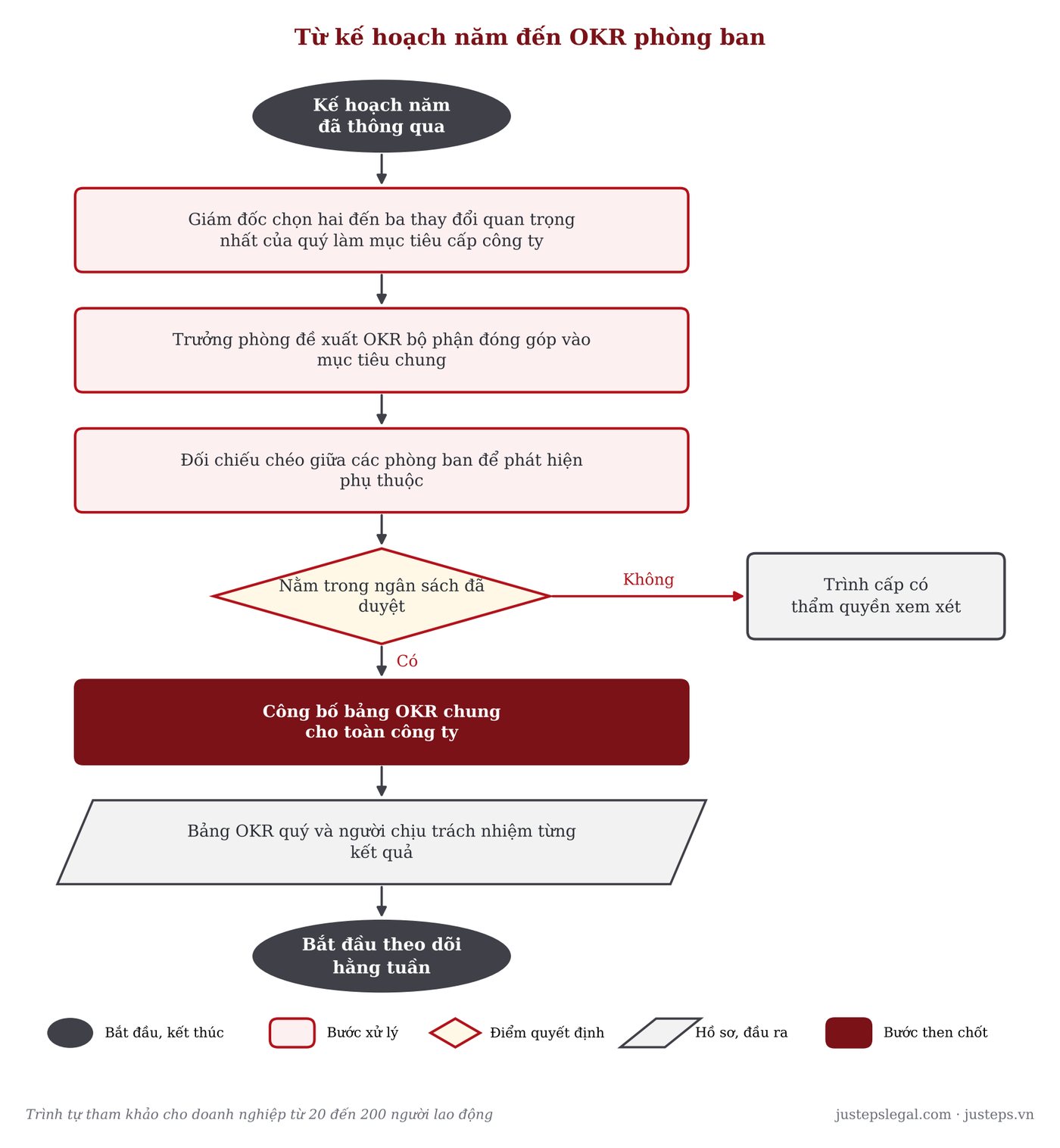
Sequence for turning the annual business plan into company-level and department-level OKRs
The sequence starts from the annual business plan approved by the competent body, from which the Director selects the two or three most important changes for the quarter to set as company-level objectives. Heads of department propose their own department’s OKRs to contribute to the shared objectives, rather than receiving targets handed down from above. At the cross-check session, departments review each other’s objectives to identify dependencies; for example, the sales department’s objective of increasing new customers requires the operations department to ensure delivery capacity. If an OKR would require exceeding the approved budget, the proposal is referred to the competent body for consideration before publication. The key step is publishing all OKRs on a shared board that everyone in the company can see.
Writing measurable objectives and key results
An objective should be short, contain an action verb and show the reader clearly what will be different after the quarter, for example increasing the rate of repeat customers or shortening delivery times for customers in the provinces. Key results must be expressed in numbers, with a starting value and a target value, and must describe the result achieved rather than the work to be done. A simple test is to ask whether completing the task would mean anything if the indicator did not change, and if the answer is no, it is a task, not a key result.
The table below compares some key results that are often written as tasks with the same results rewritten as measurable outcomes in common areas of small businesses:
| Area | Incorrect wording | Rewritten |
|---|---|---|
| Sales | Complete sales skills training for staff. | Increase the quotation-to-order conversion rate from 18% to 25%. |
| Customer care | Call all existing customers during the quarter. | Increase the 90-day repeat purchase rate from 22% to 30%. |
| Operations | Implement new warehouse management software. | Reduce the discrepancy between physical stock and the books from 3% to below 1%. |
| Finance | Chase customers to pay on time. | Reduce average days to collect payment from 65 days to 45 days. |
| HR | Hold three rounds of recruitment for sales staff. | Have 4 sales staff complete probation before day 30 of the last month of the quarter. |
Small businesses should limit each level to no more than three objectives, each with three to four key results, because a larger number causes heads of department to spread resources thinly and makes the weekly check-in drag on. Each key result needs one person responsible and a data source agreed at the start of the quarter, such as the sales report in the accounting software or the stock tracking sheet, to avoid disputes over figures when scoring. For an indicator the company has never measured, the first quarter should be used to establish the method of measurement and the starting value, and only then should a target value be set.
Committed objectives and aspirational objectives
Many businesses distinguish two types of OKRs, namely committed objectives that must be achieved in full, such as meeting reporting obligations or maintaining the on-time delivery rate, and aspirational objectives for which achieving around 70% is already a good result. Stating the type of each OKR from the outset helps avoid misunderstandings when scoring, because the same score of 0.7 may be a failure for a committed objective but a success for an aspirational one. In small businesses, a reasonable ratio is usually about two-thirds committed objectives and one-third aspirational objectives, so that the company maintains stable operations while still having the drive to improve.
The OKR operating rhythm within a quarter
The real value of OKRs lies in a regular tracking rhythm, because a well-written set of objectives that is reviewed only at the end of the quarter is no different from the old annual plan. Small businesses should keep the rhythm simple, with few meetings each producing a specific output, rather than copying the multi-layered processes of large corporations. The OKR coordinator, usually the director’s assistant or the head of HR, is responsible for keeping the schedule and templates and for prompting progress, but does not write OKRs on behalf of departments.
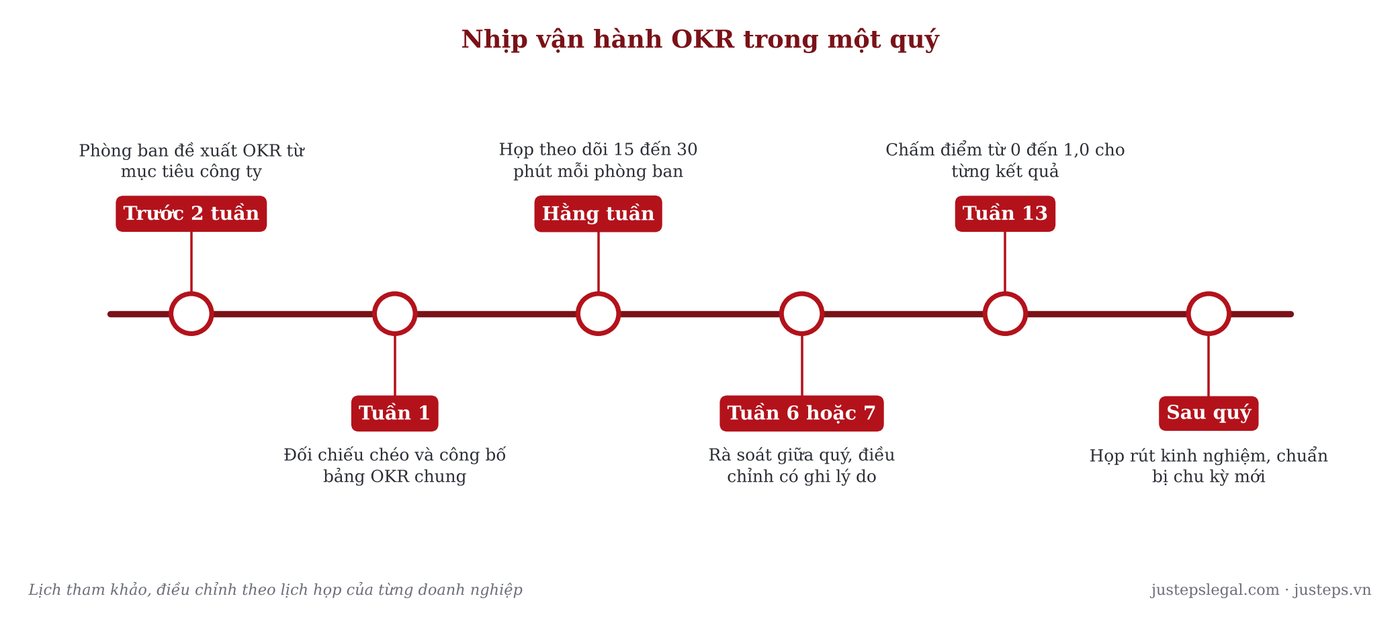
Milestones of a quarterly OKR cycle in a small or medium-sized enterprise
Two weeks before the quarter begins, departments complete their OKR proposals in time for cross-checking and publication in the first week of the quarter. Throughout the quarter, each department holds a weekly tracking meeting of about 15 to 30 minutes, in which each person updates their indicators, their confidence in reaching the target and any obstacles requiring support. The mid-quarter review, usually around week six or seven, is the point at which a key result may be adjusted or dropped if circumstances have changed, provided the reason is recorded. At the end of the quarter, departments score each key result from 0 to 1.0 and hold a lessons-learned meeting before moving on to the next cycle.
The minimum records for each cycle are the shared OKR board, the weekly update template, the minutes of the mid-quarter review and the end-of-quarter scoring report. These documents need not be long, but they must be kept by quarter so that the company can compare progress across cycles and use them as data when preparing the next annual plan. Businesses that already have a KPI system may consider Justeps’ service on KPI systems and performance appraisal to design the two tools to operate in parallel without overlapping.
OKRs, assessment of work performance and bonuses
The question businesses ask most often is whether OKR scores should be used to calculate bonuses. The general experience is that the OKR completion rate should not be linked directly to bonuses, because employees then tend to set safe targets to be sure of a high score, and OKRs lose the element of challenge that is the reason for applying them. The chart below illustrates this tendency in two hypothetical groups of departments over the first four quarters of application.
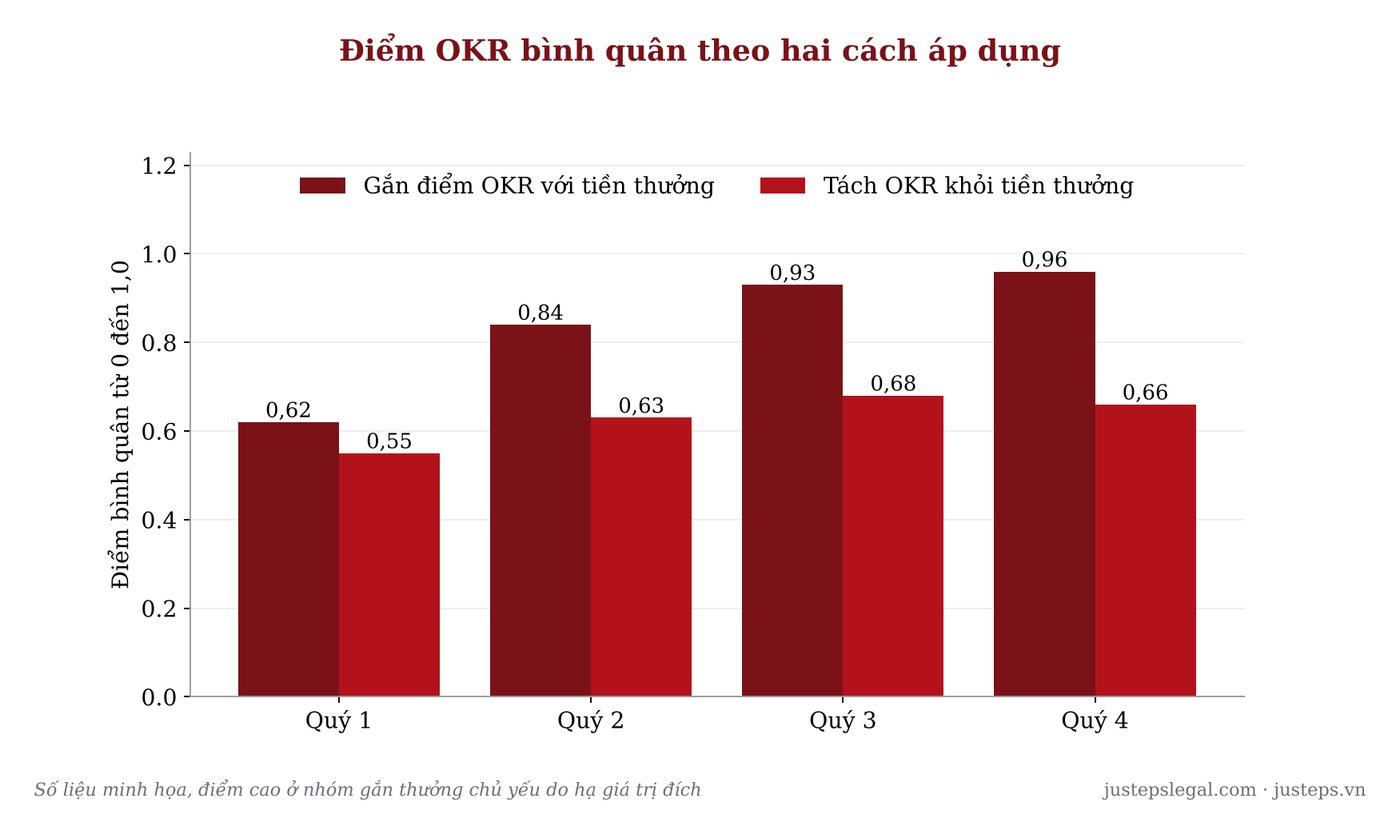
Average OKR scores under two approaches over the first four quarters, illustrative figures
In the group that links OKR scores directly to bonuses, the average score rises quickly to near the maximum after two quarters, but this is mainly because departments have lowered their target values to levels they are certain to reach. In the group that separates OKRs from bonuses, the average score fluctuates around 0.6 to 0.7, which is generally regarded as a reasonable level for challenging objectives. A high score does not therefore necessarily reflect better business results, and businesses should read OKR scores together with actual business indicators rather than looking at the score in isolation.
The recommended approach is to keep KPIs for calculating periodic bonuses, while OKR results are used as qualitative information when assessing capability, considering promotion or awarding project bonuses. Under the Labour Code, a bonus is money, property or another form of reward that the employer gives to an employee based on business results and the extent to which the employee has completed their work, and the bonus rules are decided by the employer and published at the workplace after consulting the grassroots employee representative organisation where one exists[4]. If the business still wishes to include OKR results in its bonus rules, the rules must state clearly the criteria, the method of calculation and the weighting of OKRs, so that employees know in advance and the business has a basis for responding to complaints.
Another risk is using a low OKR score as the basis for concluding that an employee has failed to perform their work. An employer may unilaterally terminate an employment contract only where the employee regularly fails to perform the work according to the criteria for assessing the extent of work completion set out in rules issued by the employer, and those rules must be issued after consulting the grassroots employee representative organisation where one exists[5]. Aspirational objectives are by nature objectives that may not be achieved, so using OKR scores as the criteria for assessing work completion both contradicts the philosophy of the method and is likely to be regarded as an unreasonable basis if a labour dispute arises.
When changing the assessment method or bonus rules to apply OKRs, the business should include the matter in the workplace dialogue programme, because bonus rules and the implementation of workplace democracy rules fall within the scope of dialogue[6]. In addition, the Law amending and supplementing a number of articles of the Labour Code was passed by the National Assembly on 21 November 2026 and takes effect on 1 March 2027[7], so labour rules issued during this period should be reviewed again once implementing guidance is issued. Businesses may consider Justeps’ service on pay scales, pay tables and pay and bonus regulations to adjust their bonus rules to the way they apply OKRs.
Tools, data and common mistakes
Small businesses do not need to buy specialised OKR software in the first two quarters, because a shared spreadsheet with columns for objectives, key results, starting value, target value, current value and the person responsible is sufficient to operate the system. Software becomes genuinely useful only once the company has the habit of weekly updates and needs to connect OKRs with data from its sales and accounting software. When choosing software, businesses should note that such systems usually store employees’ names, job titles, work results and comments about each individual, which is personal data governed by the law on personal data protection[8]. The business needs to inform employees of the purpose of processing, set access rights and review its contract with the software provider regarding the place of storage and responsibility for security.
From our experience supporting businesses, five mistakes occur most often when applying OKRs. The first is copying the list of daily tasks into the OKRs, which makes the objectives board long but shows no change. The second is assigning OKRs from the top down without discussion, so heads of department do not feel the objectives are their own. The third is reviewing OKRs only at the end of the quarter, when there is no time left to adjust. The fourth is buying software before the habit of tracking exists, and the fifth is using OKR scores to criticise individuals in front of colleagues, which leads everyone to set low targets in later quarters.
To avoid these mistakes, the business should allocate roles clearly from the first cycle, and the following table suggests how roles may be divided between levels when starting to apply OKRs:
| Role | Main responsibilities | Records kept |
|---|---|---|
| Competent body | Approves the annual business plan and reviews company-level OKR results each quarter. | Resolutions and decisions approving the annual plan. |
| Director | Selects company-level objectives and chairs the cross-check and the mid-quarter review. | Company-level OKR board and minutes of the mid-quarter review. |
| Head of department | Proposes department OKRs, chairs the weekly meeting and scores results at quarter end. | Department OKR board and weekly update template. |
| Coordinator | Keeps the schedule and templates, prompts progress and consolidates reports. | End-of-quarter scoring and lessons-learned report. |
| HR function | Ensures bonus and assessment rules are kept separate or state clearly how OKR results are used. | Bonus rules and rules for assessing work completion. |
Typically, a business needs two to three quarters for OKRs to run smoothly. The first quarter is a period of learning to write objectives and key results, so the trial should be limited to company level and two departments with clear data, such as sales and operations. The second quarter focuses on building the habit of weekly tracking and extending the approach to the remaining departments. From the third quarter, OKRs begin to genuinely guide the allocation of time and resources, and this is when the business should assess whether to invest in software or adjust its bonus rules.
How Justeps can help
Justeps supports small and medium-sized enterprises in implementing OKRs linked to their business plan and in compliance with labour law through the following services:
- KPI systems and performance appraisal. Justeps designs company-level and department-level OKRs, tracking templates and a way of operating them alongside existing KPIs.
- Pay scales, pay tables and pay and bonus regulations. Justeps reviews and adjusts bonus rules and assessment rules so that OKR results are used in line with labour regulations.
- KPI and performance management training for managers. Justeps trains heads of department in writing objectives and key results and in chairing the weekly tracking meeting.
- Ongoing management and operations advisory. Justeps accompanies the business through its first two quarters, attending the mid-quarter review and the end-of-quarter scoring.
Frequently asked questions
Should a company of about 20 people apply OKRs?
It can apply them at company level with one or two objectives per quarter, tracked directly by the director. A business of this size does not yet need to cascade OKRs down to each department or individual.
Should OKRs be set by quarter or by year?
Most small and medium-sized enterprises suit a quarterly cycle, which is long enough to create change and short enough to allow adjustment. Some businesses keep a few annual objectives drawn from the approved business plan and set key results for each quarter[1].
How long does it take for OKRs to run smoothly?
It usually takes two to three quarters, respectively to learn to write OKRs, to build the habit of weekly tracking and for OKRs to begin guiding the allocation of resources. The business should pilot them at company level and in two departments before extending them.
Should OKR scores be used to calculate bonuses?
They should not be linked directly, because employees will tend to set safe targets. If OKRs are nevertheless included in the bonus rules, the rules must state the criteria and method of calculation clearly, be published openly and be issued after consulting the employee representative organisation where there is one[4].
Is a low OKR score a ground for terminating an employment contract?
The ground for termination is regularly failing to perform the work according to the criteria in the assessment rules issued by the employer[5]. Aspirational objectives are inherently likely not to be achieved, so they are not suitable as such criteria.
May the Director adjust objectives beyond the approved plan through OKRs on their own?
The Director organises the implementation of the business plan, while changing the plan or the budget falls within the authority of the Members’ Council, the owner or the Board of Directors[2]. OKRs that go beyond the approved scope must be submitted to the competent body before publication.
What should be considered about personnel data when using OKR software?
Such software usually stores work results and comments about each employee, which is personal data requiring protection[8]. The business should inform employees of the purpose of processing, set access rights and review its contract with the provider.
Related articles
- How businesses should organise periodic performance appraisals that can be relied on for pay, bonuses and people management
- Annual budget planning for small and medium-sized enterprises, from assumptions and payroll to cash flow and control
- Designing KPIs for production workshops and linking assessment results to workers’ piece-rate pay
- Five common pay models and how a business can choose the right one for each group of positions
Notes
[1] Clause 2 of Article 55 and Clause 2 of Article 63 of the Law on Enterprises No. 59/2020/QH14 dated 17 June 2020, as amended and supplemented by Law No. 76/2025/QH15 dated 17 June 2025.
[2] Clause 2 of Article 138, Clause 2 of Article 153 and Article 162 of the Law on Enterprises No. 59/2020/QH14.
[3] Article 76 of the Law on Enterprises No. 59/2020/QH14.
[4] Article 104 of the Labour Code No. 45/2019/QH14 dated 20 November 2019.
[5] Point a of Clause 1 of Article 36 of the Labour Code No. 45/2019/QH14.
[6] Articles 63 and 64 of the Labour Code No. 45/2019/QH14.
[7] The Law amending and supplementing a number of articles of the Labour Code, passed by the National Assembly on 21 November 2026 and effective from 1 March 2027.
[8] The Law on Personal Data Protection No. 91/2025/QH15 and Decree No. 363/2026/ND-CP.
This article is for reference and reflects the regulations in force at the time of publication. Please consult Justeps for advice tailored to your company’s records and situation.
For further information, please contact:
📩 Email: info@justeps.vn
🌐 Website: https://justepslegal.com · https://justeps.vn
🌐 Page: Justeps
☎️ Hotline (Zalo): 096 172 2607
📍 Thanh Xuan Office: 12th Floor, Licogi 13 Tower, 164 Khuat Duy Tien Street, Thanh Xuan Ward, Hanoi, Vietnam
📍 Ha Dong Office: LK06B, No.10, Dong Dua Area, Ha Dong Ward, Hanoi, Vietnam
📍 Ho Chi Minh City Branch: 528 Le Van Sy, Ho Chi Minh City, Vietnam
📍 Hai Phong Office: Truong Thinh Village, Ha Dong Commune, Hai Phong, Vietnam
📍 Quang Ninh Office: Van Don Special Zone, Quang Ninh Province, Vietnam





