
Key takeaways
- Information is protected as a business secret only when the business can prove that it has applied the necessary security measures, so document classification and access control are both management tools and legal conditions.
- An effective internal information security framework has three layers, namely document classification, access control and a leak response procedure, and all three must be linked to employment contracts and the internal labour rules.
- To dismiss an employee for disclosing business secrets, that act must be specified in the internal labour rules, and the limitation period for disciplinary action for this act is 12 months.
- Where leaked information contains personal data, the business must also perform the notification obligation under the Law on Personal Data Protection, so the response procedure needs to distinguish between these two types of incident from the outset.
A packaging manufacturer discovered that a competitor had quoted three of its major customers prices exactly one per cent lower than its newly approved internal price list. Three months earlier, a sales employee had resigned and joined that competitor. When the company wanted to claim compensation from this person, the human resources department realised that the employment contract had no confidentiality clause, that the price list had been sent through a chat group that included outside freelancers, and that anyone in the company could open the folder containing the price list. The information clearly had value, but the company had almost nothing to show that it had actually protected it.
This article explains how to build an internal information security framework in the order in which the work is done, including identifying the information to be protected and the legal conditions for protection, document classification, access control, linking confidentiality with employment contracts and the internal labour rules, the procedure for handling leaks, and common mistakes and the records to keep. The content suits trading, service, manufacturing and technology businesses with from around ten to several hundred employees. The main readers are directors, heads of human resources, the person in charge of information technology and the heads of departments that hold important information.
Which information needs protection and the conditions for legal protection
A business holds a wide range of internal information, from price lists, customer lists, production formulas and software source code to business plans, unpublished financial statements and personnel files. Not all information has the same value, and protecting everything to the same degree is both costly and slows down work. A business should start by listing the groups of information whose disclosure would cause significant damage, and then determine which of those groups may be protected as business secrets.
Under the Law on Intellectual Property, a business secret is information obtained from financial or intellectual investment, which has not been disclosed and is capable of being used in business[1]. Information is protected only when it meets all three conditions, namely that it is not common knowledge and is not easily obtained, that it is capable of creating an advantage when used in business, and that its owner keeps it secret by the necessary measures so that it is not disclosed and is not easily accessible[2]. The third condition is entirely within the business’s control but is often overlooked. If documents are left open in a shared folder, sent through personal chat channels or have no one responsible for managing them, the business will find it very difficult to argue that the information is a business secret when a dispute arises.
When information meets the above conditions, acts such as accessing or obtaining the information by defeating the owner’s security measures, or disclosing or using it without permission, all infringe the rights to the business secret[3]. This is the basis on which the business may demand that the infringing act cease and claim compensation for damage. Alongside business secrets, a business also holds the personal data of customers and employees, which is protected under the Law on Personal Data Protection No. 91/2025/QH15 with its own obligations[4]. A good internal security framework should handle both groups of information within the same system without treating their legal obligations as identical.
Classifying documents by security level
Document classification is the foundation, because every subsequent control measure depends on the level of the document. A common classification has four levels, namely public, internal, restricted and confidential, each linked to a set of minimum measures. A business with fewer than around twenty people may reduce this to three levels by dropping the restricted level, provided that the confidential level is clearly defined. The table below describes the four levels and the corresponding measures.
| Level | Example documents | Minimum measures |
|---|---|---|
| Public | Brochures, published price lists and content on the website. | No restriction, but the responsible department must approve the content before publication. |
| Internal | Procedures, forms, internal notices and work schedules. | Shared only within the business and not sent outside without the consent of the head of department. |
| Restricted | Personnel files, payrolls, customer contracts and customer lists. | Accessible only to those with a related duty, stored in folders with assigned rights, with rights reviewed every quarter. |
| Confidential | Cost price lists, formulas, source code, investment plans and negotiation information. | Access list approved by the director, access logged, and no storage on personal devices. |
Who assigns labels and how labels are shown
The person who creates a document is usually best placed to propose its level, but the confidential level should be decided by the head of department or the director to avoid every document being marked confidential and the label losing its meaning. The label needs to appear on the document, for example in the header or footer of the text, in the file name or in the folder properties, so that the recipient knows immediately which level of document they are holding. Documents without a label should be treated as internal by default, not as public. This default rule needs to be written into the regulations so that employees cannot argue that unlabelled documents may be shared freely.
Periodic review of the confidential document list
The value of information changes over time, for example last year’s price list may no longer be sensitive, and an investment plan becomes public information once it has been announced. A business should review its list of confidential documents about every six months in order to downgrade or destroy documents that no longer need protection. Such reviews reduce the number of documents requiring strict control and also show that the business manages its secrets systematically. The review records and document destruction records should be kept as part of the evidence of security measures.
Access control and day-to-day management
The basic principle of access control is that each person may access only the information needed for their own work, known as the principle of least privilege. A business should prepare an access matrix in which each row is a group of information, each column is a position or department, and each cell states whether there is a right to view, a right to edit or no right at all. The matrix below illustrates the level of permission for several common actions by document level.
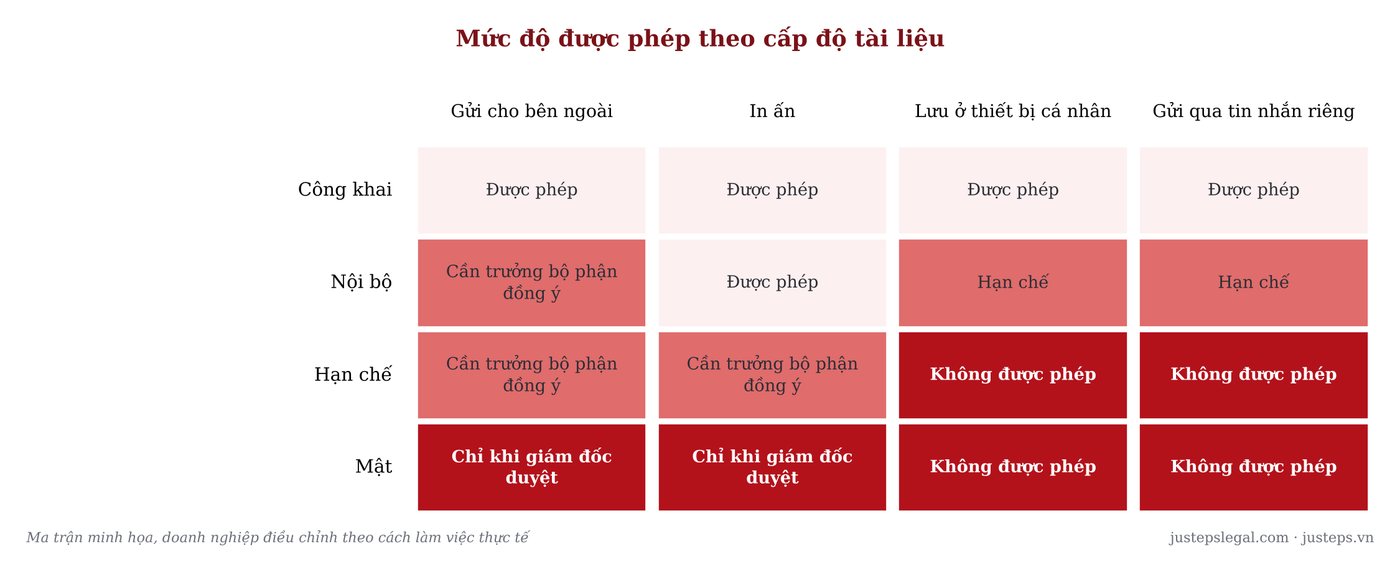
Level of permission for sharing actions by document level
According to the matrix, public and internal documents may be used relatively flexibly, whereas restricted documents require the consent of the head of department before being sent outside or printed. For confidential documents, actions such as storing them on personal devices, sending them through personal messaging applications or sending them to outside parties are not permitted, except where the director approves in writing for each specific occasion. This matrix is only an example, and each business needs to adapt it to its actual way of working, especially where staff work remotely or work with many outside partners.
Granting and revoking access rights
Access rights should be granted at the written or system request of the head of department, then implemented and recorded by the information technology department. When an employee changes position, the old rights must be revoked before new rights are granted, because the accumulation of rights over several transfers is a common source of risk. When an employee resigns, all access rights, email accounts and software accounts must be disabled no later than the last working day, and devices and documents must be handed over under a handover record. Every quarter, heads of department should review the list of people with access to restricted and confidential folders to identify excess rights.
Devices, chat channels and remote work
Most leaks in small and medium-sized businesses come not from cyberattacks but from everyday working habits such as sending documents through personal chat groups, sharing accounts or saving files on home computers. A business should specify the official communication channel for each type of information, enable two-factor authentication for email and administrator accounts, and restrict copying of data to portable storage devices. For remote workers, the regulations need to state which devices may be used to access restricted documents, how to connect securely and the duty to report immediately when a device is lost. The business’s information systems must also comply with the general cybersecurity requirements under the Law on Cybersecurity No. 116/2025/QH15[5], and the specific requirements should be reviewed periodically by the information technology department.
Linking confidentiality with employment contracts and internal labour rules
Technical measures only reduce the likelihood of leaks, whereas an employee’s legal liability for a breach must be established through the employment contract and the internal labour rules. Where an employee’s work is directly related to business secrets or technological secrets, the employer has the right to agree in writing with the employee on the content and duration of the protection of secrets, the employee’s benefits and compensation in case of breach[6]. Such an agreement should identify the specific groups of information protected rather than referring generally to all information of the company, because an overly broad clause is easily found to be unclear in a dispute. The protection period may extend beyond the termination of the employment contract, and the business should consider commensurate benefits for the employee so that the agreement is persuasive.
The internal labour rules must contain provisions on the protection of the employer’s assets, business secrets, technological secrets and intellectual property[7]. An employee who discloses business secrets or technological secrets may be dismissed, but only where that act is specified in the internal labour rules[8]. A business is also prohibited from disciplining an employee for an act that is not specified in the internal labour rules, the signed employment contract or the labour legislation[9]. The internal labour rules should therefore list specific violations such as copying confidential documents to personal devices, sending restricted documents to outsiders and sharing passwords, and grade the disciplinary measures according to seriousness.
The usual limitation period for labour discipline is six months from the date of the violation, but it is extended to twelve months for violations relating to the disclosure of technological secrets or business secrets[10]. Because leaks are often discovered late, the business needs to keep access logs and evidence long enough to still be able to take action within this period. Businesses wishing to review their employment contracts, confidentiality agreements and internal labour rules together may refer to Justeps’ service on information security and conflicts of interest.
Handling information leaks
The speed of response in the first twenty-four hours often determines the extent of the damage, because this is the time to contain the incident, revoke access and preserve evidence before it is deleted. A business should designate in advance a focal point for receiving incidents, usually the person in charge of information technology or legal affairs, and require every employee who detects signs of a leak to report immediately to this focal point. The flowchart below describes a reference handling sequence.
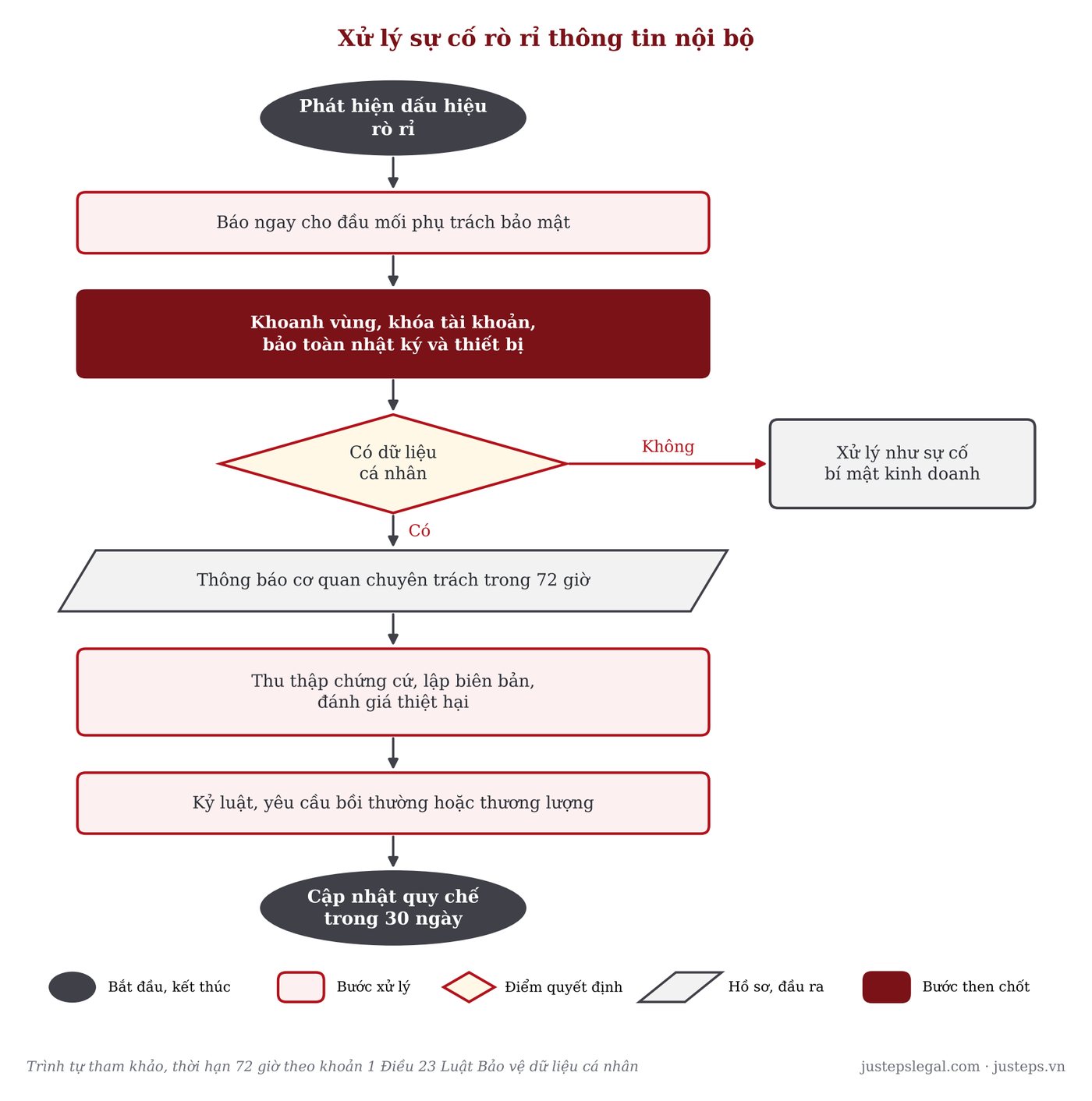
Handling sequence when a leak of internal information is detected
After receiving the report, the focal point contains the incident, locks the accounts or revokes the relevant rights and orders the preservation of system logs, emails and devices. The next step is to determine whether the leaked information contains personal data, because this is the point at which the legal obligations diverge. Where personal data is involved, the business must notify the breach to the specialised personal data protection authority within seventy-two hours of discovery[11], so the focal point should have a notification template and a list of the information to be provided ready in advance. Where only business secrets are involved, the business continues to handle the matter internally, collecting evidence, making records and deciding on the course of action.
The course of action may include disciplining the employee under the internal labour rules, claiming compensation under the confidentiality agreement, sending a written demand to a third party to stop using the information, or negotiating with the parties concerned. Bringing a lawsuit is the business’s right, and if it chooses this course, the business needs to pass the file to a practitioner of its own choosing. Within around thirty days after the incident, the business should assess the root cause and update its regulations, access matrix or procedures so that a similar incident does not recur. For incidents involving customer data, the business may refer to Justeps’ service on personal data protection and cybersecurity to review the notification obligations and remedial measures.
Common mistakes and the records to keep
In our advisory practice, the most common sources of information leaks in small and medium-sized businesses are people and working habits rather than technical incidents. The chart below illustrates the breakdown of common causes.
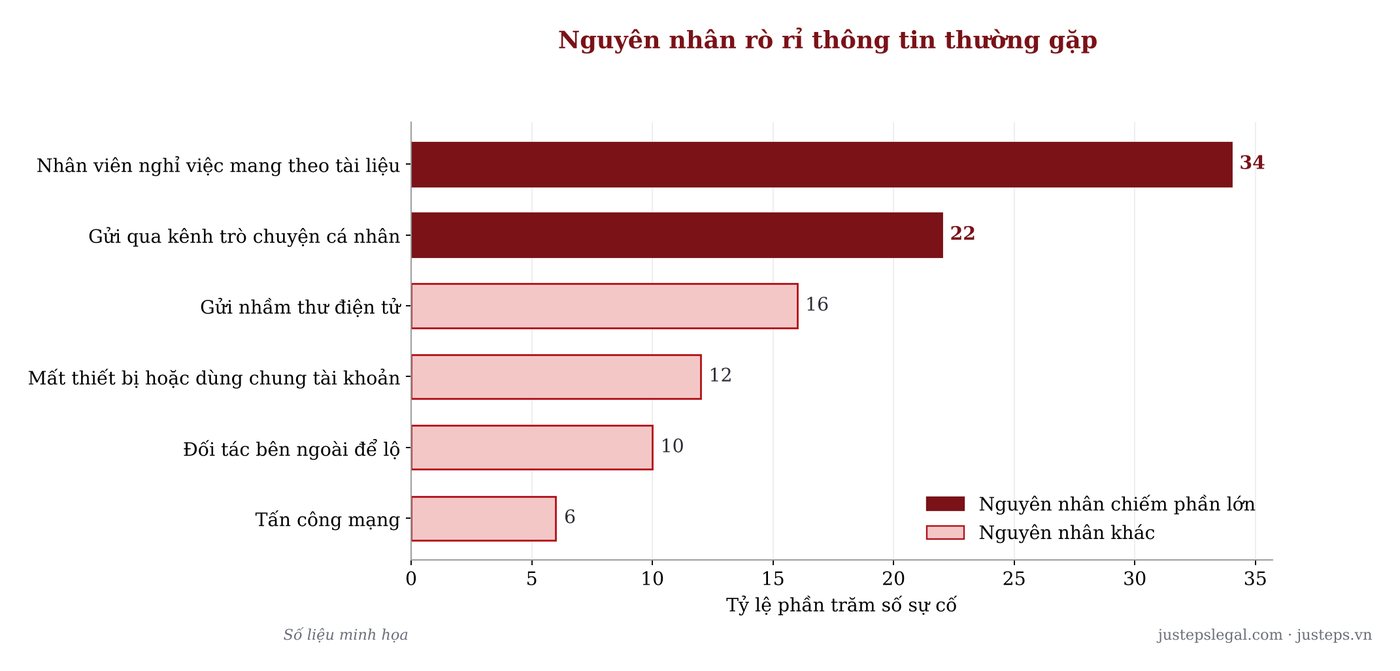
Example breakdown of the causes of information leaks in small and medium-sized businesses
In the example, departing employees taking documents with them and documents sent through unofficial channels account for most cases, while cyberattacks account for only a small share. This shows that the focus of a security framework in small and medium-sized businesses should be on the resignation procedure, rules on communication channels and employee training, before investing in expensive technical solutions. The figures in the chart are illustrative, and each business should compile its own incident statistics to determine its priorities. In addition, businesses often make the following mistakes:
- The business marks too many documents as confidential, so employees no longer take the label seriously and the security rules are ignored.
- The employment contract has a confidentiality clause but the internal labour rules do not specify the violation, so the business lacks a basis for disciplinary action.
- Access rights are not revoked when an employee changes position or resigns.
- The business does not keep access logs or deletes them too early, so evidence is lost when an incident is discovered late.
- The response procedure does not distinguish incidents involving personal data, so the business misses the notification deadline.
To prove that it has applied the necessary security measures, a business should keep a set of records comprising the information security regulations, the list of confidential documents and the review records, the access matrix, the signed confidentiality agreements, the registered internal labour rules, the training materials and records, the handover records on resignation and the files on incidents handled. This set of records serves management purposes and is also the most important evidence when the business needs to claim compensation or prove that its information is a business secret. The records should be updated by the person in charge of security at least once a year and whenever there is a change in the organisation or the systems.
How Justeps can help
Justeps supports businesses in building and operating an internal information security framework through the following services:
- Information security and conflicts of interest. Justeps drafts security regulations, the document classification list, the access matrix and the leak response procedure.
- Personal data protection and cybersecurity. Justeps reviews personal data processing activities and prepares the procedure and notification templates for use when a breach occurs.
- Internal labour rules and disciplinary action. Justeps adds security-related violations to the internal labour rules and supports a disciplinary process that follows the statutory sequence.
- Labour records and employment contracts. Justeps drafts confidentiality agreements for positions holding important information and handover records for use on resignation.
- Negotiation strategy and handling of violations. Justeps assesses the case, reviews evidence, drafts demand letters and supports negotiation when information has been misused.
Frequently asked questions
Does a small business need to classify documents into four levels?
A business with fewer than around twenty people may use three levels, namely public, internal and confidential. What matters is that the confidential level is clearly defined and protected by real measures, because that is a condition for the information to be protected as a business secret[2].
Without a confidentiality agreement, can a business take action against an employee who discloses information?
The business may still take disciplinary action if disclosure of business secrets is specified in the internal labour rules[8]. However, claiming compensation is much easier when there is a written agreement on the content of confidentiality and compensation[6].
How does internal information security differ from personal data protection?
Internal information security protects the interests of the business, whereas personal data protection protects the rights of customers and employees. The two sets of obligations can be managed within the same system, but incidents involving personal data carry a separate notification obligation[11].
What is the limitation period for disciplining an employee who discloses business secrets?
The limitation period is twelve months from the date of the violation for acts relating to the disclosure of technological secrets or business secrets[10]. The business should keep access logs long enough to retain evidence within this period.
Who should be the security focal point in a business?
The focal point is usually the person in charge of information technology, legal affairs or administration and human resources, with the power to order accounts to be locked and to access system logs. The business should also appoint a deputy so that someone can receive incidents outside working hours.
May a business check employees’ work emails to detect leaks?
The business should state clearly in the internal labour rules and regulations that work accounts are company assets and may be checked to the extent necessary. Such checks must comply with the rules on personal data protection, and employees need to be informed of this measure in advance[4].
Is information that has been sent to a partner still a business secret?
The information may still be protected if it is shared in a controlled way, for example under a confidentiality agreement and only with those who need to know. Conversely, sending information to a partner without any confidentiality obligation may cause the condition of being kept secret by the necessary measures to be lost[2].
Related articles
- Personal data protection in the HR department under the 2025 Law on Personal Data Protection
- The internal misconduct investigation procedure
- A minimum set of internal governance regulations for businesses with 50 to 200 staff
- The procedure for issuing internal documents in a company, from drafting to archiving and monitoring their validity
Notes
[1] Clause 23, Article 4 of the Law on Intellectual Property No. 50/2005/QH11 dated 29 November 2005, as amended and supplemented.
[2] Article 84 of the Law on Intellectual Property No. 50/2005/QH11, as amended and supplemented.
[3] Clause 1, Article 127 of the Law on Intellectual Property No. 50/2005/QH11, as amended and supplemented.
[4] Law on Personal Data Protection No. 91/2025/QH15 dated 26 June 2025.
[5] Law on Cybersecurity No. 116/2025/QH15.
[6] Clause 2, Article 21 of the Labour Code No. 45/2019/QH14 dated 20 November 2019.
[7] Point dd, Clause 2, Article 118 of the Labour Code No. 45/2019/QH14.
[8] Clause 2, Article 125 of the Labour Code No. 45/2019/QH14.
[9] Clause 3, Article 127 of the Labour Code No. 45/2019/QH14.
[10] Clause 1, Article 123 of the Labour Code No. 45/2019/QH14.
[11] Clause 1, Article 23 of the Law on Personal Data Protection No. 91/2025/QH15.
This article is for reference and reflects the regulations in force at the time of publication. Please consult Justeps for advice tailored to your company’s records and situation.
For further information, please contact:
📩 Email: info@justeps.vn
🌐 Website: https://justepslegal.com · https://justeps.vn
🌐 Page: Justeps
☎️ Hotline (Zalo): 096 172 2607
📍 Thanh Xuan Office: 12th Floor, Licogi 13 Tower, 164 Khuat Duy Tien Street, Thanh Xuan Ward, Hanoi, Vietnam
📍 Ha Dong Office: LK06B, No.10, Dong Dua Area, Ha Dong Ward, Hanoi, Vietnam
📍 Ho Chi Minh City Branch: 528 Le Van Sy, Ho Chi Minh City, Vietnam
📍 Hai Phong Office: Truong Thinh Village, Ha Dong Commune, Hai Phong, Vietnam
📍 Quang Ninh Office: Van Don Special Zone, Quang Ninh Province, Vietnam





