
Key takeaways
- A 30-60-90 day roadmap is an internal management tool and does not change the maximum probationary period that the Labour Code sets for each category of work.
- The milestone for concluding probation must fall before the probationary period ends, because the business is obliged to notify the result when that period ends.
- Each new joiner needs a line manager responsible for objectives and a mentor who provides day-to-day guidance, and these two roles should be held by different people.
- The objectives for each phase must be measurable and acknowledged in writing by the new joiner, so that the assessment form can serve as evidence if the probation result is disputed.
- Onboarding records contain a great deal of personal data, so the business should restrict who may view them and must not retain the originals of employees’ qualifications or identity documents.
Many businesses put considerable effort into recruitment but leave new joiners to fend for themselves from their very first day. The new joiner arrives without a computer or software accounts and does not know whom to ask about procedures, while the line manager is busy and only meets the new joiner again when probation is about to end. As a result, the probation decision is based on impressions, some people resign within their second month, and when the business decides not to retain someone, there is no document showing that the person did not meet the requirements. In businesses that hire three or more people each quarter, these problems recur often enough to become a significant cost.
This article analyses how to build an onboarding programme for new employees around three milestones at 30, 60 and 90 days, focusing on aligning the roadmap with the probation rules of the Labour Code 2019, the content of each phase, the allocation of roles, assessment at each milestone and the set of records to be kept. It applies to businesses of every type that employ workers under employment contracts, from a small company whose HR department consists of one person to a business with many branches. It is written mainly for directors, heads of HR and line managers who have new joiners in their teams.
When a business needs a structured onboarding programme
Labour law does not require businesses to have an onboarding programme for new employees, but several obligations must be performed as soon as an employee starts work. The employer must issue internal labour regulations and notify them to employees, and must also post the main contents in the necessary places at the workplace[1]. New employees must also receive occupational safety and hygiene training on recruitment and before being assigned to work[2]. An onboarding programme brings these obligations together in a sequence with a named person responsible, instead of leaving each department to remember them on its own.
Beyond the legal obligations, certain signs indicate that a business should standardise its onboarding. The clearest sign is that the proportion of new hires who leave within the first 90 days exceeds around 15%, or that new joiners in the same position at two branches are trained in two different ways. Another sign is that line managers conclude probation with a single general comment that is not linked to any specific objective set at the outset. When any of these signs appears, the business should start by drawing up a standard roadmap for the positions it hires most often and then extend it gradually to other positions.
The chart below illustrates the gap commonly seen in early attrition between new joiners onboarded under a roadmap and those left to learn on the job at a hypothetical business.
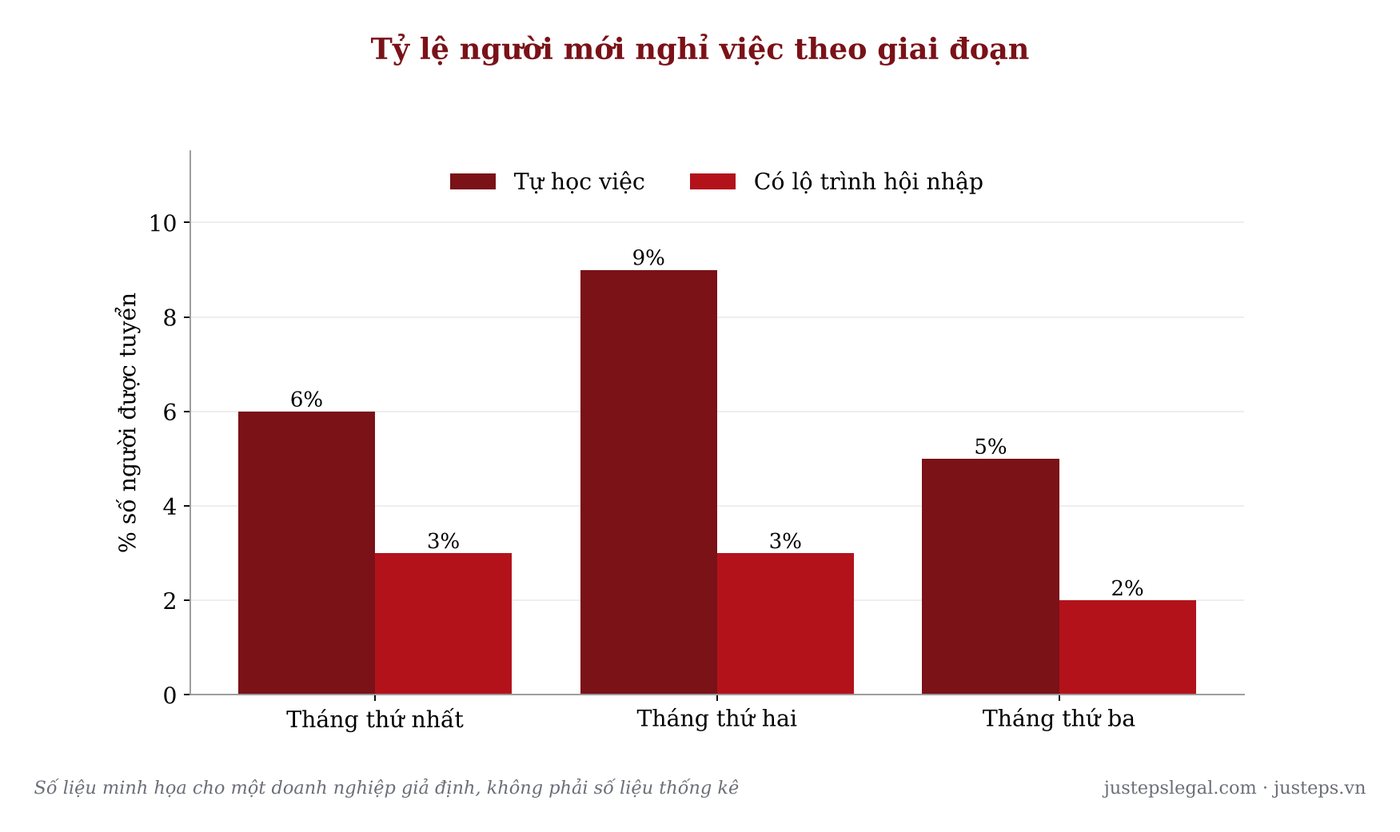
Attrition by phase for two groups of new joiners, illustrative figures
Among new joiners left to learn on their own, attrition peaks in the second month, when they have understood the real work but do not yet feel supported or fairly assessed. The group with an onboarding roadmap shows lower attrition in all three phases, and the largest gap is also in the second month, when the 30-day review helps both sides adjust their expectations early. The figures are illustrative only, but a business can build a similar chart from its own attrition data to measure the effectiveness of the programme each year.
Aligning the 30-60-90 day roadmap with the statutory probationary period
The 30-60-90 day roadmap is a management tool, whereas probation is a legal institution with its own limits, so the two must be designed to fit together. Under the Labour Code, the employer and the employee may agree on probation in the employment contract or enter into a separate probation contract, and probation does not apply to employees who enter into an employment contract with a term of less than one month[3]. The probationary period is agreed by the parties based on the nature and complexity of the work, probation may take place only once for the same job, and it may not exceed the maximum set for each category of work[4].
The following table compares the maximum probationary periods under the Labour Code with how the onboarding milestones should be set, so that line managers know which milestone concludes probation for each category of position:
| Category of work | Maximum probationary period | How to set onboarding milestones |
|---|---|---|
| Enterprise managers | Not more than 180 days. | The 30 and 60-day milestones review progress, the 90-day milestone is a mid-term review, and probation is concluded at the end of the probationary period. |
| College level or above | Not more than 60 days. | Probation is concluded at the 60-day milestone, and days 61 to 90 move on to development objectives for a permanent employee. |
| Intermediate level, technical workers, clerical staff | Not more than 30 days. | Probation is concluded at the 30-day milestone, and the 60 and 90-day milestones are used to track productivity and mentoring. |
| Other work | Not more than 6 working days. | Assessment takes place in the first week, and the rest of the roadmap is on-the-job guidance for a permanent employee. |
A point to note is that the 90-day roadmap does not extend the probationary period. For a specialist with a university degree, the maximum probationary period is 60 days, so the business cannot wait until the 90-day milestone to decide whether to retain that person. If it wants more time to observe, the business should sign a permanent employment contract after probation and use the remaining phase to set development objectives, rather than asking the employee to undergo another round of probation. Requiring a second probation for the same job breaches the rule that probation takes place only once and may attract an administrative penalty[5].
The employee’s wage during probation is agreed by the parties but must be at least 85% of the wage for that job[6]. When preparing the recruitment budget, the business should state both the probationary wage and the permanent wage in the offer letter to avoid misunderstandings. Where probation ends in the middle of a month, the payroll accountant needs to split the two wage levels according to the actual number of days worked, and the permanent wage applies from the day after the day on which a successful result is notified.
When the probationary period ends, the employer must notify the employee of the probation result. If the result is satisfactory, the parties continue to perform the employment contract already signed, or enter into an employment contract if only a separate probation contract was signed previously; if it is unsatisfactory, the contract or probation agreement is terminated. During probation, either party may cancel the probation agreement without prior notice and without paying compensation[7]. Therefore, the concluding milestone in the onboarding roadmap should be set a few working days before probation ends, allowing enough time to compile the assessment forms, seek approval and send the notice on time.
Designing onboarding content for each phase
An effective onboarding programme is divided into four phases with different objectives, moving from preparation, to learning and observing, to working with mentoring and finally to working independently. The roadmap below is a reference framework for an office position with a 60-day probationary period, and the business should adjust it according to the categories of work in the table in the previous section.
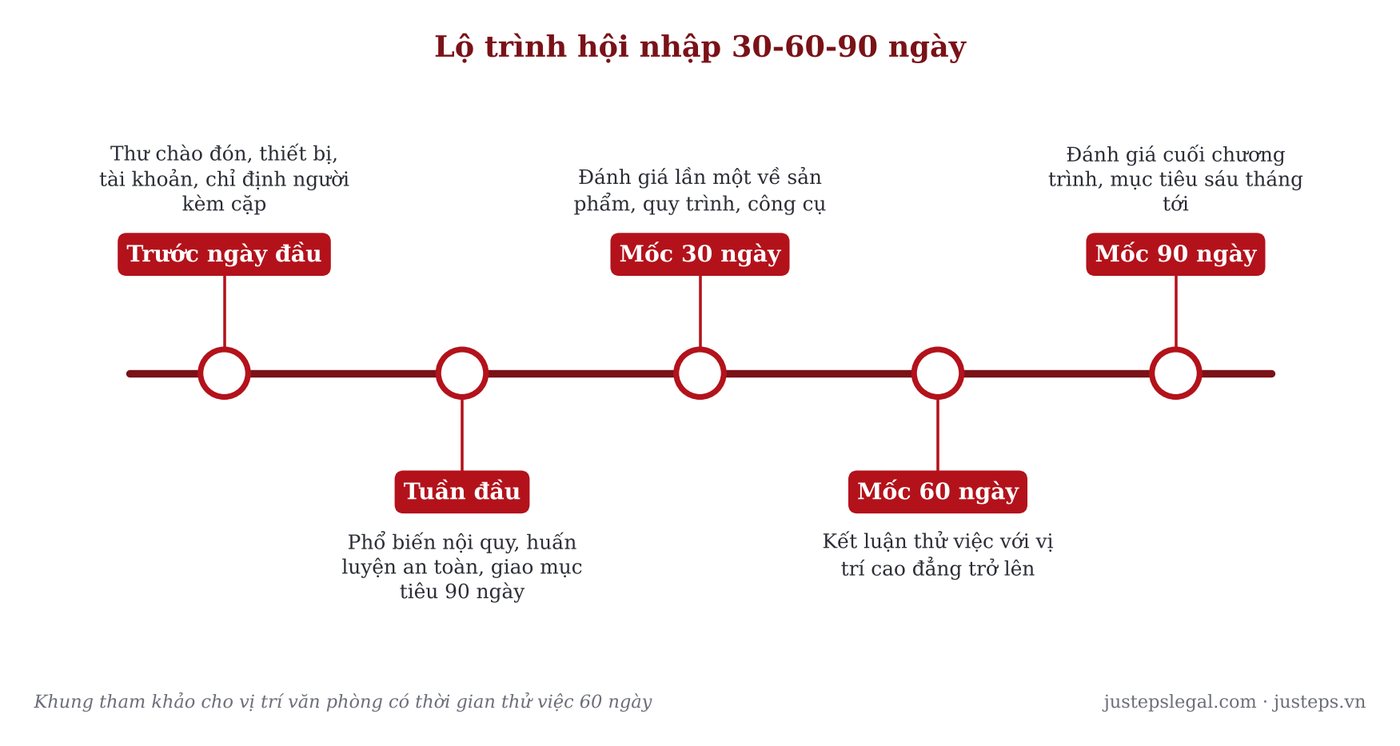
Key milestones of a 30-60-90 day onboarding roadmap for an office position
The roadmap begins before the first working day, when the HR department sends a welcome letter and the IT team prepares equipment and accounts. The 30-day milestone is the first review, checking whether the new joiner has grasped the products, procedures and tools. The 60-day milestone is when probation is concluded for positions requiring college-level qualifications or above, so this review has legal consequences. The 90-day milestone closes the programme with agreement on objectives for the next six months, after which the new joiner is managed like any other permanent employee.
Before the first working day
The preparation phase shapes the new joiner’s first impression and is the one most often skipped. The HR department should send a welcome letter at least three working days in advance, stating the arrival time, the person who will receive the new joiner, the documents to bring and the schedule for the first week. The IT team prepares the computer, email address and software access appropriate to the position, while the line manager appoints a mentor and drafts the 90-day objectives to discuss during the first week. The employment contract or probation contract should be sent in advance so that the new joiner can read it carefully, and if the business concludes contracts electronically, it should check the new joiner’s signing account beforehand.
When receiving documents, the business may only ask the employee to present or submit copies; it must not retain the originals of the employee’s identity papers, diplomas or certificates and must not require the employee to provide a security in cash or other assets for the performance of the contract[8]. Some businesses still keep original degree certificates during probation on the pretext of guarding against new joiners leaving abruptly, but this practice breaches the law and may be penalised. If verification is needed, HR staff should only inspect the original, photograph or copy what needs to be kept and return it the same day.
The first 30 days for learning and observing
The aim of the first month is to help the new joiner understand the business, its products, its customers and how departments work together, without placing heavy emphasis on business results. In the first week, the new joiner should be briefed on the internal labour regulations, rules on working hours, timekeeping, the leave request procedure and information security policies. Employees whose work involves hazardous elements, such as operating machinery, working at height or handling chemicals, must complete safety training before being assigned to actual work. By the end of the month, the new joiner should be able to perform some simple tasks under supervision; for example, a salesperson might accompany around ten customer meetings and prepare quotations independently using the template.
Days 31 to 60 for working with mentoring
In the second month, the new joiner takes on real work with a gradually increasing workload, while the mentor moves from demonstrating to checking and giving feedback. Objectives for this phase must be measurable; for example, a technician resolves around 70% of first-level incidents independently, or an accountant prepares a complete set of payment vouchers in line with internal rules without having them returned. For positions with a 60-day probationary period, the results of this phase are the very basis for concluding probation, so the objectives should be set in writing at the start of the month and acknowledged by the new joiner’s signature.
Days 61 to 90 for working independently
In the third month, the new joiner handles a workload close to that of a permanent employee in the same position and begins to be assigned tasks requiring independent decisions within delegated authority. This is also a good time for the new joiner to suggest improvements, because they understand the procedures well enough but are not yet used to the inefficiencies that longer-serving staff have come to accept. The review at the end of the programme should shift the focus to objectives for the next six months and training needs, so that the new joiner can see a clear development path within the business.
If the business sends the new joiner on costly external training during this phase, the parties should sign a training contract stating the trade or skill trained, the duration, the cost, the period the employee commits to work after training and the obligation to reimburse costs[9]. A commitment to reimburse training costs should not be inserted into the probation contract, because once the probation agreement is cancelled, the basis for recovering the costs becomes unclear.
Allocating roles in the onboarding programme
An onboarding programme only works when every task has a specific person responsible for it. A common mistake is to hand everything to the HR department, even though HR cannot assess the professional competence of an engineer or a salesperson. The following table suggests how roles may be allocated among the four parties involved:
| Party | Main responsibilities | When involved |
|---|---|---|
| HR department | Coordinates the roadmap, runs the orientation session, briefs on internal regulations, reminds participants of review dates and keeps records. | From before the first day until the 90-day milestone. |
| Line manager | Sets objectives for each phase, assigns work, chairs the reviews and proposes the probation result. | Meets the new joiner on the first day and at each 30, 60 and 90-day milestone. |
| Mentor | Provides day-to-day guidance, answers questions and gives weekly feedback to the new joiner and the manager. | Regularly during the first 60 days, tapering off in the third month. |
| Senior management | Meets new joiners, explains the direction of the business and approves probation results for management positions. | During the first month and when approving probation results. |
The mentor should be an experienced colleague in the same team rather than the line manager, so that the new joiner feels free to ask about anything unclear without fear of being marked down. The business should include mentoring duties in the mentor’s own objectives and take them into account in the mentor’s appraisal; otherwise mentoring will always come second to the mentor’s main work. In a small business without a separate HR department, the director or an HR and administration employee can take on the coordinating role, provided that the review dates are entered in the shared calendar from the outset.
The job description is the foundation document from which the line manager sets the new joiner’s objectives. When the job description is vague, onboarding objectives become vague too, and the employee is more likely to contest the probation conclusion. Businesses can standardise their contract templates, job descriptions and confirmation decisions through Justeps’ labour records and employment contracts service.
Assessment at the 30, 60 and 90-day milestones
Each milestone review is a meeting of around 30 to 45 minutes between the new joiner, the line manager and an HR representative. The assessment form should score three groups of criteria, namely work results against the objectives set, command of procedures and tools, and cooperative attitude and compliance with internal regulations, each on a four-point scale with specific comments. The new joiner completes a self-assessment before the meeting, after which both sides compare notes and agree on what needs to improve in the next phase. The minutes of the review should be signed by the new joiner even where they disagree with some comments, because the signature confirms that the meeting took place and that its content was communicated.
The review that coincides with the end of probation has legal consequences, so it should follow a clear sequence from compiling the results to sending the notice.
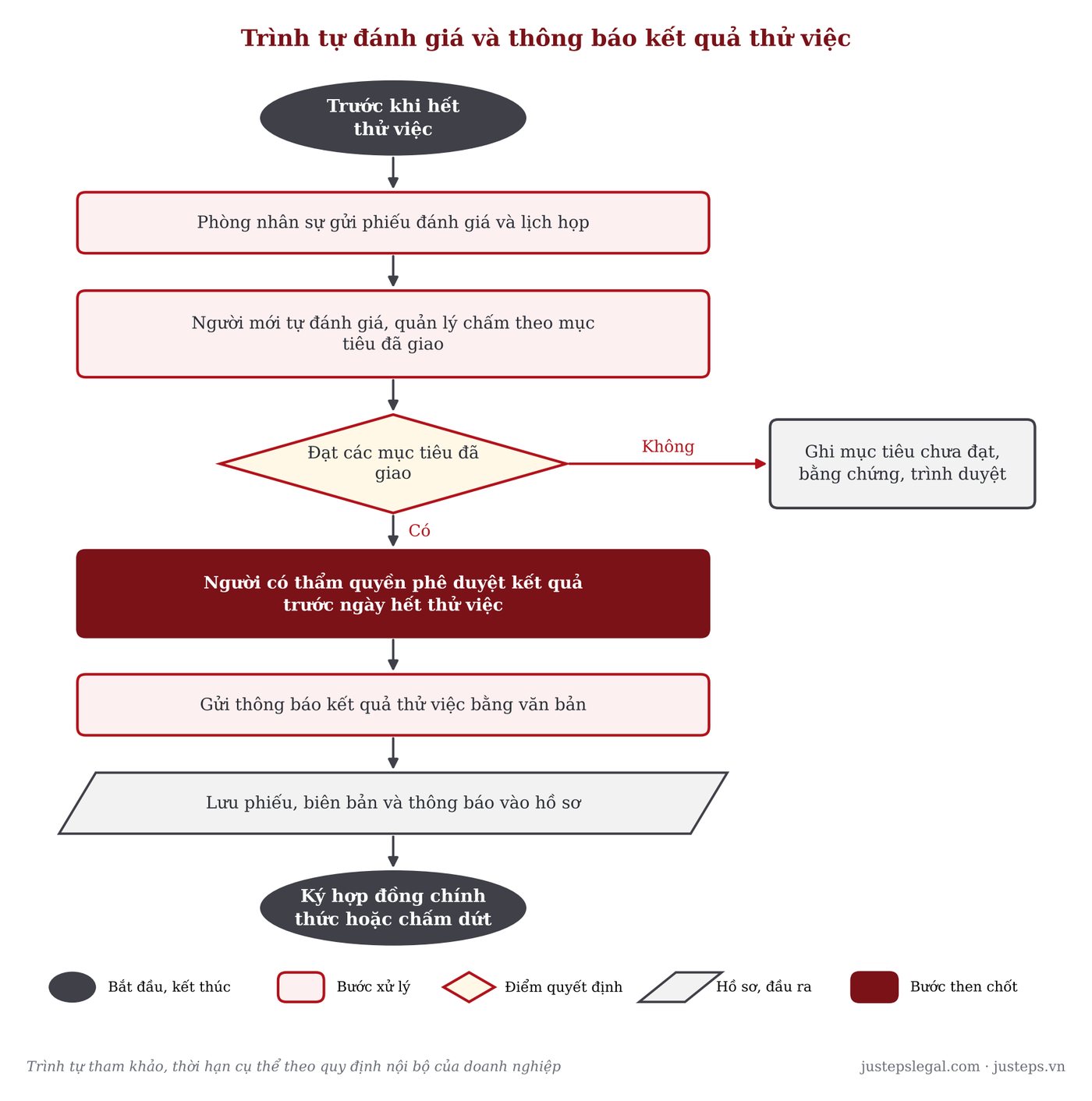
Sequence for assessing and notifying the probation result
The sequence begins when the HR department sends a reminder about five working days before probation ends and forwards the form to the line manager. The manager scores the new joiner against the objectives set in writing; if the new joiner meets the requirements, the manager proposes confirmation, and if not, the manager must state which objectives were not met and attach the supporting evidence. The decisive step is for the person with authority to approve the result before probation ends, after which the HR department sends written notice to the employee. All milestone assessment forms, minutes and notices are filed in the personnel record to serve as evidence whenever an explanation is required.
Where the new joiner does not pass, the business should give notice in writing, state the reasons briefly by reference to the objectives set and pay the wages for all days worked in full. The business should not extend probation for another round in the hope that the new joiner will improve, as this contravenes the principle that probation takes place only once. Conversely, if the business does not notify the result but lets the employee keep working after probation has ended, the employment relationship will be treated as continuing under the contract already signed, or a dispute may arise as to whether an employment contract exists. Linking the onboarding roadmap with a KPI and performance appraisal system allows the probation assessment form to use the same criteria as later periodic appraisals.
Records, personal data and common mistakes
A complete onboarding programme should have five types of forms issued uniformly across the business. These forms spare new managers from drafting their own and allow the HR department to check how the programme is carried out:
- A list of tasks to prepare before the first day, stating the person responsible for and the deadline of each task.
- A 90-day onboarding schedule for each position, naming the person responsible for each orientation, training and review session.
- A statement of objectives for each phase signed by the new joiner and the line manager.
- A common assessment form for the 30, 60 and 90-day milestones, with a self-assessment section and a section for the manager’s comments.
- Template notices of the probation result for both satisfactory and unsatisfactory outcomes.
Onboarding records contain a great deal of personal data, such as identity card numbers, bank account details, comments on competence and sometimes health information. The Law on Personal Data Protection 2025 requires employers to collect only information needed for recruitment and labour management, to protect the data collected and to process it strictly for the purposes notified[10]. On that basis, the business should limit access to assessment forms to the line manager, the HR department and the approving level, should not send forms through shared chat groups and should store records in folders with access controls.
From its consulting projects, Justeps has observed three mistakes that recur most often in onboarding programmes. The first is a roadmap that only covers the first week, after which the new joiner is left to work alone without any checkpoint. The second is objectives written in general terms, such as mastering procedures or being proactive at work, which leave the manager with no basis for a conclusion and the employee with no idea of what they need to achieve. The third is holding the review after probation has ended, when the new joiner has already worked several more weeks without receiving notice of the result.
In addition, the business needs to track changes in labour law when updating its onboarding materials. The Law amending and supplementing a number of articles of the Labour Code, passed by the National Assembly on 21 November 2026 and effective from 1 March 2027, adds 27 July and 24 November as fully paid public holidays[11], so the section introducing leave entitlements in the orientation materials for new joiners must be amended accordingly. The HR department should review the onboarding materials at least once a year and whenever the internal labour regulations, pay rules or occupational safety rules change.
How Justeps can help
Justeps supports businesses in building onboarding programmes linked to probation, labour records and performance appraisal through the following services:
- Labour records and employment contracts. Justeps drafts templates for probation contracts, employment contracts and notices of probation results and reviews probationary wage levels.
- Organisational structure, functions and duties, and job descriptions. Justeps prepares job descriptions that serve as the foundation for the onboarding objectives of each position.
- KPI and performance appraisal system. Justeps designs assessment forms for the 30, 60 and 90-day milestones consistent with the criteria used in periodic appraisals.
- Internal labour regulations and disciplinary procedures. Justeps drafts internal labour regulations and the materials used to brief new joiners on them in their first week.
- HR, labour and compliance training. Justeps trains line managers and mentors on setting objectives, assessing new joiners and notifying probation results.
Frequently asked questions
Is a business required to have an onboarding programme for new employees?
The law does not require businesses to have an onboarding programme under any particular name. However, a business must brief new joiners on the internal labour regulations and provide occupational safety and hygiene training[2], so an onboarding programme is a way of organising these obligations systematically.
Does a 90-day roadmap extend probation to 90 days?
No. The probationary period must remain within the maximum for each category of work, for example not more than 60 days for work requiring college-level qualifications or above[4]. The part of the roadmap after probation ends applies to someone who is already a permanent employee.
May a business require another round of probation if it is unsure of the new joiner’s ability?
The Labour Code permits probation only once for the same job[4]. If more time to observe is needed, the business should sign a permanent employment contract and set specific improvement objectives instead of extending probation.
What must a business do if a new joiner fails probation?
The business notifies the employee of the probation result when the probationary period ends and terminates the probation agreement[7]. It should give notice in writing, state reasons linked to the objectives set and pay the wages for all days worked in full.
What is the minimum wage during probation?
The probationary wage is agreed by the parties but must be at least 85% of the wage for that job[6]. It also must not be lower than the regional minimum wage where the employee works full normal working hours.
May a business keep a new joiner’s original degree certificate during probation?
No. The employer must not retain the originals of the employee’s identity papers, diplomas or certificates[8]. The business should only check the original and keep a copy on file.
Who should mentor a new joiner?
The mentor should be an experienced colleague in the same team rather than the line manager. Mentoring duties should be included in the mentor’s own appraisal objectives to ensure that guidance is given consistently.
How long should onboarding assessment forms be kept?
Assessment forms are part of the personnel record and should be kept at least for as long as the employee works for the business. The specific retention period should be set out in the internal rules on personnel records and notified to employees in line with personal data protection requirements[10].
Related articles
- Hiring the first employees of a newly established company, from the order of positions to contracts and insurance
- Practical lessons in building an employee handbook for a small business that is concise, practical and consistent with the internal labour regulations
- Preparing an annual in-house training plan and vocational training contracts in line with the Labour Code
- What companies must satisfy when moving to electronic employment contracts and how those contracts should be stored
Notes
[1] Article 118 of the Labour Code No. 45/2019/QH14 dated 20 November 2019.
[2] Article 14 of the Law on Occupational Safety and Health No. 84/2015/QH13 dated 25 June 2015 and Government Decree No. 44/2016/ND-CP dated 15 May 2016 detailing occupational safety and health training.
[3] Article 24 of the Labour Code No. 45/2019/QH14.
[4] Article 25 of the Labour Code No. 45/2019/QH14.
[5] Government Decree No. 283/2026/ND-CP on administrative penalties in the fields of labour and social insurance.
[6] Article 26 of the Labour Code No. 45/2019/QH14.
[7] Clauses 1 and 2 of Article 27 of the Labour Code No. 45/2019/QH14.
[8] Clauses 1 and 2 of Article 17 of the Labour Code No. 45/2019/QH14.
[9] Article 62 of the Labour Code No. 45/2019/QH14 on vocational training contracts between employers and employees and vocational training costs.
[10] Article 25 of the Law on Personal Data Protection No. 91/2025/QH15 dated 26 June 2025, effective from 1 January 2026.
[11] The Law amending and supplementing a number of articles of the Labour Code, passed by the National Assembly on 21 November 2026 and effective from 1 March 2027.
This article is for reference and reflects the regulations in force at the time of publication. Please consult Justeps for advice tailored to your company’s records and situation.
For further information, please contact:
📩 Email: info@justeps.vn
🌐 Website: https://justepslegal.com · https://justeps.vn
🌐 Page: Justeps
☎️ Hotline (Zalo): 096 172 2607
📍 Thanh Xuan Office: 12th Floor, Licogi 13 Tower, 164 Khuat Duy Tien Street, Thanh Xuan Ward, Hanoi, Vietnam
📍 Ha Dong Office: LK06B, No.10, Dong Dua Area, Ha Dong Ward, Hanoi, Vietnam
📍 Ho Chi Minh City Branch: 528 Le Van Sy, Ho Chi Minh City, Vietnam
📍 Hai Phong Office: Truong Thinh Village, Ha Dong Commune, Hai Phong, Vietnam
📍 Quang Ninh Office: Van Don Special Zone, Quang Ninh Province, Vietnam





