
Key takeaways
- A job title and grade framework places positions into job families and grades according to clear criteria, and it is the foundation on which a business builds its pay scales and pay tables under the Labour Code.
- Positions are scored on the content of the work rather than on the person currently holding them, which allows the business to explain differences in pay and to demonstrate equal pay.
- Businesses with 50 to 300 employees usually use 6 to 8 grades, the pay range of each grade overlaps the grade below by about 20% to 30%, and the lowest point of the lowest grade must not be below the regional minimum wage.
- Pay scales and pay tables built from the framework must be subject to consultation with the employee representative organisation, if there is one, and be published at the workplace before they are applied.
- When moving staff to the new framework, the business may not unilaterally reduce an agreed wage, and every change must be recorded in an appendix to the employment contract.
In many growing businesses, job titles are set by each department and wages are negotiated individually with each person at the time of recruitment. After a few years, the business faces situations that are hard to explain, such as two accountants doing almost identical work but earning VND 4 million a month apart, a head of department who does not know the salary ceiling for their own staff, or a talented engineer resigning after three years because they see no path to a more senior position. The common cause of these situations is that the business has not established a hierarchy between jobs, so its pay scale exists only on paper and pay rises depend on each person’s ability to negotiate.
This article explains how to build a job title and grade framework in the order in which the work is carried out, covering listing positions, grouping them into job families, choosing the number of grades, scoring and placing positions into grades, attaching pay ranges and promotion conditions, together with the procedures for consultation, publication and transitioning staff under the Labour Code. It applies to businesses with roughly 30 to 300 employees, including foreign-invested businesses wishing to align their parent company’s framework with Vietnamese rules. It is written mainly for directors, HR managers, payroll accountants and the heads of department who take part in scoring.
The job title and grade framework and the legal obligations on wages
A job title and grade framework (the Grade Framework) is a table that places a business’s positions into job families and grades according to uniform criteria. The job title tells you what work the employee does, while the grade tells you what level of responsibility, knowledge and difficulty that work requires compared with other jobs. The Grade Framework is an internal management document that does not have to be registered with any state authority, yet it underpins many of the employer’s legal obligations on wages.
The Labour Code requires employers to develop pay scales, pay tables and labour norms as the basis for recruiting and using workers, agreeing wages by job or title in the employment contract and paying employees[1]. The employment contract must state the wage by job or title, the form of payment, wage allowances and other additional payments[2]. Therefore, when the title in a contract does not match any position in the pay scale, the business will find it hard to prove that the agreed wage has a proper basis, particularly in a dispute or a labour inspection.
In addition, employers must ensure equal pay, without discrimination on grounds of gender, for employees performing work of equal value[3]. To show whether two jobs are of equal or different value, the business needs a consistent job evaluation method, and a Grade Framework with scoring sheets is precisely the evidence of that method. The wage paid to an employee who works normal hours must also not be lower than the regional minimum wage, which from 1 January 2027 is VND 5,700,000 in Region I, VND 5,080,000 in Region II, VND 4,450,000 in Region III and VND 4,040,000 in Region IV[4].
When a business needs a Grade Framework
Businesses with fewer than 15 people can usually still manage through direct agreement, but once headcount reaches around 30 to 50, the following signs indicate that it is time for a Grade Framework:
- The same job carries several different titles across departments, or the same title covers very different work.
- New recruits are paid more than existing staff doing the same job and the business cannot explain why.
- The business is preparing to revise its pay scales and pay tables or to carry out an annual pay review for all employees.
- Many staff with two to four years of experience are leaving, and the reason they usually give is that they see no opportunity for advancement.
Listing positions and grouping them into job families
The first step is to list all existing positions, including the titles in use, the department, the direct manager, the number of people in each position and current wages. The core principle is to describe the job rather than the person, meaning that the description records the tasks the position must perform and the decision-making authority attached to it, not the abilities or seniority of the current holder. When the descriptions are placed side by side, the business often finds that many titles are in fact one position; for example, a business of 80 staff with 47 job titles may be able to consolidate them into about 18 standard positions.
Once positions have been standardised, the business groups positions requiring the same type of specialist knowledge into job families. Small and medium-sized enterprises usually have four to seven job families, such as sales, finance and accounting, production or operations, logistics, administration and HR, and general management. Each job family should have two parallel tracks, a specialist track and a management track, so that a strong specialist can reach a senior grade without having to become a manager, which avoids the business losing a good specialist and gaining an unsuitable manager.
The output of this step is a coded list of standard positions, each accompanied by a short job description setting out its purpose, main tasks, decision-making authority, required qualifications and reporting line. Businesses that need support in standardising departmental functions and job descriptions may consider the organisational structure, functions and duties, and job descriptions service of Justeps.
Choosing the number of grades and scoring positions to place them into grades
The number of grades depends on the size and complexity of the organisation. Businesses with 50 to 300 people usually use six to eight grades, because with too few grades employees must wait a very long time for promotion, while with too many grades the boundaries between them become blurred and the wage bill tends to grow faster than revenue. The table below is an example of a seven-grade framework, with general descriptions applicable to all job families:
| Grade | General description | Example positions |
|---|---|---|
| Grade 1 | Performs work under detailed instructions, is still learning the job or has recently graduated. | Trainees and newly recruited general workers. |
| Grade 2 | Performs routine work independently following established procedures, with little guidance needed. | Sales staff, accounting clerks and storekeepers. |
| Grade 3 | Handles complex situations within the specialism and guides new joiners. | Specialists, general accountants and team leaders on the shop floor. |
| Grade 4 | Is responsible for one area of specialism or runs a small team. | Senior specialists, team leaders and production supervisors. |
| Grade 5 | Manages a department or is the leading expert in the business. | Heads of department, chief accountants and senior experts. |
| Grades 6 and 7 | Makes decisions on strategy and budget for a division or the whole business. | Division directors, deputy general directors and the general director. |
To place positions into grades objectively, the business sets up an evaluation panel consisting of the Director, the HR manager and the heads of department, which scores each position against four or five weighted factors. The factors commonly used are the specialist knowledge required, the complexity of decisions, the scope of impact on the business’s results, responsibility for managing people and working conditions. Each head of department scores the positions in their own department, after which the whole panel calibrates the results so that all departments apply one standard, preventing every department from scoring its own people highly.
The chart below illustrates the scoring results for a number of positions on a 1,000-point scale at a trading business with about 120 staff.
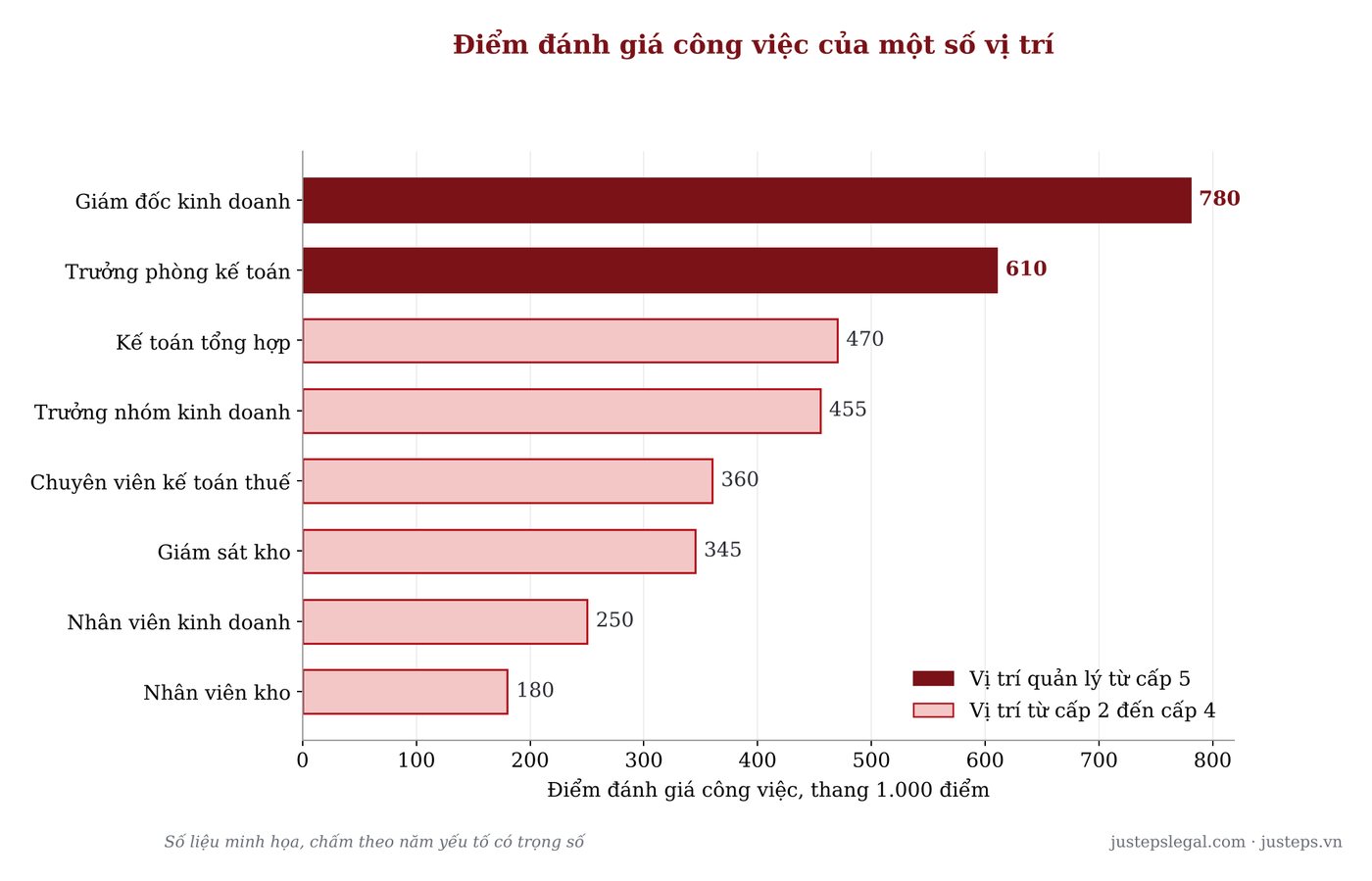
Job evaluation scores for a number of positions at a trading business with about 120 staff
The results show that the general accountant and the sales team leader have similar scores and should therefore both be placed in Grade 4, even though they belong to different job families and were previously paid quite differently. The tax accounting specialist and the warehouse supervisor also fall within the same score band, while the two positions shown in a darker colour are management positions at Grade 5 and above. Where a position’s score lies close to the boundary between two grades, the panel should revisit the job description rather than rounding as it pleases, because an error at this step will distort the entire pay range.
Attaching pay ranges and promotion conditions
After positions have been graded, each grade is given a pay range consisting of a minimum, a midpoint and a maximum. The midpoint is usually set close to the market rate for the positions in the grade, the minimum applies to people who have just met the minimum requirements, and the maximum is reserved for those who are fully proficient and consistently perform well. The pay range of each grade should overlap the range of the grade below by about 20% to 30%, so that a strong performer in a lower grade can be paid more than someone newly promoted to the grade above without breaking the structure of the framework.
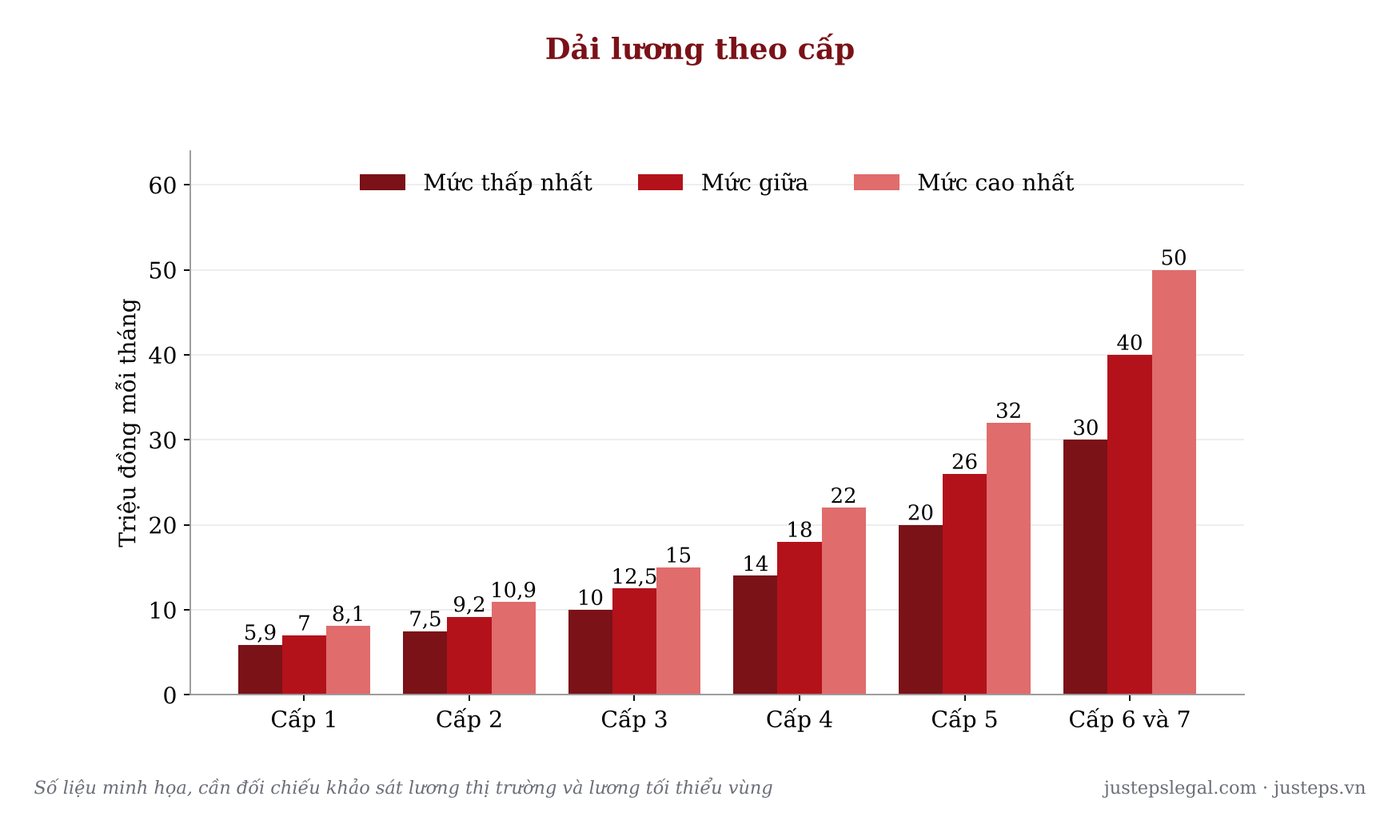
Example pay ranges by grade showing the minimum, midpoint and maximum
In the example above, the minimum for Grade 1 is VND 5.9 million, which is higher than the Region I minimum wage applying from 1 January 2027, so the framework still meets the minimum wage requirement when the new rate takes effect. The gap between the minimum and the maximum widens at higher grades, because the more senior the position, the greater the difference in ability and results between a newcomer and a fully proficient holder. The figures are for illustration only, and the business should base its ranges on a market pay survey for its sector and location before finalising them.
From the pay ranges, the business builds its pay scales and pay tables, deciding itself the number of steps within each grade and the gap between steps, since current law no longer prescribes a minimum gap between steps as it used to. The accountant should calculate the resulting costs in advance, because the wage by job or title stated in the contract forms part of the wage on which compulsory social insurance contributions are based[5], so raising wages under the framework will also increase the business’s insurance contributions. The business should also decide which amounts form part of the wage by title and which are allowances or bonuses under the bonus regulations, so that costs and contribution obligations can be estimated accurately[6].
Promotion conditions must be measurable, for example achieving a good performance rating in two consecutive appraisal periods, meeting the qualification requirements of the new grade and there being a vacancy or a business need at the higher grade. Moving up a step within the same grade may be linked to the annual appraisal results, while moving up a grade is linked to a change in the scope of work and requires a written decision. Businesses that need support in designing pay ranges and step and grade promotion regulations may consider the pay scales, pay tables and pay and bonus regulations service of Justeps.
Consultation, publication and dialogue at the workplace
When developing pay scales, pay tables and labour norms, the employer must consult the grassroots employee representative organisation, where one exists, and must publish them at the workplace before applying them[1]. Developing pay scales and pay tables is also one of the cases in which the employer must hold a dialogue at the workplace[7]. The Grade Framework should therefore be presented to employees before the new pay scale is issued, rather than merely announcing the result once it has been finalised.
Where there is no grassroots trade union or other employee representative organisation, the business should still hold a dialogue with a group of employee representatives elected under the workplace democracy regulations, and keep minutes recording their views and how the business has taken them into account. Once issued, pay scales and pay tables must be posted or published in a form that employees can access, for example on the internal system and sent with the relevant decision to each person. Failing to develop pay scales and pay tables, or failing to publish them before applying them, may result in an administrative penalty under Decree 283/2026/ND-CP[8].
A current development is that the Law amending and supplementing the Labour Code, passed on 21 November 2026 and taking effect on 1 March 2027, adds 27 July and 24 November as fully paid days off[9]. Businesses issuing new pay scales during this period should at the same time review their wage regulations, internal labour regulations and labour norms, so that the calculation of pay for days off, overtime and output norms correctly reflect the new number of working days.
Moving staff to the new framework without giving rise to disputes
The hardest step is placing each employee into a grade and step in the new framework, because the current wages of many people do not fall neatly within the pay range of the corresponding grade. The business should prepare a mapping table recording the old title, the new standard position, the grade, the step, the current wage, the wage under the framework and the difference, and then deal with each group according to principles announced in advance. People currently paid below the minimum of their range are brought up to it over a timetable, which may be split into two or three stages depending on the business’s financial capacity.
For people currently paid above the maximum of their range, the business may not unilaterally reduce their wage, because the wage is a term of the employment contract and may only be amended by agreement between the two parties, by signing a contract appendix or entering into a new contract[10]. The usual approach is to keep the current wage, pause fixed pay rises until the pay range catches up and shift any increase in earnings to performance-based bonuses. Transferring an employee to work different from that in the contract is a separate matter, permitted only temporarily where there are grounds prescribed by law, and it may not be used as a way of downgrading employees when moving to the new framework[11].
After the transition, the title and wage in the employment contract, the wage decision, the social insurance file and the timekeeping and payroll software must all be updated consistently. Discrepancies between these records are the most common error found in labour inspections and insurance checks after a business changes its pay scale. The mapping table contains each person’s wage data, so it may only be shared with those who have authority and must be protected in accordance with the law on personal data protection[12].
Roles, timetable and required records
For a business with fewer than 200 people, a project to build a Grade Framework usually takes six to ten weeks, depending on the number of positions and how far job descriptions are already available. The Director approves the principles, the number of grades and the wage bill budget, the HR department coordinates and prepares the documents, heads of department score positions and propose placements, the accountant calculates the resulting wage bill and insurance costs, and the employee representative organisation or representative group gives its views before issuance.
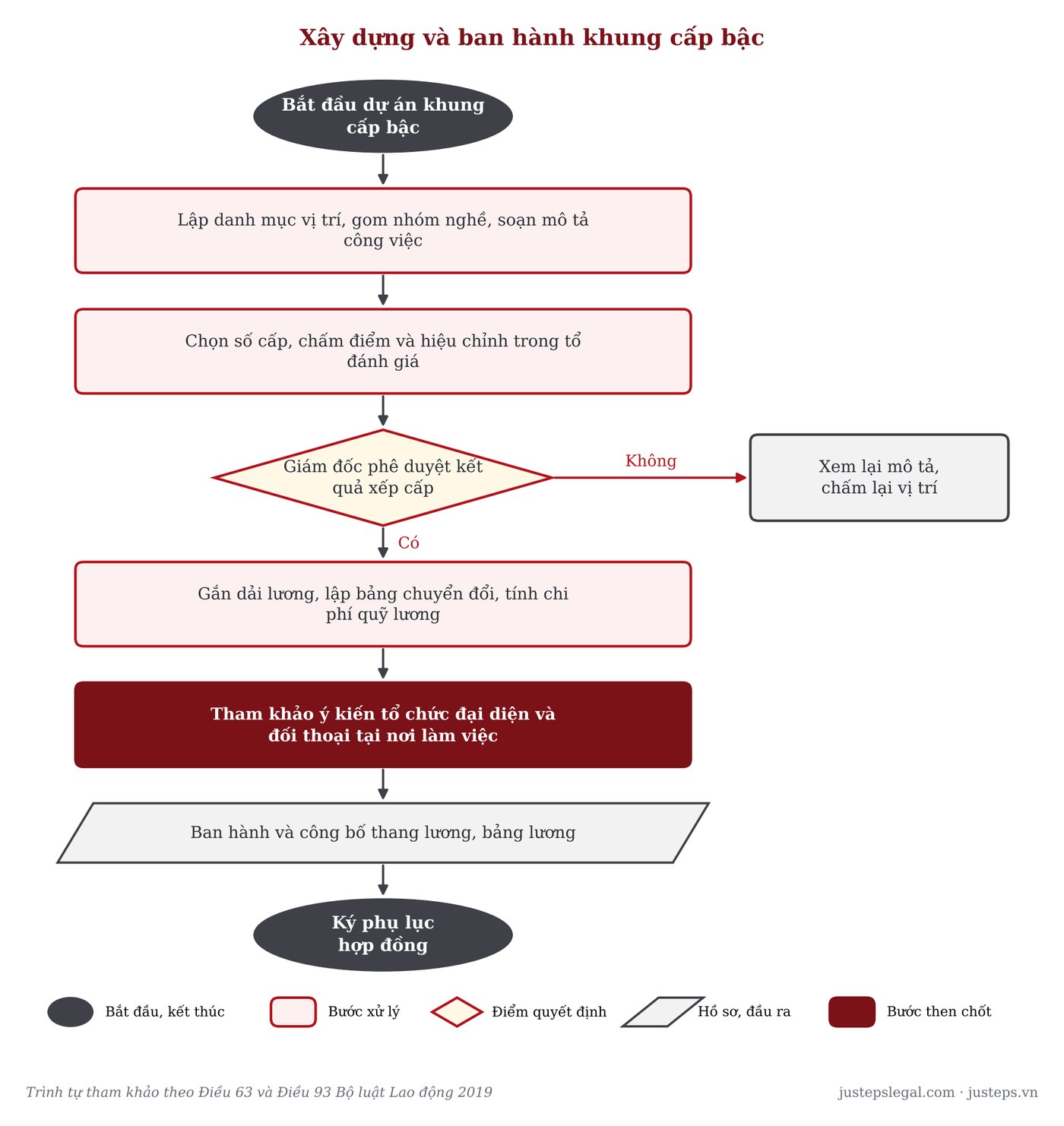
The sequence for building and issuing the job title and grade framework and pay scale
The sequence begins with listing positions and grouping job families, followed by choosing the number of grades, scoring and calibration within the evaluation panel. If the Director has not approved the grading results, the panel must revisit the job descriptions and rescore the disputed positions, rather than moving on to attaching pay ranges. After the pay ranges have been attached and the mapping table prepared, the business carries out consultation and dialogue, issues and publishes the pay scales and pay tables, and only then signs contract appendices with each employee whose terms change.
The complete set of records should be kept with the business’s payroll records for use in annual pay reviews and in inspections by state authorities:
| Record | Main content |
|---|---|
| Standard position list | Position code, job family, grade, number of holders and direct manager. |
| Job descriptions | Purpose, main tasks, decision-making authority, required qualifications and appraisal targets for each position. |
| Scoring sheets | Scores for each factor, weightings, the scorer and the minutes of the panel’s calibration. |
| Pay scales and pay tables | Pay ranges and the number of steps in each grade, with the consultation minutes and evidence of publication. |
| Step and grade promotion rules | Conditions, review timing, the proposer and the decision-maker for moving up a step or grade. |
| Mapping table and appendices | Placement of each person in the new grade and step and the contract appendices signed with those whose pay changes. |
Common mistakes include grading by person, so that the framework becomes distorted as soon as that person leaves, creating too many grades so that everyone can be promoted every year, and failing to explain how grading works so that employees see the framework as a tool for cutting pay. A Grade Framework only works when it is actually used in recruitment, appraisal and pay reviews, and is reviewed every year when the business changes its structure or launches new activities.
How Justeps can help
Justeps helps businesses build job title and grade frameworks, pay scales and related regulations in line with the Labour Code through the following services:
- Pay scales, pay tables and pay and bonus regulations. Justeps designs the grade framework, pay ranges, step promotion regulations and the records for consulting on and publishing pay scales and pay tables.
- Organisational structure, functions and duties, and job descriptions. Justeps standardises the position list, groups job families and drafts job descriptions as the input for scoring.
- KPI and performance management system. Justeps develops appraisal criteria linked to step and grade promotion conditions so that advancement has a measurable basis.
- Labour records and employment contracts. Justeps drafts contract appendices and wage decisions and checks consistency between contracts, insurance and HR records during the transition.
Frequently asked questions
Does a small business need a job title and grade framework?
A business with fewer than 15 people can use a simple framework of three to four grades, which is sufficient as a basis for developing pay scales and pay tables under the Labour Code[1]. Once headcount reaches around 30 to 50, the business should move to a full framework with position scoring.
Must a job title and grade framework be registered with a state authority?
The Grade Framework is an internal management document, so it does not need to be registered. Pay scales and pay tables built from the framework must be subject to consultation with the employee representative organisation, if any, and be published at the workplace before they are applied[1].
How should the business deal with someone paid above the range for their new grade?
The business usually keeps the current wage and pauses fixed pay rises until the pay range catches up. Any change to the wage must be agreed by both parties and recorded in an appendix to the employment contract[10].
How many grades should a business have?
Businesses with 50 to 300 people usually use six to eight grades. Too few grades make employees wait a long time for promotion, while too many blur the boundaries between grades and make the wage bill grow quickly.
How does a Grade Framework help with equal pay?
The law requires equal pay, without discrimination on grounds of gender, for work of equal value[3]. Position scoring sheets show that the business evaluates jobs against uniform criteria and provide the basis for explaining pay differences if a complaint is made.
What should be noted about the minimum of the Grade 1 pay range from 2027?
The minimum must not be lower than the regional minimum wage applying from 1 January 2027, which is VND 5,700,000 in Region I[4]. Businesses with locations in different regions must check their pay ranges against the minimum for each region.
Is dialogue with employees required when issuing a new pay scale?
Developing pay scales and pay tables is one of the cases in which the employer must hold a dialogue at the workplace[7]. The business should keep minutes of the dialogue together with the consultation records.
Related articles
- How to write job descriptions that a business can use consistently from recruitment to appraisal and pay
- Five common pay models and how a business can choose the right one for each group of positions
- How businesses should organise periodic performance appraisals that can be relied on for pay, bonuses and people management
- A monthly labour and payroll compliance checklist for HR departments
Notes
[1] Clauses 1 and 3 of Article 93 of the Labour Code No. 45/2019/QH14 dated 20 November 2019.
[2] Point (dd) of Clause 1 of Article 21 of the Labour Code No. 45/2019/QH14.
[3] Clause 3 of Article 90 of the Labour Code No. 45/2019/QH14.
[4] Clause 2 of Article 90 of the Labour Code No. 45/2019/QH14; Decree No. 399/2026/ND-CP on the minimum wage for employees working under employment contracts, applying from 1 January 2027.
[5] The Law on Social Insurance No. 41/2024/QH15 dated 29 June 2024, provisions on the wage used as the basis for compulsory social insurance contributions.
[6] Article 104 of the Labour Code No. 45/2019/QH14.
[7] Point (c) of Clause 2 of Article 63 of the Labour Code No. 45/2019/QH14.
[8] Decree No. 283/2026/ND-CP on administrative penalties in the fields of labour and social insurance, effective from 10 September 2026.
[9] The Law amending and supplementing a number of articles of the Labour Code, passed by the National Assembly on 21 November 2026 and taking effect on 1 March 2027.
[10] Articles 22 and 33 of the Labour Code No. 45/2019/QH14.
[11] Article 29 of the Labour Code No. 45/2019/QH14.
[12] The Law on Personal Data Protection No. 91/2025/QH15 and Decree No. 363/2026/ND-CP.
This article is for reference and reflects the regulations in force at the time of publication. Please consult Justeps for advice tailored to your company’s records and situation.
For further information, please contact:
📩 Email: info@justeps.vn
🌐 Website: https://justepslegal.com · https://justeps.vn
🌐 Page: Justeps
☎️ Hotline (Zalo): 096 172 2607
📍 Thanh Xuan Office: 12th Floor, Licogi 13 Tower, 164 Khuat Duy Tien Street, Thanh Xuan Ward, Hanoi, Vietnam
📍 Ha Dong Office: LK06B, No.10, Dong Dua Area, Ha Dong Ward, Hanoi, Vietnam
📍 Ho Chi Minh City Branch: 528 Le Van Sy, Ho Chi Minh City, Vietnam
📍 Hai Phong Office: Truong Thinh Village, Ha Dong Commune, Hai Phong, Vietnam
📍 Quang Ninh Office: Van Don Special Zone, Quang Ninh Province, Vietnam





