
Key takeaways
- The Labour Code leaves it to the business to decide its allowance regime through employment contracts, collective agreements or internal regulations, so the quality of a policy depends on each item having a clear purpose, eligibility conditions and conditions for ending it.
- An allowance or support amount paid regularly and consistently in each pay period risks being included in the wages used as the basis for social insurance contributions, whatever name the business gives it.
- Most allowances are income subject to personal income tax, whereas for mid-shift meals only the portion above 1,200,000 dong per month has been taxable since 1 July 2026.
- Allowances may not be used to make up for a wage rate below the regional minimum wage, and the Region I minimum wage will rise to 5,700,000 dong from 1 January 2027.
- A good policy should be reviewed every year alongside budget planning, and any change that reduces an allowance stated in an employment contract must be agreed with the employee.
A technical services company that has been operating for six years pays its staff as many as nine different allowances, namely for fuel, telephone, lunch, housing, attendance, responsibility, seniority, site work and a hardship support payment. Each item was added at a different time, usually to attract a particular candidate or to meet a request from a group of employees, and none of them has a written document setting out eligibility conditions. As a result, two technicians in the same position have total incomes almost three million dong apart, a team leader who gave up the role the previous year still receives a responsibility allowance, and during an inspection the social insurance authority required arrears contributions on the fixed support amounts.
This article sets out how to build an employee allowance policy in a logical sequence, covering the legal framework for allowances, how to choose types of allowance by purpose, the effect of each item on social insurance and personal income tax, how to set the amounts, how to issue and amend the policy, and common errors. The content applies to businesses outside the state sector, where the allowance regime is decided by the business itself. The main readers are directors, heads of human resources, chief accountants and those in charge of payroll.
The legal framework for allowances in a business
Under the Labour Code, the wages an employer pays to an employee comprise the wage rate for the job or title, wage allowances and other supplementary amounts[1]. Allowance, subsidy and incentive regimes are implemented as agreed in the employment contract or the collective labour agreement, or as provided in the employer’s regulations[2]. In other words, the law does not require a business to pay any particular allowance, but once an allowance has been recorded in one of these three types of document, it becomes an obligation that must be honoured.
An employment contract must contain provisions on the wage rate for the job or title, the form of wage payment, the time of wage payment, wage allowances and other supplementary amounts[3]. An allowance that applies to an individual should therefore be stated in the contract or a contract annex, while an allowance that applies to many employees may be set out in internal regulations and referred to in the contract. When paying wages, the business must provide the employee with a payslip stating clearly the amounts received[4], so the payslip should list each allowance separately instead of combining them into a single line.
One limit to bear in mind is that the wage rate for the job or title may not be lower than the minimum wage[5]. Allowances are paid on top of that wage rate, so a business cannot use allowances to make up for a wage rate below the regional minimum wage. From 1 January 2027, the monthly minimum wage rises to 5,700,000 dong in Region I, 5,080,000 dong in Region II, 4,450,000 dong in Region III and 4,040,000 dong in Region IV[6], so businesses paying wage rates close to the minimum should review their income structure before that date.
Choosing types of allowance by purpose
Each allowance should answer the question of what the business is paying it to compensate for or encourage. Once the purpose is clear, the business can determine who is eligible, when the allowance ends and whether it falls within the insurance contribution basis or taxable income. In practice, allowances are usually divided into three groups as follows:
- The group tied to position and working conditions comprises position allowances, responsibility allowances, allowances for heavy or hazardous work, mobility allowances and area allowances, which compensate for factors not reflected in the wage rate.
- The living support group comprises mid-shift meals, travel support, telephone, housing and childcare support, which reduce the costs employees incur in working.
- The incentive group comprises seniority allowances, attendance allowances and attraction allowances for hard-to-fill positions, which aim to retain employees or encourage a specific behaviour.
The first group should be closely tied to the title and working conditions, so that when an employee gives up the position or leaves that environment, the allowance ends automatically. The second group usually grows fastest over time because it is easily used as a bargaining tool in recruitment, so it needs ceilings by grade. The third group needs measurable conditions, for example an attendance allowance paid only where the employee has not been absent for more than the specified number of days in the month, otherwise it becomes part of fixed pay.
Setting eligibility conditions and conditions for ending an allowance
For each allowance, the policy should state clearly who it applies to, the eligibility conditions, the amount or method of calculation, the start date, the cases in which it is suspended and the conditions for ending it. For example, a site allowance is paid only for the days on which the employee actually works on site according to the timesheet, and stops when the employee is transferred back to the office. A team leader responsibility allowance is paid from the date the appointment decision takes effect and ends from the date the dismissal decision takes effect. When the conditions are written this specifically, the human resources department can automate the calculation and employees understand why they are or are not eligible.
Checking each item against social insurance and tax
Before issuing the policy, each allowance should be tested against two questions, namely whether it falls within the wages used as the basis for social insurance contributions and whether it is subject to personal income tax. These two questions are independent of each other, because an item may be subject to insurance contributions but excluded when calculating tax, or vice versa. The matrix below illustrates how some common items may be assessed.
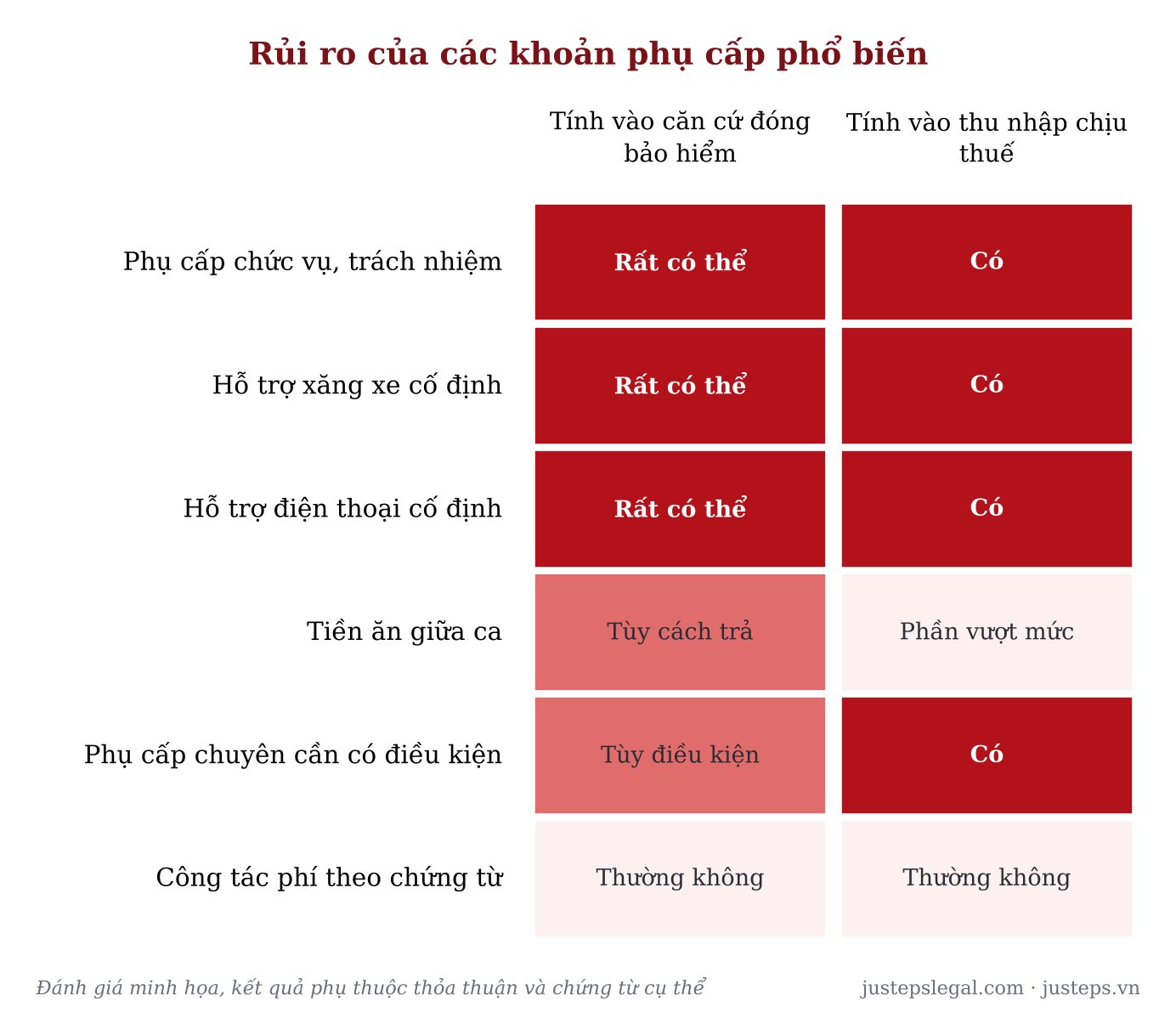
Level of risk that common items are included in the insurance contribution basis and in taxable income
The matrix shows that position and responsibility allowances and fixed support amounts such as fuel and telephone paid every month carry a high risk on both the insurance and the tax side. Mid-shift meals carry a low tax risk when they stay within the excluded amount, while business travel expenses reimbursed against actual vouchers carry a low risk on both sides because they are expenses incurred for work rather than income. The assessments in the matrix are for illustration only, because the final outcome depends on how the item is agreed, its eligibility conditions and the supporting documents.
Allowances and the wages used as the basis for social insurance contributions
Under the 2024 Law on Social Insurance, the wages used as the contribution basis comprise the wage rate for the job or title, wage allowances and other supplementary amounts agreed to be paid regularly and consistently in each pay period[7]. The decisive criterion is whether the amount is regular and consistent, not what it is called. A fuel support amount of a fixed 1,000,000 dong per month paid to all staff, regardless of whether they travel for work, is very difficult to treat as falling outside the contribution basis. Conversely, a support amount paid only when a specific event occurs, such as support when an employee has a new baby, is usually outside the contribution basis.
Allowances and personal income tax
The Law on Personal Income Tax No. 109/2025/QH15, which applies to income from salaries and wages from 2026, in principle treats salaries, wages, allowances and subsidies as taxable income, except for items excluded or exempted by law[8]. Under Decree No. 253/2026/ND-CP, from 1 July 2026 only the portion of mid-shift meal or lunch money above 1,200,000 dong per person per month is included in taxable income[9]. Fixed support amounts such as fuel, telephone and housing paid in cash generally remain taxable income, unless the business reimburses them against vouchers for work-related expenses in accordance with its regulations. Businesses that need to standardise tax withholding on each item may refer to Justeps’ service on personal income tax on salaries and wages.
On the business side, allowances are deductible expenses for corporate income tax purposes only if they have actually been paid, are supported by valid documents and are stated in the employment contract, collective agreement or the business’s regulations, under the Law on Corporate Income Tax No. 67/2025/QH15 and its guiding documents[10]. An allowance paid out of habit without any written provision therefore carries an insurance risk and may also be disallowed as a deductible expense at tax finalisation. This is why the chief accountant should be involved in the allowance policy from the drafting stage.
Setting the amounts and controlling the budget
The amount of each allowance should be determined from three sources of information, namely the market rate for equivalent positions, the actual cost the allowance is meant to cover and the business’s ability to pay. For the living support group, the business can survey actual costs, for example the average price of a meal near the workplace or the average commuting distance. For the group tied to position, the allowance should be set by grade or as a percentage of the wage rate, so that it adjusts automatically when the wage rate changes. The chart below illustrates the structure of monthly allowance costs at a business with around 100 employees.
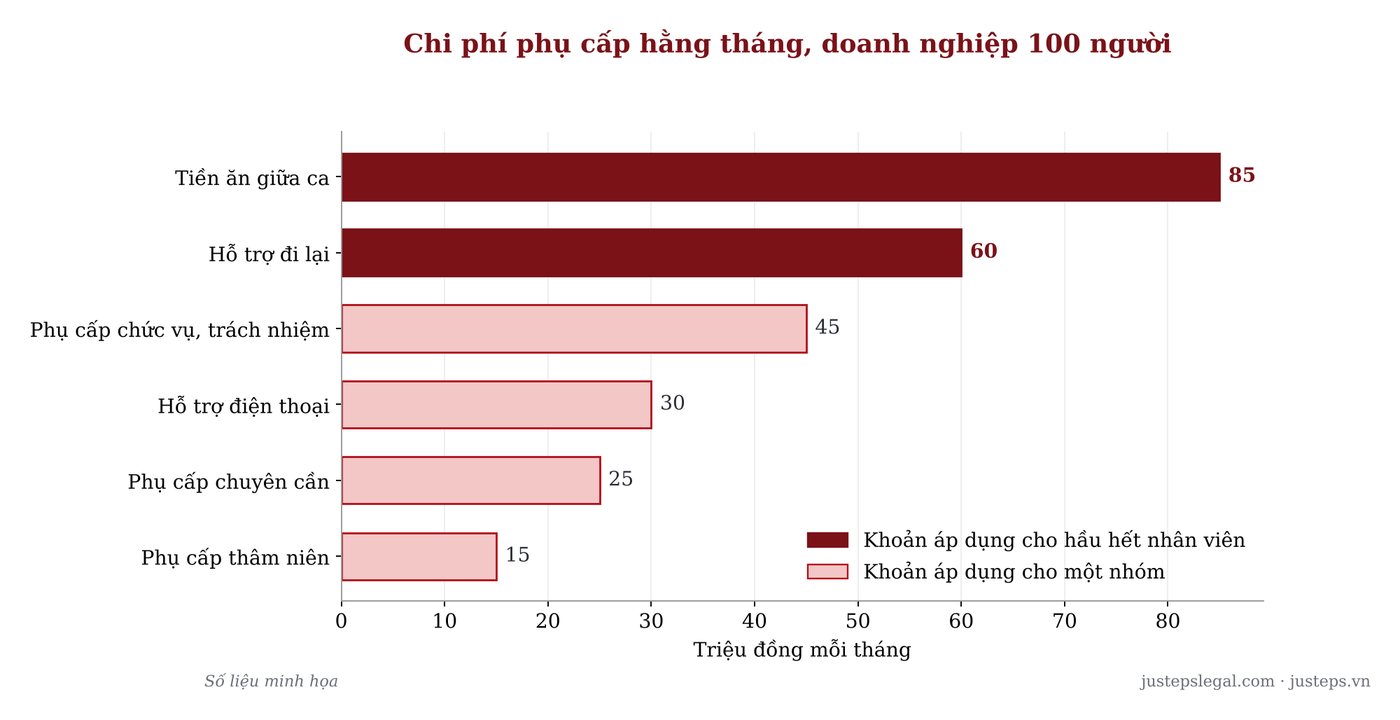
Example of monthly allowance costs by item
In the example, mid-shift meals and travel support account for the largest shares because they apply to almost all employees, whereas position and responsibility allowances apply to only a few people but at higher amounts. Looking at this structure, management can readily see that an increase of 100,000 dong in an item that applies to everyone has a much greater effect on the budget than an increase in the allowance of a small group. The business should calculate the total cost of the allowance policy, including the additional insurance contributions on items falling within the contribution basis, and then include it in the annual personnel budget.
To control costs over the long term, the policy should set a ceiling on total allowances by grade, for example not exceeding a certain percentage of the wage rate. Whenever a new allowance is proposed, the human resources department should assess whether the need can be met by adjusting the wage rate or an existing item. This approach prevents the number of allowances from growing with each recruitment round, as happened in the case described at the start of this article.
Issuing, amending and announcing the policy
The allowance policy should be issued as a separate regulation or as a chapter of the pay and bonus regulations, following a clear sequence. The flowchart below describes the steps from reviewing the current situation to applying the policy.
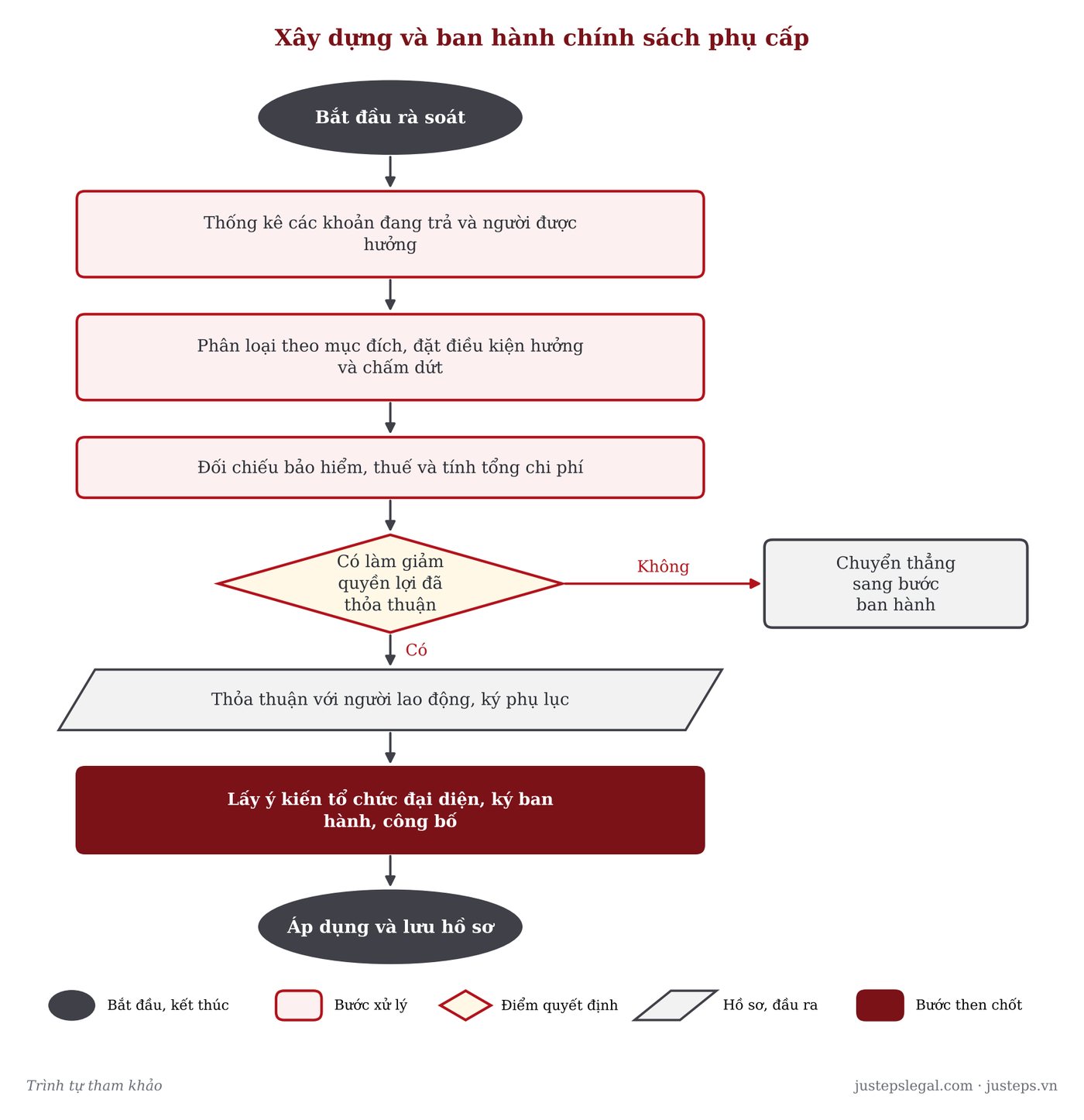
Sequence for building and issuing an allowance policy
The sequence begins with listing all items currently paid, the people receiving them and the basis for payment, followed by classifying them by purpose and checking them against insurance and tax. The draft is checked by the chief accountant for cost and supporting documents, and then submitted for comments to the grassroots employee representative organisation if the business has one. If the policy reduces entitlements stated in some employees’ contracts, the business must reach a new agreement with each of them before applying it. Once the competent person has signed and issued the policy, it is announced publicly and the related contracts and annexes are updated.
To amend or supplement an allowance stated in an employment contract, the party requesting the change must notify the other party of the proposed content at least 03 working days in advance, and the amendment is made by an annex or a new contract if the two parties reach agreement[11]. A business cannot unilaterally cut an agreed allowance merely by issuing an internal notice. For items set out in general regulations and not specified in the contract, an amendment should still be preceded by reasonable notice and a clear reason in order to avoid complaints.
Common errors and the records to be kept
Reviews of allowance policies at many businesses show that errors tend to concentrate in a few recurring situations. The table below summarises these errors together with their consequences and how to prevent them.
| Error | Consequence | Preventive measure |
|---|---|---|
| Splitting wages into fixed support | Arrears insurance contributions may be required on the support amounts, plus late payment interest and administrative fines. | Classify each item by purpose and attach genuine eligibility conditions. |
| No condition for ending | Employees who have changed position keep receiving the allowance, which is hard to recover and causes resentment among colleagues. | Tie position and responsibility allowances to appointment and dismissal decisions. |
| Applying the old tax-free amount | Tax is withheld incorrectly from July 2026 and must be adjusted at year-end finalisation. | Update the 1,200,000 dong monthly mid-shift meal threshold in the payroll software. |
| Allowances combined in one line | Employees do not know which items they are paid, which easily leads to complaints. | Show each item separately on the payslip using the name given in the policy. |
| Payments without a written basis | The expense may be disallowed as a deductible expense at corporate income tax finalisation. | Record every item in the regulations or the contract and keep the payment documents. |
The records to be kept include the signed and issued allowance regulation or policy, the minutes of consultation with the employee representative organisation if any, the appointment and transfer decisions that form the basis for allowances, contracts and annexes stating allowances, timesheets used to calculate daily allowances and payment documents. This set of records is used when the social insurance authority or the tax authority carries out an inspection, or when an employee queries the amounts they receive. Every year, at budget planning time, the human resources department and the chief accountant should review the policy and propose adjustments if there are changes in the law or in the market. Businesses wishing to design wage rates and allowances consistently within a single system may refer to Justeps’ service on development of salary scales and pay and bonus regulations.
How Justeps can help
Justeps supports businesses in building and reviewing their employee allowance policy through the following services:
- Development of salary scales and pay and bonus regulations. Justeps designs the income structure, the list of allowances, eligibility conditions and ceilings by grade within the pay and bonus regulations.
- Personal income tax on salaries and wages. Justeps reviews each allowance under the 2025 Law on Personal Income Tax and advises on withholding and finalisation.
- Advice on compulsory social insurance and employee benefits. Justeps assesses which allowances fall within the wages used as the contribution basis and the risk of arrears under the current structure.
- Labour records and employment contracts. Justeps drafts contract annexes and agreements when the business adjusts allowances stated in employment contracts.
Frequently asked questions
Is a business required to pay allowances to its employees?
No. Allowance regimes are implemented as agreed in the contract or collective agreement, or as provided in the employer’s regulations[2]. However, once an allowance has been recorded in those documents, the business must honour it.
Is a fuel allowance paid as a fixed monthly amount subject to social insurance contributions?
The wages used as the contribution basis include supplementary amounts agreed to be paid regularly and consistently in each pay period[7]. A fixed fuel amount paid to everyone and not tied to specific conditions therefore carries a high risk of being included in the contribution basis.
Up to what amount is lunch money exempt from personal income tax?
From 1 July 2026, under Decree No. 253/2026/ND-CP, mid-shift meal or lunch money not exceeding 1,200,000 dong per person per month is not included in taxable income[9]. The portion above this amount is added to the employee’s taxable income.
Can allowances be used to make up for a wage rate below the regional minimum wage?
No. The wage rate for the job or title may not be lower than the minimum wage[5]. Allowances may only be paid on top of that wage rate.
Can a business cut an allowance stated in an employment contract?
A business cannot unilaterally cut an agreed allowance. Any amendment must be notified at least 03 working days in advance and can be made only if the two parties agree, by an annex or a new contract[11].
Do allowances need to be shown on the payslip?
When paying wages, the business must provide a payslip stating clearly the amounts the employee receives[4]. Each allowance should be shown on a separate line using the name given in the policy.
How often should an allowance policy be reviewed?
A business should review it once a year alongside budget planning, and carry out an additional review when the regional minimum wage, tax rules or insurance rules change. The nearest milestone is 1 January 2027, when the new regional minimum wage takes effect[6].
Related articles
- Five common pay models and how a business can choose the right one for each group of positions
- The annual pay review process, from criteria, budget and merit matrix to records and employee notification
- Reviewing pay arrangements before 1 January 2027
- Monthly labour and payroll compliance checklist for HR departments
Notes
[1] Clause 1, Article 90 of the Labour Code No. 45/2019/QH14 dated 20 November 2019.
[2] Article 103 of the Labour Code No. 45/2019/QH14.
[3] Point e, Clause 1, Article 21 of the Labour Code No. 45/2019/QH14.
[4] Clause 3, Article 95 of the Labour Code No. 45/2019/QH14.
[5] Clause 2, Article 90 of the Labour Code No. 45/2019/QH14.
[6] Decree No. 399/2026/ND-CP on the minimum wage for employees working under employment contracts.
[7] Point b, Clause 1, Article 31 of the Law on Social Insurance No. 41/2024/QH15 dated 29 June 2024.
[8] Law on Personal Income Tax No. 109/2025/QH15.
[9] Decree No. 253/2026/ND-CP detailing the implementation of the Law on Personal Income Tax.
[10] Law on Corporate Income Tax No. 67/2025/QH15.
[11] Article 33 of the Labour Code No. 45/2019/QH14.
This article is for reference and reflects the regulations in force at the time of publication. Please consult Justeps for advice tailored to your company’s records and situation.
For further information, please contact:
📩 Email: info@justeps.vn
🌐 Website: https://justepslegal.com · https://justeps.vn
🌐 Page: Justeps
☎️ Hotline (Zalo): 096 172 2607
📍 Thanh Xuan Office: 12th Floor, Licogi 13 Tower, 164 Khuat Duy Tien Street, Thanh Xuan Ward, Hanoi, Vietnam
📍 Ha Dong Office: LK06B, No.10, Dong Dua Area, Ha Dong Ward, Hanoi, Vietnam
📍 Ho Chi Minh City Branch: 528 Le Van Sy, Ho Chi Minh City, Vietnam
📍 Hai Phong Office: Truong Thinh Village, Ha Dong Commune, Hai Phong, Vietnam
📍 Quang Ninh Office: Van Don Special Zone, Quang Ninh Province, Vietnam





