
Key takeaways
- The Labour Code has no dedicated chapter on remote work, so the policy must be built on the general rules on employment contracts, place of work, working hours and internal labour regulations.
- Flexible hours only change the start and finish times; they do not change the limits of 8 hours a day and 48 hours a week or the rules on overtime and night work.
- A business must still be able to record the actual working hours of remote employees, because these records are the basis for paying overtime and night work and for proving compliance if a dispute arises.
- Any technological monitoring measure may only be applied when employees are clearly aware of it, and the data collected must be used only for the purpose that was notified.
- Moving an employee to permanent remote work, or withdrawing the right to work remotely, should be recorded in a contract annex together with the conditions published in the policy.
After the period in which working from home was compulsory, many businesses have kept remote work and flexible hours as part of their benefits package, particularly for technology, design, accounting and digital customer service roles. However, most businesses run these arrangements through messages from department heads or verbal announcements, without amending contracts, updating internal labour regulations or establishing any way of recording working hours. When a dispute arises over overtime pay, an accident while working from home or the withdrawal of the right to work remotely, the business usually has no document proving the terms that were agreed.
This article analyses how to build a remote work and flexible working hours policy (the Policy) under current labour law, covering the applicable legal framework, how to choose models and eligible positions, the rules on working hours, equipment and costs, security and monitoring, the issuance procedure and common mistakes. It applies to businesses employing workers under employment contracts, including foreign-invested enterprises. It is written mainly for the board of directors, the HR department, the IT department and department heads who have staff working outside the office.
The legal framework for remote work and flexible working hours
The Labour Code 2019 contains no chapter or article dedicated to remote work, and the amendments announced in 2026 focus mainly on public holidays, labour sub-leasing and collective bargaining. The Policy must therefore be built on the general rules on employment contracts, working hours, rest periods, occupational safety and internal labour regulations. The advantage of this approach is that the business is free to design a model that suits its operations, but it also means that every condition must be written down, because there is no specific rule to fall back on when the two parties understand things differently.
The place of work is a term of the employment contract
Under the Labour Code, an employment contract must contain certain principal terms, including the job and place of work, and the working hours and rest periods[1]. When an employee moves permanently from working in the office to working from home, the place of work has changed from that stated in the contract, so the two parties need to sign a contract annex to record the change. An annex to an employment contract forms part of the contract and has the same effect as the contract, but it may not amend the term of the contract[2]. A party wishing to amend or supplement the contract must notify the other party at least 03 working days in advance of the proposed changes, and if the parties cannot agree, they continue to perform the contract as originally concluded[3].
In practice, this means that a business cannot unilaterally require an employee to work remotely full time, nor can it unilaterally withdraw a right to work remotely that has been recorded in an annex if the annex contains no conditions for withdrawal. To retain flexibility, the annex should refer to the Policy and state clearly the cases in which the business may require the employee to return to the office, such as failing to meet targets in two consecutive appraisal periods or breaching security rules. The annex may be concluded electronically in the form of a data message, in the same way as the employment contract[4], which is particularly convenient when the employee works in another province.
Internal labour regulations and the right to set working hours
The employer has the right to set working hours on a daily or weekly basis but must notify employees accordingly[5]. For a business employing 10 or more workers, working hours and rest periods are principal contents of the internal labour regulations, which must be made in writing and registered with the provincial labour authority[6]. Therefore, when introducing flexible hours or a new timekeeping method across the business, the company needs to amend the working hours section of its internal labour regulations, consult the grassroots employee representative organisation where one exists, and file the amended regulations for registration. Purely procedural internal matters, such as forms, communication channels and the list of equipment, may be kept in the separate Policy so that they can be updated easily without re-registration.
Choosing the model and identifying eligible positions
Not every position is suitable for remote work, and applying it across the board usually leads to each department head approving requests according to their own criteria. A position is suitable when its results can be measured by output, the work does not require specialised equipment or face-to-face contact with customers at the office, and the data needed can be accessed securely from outside. By contrast, positions that operate machinery, handle cash, manage warehouses or receive visitors are usually only suited to flexible hours within a narrow range. A business should assess each group of positions against these criteria and publish the list of eligible positions together with the Policy.
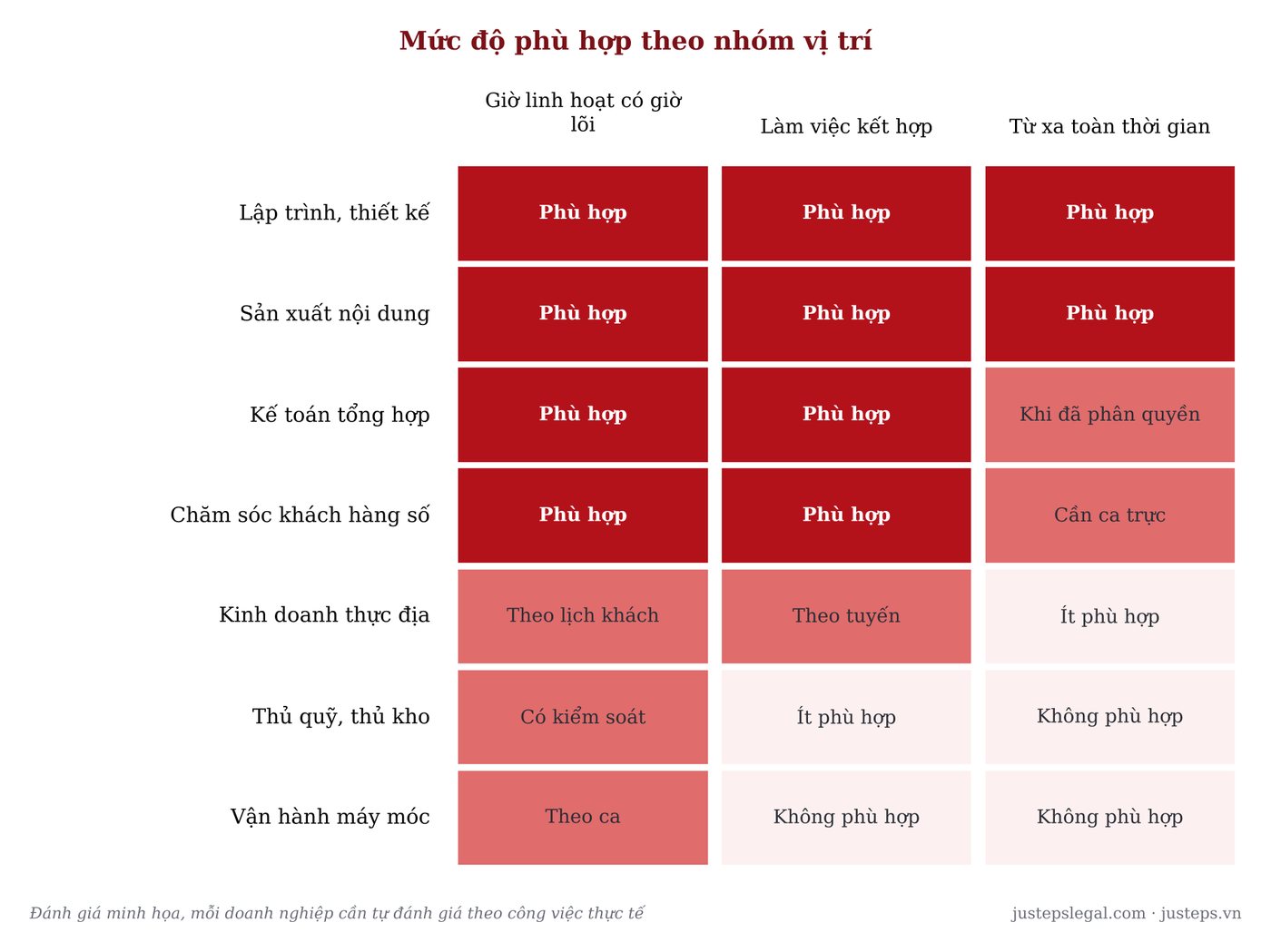
Suitability of each group of positions for the different forms of flexible working
The illustrative assessment shows that programming, design and content production are suited to all three forms, because their output is clearly measurable and depends little on location. Accounting and digital customer service are suited to flexible hours and hybrid working, but should only move to full-time remote work once the system of data access rights is complete. Cashiers, storekeepers and operations staff can in practice only use controlled flexible hours, because their work is tied to specific assets and locations. Each business will have its own list, so the level of suitability should be agreed jointly by department heads and the HR department.
After identifying eligible positions, the business chooses one or a combination of the models below. Each model involves a different way of managing staff and different legal risks, so the Policy should state clearly which model applies to which group of positions:
| Model | How it works | What needs to be regulated |
|---|---|---|
| Flexible hours with core hours | Employees choose their start time within a range but must be present during core hours for coordination. | The core hours, the permitted range of start times and how full hours are counted per day or per week. |
| Hybrid working by day | Employees work at the office on certain fixed days and from home on the remaining days. | The minimum number of office days, the fixed days for each group and how days are swapped when urgent work arises. |
| Full-time remote work | Employees work outside the office almost all of the time, with regular scheduled meetings. | The place of work in the annex, equipment, communication channels, in-person meeting schedule and conditions for returning to the office. |
A business that has never used these arrangements should pilot flexible hours or hybrid working for about three months with one or two departments before extending them. During the pilot, the HR department collects data on target completion, overtime hours incurred and security incidents, and then adjusts the Policy before applying it across the business. This approach helps the business avoid amending its internal labour regulations several times, because each amendment requires another round of consultation and registration.
Working hours, overtime and night work outside the office
Flexible hours do not change the limits on normal working hours, namely no more than 08 hours a day and no more than 48 hours a week. If the business sets working hours on a weekly basis, normal working hours may not exceed 10 hours a day and still may not exceed 48 hours a week[5]. Accordingly, a Policy that allows employees to bank hours in order to finish early on Fridays is only valid where the business has chosen to set working hours on a weekly basis and the daily hours do not exceed 10.
Remote work can easily give rise to night work that nobody notices, because employees may choose to work after 22:00. Night work is counted from 22:00 to 06:00 the following morning[7], and employees working at night are paid at least an additional 30% of the wage for a normal working day; if they work overtime at night, they are also paid an additional 20% of the wage calculated at the rate for a normal working day, a day off or a public holiday[8]. If the Policy does not limit the hours during which work is permitted, the business may have to pay night work wages for hours that employees chose for themselves rather than hours the business required.
Overtime requires the employee’s consent, and overtime hours may not exceed 50% of normal working hours in a day, 40 hours in a month or 200 hours in a year, except in certain sectors and jobs where up to 300 hours is permitted[9]. For remote employees, replying to work messages late at night or dealing with customer requests outside working hours may be treated as overtime if it was assigned by a manager. The Policy should set the window during which work is permitted, for example from 07:00 to 21:00, and require any work outside that window or beyond normal hours to be approved in advance by the manager in writing or in the software. The Policy should also state clearly that employees are not required to reply to messages outside the permitted window unless they are on an assigned on-call shift.
Recording actual working hours
A business cannot prove that it has complied with working hour limits or calculated overtime pay correctly if it has no data on the hours worked by remote employees. A common approach is to combine electronic timekeeping on logging into the work system with a weekly timesheet confirmed by the manager. These data should be kept together with the labour management register that the business must establish and update[10], so that they can be produced immediately when the authorities or the employee request them. The following chart illustrates a working week for three remote employees and shows the additional amounts payable when working hours fall outside the permitted window.
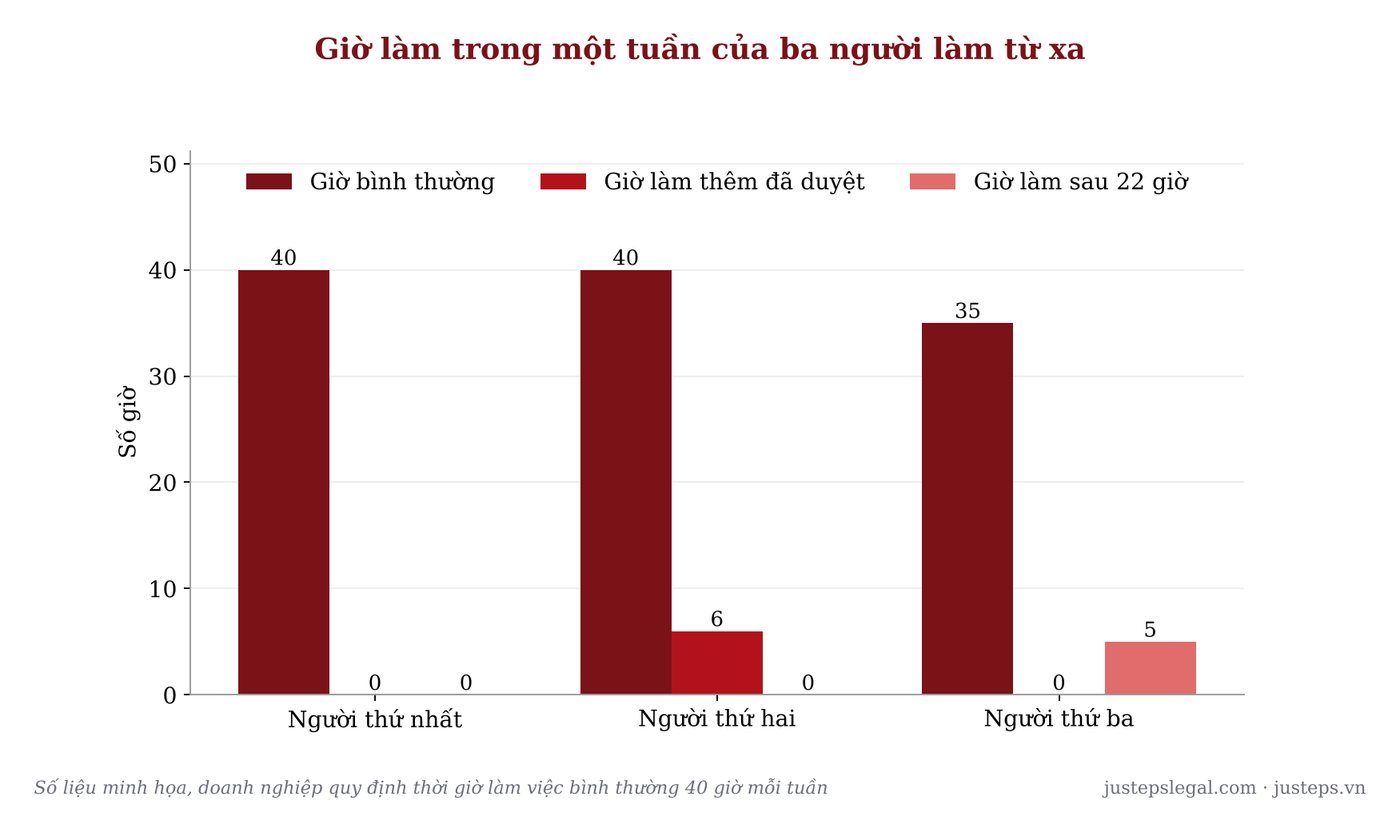
Example of normal hours, overtime and night work in one week
The first employee works the full 40 hours within the permitted window, so no wage is payable beyond the agreed salary. The second employee works 46 hours, 6 of which exceed the business’s normal working hours and were approved, so they must be paid overtime. The third employee still works 40 hours but 5 of them are after 22:00, so the business must pay an additional night work wage even though total hours do not exceed the limit. This example shows that controlling total hours alone is not enough, and the Policy must also control when in the day the work takes place.
Equipment, costs and occupational safety when working outside the office
The Policy needs to answer clearly who provides the computer, telephone and internet connection and who bears the cost of electricity and internet incurred when working from home. There are two common approaches: either the business provides the equipment and manages it as company property, or employees use personal equipment meeting a minimum specification and receive a fixed monthly allowance. If the second approach is chosen, the allowance should be recorded in the annex or in the wage regulations, and the accounting team needs to determine under current rules whether it forms part of the wage used as the basis for social insurance contributions and whether it is taxable income for personal income tax purposes. For the payment to qualify as a deductible expense for corporate income tax purposes, the allowance must be provided for in the contract, the collective agreement or the regulations and be supported by payment documents[11].
Equipment provided by the business should be handed over under a handover record stating its condition, value and responsibility in the event of loss or damage. Compensation for damage to property by an employee must follow the rules on material liability in the Labour Code and the internal labour regulations, so the business cannot simply deduct the full value of the equipment from wages without a decision issued in accordance with the proper procedure. When an employee leaves, the Policy should set the deadline for returning equipment, the method for deleting data and the procedure for revoking access rights on the same day the employee leaves.
As regards occupational safety, the business remains responsible for ensuring safe working conditions for employees, even when they work outside the office[12]. Whether an incident at home is an occupational accident depends on the place and time of work that were agreed, so an annex that clearly states the work address and working hours gives both parties a basis when the matter has to be resolved. The Policy should include a self-assessment of home working conditions, covering seating, lighting, electrical safety and the ability to communicate in an emergency, for the employee to confirm before remote work is approved.
Information security, monitoring and personal data
Remote work increases the risk of information leaks because documents are accessed from home networks, cafés or shared devices. The Policy should require connection through a virtual private network and multi-factor authentication, prohibit storing customer documents on personal computers and prohibit using personal messaging apps to send internal documents. For positions with access to trade secrets, the parties may agree in the employment contract or in a separate document on the content and duration of trade secret protection and on the benefits and method of compensation in the event of a breach[13].
Many businesses use software that records activity time, takes screenshots or tracks location in order to manage remote employees. The Law on Personal Data Protection 2025 permits technological and technical measures to manage employees where they comply with the law, safeguard the rights of data subjects and are applied on the basis that employees are clearly aware of them; the data collected may not be processed or used unlawfully[14]. Accordingly, the Policy needs to list the monitoring tools in use, the types of data collected, the purpose of use, who may view the data and the retention period, and obtain the employees’ confirmation. Monitoring should be proportionate to its purpose, for example recording only login times for timekeeping rather than taking continuous screenshots.
Employees’ personal data must be retained for the period prescribed by law or agreed, and must be deleted or destroyed when the contract ends, unless otherwise agreed or otherwise provided by law[14]. Decree No. 363/2026/ND-CP sets out further detailed requirements on the processing of personal data, so the IT department and the HR department need to review the configuration of monitoring software before putting it into use[15]. Businesses that need to review this area may consider Justeps’ personal data protection compliance service.
Issuing and applying the Policy
The Policy is only effective in practice when it is issued by the competent person, linked to the contracts and internal regulations, and supported by a clear approval procedure for each individual. The sequence below suggests the steps from drafting to the point at which an employee starts working remotely.
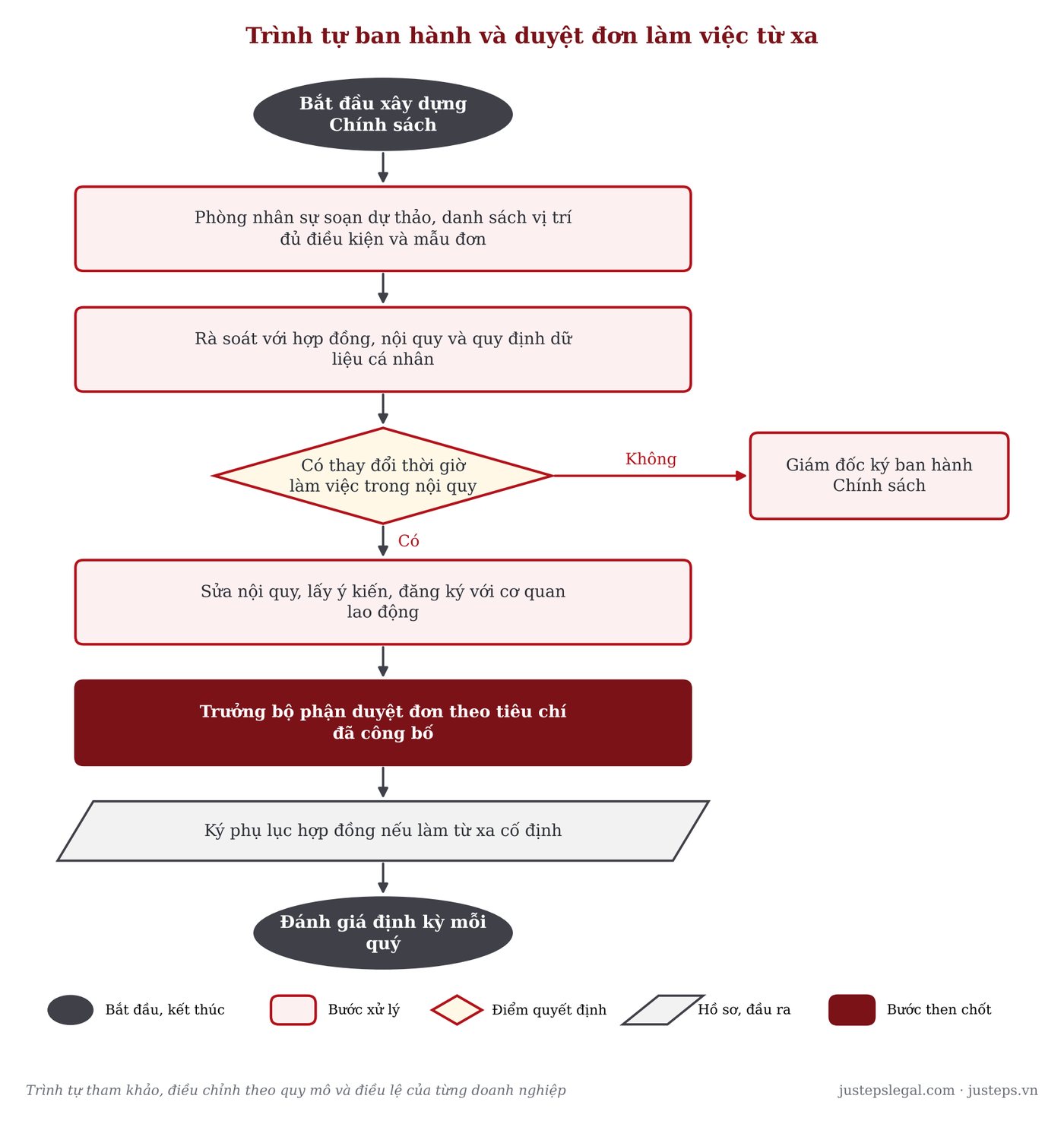
Sequence for issuing the Policy and approving remote work applications
The HR department prepares the draft Policy, the list of eligible positions and the application forms, after which in-house legal staff or an external consultant review them against the contracts, the internal regulations and the rules on personal data. If the Policy changes provisions on working hours and rest periods already contained in the internal labour regulations, the business must amend and re-register those regulations before applying it. When an employee submits an application, the department head checks it against the published criteria and replies within the set time limit, for example 03 working days; where permanent remote work is approved, the two parties sign a contract annex. Every quarter, the department head reviews the results and proposes to maintain, adjust or end the remote work arrangement in accordance with the conditions in the Policy.
So that each of these steps has a documentary basis when the authorities carry out an inspection or a dispute arises, the business should keep a minimum set of records, comprising the documents summarised in the following table:
| Document | Main contents | Prepared and approved by |
|---|---|---|
| Flexible working policy | Scope, models, core hours, permitted working window, approval criteria and conditions for termination. | Drafted by the HR department and issued by the Director after legal review. |
| Amended internal labour regulations | The sections on working hours, rest periods and material liability, taking remote work into account. | Drafted by HR, with consultation of the representative organisation, signed by the Director and registered. |
| Application and self-assessment | The proposed model, place of work and commitments on working conditions and security. | Prepared by the employee and approved by the department head. |
| Employment contract annex | Place of work, working window, equipment, allowances and conditions for returning to the office. | Prepared by HR and signed by the business’s representative and the employee. |
| Monitoring notice | Tools, data collected, purpose, who may view the data and the retention period. | Drafted by the IT department and acknowledged in writing by the employee. |
| Weekly timesheet | Normal hours, approved overtime and hours worked after 22:00. | Completed by the employee, confirmed by the manager and kept by HR. |
A business with 10 or more employees should prepare the Policy in parallel with a review of its internal labour regulations, because the two documents must be consistent on working hours and timekeeping. Where support is needed to draft and register amended regulations, the business may consider Justeps’ internal labour regulations and disciplinary procedures service.
Common mistakes and how to correct them
The most common mistake is allowing remote work solely through a message from the department head, with no annex and no criteria. When the business later wants to withdraw the arrangement, the employee may argue that the place of work has been renegotiated and that the business is unilaterally amending the contract. The remedy is to review all current remote work arrangements, classify them by model and then sign annexes or written confirmations under the new Policy in a single exercise.
The second mistake is offering flexible hours without core hours, which makes it difficult for departments to schedule joint meetings and leaves customers unable to make contact during office hours. The third mistake is failing to record working hours, so that when an employee complains about overtime pay, the business has no data to compare and often has to accept figures the employee compiled from messages and emails. Both mistakes are remedied by writing core hours and the permitted working window into the Policy and making weekly timesheets compulsory.
The fourth mistake is failing to regulate costs and equipment, leading to disputes when equipment breaks down or when employees ask to be reimbursed for electricity and internet. In addition, the business needs to update its work schedule in line with changes in the law; for example, the Law amending and supplementing the Labour Code, passed by the National Assembly on 21 November 2026 and taking effect on 1 March 2027, adds 27 July and 24 November as fully paid public holidays[16]. Working remotely on these days at the request of the business is overtime on a public holiday and must be paid at the corresponding rate, so the duty rosters of remote customer service teams should be rearranged before 2027.
For the Policy to become established practice, the business should roll it out in phases rather than applying it to the whole company at once. The roadmap suggested below gives the business enough time to pilot the arrangements, amend its internal regulations and sign annexes before general application.
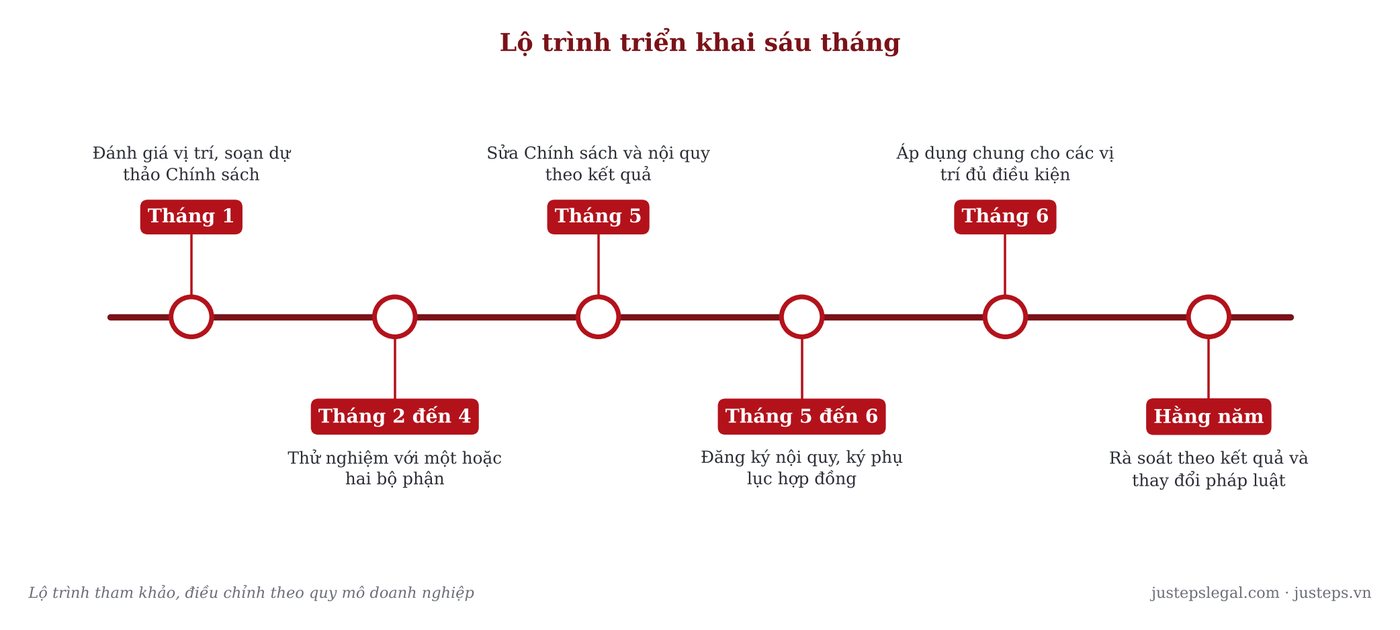
Six-month roadmap for implementing the flexible working Policy
In the first month, the business assesses positions and prepares the draft, then pilots the arrangements with one or two departments for about three months. The pilot results form the basis for amending the Policy and the internal regulations, after which the business registers the internal regulations and signs annexes with employees working remotely on a permanent basis. From the sixth month, the Policy applies across the business and is reviewed once a year, or earlier when labour law or personal data law changes.
How Justeps can help
Justeps helps businesses build and apply a lawful remote work and flexible hours policy through the following services:
- Internal labour regulations and disciplinary procedures. Justeps amends the working hours and rest period sections of the internal labour regulations and prepares the file for registering the amended regulations.
- Building a system of company regulations and internal rules. Justeps drafts the flexible working Policy, application forms, contract annexes and timesheets consistent with the company’s other regulations.
- Labour, payroll and insurance. Justeps advises on calculating overtime and night work pay and on handling allowances for the costs of working from home.
- Personal data protection compliance. Justeps reviews monitoring tools and drafts data processing notices and the procedure for deleting data when an employee leaves.
Frequently asked questions
Must a business sign a contract annex when allowing staff to work remotely?
If the employee only works remotely occasionally under the general Policy, an annex is not strictly necessary. For permanent remote work, the place of work differs from the contract, so the parties should sign an annex recording the place of work, the working window and the conditions for returning to the office[1].
Do flexible hours change the limit of 8 hours a day?
No. Flexible hours only change the start and finish times, while normal working hours remain no more than 08 hours a day, or no more than 10 hours a day if the business sets hours on a weekly basis, and no more than 48 hours a week[5].
If an employee chooses to work after 22:00, must the business pay night work wages?
Hours worked from 22:00 to 06:00 the following morning are night work and attract an additional payment of at least 30%[8]. To control costs, the Policy should set a permitted working window and require prior approval for work outside it.
May a business use software that takes screenshots of remote employees?
A business may apply technological measures to manage employees if they comply with the law and employees are clearly aware of them[14]. The Policy should state the tools, data collected, purpose, who may view the data and the retention period, and monitoring should go no further than necessary.
Must a business pay electricity and internet costs for employees working from home?
The law does not require any specific amount, so this is a matter for agreement between the parties. If an allowance is paid, the business should record it in the annex or the regulations and keep payment documents so that it qualifies as a deductible expense[11].
Can a business require employees to return to the office at any time?
If remote work has been recorded in an annex without conditions for withdrawal, the business needs to renegotiate with the employee under the procedure for amending the contract[3]. The annex should therefore refer to the Policy and list clearly the cases in which the business may require a return to the office.
Does a business with fewer than 10 employees need a written Policy?
A business with fewer than 10 employees is not required to register internal labour regulations[6], but it should still have a written Policy. Such a document aligns the working window, timesheet procedure and conditions of application, and avoids disputes as the business grows.
Related articles
- The procedure for issuing internal documents in a company, from drafting to archiving and monitoring their validity
- Practical lessons in building an employee handbook for a small business that is concise, practical and consistent with the internal labour regulations
- What the HR department must do to protect employees’ personal data under the 2025 Law on Personal Data Protection
- What companies must satisfy when moving to electronic employment contracts and how those contracts should be stored
Notes
[1] Points c and g of Clause 1 of Article 21 of the Labour Code No. 45/2019/QH14 dated 20 November 2019.
[2] Article 22 of the Labour Code No. 45/2019/QH14.
[3] Article 33 of the Labour Code No. 45/2019/QH14.
[4] Clause 1 of Article 14 of the Labour Code No. 45/2019/QH14; Government Decree No. 337/2025/ND-CP on electronic employment contracts.
[5] Article 105 of the Labour Code No. 45/2019/QH14.
[6] Articles 118 and 119 of the Labour Code No. 45/2019/QH14.
[7] Article 106 of the Labour Code No. 45/2019/QH14.
[8] Clauses 2 and 3 of Article 98 of the Labour Code No. 45/2019/QH14.
[9] Clauses 2 and 3 of Article 107 of the Labour Code No. 45/2019/QH14.
[10] Article 12 of the Labour Code No. 45/2019/QH14.
[11] The Law on Corporate Income Tax No. 67/2025/QH15 and its guiding documents on deductible expenses.
[12] The Law on Occupational Safety and Hygiene No. 84/2015/QH13 dated 25 June 2015.
[13] Clause 2 of Article 21 of the Labour Code No. 45/2019/QH14.
[14] Article 25 of the Law on Personal Data Protection No. 91/2025/QH15, effective from 1 January 2026.
[15] Government Decree No. 363/2026/ND-CP detailing a number of articles of the Law on Personal Data Protection.
[16] The Law amending and supplementing a number of articles of the Labour Code, passed by the National Assembly on 21 November 2026 and effective from 1 March 2027.
This article is for reference and reflects the regulations in force at the time of publication. Please consult Justeps for advice tailored to your company’s records and situation.
For further information, please contact:
📩 Email: info@justeps.vn
🌐 Website: https://justepslegal.com · https://justeps.vn
🌐 Page: Justeps
☎️ Hotline (Zalo): 096 172 2607
📍 Thanh Xuan Office: 12th Floor, Licogi 13 Tower, 164 Khuat Duy Tien Street, Thanh Xuan Ward, Hanoi, Vietnam
📍 Ha Dong Office: LK06B, No.10, Dong Dua Area, Ha Dong Ward, Hanoi, Vietnam
📍 Ho Chi Minh City Branch: 528 Le Van Sy, Ho Chi Minh City, Vietnam
📍 Hai Phong Office: Truong Thinh Village, Ha Dong Commune, Hai Phong, Vietnam
📍 Quang Ninh Office: Van Don Special Zone, Quang Ninh Province, Vietnam





