
Key takeaways
- Restaurant operating procedures must be written down, with a person responsible and supporting records for each step, because only then can the owner control costs and quality without being present at every shift.
- The person who places orders, the person who receives goods and the person who confirms payment must be three different people; this is the most basic control for limiting losses of ingredients and cash.
- Three-step food checks, retained food samples and records of ingredient origin are the only evidence that allows a restaurant to prove its compliance when food poisoning is suspected.
- End-of-shift revenue reconciliation and comparison of actual dish costs against standard recipes should be carried out daily, because small discrepancies repeated over many shifts become a large loss by the end of the month.
- The set of procedures should be formally issued, taught by position and reviewed at least once a year or as soon as the law, the menu or the business model changes.
A restaurant is a business model with a very large number of small transactions that happen quickly, continuously and depend on whoever is on shift. Each day, a medium-sized restaurant may take deliveries from five to ten suppliers, serve hundreds of guests, handle dozens of discounts, dish changes and cancellations, and close out cash across several payment methods. When all of this exists only in the experience of the manager or head chef, food quality varies from shift to shift, cash at the end of the shift is frequently out, and the owner cannot tell at which stage the losses occur. Legal risk rises as well, because when a guest suspects food poisoning or an inspection team arrives, the restaurant has no records to prove that it did things correctly.
This article explains how to build a written set of restaurant operating procedures in the order in which they are implemented, starting with the organisation chart and allocation of authority, then moving to ingredient control, guest service, cashiering, food costing, shift scheduling and, finally, issuance and review. In each part, the article sets out the requirements of Vietnamese law currently in force, the consequences of getting things wrong and how to allocate the work. The main readers are restaurant owners, operations directors, store managers, head chefs and accountants of independent restaurants or restaurant chains, including foreign-invested enterprises operating food and beverage services.
Why restaurants need written procedures and which legal requirements those procedures must meet
Operating procedures are a set of standard working steps issued in writing, which state who does what, when, to which standard and what record is left behind (Operating procedures). The first value of a written document is that it helps new staff work correctly from their first week, rather than learning from their predecessors along with all of their bad habits. The second value is that it allows the owner to check every stage through records, such as goods received notes, food check logs and end-of-shift reports, without needing to be at the store. For restaurant chains, written procedures are also a precondition for opening new outlets while keeping food quality and service consistent.
Beyond management objectives, a significant part of the procedures exists to discharge legal obligations. The Law on Food Safety sets conditions for the preparation area, utensils, water supply and food handlers, and requires food service establishments to hold a certificate of eligibility for food safety, except where exempt[1]. Decree No. 46/2026/ND-CP guiding the Law on Food Safety is currently suspended until the amended law and its guiding documents take effect, so during this period restaurants continue to apply Decree No. 15/2018/ND-CP[2]. The procedures therefore need to be designed flexibly enough to be updated as soon as the new legal framework is issued. The table below summarises the main groups of obligations that a restaurant’s procedures must reflect.
| Procedure group | Legal requirements to reflect | Records the restaurant should keep |
|---|---|---|
| Ingredients and kitchen | Ingredients of clear origin, a one-way kitchen layout, and food handlers who have had health checks and food safety training. | Supplier contracts and invoices, goods received notes, health certificates, training confirmations. |
| Food checks and sample retention | Checking ingredients on receipt, before preparation and before serving; retaining food samples for at least 24 hours. | Three-step food check log, sample labels stating the dish, time of sampling and person who took the sample. |
| Cashiering and invoices | Displaying selling prices, issuing e-invoices on sale and handling discounts and cancellations under control. | End-of-shift sales report, list of cancelled dishes, approved discount records. |
| Labour and shifts | Complying with limits on working hours, overtime and breaks, and paying night work and overtime in full. | Employment contracts, shift rosters, timesheets, written consent to overtime. |
| Fire prevention and safety | Gas stoves, extraction systems and escape routes must be inspected; staff must be instructed in handling incidents. | Gas and electrical equipment inspection log, drill records, list of trained staff. |
Many restaurants only have a guest service procedure and neglect the other groups, even though the greatest risks of penalties and losses lie in the storeroom, the kitchen and the cash desk. A complete set of procedures should therefore have seven parts, namely the organisation chart and allocation of authority, ingredient control and food safety, service and banquet bookings, cashiering and reconciliation, food cost and wastage, shift scheduling and occupational safety, and the mechanism for issuance and review. The sections below analyse each group in turn in that order.
Organisation chart and allocation of decision-making authority during the shift
Dividing the work into four blocks and separating conflicting roles
Whatever its size, the work of a restaurant can be divided into four blocks, namely a sales block in charge of customers, table reservations and banquet bookings, a front-of-house block in charge of service and cashiering, a kitchen block in charge of preparation and portioning, and a support block covering purchasing, storeroom, accounting and human resources. A small restaurant may assign several blocks to one person, but the organisation chart must still state who bears final responsibility for each block. When new outlets open, the support block is usually centralised at the chain’s head office, while each store keeps its front-of-house and kitchen blocks.
The most important control principle is to separate the person who places orders, the person who receives goods and the person who confirms payment to the supplier into three different people. When one person both orders and signs for delivery, the restaurant has no way of detecting short deliveries, poor-quality goods or invoices showing more than was actually received. Similarly, the person at the cash desk should not also be the one who approves cancellations or discounts. Where the restaurant is too small to separate the roles, the owner should personally carry out random weekly checks of goods received notes and cancellation reports to compensate for the missing control.
Allocating authority for decisions that arise during the shift
Most of a restaurant’s decisions arise during the shift and must be made within minutes, such as giving a discount to a guest who complains, withdrawing a dish because an ingredient has run out, switching supplier when a delivery is substandard or paying for urgent repair of broken equipment. If everything has to be referred to the owner, the shift slows down and shift managers cannot develop their capabilities. Conversely, without clear limits, discounts and cancellations easily become channels for losses. The table below is an example of an authority matrix that can be adjusted to the size of the restaurant.
| In-shift decision | Approver and limit | Records to be kept |
|---|---|---|
| Discounts and complimentary dishes | The shift manager approves within a limit expressed as a percentage of the bill; above that limit, the store manager must approve. | Reason for the discount recorded in the point-of-sale software together with the approver’s name. |
| Cancelling an ordered dish | The shift manager approves if the dish has not been prepared; a prepared dish requires confirmation from the head chef. | Cancellation slip stating the time, table and reason, compiled in the end-of-shift report. |
| Withdrawing a dish | The head chef decides when an ingredient is substandard or has run out, then immediately informs front of house and the cashier. | Note in the shift handover log and update of the dish status in the software. |
| Changing supplier | The purchasing team proposes, and the store manager or operations director approves. | Capability profile, food safety documents and price quotation of the new supplier. |
| Urgent repair spending | The store manager approves within the spending limit; above the limit, the director must be consulted. | Incident report, repair quotation or invoice, photographs before and after the repair. |
| Signing a banquet contract | The sales team signs after the kitchen and storeroom confirm they can meet the order. | Banquet contract, confirmed menu, deposit documents. |
The limits in the matrix should be linked to the company’s financial regulations, since that is the document setting out general spending and approval authority. For a limited liability company or joint stock company that owns a restaurant chain, authorising store managers to sign banquet contracts or supplier contracts should be done through a letter of authorisation from the legal representative, stating its scope and maximum value. When a person without authority still signs a contract, the business easily becomes embroiled in disputes with customers or suppliers about the validity of the transaction, and it is difficult to determine the internal liability of the person who exceeded their authority.
Controlling incoming ingredients and food safety
Selecting suppliers, receiving goods and storage
The ingredient control procedure begins with selecting suppliers. The restaurant should maintain a list of approved suppliers and require each supplier to provide documents proving that its establishment meets food safety conditions or equivalent documents, product declaration files for pre-packaged food and an invoice for every delivery. Meat and poultry should come with a quarantine certificate or slaughter control stamp, while vegetables should preferably come from sources under contract that can be traced back to the growing area.
On receipt, the receiver checks quantity, expiry dates, the temperature of frozen and chilled goods and their sensory condition, then records the results on the goods received note before the goods enter the storeroom. Substandard goods must be rejected on the spot, with the reason recorded and the purchasing team informed, rather than being accepted provisionally and dealt with later. In the storeroom, the restaurant applies first-in, first-out, labels opened ingredients with the date of opening and separates raw food from cooked food to avoid cross-contamination.
Three-step food checks, sample retention and requirements for food handlers
A three-step food check means checking food before it enters the kitchen, during preparation and before it is served, in accordance with the guidance of the Ministry of Health[3]. The restaurant should apply full food checks and sample retention at least for banquet menus and large pre-ordered meals, because this is where the risk of food poisoning is concentrated and also where the clearest evidence is needed if an incident occurs. Food samples are retained for at least 24 hours in a separate refrigerator, and each sample bears a label stating the name of the dish, the time of sampling and the person who took the sample. Food handlers must undergo health checks, be trained in food safety and must not come into contact with food while suffering from an infectious disease on the Ministry of Health’s list[1].
When a guest reports signs of food poisoning after a meal, the procedure must tell staff exactly what to do in the first hour, because this is the decisive period both for the guest’s health and for the restaurant’s ability to prove its compliance. The sequence below shows how to handle a suspected case of food poisoning at a restaurant.
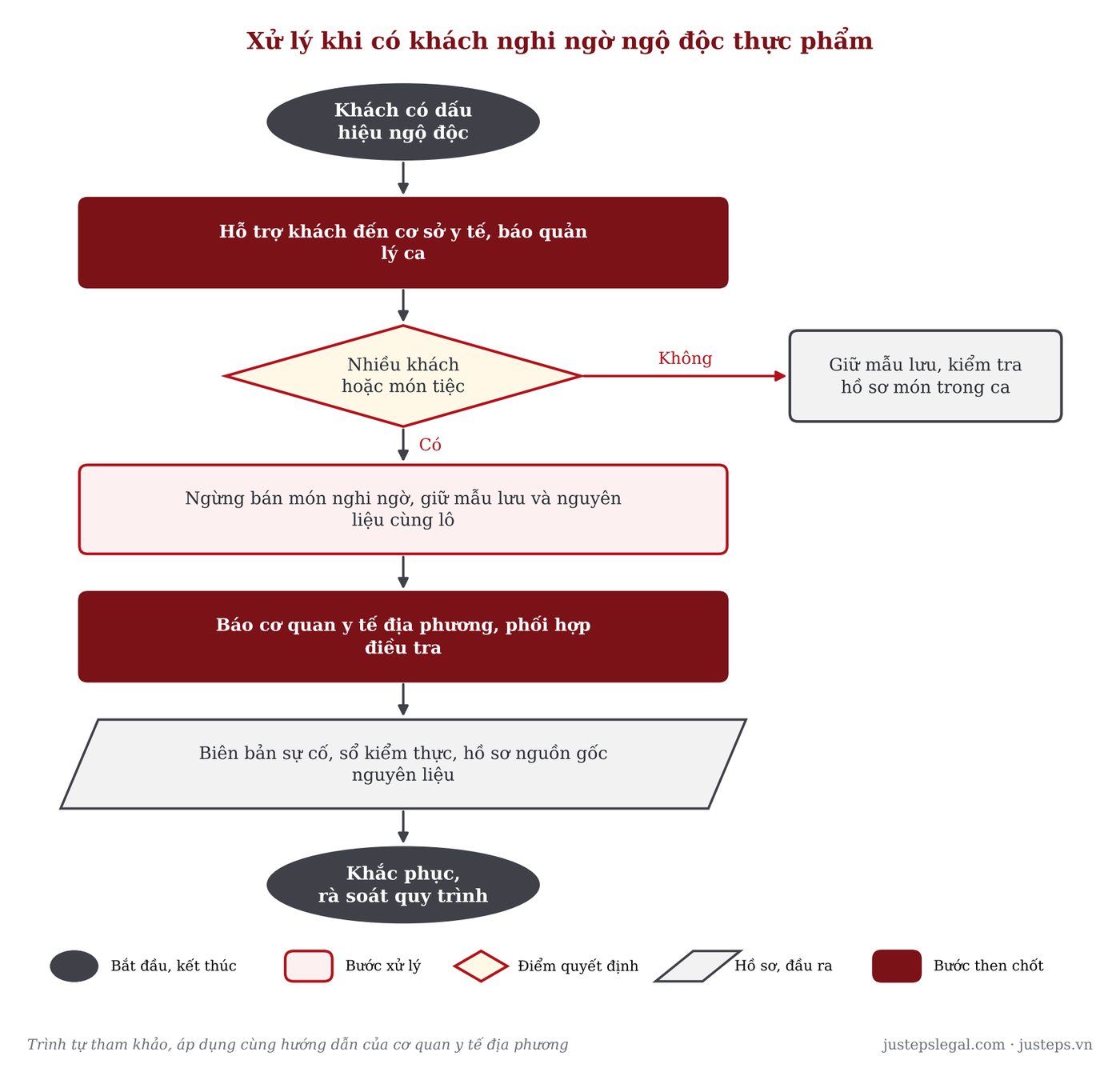
Sequence for handling a guest suspected of food poisoning after a meal at the restaurant
The first step is always to help the guest get to a medical facility, after which the shift manager decides whether to stop selling the suspected dish. If several guests have symptoms or the dish is connected with a banquet, the restaurant must stop selling immediately, preserve the retained samples and remaining ingredients from the same batch and notify the local health authority. Where only one guest is affected and there is no basis yet to identify the cause, the restaurant still keeps the retained samples and re-checks the records for that dish during the shift. Whichever branch applies, the incident is recorded in an incident report stating the time, dish, ingredient batch and person handling it, because this report together with the food check log will form the basis when the authorities investigate or when the guest claims compensation. The restaurant must not destroy retained samples or suspected ingredients on its own initiative before a conclusion has been reached.
Guest service, banquet bookings and protection of customer information
A guest’s visit to a restaurant usually passes through six touchpoints, namely greeting, presenting the menu and taking the order, passing the order to the kitchen, serving the dishes, handling feedback during the meal, and payment and farewell. The procedures should set standards for each touchpoint, such as the maximum time from ordering to the first dish, but the focus should be on two control points. The first is that the head chef or a designated person checks that each dish meets the standard for portion, temperature and presentation before it leaves the kitchen. The second is that the server asks the guest about the quality of the dishes before bringing the bill, so that complaints are resolved at the table rather than turning into arguments at the cash desk.
Information on guests’ allergies and special diets should be recorded on the order slip and displayed prominently on the kitchen screen. As regards alcohol and beer, the restaurant must not sell or serve them to persons under 18 years of age[4] and must meet the conditions for trading in alcohol under current regulations. The procedures should give servers the right to ask guests to produce identification when in doubt about their age and the right to refuse further service when a guest shows signs of intoxication. Prices of dishes and drinks must be clearly displayed, including any service charge, and the restaurant must not charge more than the displayed price[5].
Banquet bookings and banquet contracts
Banquets are a major source of revenue but also the source of the most disputes, usually because the sales team makes promises to the customer before the kitchen and storeroom have confirmed. The correct procedure is for the sales team to send a banquet request form stating the expected number of guests, the menu, serving time and special requirements to the head chef and the storeroom; only when these two departments confirm sufficient ingredients, staff and kitchen capacity is the contract signed with the customer. The banquet contract should state the minimum number of guests to be charged, the deadline for confirming final numbers, the deposit, cancellation terms and how to handle situations where fewer or more guests attend than confirmed. Under the Civil Code, where the party paying a deposit refuses to perform the contract, it forfeits the deposit, and where the party receiving the deposit refuses, it must return the deposit plus an equivalent amount, unless otherwise agreed[6], so the cancellation clause needs to be drafted carefully.
Reservation data, membership programmes and CCTV
Guests’ telephone numbers, names and dates of birth in the reservation book, the membership programme and images from CCTV cameras are all personal data. Under the Law on Personal Data Protection, the restaurant must give notice of the purpose of collection, use the data only for the notified purpose, apply protective measures and delete the data when it is no longer needed[7]. The procedures should specify who may access the guest list, prohibit staff from copying the list or taking it off the premises, place notices about cameras in areas under surveillance and not install cameras in changing rooms or toilets. Sending promotional messages to guests also requires their consent.
Cashiering, invoicing, dish costing and control of wastage
Issuing invoices and reconciling revenue at the end of the shift
The cash desk is where cash and tax risks are concentrated. From 1 July 2026, the issuance and management of e-invoices is governed by Decree No. 254/2026/ND-CP, which replaces Decree No. 123/2020/ND-CP[8], so restaurants need to review how their point-of-sale software connects to the e-invoicing system and when an invoice is issued for each transaction. The operating principle is that every dish served must go through the point-of-sale software, with no handwritten bills and no dishes sold outside the system. When a guest asks to split or combine bills, the cashier does so in the software so that the trail of the original transaction is preserved.
At the end of each shift, the cashier prints the sales report and reconciles it against the cash actually in the till, bank transfers shown on the statement and card payments according to the payment terminal report. The shift manager recounts the cash together with the cashier, signs a handover record and notes any surplus or shortfall. Any discrepancy above the permitted level must be explained within the shift and not carried over to the next day. Requiring a cashier to make good a cash shortfall may only be done under the compensation mechanism in the internal labour rules and following the statutory procedure; arbitrary deductions from wages are not permitted.
Tracking dish costs and wastage by shift
The most basic kitchen indicator is the food cost ratio, calculated as the cost of ingredients according to the standard recipe divided by the selling price before tax. Each dish on the menu needs a standard recipe stating the weight of each ingredient, the trimming yield and a presentation photograph, so that every cook on every shift makes the same dish. From these recipes, the accountant can calculate the quantity of ingredients that should have been used for the number of dishes sold, then compare it with the quantity actually issued from the storeroom to identify wastage.
Wastage should be broken down by cause so that appropriate action can be taken, namely trimming losses, disposal of expired items, dishes discarded because they were prepared incorrectly, complimentary or discounted dishes, and an unexplained remainder. The unexplained remainder is a sign of non-standard portioning, short deliveries or leakage, and it is the part the owner needs to monitor most closely. The following chart illustrates how actual ingredient usage compares with the standard recipe for several ingredient groups over one month.
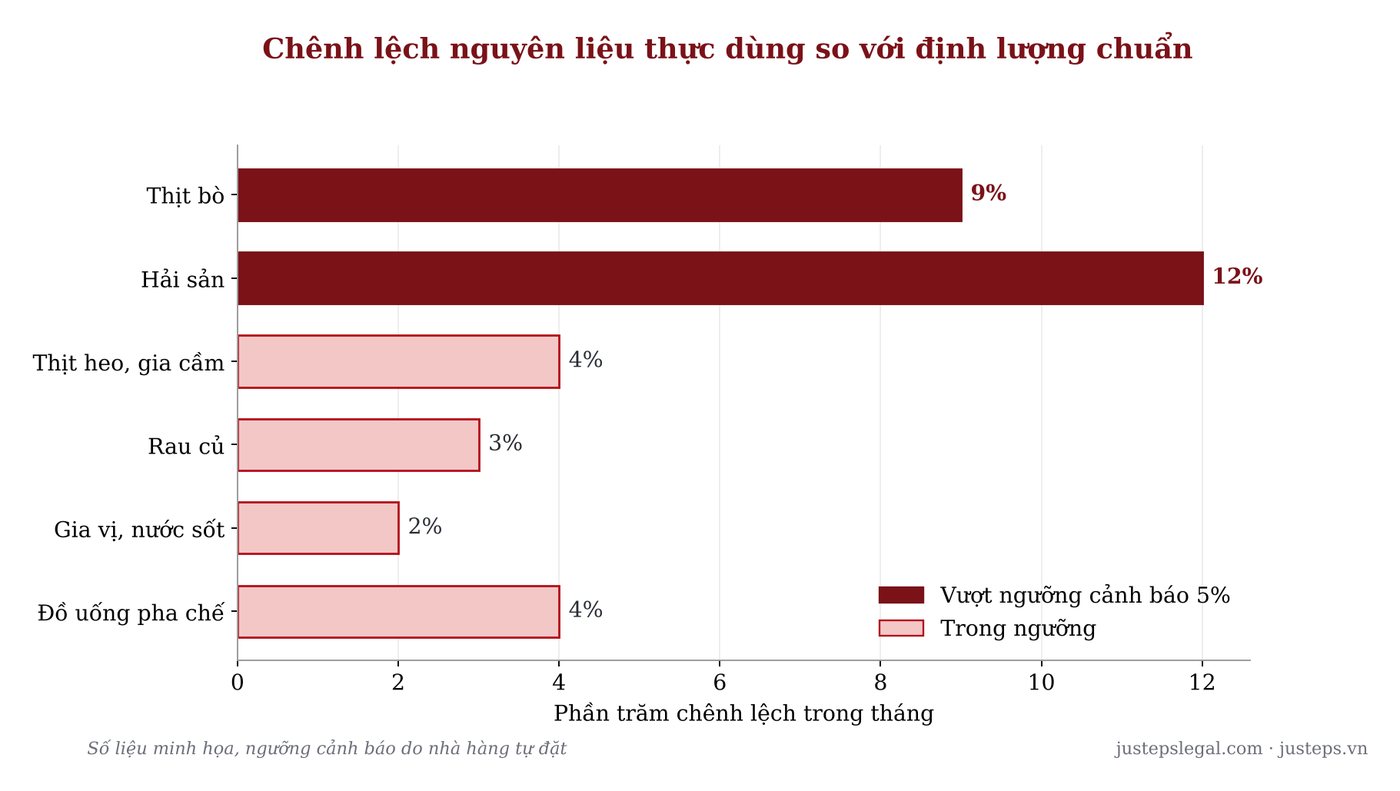
Example of the difference between actual ingredient usage and usage under the standard recipe at a restaurant over one month
In this example, beef and seafood show variances of 9% and 12% respectively against the standard recipe, much higher than vegetables, seasonings and drinks. These are two high-value ingredient groups, so a variance of only a few percentage points amounts to many millions of dong each month. The restaurant should set an alert threshold, for example 5%, for each ingredient group, and when the threshold is exceeded it should check in turn the goods received notes, trimming methods, portioning at the pass and cancellation reports before concluding that there has been leakage. Stocktakes should be carried out daily for high-value groups and weekly for the others.
Shift scheduling, labour and fire safety in the kitchen
Working hours, split shifts and overtime
Restaurants often use split shifts, where staff work at lunchtime, take a few hours off and return for the evening service, together with part-time and seasonal workers during peak periods. However shifts are arranged, normal working hours may not exceed 8 hours a day and 48 hours a week, and an employee who works continuously for 6 hours or more is entitled to a break of at least 30 minutes, or 45 minutes for night work[9]. Hours worked between 22:00 and 06:00 the following morning are night work and must attract additional pay. Overtime requires the employee’s consent and may not exceed 40 hours a month; food and beverage services are not among the sectors permitted to work up to 300 hours of overtime, so the applicable limit is 200 hours a year[10].
Part-time and seasonal workers must still sign a written or electronic employment contract when working for one month or more, and they are entitled to the same rights to wages and rest as full-time staff in proportion to their working time. The shift roster should be published at least one week in advance, stating start times, finish times and break times, and then reconciled against timekeeping data when calculating pay. From 1 March 2027, 27 July and 24 November become paid public holidays[11], so restaurants that open on those two days need to prepare written overtime consents and the method of calculating holiday pay for staff who work. Businesses may refer to Justeps’ labour, payroll and insurance services for restaurants, cafés and F&B chains for a review of contracts, shift rosters and pay calculations.
Fire prevention, firefighting and kitchen safety
A restaurant kitchen contains gas burners, cooking oil, high-powered electrical equipment and a smoke extraction system, so the fire risk is much higher than in many other types of business. The 2024 Law on Fire Prevention, Firefighting and Rescue requires the head of an establishment to be responsible for organising fire prevention and firefighting at their establishment[12]. The procedures should require the main gas valve to be closed at closing time, extraction hoods and flue ducts to be cleaned on schedule, fire extinguishers to be checked monthly, escape routes to be kept clear and instruction and drills to be organised for all staff, including part-time staff. A restaurant located in a shopping centre or mixed-use building must also comply with the fire safety rules of the building management board.
Opening and closing shifts and the mechanism for issuing and reviewing the procedures
The procedures above only work when they are built into the daily rhythm of work. The most effective way is to create opening and closing shift packs, in which each department has its own checklist and its own person who signs off. The diagram below illustrates the sequence of a working day between the shift manager, the kitchen and the cashier.
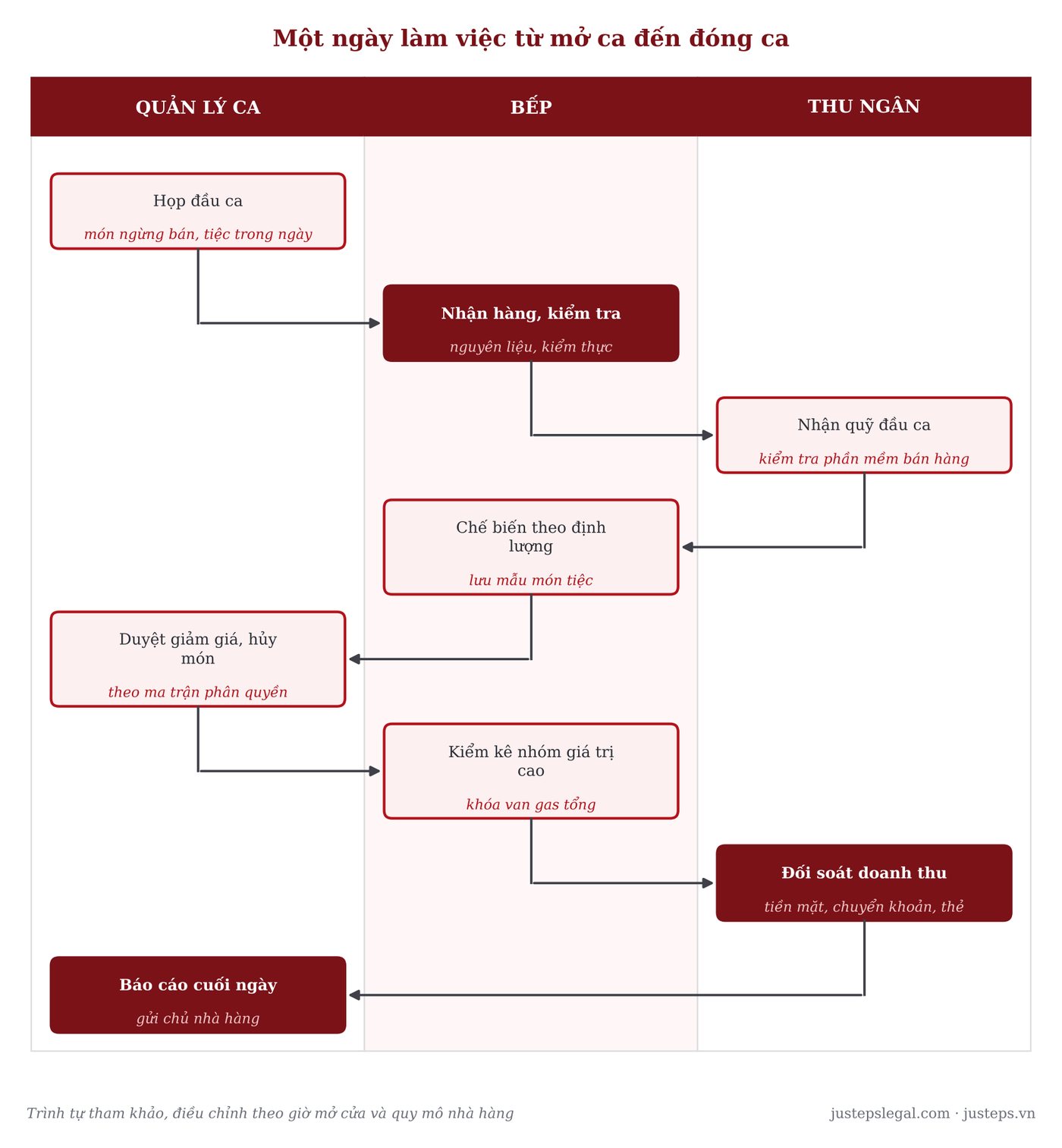
Sequence of opening, in-shift operations and closing between the shift manager, the kitchen and the cashier
At the start of the day, the kitchen receives deliveries and checks ingredients, the cashier receives the opening float, and the shift manager holds a quick briefing to announce withdrawn dishes, the day’s banquets and who is in charge of each area. During the shift, the kitchen keeps the food check log and retains samples, and the shift manager approves discounts and cancellations in accordance with the authority matrix. At closing, the kitchen counts high-value ingredient groups and closes the gas valve, the cashier reconciles revenue, and the shift manager compiles an end-of-day report for the owner. This report should be short enough to read in five minutes, covering revenue, guest numbers, cash discrepancies, cancelled dishes, the value of discounts and incidents during the day.
The procedures should be issued by a decision of the director or legal representative, with a reference number, an effective date and a department responsible for updates. Matters relating to labour discipline and compensation for damage must be incorporated into the internal labour rules, because an employer may only take disciplinary action for conduct specified in those rules[13]. After issuance, each position should be trained in its part of the procedures, with a short test and a confirmation that instruction has been received. Implementation can be phased according to the indicative roadmap below.
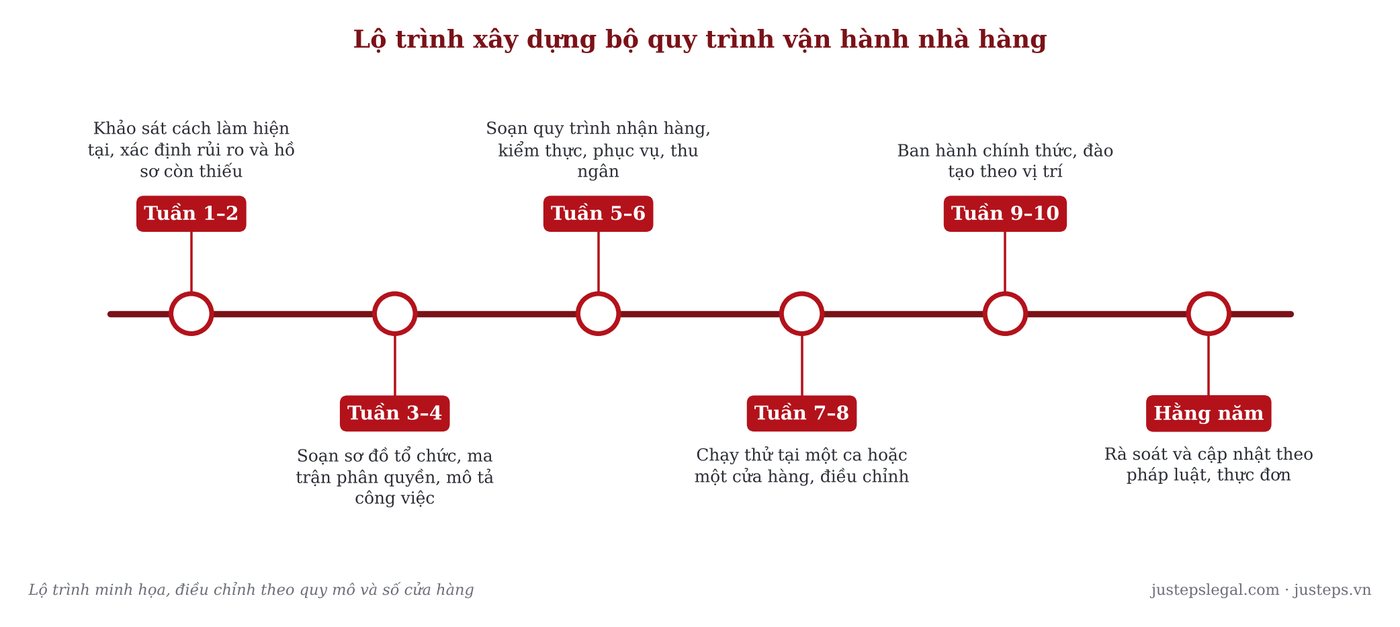
Indicative roadmap for building and implementing restaurant operating procedures over ten weeks
The first two weeks are devoted to surveying current practices and risks, followed by a phase of drafting the organisation chart, the authority matrix and detailed procedures. Once a draft is ready, the restaurant should trial it on one shift or in one store, adjust it based on staff feedback and only then issue it formally and train everyone. The procedures need to be reviewed at least once a year and whenever there is a major change, such as opening a new store, changing the menu, changing the point-of-sale software or when the amended Law on Food Safety and its new guiding documents take effect. Businesses that need support in drafting and implementation may refer to Justeps’ development of internal procedures and regulations for restaurants, cafés and F&B chains service.
There are five signs that the current procedures are not working well, namely cash at the end of the shift being frequently out, high and unexplained wastage, food quality differing between shifts, the owner having to approve every small matter personally, and new staff taking many weeks before they can work independently. Where two or more of these signs appear, the restaurant should review the entire set of procedures rather than fixing individual points, because the cause usually lies in the allocation of authority and in record-keeping, not just in one department.
How Justeps can help
Justeps supports restaurants and restaurant chains in building and implementing operating procedures through the following services:
- Development of internal procedures and regulations for restaurants, cafés and F&B chains. Justeps drafts procedures for receiving goods, food checks, service, cashiering, end-of-shift reconciliation and opening and closing packs tailored to each restaurant’s model.
- Organisational structure design for restaurants, cafés and F&B chains. Justeps designs the organisation chart, job descriptions and authority matrix for stores and the chain’s head office.
- Labour, payroll and insurance services for restaurants, cafés and F&B chains. Justeps reviews employment contracts, shift rosters, the calculation of night work and overtime pay, and the internal labour rules of restaurants.
- Ongoing legal advisory services for restaurants, cafés and F&B chains. Justeps advises on food safety, banquet contracts, supplier contracts and updates on new regulations for restaurants.
- In-house training. Justeps trains shift managers, head chefs and cashiers on allocation of authority, food checks, incident handling and end-of-shift reconciliation.
Frequently asked questions
Does a small restaurant with fewer than ten staff need written operating procedures?
A small restaurant should still have written procedures, but they can be kept to a few pages focusing on receiving goods, food checks, cashiering and closing. Where one person holds several roles, the owner should carry out random weekly checks of goods received notes and cancellation reports.
Is a restaurant required to hold a certificate of eligibility for food safety?
In principle, food service establishments must hold the certificate, except in cases exempted under the guiding documents currently in force[1]. While Decree No. 46/2026/ND-CP is suspended, restaurants apply Decree No. 15/2018/ND-CP[2].
How long must food samples be retained?
Under the guidance of the Ministry of Health, food samples are retained for at least 24 hours from the time of sampling[3]. Each sample needs a label stating the name of the dish, the time of sampling and the person who took it, and samples must not be destroyed while food poisoning is suspected.
How large a discount may a shift manager give a guest?
The law does not set this level, so the restaurant sets its own limit in the authority matrix, usually as a percentage of the bill. Every discount must have its reason and the approver’s name recorded in the point-of-sale software for reconciliation at the end of the shift.
May a restaurant deduct a cashier’s wages when cash is short at the end of the shift?
The restaurant may not make deductions arbitrarily. Compensation may only be required under the material liability provisions of the internal labour rules, following the prescribed procedure and with monthly deductions not exceeding 30% of the wages actually paid[13].
Do servers on split shifts qualify for overtime?
The break between the two parts of a split shift does not count as working time if the employee is free to use that time as they wish. Only actual working hours in the day that exceed the agreed normal working hours count as overtime[10].
How often should a restaurant review its operating procedures?
A restaurant should review its procedures at least once a year and whenever it opens a new store, changes the menu, changes software or when the law changes. The Law on Food Safety is being amended, so this is a time to monitor developments closely.
Related articles
- Building internal financial regulations for a limited liability company, spending norms, approvals, advances and settlement
- A minimum set of internal governance regulations for businesses with 50 to 200 staff
- Monthly labour and payroll compliance checklist for the HR department
- Authority of the General Director, delegation of management powers and limits under the charter and internal regulations
Notes
[1] Articles 19, 28, 29, 30 and 34 of the Law on Food Safety No. 55/2010/QH12 dated 17 June 2010.
[2] Government Resolution No. 15/2026/NQ-CP dated 6 April 2026 suspending Decree No. 46/2026/ND-CP; during the suspension, Decree No. 15/2018/ND-CP dated 2 February 2018 continues to apply.
[3] Decision No. 1246/QD-BYT dated 31 March 2017 of the Minister of Health issuing guidance on three-step food checks and retention of food samples.
[4] Article 5 of the Law on Prevention and Control of Harmful Effects of Alcoholic Beverages No. 44/2019/QH14 dated 14 June 2019.
[5] Law on Prices No. 16/2023/QH15 dated 19 June 2023, provisions on price display.
[6] Article 328 of the Civil Code No. 91/2015/QH13 dated 24 November 2015.
[7] Law on Personal Data Protection No. 91/2025/QH15 and Decree No. 363/2026/ND-CP.
[8] Government Decree No. 254/2026/ND-CP dated 30 June 2026 on e-invoices and electronic documents, effective from 1 July 2026.
[9] Articles 105, 106 and 109 of the Labour Code No. 45/2019/QH14 dated 20 November 2019.
[10] Article 107 of the Labour Code No. 45/2019/QH14; Government Decree No. 145/2020/ND-CP dated 14 December 2020.
[11] Law amending and supplementing the Labour Code, passed by the National Assembly on 21 November 2026, effective from 1 March 2027.
[12] Law on Fire Prevention, Firefighting and Rescue No. 55/2024/QH15 dated 29 November 2024, effective from 1 July 2025.
[13] Articles 102, 118, 127 and 129 of the Labour Code No. 45/2019/QH14.
This article is for reference and reflects the regulations in force at the time of publication. Please consult Justeps for advice tailored to your company’s records and situation.
For further information, please contact:
📩 Email: info@justeps.vn
🌐 Website: https://justepslegal.com · https://justeps.vn
🌐 Page: Justeps
☎️ Hotline (Zalo): 096 172 2607
📍 Thanh Xuan Office: 12th Floor, Licogi 13 Tower, 164 Khuat Duy Tien Street, Thanh Xuan Ward, Hanoi, Vietnam
📍 Ha Dong Office: LK06B, No.10, Dong Dua Area, Ha Dong Ward, Hanoi, Vietnam
📍 Ho Chi Minh City Branch: 528 Le Van Sy, Ho Chi Minh City, Vietnam
📍 Hai Phong Office: Truong Thinh Village, Ha Dong Commune, Hai Phong, Vietnam
📍 Quang Ninh Office: Van Don Special Zone, Quang Ninh Province, Vietnam





