
Key takeaways
- The project bonus pool should be calculated on the actual gross profit of the project and released only after acceptance and collection of payment, so that a loss-making project cannot carry a full bonus.
- Spot bonuses need a list of qualifying achievements, fixed bonus tiers and a limit for each approval level, instead of leaving the amount to the discretion of individual managers.
- The business decides its own bonus regulations, but they must be made public at the workplace after consulting the employee representative organisation where one exists, failing which the business may be penalised.
- A bonus is excluded from the salary subject to social insurance contributions and is deductible for corporate income tax only when its nature, supporting documents and method of payment match the regulations that have been issued.
A software company had a project team work overtime for three weeks in a row to meet a delivery deadline for a client, after which the director decided to give each person a bonus based on his own impression, with some receiving more and others less and no one knowing why. At a trading company, the head of sales promised by text message a spot bonus of twenty million dong to the employee who closed a large contract, but when the accountant asked for the basis for the payment, the company had no regulations at all. A third situation is the most common of all, in which a company commits to paying bonuses according to delivery milestones and only discovers at final settlement that the project made a loss because of additional costs, yet still has to pay the full bonus as promised. All three situations arise because a bonus was promised before the business had clearly determined which result it rewards, from which source it is paid and who has the authority to decide it.
This article explains how to build a project bonus and spot bonus policy in the order in which the work is done, covering the distinction between the two types of bonus, the design of the project bonus pool, the design of the spot bonus framework, the procedure for issuing the regulations, social insurance and tax obligations, the bonus payment procedure and common mistakes. The content suits businesses that work on a project basis, such as technology, construction, consulting, events and advertising, as well as trading businesses that wish to recognise employee achievements quickly. The main readers are directors, heads of human resources, chief accountants and project managers.
Project bonuses and spot bonuses within the framework of labour law
The Labour Code defines a bonus as an amount of money, property or another form of reward that the employer gives to the employee on the basis of the results of production and business and the employee’s level of work performance[1]. This definition is broad enough to cover year-end bonuses, project bonuses and spot bonuses alike, and it also shows that what all bonuses have in common is that they must be tied to results. The law does not require a business to pay project bonuses or spot bonuses, but once it does, the way they are designed and paid must be consistent with their nature as a reward for results rather than a part of the salary paid on a fixed basis.
In practice, project bonuses and spot bonuses serve two different purposes and therefore need to be designed according to two different logics. A project bonus ties the whole team to the final result of a contract or a project, so it is usually paid after the project ends and is calculated by a formula. A spot bonus immediately recognises a specific act or achievement of an individual or a small group, so each award is of lower value but more frequent and requires fast approval. The table below compares the two types of bonus against the criteria that the regulations need to address.
| Criterion | Project bonus | Spot bonus |
|---|---|---|
| Purpose | Ties the whole project team to the final financial result and quality of the project. | Promptly recognises a specific achievement that goes beyond normal job requirements. |
| Time of payment | After the client has signed the acceptance and the company has collected most of the contract value. | Within a few days to a few weeks after the achievement has been confirmed. |
| How the amount is set | By a formula based on actual gross profit, divided according to role coefficients and contribution scores. | By fixed tiers published in the regulations, with the approver only choosing the tier. |
| Approver | The director or the bonus review committee, depending on the size of the pool. | The head of department within a limit, with any amount above the limit approved by the director. |
| Main risk | Paying a full bonus for a project that made a loss or has not yet been paid for. | Arbitrary awards, unfairness and encouragement of the wrong behaviour. |
The comparison shows that the two types of bonus do not replace each other. Businesses that work on a project basis usually need both, with the project bonus as the main means of sharing results and the spot bonus as a supplementary tool for recognising outstanding contributions during the course of the project. If there are only spot bonuses and no project bonus, the team tends to focus on visible tasks rather than on the final result of the project.
Designing the project bonus pool
The first question when designing a project bonus is the basis on which the bonus pool is calculated. Many businesses choose a percentage of the contract value because it is easy to calculate, but this approach separates the bonus from the real performance of the project, so that a project with low profit or a loss still has to pay a bonus like a good project. A more reasonable method is to set aside a percentage of the actual gross profit of the project, meaning project revenue less direct costs such as labour, materials, subcontractors and travel costs incurred for the project. The project team then has an incentive to control costs, and the bonus pool adjusts itself to the result.
For example, for a project worth two billion dong, the business may set aside two per cent of revenue or ten per cent of gross profit. When the project performs exactly to plan with a gross profit of four hundred million dong, both methods produce the same pool of forty million dong. The chart below compares the bonus pool under the two methods in four outcome scenarios for the same project.
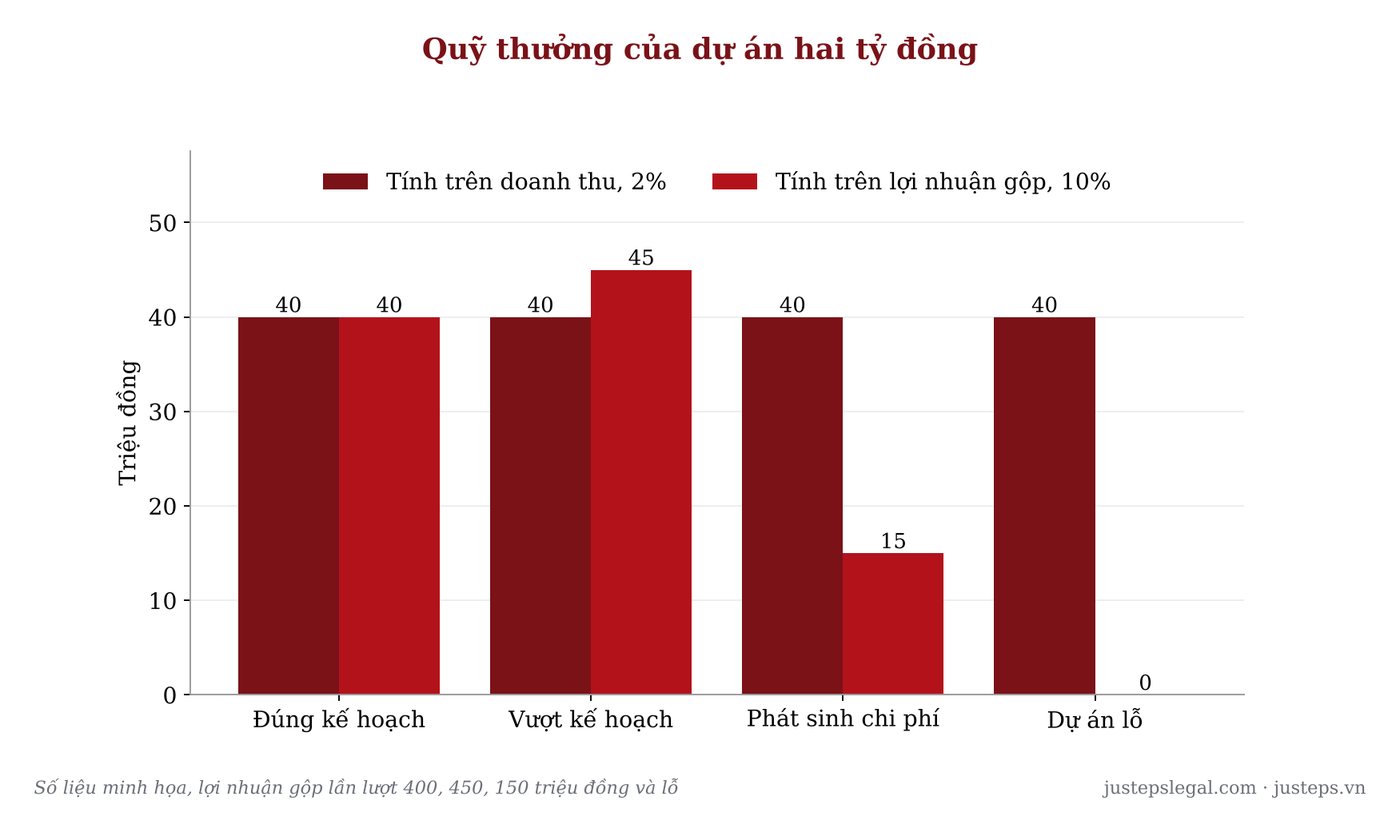
Bonus pool of the same project under two calculation methods in four outcome scenarios
When the project exceeds the plan, the pool calculated on profit increases and properly recognises the team’s effort. When additional costs reduce gross profit to only one hundred and fifty million dong, the pool calculated on profit falls to fifteen million dong, whereas the pool calculated on revenue remains at forty million dong. In the loss scenario, the pool calculated on profit is zero, while the revenue-based method forces the business to pay a bonus for a project that has lost money. The figures are only an illustrative example, but they show why the regulations should tie the pool to profit and clearly specify how the accounting department determines the direct costs of the project.
Conditions for releasing the bonus pool
Profit in the books is not yet money in the bank, so the regulations need to set out the conditions that must be met before the bonus pool is paid. Commonly used conditions are that the client has signed the acceptance record, that the company has collected a certain percentage of the contract value, for example eighty per cent, and that there is no pending quality complaint. For projects lasting several months, the business may advance part of the pool for each accepted phase and retain the remainder until the warranty period ends or payment is collected in full. This approach means employees do not have to wait too long, while the business still keeps a reserve for risks arising after handover.
Dividing the pool by role and contribution
Once the pool has been determined, the most difficult part is dividing it among the members in a way that is fair and can be explained. A common method is to assign coefficients by role, for example a coefficient of two for the project manager, one point five for key members and one for supporting members, and then multiply them by contribution scores given by the project manager and approved by the director. The list of members and their coefficients should be finalised as soon as the project is opened to avoid later arguments, and people who do not work on the project full time are counted in proportion to the time they actually spend on it. The regulations should also state clearly whether an employee who resigns or moves to another project midway is entitled to the corresponding share of the bonus, because this is a point that often gives rise to complaints.
Annual cap on bonus costs
When many projects end at the same time at the end of the year, total project bonuses may exceed the business’s ability to pay if there is no overall limit. The business should set a cap on the total project bonus pool for the year as a percentage of planned profit before tax, or limit the maximum bonus for each person to a certain number of months’ salary. The cap should be written into the regulations and tracked cumulatively by the accounting department every month, so that when it is close to being reached, the board of management has time to adjust rather than discovering the problem at the time of payment.
A control framework for spot bonuses
Spot bonuses are valuable because they are awarded quickly, but that very speed easily leads to arbitrariness if there is no framework. The regulations should list the types of achievement eligible for a spot bonus, such as saving a contract that was at risk of cancellation, detecting an error that could have caused major loss, proposing a cost-saving initiative that has been put into practice, or resolving an incident outside working hours so that the client suffers no disruption. This list helps employees understand which behaviour the business values, and it gives approvers a basis for rejecting unsuitable proposals.
Bonus amounts should be divided into three or four fixed tiers, for example one, three, five and ten million dong, linked to the level of impact of the achievement. The proposer only chooses the tier and describes the achievement without proposing an amount, which avoids a situation in which the same type of achievement is rewarded at a different level by each department. Each head of department is given a quarterly spot bonus limit, and every proposal that exceeds the tier within his or her authority or exceeds the limit must be submitted to the director. The matrix below illustrates how approval authority can be allocated by bonus tier.
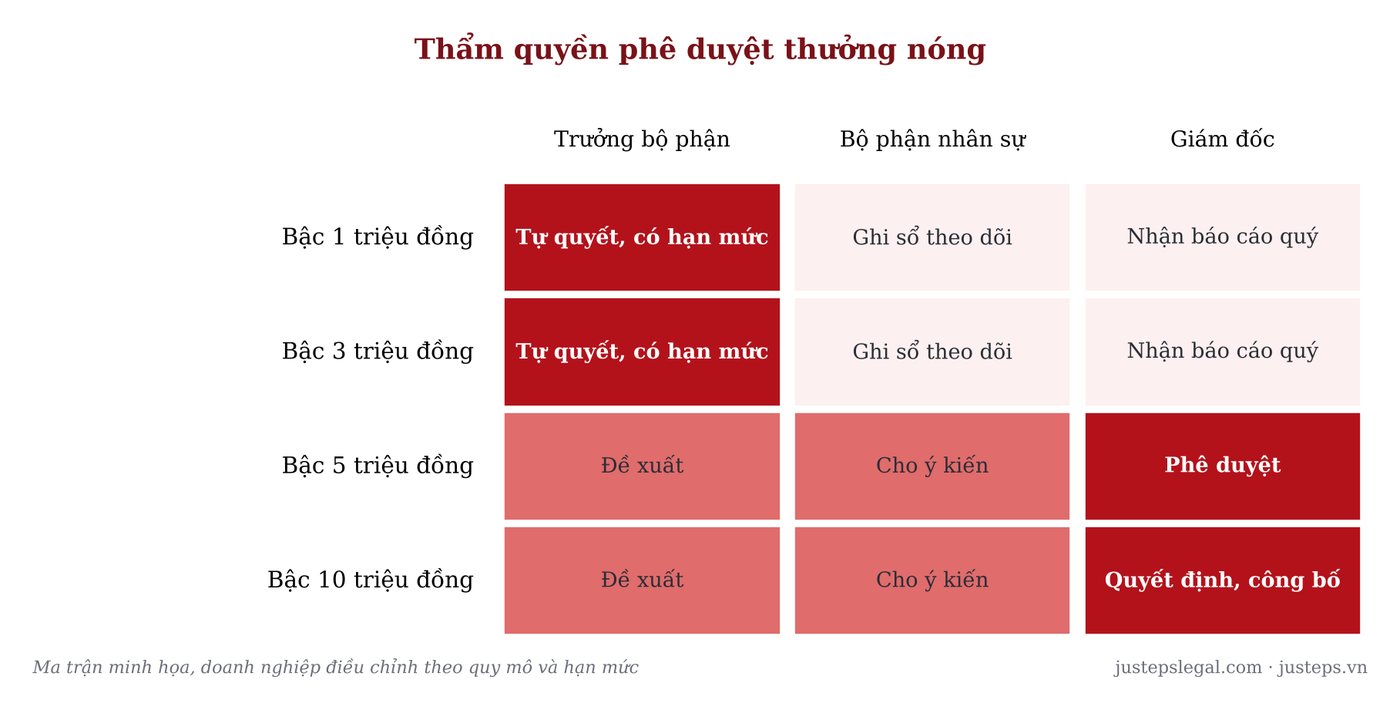
Allocation of approval authority for spot bonuses by bonus tier
In the example in the matrix, the head of department may decide the two lower tiers alone within the quarterly limit, while the five million dong tier also requires the opinion of the human resources department to ensure consistency between departments. The highest tier is decided by the director and should be announced widely within the company to maximise the recognition effect. Every award requires a proposal form recording the achievement, the bonus tier, the proposer and the decision of the competent person, because this is the accounting document used for bookkeeping and also the basis for handling any complaint.
The business also needs to consider the side effects of spot bonuses. If it frequently rewards people who stay late or work at weekends, the business unintentionally encourages overtime instead of efficient work during working hours, and may also incur an obligation to pay overtime if that time has not been properly recorded. Spot bonuses should not be used as a substitute for adjusting the salary of employees who consistently perform well either, because a bonus that recurs regularly gradually takes on the character of a regular payment.
Issuing and publishing the bonus regulations
The bonus regulations are decided by the employer and made public at the workplace after consulting the grassroots employee representative organisation, where the workplace has such an organisation[2]. Accordingly, the business has the right to decide the content itself, but must carry out two procedures, namely consultation where a representative organisation exists and public disclosure. Failing to make the bonus regulations public or failing to consult the employee representative organisation when drawing up the regulations may result in a fine, and the fine for an organisation is twice that for an individual[3]. In addition, when a matter relating to the bonus regulations arises, the employer must also organise dialogue at the workplace in accordance with the Labour Code[4].
Project bonuses and spot bonuses may be set out in the general salary and bonus regulations or in separate regulations, provided that they are issued by the competent person in accordance with the company’s charter and internal management regulations. The employment contracts of project-based positions should refer to the bonus regulations rather than fixing a specific bonus amount, so that the business can adjust the regulations without signing a new annex with each person. When amending the regulations, the business must also repeat the consultation and publication procedures and state clearly from which date the new regulations apply to newly opened projects.
Limits when the business faces financial difficulty and when handling violations
For limited liability companies, the Law on Enterprises provides that managers must not increase salaries or pay bonuses when the company is unable to pay its debts in full as they fall due[5]. The regulations should therefore include a provision allowing bonus payments to be deferred when the company has payment difficulties, and the accounting department should check the status of debts falling due before submitting large bonuses for approval. Another limit is that a business must not impose fines or cut wages in place of labour discipline[6]. Conditions for not receiving a bonus should therefore be designed as eligibility conditions, for example the project failing to meet quality standards or the employee failing to complete the assigned work, rather than as a bonus deduction to penalise a disciplinary violation.
Social insurance, tax and deductible expenses
Under the Law on Social Insurance, the salary used as the basis for compulsory social insurance contributions comprises the salary for the job or title, salary allowances and other additional amounts agreed to be paid regularly and stably in each pay period[7]. A bonus based on the results of a project or a specific achievement, which is not fixed and is not paid regularly every month, in principle does not form part of the salary subject to social insurance contributions. However, if an amount called a project bonus is paid every month as an almost unchanged fixed sum, the social insurance authority may regard it as an additional amount paid regularly and require back contributions. The regulations and the employment contract need to describe the nature of the bonus correctly, and the actual method of payment must reflect that nature.
As regards personal income tax, bonuses in cash or in kind are taxable income from salaries and wages[8]. For employees with an employment contract of three months or more, the bonus is added to the income of the payment period and tax is withheld according to the progressive tax schedule, while for individuals without an employment contract or with a contract of less than three months, the business withholds ten per cent on each payment of five million dong or more[9]. This point is especially important for project-based businesses, because project teams often include both freelancers and external specialists. Bonuses in kind, such as telephones or travel vouchers, must also be converted into money for tax purposes.
As regards corporate income tax, salaries, wages and other amounts recorded as payable to employees but not actually paid, or without payment documents, are not deductible expenses[10]. In addition, an expense of five million dong or more per payment is deductible only if it is supported by non-cash payment documents[11]. Bonuses should therefore be transferred to the employee’s bank account, together with the regulations, the bonus decision and the calculation sheet. A business wishing to re-check all of its bonus documents before the tax finalisation period may refer to Justeps’ service on reviewing deductible expenses and corporate income tax finalisation.
| Area | Requirements the business must meet |
|---|---|
| Bonus regulations | Issued by the competent person, with consultation of the employee representative organisation where one exists, and made public before being applied. |
| Social insurance | The bonus is tied to results, is not paid as a fixed monthly sum and is described according to its true nature in the regulations and contracts. |
| Personal income tax | Added to the income of the payment period for persons with contracts of three months or more, with ten per cent withheld for freelancers on payments of five million dong or more. |
| Deductible expenses | Supported by a bonus decision, a calculation sheet, documents of actual payment and non-cash payment documents for amounts of five million dong or more. |
The project bonus payment procedure
A clear procedure ensures that every project bonus has a basis, a responsible person and complete documents from the opening of the project to the payment. The procedure should be set out in the regulations or in an annex to them, with a form for each step. The flowchart below describes a reference sequence.
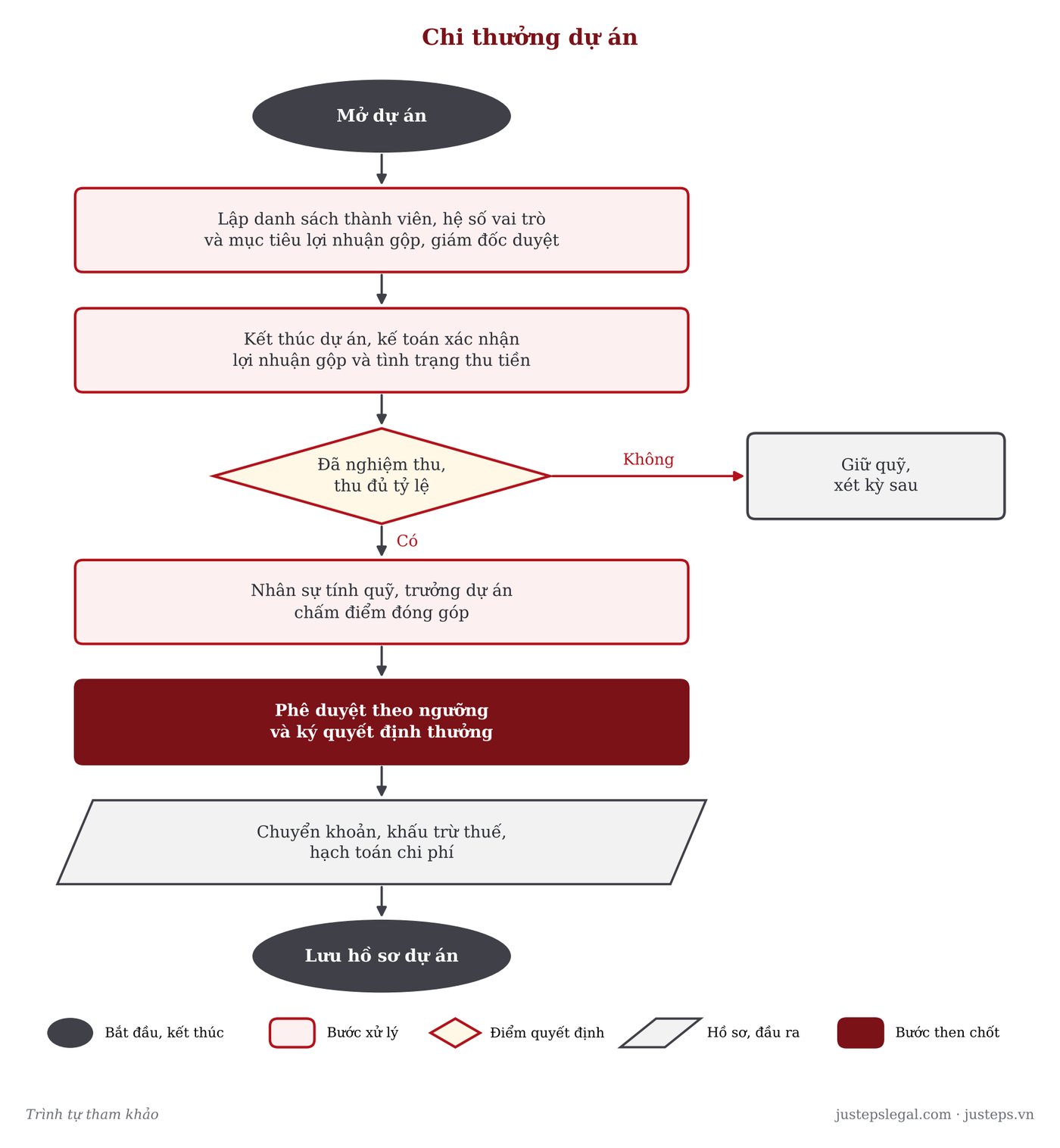
Sequence for paying a project bonus from opening the project to filing the records
When the project is opened, the project manager prepares the list of members, role coefficients and the gross profit target for the director’s approval, and this is the point at which the project team knows exactly how it will be rewarded. When the project ends, the accounting department confirms the actual gross profit and the status of payment collection, and if the conditions for releasing the pool are not yet met, the pool is retained and reconsidered in the following period. Once the conditions are met, the human resources department calculates the pool, the project manager scores contributions, and the director or the bonus review committee approves according to value thresholds and signs the decision. The final step is for the accounting department to make the bank transfer, withhold personal income tax, record the entries and file the project’s set of records.
The minimum set of records for each project comprises the published bonus regulations, the decision opening the project with the list of members and coefficients, the actual gross profit report, the acceptance record and confirmation of payment collection, the pool calculation sheet, the contribution scoring sheet, the bonus decision and the bank transfer documents. For spot bonuses, the records comprise the approved proposal form, the bonus decision and the payment documents. The accounting department should keep a spot bonus register by department to compare against the quarterly limits and to detect early any concentration of bonuses on a few people.
Common mistakes when paying bonuses
Most disputes and risks relating to bonuses in small and medium-sized enterprises arise not from bonuses being too high or too low, but from a lack of basis and a lack of consistency between what was promised, the regulations and the way payments are actually made. Businesses commonly make the following mistakes:
- Managers promise bonuses orally or by text message before any regulations exist, leading to disputes when the amount actually paid differs from the promise.
- The bonus pool is calculated on contract revenue, so a project that made a loss or has not yet been paid for still carries a full bonus.
- Bonuses are paid in cash, which makes payments of five million dong or more difficult to deduct at tax finalisation.
- The business forgets to withhold personal income tax for freelancers and external specialists in the project team.
- A fixed monthly payment is labelled a bonus to reduce social insurance contributions, creating a risk of having to pay back contributions.
- The regulations do not deal with employees who leave before the pool is paid, so each case is handled differently.
To remedy this, the business should review its existing regulations against three questions, namely which result the bonus is tied to, from which source it is calculated and who has the authority to decide at which level. If the regulations cannot answer all three questions, the business should amend them before the year-end project settlement season begins. A business that needs support in building a consistent salary scale, payroll table and bonus regulations may refer to Justeps’ service on building salary scales, payroll tables and salary and bonus regulations.
How Justeps can help
Justeps supports businesses in designing and operating project bonus and spot bonus policies through the following services:
- Building salary scales, payroll tables and salary and bonus regulations. Justeps designs the project bonus pool formula and the spot bonus tier framework and drafts bonus regulations suited to the business model.
- Financial regulations and delegation of authority. Justeps sets approval thresholds, the bonus limits of each management level and the annual cap on bonus costs.
- Labour records and employment contracts. Justeps reviews employment contracts to separate bonuses from additional amounts paid regularly and to refer correctly to the regulations.
- Review of deductible expenses and corporate income tax finalisation. Justeps checks bonus decisions, calculation sheets and payment documents so that the expense meets the conditions for deduction.
- KPI systems and performance assessment. Justeps builds criteria for scoring contributions within a project so that the bonus pool is divided fairly and in a way that can be explained.
Frequently asked questions
Is a business required to have project bonus regulations?
The law does not require a business to pay project bonuses, but once a bonus scheme exists, the bonus regulations must be made public at the workplace[2]. The regulations are also the basis for substantiating the expense at tax finalisation and for handling employee complaints.
Are project bonuses subject to social insurance contributions?
A bonus tied to results and not paid regularly and stably in each pay period in principle does not form part of the salary subject to social insurance contributions[7]. The business needs to describe this nature correctly in the regulations and contracts and pay exactly as described.
Must tax be withheld on spot bonuses paid to freelancers?
Yes, for individuals without an employment contract or with a contract of less than three months, the business withholds ten per cent on each payment of five million dong or more[9]. Amounts below five million dong need not be withheld unless the individual so requests, but they must still be declared.
Should spot bonuses be paid in cash to save time?
No, because an expense of five million dong or more per payment needs non-cash payment documents to be deductible for corporate income tax[11]. A bank transfer also gives the business clear evidence if an employee later complains.
Is an employee who leaves before the project bonus pool is divided entitled to a share?
The law has no specific provision, so entitlement depends on the published bonus regulations. The business should make this clear from the outset, for example by providing that an employee who resigns in accordance with the rules receives a share in proportion to the time of participation, while one who abandons the job receives nothing.
May the business deduct bonuses when an employee breaches labour discipline?
A business must not impose fines or cut wages in place of labour discipline[6]. The regulations should design the eligibility criteria for receiving a bonus around work results, while disciplinary violations are handled under the internal labour rules.
May a company with cash flow difficulties defer bonus payments?
For limited liability companies, managers must not pay bonuses when the company is unable to pay its debts in full as they fall due[5]. The regulations should include a provision deferring bonus payments in this case and state clearly when the matter will be reconsidered.
Related articles
- Building an employee allowance policy that complies with the law and keeps costs under control
- Five common pay models and how a business can choose the right one for each group of positions
- Project and matrix organisational structures, when to adopt them and how to run them
- The annual pay review process, from criteria, budget and merit matrix to records and employee notification
Notes
[1] Clause 1, Article 104 of the Labour Code No. 45/2019/QH14 dated 20 November 2019.
[2] Clause 2, Article 104 of the Labour Code No. 45/2019/QH14.
[3] Points a and c, Clause 1, Article 23 and Clause 1, Article 7 of Decree No. 283/2026/ND-CP dated 15 July 2026 on administrative penalties for violations in the fields of labour and social insurance.
[4] Point c, Clause 2, Article 63 of the Labour Code No. 45/2019/QH14.
[5] Clause 2, Article 71 of the Law on Enterprises No. 59/2020/QH14 dated 17 June 2020, as amended and supplemented by Law No. 76/2025/QH15.
[6] Clause 2, Article 127 of the Labour Code No. 45/2019/QH14.
[7] Clause 1, Article 31 of the Law on Social Insurance No. 41/2024/QH15 dated 29 June 2024.
[8] Point i, Clause 2, Article 8 of Decree No. 253/2026/ND-CP dated 30 June 2026 detailing the Law on Personal Income Tax.
[9] Clauses 1 and 2, Article 50 of Decree No. 253/2026/ND-CP dated 30 June 2026.
[10] Point h, Clause 2, Article 9 of the Law on Corporate Income Tax No. 67/2025/QH15 dated 14 June 2025.
[11] Point c, Clause 1, Article 9 of Decree No. 320/2025/ND-CP dated 15 December 2025 detailing the Law on Corporate Income Tax.
This article is for reference and reflects the regulations in force at the time of publication. Please consult Justeps for advice tailored to your company’s records and situation.
For further information, please contact:
📩 Email: info@justeps.vn
🌐 Website: https://justepslegal.com · https://justeps.vn
🌐 Page: Justeps
☎️ Hotline (Zalo): 096 172 2607
📍 Thanh Xuan Office: 12th Floor, Licogi 13 Tower, 164 Khuat Duy Tien Street, Thanh Xuan Ward, Hanoi, Vietnam
📍 Ha Dong Office: LK06B, No.10, Dong Dua Area, Ha Dong Ward, Hanoi, Vietnam
📍 Ho Chi Minh City Branch: 528 Le Van Sy, Ho Chi Minh City, Vietnam
📍 Hai Phong Office: Truong Thinh Village, Ha Dong Commune, Hai Phong, Vietnam
📍 Quang Ninh Office: Van Don Special Zone, Quang Ninh Province, Vietnam





