
Key takeaways
- From 2026, household businesses are taxed on income and enterprises with the same turnover are subject to the same rates on income, so tax is no longer the main reason to remain a household business.
- A household business suits an individual or a family trading on a small scale, mainly selling to consumers; the head of the household is liable with all of his or her assets.
- A limited liability company suits a single owner or a small group of investors who want tight control over transfers, while a joint stock company is needed where the business plans to raise capital, set up an employee share plan or bring in foreign investors.
- The business form can be converted as the business grows, but each conversion involves registration, invoicing, contractual and employment formalities, so the business should choose the form that fits its plans for the next three to five years.
When starting out, many people choose a business form on the advice of acquaintances or on the basis of whichever application is easiest to prepare, and only discover its limitations once trading is under way. A shop registered as a household business may lose corporate customers because it cannot issue value added tax invoices, two friends who invest together in a household business have no way of recording the share owned by the one who is not the registered holder, and a small joint stock company must hold meetings, keep minutes and maintain a register of shareholders even though it has only three family members. All of these problems can be avoided if the business form is chosen on the basis of a business plan rather than habit.
This article compares the three forms most commonly used by domestic business owners, namely the household business, the limited liability company (an LLC) and the joint stock company, in terms of legal status, liability for debts, formalities and running costs, tax, governance, employment and the ability to raise capital. The tax analysis reflects the policy applicable from 2026, following the abolition of presumptive tax and the business licence fee. It is written primarily for people preparing to start a business, heads of household businesses considering incorporation and owners of small companies who wish to reassess their business form before expanding.
Legal status and liability for debts under each business form
A household business is registered by an individual or by members of a household and does not have legal personality, so the head of the household is liable for the business’s activities with all of his or her assets[1]. Accordingly, where a household business cannot pay its suppliers or must compensate a customer, creditors may seek enforcement against the owner’s house, car and savings accounts, and are not limited to the assets used in the business. Where members of a household register together, they are jointly liable in accordance with their agreement and the provisions of the Civil Code on households.
By contrast, an LLC and a joint stock company are legal entities with their own assets, and their owners are liable only to the extent of the capital they have contributed or undertaken to contribute[2][3]. This boundary has real value when the company faces a major risk such as a failed contract, a product incident or a tax debt, because losses exceeding the company’s assets do not pass to the owners’ personal assets. However, when borrowing from a bank, owners of small companies are often required to give personal guarantees backed by their own assets, so the advantage of limited liability is fully realised only in respect of unsecured debts. Company owners should also keep the company’s accounts and spending separate from personal spending, because using company funds for private purposes may be dealt with for tax purposes and may give rise to personal liability.
The table below summarises the basic legal differences between the three forms, from legal status and number of owners to the means of raising capital and transferring ownership:
| Criterion | Household business | LLC | Joint stock company |
|---|---|---|---|
| Legal status | Has no legal personality. | Has legal personality from the date the enterprise registration certificate is issued. | Has legal personality from the date the enterprise registration certificate is issued. |
| Owners | An individual or members of a household who are Vietnamese citizens. | One organisation or individual, or between 2 and 50 members. | At least 3 shareholders, with no maximum number. |
| Liability | The head of the household is liable with all of his or her assets. | Limited to the capital contributed or undertaken to be contributed. | Limited to the capital contributed to the company. |
| Raising capital | Only through the owner’s own capital and borrowing. | Admitting new members or issuing bonds privately; may not issue shares. | Issuing shares and bonds, with public offerings possible once the conditions are met. |
| Transfer of ownership | There is no capital interest to transfer; a change of owner requires re-registration. | A member must first offer the interest to the other members. | Shares are freely transferable, subject to certain statutory restrictions. |
| Management structure | The head of the household runs the business. | The owner or the Members’ Council, and a director. | General Meeting of Shareholders, Board of Directors, director, and possibly a Supervisory Board. |
Formation procedures and annual running costs
A household business is registered with the commune-level business registration authority using a simple application consisting of a request form and the owner’s identity documents, while a company is registered with the provincial business registration authority and must submit a charter and a list of members or founding shareholders[4]. Both procedures are processed quickly, so the real difference lies in the running costs after registration. From 1 January 2026, neither household businesses nor enterprises are required to pay the business licence fee[5], so the main fixed annual costs are accounting, electronic invoicing and digital signatures.
An enterprise must organise its accounting function, appoint an accountant or engage an accounting service, prepare and file annual financial statements and finalise corporate income tax each year[6]. The requirements for household businesses are simpler, but from 2026 households with turnover above the tax-free threshold must also self-declare on the basis of actual turnover, and households with turnover above VND 1 billion must use electronic invoices bearing a tax authority code or generated from a cash register[7]. As a result, the cost gap between a household business with turnover of several billion dong and a small company has narrowed considerably compared with the past.
In addition to accounting, a company has internal governance obligations that a household business does not, such as maintaining a register of members or shareholders, preparing minutes and resolutions when deciding important matters, notifying changes to its enterprise registration details and updating beneficial ownership information. For a single-member LLC owned by an individual, these formalities are fairly light because the owner takes decisions in writing alone. For a joint stock company, convening and holding the annual General Meeting of Shareholders, holding Board meetings and keeping records in the correct sequence require considerably more effort, especially where shareholders are not directly involved in management.
The following matrix compares each form against five operational criteria that business owners commonly consider when making their choice.
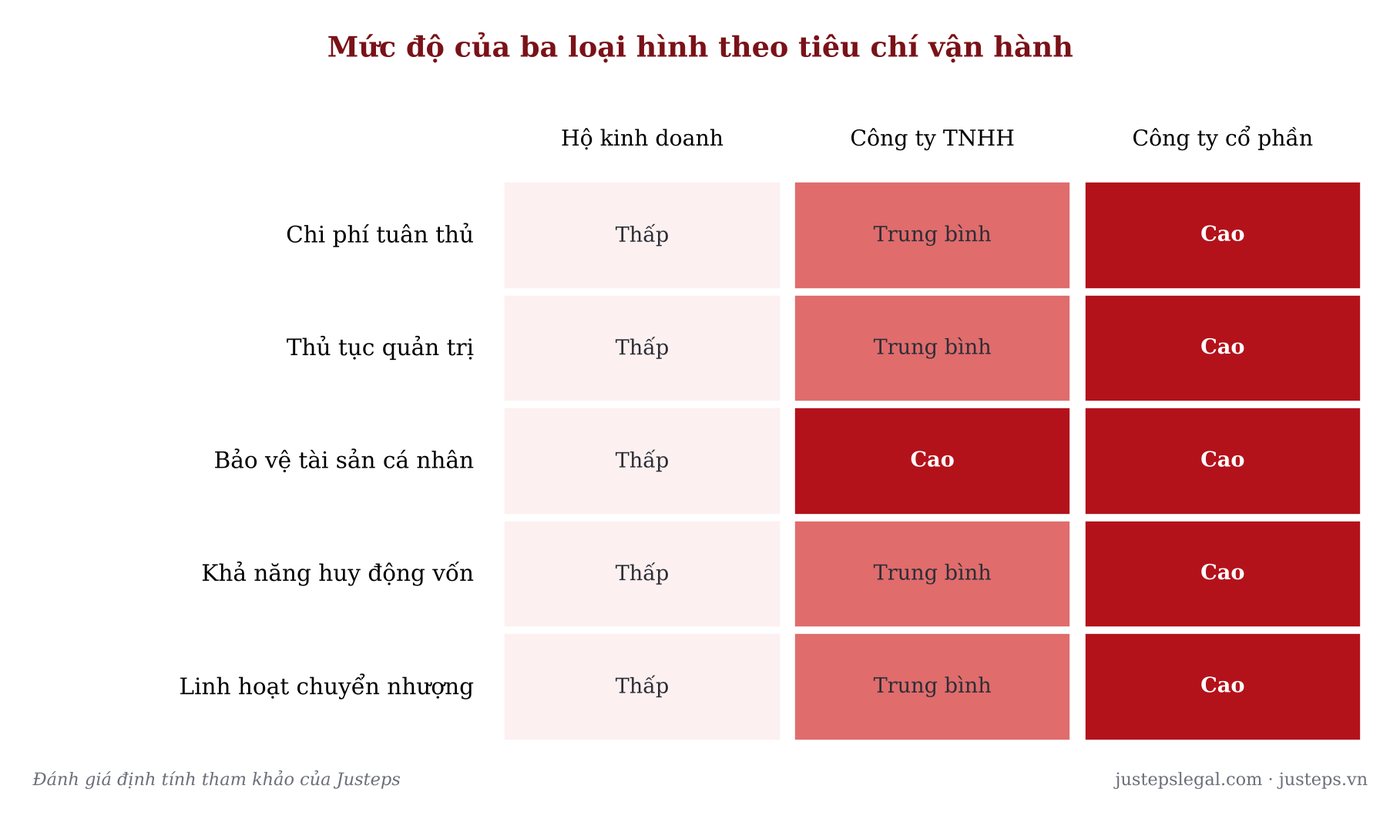
Comparison of the three business forms against five operational criteria
A household business has the lowest compliance costs and governance formalities, but also the lowest protection of personal assets and the lowest ability to raise capital. A joint stock company sits at the opposite end, with the greatest ability to raise capital and the heaviest governance formalities, while an LLC sits in between and suits most small and medium-sized businesses. As regards standing with counterparties, corporate customers, banks and state authorities generally regard LLCs and joint stock companies as equivalent, so business owners need not choose a joint stock company merely for reasons of image.
Tax applicable to household businesses and enterprises from 2026
Tax on household businesses
From 1 January 2026, the presumptive tax method has been abolished and household businesses self-declare and pay tax on the basis of actual turnover[5]. Under Decree 68/2026/ND-CP, as amended by Decree 141/2026/ND-CP, household businesses with annual turnover of VND 1 billion or less are not required to pay value added tax or personal income tax[7]. Households with turnover above that threshold and up to VND 3 billion may choose either to pay tax at a rate applied to the turnover above the threshold, depending on the business line, or to pay 15% on income, being turnover less expenses, while households with turnover above VND 3 billion and up to VND 50 billion, and above VND 50 billion, must pay on income at 17% and 20% respectively[8]. The chosen method must be retained for at least two years, and expenses are deductible only if supported by valid invoices and documents.
Tax on companies
LLCs and joint stock companies pay corporate income tax under the same rules, at 15% for enterprises with total annual turnover not exceeding VND 3 billion, 17% for turnover above VND 3 billion and up to VND 50 billion, and 20% in all other cases[9]. Enterprises with total annual turnover of VND 1 billion or less are exempt from corporate income tax under Decree 141/2026/ND-CP, except in certain cases involving subsidiaries or associates of enterprises that do not meet the conditions[7]. In addition, small and medium-sized enterprises are exempt from corporate income tax for three years from the date on which they are first issued an enterprise registration certificate[5], an incentive worth considering for profitable household businesses preparing to convert.
The following chart compares the tax rates on income applicable to household businesses that elect to be taxed on income and to enterprises, by annual turnover band.
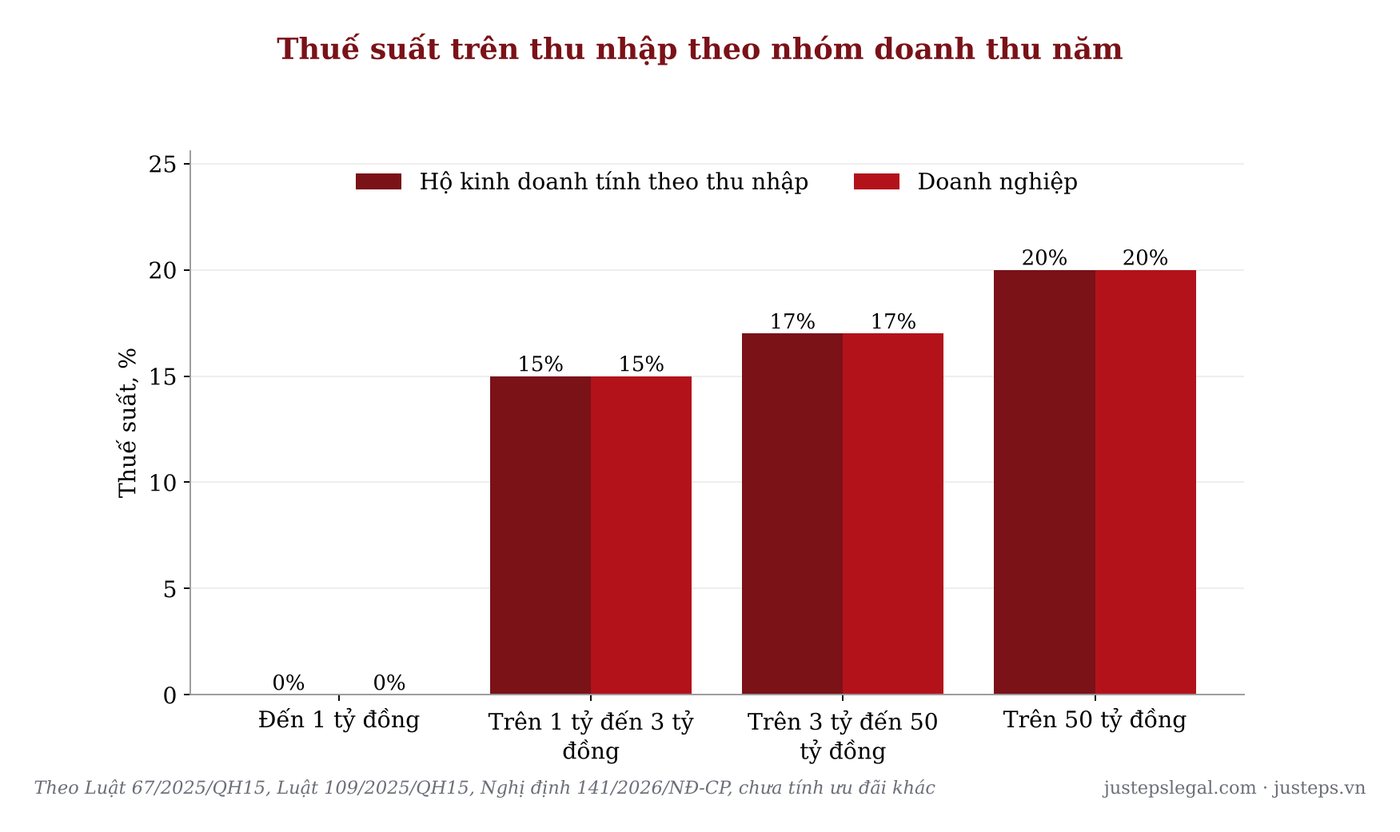
Tax rates on income for household businesses and enterprises by annual turnover band
In all four turnover bands, the rate on income is the same for household businesses and enterprises, ranging from 0% for the band below VND 1 billion to 20% for the band above VND 50 billion. The tax differences between the two models therefore arise mainly from three other factors, namely the method of calculating value added tax, the ability to deduct expenses and the tax payable when the owner withdraws profits. Enterprises that meet the conditions may pay value added tax under the credit method and issue value added tax invoices, allowing corporate customers to claim input tax credits, whereas household businesses pay at a percentage of turnover and issue sales invoices. Conversely, when a company distributes dividends or profits to an individual owner, those profits are also subject to personal income tax on income from capital investment[8], whereas the income of the head of a household business is taxed only once.
One point that is often overlooked is the owner’s salary. The owner of a single-member LLC or a shareholder who works directly in the business may receive a salary from the company, which is a deductible expense where there is a contract, supporting documents and insurance contributions as required, and is subject to personal income tax on employment income with family circumstance deductions. A household business cannot deduct remuneration paid to the head of the household, so for the same level of profit, the split between salary and profit in a company may produce a different tax result. Businesses should prepare a comparative calculation for their own model before deciding, rather than relying on general assumptions.
Raising capital and admitting co-investors
A household business has no mechanism for recording the ownership share of an investor who is not a member of the household, so when two friends contribute money together, only the person registered as head of the household is recognised by law. The other investor can rely only on a separate civil agreement, which is difficult to prove and difficult to enforce if a dispute arises. A household business also cannot accept capital from investors, including foreign investors, and can expand only with its own funds or borrowing.
An LLC with two or more members can increase its capital by increasing members’ contributions or admitting new members, up to a maximum of 50 members, and may issue bonds privately but may not issue shares, except where it converts into a joint stock company[2][10]. This limitation suits family businesses or small groups of investors who want to retain control, because a member who wishes to sell a capital interest must first offer it to the other members. A joint stock company is more flexible, being able to offer shares privately to investors, establish an employee share option plan (ESOP), issue convertible bonds and, once the conditions are met, make a public offering[3].
Venture capital investors and investment funds generally invest only in joint stock companies, because the share structure allows them to receive classes of preference shares, value the company round by round and exit by selling shares. Where the investor is foreign, the capital contribution or share purchase must also satisfy market access conditions and procedures under the Law on Investment[11]. Businesses planning to raise capital within the next two to three years should therefore consider establishing a joint stock company from the outset or allowing time for conversion before negotiating with investors.
Internal governance and decision-making
In a single-member LLC, the owner decides all major matters and may act as director or appoint someone to manage the business, so this model is close to the way a household business operates while still having legal personality. In an LLC with two or more members, the Members’ Council is the highest decision-making body; ordinary resolutions require the approval of members holding at least 65% of the capital of the members attending, while matters such as selling assets worth 50% or more of total assets, amending the charter, reorganisation or dissolution require at least 75%[12]. A member holding more than 35% of the capital therefore has a de facto veto over most decisions, which the parties need to take into account before agreeing their contribution ratios.
A joint stock company has a multi-tier structure comprising the General Meeting of Shareholders, a Board of Directors of 3 to 11 members, a director or general director, and a Supervisory Board unless the company has fewer than 11 shareholders and corporate shareholders hold less than 50% of the total shares[13]. This model clearly separates ownership from management and is suitable where there are many shareholders who do not work in the company or where investors need a channel for oversight. In a joint stock company made up of only a few family members, this structure can easily become a formality if meetings are not held properly, and deficient meeting records may lead to resolutions being challenged for annulment if a dispute arises.
Whichever form is chosen, the owner should adopt a minimum set of internal rules at an early stage, such as signing authority, spending limits and approval procedures. The move from a household business to a company is a good moment to separate the roles of owner and manager and to assign clear authority to the accountant, the store manager and the person in charge of sales. Businesses may consider Justeps’ organisational design for household businesses converting into enterprises to design a structure suited to their size.
Employment, insurance and conditional business lines
Obligations towards employees do not depend on the business form, because a household business that hires workers is also an employer under the Labour Code[14]. Household businesses and companies alike must enter into written or electronic employment contracts, pay no less than the regional minimum wage and make compulsory social insurance contributions for employees who are subject to them. From 1 January 2027, the monthly minimum wage is VND 5,700,000 in Region I, VND 5,080,000 in Region II, VND 4,450,000 in Region III and VND 4,040,000 in Region IV[15]. The 2024 Law on Social Insurance also extends compulsory participation to registered heads of household businesses in accordance with Government regulations[16], so the belief that household businesses do not need to pay insurance is no longer correct.
Some business lines are licensed only to enterprises; for example, travel services must be provided by an enterprise that meets the deposit requirements[17]. Many project owners, retail chains and exporters also contract only with suppliers that are enterprises, because they need value added tax invoices and a clear capability profile. Before registering, business owners should therefore check whether the intended business line imposes conditions on the type of entity, and what target customers require in terms of invoices and contracts.
When a household business converts into a company, employees working for the household should sign new employment contracts with the company, and the parties should agree how prior service will be recognised in order to avoid disputes over seniority and severance allowances. Conversion is also an opportunity to review the pay scale, internal labour rules and insurance contribution levels, for example through Justeps’ labour, payroll and insurance services for household businesses converting into enterprises.
Choosing a business form by stage of growth and the conversion path
No single business form is best in every case, so the sensible approach is to work through a series of questions in order of priority. The sequence below takes business owners from the need to separate personal assets to the number of owners and plans for raising capital in order to choose a suitable form.
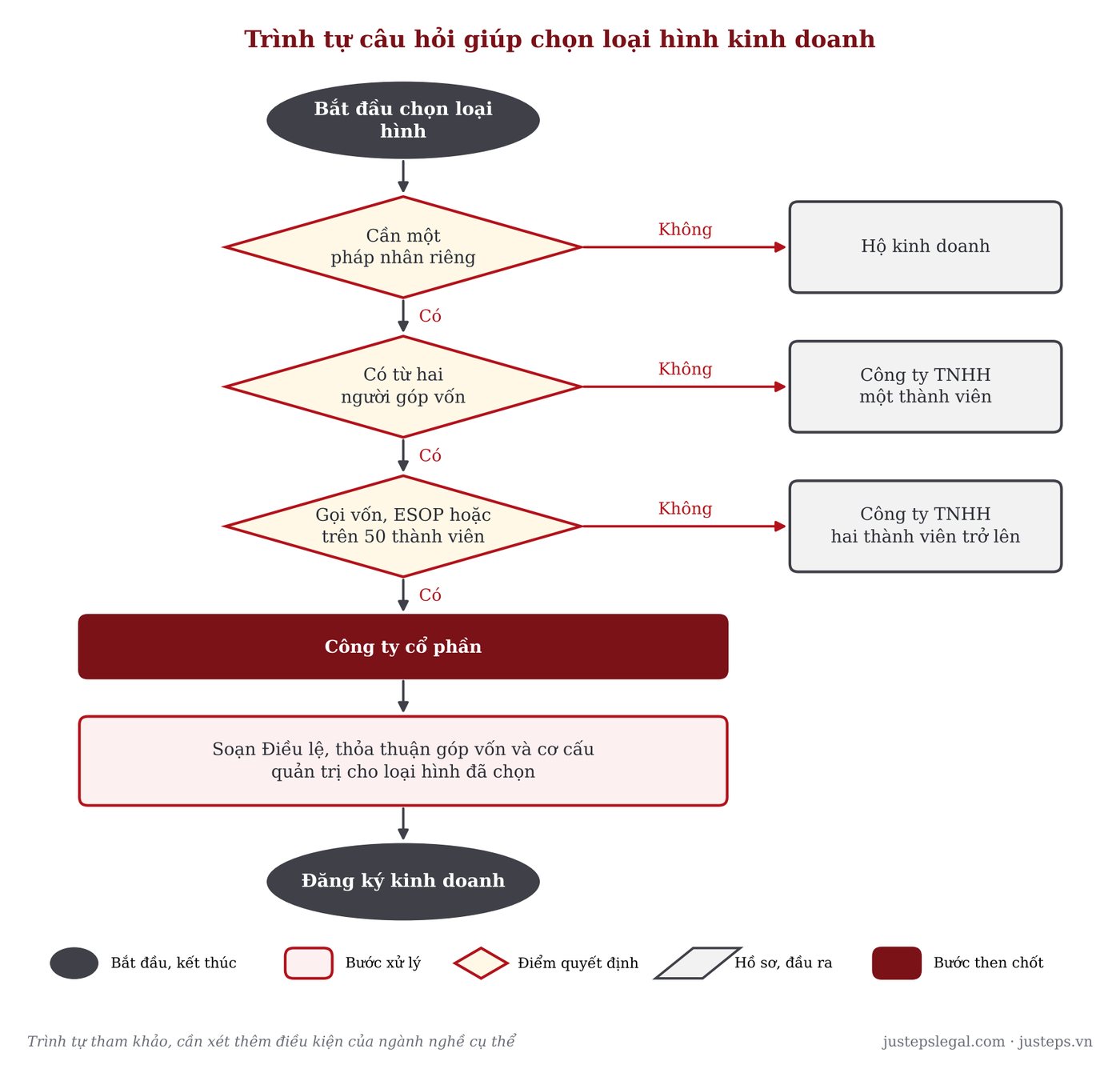
Sequence of questions to help choose a business form
The first question is whether a separate legal entity is needed, arising from the need to separate personal assets from business risk or from the requirements of corporate customers, and if the answer is no, a household business is usually sufficient. If a legal entity is needed, the next question is the number of owners, since a sole owner suits a single-member LLC. Where there are two or more investors, plans to raise capital, establish an ESOP or exceed 50 members decide between an LLC with two or more members and a joint stock company. Whatever the result, the next step is to draft a charter and a capital contribution agreement suited to the chosen form before registration.
The chosen form is not fixed, because a household business may register an enterprise on the basis of conversion, and the State encourages such conversion through support policies for small and medium-sized enterprises[18]. An LLC may convert into a joint stock company, in which case the converted company inherits all rights, obligations, contracts and employees of the former company without having to be newly established[19]. However, each conversion requires updating seals, invoices, bank accounts, customer contracts and sub-licences, so choosing correctly from the outset still saves costs.
The indicative path below shows how a business can move from a household business to a joint stock company as its size and capital needs grow.
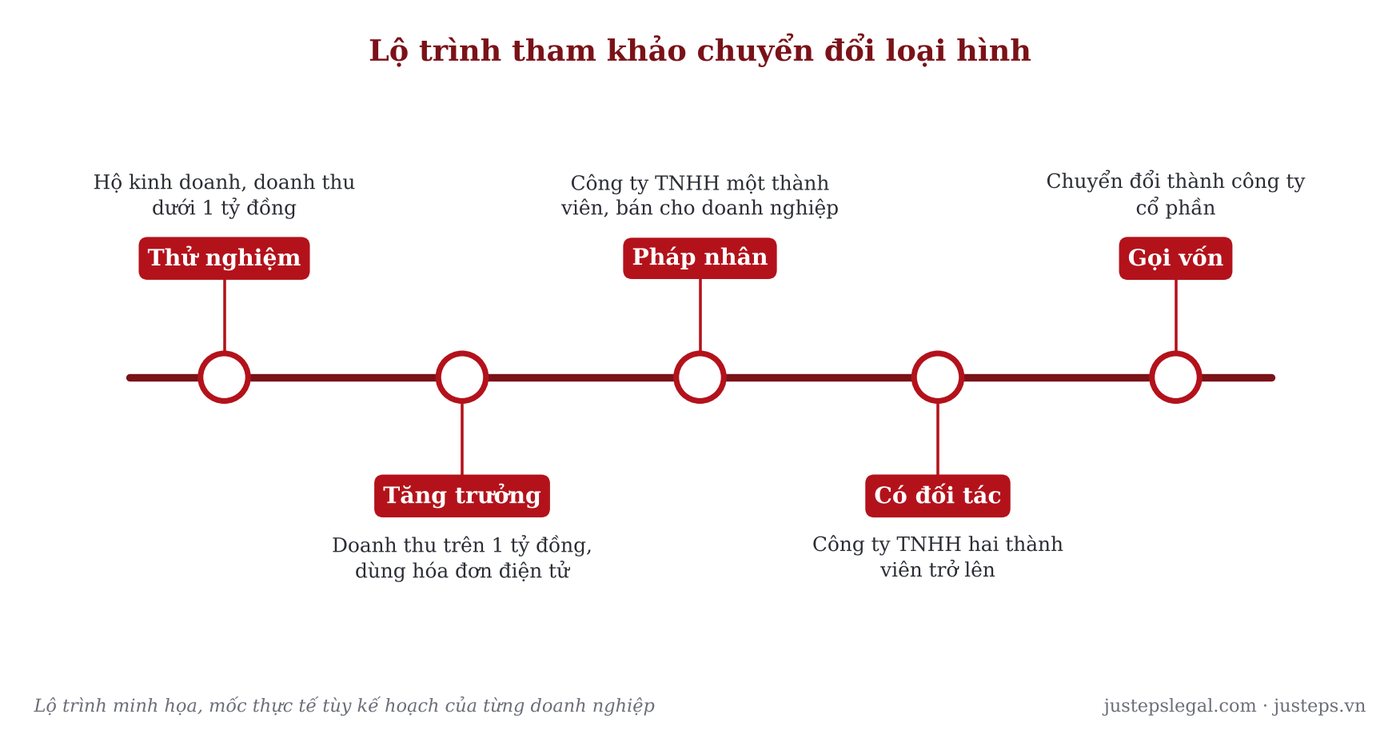
Indicative path for converting the business form as the business grows
At the trial stage, a household business allows the product to be tested at low cost. Once turnover exceeds VND 1 billion, the household must use electronic invoices and make full tax declarations, which is a sensible point to consider moving to a single-member LLC, especially when starting to sell to corporate customers. When co-investors join, the company moves to the two-or-more-member model, and when preparing to raise capital from investors, it converts into a joint stock company. These milestones are indicative only, as some businesses should start directly as a joint stock company if they have clear plans to raise capital from day one.
How Justeps can help
Justeps assists business owners in choosing a business form and converting into an enterprise through the following services:
- Company formation. Justeps compares business form options against the business plan and drafts the charter, the capital contribution agreement and the enterprise registration application.
- Organisational design for household businesses converting into enterprises. Justeps designs the management structure, delegation of authority and organisation chart when a household business converts into a company.
- Internal processes and regulations for household businesses converting into enterprises. Justeps drafts financial regulations, expenditure approval procedures and signing authority for newly converted companies.
- Labour, payroll and insurance services for household businesses converting into enterprises. Justeps transfers employment contracts to the company, builds pay scales and reviews insurance contribution levels.
- Corporate restructuring and tax optimisation. Justeps prepares a comparison of the tax obligations under each business form option and a lawful conversion path.
Frequently asked questions
Does a household business with annual turnover below VND 1 billion have to pay tax?
Under Decree 68/2026/ND-CP, as amended by Decree 141/2026/ND-CP, household businesses with annual turnover of VND 1 billion or less are not required to pay value added tax or personal income tax[7]. The household must still notify its turnover as instructed by the tax authority.
Can two friends jointly register a household business?
A household business may be registered only by an individual or by members of the same household[1], so two friends who are not members of the same household cannot register one jointly. In that case they should establish an LLC with two or more members so that each person’s contribution is recorded.
May an LLC sell shares to investors?
An LLC may not issue shares, except where it converts into a joint stock company[2]. The company may admit an investor as a new member or convert its business form before raising capital.
Must a joint stock company have a Supervisory Board?
A joint stock company is not required to have a Supervisory Board if it has fewer than 11 shareholders and corporate shareholders hold less than 50% of the total shares[13]. The company may also choose a model with an Audit Committee under the Board of Directors.
Are there tax incentives for converting a household business into a company?
Small and medium-sized enterprises are exempt from corporate income tax for three years from the date on which they are first issued an enterprise registration certificate[5]. Businesses should check the specific conditions of application in the implementing guidance before planning their tax position.
When an LLC converts into a joint stock company, must existing contracts be re-signed?
The converted company inherits all rights, obligations and contracts of the company being converted[19], so in principle they need not be re-signed. Nevertheless, the business should notify its counterparties and update its name and tax code on invoices and bank accounts.
Must a household business pay social insurance for its employees?
A household business that hires employees is an employer[14], so it must make compulsory social insurance contributions for employees who are subject to them, in the same way as an enterprise. Registered heads of household businesses are also subject to compulsory participation in accordance with Government regulations[16].
Related articles
- Setting up a company in Hanoi: documents required, processing time and what to do immediately after registration
- What a founders’ shareholders agreement should provide on governance, vesting, veto rights and exit
- Choosing a model for converting an agricultural processing cooperative into an enterprise and reorganising its governance
- Building internal financial regulations for a limited liability company, from approval authority to advances and their settlement
Notes
[1] Government Decree No. 168/2025/ND-CP on enterprise registration, provisions on the registration of household businesses.
[2] Articles 46 and 74 of the Law on Enterprises No. 59/2020/QH14 dated 17 June 2020, as amended and supplemented by Law No. 76/2025/QH15.
[3] Article 111 of the Law on Enterprises No. 59/2020/QH14.
[4] Decree No. 168/2025/ND-CP on enterprise registration, as amended and supplemented by Decree No. 296/2026/ND-CP.
[5] Resolution No. 198/2025/QH15 of the National Assembly dated 17 May 2025 on special mechanisms and policies for the development of the private economy.
[6] Law on Accounting No. 88/2015/QH13 dated 20 November 2015.
[7] Decree No. 68/2026/ND-CP dated 5 March 2026 on tax policy and tax administration for household businesses and individual traders, as amended and supplemented by Decree No. 141/2026/ND-CP.
[8] Law on Personal Income Tax No. 109/2025/QH15 dated 10 December 2025.
[9] Article 10 of the Law on Corporate Income Tax No. 67/2025/QH15.
[10] Article 68 of the Law on Enterprises No. 59/2020/QH14.
[11] Law on Investment No. 143/2025/QH15, provisions on investment by foreign investors in the form of capital contributions and share purchases.
[12] Article 59 of the Law on Enterprises No. 59/2020/QH14.
[13] Articles 137 and 154 of the Law on Enterprises No. 59/2020/QH14.
[14] Clause 2 of Article 3 of the Labour Code No. 45/2019/QH14 dated 20 November 2019.
[15] Decree No. 399/2026/ND-CP on the minimum wage for employees working under employment contracts, applicable from 1 January 2027.
[16] Article 2 of the Law on Social Insurance No. 41/2024/QH15 dated 29 June 2024.
[17] Article 31 of the Law on Tourism No. 09/2017/QH14 dated 19 June 2017.
[18] Article 16 of the Law on Support for Small and Medium-sized Enterprises No. 04/2017/QH14 dated 12 June 2017.
[19] Article 202 of the Law on Enterprises No. 59/2020/QH14.
This article is for reference and reflects the regulations in force at the time of publication. Please consult Justeps for advice tailored to your company’s records and situation.
For further information, please contact:
📩 Email: info@justeps.vn
🌐 Website: https://justepslegal.com · https://justeps.vn
🌐 Page: Justeps
☎️ Hotline (Zalo): 096 172 2607
📍 Thanh Xuan Office: 12th Floor, Licogi 13 Tower, 164 Khuat Duy Tien Street, Thanh Xuan Ward, Hanoi, Vietnam
📍 Ha Dong Office: LK06B, No.10, Dong Dua Area, Ha Dong Ward, Hanoi, Vietnam
📍 Ho Chi Minh City Branch: 528 Le Van Sy, Ho Chi Minh City, Vietnam
📍 Hai Phong Office: Truong Thinh Village, Ha Dong Commune, Hai Phong, Vietnam
📍 Quang Ninh Office: Van Don Special Zone, Quang Ninh Province, Vietnam





