
Key takeaways
- The right organisational model is the one that matches how the business generates revenue; a business with a single product line should usually keep a functional model until clearly distinct business units emerge.
- The organisation chart must be adopted by the body with authority under the Law on Enterprises and the charter, usually the Board of Directors, the Members’ Council or the owner, while the Director only proposes options.
- Division directors, regional directors and branch heads may sign contracts only within the scope of their letter of authorisation, so every change of model requires the delegation of authority matrix and the letters of authorisation to be updated.
- Changing the model changes employees’ jobs; any transfer, abolition of a position or dismissal must follow the procedures of the Labour Code to avoid being treated as an unlawful unilateral termination.
Many businesses keep the organisation chart they drew up on the day of incorporation even though their size and the way they sell have changed considerably. A distribution company adds a new product category but nobody is specifically responsible for the revenue of that category, a business with offices in three cities lets each office set its own selling prices, or a factory with several workshops allows each workshop to buy its own materials and so loses its bargaining power on price. These problems seldom stem from the ability of individual managers; they usually arise because the organisation chart no longer reflects where revenue and profit actually come from.
This article analyses four common organisation chart models, namely functional, product-based, regional and hybrid, including the matrix form. For each model, it explains how the model works, the conditions under which it is effective, the risks of applying it wrongly and the legal and internal documents that must accompany it. It is written mainly for business owners, members of the Board of Directors or the Members’ Council, the management team and the HR department of businesses with roughly 30 to a few hundred staff that are considering reorganising their structure.
What an organisation chart shows and who has authority to adopt it
In this article, an organisation chart (organisation chart) means the way a business divides the executive structure beneath the Director or General Director into divisions, departments and branches, and sets out who reports to whom. It differs from the corporate governance model prescribed by the Law on Enterprises; for example, a joint stock company must choose between a model with a Supervisory Board and a model with an Audit Committee under the Board of Directors[1]. The governance model is written into the charter and registered with the state authority, whereas the organisation chart of the executive structure is designed by the business itself and may change many times as it grows.
Although the business designs it itself, the organisation chart must still be adopted by the competent body. In a joint stock company, the Board of Directors decides on the organisational structure and the internal management rules[2]; in a multi-member limited liability company, this authority lies with the Members’ Council[3]; in a single-member limited liability company, the owner decides on internal management unless the charter provides otherwise[4]. The Director or General Director has the right to propose the organisational structure and to appoint managers whose appointment does not fall within the authority of the higher body[5]. Where the Director signs and issues the chart without being empowered to do so by the charter, appointments and delegations based on that chart may easily be challenged by shareholders, members or even employees as to their validity.
The specific allocation of authority also depends on each company’s charter, since the charter may delegate further powers to the Director for lower-level units. The table below summarises the decision-making body and the role of the executive for each common type of enterprise:
| Type of enterprise | Body deciding on the organisational structure | Role of the Director or General Director |
|---|---|---|
| Joint stock company | The Board of Directors decides by resolution, at a meeting or by written consultation. | Proposes options, organises implementation and appoints managers within their own authority. |
| Limited liability company with two or more members | The Members’ Council decides by resolution, according to the voting thresholds in the charter. | Proposes the organisational structure and internal management rules for adoption by the Members’ Council. |
| Single-member limited liability company | The owner decides, or the Members’ Council or Company Chairperson does so if the owner is an organisation and the charter so provides. | Submits options and manages operations within the delegation set by the owner or the charter. |
The functional model
In the functional model (functional model), the business divides its structure by specialism, such as sales, marketing, production or operations, finance and accounting, and human resources, with each department head reporting directly to the Director. Its greatest advantage is that staff with the same expertise work together, so skills develop quickly, processes are easy to standardise and management costs are low because no position is duplicated. This model suits businesses with one main product or service line, a relatively homogeneous customer base and operations concentrated in a few locations.
The limitation of the functional model is that only the Director is accountable for overall profit, while each department is accountable only for its own specialist work. Once the business has many products, every decision on pricing, inventory or promotions requires several departments to coordinate, and conflicts between departments tend to be pushed up to the Director to resolve. A clear warning sign is that the Director spends most of their time settling disagreements between sales and production while strategic matters are postponed.
A business that keeps the functional model can reduce these limitations by setting cross-departmental targets, such as a shared inventory target for sales and purchasing, and by holding regular coordination meetings with minutes. The table of functions and duties of each department should state clearly which department decides and which is merely consulted on matters that often cause disputes, such as approving selling prices, accepting urgent orders or recruitment. When these measures are no longer sufficient, the business should consider moving to a product-based or hybrid model.
The product or product category model
The product model divides the business into divisions by product line, product category or customer group, with each division headed by a division director accountable for its revenue and profit. A division usually has its own sales and marketing teams and sometimes its own production, so it responds quickly to changes in the market for that product and accountability for results is clearly assigned. This model suits businesses whose product lines have different customers, distribution channels and purchasing decision processes, for example a food company that sells both to supermarket chains and to industrial catering kitchens.
The essential precondition is that the business can produce a separate profit and loss statement for each division. If shared costs such as warehouse rental, transport and technology are not allocated on consistent criteria, division directors will argue about the figures rather than look for ways to improve results, and bonuses based on divisional profit lose their basis. The business must also set rules on transfer pricing where one division uses the products or services of another, as this is the most common source of conflict in this model.
The product model costs considerably more than the functional model, because each division needs its own manager and some functions are duplicated. Another major risk is that divisions compete for the same customer, or that each division signs contracts with shared suppliers on different terms. For this reason, businesses usually keep the functions that create economies of scale, such as purchasing, finance, HR and technology, centralised and divide into divisions only the revenue-generating parts.
The regional model and the legal issues of branches
The regional model organises the structure by geographical area, with each region headed by a regional director responsible for sales, operations and sometimes local HR. This model helps the business understand local markets and make decisions close to customers, and suits distribution, retail, construction or service businesses with warehouses, shops or teams in many provinces. The downside is that it is difficult to keep prices, sales policies and brand image consistent across regions unless head office has sufficiently strict common rules.
Where a regional unit is registered as a branch, the branch is a dependent unit of the enterprise that performs all or part of the enterprise’s functions, including the function of authorised representation[6]. A branch must register its operations with the business registration authority where it is located, and changes such as a new branch head or a new address must also be notified under the current business registration procedures[7]. A regional director or branch head does not automatically have the right to sign contracts on behalf of the enterprise, and may sign only within the scope of their authorisation.
Under the Civil Code, a transaction entered into by a representative beyond the scope of their authorisation does not create obligations for the enterprise in respect of the excess, unless the enterprise approves it or knows of it and does not object[8]. In practice, counterparties often ask for a copy of the letter of authorisation before signing, and contracts signed by a regional director without authorisation are prone to disputes when debts arise. The business should therefore issue letters of authorisation stating the types of contract, the value limits and the term, and keep a register of the letters of authorisation currently in force. The procedures for opening or changing a branch can be carried out together with Justeps’ service for setting up branches, representative offices and business locations.
The hybrid model and the matrix model
Once they reach around one hundred staff or more, most businesses move to a hybrid model in which support functions such as finance, HR, purchasing and technology remain centralised, while revenue-generating units are divided by product or by region. This approach preserves economies of scale in support functions and creates clear accountability for results in the business units. The point that needs careful design is the relationship between the business divisions and the shared support functions, including service turnaround times, cost allocation and who has priority when resources are insufficient.
The matrix model is a tighter form of hybrid in which an employee reports simultaneously to a functional manager and to a product or project manager. For example, an accountant assigned to the retail division receives day-to-day work from the division director but follows the standards and procedures issued by the chief accountant. This model works only when the delegation of authority matrix clearly states who decides on work allocation, appraisal, rewards and discipline; otherwise, employees will receive conflicting instructions and nobody will bear final responsibility.
The assessment table below compares the four models against the criteria businesses commonly weigh when choosing, with high, medium and low ratings determined for a medium-sized business.
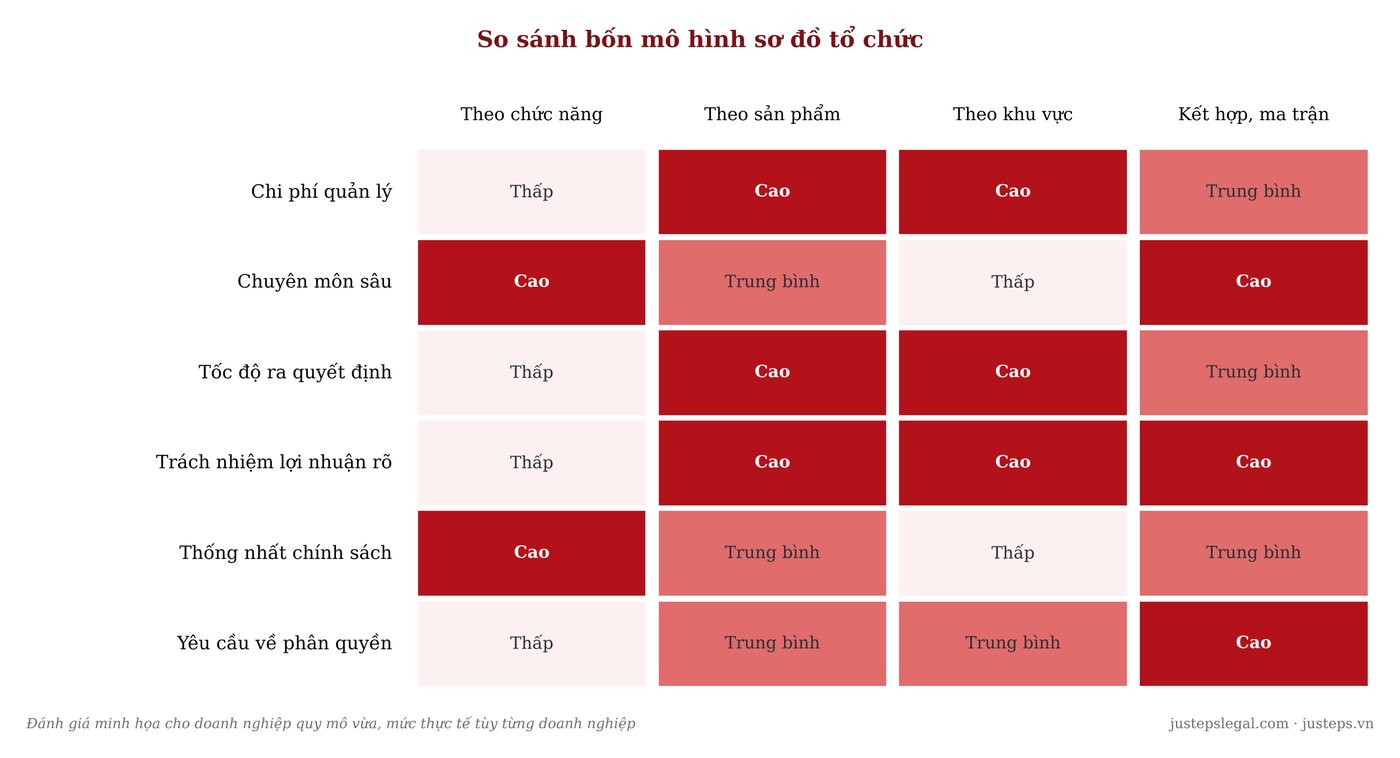
Comparison of the four organisation chart models against common selection criteria
The functional model has the lowest management cost and the deepest expertise, but accountability for profit rests solely with the Director and coordination between departments is weak. The product and regional models trade higher management costs for faster decision-making and clear accountability for results, with the regional model carrying the highest risk of inconsistent policies. The hybrid and matrix models balance many criteria but in return place the greatest demands on delegation and management capability, so they do not suit businesses that still lack middle managers.
When a business should move to a different model
A business should review its model when a new product category already accounts for around one fifth to one third of revenue but still has no dedicated person in charge, when a branch has more than twenty staff but every decision still waits for head office, when the Director regularly has to arbitrate conflicts between departments, or when management reports do not show which products or regions are making a profit or a loss. These thresholds are indicative only; the business should rely on trends sustained over several quarters rather than on the figures of a single reporting period.
When choosing, the business should answer four questions in order, concerning its sources of revenue, the differences between customer groups or regions, its existing management capability and the functions that need to stay centralised. The question of management capability is often overlooked, yet it is the decisive condition, because dividing into divisions without people capable of taking responsibility for profit and loss merely increases costs. The decision sequence can be illustrated as follows.
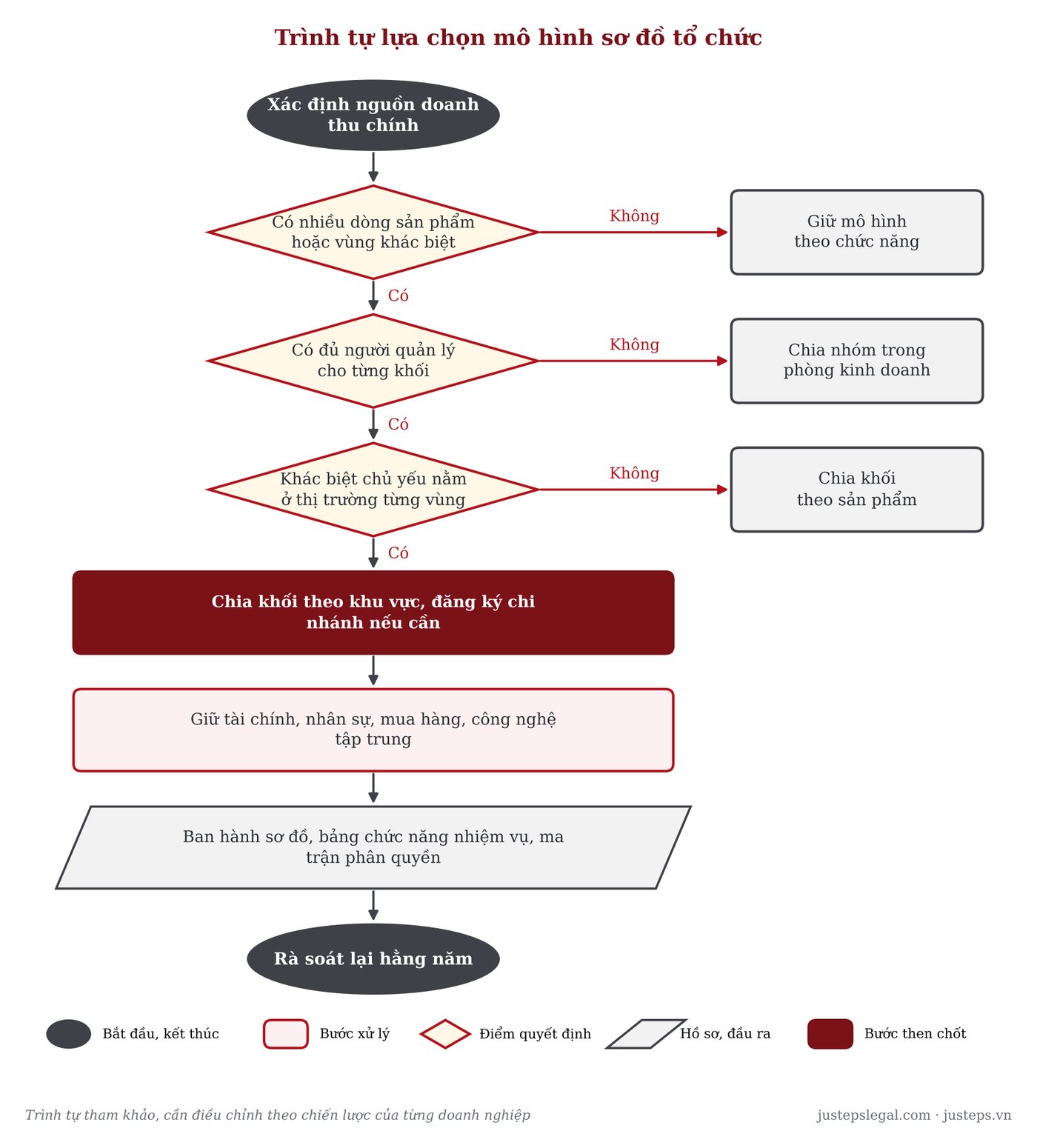
Sequence for choosing an organisation chart model based on revenue sources and management capability
The business begins by establishing whether its revenue comes from a single product line or from several product lines or regions with different characteristics; if there is only one main source, the functional model remains a sensible choice. Where there are already several distinct revenue sources but not enough managers for each division, an interim solution is to split the sales department into teams with their own team leaders and targets, while the other functions stay as they are. Only when it has enough managers should the business divide into divisions by product or by region, depending on whether the differences lie mainly in the products or in local markets. Whichever direction is chosen, the end result must be an adopted set of documents comprising the chart, the table of functions and duties and the delegation of authority matrix, reviewed every year.
For example, a trading company with about 60 staff dealing in three product categories may keep finance, warehousing and logistics, and purchasing centralised, while dividing its sales department into three teams by product category, with team leaders accountable for revenue and gross margin targets. After one to two years, once a category is large enough and its team leader has proved capable, the business can then turn that category into a division with its own director. Such a step-by-step transition allows the business to test its assumptions before increasing management costs.
Common mistakes when applying a new model
The first common mistake is copying the chart of a large business in the same sector, resulting in many management positions without enough work and many layers of approval that slow down decisions. The second mistake is dividing into product divisions while the management accounting system still produces only a single combined profit and loss statement, so division directors are given responsibility without the tools to measure results. The third mistake is appointing regional directors without issuing letters of authorisation, so that every contract still has to be sent to head office for signature and the regional model loses its purpose.
Another group of mistakes concerns remuneration and delegation. Many businesses change their model but keep their old pay and bonus rules, so people given responsibility for profit are still rewarded on sales and have no incentive to control costs. A business that applies a matrix model without a delegation of authority matrix will find that an employee is appraised in contradictory ways by two managers, and disciplinary action or performance assessments may then be challenged through complaints. These mistakes can be prevented if the change of model is handled as a project with a plan, a person in charge and clear milestones.
Implementing a new model and managing labour risks
Changes to employees’ jobs
A change of organisational model usually alters the job, title, place of work or line manager of some employees. Where the job content or place of work stated in the employment contract changes, the business must give at least three working days’ notice and may proceed only if both parties agree, by way of an appendix or a new contract[9]. The Labour Code permits an employee to be temporarily transferred to other work only in certain cases, such as sudden difficulties or production and business needs specified in the internal labour regulations, and for no more than 60 cumulative working days in a year if the employee does not agree[10]. Using a transfer decision to change an employee’s job permanently without agreement may lead to complaints or labour disputes.
Abolishing positions and dismissals due to structural change
Where the new model makes certain positions unnecessary, the business must give priority to retraining and redeploying employees to other positions before dismissing them. If dismissal is unavoidable, the business must draw up a labour utilisation plan, consult the grassroots employee representative organisation where one exists, give prior notice to the provincial state labour authority and to the employees, and then pay job-loss allowance to those with sufficient length of service under the law[11]. Skipping these steps may lead to the dismissal being found to be an unlawful unilateral termination of the employment contract, with the resulting obligation to reinstate the employee and pay compensation.
The documents to be issued and the implementation roadmap
An organisational model works only when accompanied by a consistent set of documents. The minimum set comprises the resolution or decision of the competent body adopting the chart, the table of functions and duties for each division and department, a delegation of authority matrix setting out decision rights and value limits, letters of authorisation for division or branch heads, management report templates broken down by division and pay and bonus rules adjusted to the new responsibilities. The job descriptions of affected positions must also be updated so that they are consistent with the employment contracts and the appraisal rules. Businesses may consider Justeps’ service on organisational structure, functions and duties, and job descriptions to prepare this set of documents.
The roadmap below applies to a medium-sized business and may be shortened for minor changes or extended where several branches are involved.
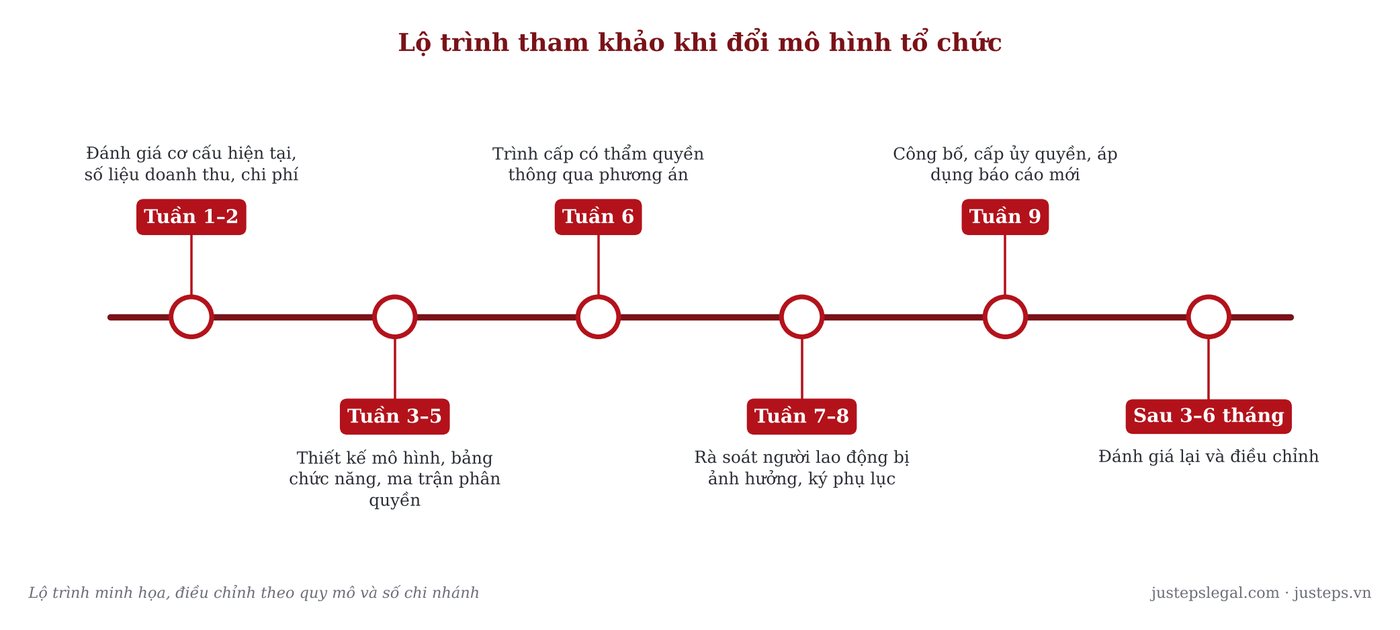
Indicative roadmap for moving to a new organisational model
The first two weeks are devoted to assessing the current structure through revenue and cost data and interviews with managers, followed by the design of the model, the table of functions and duties and the delegation of authority matrix. The proposal is then submitted to the Board of Directors, the Members’ Council or the owner for approval, while the employees affected are identified and contract appendices are prepared in parallel. The announcement and roll-out phase should be accompanied by briefing sessions for managers and staff, after which the business should review the model after about three to six months to adjust any points that do not work well.
How Justeps can help
Justeps helps businesses choose and implement an organisation chart model through the following services:
- Organisational structure, functions and duties, and job descriptions. Justeps assesses the current structure, proposes a suitable model and drafts the chart, the table of functions and duties and the job description for each position.
- Financial regulations and delegation of authority. Justeps develops the delegation of authority matrix, approval limits and template letters of authorisation consistent with the new organisational model.
- Setting up branches, representative offices and business locations. Justeps prepares the filings for registering and changing branches and the operating rules of branches within a regional model.
- Organisational restructuring and workforce streamlining. Justeps prepares the labour utilisation plan, contract appendices and dismissal documents in the correct order when positions are abolished or merged.
- Salary scales and pay and bonus regulations. Justeps adjusts the pay and bonus rules so that bonuses are linked to the profit responsibility of each division or region.
Frequently asked questions
Which model should a business with fewer than 50 staff choose?
A small business with one or two main product lines should usually use the functional model because management costs are low and control is easy. When it adds a distinctly different product category, the business can split the sales department into teams before creating separate divisions.
May the Director issue the organisation chart on their own?
Under the Law on Enterprises, the organisational structure falls within the authority of the Board of Directors, the Members’ Council or the owner, depending on the type of enterprise[2]. The Director only proposes options, unless the charter or a resolution of the competent body authorises the Director to decide on the structure of lower-level units.
Can several models be combined in the same chart?
A business may certainly combine them, and this is the common approach in medium-sized and larger businesses. The usual method is to keep support functions centralised and to divide revenue-generating units by product or by region.
May a branch director sign contracts on their own?
A branch performs the functions of the enterprise under authorisation, so the branch head may sign only within the scope of the letter of authorisation[6]. Any part of a transaction exceeding that scope does not bind the enterprise unless the enterprise approves it[8].
Does changing the organisational model require employment contracts to be re-signed?
The business needs to amend contracts only where the job, place of work, wages or other terms stated in the contract change. The amendment is made by an appendix or a new contract after the two parties have agreed[9].
Is the matrix model suitable for small and medium-sized businesses?
The matrix model requires detailed delegation and a management team experienced in coordination, so it usually suits only businesses running many projects in parallel. A small business may apply a temporary matrix to individual projects rather than to the whole structure.
How often should a business review its organisational model?
A business should review it once a year when preparing its business plan, and immediately when it opens a new product category, market or branch. The outcome of the review should be recorded in writing even if the decision is to keep the current model.
Related articles
- The authority of the General Director and how to delegate executive powers within the limits of the charter and internal rules
- Which documents make up the minimum set of internal governance rules for a company with 50 to 200 staff
- Lawful procedure and documentation for workforce reduction when a company changes its structure or technology
- How to write job descriptions that a business can use consistently from recruitment to appraisal and pay
Notes
[1] Article 137 of the Law on Enterprises No. 59/2020/QH14 dated 17 June 2020, as amended and supplemented by Law No. 76/2025/QH15.
[2] Clause 2 of Article 153 of the Law on Enterprises No. 59/2020/QH14, as amended and supplemented by Law No. 76/2025/QH15.
[3] Clause 2 of Article 55 of the Law on Enterprises No. 59/2020/QH14, as amended and supplemented by Law No. 76/2025/QH15.
[4] Article 76 of the Law on Enterprises No. 59/2020/QH14, as amended and supplemented by Law No. 76/2025/QH15.
[5] Clause 2 of Article 63 and Clause 3 of Article 162 of the Law on Enterprises No. 59/2020/QH14, as amended and supplemented by Law No. 76/2025/QH15.
[6] Clause 1 of Article 44 of the Law on Enterprises No. 59/2020/QH14, as amended and supplemented by Law No. 76/2025/QH15.
[7] Government Decree No. 168/2025/ND-CP dated 30 June 2025 on enterprise registration, as amended and supplemented by Decree No. 296/2026/ND-CP.
[8] Articles 141 and 143 of the Civil Code No. 91/2015/QH13 dated 24 November 2015.
[9] Articles 22 and 33 of the Labour Code No. 45/2019/QH14 dated 20 November 2019.
[10] Article 29 of the Labour Code No. 45/2019/QH14 dated 20 November 2019.
[11] Articles 42, 44 and 47 of the Labour Code No. 45/2019/QH14 dated 20 November 2019.
This article is for reference and reflects the regulations in force at the time of publication. Please consult Justeps for advice tailored to your company’s records and situation.
For further information, please contact:
📩 Email: info@justeps.vn
🌐 Website: https://justepslegal.com · https://justeps.vn
🌐 Page: Justeps
☎️ Hotline (Zalo): 096 172 2607
📍 Thanh Xuan Office: 12th Floor, Licogi 13 Tower, 164 Khuat Duy Tien Street, Thanh Xuan Ward, Hanoi, Vietnam
📍 Ha Dong Office: LK06B, No.10, Dong Dua Area, Ha Dong Ward, Hanoi, Vietnam
📍 Ho Chi Minh City Branch: 528 Le Van Sy, Ho Chi Minh City, Vietnam
📍 Hai Phong Office: Truong Thinh Village, Ha Dong Commune, Hai Phong, Vietnam
📍 Quang Ninh Office: Van Don Special Zone, Quang Ninh Province, Vietnam





