
Key takeaways
- The law does not prescribe a mandatory template for documents on department functions and duties, but the document must be issued by the competent person under the Law on Enterprises and the company charter.
- A document written around outputs, with a start point and an end point for each cross-departmental task, removes most arguments about who has to deal with it.
- Each cross-departmental task should have exactly one department with final accountability; if two departments share accountability, in practice neither of them is accountable.
- A department’s responsibilities must come with matching authority, and the power to sign with external parties requires a letter of authorisation, failing which the transaction may not bind the business.
- The document is effective only when it is linked to the job descriptions, employment contracts, internal labour regulations and performance appraisal of each position.
In many businesses, the same problem can recur again and again without anyone resolving it for good. When a customer complains about an incorrect invoice, the sales department passes it to accounting, and accounting replies that the order details were entered by sales. Expired stock sits in the warehouse for months because the warehouse only holds the goods, while sales and purchasing each think it is the other’s job to propose how to deal with it. A new employee who asks three people who approves a particular expense receives three different answers. The common cause of these situations usually lies in a document on department functions and duties that is written in general terms, copied from a template or not updated as the business has grown.
This article analyses the legal nature of the document on functions and duties, the reasons it so often overlaps, how to write it around outputs and handover boundaries, how to build a responsibility matrix between departments, and how to link the document to employment contracts, internal labour regulations and the signing authority of department heads. It is written mainly for business owners, managing directors, HR managers and those in charge of legal affairs at limited liability companies and joint stock companies with around 20 staff or more. Smaller businesses can still apply it in a condensed form, as suggested at the end of the article.
The legal status of a document on department functions and duties
A document setting out the functions, duties, powers and working relationships of departments (functions and duties document) is an internal governance document. Neither the Law on Enterprises nor the Labour Code prescribes a mandatory template for this type of document, so the business is free to decide its form, level of detail and presentation. However, the document is effective internally only when issued by a person with authority, and that authority is determined by the type of company and its charter.
In a limited liability company with two or more members, the Members’ Council decides on the company’s management structure, while the Director or General Director issues the internal management rules unless the charter provides otherwise[1]. In a joint stock company, the Board of Directors decides on the organisational structure and internal management rules, while the Director or General Director proposes the organisational structure and issues internal management rules to the extent permitted by the charter[2]. Before drafting, therefore, the person in charge should read the charter to find out who has authority to establish or dissolve a department and who has authority to allocate duties among existing departments. A document signed and issued by the HR manager, where the charter assigns this task to the Director, is likely to be treated by other departments as merely advisory.
The functions and duties document also has indirect legal significance through employment relationships. The job and the place of work are essential terms of an employment contract[3], so when a department’s duties change significantly, the business may need to amend job descriptions and sign contract appendices with the employees affected. In addition, when the business takes disciplinary action or assesses work performance, this document together with the job description serves as evidence of what work the employee was assigned.
Why functions and duties so often overlap between departments
Most businesses write their first functions and duties document when they have only about 15 to 20 people and then rarely update it. As the business grows, new tasks are usually assigned to people, that is, to whoever is free or able to do them, rather than to a specific department. After a few years, the same task may sit in two departments while some other tasks sit in none. In its review projects, Justeps regularly encounters the three main causes below.
Listing areas without stating outputs
A sentence such as the sales department is in charge of customer affairs merely names an area and does not say what result the department must produce. When customers are overdue, the sales department may consider debt collection to be accounting’s job, while accounting considers customers to be the domain of sales. A document written around outputs makes clear that the sales department is accountable for revenue that has actually been collected, while accounting is accountable for accurate receivables data and timely warnings.
Using the same vague verb for several departments
Verbs such as coordinate, participate, manage and monitor are often used for several departments in relation to the same task. When three departments jointly coordinate the management of inventory, nobody knows who has to make a proposal, who approves it and who carries it out. The remedy is to replace vague verbs with verbs that produce a verifiable result, such as prepare, propose, approve, reconcile, sign, file and report.
Cross-departmental tasks without a lead owner
Many of a business’s most important tasks pass through several departments, such as from quotation to cash collection, from purchase request to payment, and from recruitment to starting work. A document written vertically, one page per department, usually describes only the work within each department and leaves the handover point between two departments blank. Most recurring problems arise precisely at these handover points, so the document needs to be supplemented with a horizontal tool, analysed in the section on the responsibility matrix.
The chart below illustrates the results of a hypothetical review at a trading business of about 80 people, counting the recurring problems over six months on which departments were still arguing about who should deal with them.
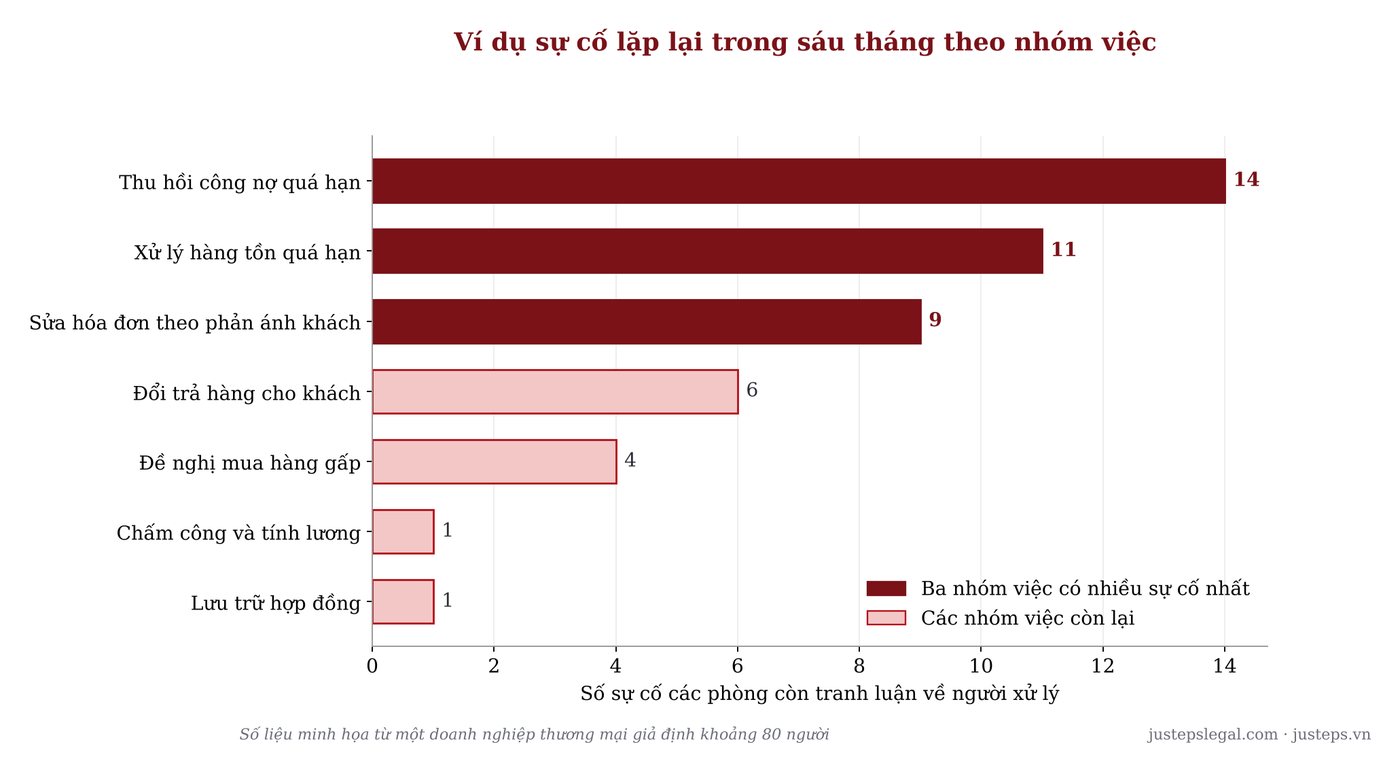
Example of the number of recurring problems over six months by task group at a trading business
In this example, the three task groups with the most problems all pass through at least two departments, namely collection of overdue receivables, handling of expired stock and correction of invoices following customer complaints. Tasks contained within a single department, such as timekeeping or filing contracts, give rise to almost no arguments. The business should therefore give priority to rewriting the boundaries for the cross-departmental tasks with the most problems first, rather than rewriting the whole document at once.
When a business needs to rewrite functions and duties
A business need not wait for the annual review if there are already signs that its structure is not running smoothly. The signs below indicate that the current document no longer reflects the way the business actually works:
- The same problem has recurred three or more times and departments are still arguing about who has to deal with it.
- The Director has to arbitrate minor matters between department heads almost every week.
- The business has just created, merged or split departments, or has just replaced the head of a key department.
- The business is preparing to implement enterprise resource planning (ERP) software, customer relationship management software or an electronic approval workflow.
- The business is preparing to introduce key performance indicators (KPIs) or position-based pay.
The last two cases deserve particular attention because both software and indicator systems need to know exactly who prepares, who approves and who receives the result. If a business puts an overlapping process into software, the software simply makes the overlap happen faster, and indicators that assign the same result to two departments will make appraisal unfair. Rewriting functions and duties should therefore be the first step of such projects.
How to write functions and duties around outputs and handover boundaries
An effective approach is to start from the actual work of the business and only then allocate the work to departments, rather than starting from the list of existing departments. The five-step sequence below can be applied to most businesses with between 20 and a few hundred staff.
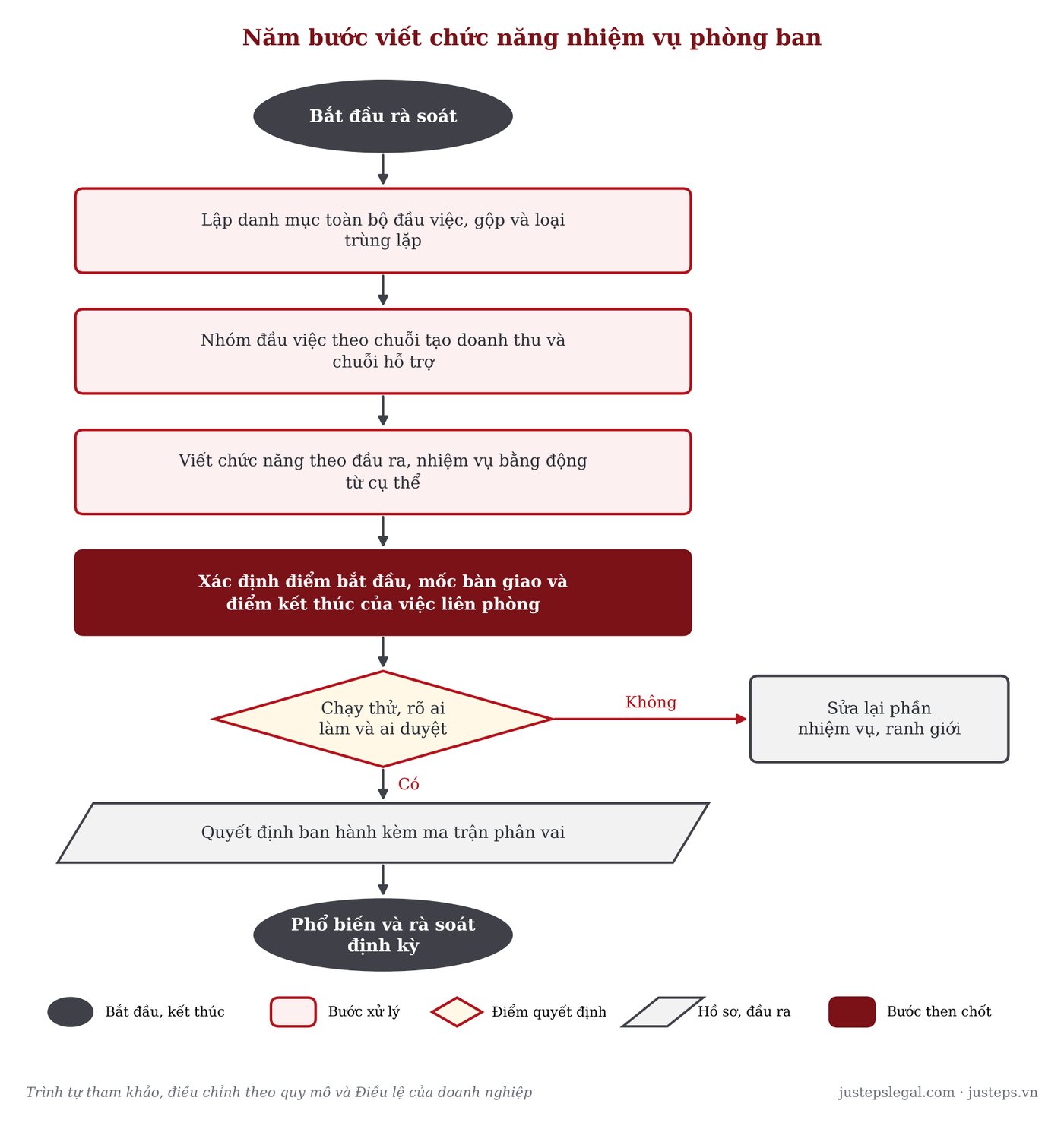
Five steps for writing department functions and duties, from the task inventory to issuance
The first step is to compile an inventory of all the business’s tasks by asking each department to record what it does over one month, then merging and removing duplicate tasks. The second step is to group tasks by the revenue-generating chains, such as sales, purchasing, warehousing, delivery and collection, and by support chains such as HR, finance, administration and legal, so that the handover points between departments become visible. The third and fourth steps are to write the functions and duties of each department and to set the boundaries of each cross-departmental task, which are analysed in more detail in the two parts below. The final step is to obtain cross-comments from department heads and to test the document against situations that have previously caused arguments. If the document cannot immediately answer who does the work and who approves it in a given situation, the drafting team returns to the third step to correct it before submitting it for issuance.
Writing functions as results and duties with specific verbs
The function consists of one to three sentences stating why the department exists, that is, the result the business needs that department to produce. For example, the function of the accounting department might be written as ensuring that financial data is accurate and timely, supporting the decisions of the management team and the reporting obligations to state authorities. Duties are the specific tasks needed to fulfil the function, each beginning with a verb that produces a result, together with a frequency or deadline where possible, such as preparing the overdue receivables report and sending it to the sales department before the 5th of each month. Each department should also have a duty to report periodically to the Director, because without it the Director has no tool for checking whether the department has fulfilled its function.
Setting a start point and an end point for each cross-departmental task
For each task that passes through several departments, the document should state clearly where the task starts, at which milestone it is handed over, with which documents, and when it ends. Taking debt collection as an example, the business may provide that the sales department chases the customer until the end of the 30th day after the payment due date, after which the file is handed to the legal function or the designated person to send a formal payment demand. The handover milestone must be a measurable event, such as the number of days overdue, the value of the debt or the customer’s refusal to confirm the balance, rather than a judgement such as when the customer shows signs of being a bad debtor. Once the milestone is clear, the receiving department cannot refuse on the grounds that the file has arrived too early, and the handing-over department cannot hold on to the file for too long.
The responsibility matrix between departments
The functions and duties document describes each department vertically, whereas the responsibility matrix describes each task horizontally, showing the role of each department in the same task. Businesses commonly use a responsibility matrix (RACI) with four roles, namely the party that performs the work, the party with final accountability, the party consulted before a decision is made and the party informed once there is a result. The most important principle of the matrix is that each task has exactly one department with final accountability, because if two departments share accountability, nobody will step forward to answer for it when something goes wrong.
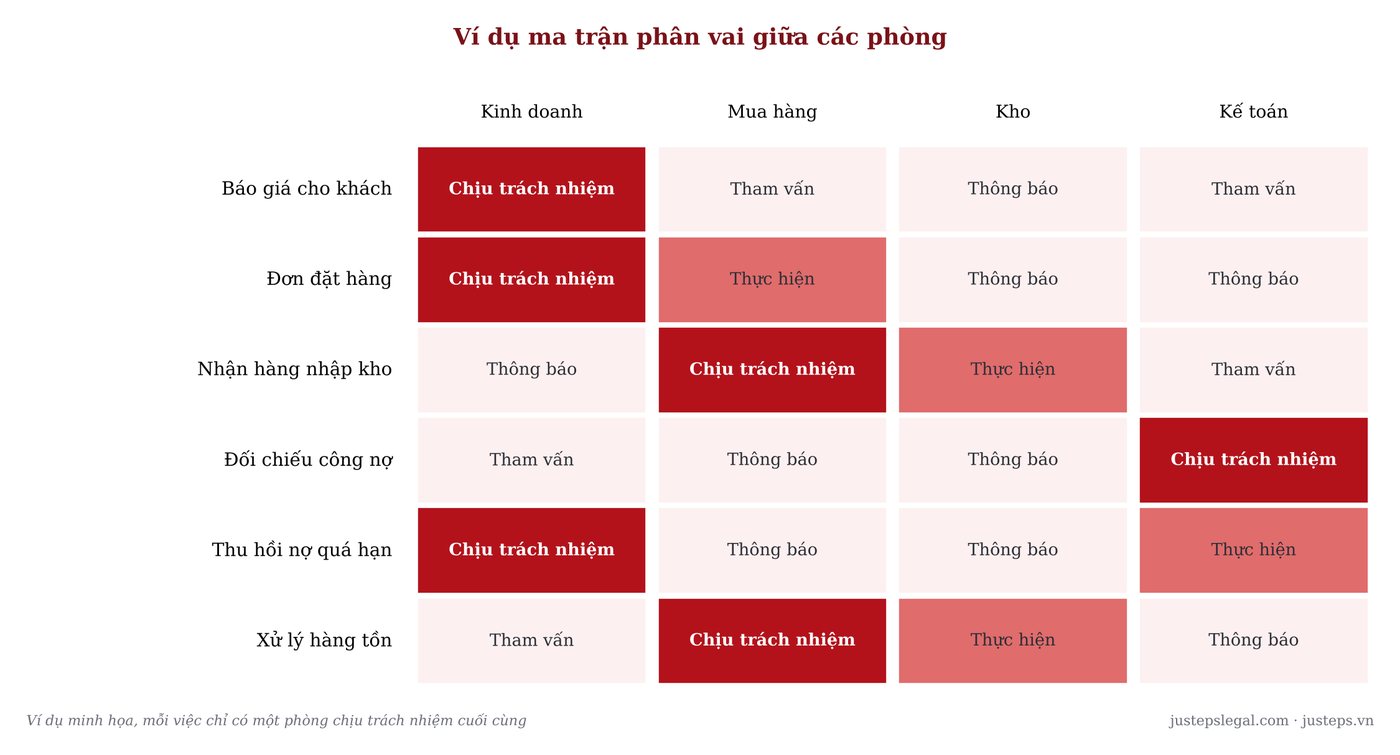
Example responsibility matrix for six cross-departmental tasks at a trading business
In the example, each row is a task, each column is a department, and the intersection of row and column shows the role of that department in that task. Each row has only one department marked as accountable, while the other departments perform, are consulted or are merely informed. It can be seen that sales has final accountability for collecting overdue receivables while accounting carries out the reconciliation, whereas the handling of expired stock is assigned to purchasing as the accountable department, with the warehouse only carrying out the stocktake. The business should attach this matrix as an appendix to the issuing decision, so that when arguments arise the departments consult a single document rather than asking the Director.
The responsibility matrix should also be checked against the rules on delegation of approval authority. The department with final accountability for a task must have the corresponding decision-making power, for example the power to propose discounts on stock up to a certain level without referring to the Director. If the matrix gives accountability to purchasing but the financial regulations still require every discount to be approved by the Director, every file will end up back on the Director’s desk as before.
Linking functions and duties to authority, employment contracts and internal labour regulations
Responsibility must come with authority and valid authorisation
A common mistake is to assign responsibility to a department without the corresponding authority, so that the department head has to seek approval for everything. For internal transactions, authority is determined in the functions and duties document and the rules on delegation of authority. For transactions with external parties, such as signing purchase orders, signing receivables reconciliation statements or sending notices to customers, a department head may represent the business only with a letter of authorisation from the legal representative and within the scope of that authorisation[4]. A transaction entered into by a person without power of representation or beyond the scope of representation does not create obligations for the business unless the business accepts it or knows of it and does not object within a reasonable time[4]. The business should therefore review the functions and duties document together with its financial regulations and delegation of authority so that the power to sign with external parties matches the duties assigned.
Linking to job descriptions and employment contracts
The functions and duties document applies to the department as a whole, whereas a job description applies to each position and shows which part of the department’s duties the jobholder performs. Each departmental duty must be allocated to at least one position, otherwise it will exist only on paper. Where reallocating duties changes the work stated in an employment contract, the business must agree an amendment to the contract, usually by an appendix, and the party proposing it must give the other party at least 3 working days’ notice[5]. Where the employee merely needs to do different work temporarily because of production or business needs, the business may transfer them for no more than 60 cumulative working days in a year if the internal labour regulations provide for this case, and beyond that period the employee’s written consent is required[6].
Linking to internal labour regulations and units required by sector-specific laws
A business employing 10 or more workers must have written internal labour regulations[7]. If it wishes to take disciplinary action when an employee fails to carry out assigned duties, the regulations must specify the corresponding breach, while the functions and duties document and the job description provide the basis for proving that the duties were clearly assigned. In addition, some sector-specific laws require a business to have a unit or person performing particular tasks, such as staff responsible for occupational safety and health and for on-site healthcare[8], or personnel or a unit responsible for personal data protection[9]. Accounting law also prohibits storekeepers, cashiers or persons who regularly buy and sell assets from acting as accountants in the same entity, except for certain small business types that are exempted[10]. These requirements need to be reflected in the functions and duties document to avoid assigning duties in breach of the rules when the business reorganises its departments.
The table below distinguishes four documents that are often confused or duplicated when a business builds its system of task allocation:
| Document | Question it answers | Scope and issuer |
|---|---|---|
| Functions and duties | What result the department exists to produce and what tasks it must carry out. | Applies to each department and is issued by the person with authority under the charter. |
| Responsibility matrix | In a cross-departmental task, which department performs the work and which has final accountability. | Applies to each task and is usually an appendix to the decision issuing the functions and duties. |
| Delegation of authority | Who may approve expenditure, contracts and discounts, and up to what value. | Applies company-wide and is usually approved by the Board of Directors or the Members’ Council. |
| Job description | Which part of the work the person in a specific position performs, to whom they report and how they are appraised. | Applies to each position, is linked to the employment contract and is managed by the HR department. |
Issuing, communicating and updating the functions and duties document
A complete set of documents usually comprises the issuing decision, the organisation chart, the functions and duties document for each department with sections on position, functions, duties, powers and working relationships, the responsibility matrix, a staffing table by department and an amendment log. The issuing decision should state clearly the effective date, the documents it replaces and the person responsible for interpreting it when views differ. After issuance, the business should hold a briefing for department heads and deputies, send an electronic copy to all staff and keep evidence that the document has been communicated.
The business should review the document at least once a year and immediately when departments are created, merged or split or when management software is changed. Each amendment should be recorded in the log with the change made, the reason and the effective date, so that if a labour dispute arises the business can prove the duties of a position at any given time. For a business with fewer than 20 people, the document may be only one page long, listing the outputs of each unit and five to seven cross-departmental tasks with the person with final accountability, and then be gradually expanded as the business grows.
The mistakes Justeps commonly encounters in reviews include copying templates from businesses of a different size, writing duties around the abilities of the current jobholder, omitting reporting duties, and assigning responsibility without authority. Another mistake is failing to link the document to job descriptions, so that it looks good on paper but nobody uses it when issues arise. Businesses wishing to build this set of documents consistently with their other rules may consider Justeps’ service for developing and implementing internal regulation systems.
How Justeps can help
Justeps helps businesses develop and update documents on department functions and duties through the following services:
- Advice on business models and corporate structure. Justeps surveys tasks, interviews department heads and proposes an organisation chart and functions and duties suited to the size of the business.
- Developing and implementing internal regulation systems. Justeps drafts the functions and duties document, the responsibility matrix and the issuing decision with the proper authority under the charter.
- Financial regulations and delegation of authority. Justeps designs approval thresholds and letters of authorisation so that department heads’ powers match the duties assigned to them.
- KPI systems and performance appraisal. Justeps turns departmental duties into job descriptions and appraisal indicators for each position.
- Internal labour regulations and disciplinary procedures. Justeps reviews internal labour regulations, contracts and appendices so that the reallocation of duties complies with the Labour Code.
Frequently asked questions
Who has authority to issue the document on department functions and duties?
Usually the Director or General Director issues this document as internal management rules, while the creation and dissolution of departments falls within the authority of the Members’ Council or the Board of Directors[1][2]. The company charter may provide otherwise, so the business should check the charter before signing and issuing the document.
Does a business with fewer than 20 people need a functions and duties document?
The law does not require it, but a small business should still have a concise version of about one page. It sets out the outputs of each unit and the person with final accountability for cross-departmental tasks, so that the Director does not have to arbitrate every minor matter.
How often should a business review its functions and duties document?
The business should review it at least once a year. It should also be reviewed immediately when departments are created, merged or split, when the head of a key department is replaced or when new management software is introduced.
How do department functions and duties differ from a job description?
Functions and duties apply to the department as a whole and state what result the department must produce. A job description applies to each position and states which part of the work the person does, to whom they report and the criteria on which they are appraised.
When new duties are given to a department, does the business have to re-sign employment contracts?
If the new duties change the work stated in the contract, the business needs to agree an amendment, usually by a contract appendix[5]. If it is merely a temporary transfer due to business needs, the business applies the rules on transferring employees to work different from that in the contract[6].
May a department head sign contracts and records with customers on the basis of the duties assigned?
The functions and duties document is no substitute for a letter of authorisation. A department head may sign on behalf of the business only with authorisation from the legal representative and within the scope of that authorisation[4].
Should two departments share accountability for an important task?
The business should not do so, because when something goes wrong it will be unclear who must answer for it. Several departments may perform the work or be consulted, but only one department should have final accountability.
Related articles
- How to choose an organisation chart model that fits the size of a business and the way it generates revenue
- How to write job descriptions that a business can use consistently from recruitment to appraisal and pay
- The procedure for issuing internal documents in a business
- Which documents make up the minimum set of internal governance rules for a company with 50 to 200 staff
Notes
[1] Articles 55 and 63 of the Law on Enterprises No. 59/2020/QH14 dated 17 June 2020, as amended and supplemented by Law No. 03/2022/QH15 and Law No. 76/2025/QH15.
[2] Articles 153 and 162 of the Law on Enterprises No. 59/2020/QH14, as amended and supplemented by Law No. 76/2025/QH15.
[3] Point c, Clause 1 of Article 21 of the Labour Code No. 45/2019/QH14 dated 20 November 2019.
[4] Articles 141, 142 and 143 of the Civil Code No. 91/2015/QH13 dated 24 November 2015.
[5] Articles 22 and 33 of the Labour Code No. 45/2019/QH14.
[6] Article 29 of the Labour Code No. 45/2019/QH14.
[7] Article 118 of the Labour Code No. 45/2019/QH14.
[8] Articles 72 and 73 of the Law on Occupational Safety and Health No. 84/2015/QH13 dated 25 June 2015.
[9] Law on Personal Data Protection No. 91/2025/QH15 and Decree No. 363/2026/ND-CP.
[10] Article 51 of the Law on Accounting No. 88/2015/QH13 dated 20 November 2015 and its implementing documents.
This article is for reference and reflects the regulations in force at the time of publication. Please consult Justeps for advice tailored to your company’s records and situation.
For further information, please contact:
📩 Email: info@justeps.vn
🌐 Website: https://justepslegal.com · https://justeps.vn
🌐 Page: Justeps
☎️ Hotline (Zalo): 096 172 2607
📍 Thanh Xuan Office: 12th Floor, Licogi 13 Tower, 164 Khuat Duy Tien Street, Thanh Xuan Ward, Hanoi, Vietnam
📍 Ha Dong Office: LK06B, No.10, Dong Dua Area, Ha Dong Ward, Hanoi, Vietnam
📍 Ho Chi Minh City Branch: 528 Le Van Sy, Ho Chi Minh City, Vietnam
📍 Hai Phong Office: Truong Thinh Village, Ha Dong Commune, Hai Phong, Vietnam
📍 Quang Ninh Office: Van Don Special Zone, Quang Ninh Province, Vietnam





